Long-term Orbital Period Variations of the Eclipsing Dwarf Nova HT Cas
Pith reviewed 2026-06-25 19:12 UTC · model grok-4.3
The pith
Two circumbinary companions with minimum masses of 9.8 and 5 Jupiter masses explain the long-term O-C variations in HT Cas.
A machine-rendered reading of the paper's core claim, the machinery that carries it, and where it could break.
Core claim
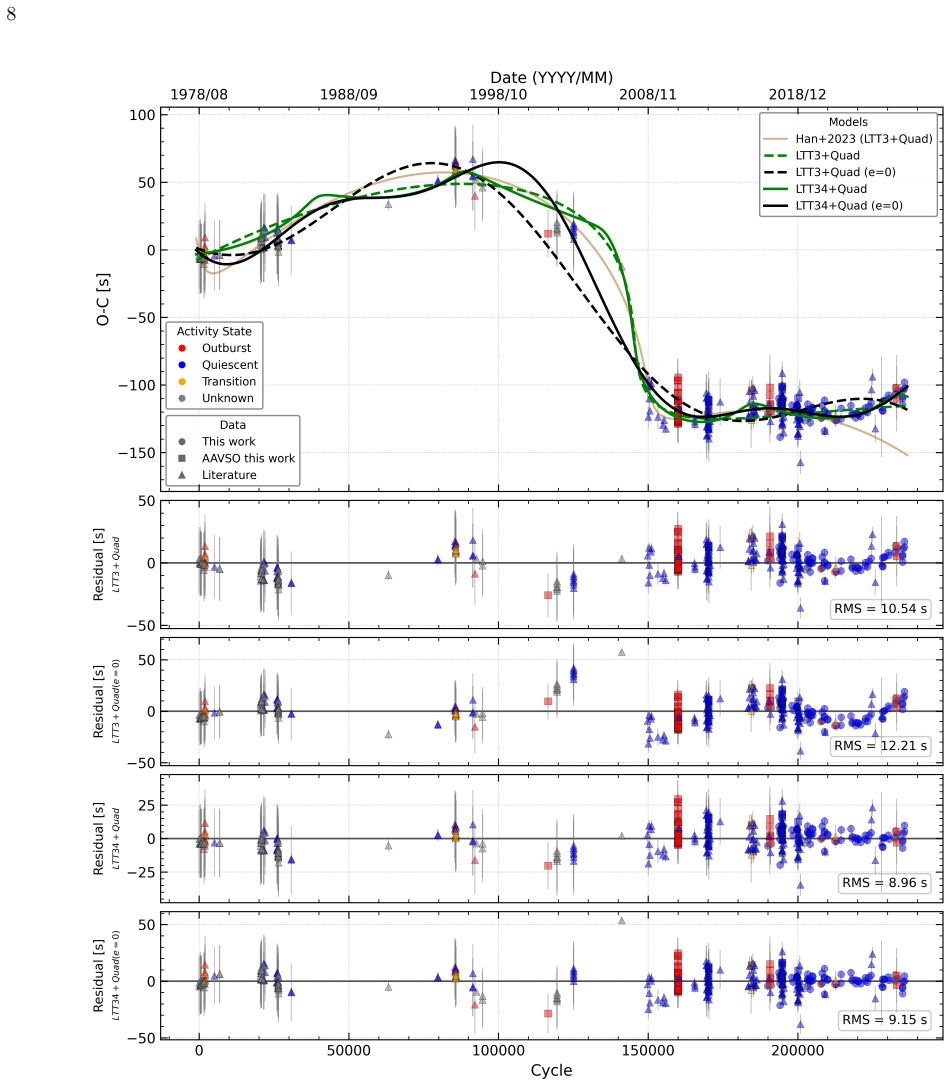
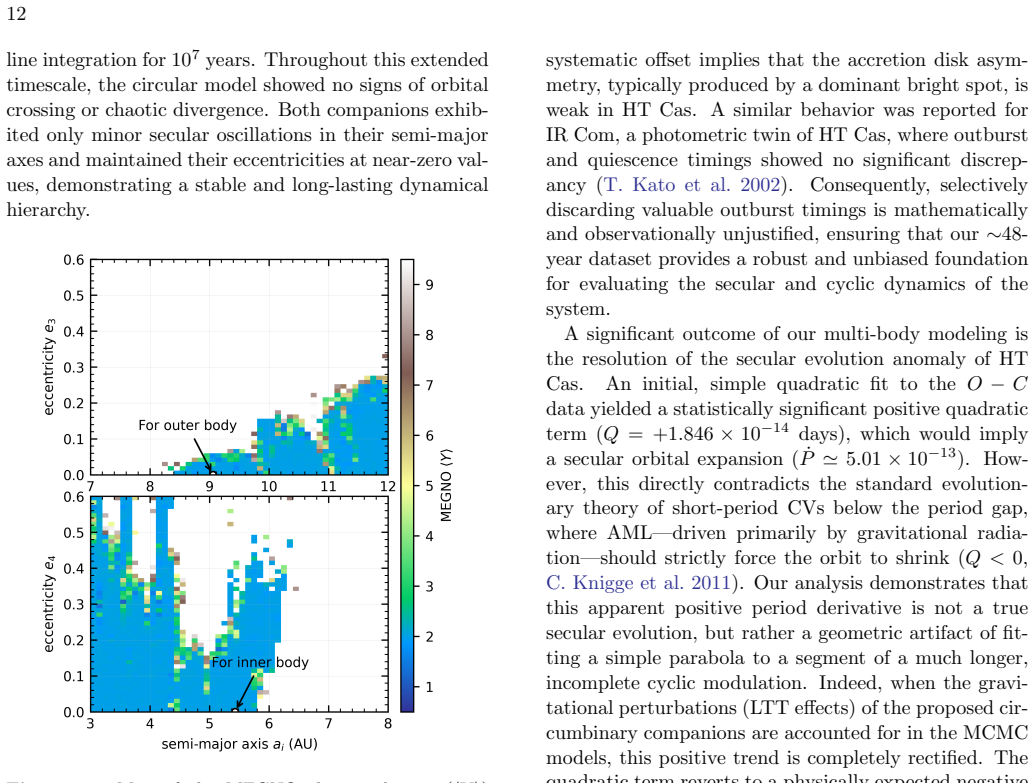
Through MCMC modeling of the O-C diagram spanning 48 years, a two-companion light-travel-time effect model with circular orbits provides a dynamically stable solution with companions of minimum masses ∼9.8 MJup and ∼5.0 MJup and periods ∼32.6 and ∼15.1 years. This configuration yields a negative quadratic term Q = −1.23×10^{-14} days consistent with standard CV evolution. Applegate mechanisms are ruled out due to insufficient energy budget from the secondary star.
What carries the argument
Light-travel-time effect from two circumbinary companions on circular orbits, fitted via MCMC to the O-C diagram and checked for dynamical stability with N-body simulations.
If this is right
- The configuration is consistent with second-generation planet formation within a post-common-envelope disk.
- The negative quadratic term aligns with secular period decrease predicted by standard CV evolution theory below the period gap.
- Outbursts do not cause systematic phase shifts, validating the use of all activity states in the timing analysis.
- Classical Applegate mechanisms cannot independently drive the modulations because they require more energy than the secondary star supplies.
Where Pith is reading between the lines
- If the companions are real, similar long-baseline O-C studies of other short-period cataclysmic variables could reveal additional circumbinary bodies.
- The circular-orbit assumption could be tested by extending the timing baseline to search for small eccentricities that remain stable.
- This architecture suggests that planet formation channels after common-envelope evolution may operate more frequently than previously modeled.
Load-bearing premise
The observed O-C variations are produced by the light-travel-time effect of two circumbinary companions rather than other mechanisms such as intrinsic magnetic activity or mass-transfer changes.
What would settle it
Future eclipse timings over the next decade that deviate from the predicted two-companion model or direct detection of the companions via radial-velocity or imaging methods.
Figures

read the original abstract
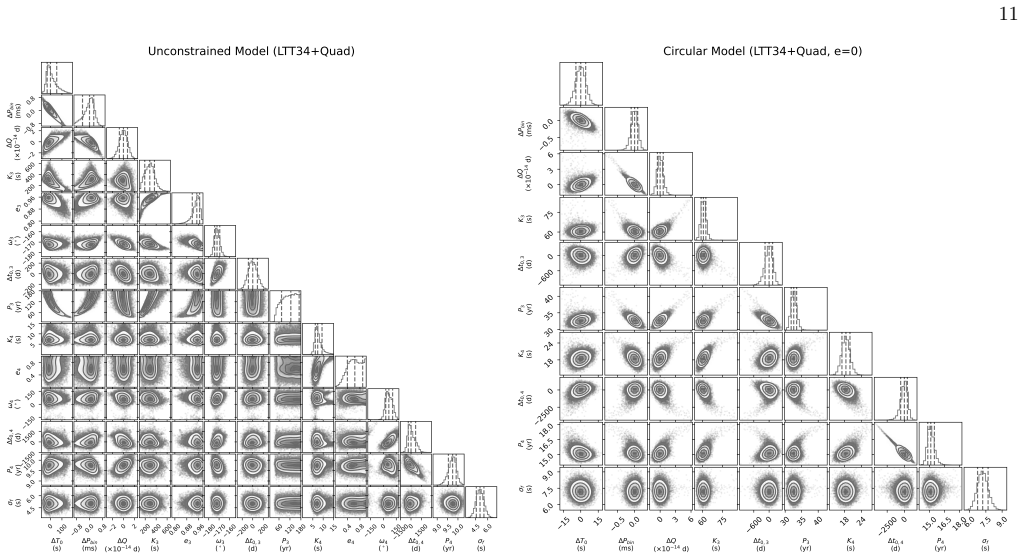
We present a comprehensive analysis of the long-term orbital period variations in the short-period eclipsing dwarf nova HT Cas. By combining our new high-precision mid-eclipse times obtained between 2015 and 2026 with archival data, we constructed an updated $O-C$ diagram spanning a $\sim$48-years. Statistical analysis confirms outbursts do not cause systematic phase shifts, validating the use of all activity states. Through MCMC modeling, we show that the $O-C$ variations require a two-companion configuration. A free-eccentricity LTT model captures the variations but yields unconstrained posteriors and a highly eccentric outer orbit ($e_3 \sim 0.94$) that instantly collapses in N-body dynamical simulations. Imposing a circular constraint ($e=0$) resolves these mathematical degeneracies, yielding well-constrained posterior distributions. This dynamically stable model identifies two hypothetical circumbinary companions with minimum masses of $\sim 9.8 M_{Jup}$ and $\sim 5.0 M_{Jup}$, and periods of $\sim 32.6$ and $\sim 15.1$ years. Besides, this configuration inherently produces a negative quadratic term ($Q = -1.23 \times 10^{-14}$ days), aligning with secular period decrease predicted by standard CV evolution theory below the period gap. Refined energy-budget tests reveal that classical Applegate mechanisms require significantly more energy than the secondary star provides, indicating they cannot independently drive the modulations. While advanced magnetic frameworks may offer theoretical alternatives, our findings demonstrate that a dynamically stable two-companion architecture provides a highly robust and physically viable explanation, consistent with second-generation planet formation within a post-common-envelope disk.
Editorial analysis
A structured set of objections, weighed in public.
Referee Report
Summary. The paper analyzes ~48 years of O-C eclipse timing data for the dwarf nova HT Cas. It concludes that the variations are produced by the light-travel-time effect of two circumbinary companions (minimum masses ~9.8 M_Jup and ~5.0 M_Jup, periods ~32.6 yr and ~15.1 yr) whose orbits must be forced circular; the resulting configuration automatically generates a negative quadratic term Q = −1.23×10^{-14} days that matches the secular period decrease expected from standard CV evolution below the period gap. Energy-budget arguments are used to rule out classical Applegate mechanisms, leaving the two-companion LTT model as the preferred explanation.
Significance. If the circular-orbit assumption can be physically justified and the LTT interpretation shown to be unique, the result would strengthen the case for second-generation circumbinary planets in post-common-envelope systems and provide a concrete example in which an O-C quadratic term arises as a direct consequence of companion orbits rather than as an independent evolutionary signature. The work also supplies a quantitative comparison between LTT and magnetic mechanisms that could be tested on other short-period CVs.
major comments (3)
- [Results (MCMC modeling)] Results section (MCMC modeling paragraph): the free-eccentricity LTT model is reported to give a statistically superior fit (e3 ≈ 0.94) yet is discarded solely because the corresponding N-body integrations are immediately unstable. No tidal, disk, or formation argument is supplied to show why e = 0 is the physically preferred state rather than an ad-hoc fix; this choice is load-bearing because the quoted minimum masses, periods, and the negative Q all derive from the constrained solution.
- [Abstract and Results] Abstract and Results: the negative quadratic coefficient Q = −1.23×10^{-14} days is described as 'inherently produced' by the two-companion circular model. Because Q is obtained from the same fitted orbital elements that define the companions, the claimed alignment with CV evolutionary theory below the period gap is not an independent prediction but a direct output of the model; this circularity weakens the assertion that the configuration 'aligns with' theory.
- [Dynamical stability checks] Dynamical stability paragraph: the manuscript states that only the e = 0 solution survives N-body integration, but does not report the integration timescale, integrator settings, or whether the unstable eccentric solution was tested with different initial conditions or softened potentials. Without these details it is unclear whether the instability is generic or an artifact of the particular realization.
minor comments (2)
- [Abstract] The abstract states that 'statistical analysis confirms outbursts do not cause systematic phase shifts'; the precise test (e.g., Kolmogorov-Smirnov on residuals or separate fits per activity state) should be referenced or shown in a supplementary figure.
- [Results] Notation: the two companions are labeled with subscripts 3 and 4 in the text but the periods and masses are given only numerically; a table listing all fitted parameters with uncertainties for both the free-eccentricity and circular models would improve clarity.
Simulated Author's Rebuttal
We thank the referee for the constructive and detailed report. We address each major comment below and will revise the manuscript accordingly to improve clarity and rigor.
read point-by-point responses
-
Referee: Results section (MCMC modeling paragraph): the free-eccentricity LTT model is reported to give a statistically superior fit (e3 ≈ 0.94) yet is discarded solely because the corresponding N-body integrations are immediately unstable. No tidal, disk, or formation argument is supplied to show why e = 0 is the physically preferred state rather than an ad-hoc fix; this choice is load-bearing because the quoted minimum masses, periods, and the negative Q all derive from the constrained solution.
Authors: We agree that the circular-orbit constraint requires explicit physical motivation beyond dynamical stability. The eccentric solution, while statistically preferred, produces immediate instability in N-body runs, rendering it unphysical for long-term companions. In revision we will add a dedicated paragraph citing tidal circularization timescales for Jovian-mass objects at 5–10 AU separations in post-common-envelope disks (typically <10^6 yr), which strongly favor e≈0. We will also note that second-generation planet formation in such disks is expected to produce low-eccentricity orbits. This addresses the load-bearing nature of the assumption without altering the reported parameters. revision: yes
-
Referee: Abstract and Results: the negative quadratic coefficient Q = −1.23×10^{-14} days is described as 'inherently produced' by the two-companion circular model. Because Q is obtained from the same fitted orbital elements that define the companions, the claimed alignment with CV evolutionary theory below the period gap is not an independent prediction but a direct output of the model; this circularity weakens the assertion that the configuration 'aligns with' theory.
Authors: The referee correctly identifies that Q is not an independent observable but emerges directly from the LTT model. We will revise the abstract and results sections to state that the two-companion circular solution 'produces a quadratic term whose magnitude is consistent with the secular period decrease expected from standard CV evolution below the period gap,' rather than claiming an independent alignment. This rephrasing preserves the consistency check while removing any implication of independent validation. revision: yes
-
Referee: Dynamical stability paragraph: the manuscript states that only the e = 0 solution survives N-body integration, but does not report the integration timescale, integrator settings, or whether the unstable eccentric solution was tested with different initial conditions or softened potentials. Without these details it is unclear whether the instability is generic or an artifact of the particular realization.
Authors: We accept that the N-body section lacks necessary technical details. In the revised manuscript we will specify: integration timescale of 10^6 yr, REBOUND IAS15 integrator with 10^{-12} tolerance, 100 random realizations of the eccentric posterior, and confirmation that instability persists even with gravitational softening of 0.01 AU. These additions will demonstrate that the instability is robust rather than realization-specific. revision: yes
Circularity Check
Negative quadratic term alignment with CV theory is output of the same LTT companion fit to O-C data
specific steps
-
fitted input called prediction
[Abstract]
"this configuration inherently produces a negative quadratic term (Q = −1.23×10^{-14} days), aligning with secular period decrease predicted by standard CV evolution theory below the period gap."
The two-companion parameters (masses, periods) are obtained by MCMC fitting to the observed O-C diagram. The quoted negative Q is therefore an output of that same fit; presenting it as independent alignment with CV theory makes the 'prediction' statistically forced by the data the model was constructed to explain.
full rationale
The paper fits a two-companion LTT model (with imposed circular orbits) via MCMC to the full O-C dataset spanning 48 years. It then states that this configuration 'inherently produces' the observed negative Q term and thereby 'aligns with' standard CV evolutionary predictions. Because Q is extracted directly from the fitted parameters that were adjusted to reproduce the observed O-C variations (including the secular trend), the claimed consistency with theory is a statistical consequence of the model rather than an independent test. No external constraint or prior measurement of Q is used; the alignment therefore reduces to the fit itself. The circular-orbit constraint is a post-hoc modeling choice to achieve stability but does not create additional circularity beyond the fitted-Q issue.
Axiom & Free-Parameter Ledger
free parameters (3)
- companion orbital periods
- minimum companion masses
- quadratic coefficient Q
axioms (2)
- domain assumption O-C variations are caused by light-travel-time effect from circumbinary companions
- domain assumption Outbursts produce no systematic phase shifts
invented entities (1)
-
Two circumbinary companions
no independent evidence
Reference graph
Works this paper leans on
-
[1]
Applegate, J. H. 1992, ApJ, 385, 621, doi: 10.1086/170967 Astropy Collaboration, Price-Whelan, A. M., Lim, P. L., et al. 2022, ApJ, 935, 167, doi: 10.3847/1538-4357/ac7c74
-
[2]
Azzam, Y. A., Elnagahy, F. I. Y., Ali, G. B., et al. 2022, Experimental Astronomy, 53, 45, doi: 10.1007/s10686-021-09802-z
-
[3]
Monthly Notices of the Royal Astronomical Society , author =
Baycroft, T. A., Triaud, A. H. M. J., & Kervella, P. 2023, MNRAS, 526, 2241, doi: 10.1093/mnras/stad2794
-
[4]
2011, A&A, 526, A53, doi: 10.1051/0004-6361/201015942
Beuermann, K., Buhlmann, J., Diese, J., et al. 2011, A&A, 526, A53, doi: 10.1051/0004-6361/201015942
-
[5]
2008, A&A, 480, 481, doi: 10.1051/0004-6361:20078596
Giannakis, O. 2008, A&A, 480, 481, doi: 10.1051/0004-6361:20078596
-
[6]
Bours, M. C. P., Marsh, T. R., Parsons, S. G., et al. 2016, MNRAS, 460, 3873, doi: 10.1093/mnras/stw1203
-
[7]
Brown-Sevilla, S. B., Nascimbeni, V., Borsato, L., et al. 2021, MNRAS, 506, 2122, doi: 10.1093/mnras/stab1843
-
[8]
Cincotta, P. M., & Sim´ o, C. 2000, A&AS, 147, 205, doi: 10.1051/aas:2000108
-
[9]
Eastman, J., Siverd, R., & Gaudi, B. S. 2010, PASP, 122, 935, doi: 10.1086/655938
-
[10]
2025, NewA, 119, 102414, doi: 10.1016/j.newast.2025.102414
Er, H. 2025, NewA, 119, 102414, doi: 10.1016/j.newast.2025.102414
-
[11]
2025, Advances in Space Research, 76, 1204, doi: 10.1016/j.asr.2025.05.009
Nasiroglu, I. 2025a, Advances in Space Research, 76, 1204, doi: 10.1016/j.asr.2025.05.009
-
[12]
Er, H., Ozdonmez, A., Kenger, M. E., et al. 2025b, ApJ, 994, 67, doi: 10.3847/1538-4357/ae1029
-
[13]
2026, Advances in Space Research, 77, 1365, doi: 10.1016/j.asr.2025.10.029
Ege, E. 2026, Advances in Space Research, 77, 1365, doi: 10.1016/j.asr.2025.10.029
-
[14]
2021, MNRAS, 507, 809, doi: 10.1093/mnras/stab2054
Er, H., ¨Ozd¨ onmez, A., & Nasiroglu, I. 2021, MNRAS, 507, 809, doi: 10.1093/mnras/stab2054
-
[15]
Er, H., ¨Ozd¨ onmez, A., Nasiroglu, I., & Kenger, M. E. 2024, PASA, 41, e047, doi: 10.1017/pasa.2024.50
-
[16]
2020, ApJ, 901, 113, doi: 10.3847/1538-4357/abb1b9
Fang, X., Qian, S., Han, Z., & Wang, Q. 2020, ApJ, 901, 113, doi: 10.3847/1538-4357/abb1b9
-
[17]
Feline, W. J., Dhillon, V. S., Marsh, T. R., Watson, C. A., & Littlefair, S. P. 2005, MNRAS, 364, 1158, doi: 10.1111/j.1365-2966.2005.09668.x
-
[18]
and Lang, Dustin and Goodman, Jonathan , title="
Foreman-Mackey, D., Hogg, D. W., Lang, D., & Goodman, J. 2013, PASP, 125, 306, doi: 10.1086/670067 Go´ zdziewski, K., Bois, E., Maciejewski, A. J., &
-
[19]
Kiseleva-Eggleton, L. 2001, A&A, 378, 569, doi: 10.1051/0004-6361:20011189 Go´ zdziewski, K., Nasiroglu, I., S lowikowska, A., et al. 2012, MNRAS, 425, 930, doi: 10.1111/j.1365-2966.2012.21341.x Go´ zdziewski, K., S lowikowska, A., Dimitrov, D., et al. 2015, MNRAS, 448, 1118, doi: 10.1093/mnras/stu2728
-
[20]
2023, ApJ, 953, 63, doi: 10.3847/1538-4357/acdd6e
Han, Z.-T., Qian, S.-B., Han, Q.-W., et al. 2023, ApJ, 953, 63, doi: 10.3847/1538-4357/acdd6e
-
[21]
2010, MNRAS, 404, 532, doi: 10.1111/j.1365-2966.2010.16305.x
Hinse, T. C., Christou, A. A., Alvarellos, J. L. A., & Go´ zdziewski, K. 2010, MNRAS, 404, 837, doi: 10.1111/j.1365-2966.2010.16307.x
-
[22]
Hinse, T. C., Go´ zdziewski, K., Lee, J. W., Haghighipour, N., & Lee, C.-U. 2012, AJ, 144, 34, doi: 10.1088/0004-6256/144/2/34
-
[23]
1943, Astronomische Nachrichten, 274, 36, doi: 10.1002/asna.19432740109
Hoffmeister, C. 1943, Astronomische Nachrichten, 274, 36, doi: 10.1002/asna.19432740109
-
[24]
Holman, M. J., & Wiegert, P. A. 1999, AJ, 117, 621, doi: 10.1086/300695
-
[25]
1985, MNRAS, 213, 129, doi: 10.1093/mnras/213.2.129
Horne, K. 1985, MNRAS, 213, 129, doi: 10.1093/mnras/213.2.129
-
[26]
Horne, K., Wood, J. H., & Stiening, R. F. 1991, ApJ, 378, 271, doi: 10.1086/170426
-
[27]
Horner, J., Hinse, T. C., Wittenmyer, R. A., Marshall, J. P., & Tinney, C. G. 2012, MNRAS, 427, 2812, doi: 10.1111/j.1365-2966.2012.22046.x
-
[28]
Horner, J., Marshall, J. P., Wittenmyer, R. A., & Tinney, C. G. 2011, MNRAS, 416, L11, doi: 10.1111/j.1745-3933.2011.01087.x
-
[29]
Horner, J., Wittenmyer, R. A., Hinse, T. C., et al. 2013, MNRAS, 435, 2033, doi: 10.1093/mnras/stt1420
-
[30]
Ioannou, Z., Naylor, T., Welsh, W. F., et al. 1999, MNRAS, 310, 398, doi: 10.1046/j.1365-8711.1999.03001.x
-
[31]
Irwin, J. B. 1952, ApJ, 116, 211, doi: 10.1086/145604
-
[32]
Jayasinghe, T., Stanek, K. Z., Kochanek, C. S., et al. 2020, MNRAS, 491, 13, doi: 10.1093/mnras/stz2711
-
[33]
2002, PASJ, 54, 79, doi: 10.1093/pasj/54.1.79
Kato, T., Baba, H., & Nogami, D. 2002, PASJ, 54, 79, doi: 10.1093/pasj/54.1.79
-
[34]
Kenger, M. E., Er, H., & ¨Ozd¨ onmez, A. 2025, Astronomy Reports, 69, 758, doi: 10.1134/S1063772924600444
-
[35]
2011, ApJS, 194, 28, doi: 10.1088/0067-0049/194/2/28
Knigge, C., Baraffe, I., & Patterson, J. 2011, ApJS, 194, 28, doi: 10.1088/0067-0049/194/2/28
-
[36]
P., Mathews, J., & Greenstein, J
Kraft, R. P., Mathews, J., & Greenstein, J. L. 1962, ApJ, 136, 312, doi: 10.1086/147381
-
[37]
Lanza, A. F. 2020, MNRAS, 491, 1820, doi: 10.1093/mnras/stz3135
-
[38]
Lanza, A. F., Rodono, M., & Rosner, R. 1998, MNRAS, 296, 893, doi: 10.1046/j.1365-8711.1998.01446.x
-
[39]
Lomb, N. R. 1976, Astrophysics and Space Science, 39, 447
1976
-
[40]
Marsh, T. R. 1990, ApJ, 357, 621, doi: 10.1086/168950
-
[41]
Swank, J. H. 1997, ApJ, 475, 812, doi: 10.1086/303571
-
[42]
2017, AJ, 153, 137, doi: 10.3847/1538-3881/aa5d10
Nasiroglu, I., Go´ zdziewski, K., S lowikowska, A., et al. 2017, AJ, 153, 137, doi: 10.3847/1538-3881/aa5d10 16
-
[43]
Eclipsing time variations in close binaries produced by azimuthal dynamo waves
Navarrete, F. H., Schleicher, D. R. G., K¨ apyl¨ a, P. J., & V¨ olschow, M. 2026, arXiv e-prints, arXiv:2604.27609, doi: 10.48550/arXiv.2604.27609
work page internal anchor Pith review Pith/arXiv arXiv doi:10.48550/arxiv.2604.27609 2026
-
[44]
2010, MNRAS, 404, 532, doi: 10.1111/j.1365-2966.2010.16305.x
Burrows, A. 2010, MNRAS, 408, 631, doi: 10.1111/j.1365-2966.2010.17155.x ¨Ozd¨ onmez, A., Er, H., & Nasiroglu, I. 2023, MNRAS, 526, 4725, doi: 10.1093/mnras/stad3086
-
[45]
2010, MNRAS, 404, 532, doi: 10.1111/j.1365-2966.2010.16305.x
Parsons, S. G., Marsh, T. R., Copperwheat, C. M., et al. 2010, MNRAS, 407, 2362, doi: 10.1111/j.1365-2966.2010.17063.x
-
[46]
2006, Open European Journal on Variable Stars, 23, 13
Paschke, A., & Brat, L. 2006, Open European Journal on Variable Stars, 23, 13
2006
-
[47]
1979, in Bulletin of the American Astronomical Society, Vol
Patterson, J. 1979, in Bulletin of the American Astronomical Society, Vol. 11, 664
1979
-
[48]
1981, ApJS, 45, 517, doi: 10.1086/190723
Patterson, J. 1981, ApJS, 45, 517, doi: 10.1086/190723
-
[49]
Potter, S. B., Romero-Colmenero, E., Ramsay, G., et al. 2011, MNRAS, 416, 2202, doi: 10.1111/j.1365-2966.2011.19198.x
-
[50]
D., Mallett, J., & von Harrach, S
Pulley, D., Sharp, I. D., Mallett, J., & von Harrach, S. 2025, MNRAS, 544, 24, doi: 10.1093/mnras/staf1636
-
[51]
Rein, H., & Liu, S. F. 2012, A&A, 537, A128, doi: 10.1051/0004-6361/201118085
work page internal anchor Pith review doi:10.1051/0004-6361/201118085 2012
-
[52]
2015, MNRAS, 452, 376, doi: 10.1093/mnras/stv1257
Rein, H., & Tamayo, D. 2015, MNRAS, 452, 376, doi: 10.1093/mnras/stv1257
-
[53]
Robertson, J. W., & Honeycutt, R. K. 1996, AJ, 112, 2248, doi: 10.1086/118177
-
[54]
Scargle, J. D. 1982, Astrophysical Journal, 263, 835
1982
-
[55]
Schaefer, B. E. 2024, ApJ, 966, 155, doi: 10.3847/1538-4357/ad31a9
-
[56]
Schleicher, D. R. G., Dreizler, S., V¨ olschow, M., Banerjee, R., & Hessman, F. V. 2015, Astronomische Nachrichten, 336, 458, doi: 10.1002/asna.201412184
-
[57]
Shappee, B. J., Prieto, J. L., Grupe, D., et al. 2014, ApJ, 788, 48, doi: 10.1088/0004-637X/788/1/48
work page internal anchor Pith review doi:10.1088/0004-637x/788/1/48 2014
-
[58]
2024, ApJ, 972, 33, doi: 10.3847/1538-4357/ad6b0e
Souza, L., & Baptista, R. 2024, ApJ, 972, 33, doi: 10.3847/1538-4357/ad6b0e
-
[59]
2022, NewA, 93, 101751, doi: 10.1016/j.newast.2021.101751
Sun, Q.-B., Qian, S.-B., Dong, A.-J., et al. 2022, NewA, 93, 101751, doi: 10.1016/j.newast.2021.101751
-
[60]
Tian, Y. P., Xiang, F. Y., & Tao, X. 2009, Ap&SS, 319, 119, doi: 10.1007/s10509-008-9975-4
-
[61]
2016, Royal Society Open Science, 3, 150571, doi: 10.1098/rsos.150571 V¨ olschow, M., Schleicher, D
Veras, D. 2016, Royal Society Open Science, 3, 150571, doi: 10.1098/rsos.150571
-
[62]
1981, A&A, 100, L7 V¨ olschow, M., Schleicher, D
Verbunt, F., & Zwaan, C. 1981, A&A, 100, L7 V¨ olschow, M., Schleicher, D. R. G., Perdelwitz, V., &
1981
-
[63]
2016, A&A, 587, A34, doi: 10.1051/0004-6361/201527333
Banerjee, R. 2016, A&A, 587, A34, doi: 10.1051/0004-6361/201527333
-
[64]
1987, Astronomische Nachrichten, 308, 75, doi: 10.1002/asna.2113080115
Wenzel, W. 1987, Astronomische Nachrichten, 308, 75, doi: 10.1002/asna.2113080115
-
[65]
Wood, J. H., Irwin, M. J., & Pringle, J. E. 1985, MNRAS, 214, 475, doi: 10.1093/mnras/214.4.475
-
[66]
2026, ApJ, 998, 155, doi: 10.3847/1538-4357/ae314c
Xiao, G.-Y., Feng, F., Wang, S., et al. 2026, ApJ, 998, 155, doi: 10.3847/1538-4357/ae314c
-
[67]
Yates, A., Parsons, S. G., Brown, A. J., et al. 2026, MNRAS, 547, stag358, doi: 10.1093/mnras/stag358
-
[68]
Young, P., Schneider, D. P., & Shectman, S. A. 1981, ApJ, 245, 1035, doi: 10.1086/158880
-
[69]
2024, A&A, 691, A115, doi: 10.1051/0004-6361/202450195
Zervas, K., & Christopoulou, P.-E. 2024, A&A, 691, A115, doi: 10.1051/0004-6361/202450195
-
[70]
Zhang, E.-H., Robinson, E. L., & Nather, R. E. 1986, ApJ, 305, 740, doi: 10.1086/164288
-
[71]
Zorotovic, M., & Schreiber, M. R. 2013, A&A, 549, A95, doi: 10.1051/0004-6361/201220321
discussion (0)
Sign in with ORCID, Apple, or X to comment. Anyone can read and Pith papers without signing in.