Long-lasting Topological Entanglement in a Monitored Rashba Nanowire
Pith reviewed 2026-06-25 21:09 UTC · model grok-4.3
The pith
The disconnected entanglement entropy in a monitored Rashba nanowire remains at its topological value for a time linear in system size.
A machine-rendered reading of the paper's core claim, the machinery that carries it, and where it could break.
Core claim
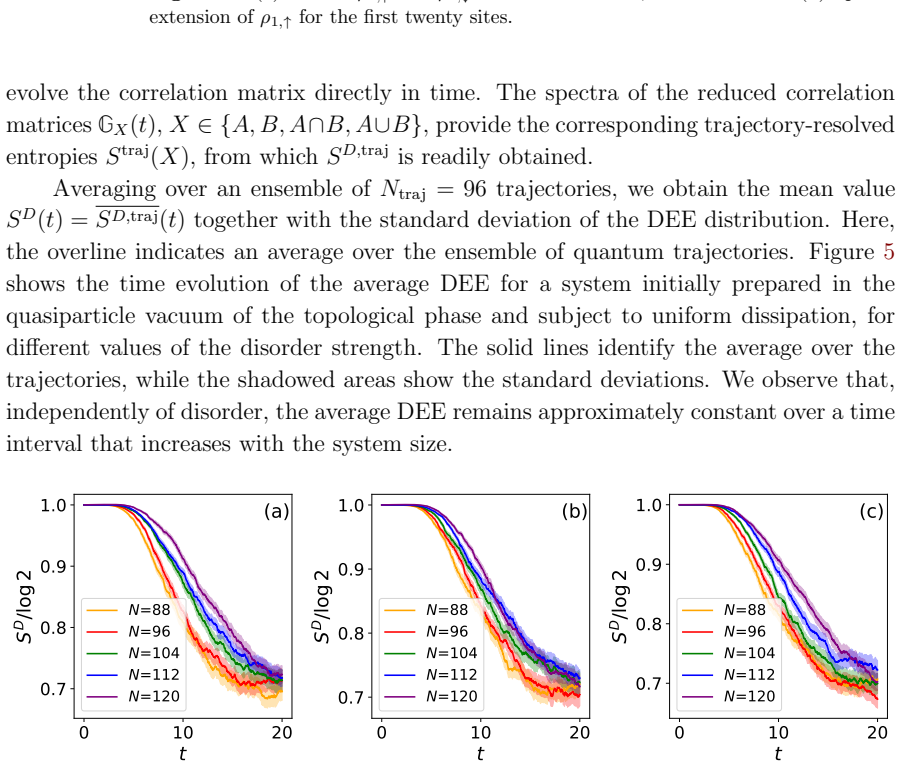
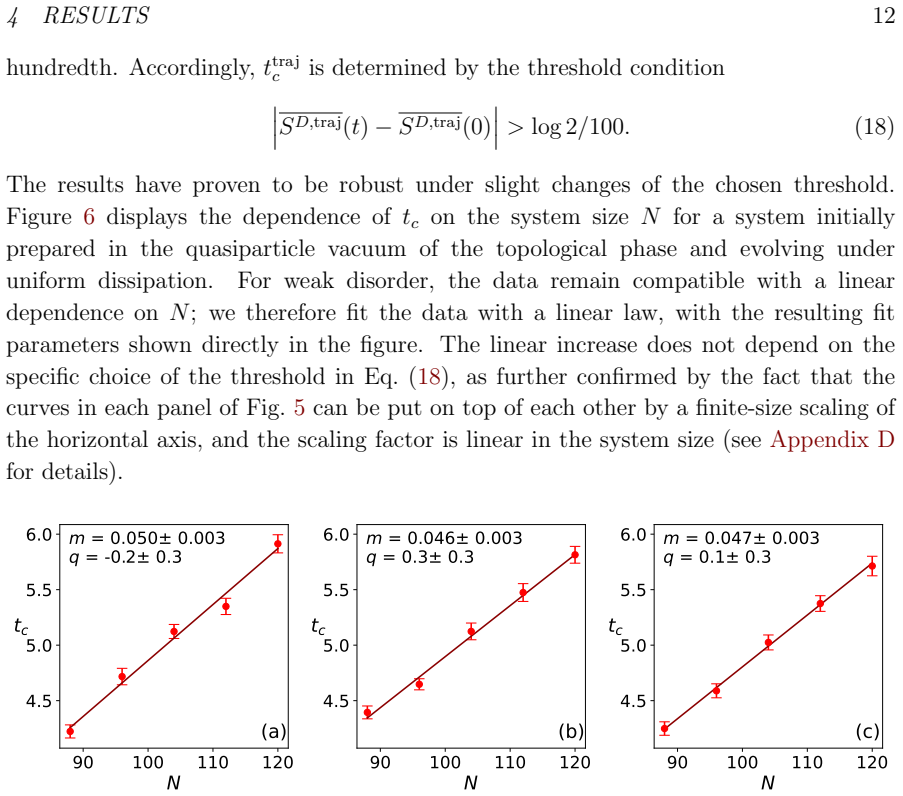
Along quantum-jump trajectories of a monitored Rashba nanowire, the disconnected entanglement entropy stays at its initial topological value for a time that scales linearly with system size. This holds even though dissipation occurs at the boundary and directly affects the topological Majorana modes. The underlying reason is the absence of particle conservation together with the degeneracy of the topological manifold: monitoring can switch the system between different topological states, alternately creating and annihilating a Majorana mode, while it simultaneously poisons finite-energy ballistically propagating quasiparticles that eventually destroy the topological entanglement structure.
What carries the argument
Disconnected entanglement entropy (DEE) evaluated along individual quantum-jump trajectories of the monitored Rashba chain, which tracks how topological character survives monitoring-induced switching and quasiparticle poisoning.
If this is right
- The DEE remains topological for a time proportional to system size even under boundary monitoring.
- Majorana modes can be created and annihilated by the monitoring process without immediate loss of topological entanglement.
- Finite-energy quasiparticles are poisoned by the dynamics, postponing the destruction of the entanglement structure.
- Switching between degenerate topological states is enabled by the lack of particle conservation.
Where Pith is reading between the lines
- The linear scaling may set a practical upper limit on how long topological information can be protected in monitored open nanowires before quasiparticle poisoning wins.
- Similar persistence might appear in other monitored topological chains if they also lack particle conservation and possess a degenerate ground-state manifold.
- Varying the monitoring rate could shift the coefficient of the linear scaling and therefore change the usable lifetime of the topological entanglement.
Load-bearing premise
The absence of particle conservation and the degeneracy of the topological manifold allow monitoring to switch the system between different topological states while poisoning finite-energy quasiparticles.
What would settle it
Numerical or experimental measurement of the time at which the DEE first deviates from its topological value; that time should grow linearly with nanowire length if the central claim holds.
Figures
read the original abstract
We study the topological properties of a monitored Rashba chain along quantum-jump trajectories, investigating the persistence of the initial topological value of the disconnected entanglement entropy (DEE). We find that the DEE persists in its topological value for a time linear in the system size, even if the dissipation acts on the boundary and affects the topological Majorana modes. The reason for this phenomenon lies in the absence of particle conservation and in the degeneracy of the topological manifold, allowing the monitoring to let the system switch between different topological states -- alternatively creating and annihilating a Majorana mode -- while producing a poisoning of finite-energy ballistically propagating quasiparticles that eventually destroy the topological entanglement structure.
Editorial analysis
A structured set of objections, weighed in public.
Referee Report
Summary. The manuscript studies the topological properties of a monitored Rashba chain along individual quantum-jump trajectories. The central claim is that the disconnected entanglement entropy (DEE) remains at its initial topological value for a time that scales linearly with system size, even when dissipation acts at the boundary and perturbs the Majorana modes. The proposed mechanism relies on the absence of particle-number conservation together with the degeneracy of the topological manifold, which permits the monitoring to switch the system between distinct topological sectors while finite-energy quasiparticles are poisoned and propagate ballistically, eventually destroying the entanglement after a time proportional to system length.
Significance. If the linear-in-size persistence is robustly demonstrated, the result would establish a concrete mechanism by which topological entanglement can survive monitoring-induced dissipation for parametrically long times in one-dimensional systems. This would be relevant to the broader study of measurement-induced phases and to proposals for topological protection in open quantum devices.
minor comments (2)
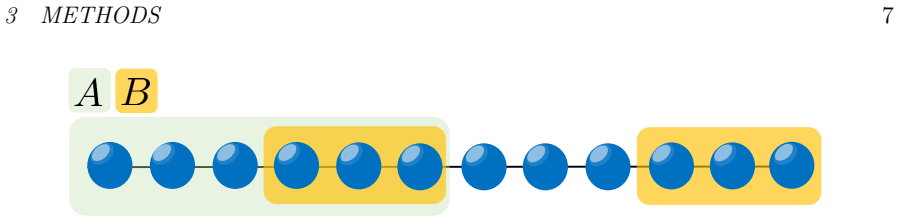
- The abstract states that the DEE 'persists in its topological value for a time linear in the system size,' but the manuscript should explicitly define the precise quantity used for the DEE (e.g., which bipartition and which reference state) already in the introduction or methods section.
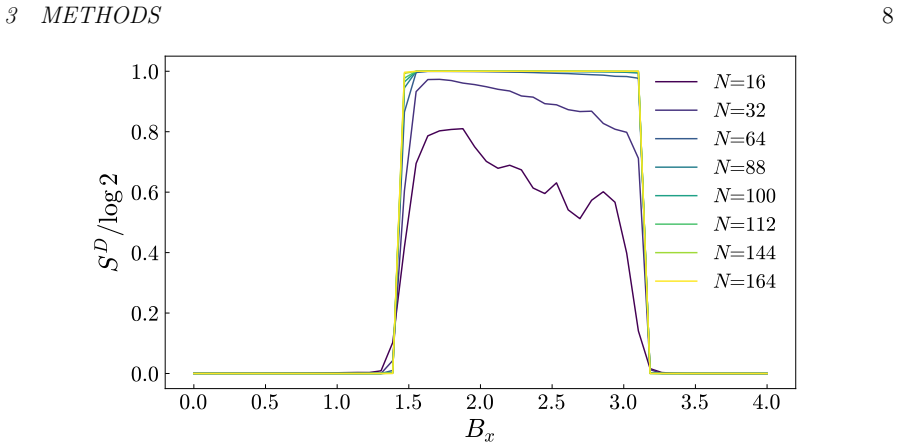
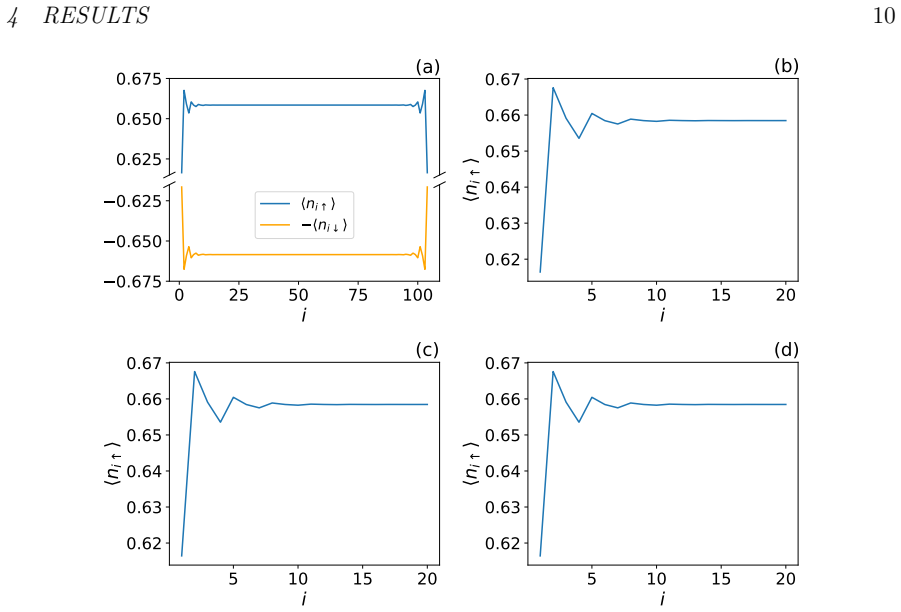
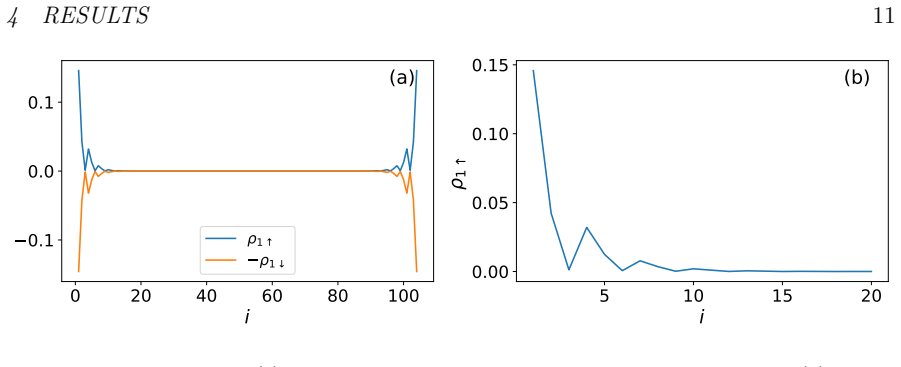
- Figure captions and axis labels should state the system sizes, monitoring rates, and disorder realizations over which the linear scaling is averaged; without this information the reader cannot assess the statistical significance of the reported time scale.
Simulated Author's Rebuttal
We thank the referee for their positive assessment of our manuscript, accurate summary of the central claim, and recommendation for minor revision. No specific major comments were listed under the MAJOR COMMENTS section of the report.
Circularity Check
No significant circularity identified
full rationale
The paper presents a physical mechanism for long-lasting topological DEE under monitoring, attributing persistence to lack of particle conservation and degeneracy allowing state switching while poisoning quasiparticles. No equations, fitted parameters, self-citations, or ansatzes appear in the provided text that reduce any claim to its own inputs by construction. The argument is self-contained as an explanatory model consistent with standard monitored quantum dynamics and topology, with no load-bearing steps that qualify under the enumerated circularity patterns.
Axiom & Free-Parameter Ledger
Reference graph
Works this paper leans on
-
[1]
Haldane F D M 2017Rev. Mod. Phys.89(4) 040502 URLhttps://link.aps.org/ doi/10.1103/RevModPhys.89.040502
-
[2]
Su W P, Schrieffer J R and Heeger A J 1979Phys. Rev. Lett.42(25) 1698–1701 URLhttps://link.aps.org/doi/10.1103/PhysRevLett.42.1698
-
[3]
Su W P, Schrieffer J R and Heeger A J 1980Phys. Rev. B22(4) 2099–2111 URL https://link.aps.org/doi/10.1103/PhysRevB.22.2099
-
[4]
1103/PhysRevB.97.045106
Lieu S 2018Physical Review B97ISSN 2469-9969 URLhttp://dx.doi.org/10. 1103/PhysRevB.97.045106
-
[5]
Kitaev A Y 2001Physics-Uspekhi44131 URLhttps://dx.doi.org/10.1070/ 1063-7869/44/10S/S29
-
[6]
Alicea J 2012Reports on Progress in Physics75076501 URLhttps://doi.org/ 10.1088/0034-4885/75/7/076501
-
[7]
Mbeng G B, Russomanno A and Santoro G E 2024SciPost Phys. Lect. Notes82 URLhttps://scipost.org/10.21468/SciPostPhysLectNotes.82
-
[8]
Fromholz P, Magnifico G, Vitale V, Mendes-Santos T and Dalmonte M 2020Phys. Rev. B101(8) 085136 URLhttps://link.aps.org/doi/10.1103/PhysRevB. 101.085136
-
[10]
Core7050 URLhttps://scipost.org/10.21468/SciPostPhysCore.7.3.050
Torre G, Odavi´ c J, Fromholz P, Giampaolo S M and Franchini F 2024SciPost Phys. Core7050 URLhttps://scipost.org/10.21468/SciPostPhysCore.7.3.050
-
[11]
Arora A, Kejriwal A and Muralidharan B 2024New Journal of Physics26023038 URLhttps://doi.org/10.1088/1367-2630/ad23a2
-
[12]
Pichler H, Zhu G, Seif A, Zoller P and Hafezi M 2016Phys. Rev. X6(4) 041033 URLhttps://link.aps.org/doi/10.1103/PhysRevX.6.041033
-
[14]
org/doi/abs/10.1126/science.aau4963
Brydges T, Elben A, Jurcevic P, Vermersch B, Maier C, Lanyon B P, Zoller P, Blatt R and Roos C F 2019Science364260–263 URLhttps://www.science. org/doi/abs/10.1126/science.aau4963
-
[15]
Lieb E H and Robinson D W 1972Communications in Mathematical Physics28 251 – 257
-
[16]
Core3012 URLhttps://scipost.org/10.21468/SciPostPhysCore.3.2.012
Micallo T, Vitale V, Dalmonte M and Fromholz P 2020SciPost Phys. Core3012 URLhttps://scipost.org/10.21468/SciPostPhysCore.3.2.012
-
[17]
Mondal S, Sen D and Dutta A 2022Journal of Physics: Condensed Matter35 085601 ISSN 1361-648X URLhttp://dx.doi.org/10.1088/1361-648X/aca7f7 REFERENCES29
-
[18]
Ashida Y, Gong Z and Ueda M 2020Advances in Physics69249–435 ISSN 1460- 6976 URLhttp://dx.doi.org/10.1080/00018732.2021.1876991
-
[19]
Okuma N and Sato M 2023Annual Review of Condensed Matter Physics1483–107 ISSN 1947-5462 URLhttp://dx.doi.org/10.1146/ annurev-conmatphys-040521-033133
1947
-
[20]
Diehl S, Rico E, Baranov M A and Zoller P 2011Nature Physics7971–977 ISSN 1745-2481 URLhttp://dx.doi.org/10.1038/nphys2106
-
[21]
Bardyn C E, Baranov M A, Kraus C V, Rico E, ˙Imamoglu A, Zoller P and Diehl S 2013New Journal of Physics15085001 ISSN 1367-2630 URLhttp: //dx.doi.org/10.1088/1367-2630/15/8/085001
-
[22]
Lieu S, McGinley M and Cooper N R 2020Phys. Rev. Lett.124(4) 040401 URL https://link.aps.org/doi/10.1103/PhysRevLett.124.040401
-
[23]
Altland A, Fleischhauer M and Diehl S 2021Phys. Rev. X11(2) 021037 URL https://link.aps.org/doi/10.1103/PhysRevX.11.021037
-
[24]
Viotti L, Gramajo A L, Villar P I, Lombardo F C and Fazio R 2023Quantum7 1029 ISSN 2521-327X URLhttps://doi.org/10.22331/q-2023-06-02-1029
-
[25]
Kells G, Meidan D and Romito A 2023SciPost Phys.14031 URLhttps: //scipost.org/10.21468/SciPostPhys.14.3.031
-
[26]
Salatino G, Passarelli G, Russomanno A, Santoro G E, Lucignano P and Fazio R 2025Phys. Rev. B111(23) 235437 URLhttps://link.aps.org/doi/10.1103/ z4sw-zj8z
-
[28]
Gong Z, Ashida Y, Kawabata K, Takasan K, Higashikawa S and Ueda M 2018 Phys. Rev. X8(3) 031079 URLhttps://link.aps.org/doi/10.1103/PhysRevX. 8.031079
-
[29]
Shen H, Zhen B and Fu L 2018Phys. Rev. Lett.120(14) 146402 URLhttps: //link.aps.org/doi/10.1103/PhysRevLett.120.146402
-
[30]
Viyuela O, Rivas A and Martin-Delgado M A 2014Phys. Rev. Lett.112(13) 130401 URLhttps://link.aps.org/doi/10.1103/PhysRevLett.112.130401
-
[31]
Viyuela O, Rivas A, Gasparinetti S, Wallraff A, Filipp S and Martin-Delgado M A 2018npj Quantum Information410 URLhttps://doi.org/10.1038/ s41534-017-0056-9
-
[32]
Carollo A, Spagnolo B and Valenti D 2018Scientific Reports89852 ISSN 2045-2322 URLhttps://doi.org/10.1038/s41598-018-27362-9
-
[33]
Bardyn C E, Wawer L, Altland A, Fleischhauer M and Diehl S 2018Phys. Rev. X 8(1) 011035 URLhttps://link.aps.org/doi/10.1103/PhysRevX.8.011035 REFERENCES30
-
[34]
Unanyan R, Kiefer-Emmanouilidis M and Fleischhauer M 2020Phys. Rev. Lett. 125(21) 215701 URLhttps://link.aps.org/doi/10.1103/PhysRevLett.125. 215701
-
[35]
Huang Z M and Diehl S 2025Phys. Rev. Res.7(3) 033028 URLhttps://link. aps.org/doi/10.1103/h1qg-96kw
-
[36]
Chen D, Chesi S and Choi M S 2025Phys. Rev. A112(4) 042440 URLhttps: //link.aps.org/doi/10.1103/qsc2-rcy7
-
[37]
Nava A, Campagnano G, Sodano P and Giuliano D 2023Phys. Rev. B107(3) 035113 URLhttps://link.aps.org/doi/10.1103/PhysRevB.107.035113
-
[38]
Cinnirella E G, Nava A, Campagnano G and Giuliano D 2024Phys. Rev. B109(3) 035114 URLhttps://link.aps.org/doi/10.1103/PhysRevB.109.035114
-
[39]
Plenio M B and Knight P L 1998Reviews of Modern Physics70101–144 ISSN 1539-0756 URLhttp://dx.doi.org/10.1103/RevModPhys.70.101
-
[40]
Daley A J 2014Advances in Physics6377–149 ISSN 1460-6976 URLhttp: //dx.doi.org/10.1080/00018732.2014.933502
-
[41]
Fazio R, Keeling J, Mazza L and Schir` o M 2025SciPost Phys. Lect. Notes99 URL https://scipost.org/10.21468/SciPostPhysLectNotes.99
-
[42]
Agaudo R 2017La Rivista del Nuovo Cimento40523–593 ISSN 0393697X, 0393697X URLhttps://doi.org/10.1393/ncr/i2017-10141-9
-
[43]
Oreg Y, Refael G and von Oppen F 2010Phys. Rev. Lett.105ISSN 1079-7114 URLhttp://dx.doi.org/10.1103/PhysRevLett.105.177002
-
[44]
Leijnse M and Flensberg K 2012Semiconductor Science and Technology27124003 URLhttps://doi.org/10.1088/0268-1242/27/12/124003
-
[45]
Lutchyn R M, Sau J D and Das Sarma S 2010Phys. Rev. Lett.105(7) 077001 URL https://link.aps.org/doi/10.1103/PhysRevLett.105.077001
-
[46]
Mourik V, Zuo K, Frolov S M, Plissard S R, Bakkers E P A M and Kouwenhoven L P 2012Science3361003–1007 (Preprinthttps://www.science.org/doi/ pdf/10.1126/science.1222360) URLhttps://www.science.org/doi/abs/10. 1126/science.1222360
-
[47]
Das A, Ronen Y, Most Y, Oreg Y, Heiblum M and Shtrikman H 2012Nature Physics8887–895 ISSN 1745-2481 accessed: 2026-02-01 URLhttps://doi.org/ 10.1038/nphys2479
-
[48]
Ghosh A K and Black-Schaffer A M 2024SciPost Phys.17036 URLhttps: //scipost.org/10.21468/SciPostPhys.17.2.036
-
[49]
Hassler F 2014 Majorana qubits (Preprint1404.0897) URLhttps://arxiv.org/ abs/1404.0897
Pith/arXiv arXiv 2014
-
[50]
Rainis D and Loss D 2012Phys. Rev. B85(17) 174533 URLhttps://link.aps. org/doi/10.1103/PhysRevB.85.174533 REFERENCES31
-
[51]
Karzig T, Cole W S and Pikulin D I 2021Phys. Rev. Lett.126(5) 057702 URL https://link.aps.org/doi/10.1103/PhysRevLett.126.057702
-
[52]
Albrecht S M, Hansen E B, Higginbotham A P, Kuemmeth F, Jespersen T S, Nyg˚ ard J, Krogstrup P, Danon J, Flensberg K and Marcus C M 2017Phys. Rev. Lett.118(13) 137701 URLhttps://link.aps.org/doi/10.1103/PhysRevLett. 118.137701
-
[53]
Lucignano P, Mezzacapo A, Tafuri F and Tagliacozzo A 2012Phys. Rev. B86(14) 144513 URLhttps://link.aps.org/doi/10.1103/PhysRevB.86.144513
-
[54]
Lucignano P, Tafuri F and Tagliacozzo A 2013Phys. Rev. B88(18) 184512 URL https://link.aps.org/doi/10.1103/PhysRevB.88.184512
-
[55]
Mondal D, Ghosh A K, Nag T and Saha A 2023Phys. Rev. B107(3) 035427 URL https://link.aps.org/doi/10.1103/PhysRevB.107.035427
-
[56]
Breuer H P and Petruccione F 2002The theory of open quantum systems(Great Clarendon Street: Oxford University Press)
-
[57]
Lindblad G 1976Commun. Math. Phys.48119
-
[58]
Carmichael H 2013Statistical Methods in Quantum Optics 1: Master Equations and Fokker-Planck EquationsTheoretical and Mathematical Physics (Springer Berlin Heidelberg)
-
[59]
Mølmer K, Castin Y and Dalibard J 1993J. Opt. Soc. Am. B10524–538 URL https://opg.optica.org/josab/abstract.cfm?URI=josab-10-3-524
-
[60]
Perfetto G, Carollo F and Lesanovsky I 2022SciPost Physics13ISSN 2542-4653 URLhttp://dx.doi.org/10.21468/SciPostPhys.13.4.079
-
[61]
Landi G T, Kewming M J, Mitchison M T and Potts P P 2024PRX Quantum5 ISSN 2691-3399 URLhttp://dx.doi.org/10.1103/PRXQuantum.5.020201
-
[62]
Jacobs K 2014Quantum Measurement Theory and its Applications(Cambridge University Press)
-
[63]
Yip K W, Albash T and Lidar D A 2018Physical Review A97URLhttps: //doi.org/10.1103%2Fphysreva.97.022116
-
[64]
Wiseman H and Milburn G 2010Quantum Measurement and Control(Cambridge University Press)
-
[65]
Bettmann L P, Kewming M J, Landi G T, Goold J and Mitchison M T 2025Phys. Rev. E112(1) 014105 URLhttps://link.aps.org/doi/10.1103/3msj-9qgb
-
[66]
Kitaev A and Preskill J 2006Phys. Rev. Lett.96(11) 110404 URLhttps://link. aps.org/doi/10.1103/PhysRevLett.96.110404
-
[67]
Levin M and Wen X G 2006Phys. Rev. Lett.96(11) 110405 URLhttps://link. aps.org/doi/10.1103/PhysRevLett.96.110405
-
[68]
Zeng B, Chen X, Zhou D and Wen X 2019Quantum Information Meets Quantum Matter: From Quantum Entanglement to Topological Phases of Many-Body Systems Quantum science and technology (Springer New York) REFERENCES32
-
[69]
Calabrese P and Cardy J 2005Journal of Statistical Mechanics: Theory and Experiment2005P04010 ISSN 1742-5468 URLhttp://dx.doi.org/10.1088/ 1742-5468/2005/04/P04010
2005
-
[70]
Calabrese P 2020SciPost Physics Lecture NotesISSN 2590-1990 URLhttp: //dx.doi.org/10.21468/SciPostPhysLectNotes.20
-
[71]
Knill E 2001 Fermionic Linear Optics and Matchgates (Preprintquant-ph/ 0108033) URLhttps://arxiv.org/abs/quant-ph/0108033
Pith/arXiv arXiv 2001
-
[72]
Bravyi S 2004 Lagrangian representation for fermionic linear optics (Preprint quant-ph/0404180) URLhttps://arxiv.org/abs/quant-ph/0404180
Pith/arXiv arXiv 2004
-
[73]
thesis SISSA, Italy
Lumia L 2025Quantum and classical aspects of complexity in open many-body dynamicsPh.D. thesis SISSA, Italy
discussion (0)
Sign in with ORCID, Apple, or X to comment. Anyone can read and Pith papers without signing in.