The SKA View of Cool-core Clusters: Evolution of Radio Mini-halos and AGN Feedback
Pith reviewed 2026-06-25 20:12 UTC · model grok-4.3
The pith
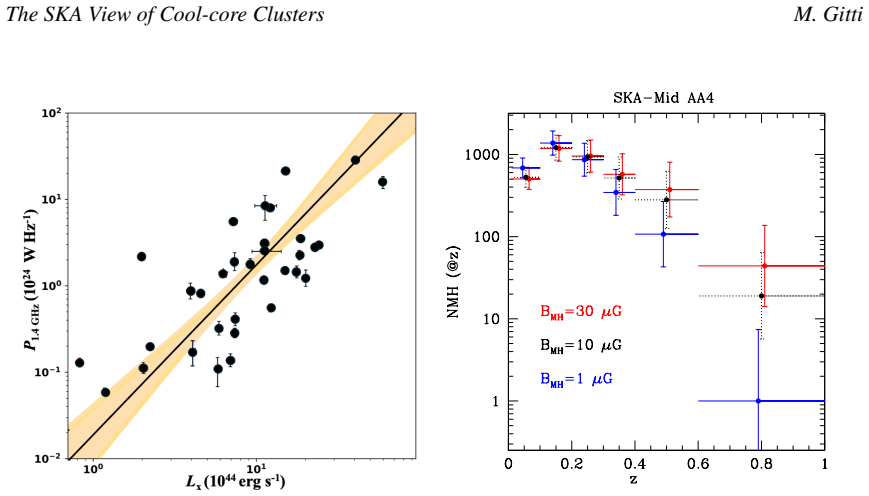
All-sky SKA-Mid surveys could detect up to 3500 radio mini-halos in cool-core clusters at z<1.
A machine-rendered reading of the paper's core claim, the machinery that carries it, and where it could break.
Core claim
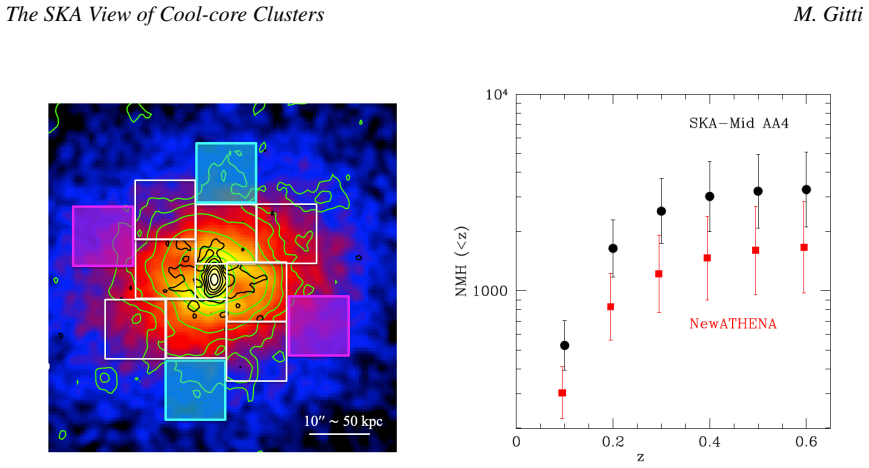
In roughly 70 percent of cool-core clusters the central AGN is radio-loud and its relativistic plasma fills X-ray cavities while driving turbulence that can generate extended radio mini-halos. The central claim is that SKA-Mid all-sky surveys at arcsecond resolution have the potential to detect up to about 3500 mini-halos at z<1, while deep tier surveys at sub-arcsecond resolution would enable a complete census of radio-loud BCGs down to 1.4 GHz powers of 10^23 W/Hz up to z~2, yielding a comprehensive view of AGN feedback.
What carries the argument
Radio mini-halos, defined as diffuse non-thermal emission surrounding the radio-loud BCG on scales comparable to the cooling radius, whose statistics are extrapolated from current samples using luminosity functions.
If this is right
- A sample of thousands of mini-halos would clarify their origin and connection to the thermal and dynamical properties of cluster cores.
- A complete census of radio-loud BCGs to z~2 would map how AGN feedback operates across cosmic time.
- The resulting statistics would support future high-resolution X-ray studies of cluster cores by providing a large radio-selected parent sample.
- The data would reveal the role of AGN feedback in regulating gas cooling and shaping large-scale structure.
Where Pith is reading between the lines
- If the predicted numbers are confirmed, it would test whether mini-halo formation efficiency remains roughly constant over the last 8 billion years.
- The same surveys would also constrain how often radio-loud BCGs appear in non-cool-core clusters, testing the link between mini-halos and core relaxation.
- Comparison of the new radio sample with X-ray cavity statistics could quantify the fraction of mechanical AGN power that goes into turbulence versus direct heating.
Load-bearing premise
The number of detectable mini-halos scales directly from the small existing sample using current luminosity functions with no strong redshift evolution in mini-halo properties or occurrence rates.
What would settle it
An SKA survey that finds far fewer than several thousand mini-halos at z<1 or that shows clear redshift evolution in mini-halo occurrence or luminosity would falsify the stated detection potential.
Figures


read the original abstract
In about 70 per cent of relaxed, cool-core galaxy clusters, the brightest cluster galaxy (BCG) is radio loud, showing non-thermal radio jets and lobes ejected by the central active galactic nucleus (AGN). In recent years such relativistic plasma has been shown to interact with the surrounding thermal intra-cluster medium (ICM) as revealed by striking images where radio lobe fill the cavities in the X-ray-emitting gas. This "radio-mode feedback" phenomenon is widespread and crucial for understanding the physics of cluster cores and the properties of the central BCG. Mechanically-powerful AGN are expected to drive turbulence in the central ICM which may also contribute to the origin of non-thermal emission on cluster-scales. Diffuse non-thermal emission has been observed in many cool-core clusters in the form of a radio mini-halo surrounding the radio-loud BCG on scales comparable to the cooling radius. Large samples of mini-halos are essential to clarify their origin and their link with the thermal and dynamical properties of clusters, especially in view of future high-resolution X-ray studies with NewAthena X-IFU. All-sky surveys with the SKA-Mid telescope at arcsecond resolution would have the potential to detect up to about 3500 mini-halos at redshift z<1 (compared to the few tens currently known). Deep Tier surveys with the SKA-Mid at sub-arcsecond resolution would further enable a complete census of radio-loud BCGs down to 1.4 GHz powers of 10^23 W/Hz up to z~2. This will provide a comprehensive view of AGN feedback and its role in shaping large scale structures.
Editorial analysis
A structured set of objections, weighed in public.
Referee Report
Summary. The manuscript reviews radio-mode AGN feedback in cool-core clusters, where radio jets from the BCG interact with the ICM to create cavities and potentially drive turbulence leading to radio mini-halos on scales comparable to the cooling radius. It argues that large mini-halo samples are needed to clarify their origin and connection to cluster properties ahead of NewAthena X-IFU observations, and forecasts that all-sky SKA-Mid surveys at arcsecond resolution could detect up to ~3500 mini-halos at z<1 (versus the few tens known today), while deep Tier surveys at sub-arcsecond resolution would enable a complete census of radio-loud BCGs down to 1.4 GHz powers of 10^23 W/Hz out to z~2.
Significance. If the detection forecasts hold, the work would highlight how SKA surveys can deliver order-of-magnitude increases in mini-halo statistics, enabling statistical studies of their link to thermal and dynamical cluster properties and providing a comprehensive view of AGN feedback's role in structure formation.
major comments (2)
- [Abstract] Abstract: the central forecast of up to ~3500 detectable mini-halos at z<1 is obtained by scaling the current small sample using existing luminosity functions, yet no explicit luminosity function, derivation steps, assumed parameters, or error ranges on the extrapolation are supplied, leaving the numerical claim without visible support.
- [Abstract] Abstract: the scaling implicitly assumes no strong redshift evolution in mini-halo occurrence rates or luminosity-function shape beyond the current low-z, X-ray-selected sample, but the manuscript provides no test, justification, or sensitivity analysis of this assumption against higher-redshift data.
Simulated Author's Rebuttal
We thank the referee for the detailed and constructive report. The two major comments both concern the level of detail and justification provided for the mini-halo detection forecast in the abstract. We address each point below and will revise the manuscript to improve transparency.
read point-by-point responses
-
Referee: [Abstract] Abstract: the central forecast of up to ~3500 detectable mini-halos at z<1 is obtained by scaling the current small sample using existing luminosity functions, yet no explicit luminosity function, derivation steps, assumed parameters, or error ranges on the extrapolation are supplied, leaving the numerical claim without visible support.
Authors: We agree that the abstract states the numerical forecast without sufficient supporting information. The full manuscript derives the estimate from published mini-halo luminosity functions and the known cool-core fraction, but these steps are not summarized in the abstract. In the revised version we will add a concise description of the adopted luminosity function, the scaling procedure, key parameters (e.g., flux limit, redshift range), and an indicative uncertainty range, while retaining the abstract length limit. revision: yes
-
Referee: [Abstract] Abstract: the scaling implicitly assumes no strong redshift evolution in mini-halo occurrence rates or luminosity-function shape beyond the current low-z, X-ray-selected sample, but the manuscript provides no test, justification, or sensitivity analysis of this assumption against higher-redshift data.
Authors: The forecast is anchored to the existing low-redshift, X-ray-selected sample because higher-redshift mini-halos remain observationally scarce. We acknowledge that the abstract does not discuss possible redshift evolution or provide a sensitivity test. In revision we will insert a short paragraph (or footnote) that (i) states the no-evolution assumption explicitly, (ii) notes the current lack of high-z constraints, and (iii) reports the effect on the predicted number if a modest positive or negative evolution is assumed, using the limited existing higher-z upper limits. revision: yes
Circularity Check
Detection forecasts are direct extrapolations from observed samples with no self-referential reduction
full rationale
The paper's central claim of detecting up to ~3500 mini-halos is an order-of-magnitude scaling from the known sample of a few tens, using existing luminosity functions and an explicit assumption of limited redshift evolution. No equations, fitted parameters, or derivations are presented that would make this number equivalent to its inputs by construction. No self-citations are invoked as load-bearing uniqueness theorems or ansatzes for the forecast. The estimates remain externally falsifiable against future observations and do not reduce to prior fitted values within the paper itself.
Axiom & Free-Parameter Ledger
Reference graph
Works this paper leans on
-
[1]
doi: 10.1086/177901. C. S. Anderson et al.ApJ, 937(1):45, Sept
-
[2]
doi: 10.3847/1538-4357/ac7ec0. F. Andrade-Santos et al.ApJ, 843(1):76, July
-
[3]
doi: 10.3847/1538-4357/aa7461. S. Andreon et al.MNRAS, 522(3):4301–4309, July
-
[4]
doi: 10.1093/mnras/stad1270. Y. Ascasibar and M. Markevitch.ApJ, 650:102–127, Oct
-
[5]
doi: 10.1086/506508. P. N. Best et al.MNRAS, 379:894–908, Aug
-
[6]
doi: 10.1111/j.1365-2966.2007.11937.x. N. Biava et al.MNRAS, 508(3):3995–4007, Dec
-
[7]
doi: 10.1093/mnras/stab2840. N. Biava et al.A&A, 686:A82, June
-
[8]
doi: 10.1051/0004-6361/202348045. L. Bîrzan et al.ApJ, 607:800–809, June
-
[9]
doi: 10.1086/383519. L. Bîrzan et al.ApJ, 686:859–880, Oct
-
[10]
doi: 10.1086/591416. A. Bonafede et al.A&A, 680:A5, Dec
-
[11]
R.Braunetal.arXive-prints,art.arXiv:1912.12699,Dec.2019
doi: 10.1051/0004-6361/202347567. R.Braunetal.arXive-prints,art.arXiv:1912.12699,Dec.2019. doi: 10.48550/arXiv.1912.12699. L.Bravi,M.Gitti,andG.Brunetti.MNRAS,455:L41–L45,Jan.2016. doi: 10.1093/mnrasl/slv137. G. Brunetti and T. W. Jones.International Journal of Modern Physics D, 23:1430007, Mar
-
[12]
doi: 10.1142/S0218271814300079. J. O. Burns.AJ, 99:14–30, Jan
-
[13]
doi: 10.1086/115307. C. L. Carilli et al.ApJ, 928(1):59, Mar
-
[14]
R.Cassano, M.Gitti, andG.Brunetti.A&A,486:L31–L34, Aug.2008b
doi: 10.3847/1538-4357/ac55a0. R.Cassano, M.Gitti, andG.Brunetti.A&A,486:L31–L34, Aug.2008b. doi: 10.1051/0004-6361: 200810179. R.Cassanoetal.Radiohalosingalaxyclustersasunveiledbytheskatelescope.InAdvancingAstro- physicswiththeSKA–II(AASKAII).2026. arXivsearch: ReportnumberAASKAII/Cassano01. M. Chiaberge et al.ApJ, 710:L107–L110, Feb
-
[15]
doi: 10.1088/2041-8205/710/2/L107. D. J. Croton et al.MNRAS, 365:11–28, Jan
-
[16]
doi: 10.1111/j.1365-2966.2005.09675.x. M. Cruise et al.Nature Astronomy, 9:36–44, Jan
-
[17]
doi: 10.1038/s41550-024-02416-3. T. J. Dennis and B. D. G. Chandran.ApJ, 622:205–216, Mar
-
[18]
doi: 10.1086/427424. M. Donahue and G. M. Voit.Phys. Rep., 973:1–109, Aug
-
[19]
doi: 10.1016/j.physrep.2022.04
-
[20]
16 The SKA View of Cool-core Clusters M
doi: 10.1088/0004-637X/753/1/47. 16 The SKA View of Cool-core Clusters M. Gitti R. J. H. Dunn and A. C. Fabian.MNRAS, 373:959–971, Dec
-
[22]
doi: 10.3390/universe7050142. A. C. Fabian.ARA&A, 32:277–318,
-
[23]
doi: 10.1146/annurev.aa.32.090194.001425. A. C. Fabian.ARA&A, 50:455–489, Sept
-
[24]
doi: 10.1146/annurev-astro-081811-125521. B. L. Fanaroff and J. M. Riley.MNRAS, 167:31P–36P, May
work page internal anchor Pith review doi:10.1146/annurev-astro-081811-125521
-
[25]
doi: 10.1088/0004-637X/746/1/53. Y. Fujita, T. Matsumoto, and K. Wada.JKAS, 37:571–574, Dec
-
[26]
M.Gaspari,F.Brighenti,andP.Temi.MNRAS,424:190–209,July2012.doi: 10.1111/j.1365-2966. 2012.21183.x. M. Gaspari, F. Brighenti, and M. Ruszkowski.Astronomische Nachrichten, 334(4-5):394, Apr
-
[27]
doi: 10.1002/asna.201211865. S. Giacintucci et al.ApJ, 841:71, June
-
[28]
doi: 10.3847/1538-4357/aa7069. S. Giacintucci et al.ApJ, 880(2):70, Aug
-
[29]
doi: 10.3847/1538-4357/ab29f1. M. Gitti, G. Brunetti, and G. Setti.A&A, 386:456–463, May
-
[31]
doi: 10.1051/0004-6361: 20053998. M. Gitti, C. Ferrari, W. Domainko, and et al.A&A, 470:L25–L28, Aug
-
[32]
doi: 10.1051/ 0004-6361:20077658. M. Gitti, F. Brighenti, and B. R. McNamara.Advances in Astronomy, 2012:950641,
2012
-
[33]
doi: 10.1155/2012/950641. M. Gitti et al.A&A, 557:L14, Sept
-
[34]
doi: 10.1051/0004-6361/201322401. M. Gitti, P. Tozzi, G. Brunetti, and et al.PoS(AASKA14)076, art. 76,
-
[35]
doi: 10.1093/mnras/stu1725. S. Heinz and E. Churazov.ApJ, 634(2):L141–L144, Dec
-
[36]
17 The SKA View of Cool-core Clusters M
doi: 10.1086/498301. 17 The SKA View of Cool-core Clusters M. Gitti S. Heinz, M. Brüggen, A. Young, and E. Levesque.MNRAS, 373:L65–L69, Nov
-
[37]
doi: 10.1111/j.1745-3933.2006.00243.x. e. a. Hitomi Collaboration.Nature, 535:117–121, July
-
[38]
doi: 10.1038/nature18627. e. a. Hitomi Collaboration.ArXiv e-prints, Nov
-
[39]
doi: 10.1111/j.1365-2966.2011. 20405.x. J. Hlavacek-Larrondo et al.ApJ, 805(1):35, May
-
[40]
doi: 10.1088/0004-637X/805/1/35. J. Hlavacek-Larrondo et al.ApJ, 898(2):L50, Aug
-
[41]
doi: 10.3847/2041-8213/ab9ca5. J. Hlavacek-Larrondo et al.ApJ, 987(2):L40, July
-
[42]
doi: 10.3847/2041-8213/add527. M. T. Hogan et al.MNRAS, 453(2):1201–1222, Oct
-
[43]
doi: 10.1093/mnras/stv1517. D. S. Hudson, R. Mittal, T. H. Reiprich, and et al.A&A, 513:A37, Apr
-
[44]
doi: 10.1093/mnras/stx132. R. Kale et al.A&A, 557:A99, Sept
-
[45]
doi: 10.1051/0004-6361/201321515. M. Koss et al.arXiv e-prints, art. arXiv:2511.00253, Oct
-
[46]
doi: 10.48550/arXiv.2511.00253. M. Lepore et al.A&A, 682:A186, Feb
-
[47]
doi: 10.1051/0004-6361/202347538. G. Lusetti et al.A&A, 683:A132, Mar
-
[48]
doi: 10.1051/0004-6361/202347635. A. B. Mantz et al.MNRAS, 496(2):1554–1564, Aug
-
[49]
doi: 10.1093/mnras/staa1581. M. Markevitch and A. Vikhlinin.Phys. Rep., 443:1–53, May
-
[50]
doi: 10.1016/j.physrep.2007. 01.001. P. Mazzotta and S. Giacintucci.ApJ, 675:L9–L12, Mar
-
[51]
doi: 10.1086/529433. M. McDonald et al.ApJ, 774:23, Sept
-
[52]
M.McDonald,M.Gaspari,B.R.McNamara,andG.R.Tremblay.ApJ,858(1):45,May2018
doi: 10.1088/0004-637X/774/1/23. M.McDonald,M.Gaspari,B.R.McNamara,andG.R.Tremblay.ApJ,858(1):45,May2018. doi: 10.3847/1538-4357/aabace. B. R. McNamara and P. E. J. Nulsen.ARA&A, 45:117–175, Sept
-
[53]
doi: 10.1146/annurev. astro.45.051806.110625. B. R. McNamara and P. E. J. Nulsen.New Journal of Physics, 14(5):055023, May
-
[54]
doi: 10.1088/1367-2630/14/5/055023. B. R. McNamara et al.ApJ, 648:164–175, Sept
-
[55]
doi: 10.1086/505859. G. K. Miley et al.ApJ, 650:L29–L32, Oct
-
[56]
18 The SKA View of Cool-core Clusters M
doi: 10.1086/508534. 18 The SKA View of Cool-core Clusters M. Gitti R. Mittal, D. S. Hudson, T. H. Reiprich, and T. Clarke.A&A, 501:835–850, July
-
[57]
doi: 10.1051/0004-6361/200810836. C. R. Mullis, A. Vikhlinin, J. P. Henry, and et al.ApJ, 607:175–189, May
-
[58]
doi: 10.1002/asna.201211863. V. Olivares et al.MNRAS, 516(1):L101–L106, Oct
-
[59]
doi: 10.1093/mnrasl/slac096. R. A. Overzier.A&A Rv., 24(1):14, Nov
-
[60]
J.R.PetersonandA.C.Fabian.Phys.Rep.,427:1–39,Apr.2006
doi: 10.1007/s00159-016-0100-3. J.R.PetersonandA.C.Fabian.Phys.Rep.,427:1–39,Apr.2006. doi: 10.1016/j.physrep.2005.12
-
[61]
doi: 10.1051/0004-6361:20031464. C. Pinto et al.MNRAS, 480(3):4113–4123, Nov
-
[62]
doi: 10.1093/mnras/sty2185. M. Postman et al.ApJS, 199:25, Apr
-
[63]
doi: 10.1088/0067-0049/199/2/25. I. Prandoni and N. Seymour.PoS(AASKA14)067,
-
[64]
doi: 10.1086/591240. C. S. Reynolds et al. In J.-W. A. den Herder, S. Nikzad, and K. Nakazawa, editors,Space Telescopes and Instrumentation 2024: Ultraviolet to Gamma Ray, volume 13093 ofSociety of Photo-Optical Instrumentation Engineers (SPIE) Conference Series, page 1309328, Aug
doi:10.1086/591240 2024
-
[65]
A.Richard-Laferrièreetal.MNRAS,499(2):2934–2958,Dec.2020
doi: 10.1117/12.3022993. A.Richard-Laferrièreetal.MNRAS,499(2):2934–2958,Dec.2020. doi: 10.1093/mnras/staa2877. C. J. Riseley et al.MNRAS, 512(3):4210–4230, May
-
[66]
doi: 10.1093/mnras/stac672. F. Ruppin et al.ApJ, 918(2):43, Sept
-
[67]
doi: 10.3847/1538-4357/ac0bba. H. R. Russell et al.MNRAS, 432(1):530–553, June
-
[68]
doi: 10.1093/mnras/stt490. H. R. Russell et al.Universe, 10(7):273, June
-
[69]
doi: 10.3390/universe10070273. J. S. Santos, P. Tozzi, P. Rosati, and H. Böhringer.A&A, 521:A64, Oct
-
[70]
doi: 10.1051/0004-6361/201118162. F. Savini et al.A&A, 622:A24, Feb
-
[71]
J.Shin,J.-H.Woo,andJ.S.Mulchaey.ApJS,227(2):31,Dec.2016
doi: 10.1051/0004-6361/201833882. J.Shin,J.-H.Woo,andJ.S.Mulchaey.ApJS,227(2):31,Dec.2016. doi: 10.3847/1538-4365/227/ 2/31. M. W. Sommer et al.MNRAS, 466(1):996–1009, Apr
-
[72]
doi: 10.1093/mnras/stw3015. M. Sun.ApJ, 704:1586–1604, Oct
-
[73]
19 The SKA View of Cool-core Clusters M
doi: 10.1088/0004-637X/704/2/1586. 19 The SKA View of Cool-core Clusters M. Gitti R. Timmerman et al.A&A, 687:A31, July
-
[74]
doi: 10.1051/0004-6361/202347974. P. Tozzi et al.ApJ, 799(1):93, Jan
-
[75]
doi: 10.1088/0004-637X/799/1/93. P. Tozzi et al.A&A, 667:A134, Nov
-
[76]
doi: 10.1051/0004-6361/202244337. A. Travascio et al.arXiv e-prints, art. arXiv:2508.20074, Aug
-
[77]
doi: 10.48550/arXiv.2508. 20074. F. Ubertosi et al.ApJ, 923(2):L25, Dec
-
[78]
doi: 10.3847/2041-8213/ac374c. F. Ubertosi et al.ApJ, 944(2):216, Feb
-
[79]
doi: 10.3847/1538-4357/acacf9. F. Ubertosi et al.A&A, 688:A86, Aug. 2024a. doi: 10.1051/0004-6361/202349011. F. Ubertosi et al.ApJ, 961(1):134, Jan. 2024b. doi: 10.3847/1538-4357/ad11d8. R. J. van Weeren et al.Space Sci. Rev., 215(1):16, Feb
-
[80]
doi: 10.1007/s11214-019-0584-z. R. J. van Weeren et al.A&A, 692:A12, Dec
-
[81]
doi: 10.1051/0004-6361/202451618. R. J. van Weeren et al.MNRAS, 546(2):stag054, Feb
-
[82]
doi: 10.1093/mnras/stag054. F. Vazza and G. Brunetti.arXiv e-prints, art. arXiv:2507.04727, July
discussion (0)
Sign in with ORCID, Apple, or X to comment. Anyone can read and Pith papers without signing in.