Shoot the Honey, Cloak the Player: Towards Zero-Runtime-Overhead Proactive Defense and Detection for Visual Game Cheating
Pith reviewed 2026-06-25 20:06 UTC · model grok-4.3
The pith
AimTrap uses adversarial camouflage textures to hide real players from visual aimbots and honeypot textures to lure them onto fakes, delivering both real-time defense and post-game detection with negligible overhead.
A machine-rendered reading of the paper's core claim, the machinery that carries it, and where it could break.
Core claim
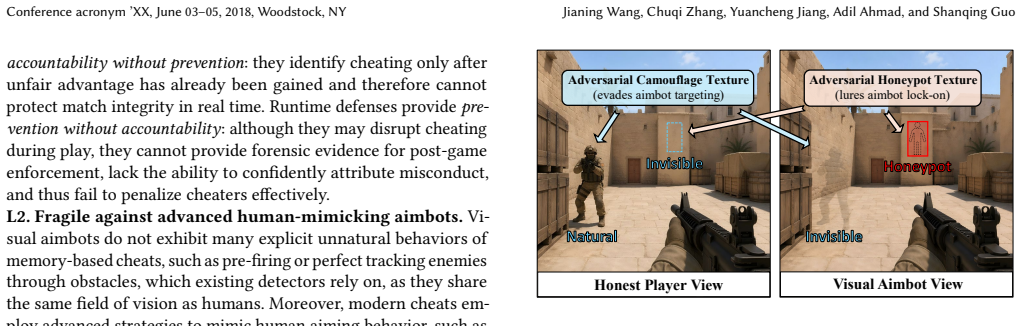
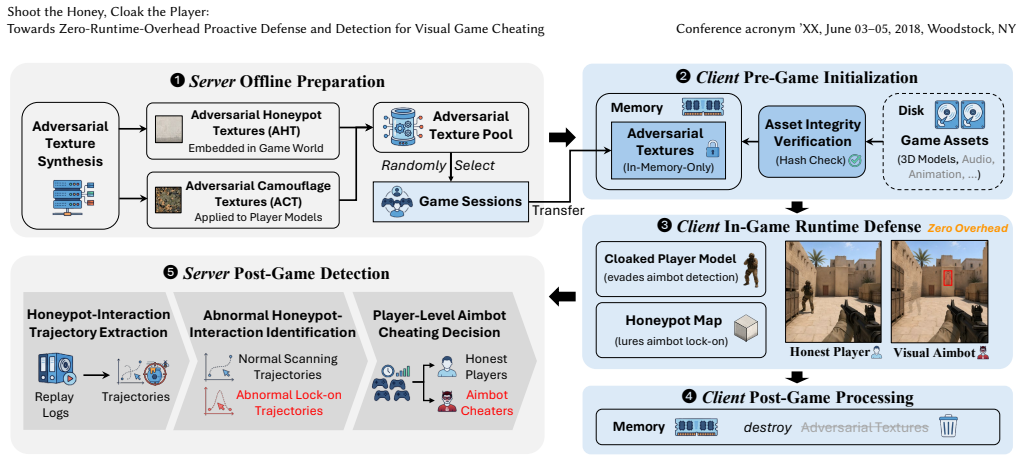
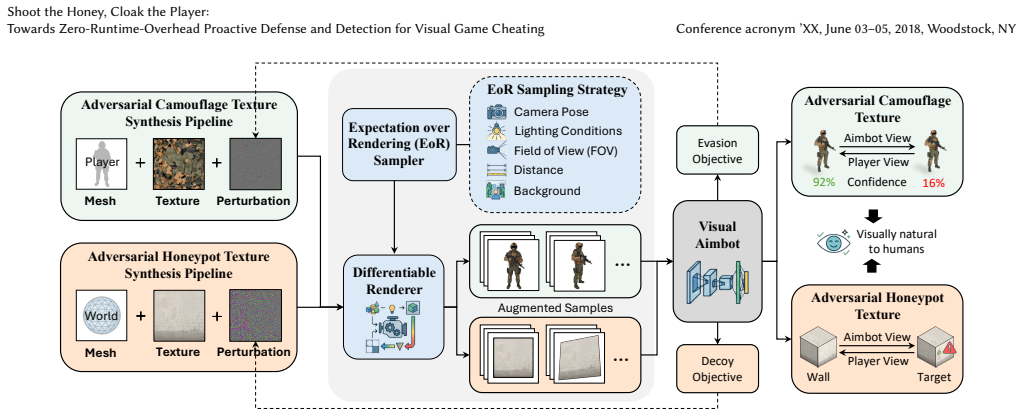
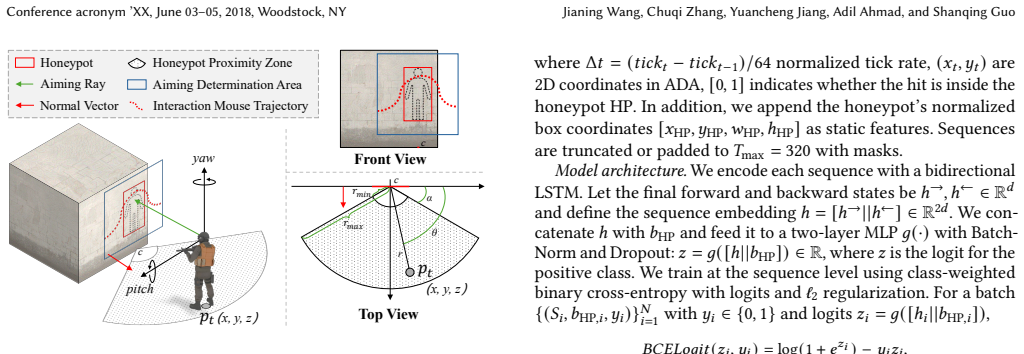
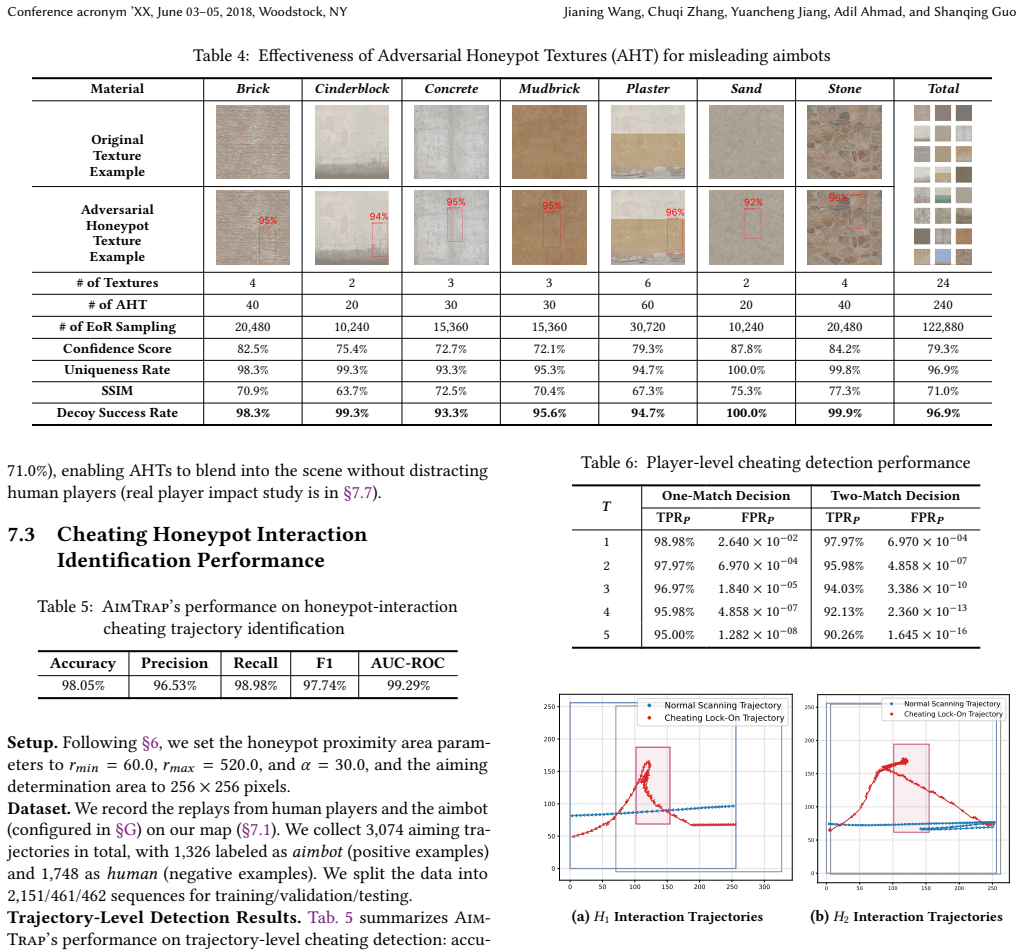
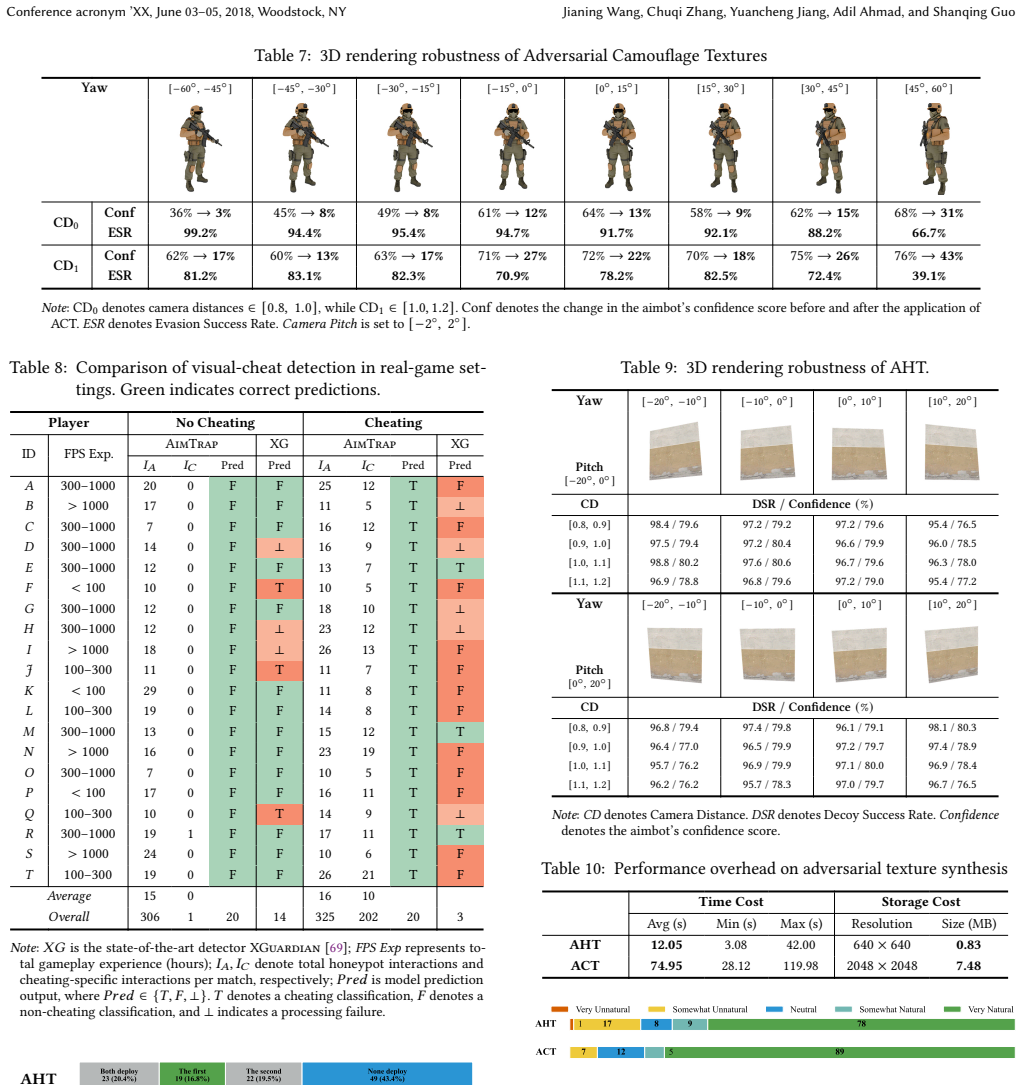
AimTrap is the first end-to-end defense against visual aimbots that combines real-time protection with post-game detection using two adversarial texture mechanisms: Adversarial Camouflage Textures (ACT) hide real players from aimbots, while Adversarial Honeypot Textures (AHT) lure aimbots into locking onto fake targets and thereby yield strong evidence of cheating. The system integrates differentiable rendering with expectation over renderings for robust 3D texture synthesis, secure texture management, and a novel honeypot-interaction trajectory analysis pipeline. In real-game evaluation against a state-of-the-art visual aimbot, ACT achieves 85.1 percent defense success and AHT achieves 96.9
What carries the argument
Adversarial Camouflage Textures (ACT) and Adversarial Honeypot Textures (AHT), synthesized via differentiable rendering with expectation over renderings and paired with a honeypot-interaction trajectory analysis pipeline.
If this is right
- Matches can be protected in real time while still producing attributable evidence after the fact.
- The same texture mechanisms can be evaluated against human-mimicking aimbots that already evade behavior detectors.
- Runtime cost remains negligible because texture application occurs at render time without additional per-frame computation.
- Low false-positive rates allow the detection pipeline to be used for actual bans without frequent wrongful accusations.
Where Pith is reading between the lines
- If texture security cannot be maintained, future aimbots could be trained to detect and ignore the specific adversarial patterns.
- The approach opens a new design space in which game engines must treat rendered textures as a security boundary rather than purely visual assets.
- Similar honeypot and camouflage textures could be tested against other visual exploits such as wallhacks that rely on rendered geometry.
Load-bearing premise
The adversarial textures can be applied inside the game engine so that they stay effective against aimbots and the trajectory analysis can attribute cheating without high false positives across varied play conditions.
What would settle it
A controlled test in which normal human players engage the AHT pipeline across many matches and the false-positive rate is measured, or an updated aimbot is trained specifically to ignore the published ACT and AHT patterns and the defense success rate is re-measured.
Figures
read the original abstract
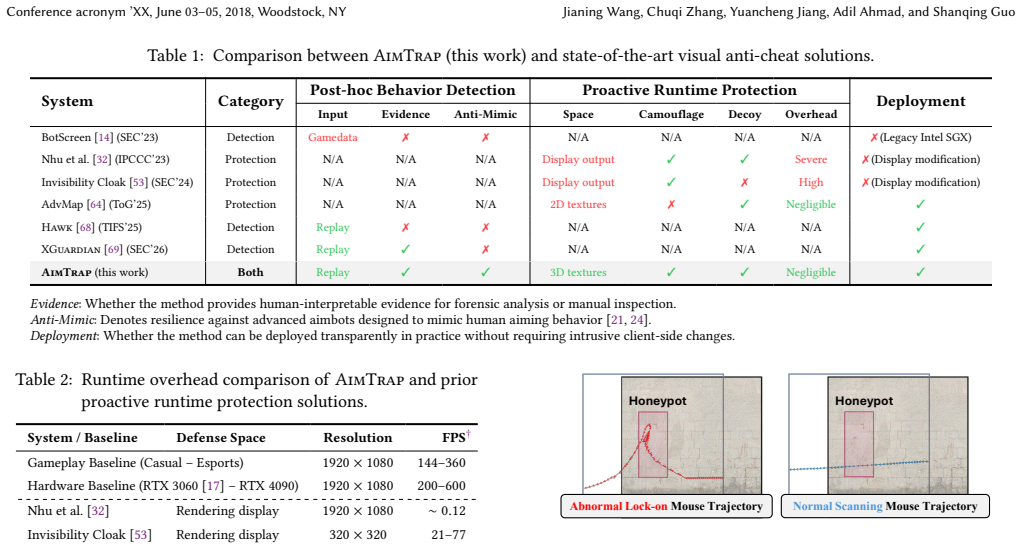
Visual aimbots have emerged as a serious cheating threat in first-person shooter (FPS) games, as they evade existing anti-cheat defenses by operating only on rendered frames rather than game memory. However, existing defenses fail to provide an end-to-end solution: post-hoc behavior detectors cannot protect match integrity in real time and are increasingly fragile against human-mimicking aimbots, while proactive runtime defenses often lack accountability, incur substantial overhead, or require intrusive system integration. We present AimTrap, the first end-to-end defense against visual aimbots that combines real-time protection with post-game detection using two adversarial texture mechanisms. Adversarial Camouflage Textures (ACT) hide real players from aimbots, while Adversarial Honeypot Textures (AHT) lure aimbots into locking onto fake targets, yielding strong evidence of cheating. To make this practical, AimTrap integrates differentiable rendering with Expectation over Renderings for robust 3D texture synthesis, secure texture management, and a novel honeypot-interaction trajectory analysis pipeline for accurate cheating attribution. In real-game evaluation against a state-of-the-art visual aimbot, ACT achieves 85.1% defense success, AHT achieves 96.9%. Compared with prior baselines, AimTrap attains extremely low false-positive rates, while incurring negligible runtime overhead. These results show that AimTrap provides a practical and effective end-to-end defense against visual aimbots.
Editorial analysis
A structured set of objections, weighed in public.
Referee Report
Summary. The manuscript presents AimTrap as the first end-to-end defense against visual aimbots in FPS games. It combines real-time protection via Adversarial Camouflage Textures (ACT) that hide players from aimbots with post-game detection via Adversarial Honeypot Textures (AHT) that lure aimbots onto fake targets, supported by a novel honeypot-interaction trajectory analysis pipeline. Textures are synthesized using differentiable rendering with Expectation over Renderings. Real-game evaluation against one state-of-the-art visual aimbot reports 85.1% defense success for ACT and 96.9% for AHT, with negligible runtime overhead and low false-positive rates relative to baselines.
Significance. If the results hold under the stated assumptions, this would be a meaningful advance in game security by delivering proactive protection alongside accountable detection without runtime cost, filling gaps left by prior post-hoc detectors and overhead-heavy runtime defenses. The integration of differentiable rendering for robust 3D texture synthesis is a technical strength that could generalize to other adversarial graphics applications.
major comments (3)
- [Abstract] Abstract: The 'novel honeypot-interaction trajectory analysis pipeline' is invoked to support the 96.9% AHT detection claim and low false-positive rates, yet no features, thresholds, or validation against human playstyle variability are described. This is load-bearing for the end-to-end accountability guarantee, as legitimate players could produce similar locking patterns on decoys or objects, undermining the reported success rates.
- [Abstract] Abstract: Evaluation is reported only against a single state-of-the-art visual aimbot, with no ablations, error bars, dataset details, or multi-baseline comparisons visible. This prevents assessment of whether the 85.1% ACT and 96.9% AHT figures generalize beyond the tested conditions.
- [Abstract] Abstract: The claim of secure texture management ensuring adversarial textures remain effective and undetectable relies on an unelaborated assumption; without concrete evidence or threat-model analysis, the proactive defense component of the end-to-end result cannot be fully evaluated.
minor comments (1)
- [Abstract] Abstract: Clarify the exact definition and measurement protocol for 'defense success' and 'false-positive rates' to improve reproducibility.
Simulated Author's Rebuttal
We thank the referee for their thorough review and constructive comments on our manuscript. We address each of the major comments point-by-point below, indicating where revisions will be incorporated to address the concerns raised.
read point-by-point responses
-
Referee: [Abstract] Abstract: The 'novel honeypot-interaction trajectory analysis pipeline' is invoked to support the 96.9% AHT detection claim and low false-positive rates, yet no features, thresholds, or validation against human playstyle variability are described. This is load-bearing for the end-to-end accountability guarantee, as legitimate players could produce similar locking patterns on decoys or objects, undermining the reported success rates.
Authors: The full manuscript provides a detailed description of the honeypot-interaction trajectory analysis pipeline, including the extracted features (locking duration, angular velocity statistics, and target consistency metrics), classification thresholds, and validation experiments against both aimbot and human gameplay data to account for playstyle variability. To improve clarity and make the abstract more self-contained, we will revise it to briefly summarize these components and reference the relevant sections. This will better substantiate the 96.9% detection rate and low false-positive claims. revision: yes
-
Referee: [Abstract] Abstract: Evaluation is reported only against a single state-of-the-art visual aimbot, with no ablations, error bars, dataset details, or multi-baseline comparisons visible. This prevents assessment of whether the 85.1% ACT and 96.9% AHT figures generalize beyond the tested conditions.
Authors: While the main results focus on a leading visual aimbot to reflect real-world threats, the manuscript includes multi-baseline comparisons for false-positive rates and overhead. We agree that additional details on ablations, error bars, and dataset information would strengthen the abstract. In the revised version, we will incorporate mentions of key ablations (e.g., on rendering expectations), report error bars from repeated trials, and summarize the evaluation dataset and baseline comparisons. This addresses the generalizability concern without altering the core findings. revision: yes
-
Referee: [Abstract] Abstract: The claim of secure texture management ensuring adversarial textures remain effective and undetectable relies on an unelaborated assumption; without concrete evidence or threat-model analysis, the proactive defense component of the end-to-end result cannot be fully evaluated.
Authors: Section 3 of the manuscript presents the threat model, which includes assumptions regarding texture security and adversary access. Section 5 details the secure texture management protocol with analysis of its resistance to extraction attacks. To provide more concrete evidence as requested, we will expand the discussion in the revision to include additional empirical results on texture undetectability and management security. This will allow fuller evaluation of the proactive defense. revision: partial
Circularity Check
No circularity; results are empirical measurements from real-game evaluation.
full rationale
The paper's central claims rest on reported outcomes from real-game evaluation (85.1% ACT success, 96.9% AHT success, low false-positive rates, negligible overhead) against an external state-of-the-art aimbot. No equations, fitted parameters, or self-citations are invoked to derive these quantities by construction from the inputs. The texture synthesis and trajectory pipeline are described as implemented components whose performance is measured externally, not redefined or forced by the evaluation data itself. This is a standard empirical security paper with no load-bearing self-referential steps.
Axiom & Free-Parameter Ledger
axioms (2)
- domain assumption Adversarial textures synthesized via differentiable rendering with Expectation over Renderings remain effective when applied to 3D game models viewed from arbitrary angles during actual gameplay.
- domain assumption Honeypot texture interactions produce distinguishable trajectories that enable accurate post-game cheating attribution.
Reference graph
Works this paper leans on
-
[1]
2025.Create Your First 3D Model with Text and Image in Seconds
Tripo AI. 2025.Create Your First 3D Model with Text and Image in Seconds. https://www.tripo3d.ai/
2025
-
[2]
2025.AIMr: The best AI Aimbot for Fortnite, Valorant, CS2, R6, COD, Apex, EVERYTHING (Good PC Recommended)
ai aimbot. 2025.AIMr: The best AI Aimbot for Fortnite, Valorant, CS2, R6, COD, Apex, EVERYTHING (Good PC Recommended). https://github.com/ai-aimbot/AIMr
2025
-
[3]
Hashem Alayed, Fotos Frangoudes, and Clifford Neuman. 2013. Behavioral- based cheating detection in online first person shooters using machine learning techniques. In2013 IEEE Conference on Computational Inteligence in Games (CIG). 1–8. doi:10.1109/CIG.2013.6633617
-
[4]
2025.Amazon Luna Cloud Gaming
Amazon. 2025.Amazon Luna Cloud Gaming. https://luna.amazon.com/home
2025
-
[5]
2025.Easy Anti-Cheat - the industry-leading anti-cheat service, countering hacking and cheating in multiplayer PC games
Easy Anti-Cheat. 2025.Easy Anti-Cheat - the industry-leading anti-cheat service, countering hacking and cheating in multiplayer PC games. https://www.easyanti cheat.net/
2025
-
[6]
2024.Vanguard x V ALORANT
Riot’s anti-cheat Vanguard team. 2024.Vanguard x V ALORANT. https://playvalo rant.com/en-us/news/game-updates/vanguard-x-valorant/
2024
-
[7]
2023.How Cheating in Video Games Impacts Game Developers
Anybrain. 2023.How Cheating in Video Games Impacts Game Developers. https: //www.linkedin.com/pulse/how-cheating-video-games-impacts-game- developers-anybraingg-1f/
2023
-
[8]
Anish Athalye, Logan Engstrom, Andrew Ilyas, and Kevin Kwok. 2018. Synthesiz- ing robust adversarial examples. InInternational conference on machine learning. PMLR, 284–293
2018
-
[9]
2025.BattlEye - The Anti-Cheat Gold Standard
BattlEye. 2025.BattlEye - The Anti-Cheat Gold Standard. https://www.battleye.c om/
2025
-
[10]
2025.Blacknut Cloud Gaming
Blacknut. 2025.Blacknut Cloud Gaming. https://www.blacknut.com/en/
2025
-
[11]
Tom B Brown, Dandelion Mané, Aurko Roy, Martín Abadi, and Justin Gilmer
-
[12]
Adversarial patch.arXiv preprint arXiv:1712.09665(2017)
Pith/arXiv arXiv 2017
-
[13]
Zikui Cai, Xinxin Xie, Shasha Li, Mingjun Yin, Chengyu Song, Srikanth V Krish- namurthy, Amit K Roy-Chowdhury, and M Salman Asif. 2022. Context-aware transfer attacks for object detection. InProceedings of the AAAI Conference on Artificial Intelligence, Vol. 36. 149–157
2022
-
[14]
Selina Cho, Jonathan Lusthaus, and Ivan Flechais. 2024. Unpacking the Dynamics of Harm in Game Cheating Communities: A Guiding Framework for Cross- Industry Intervention.ACM Games2, 2, Article 12 (Aug. 2024), 17 pages
2024
-
[15]
Minyeop Choi, Gihyuk Ko, and Sang Kil Cha. 2023. BotScreen: Trust Everybody, but Cut the Aimbots Yourself. In32nd USENIX Security Symposium (USENIX Security 23). USENIX Association, Anaheim, CA, 481–498. https://www.usenix .org/conference/usenixsecurity23/presentation/choi
2023
-
[16]
2026.GeForce RTX 4090 vs RTX 3060
Technical CITY. 2026.GeForce RTX 4090 vs RTX 3060. https://technical.city/en/ video/GeForce-RTX-3060-vs-GeForce-RTX-4090
2026
-
[17]
2025.Hammer - Counter-Strike 2 Workshop Tools
Valve Corporation. 2025.Hammer - Counter-Strike 2 Workshop Tools. https: //developer.valvesoftware.com/wiki/Counter-Strike_2_Workshop_Tools
2025
-
[18]
2026.Steam Hardware and Software Survey: March 2026
Valve Corporation. 2026.Steam Hardware and Software Survey: March 2026. https://store.steampowered.com/hwsurvey/videocard/
2026
-
[19]
Luca Galli, Daniele Loiacono, Luigi Cardamone, and Pier Luca Lanzi. 2011. A cheating detection framework for Unreal Tournament III: A machine learning approach. In2011 IEEE Conference on Computational Intelligence and Games (CIG’11). 266–272. doi:10.1109/CIG.2011.6032016
-
[20]
2025.Cheating in Asian Gaming: The Hidden Costs and Impact on Revenue
GlobeNewswire. 2025.Cheating in Asian Gaming: The Hidden Costs and Impact on Revenue. https://www.globenewswire.com/news-release/2025/04/04/305 6006/0/en/Cheating-in-Asian-Gaming-The-Hidden-Costs-and-Impact-on- Revenue.html
2025
-
[21]
Mee Lan Han, Jung Kyu Park, and Huy Kang Kim. 2015. Online Game Bot Detection in FPS Game. InProceedings of the 18th Asia Pacific Symposium on Intelligent and Evolutionary Systems - Volume 2. Springer International Publishing, Cham, 479–491
2015
-
[22]
2025.Neuromuscular Aim Assist
Basically Homeless. 2025.Neuromuscular Aim Assist. https://youtu.be/9alJwQG- Wbk?si=OhXxBYmpDJFYyl5h
2025
-
[23]
Matthew Hull, Chao Zhang, Zsolt Kira, and Duen Horng Chau. 2024. Adversarial Attacks Using Differentiable Rendering: A Survey.arXiv e-prints(2024), arXiv– 2411
2024
-
[24]
2025.Rodin AI - Free AI 3D Model Generator For Everyone
HYPER3D. 2025.Rodin AI - Free AI 3D Model Generator For Everyone. https: //hyper3d.ai/
2025
-
[25]
Anssi Kanervisto, Tomi Kinnunen, and Ville Hautamäki. 2023. GAN-Aimbots: Using Machine Learning for Cheating in First Person Shooters.IEEE Transactions on Games15, 4 (2023), 566–579. doi:10.1109/TG.2022.3173450
-
[26]
Daiping Liu, Xing Gao, Mingwei Zhang, and Haining Wang. 2016. Shoot for the Moon and You Will Never Miss: Characterizing and Detecting Aimbots in Online Games. InProceedings of the 2016 ACM SIGMETRICS International Conference on Measurement and Modeling of Computer Science(Antibes Juan-les-Pins, France) (SIGMETRICS ’16). Association for Computing Machiner...
-
[27]
Daiping Liu, Xing Gao, Mingwei Zhang, Haining Wang, and Angelos Stavrou
-
[28]
In2017 47th Annual IEEE/IFIP International Conference on Dependable Systems and Networks (DSN)
Detecting Passive Cheats in Online Games via Performance-Skillfulness In- consistency. In2017 47th Annual IEEE/IFIP International Conference on Dependable Systems and Networks (DSN). 615–626. doi:10.1109/DSN.2017.20
-
[29]
Aleksander Madry, Aleksandar Makelov, Ludwig Schmidt, Dimitris Tsipras, and Adrian Vladu. 2017. Towards deep learning models resistant to adversarial attacks. arXiv preprint arXiv:1706.06083(2017)
Pith/arXiv arXiv 2017
-
[30]
2025.A Counter-Strike 2 Demo Parser for Go (demoinfo)
Markus. 2025.A Counter-Strike 2 Demo Parser for Go (demoinfo). https://github.c om/markus-wa/demoinfocs-golang
2025
-
[31]
2025.The Easiest Way to Create 3D Models
Meshy. 2025.The Easiest Way to Create 3D Models. https://www.meshy.ai/
2025
-
[32]
2025.Xbox Cloud Gaming
Microsoft. 2025.Xbox Cloud Gaming. https://www.xbox.com/en-US/play
2025
-
[33]
2017.National Crime Agency (NCA): Pathways Into Cybercrime
National Cyber Crime Unit NCCU. 2017.National Crime Agency (NCA): Pathways Into Cybercrime. https://www.nationalcrimeagency.gov.uk/who-we-are/public ations/6-pathways-into-cyber-crime-1/file
2017
-
[34]
Anh Nhu, Hieu Phan, Chang Liu, and Xianglong Feng. 2023. A Comprehensive Defense Approach Targeting The Computer Vision Based Cheating Tools in FPS Video Games. In2023 IEEE International Performance, Computing, and Communi- cations Conference (IPCCC). 168–177. doi:10.1109/IPCCC59175.2023.10253881
-
[35]
Binghua Nie and Bin Ma. 2024. VADNet: Visual-Based Anti-Cheating Detection Network in FPS Games.Traitement du Signal41 (02 2024), 431–440. doi:10.18280 /ts.410137
2024
-
[36]
2025.APEX AIMBOT: This is a YOLOV7 based APEX and CSGO Aimbot
NTUYWANG103. 2025.APEX AIMBOT: This is a YOLOV7 based APEX and CSGO Aimbot. https://github.com/NTUYWANG103/APEX_AIMBOT
2025
-
[37]
2025.GeForce NOW - The Next Generation in Cloud Gaming
NVIDIA. 2025.GeForce NOW - The Next Generation in Cloud Gaming. https: //www.nvidia.com/en-us/geforce-now/
2025
-
[38]
Seonghyun Park, Adil Ahmad, and Byoungyoung Lee. 2020. BlackMirror: Pre- venting Wallhacks in 3D Online FPS Games. InProceedings of the 2020 ACM SIGSAC Conference on Computer and Communications Security(Virtual Event, USA)(CCS ’20). Association for Computing Machinery, New York, NY, USA, 987–1000. doi:10.1145/3372297.3417890
-
[39]
2025.A Guide to FPS in Gaming: Why It Is Important
Apex Gaming PCs. 2025.A Guide to FPS in Gaming: Why It Is Important. https: //apexgamingpcs.com/blogs/apex-support/what-is-fps-gaming
2025
-
[40]
Camilo Pestana, Naveed Akhtar, Nazanin Rahnavard, Mubarak Shah, and Ajmal Mian. 2022. Transferable 3d adversarial textures using end-to-end optimization. InProceedings of the IEEE/CVF Winter Conference on Applications of Computer Vision. 88–97
2022
-
[41]
José Pedro Pinto, André Pimenta, and Paulo Novais. 2021. Deep learning and multivariate time series for cheat detection in video games.Machine Learning 110, 11–12 (Dec. 2021), 3037–3057. doi:10.1007/s10994-021-06055-x
-
[42]
2025.Counter-Strike 2 Live Player Count and Statistics
ACTIVE PLAYER. 2025.Counter-Strike 2 Live Player Count and Statistics. https: //activeplayer.io/counter-strike-2/
2025
-
[43]
2020.NanoDet-Plus: Super fast and lightweight anchor-free object detection model.https://github.com/RangiLyu/nanodet
RangiLyu. 2020.NanoDet-Plus: Super fast and lightweight anchor-free object detection model.https://github.com/RangiLyu/nanodet
2020
-
[44]
Nikhila Ravi, Jeremy Reizenstein, David Novotny, Taylor Gordon, Wan-Yen Lo, Justin Johnson, and Georgia Gkioxari. 2020. Accelerating 3D Deep Learning with PyTorch3D. arXiv:2007.08501 [cs.CV] https://arxiv.org/abs/2007.08501
Pith/arXiv arXiv 2020
-
[45]
Joseph Redmon, Santosh Divvala, Ross Girshick, and Ali Farhadi. 2016. You only look once: Unified, real-time object detection. InProceedings of the IEEE conference on computer vision and pattern recognition. 779–788
2016
-
[46]
Shaoqing Ren, Kaiming He, Ross Girshick, and Jian Sun. 2015. Faster r-cnn: Towards real-time object detection with region proposal networks.Advances in neural information processing systems28 (2015). Conference acronym ’XX, June 03–05, 2018, Woodstock, NY Jianing Wang, Chuqi Zhang, Yuancheng Jiang, Adil Ahmad, and Shanqing Guo
2015
-
[47]
2025.AI Aimbot: World’s Best AI Aimbot - CS2, Valorant, Fortnite, APEX, every game
RootKit-Org. 2025.AI Aimbot: World’s Best AI Aimbot - CS2, Valorant, Fortnite, APEX, every game. https://github.com/RootKit-Org/AI-Aimbot
2025
-
[48]
Shouwei Ruan, Yinpeng Dong, Hang Su, Jianteng Peng, Ning Chen, and Xingx- ing Wei. 2023. Towards viewpoint-invariant visual recognition via adversarial training. InProceedings of the IEEE/CVF International Conference on Computer Vision. 4709–4719
2023
-
[49]
Hovav Shacham, Matthew Page, Ben Pfaff, Eu-Jin Goh, Nagendra Modadugu, and Dan Boneh. 2004. On the effectiveness of address-space randomization. InProceedings of the 11th ACM Conference on Computer and Communications Security(Washington DC, USA)(CCS ’04). Association for Computing Machinery, New York, NY, USA, 298–307. doi:10.1145/1030083.1030124
-
[50]
2025.PlayStation Plus Premium
Sony. 2025.PlayStation Plus Premium. https://www.playstation.com/en-sg/ps- plus/
2025
-
[51]
Ruan Spijkerman and Elizabeth Marie Ehlers. 2021. Cheat Detection in a Multi- player First-Person Shooter Using Artificial Intelligence Tools. InProceedings of the 2020 3rd International Conference on Computational Intelligence and Intelligent Systems(Tokyo, Japan)(CIIS ’20). Association for Computing Machinery, New York, NY, USA, 87–92. doi:10.1145/34408...
-
[52]
2025.Share of video gamers worldwide who have played games in select gaming genres in the past 12 months as of 3rd quarter 2024
Statista. 2025.Share of video gamers worldwide who have played games in select gaming genres in the past 12 months as of 3rd quarter 2024. https://www.statista .com/statistics/240990/global-online-games-genre-breakdown
2025
-
[53]
2025.Video gaming market size worldwide 2022-2032
Statista. 2025.Video gaming market size worldwide 2022-2032. https://www.stat ista.com/statistics/292056/video-game-market-value-worldwide/
2025
-
[54]
2025.3D AI Studio - Generate 3D Models from Image or Text
3D AI Studio. 2025.3D AI Studio - Generate 3D Models from Image or Text. https://www.3daistudio.com/
2025
-
[55]
Chenxin Sun, Kai Ye, Liangcai Su, Jiayi Zhang, and Chenxiong Qian. 2024. Invisi- bility Cloak: Proactive Defense Against Visual Game Cheating. In33rd USENIX Security Symposium (USENIX Security 24). 3045–3061
2024
-
[56]
2025.Sunone Aimbot: Aim-bot based on AI for all FPS games
SunOner. 2025.Sunone Aimbot: Aim-bot based on AI for all FPS games. https: //github.com/SunOner/sunone_aimbot
2025
-
[57]
2023.Putting the AI in Aimbot
SwissChili. 2023.Putting the AI in Aimbot. https://swisschili.sh/putting-the-ai- in-aimbot
2023
-
[58]
2025.Tencent START
Tencent. 2025.Tencent START. https://start.qq.com/
2025
-
[59]
Simen Thys, Wiebe Van Ranst, and Toon Goedemé. 2019. Fooling automated surveillance cameras: adversarial patches to attack person detection. InPro- ceedings of the IEEE/CVF conference on computer vision and pattern recognition workshops. 0–0
2019
-
[60]
2025.What Hz do pro gamers use?https://youweitrade.com/blog s/blog/what-hz-do-pro-gamers-use
YouWei Trade. 2025.What Hz do pro gamers use?https://youweitrade.com/blog s/blog/what-hz-do-pro-gamers-use
2025
-
[61]
2025.V AC - Valve Anti-Cheat System
Valve. 2025.V AC - Valve Anti-Cheat System. https://help.steampowered.com/en /faqs/view/571A-97DA-70E9-FF74
2025
-
[62]
Zhou Wang, Alan C Bovik, Hamid R Sheikh, and Eero P Simoncelli. 2004. Image quality assessment: from error visibility to structural similarity.IEEE transactions on image processing13, 4 (2004), 600–612
2004
-
[63]
Xingxing Wei, Siyuan Liang, Ning Chen, and Xiaochun Cao. 2018. Transfer- able adversarial attacks for image and video object detection.arXiv preprint arXiv:1811.12641(2018)
Pith/arXiv arXiv 2018
-
[64]
2025.UV Mapping
Wikipedia. 2025.UV Mapping. https://en.wikipedia.org/wiki/UV_mapping
2025
-
[65]
Kaidi Xu, Gaoyuan Zhang, Sijia Liu, Quanfu Fan, Mengshu Sun, Hongge Chen, Pin-Yu Chen, Yanzhi Wang, and Xue Lin. 2020. Adversarial t-shirt! evading person detectors in a physical world. InEuropean conference on computer vision. Springer, 665–681
2020
-
[66]
Kai Yan, Xianyi Chen, Qi Cui, Haoqin Yuan, and Zhenshan Tan. 2025. AdvMap: Crafting Adversarial Maps to Counter AI Aimbot in First-Person Shooter Games. IEEE Transactions on Games(2025), 1–12. doi:10.1109/TG.2025.3537824
-
[67]
S.F. Yeung, J.C.S. Lui, Jiangchuan Liu, and J. Yan. 2006. Detecting cheaters for multiplayer games: theory, design and implementation. InCCNC 2006. 2006 3rd IEEE Consumer Communications and Networking Conference, 2006., Vol. 2. 1178–1182. doi:10.1109/CCNC.2006.1593224
-
[68]
Su-Yang Yu, Nils Hammerla, Jeff Yan, and Peter Andras. 2012. Aimbot detection in online FPS games using a heuristic method based on distribution comparison matrix. InProceedings of the 19th International Conference on Neural Information Processing - Volume Part V(Doha, Qatar)(ICONIP’12). Springer-Verlag, Berlin, Heidelberg, 654–661. doi:10.1007/978-3-642-...
-
[69]
Su-Yang Yu, Nils Hammerla, Jeff Yan, and Peter Andras. 2012. A statistical aimbot detection method for online FPS games. InThe 2012 International Joint Conference on Neural Networks (IJCNN). 1–8. doi:10.1109/IJCNN.2012.6252489
-
[70]
Jiayi Zhang, Chenxin Sun, Yue Gu, Qingyu Zhang, Jiayi Lin, Xiaojiang Du, and Chenxiong Qian. 2026. Identify as a Human Does: A Pathfinder of Next- Generation Anti-Cheat Framework for First-Person Shooter Games.IEEE Trans- actions on Information Forensics and Security21 (2026), 240–255. doi:10.1109/TI FS.2025.3635024
work page doi:10.1109/ti 2026
-
[71]
Jiayi Zhang, Chenxin Sun, and Chenxiong Qian. 2026. XGuardian: Towards Ex- plainable and Generalized AI Anti-Cheat on FPS Games. arXiv:2601.18068 [cs.CR] https://arxiv.org/abs/2601.18068 Acknowledgements This paper was edited for grammar using ChatGPT and Gemini. A Ethics considerations This study was reviewed and approved by the Institutional Re- view Bo...
arXiv 2026
discussion (0)
Sign in with ORCID, Apple, or X to comment. Anyone can read and Pith papers without signing in.