Substructures in Planet-Forming Disks with the SKAO
Pith reviewed 2026-06-25 19:33 UTC · model grok-4.3
The pith
SKA-Mid Band 5b continuum observations at 12.5 GHz will resolve protoplanetary disk substructures to constrain their origins and planet-assembly roles via dust thermal emission.
A machine-rendered reading of the paper's core claim, the machinery that carries it, and where it could break.
Core claim
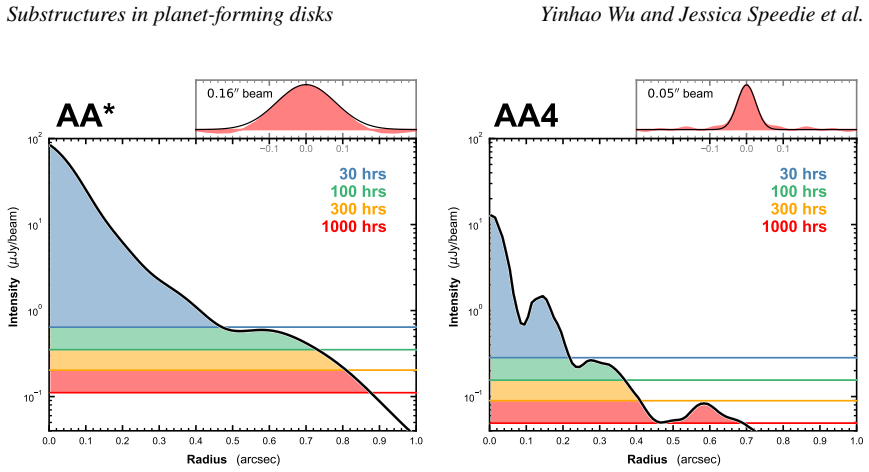
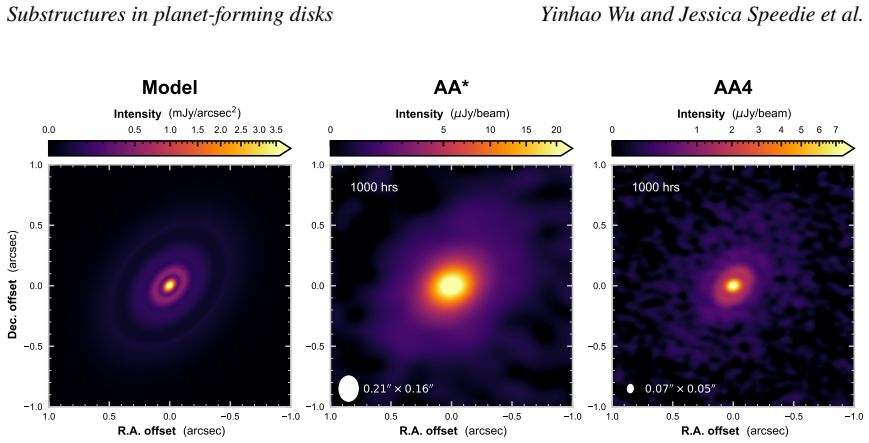
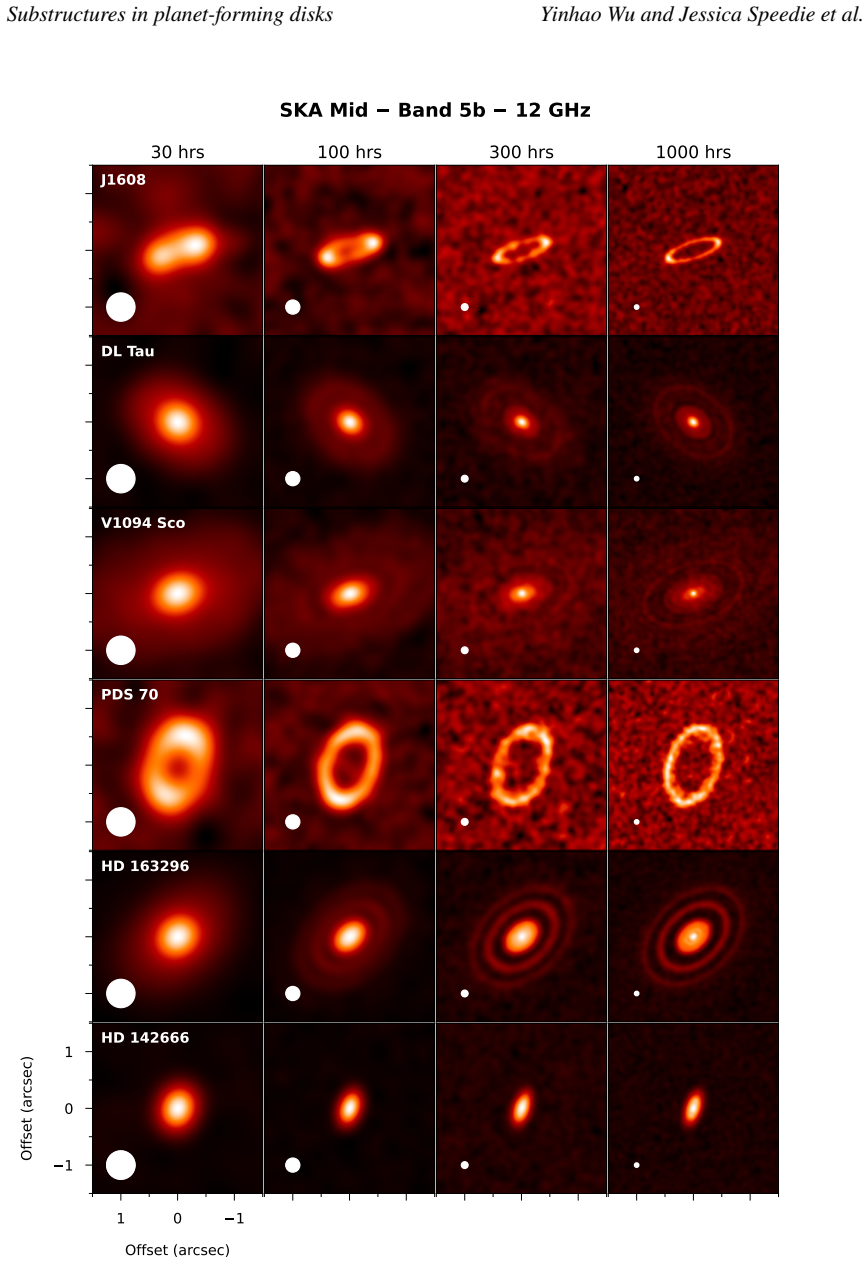
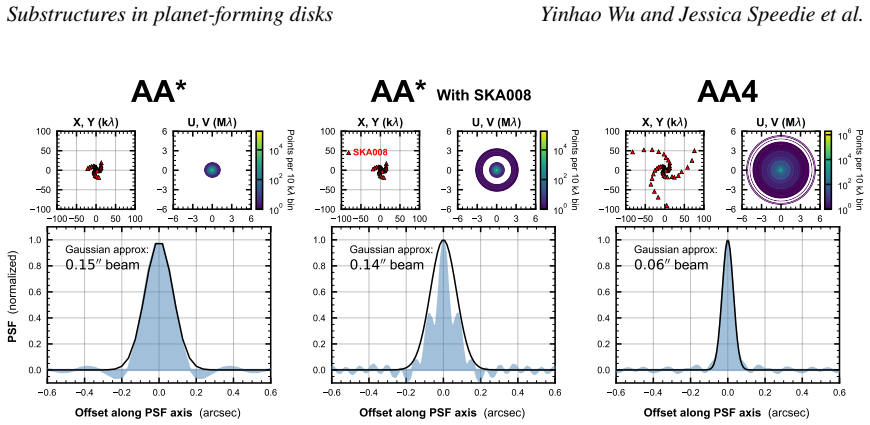
SKA-Mid Band 5b continuum observations, offering angular resolutions of ~0.05'' (~0.15'') with AA4 (AA*) at 12.5 GHz / 2.4 cm, will enable new progress on the origin of disk substructures, their role in planet assembly, and their true properties, with a lens on dust thermal emission.
What carries the argument
SKA-Mid Band 5b continuum observations at 12.5 GHz with ~0.05 arcsecond resolution, which image dust thermal emission to compare substructures across wavelengths.
If this is right
- Substructures resolved at 2.4 cm can be compared to millimeter-wave maps to test whether they trace identical physical features or different dust populations.
- Thermal emission data at this frequency will constrain grain sizes and optical depths inside rings and gaps, narrowing possible formation mechanisms.
- Spatial distributions of substructures measured at high resolution will clarify whether they promote or suppress planetesimal growth.
- Multi-epoch or multi-configuration SKA data can track time evolution of asymmetries and vortices linked to planet-disk interactions.
Where Pith is reading between the lines
- If the wavelength comparison works, joint SKA-ALMA campaigns could become standard for mapping full dust size distributions across entire disks.
- Non-detections at centimeter wavelengths for some millimeter substructures would imply strong radial drift or grain growth that current models underpredict.
- The technique might extend to fainter or more distant disks once sensitivity improves, testing whether substructure statistics vary with stellar mass or environment.
Load-bearing premise
The assumption that continuum observations at 12.5 GHz will detect and characterize the same substructures seen at shorter wavelengths in a manner that directly constrains their physical origin and planet-formation role.
What would settle it
SKA-Mid observations at 12.5 GHz that either detect no substructures where shorter-wavelength data show clear ones, or yield structures whose properties show no systematic link to planet-formation indicators such as gap widths or dust trapping.
Figures
read the original abstract
Disks of gas and dust orbiting young stars are the arenas and material reservoirs for planet formation. Over the past decade, multiwavelength observations, from infrared to radio, have resolved the spatial distribution of hundreds of protoplanetary disks in nearby star-forming regions, revealing a diverse zoo of substructures. These substructures are morphological features such as rings, gaps, spirals, vortices, asymmetries, warps, or clumps that trace variations in density, temperature, or composition relative to an otherwise smooth distribution of gas and dust. Many unknowns persist as to the origin of these substructures, their role in planet assembly, and their true properties. SKA-Mid Band 5b continuum observations, offering angular resolutions of $\sim 0.05''$ ($\sim 0.15''$) with AA4 (AA*) at $12.5$ GHz / $2.4$ cm, will enable new progress at this frontier. In this chapter, we outline the open questions in the field of disk substructure that SKA-Mid is uniquely poised to address, with a lens on dust thermal emission.
Editorial analysis
A structured set of objections, weighed in public.
Referee Report
Summary. The manuscript is a perspective chapter outlining open questions on the origins of substructures (rings, gaps, spirals, etc.) in protoplanetary disks, their role in planet assembly, and their physical properties. It argues that SKA-Mid Band 5b continuum observations at 12.5 GHz / 2.4 cm, achieving angular resolutions of ~0.05'' (AA4) or ~0.15'' (AA*), will enable new progress on these questions specifically through dust thermal emission.
Significance. If the technical assumptions hold, the paper provides a useful forward-looking roadmap for how SKA-Mid can complement existing mm-wave facilities like ALMA by accessing cm-wavelength regimes, potentially constraining grain properties and substructure origins in a manner not currently accessible.
major comments (1)
- [Abstract] Abstract (paragraph on open questions): The claim that Band 5b observations 'will enable new progress' on substructure origins and planet-assembly role via dust thermal emission is load-bearing but rests on the unexamined assumption that 12.5 GHz morphology directly maps to the same density/temperature variations seen at 1.3 mm. The text supplies no quantitative estimate of how substructure contrast or location would change under grain-size-dependent opacity (κ_ν ∝ ν^β(a_max)), size-dependent radial drift, or trapping, nor does it address possible free-free contamination or optical-depth shifts that could alter the inferred physical origin.
Simulated Author's Rebuttal
We thank the referee for their constructive report and for identifying a key point about the assumptions underlying our forward-looking claims. We address the major comment below in detail. As this is a perspective chapter focused on open questions rather than new modeling, we will incorporate clarifications to strengthen the presentation without altering the core message.
read point-by-point responses
-
Referee: [Abstract] Abstract (paragraph on open questions): The claim that Band 5b observations 'will enable new progress' on substructure origins and planet-assembly role via dust thermal emission is load-bearing but rests on the unexamined assumption that 12.5 GHz morphology directly maps to the same density/temperature variations seen at 1.3 mm. The text supplies no quantitative estimate of how substructure contrast or location would change under grain-size-dependent opacity (κ_ν ∝ ν^β(a_max)), size-dependent radial drift, or trapping, nor does it address possible free-free contamination or optical-depth shifts that could alter the inferred physical origin.
Authors: We agree that the abstract is necessarily concise and that the claim would benefit from explicit acknowledgment of wavelength-dependent effects. As a perspective piece, the manuscript does not perform or cite new quantitative radiative-transfer calculations comparing 1.3 mm and 12.5 GHz morphologies; instead it highlights that cm-wave data will access a different grain-size regime and optical-depth regime, thereby providing independent constraints on the very mechanisms (trapping, drift, opacity variations) the referee mentions. The body of the text already notes that longer wavelengths preferentially trace larger grains and can help discriminate between substructure origins, but we concede that a short, qualitative discussion of possible contrast changes, free-free contributions, and optical-depth shifts is absent. We will therefore revise the abstract to qualify the claim and add one paragraph (likely in the introduction or a new short subsection) that outlines these caveats while emphasizing that SKA-Mid observations themselves will supply the multi-wavelength data needed to test them. This constitutes a targeted clarification rather than a change in scientific content. revision: yes
Circularity Check
No circularity: qualitative forward-looking discussion with no derivations or equations
full rationale
The paper is a perspective chapter outlining open questions in disk substructures and how SKA-Mid Band 5b observations may address them. It contains no equations, derivations, fitted parameters, predictions of quantitative results, or load-bearing self-citations that reduce to inputs by construction. The central claim is a qualitative statement about observational capability enabling progress, with no reduction of any result to a fitted input or self-referential definition. This matches the default expectation of no significant circularity for papers without mathematical chains.
Axiom & Free-Parameter Ledger
axioms (1)
- domain assumption Standard assumptions about the detectability and interpretability of dust thermal emission at centimeter wavelengths in protoplanetary disks.
Reference graph
Works this paper leans on
-
[1]
Protoplanetary disk rings and gaps across ages and luminosities
Protoplanetary Disk Rings and Gaps across Ages and Luminosities. , keywords =. doi:10.3847/1538-4357/aafd31 , archivePrefix =. 1901.03680 , primaryClass =
work page internal anchor Pith review Pith/arXiv arXiv doi:10.3847/1538-4357/aafd31 1901
-
[2]
The Structure of Spiral Shocks Excited by Planetary-mass Companions
The Structure of Spiral Shocks Excited by Planetary-mass Companions. , keywords =. doi:10.1088/0004-637X/813/2/88 , archivePrefix =. 1507.03599 , primaryClass =
work page internal anchor Pith review Pith/arXiv arXiv doi:10.1088/0004-637x/813/2/88
-
[3]
Inferring Planet Mass from Spiral Structures in Protoplanetary Disks
Inferring Planet Mass from Spiral Structures in Protoplanetary Disks. , keywords =. doi:10.1088/2041-8205/815/2/L21 , archivePrefix =. 1511.01178 , primaryClass =
work page internal anchor Pith review Pith/arXiv arXiv doi:10.1088/2041-8205/815/2/l21 2041
-
[4]
What is the Mass of a Gap-Opening Planet?
What is the Mass of a Gap-opening Planet?. , keywords =. doi:10.3847/1538-4357/835/2/146 , archivePrefix =. 1612.04821 , primaryClass =
work page internal anchor Pith review Pith/arXiv arXiv doi:10.3847/1538-4357/835/2/146
-
[5]
Puffed-up Edges of Planet-opened Gaps in Protoplanetary Disks. I. Hydrodynamic Simulations. , keywords =. doi:10.3847/1538-4357/abef6b , archivePrefix =. 2103.09254 , primaryClass =
-
[6]
Gap-opening Planets Make Dust Rings Wider. , keywords =. doi:10.3847/1538-4357/aca1b1 , archivePrefix =. 2210.11488 , primaryClass =
-
[7]
Observational Signatures of Planets in Protoplanetary Disks: Temperature Structures in Spiral Arms. , keywords =. doi:10.3847/1538-3881/ac141f , archivePrefix =. 2107.06323 , primaryClass =
-
[8]
The Dependence of the Structure of Planet-opened Gaps in Protoplanetary Disks on Radiative Cooling. , keywords =. doi:10.3847/1538-4357/ad055c , archivePrefix =. 2310.11757 , primaryClass =
-
[9]
Proceedings of the Royal Society of London Series A , year = 1960, month = jun, volume =
The Origin of the Solar System. Proceedings of the Royal Society of London Series A , year = 1960, month = jun, volume =. doi:10.1098/rspa.1960.0108 , adsurl =
-
[10]
, archivePrefix = "arXiv", eprint =
On the accumulation of planetesimals near disc gaps created by protoplanets. , keywords =. doi:10.1111/j.1365-2966.2012.20967.x , archivePrefix =. 1203.4953 , primaryClass =
-
[11]
The formation of a star cluster: predicting the properties of stars and brown dwarfs. , keywords =. doi:10.1046/j.1365-8711.2003.06210.x , archivePrefix =. astro-ph/0212380 , primaryClass =
-
[12]
On the diversity and statistical properties of protostellar discs
On the diversity and statistical properties of protostellar discs. , keywords =. doi:10.1093/mnras/sty169 , archivePrefix =. 1801.07721 , primaryClass =
work page internal anchor Pith review Pith/arXiv arXiv doi:10.1093/mnras/sty169
-
[13]
On planet formation in HL Tau. , keywords =. doi:10.1093/mnrasl/slv105 , archivePrefix =. 1507.06719 , primaryClass =
work page internal anchor Pith review Pith/arXiv arXiv doi:10.1093/mnrasl/slv105
-
[14]
Two mechanisms for dust gap opening in protoplanetary discs
Two mechanisms for dust gap opening in protoplanetary discs. , keywords =. doi:10.1093/mnrasl/slw032 , archivePrefix =. 1602.07457 , primaryClass =
work page internal anchor Pith review Pith/arXiv arXiv doi:10.1093/mnrasl/slw032
-
[15]
, year = 1953, month = nov, volume =
On the Fragmentation of Gas Clouds Into Galaxies and Stars. , year = 1953, month = nov, volume =. doi:10.1086/145780 , adsurl =
-
[16]
Modeling Dust Emission of HL Tau Disk Based on Planet-Disk Interactions
Modeling Dust Emission of HL Tau Disk Based on Planet-Disk Interactions. , keywords =. doi:10.3847/0004-637X/818/1/76 , archivePrefix =. 1601.00358 , primaryClass =
work page internal anchor Pith review Pith/arXiv arXiv doi:10.3847/0004-637x/818/1/76
-
[17]
Turbulence and star formation in molecular clouds. , keywords =. doi:10.1093/mnras/194.4.809 , adsurl =
-
[18]
On the structure and evolution of the primordial solar nebula. , keywords =. doi:10.1093/mnras/191.1.37 , adsurl =
-
[19]
Control of star formation by supersonic turbulence
Control of star formation by supersonic turbulence. Reviews of Modern Physics , keywords =. doi:10.1103/RevModPhys.76.125 , archivePrefix =. astro-ph/0301093 , primaryClass =
work page internal anchor Pith review Pith/arXiv arXiv doi:10.1103/revmodphys.76.125
-
[20]
Disentangling the independently controllable factors of variation by interacting with the world
Embedded Clusters in Molecular Clouds. , keywords =. doi:10.1146/annurev.astro.41.011802.094844 , archivePrefix =. astro-ph/0301540 , primaryClass =
work page internal anchor Pith review Pith/arXiv arXiv doi:10.1146/annurev.astro.41.011802.094844
-
[21]
Planet formation signposts: observability of circumplanetary disks via gas kinematics
Planet Formation Signposts: Observability of Circumplanetary Disks via Gas Kinematics. , keywords =. doi:10.1088/2041-8205/811/1/L5 , archivePrefix =. 1505.06808 , primaryClass =
work page internal anchor Pith review Pith/arXiv arXiv doi:10.1088/2041-8205/811/1/l5 2041
-
[22]
Kinematic evidence for an embedded protoplanet in a circumstellar disc
Kinematic Evidence for an Embedded Protoplanet in a Circumstellar Disk. , keywords =. doi:10.3847/2041-8213/aac6dc , archivePrefix =. 1805.10293 , primaryClass =
work page internal anchor Pith review Pith/arXiv arXiv doi:10.3847/2041-8213/aac6dc 2041
-
[23]
Observability of planet-disc interactions in CO kinematics
Observability of planet-disc interactions in CO kinematics. , keywords =. doi:10.1093/mnrasl/sly109 , archivePrefix =. 1806.05125 , primaryClass =
work page internal anchor Pith review Pith/arXiv arXiv doi:10.1093/mnrasl/sly109
-
[24]
Turbulence in protoplanetary disks: A systematic analysis of dust settling in 33 disks. , keywords =. doi:10.1051/0004-6361/202553822 , archivePrefix =. 2503.05872 , primaryClass =
-
[25]
Radial Migration of Gap-opening Planets in Protoplanetary Disks. I. The Case of a Single Planet. , keywords =. doi:10.3847/1538-4357/aac8d9 , archivePrefix =. 1805.11101 , primaryClass =
work page internal anchor Pith review Pith/arXiv arXiv doi:10.3847/1538-4357/aac8d9
-
[26]
A transition in circumbinary accretion discs at a binary mass ratio of 1:25
A transition in circumbinary accretion discs at a binary mass ratio of 1:25. , keywords =. doi:10.1093/mnras/stw792 , archivePrefix =. 1512.05788 , primaryClass =
work page internal anchor Pith review Pith/arXiv arXiv doi:10.1093/mnras/stw792
-
[27]
The onset of protostellar disk substructures and planet formation
CAMPOS: II. The onset of protostellar disk substructures and planet formation. , keywords =. doi:10.1051/0004-6361/202555174 , archivePrefix =. 2504.11577 , primaryClass =
-
[28]
An opening criterion for dust gaps in protoplanetary discs
An opening criterion for dust gaps in protoplanetary discs. , keywords =. doi:10.1093/mnras/stx977 , archivePrefix =. 1704.06664 , primaryClass =
work page internal anchor Pith review Pith/arXiv arXiv doi:10.1093/mnras/stx977
-
[29]
Fast Radial Flows in Transition Disk Holes
Fast Radial Flows in Transition Disk Holes. , keywords =. doi:10.1088/0004-637X/782/2/62 , archivePrefix =. 1312.3817 , primaryClass =
work page internal anchor Pith review Pith/arXiv arXiv doi:10.1088/0004-637x/782/2/62
-
[30]
Accretion Kinematics through the Warped Transition Disk in HD142527 from Resolved CO(6-5) Observations. , keywords =. doi:10.1088/0004-637X/811/2/92 , archivePrefix =. 1505.07732 , primaryClass =
work page internal anchor Pith review Pith/arXiv arXiv doi:10.1088/0004-637x/811/2/92
-
[31]
Gaia Data Release 3. Summary of the content and survey properties. , keywords =. doi:10.1051/0004-6361/202243940 , archivePrefix =. 2208.00211 , primaryClass =
-
[32]
Summary of the contents and survey properties
Gaia Early Data Release 3. Summary of the contents and survey properties. , keywords =. doi:10.1051/0004-6361/202039657 , archivePrefix =. 2012.01533 , primaryClass =
-
[33]
A Census of the Taurus Star-forming Region and Neighboring Associations with Gaia. , keywords =. doi:10.3847/1538-3881/ac9da3 , archivePrefix =. 2211.09785 , primaryClass =
-
[34]
An Assessment of Dynamical Mass Constraints on Pre-Main Sequence Evolutionary Tracks
An Assessment of Dynamical Mass Constraints on Pre-Main-Sequence Evolutionary Tracks. , keywords =. doi:10.1086/382021 , archivePrefix =. astro-ph/0312189 , primaryClass =
work page internal anchor Pith review Pith/arXiv arXiv doi:10.1086/382021
-
[35]
Dynamical Stellar Masses of Pre-main-sequence Stars in Lupus and Taurus Obtained with ALMA Surveys in Comparison with Stellar Evolutionary Models. , keywords =. doi:10.3847/1538-4357/abd24f , archivePrefix =. 2012.07441 , primaryClass =
-
[36]
Magnetic inhibition of convection and the fundamental properties of low-mass stars. III. A consistent 10 Myr age for the Upper Scorpius OB association. , keywords =. doi:10.1051/0004-6361/201527613 , archivePrefix =. 1604.08036 , primaryClass =
work page internal anchor Pith review Pith/arXiv arXiv doi:10.1051/0004-6361/201527613
-
[37]
First polarimetric detections revealing disks around DH Tau B and GSC 6214-210 B
A survey of the linear polarization of directly imaged exoplanets and brown dwarf companions with SPHERE-IRDIS. First polarimetric detections revealing disks around DH Tau B and GSC 6214-210 B. , keywords =. doi:10.1051/0004-6361/202039290 , archivePrefix =. 2101.04033 , primaryClass =
-
[38]
C., Mac \' as, E., et al.\ 2020, , 642, A171
Modeling protoplanetary disk SEDs with artificial neural networks. Revisiting the viscous disk model and updated disk masses. , keywords =. doi:10.1051/0004-6361/202038352 , archivePrefix =. 2009.03323 , primaryClass =
-
[39]
, year = 1960, month = mar, volume =
The Spectra of Be- and Ae-Type Stars Associated with Nebulosity. , year = 1960, month = mar, volume =. doi:10.1086/190050 , adsurl =
-
[40]
Advances in Astronomy and Astrophysics , year = 1962, month = jan, volume =
The Properties and Problems of T Tauri Stars and Related Objects. Advances in Astronomy and Astrophysics , year = 1962, month = jan, volume =. doi:10.1016/B978-1-4831-9919-1.50006-6 , adsurl =
-
[41]
Dust and gas distribution around T Tauri stars in Taurus-Auriga. I. Interferometric 2.7mm continuum and \^13\^CO J=1-0 observations. , keywords =
-
[42]
Radio Jets from Young Stellar Objects
Radio jets from young stellar objects. , keywords =. doi:10.1007/s00159-018-0107-z , archivePrefix =. 1806.06444 , primaryClass =
work page internal anchor Pith review Pith/arXiv arXiv doi:10.1007/s00159-018-0107-z
-
[43]
, keywords =
The spectrum of the free-free radiation from extended envelopes. , keywords =
-
[44]
A Disk-based Dynamical Constraint on the Mass of the Young Binary DQ Tau
A Disk-based Dynamical Constraint on the Mass of the Young Binary DQ Tau. , keywords =. doi:10.3847/0004-637X/818/2/156 , archivePrefix =. 1601.03806 , primaryClass =
work page internal anchor Pith review Pith/arXiv arXiv doi:10.3847/0004-637x/818/2/156
-
[45]
Dual-band Observations of the Asymmetric Ring around CIDA 9A: Dead or Alive?. , keywords =. doi:10.3847/1538-4357/ad0835 , archivePrefix =. 2310.11007 , primaryClass =
-
[46]
A multiwavelength analysis of central mm/cm emission in transition disks
Correlation between accretion rate and free-free emission in protoplanetary disks. A multiwavelength analysis of central mm/cm emission in transition disks. , keywords =. doi:10.1051/0004-6361/202348387 , archivePrefix =. 2401.05798 , primaryClass =
-
[47]
arXiv , Author =:2008.08106 , Journal =
arXiv 2008
-
[48]
ALMA chemical survey of disk-outflow sources in Taurus (ALMA-DOT). II. Vertical stratification of CO, CS, CN, H _ 2 CO, and CH _ 3 OH in a Class I disk. , keywords =. doi:10.1051/0004-6361/202038952 , archivePrefix =. 2008.12648 , primaryClass =
-
[49]
doi:10.1051/0004-6361/201935928 , Eid =. arXiv , Author =:1909.01118 , Journal =
-
[50]
On the Outer Edges of Protoplanetary Dust Disks
doi:10.1088/0004-637X/780/2/153 , Eid =. arXiv , Author =:1311.5222 , Journal =
work page internal anchor Pith review Pith/arXiv arXiv doi:10.1088/0004-637x/780/2/153
-
[51]
arXiv , Author =:2005.03891 , Journal =
arXiv 2005
-
[52]
doi:10.1051/0004-6361/201832980 , Eid =. arXiv , Author =:1806.07707 , Journal =
work page internal anchor Pith review Pith/arXiv arXiv doi:10.1051/0004-6361/201832980
-
[53]
arXiv , Author =:2002.09058 , Journal =
doi:10.3847/1538-3881/ab789a , Eid =. arXiv , Author =:2002.09058 , Journal =
-
[54]
Astronomical Data Analysis Software and Systems XVI , Date-Added =
-
[55]
doi:10.1051/0004-6361/201730645 , Eid =. arXiv , Author =:1706.02608 , Journal =
work page internal anchor Pith review Pith/arXiv arXiv doi:10.1051/0004-6361/201730645
-
[56]
A Survey of CH3CN and HC3N in Protoplanetary Disks
doi:10.3847/1538-4357/aab664 , Eid =. arXiv , Author =:1803.04986 , Journal =
work page internal anchor Pith review Pith/arXiv arXiv doi:10.3847/1538-4357/aab664
-
[57]
Nitrogen Fractionation in Protoplanetary Disks from the H13CN/HC15N Ratio
doi:10.3847/1538-4357/836/1/30 , Eid =. arXiv , Author =:1701.07510 , Journal =
work page internal anchor Pith review Pith/arXiv arXiv doi:10.3847/1538-4357/836/1/30
-
[58]
doi:10.3847/0004-637X/823/2/91 , Eid =. arXiv , Author =:1603.08520 , Journal =
work page internal anchor Pith review Pith/arXiv arXiv doi:10.3847/0004-637x/823/2/91
-
[59]
doi:10.1126/science.1239560 , Eprint =
Science , Keywords =. doi:10.1126/science.1239560 , Eprint =
-
[60]
Initial Conditions of Planet Formation: Lifetimes of Primordial Disks
American Institute of Physics Conference Series , Date-Added =. doi:10.1063/1.3215910 , Editor =. arXiv , Author =:0906.5011 , Keywords =
work page internal anchor Pith review Pith/arXiv arXiv doi:10.1063/1.3215910
-
[61]
doi:10.1093/mnrasl/slaa014 , Eprint =
, Keywords =. doi:10.1093/mnrasl/slaa014 , Eprint =
-
[62]
arXiv , Author =:2004.07257 , Journal =
arXiv 2004
-
[63]
arXiv , Author =:2002.08522 , Journal =
doi:10.3847/2041-8213/ab7823 , Eid =. arXiv , Author =:2002.08522 , Journal =
-
[64]
The VLA view of the HL Tau Disk - Disk Mass, Grain Evolution, and Early Planet Formation
doi:10.3847/2041-8205/821/1/L16 , Eid =. arXiv , Author =:1603.03731 , Journal =
work page internal anchor Pith review Pith/arXiv arXiv doi:10.3847/2041-8205/821/1/l16 2041
-
[65]
arXiv , Author =:2002.10195 , Journal =
doi:10.1051/0004-6361/201937247 , Eid =. arXiv , Author =:2002.10195 , Journal =
-
[66]
Searching for circumplanetary disks around LkCa 15
Searching for Circumplanetary Disks around LkCa 15. , keywords =. doi:10.1088/0004-637X/788/2/129 , archivePrefix =. 1404.5627 , primaryClass =
work page internal anchor Pith review Pith/arXiv arXiv doi:10.1088/0004-637x/788/2/129
-
[67]
The Radial Distribution of Dust Particles in the HL Tau Disk from ALMA and VLA Observations. , keywords =. doi:10.3847/1538-4357/ab3d33 , archivePrefix =. 1908.07140 , primaryClass =
-
[68]
Imaging the photoevaporating disk and radio jet of GM Aur
Imaging the Photoevaporating Disk and Radio Jet of GM Aur. , keywords =. doi:10.3847/0004-637X/829/1/1 , archivePrefix =. 1607.04225 , primaryClass =
work page internal anchor Pith review Pith/arXiv arXiv doi:10.3847/0004-637x/829/1/1
-
[69]
Effects of Scattering, Temperature Gradients, and Settling on the Derived Dust Properties of Observed Protoplanetary Disks. , keywords =. doi:10.3847/1538-4357/ab7d32 , archivePrefix =. 2003.02982 , primaryClass =
-
[70]
Imaging a Central Ionized Component, a Narrow Ring, and the CO Snowline in the Multigapped Disk of HD 169142. , keywords =. doi:10.3847/1538-4357/aa6620 , archivePrefix =. 1703.02957 , primaryClass =
work page internal anchor Pith review Pith/arXiv arXiv doi:10.3847/1538-4357/aa6620
-
[71]
Distribution of solids in the rings of the HD 163296 disk: a multiwavelength study. , keywords =. doi:10.1051/0004-6361/202142303 , archivePrefix =. 2207.01496 , primaryClass =
-
[72]
Multiple rings in the transitional disk of GM Aurigae revealed by VLA and ALMA
Multiple Rings in the Transitional Disk of GM Aurigae Revealed by VLA and ALMA. , keywords =. doi:10.3847/1538-4357/aad811 , archivePrefix =. 1808.01920 , primaryClass =
work page internal anchor Pith review Pith/arXiv arXiv doi:10.3847/1538-4357/aad811
-
[73]
Continuum Spectra of Collimated, Ionized Stellar Winds. , keywords =. doi:10.1086/164209 , adsurl =
-
[74]
Rocky planet formation in compact disks around M dwarfs. , keywords =. doi:10.1051/0004-6361/202450350 , archivePrefix =. 2406.07760 , primaryClass =
-
[75]
Dust evolution in protoplanetary disks. arXiv e-prints , keywords =. doi:10.48550/arXiv.2310.09077 , archivePrefix =. 2310.09077 , primaryClass =
-
[76]
The Mass Budgets and Spatial Scales of Exoplanet Systems and Protoplanetary Disks. , keywords =. doi:10.3847/1538-4357/ac178e , archivePrefix =. 2107.12520 , primaryClass =
-
[77]
Empirical Temperature Measurement in Protoplanetary Disks
doi:10.3847/1538-4357/aaa481 , Eid =. arXiv , Author =:1801.03478 , Journal =
work page internal anchor Pith review Pith/arXiv arXiv doi:10.3847/1538-4357/aaa481
-
[78]
arXiv , Author =:2002.12525 , Journal =
doi:10.3847/1538-4357/ab64d9 , Eid =. arXiv , Author =:2002.12525 , Journal =
-
[79]
doi:10.1088/0004-637X/722/2/1607 , Eprint =
, Keywords =. doi:10.1088/0004-637X/722/2/1607 , Eprint =
-
[80]
, Keywords =. doi:10.1086/680342 , Eprint =
discussion (0)
Sign in with ORCID, Apple, or X to comment. Anyone can read and Pith papers without signing in.