Weight geometry governs functional memory in complex systems
Pith reviewed 2026-06-25 19:49 UTC · model grok-4.3
The pith
Real interaction strengths organize functional memory at greater hierarchical depth than random weight assignment on the same topology.
A machine-rendered reading of the paper's core claim, the machinery that carries it, and where it could break.
Core claim
Using a thermodynamic description of multiscale information flow, the authors quantify memory distribution across path lengths in thirty-four networks. They find that real interaction strengths organize memory at greater hierarchical depth than random weight assignment, and that this organization collapses onto four recurrent dynamical organisations. Weight geometry governs memory depth, mesoscale structure shapes it across scales, and directionality modulates sensitivity to perturbation, establishing that weights carry dynamical structure beyond binary topology.
What carries the argument
weighted transport geometry, the mechanism that organizes functional memory at greater hierarchical depth than random weights on identical topology
Load-bearing premise
The thermodynamic description of multiscale information flow accurately quantifies functional memory and the null models that selectively perturb weighted transport geometry, mesoscale structure, and directionality correctly isolate their distinct contributions.
What would settle it
Replicating the memory-depth calculation on the same thirty-four networks but finding that random weight assignment produces equal or greater hierarchical depth than the real weights.
Figures
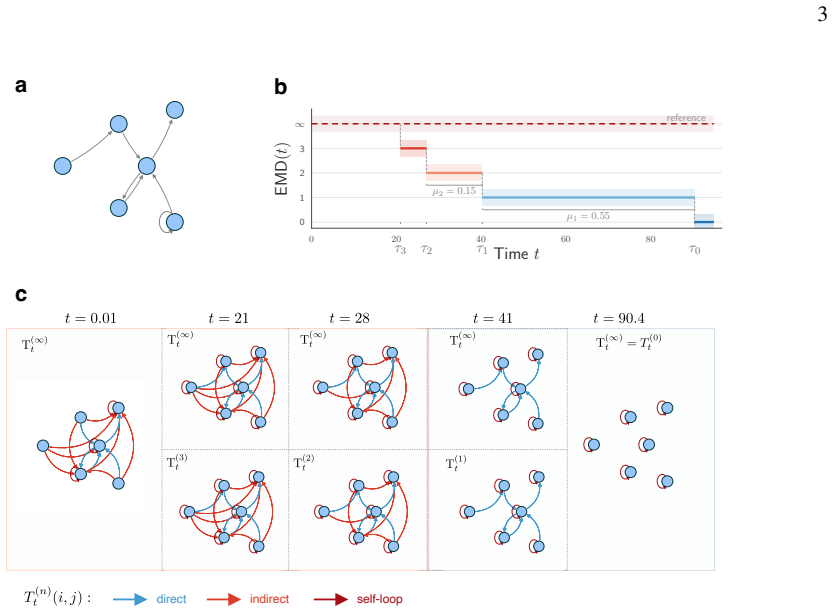
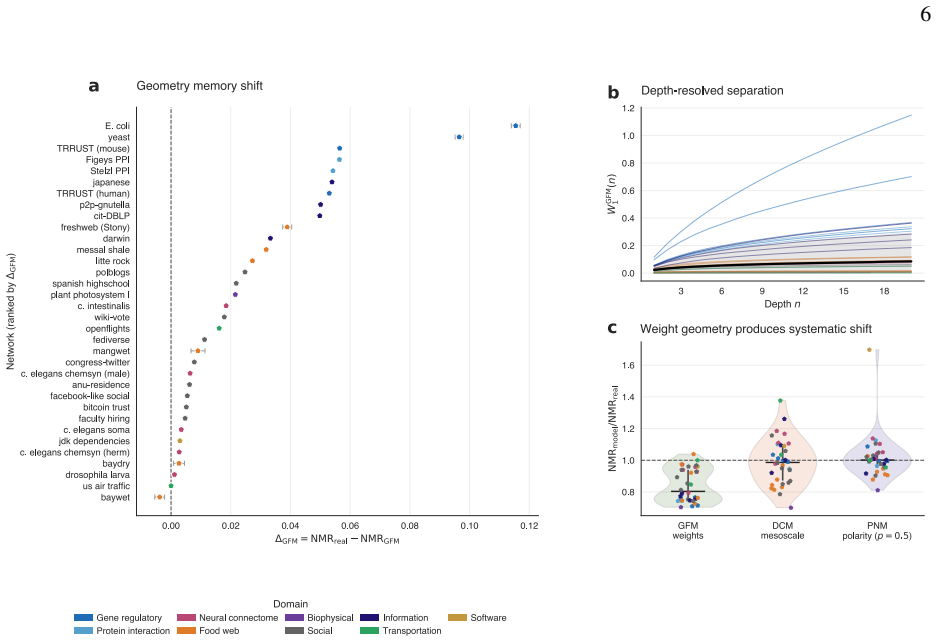
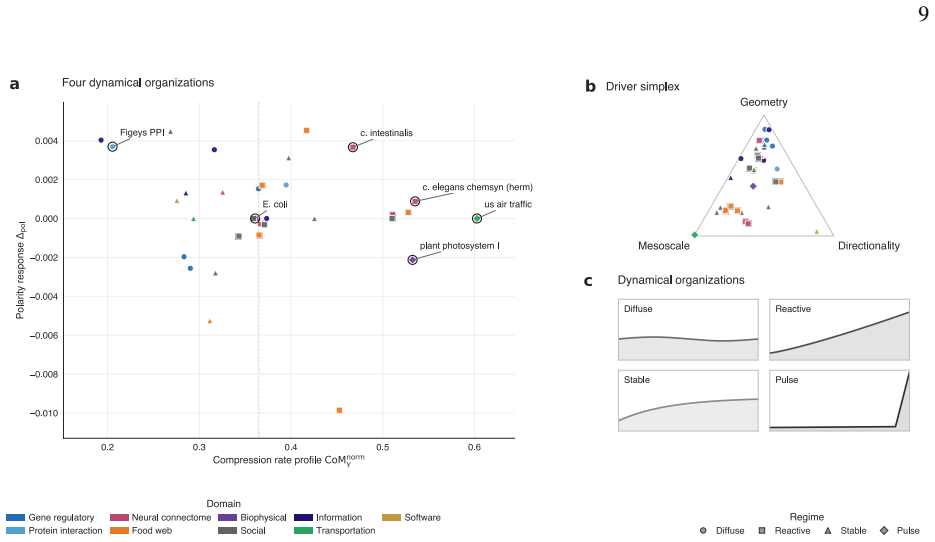
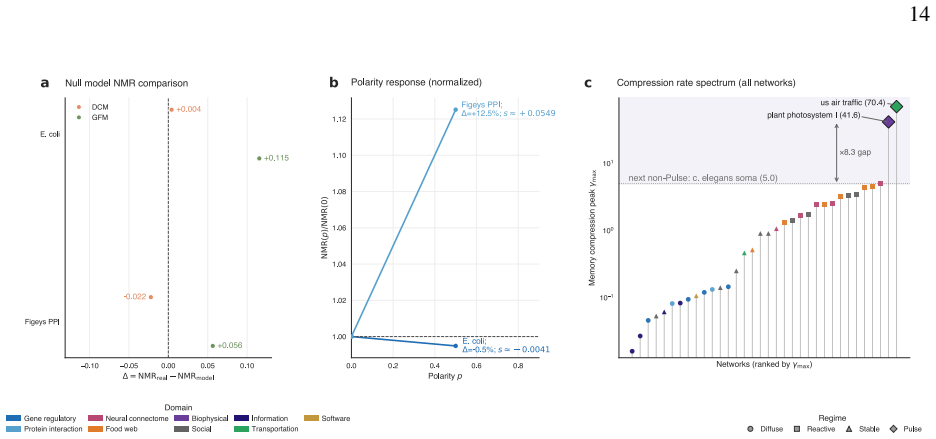
read the original abstract
Complex systems, from gene regulatory networks to neural circuits and transportation infrastructures, exhibit rich functional behaviour that topology alone does not capture. Here we show that functional memory exhibits a universal organisational regularity: in every biological, ecological, social, and technological domain studied, real interaction strengths organise memory at greater hierarchical depth than random weight assignment on the same topology, across thirty-four networks spanning several orders of magnitude in size and density. Using a thermodynamic description of multiscale information flow, we quantify how memory is distributed across path lengths and show that functional memory organisation collapses onto four recurrent dynamical organisations, revealing an intrinsically low-dimensional structure. Comparing each network against null models that selectively perturb weighted transport geometry, mesoscale structure, and directionality reveals that these ingredients contribute distinct and non-equivalent roles: weight geometry systematically governs memory depth, mesoscale structure shapes memory organisation across scales, and directionality modulates the sensitivity of the cascade to structural perturbation. The same comparison provides an operational criterion for whether network weights encode genuine functional interaction structure. These results establish weighted transport geometry as a primary organiser of functional memory and show that weighted interactions carry dynamical structure that binary topology alone cannot recover.
Editorial analysis
A structured set of objections, weighed in public.
Referee Report
Summary. The manuscript claims that across 34 networks from biological, ecological, social, and technological domains, real interaction strengths organize functional memory at greater hierarchical depth than random weight assignment on the same topology. Using a thermodynamic description of multiscale information flow, memory distribution across path lengths is quantified and shown to collapse onto four recurrent dynamical organizations. Null models selectively perturbing weighted transport geometry, mesoscale structure, and directionality demonstrate that these factors play distinct roles, with weight geometry governing memory depth, leading to the conclusion that weighted transport geometry is a primary organizer of functional memory beyond binary topology.
Significance. If the thermodynamic measure is established as a valid proxy for functional memory, the work would be significant for showing that weighted interactions encode dynamical structure not recoverable from topology alone, across a large and diverse set of networks. The scale of the study (34 networks spanning orders of magnitude in size and density) and the use of multiple targeted null models to isolate contributions are strengths that would support broader implications for understanding functional organization in complex systems.
major comments (3)
- [Abstract] Abstract: The central claim that weight geometry 'governs functional memory' equates differences in the thermodynamic multiscale information-flow measure (deeper hierarchical organization under real weights) with governance of functional memory. No independent validation is provided that this measure tracks actual functional outcomes (e.g., robustness, response specificity, or empirical memory tasks) in any of the 34 networks, so the null-model results demonstrate only a difference in the chosen dynamical statistic rather than functional governance.
- [Abstract] Abstract: The statement that functional memory organisation 'collapses onto four recurrent dynamical organisations' is load-bearing for the low-dimensional structure conclusion, yet the abstract (and by extension the manuscript) provides no detail on the classification procedure, distance metric, or statistical controls used to identify these four organizations or confirm their recurrence across domains.
- [Abstract] Abstract: The operational criterion for whether network weights encode 'genuine functional interaction structure' is derived from the same null-model comparisons; without a shown link between the thermodynamic quantities and functional performance, this criterion lacks external grounding and cannot be evaluated as operational.
minor comments (1)
- The abstract is information-dense; consider splitting the description of the null-model results and the four organizations into separate sentences for improved readability.
Simulated Author's Rebuttal
We thank the referee for the detailed and constructive report. We address each major comment below, proposing targeted revisions to the abstract and discussion to improve precision and clarity while preserving the manuscript's core findings.
read point-by-point responses
-
Referee: [Abstract] Abstract: The central claim that weight geometry 'governs functional memory' equates differences in the thermodynamic multiscale information-flow measure (deeper hierarchical organization under real weights) with governance of functional memory. No independent validation is provided that this measure tracks actual functional outcomes (e.g., robustness, response specificity, or empirical memory tasks) in any of the 34 networks, so the null-model results demonstrate only a difference in the chosen dynamical statistic rather than functional governance.
Authors: The thermodynamic measure is grounded in a maximum-entropy model of multiscale information flow and serves as a quantitative proxy for memory organization. The null-model results establish that real weights produce deeper hierarchies than randomized weights on the same topology. We agree that the manuscript does not include direct empirical validation against specific functional performance metrics across the 34 networks. We will revise the abstract and relevant discussion sections to frame the measure explicitly as a proxy and to qualify the 'governs' language as indicating systematic influence on the chosen dynamical statistic. revision: partial
-
Referee: [Abstract] Abstract: The statement that functional memory organisation 'collapses onto four recurrent dynamical organisations' is load-bearing for the low-dimensional structure conclusion, yet the abstract (and by extension the manuscript) provides no detail on the classification procedure, distance metric, or statistical controls used to identify these four organizations or confirm their recurrence across domains.
Authors: The classification into four recurrent organizations is performed via clustering of normalized memory-distribution profiles, using a Euclidean distance metric with permutation-based statistical controls to confirm recurrence across domains; full details appear in the Methods and Supplementary Information. We will revise the abstract to include a concise description of this procedure. revision: yes
-
Referee: [Abstract] Abstract: The operational criterion for whether network weights encode 'genuine functional interaction structure' is derived from the same null-model comparisons; without a shown link between the thermodynamic quantities and functional performance, this criterion lacks external grounding and cannot be evaluated as operational.
Authors: The criterion is defined internally by whether real weights produce memory depth that deviates significantly from the randomized-weight null model. We will revise the abstract sentence to state explicitly that the criterion is based on this thermodynamic null-model comparison. revision: partial
Circularity Check
No significant circularity detected; derivation relies on external null-model comparisons.
full rationale
The provided abstract and context describe a thermodynamic measure of multiscale information flow applied to real weights versus null models that randomize weights on fixed topology. This yields an empirical contrast (real weights produce greater hierarchical depth) rather than any reduction of the output to the input by definition, fitting, or self-citation. No equations or steps are quoted that equate the claimed 'governance' result to a fitted parameter or prior self-citation; the null-model design supplies an independent benchmark. The paper is therefore self-contained against its stated controls, consistent with the default expectation that most papers are not circular.
Axiom & Free-Parameter Ledger
Reference graph
Works this paper leans on
-
[1]
This convention makes columns correspond to sources and rows to targets; self-loops are permitted
Memory propagators and the thermalization cascade A directed network is modelled as a weighted directed graphG= (V, E)with adjacency matrixA, whereA ij ≥0encodes the interaction strength from nodejto nodei. This convention makes columns correspond to sources and rows to targets; self-loops are permitted. Two representations are used depending on the netwo...
-
[2]
We therefore estimate the relative Frobenius error in equation (7) using randomized trace estimation [31, 32]
Randomized estimation of effective memory depth For large networks, explicitly forming the infinite-memory resolventR (∞) t becomes computationally expensive and numerically ill-conditioned near the critical inverse temperatureβ c. We therefore estimate the relative Frobenius error in equation (7) using randomized trace estimation [31, 32]. Letz∈R N be a ...
-
[3]
The spectrum records how the total thermalization time is distributed across memory depths
Hierarchical memory spectra and Wasserstein comparison The hierarchical memory spectrum of a network is the probability distribution µG(l) = τl−1 −τ l τ0 , l≥1,(11) normalized so that X l≥1 µG(l) = 1. The spectrum records how the total thermalization time is distributed across memory depths. Large tail mass indicates that thermalization remains distribute...
-
[4]
Thermodynamic protocol Recall that the framework distinguishes two timescales. Microscopic probability flow is described by the propagatorsT (n) t , whereas a slow macroscopic timescale governs the progressive suppression of memory depth through the inverse-temperature parameterβ(t). At fixed macroscopic time, the propagators evolve under quasi-static the...
-
[5]
Null model ensembles Three null ensembles are used as counterfactual perturbations of each empirical network. Each ensemble selectively disrupts a distinct structural ingredient while preserving the others, allowing the contribution of mesoscale organisation, weight geometry, and directionality to functional memory organisation to be separated quantitativ...
-
[6]
Probabilistic classification of functional memory organisation To summarize the diversity of functional memory organisation across the empirical networks, we per- formed an unsupervised Gaussian mixture analysis on thermodynamic observables derived from the ther- malization cascade. The resulting latent components were interpreted along the two complement...
-
[7]
A.The Architecture of Complexity, 457–476 (Springer US)
Simon, H. A.The Architecture of Complexity, 457–476 (Springer US)
-
[8]
Newman, M. E. The structure and function of complex networks.SIAM review45, 167–256 (2003)
2003
-
[9]
Bianconi, G.et al.Complex systems in the spotlight: next steps after the 2021 nobel prize in physics.Journal of Physics: Complexity4, 010201. 27
2021
-
[10]
Moutuou, E. M. & Benali, H. Kubo-martin-schwinger states of path-structured flow in directed brain synaptic networks.Physical Review E112
-
[11]
Moutuou, E. M. & Benali, H. Brain functions emerge as thermal equilibrium states of the connectome.Phys. Rev. Res.7, 033156 (2025). URLhttps://link.aps.org/doi/10.1103/jmqh-bqnc
-
[12]
& Virasoro, M.Spin Glass Theory and Beyond: An Introduction to the Replica Method and Its Applications(WORLD SCIENTIFIC)
Mezard, M., Parisi, G. & Virasoro, M.Spin Glass Theory and Beyond: An Introduction to the Replica Method and Its Applications(WORLD SCIENTIFIC)
-
[13]
& Cugliandolo, L
Vincent, E., Hammann, J., Ocio, M., Bouchaud, J.-P. & Cugliandolo, L. F.Complex Behaviour of Glassy Systems, chap. Slow dynamics and aging in spin glasses, 184–219 (Springer Berlin Heidelberg)
-
[14]
& Ulanowicz, R
Baird, D. & Ulanowicz, R. E. The seasonal dynamics of the chesapeake bay ecosystem.Ecological Monographs 59, 329–364
-
[15]
Villani, C.Optimal Transport(Springer Berlin Heidelberg)
-
[16]
S., Milo, R., Mangan, S
Shen-Orr, S. S., Milo, R., Mangan, S. & Alon, U. Network motifs in the transcriptional regulation network of escherichia coli.Nature Genetics31, 64–68
-
[17]
M.et al.Large-scale mapping of human protein–protein interactions by mass spectrometry.Molecular Systems Biology3
Ewing, R. M.et al.Large-scale mapping of human protein–protein interactions by mass spectrometry.Molecular Systems Biology3
-
[18]
Stelzl, U.et al.A human protein-protein interaction network: A resource for annotating the proteome.Cell122, 957–968
-
[19]
Han, H.et al.Trrust: a reference database of human transcriptional regulatory interactions.Scientific Reports5
-
[20]
Varshney, L. R., Chen, B. L., Paniagua, E., Hall, D. H. & Chklovskii, D. B. Structural properties of the caenorhabditis elegans neuronal network.PLOS Computational Biology7, 1–21 (2011). URLhttps: //doi.org/10.1371/journal.pcbi.1001066
-
[21]
Cook, S.et al.Whole-animal connectomes of both caenorhabditis elegans sexes.Nature571, 63 (2019)
2019
-
[22]
& Meinertzhagen, I
Ryan, K., Lu, Z. & Meinertzhagen, I. A. The cns connectome of a tadpole larva of ciona intestinalis (l.) highlights sidedness in the brain of a chordate sibling.eLife5
-
[23]
URLhttps://www.science.org/doi/abs/10.1126/science.add9330
Winding, M.et al.The connectome of an insect brain.Science379, eadd9330 (2023). URLhttps://www.science.org/doi/abs/10.1126/science.add9330. https://www.science.org/doi/pdf/10.1126/science.add9330
-
[24]
Milo, R.et al.Superfamilies of evolved and designed networks.Science303, 1538–1542
-
[25]
A., Labandeira, C
Dunne, J. A., Labandeira, C. C. & Williams, R. J. Highly resolved early eocene food webs show development of modern trophic structure after the end-cretaceous extinction.Proceedings of the Royal Society B: Biological Sciences281, 20133280
-
[26]
Williams, R. J. & Martinez, N. D. Simple rules yield complex food webs.Nature404, 180–183
-
[27]
A., Williams, R
Dunne, J. A., Williams, R. J. & Martinez, N. D. Food-web structure and network theory: The role of connectance and size.Proceedings of the National Academy of Sciences99, 12917–12922
-
[28]
& Aspuru-Guzik, A
Mohseni, M., Rebentrost, P., Lloyd, S. & Aspuru-Guzik, A. Environment-assisted quantum walks in photosyn- thetic energy transfer.The Journal of Chemical Physics129
-
[29]
& Vespignani, A
Barrat, A., Barth ´elemy, M., Pastor-Satorras, R. & Vespignani, A. The architecture of complex weighted net- 28 works.Proceedings of the National Academy of Sciences101, 3747–3752
-
[30]
& Saram ¨aki, J
Holme, P. & Saram ¨aki, J. Temporal networks.Physics Reports519, 97–125 (2012). URLhttps://www. sciencedirect.com/science/article/pii/S0370157312000841. Temporal Networks
2012
-
[31]
Kivel ¨a, M.et al.Multilayer networks.Journal of complex networks2, 203–271 (2014)
2014
-
[32]
Moutuou, E. M., Ali, O. B. K. & Benali, H. Topology and spectral interconnectivities of higher-order multilayer networks.Frontiers in Complex Systems1(2023). URLhttps://www.frontiersin.org/articles/ 10.3389/fcpxs.2023.1281714
-
[33]
H.Logical Depth and Physical Complexity, 227–258 (Oxford University PressOxford)
Bennett, C. H.Logical Depth and Physical Complexity, 227–258 (Oxford University PressOxford)
-
[34]
Measures of complexity: a nonexhaustive list.IEEE Control Systems Magazine21, 7–8 (2001)
Lloyd, S. Measures of complexity: a nonexhaustive list.IEEE Control Systems Magazine21, 7–8 (2001)
2001
-
[35]
& Vinodchandran, N
Antunes, L., Fortnow, L., van Melkebeek, D. & Vinodchandran, N. Computational depth: Concept and applica- tions.Theoretical Computer Science354, 391–404
-
[36]
B.Thermodynamics and an introduction to thermostatistics(Wiley, New York, NY , 1985)
Callen, H. B.Thermodynamics and an introduction to thermostatistics(Wiley, New York, NY , 1985). URL https://cds.cern.ch/record/450289
1985
-
[37]
A stochastic estimator of the trace of the influence matrix for laplacian smoothing splines
Hutchinson, M. A stochastic estimator of the trace of the influence matrix for laplacian smoothing splines. Communications in Statistics - Simulation and Computation19, 433–450
-
[38]
& Toledo, S
Avron, H. & Toledo, S. Randomized algorithms for estimating the trace of an implicit symmetric positive semi-definite matrix.J. ACM58, 8:1–8:34
-
[39]
Bouchaud, J. P. Weak ergodicity breaking and aging in disordered systems.Journal de Physique I2, 1705–1713
-
[40]
& Bouchaud, J.-P
Monthus, C. & Bouchaud, J.-P. Models of traps and glass phenomenology.Journal of Physics A: Mathematical and General29, 3847–3869
-
[41]
Bochner’s method for cell complexes and combinatorial ricci curvature.Discrete and Computational Geometry29, 323–374 (2003)
Forman, R. Bochner’s method for cell complexes and combinatorial ricci curvature.Discrete and Computational Geometry29, 323–374 (2003)
2003
-
[42]
& Jost, J
Weber, M., Saucan, E. & Jost, J. Characterizing complex networks with forman-ricci curvature and associated geometric flows.Journal of Complex Networks5, 527–550
-
[43]
P., Mohanraj, K., Jost, J., Saucan, E
Sreejith, R. P., Mohanraj, K., Jost, J., Saucan, E. & Samal, A. Forman curvature for complex networks.Journal of Statistical Mechanics: Theory and Experiment2016, 063206
-
[44]
& Weber, M
Saucan, E., Samal, A. & Weber, M. Discrete curvatures and network analysis.MATCH Communications in Mathematical and in Computer Chemistry80(2018)
2018
-
[45]
M., Scotognella, F
Montepietra, D., Bellingeri, M., Ross, A. M., Scotognella, F. & Cassi, D. Modelling photosystem i as a complex interacting network.Journal of The Royal Society Interface17, 20200813
-
[46]
Milo, R.et al.Network motifs: Simple building blocks of complex networks.Science298, 824–827
-
[47]
Rossi, R. A. & Ahmed, N. K. The network data repository with interactive graph analytics and visualization. In AAAI(2015). URLhttps://networkrepository.com
2015
-
[48]
KONECT – The Koblenz Network Collection
Kunegis, J. KONECT – The Koblenz Network Collection. InProc. Int. Conf. on World Wide Web Companion, 1343–1350 (2013). URLhttp://dl.acm.org/citation.cfm?id=2488173
2013
-
[49]
Peixoto, T. P. The netzschleuder network catalogue and repository
-
[50]
Thompson, R. M. & Townsend, C. R. Impacts on stream food webs of native and exotic forest: 29 An intercontinental comparison.Ecology84, 145–161 (2003). URLhttps://esajournals. onlinelibrary.wiley.com/doi/abs/10.1890/0012-9658%282003%29084%5B0145% 3AIOSFWO%5D2.0.CO%3B2. https://esajournals.onlinelibrary.wiley.com/doi/pdf/10.1890/0012- 9658%282003%29084%5B0...
-
[51]
H., Zhang, S., Clauset, A
Wapman, K. H., Zhang, S., Clauset, A. & Larremore, D. B. Quantifying hierarchy and dynamics in us faculty hiring and retention.Nature610, 120–127
-
[52]
Adamic, L. A. & Glance, N. The political blogosphere and the 2004 u.s. election: divided they blog. In Proceedings of the 3rd international workshop on Link discovery, KDD05, 36–43 (ACM)
2004
-
[53]
& Krevl, A
Leskovec, J. & Krevl, A. SNAP Datasets: Stanford large network dataset collection.http://snap. stanford.edu/data(2014)
2014
-
[54]
Ruiz-Garc ´ıa, M.et al.Triadic influence as a proxy for compatibility in social relationships.Proceedings of the National Academy of Sciences120
-
[55]
& Panzarasa, P
Opsahl, T. & Panzarasa, P. Clustering in weighted networks.Social Networks31, 155–163
-
[56]
C., Webster, C
Freeman, L. C., Webster, C. M. & Kirke, D. M. Exploring social structure using dynamic three-dimensional color images.Social Networks20, 109–118
-
[57]
directed highway
Kumar, S., Spezzano, F., Subrahmanian, V . & Faloutsos, C. Edge weight prediction in weighted signed networks. InData Mining (ICDM), 2016 IEEE 16th International Conference on, 221–230 (IEEE, 2016). 30 Supplementary Information S1.Minimal example: memory compression in a single-node network c v Single-node network withkself-loops 101 103 105 k 0.0 0.5 1.0...
2016
discussion (0)
Sign in with ORCID, Apple, or X to comment. Anyone can read and Pith papers without signing in.