Harnessing electrostatics through temperature modulations to control ferroelectrics
Pith reviewed 2026-06-25 20:11 UTC · model grok-4.3
The pith
Temperature modulations harness the depolarizing field to achieve non-electrical poling in ferroelectrics.
A machine-rendered reading of the paper's core claim, the machinery that carries it, and where it could break.
Core claim
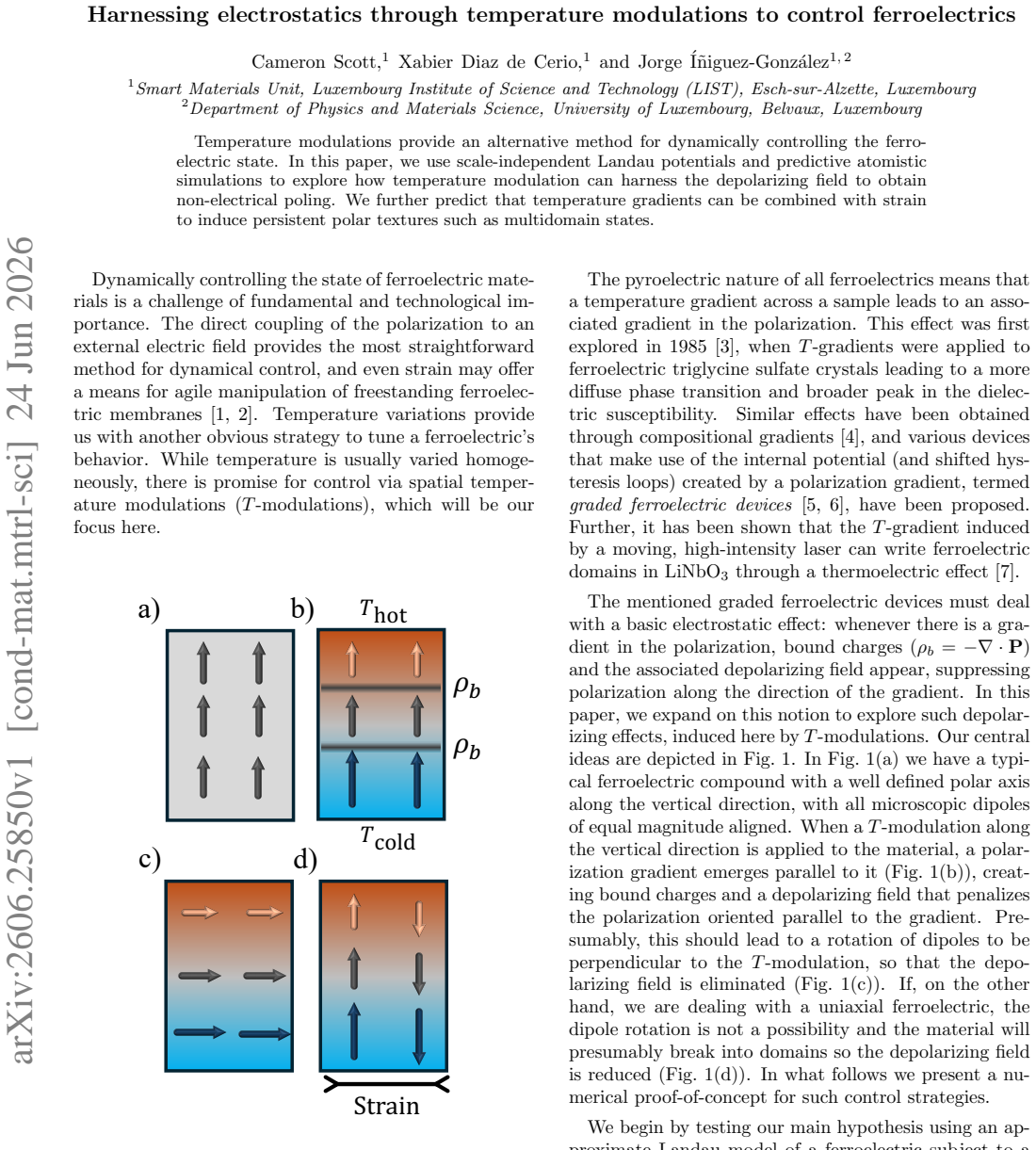
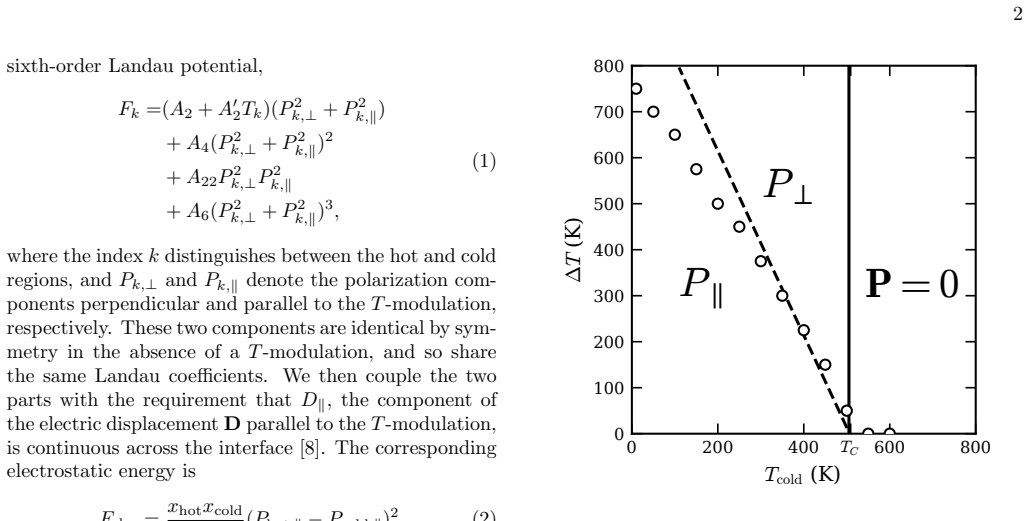
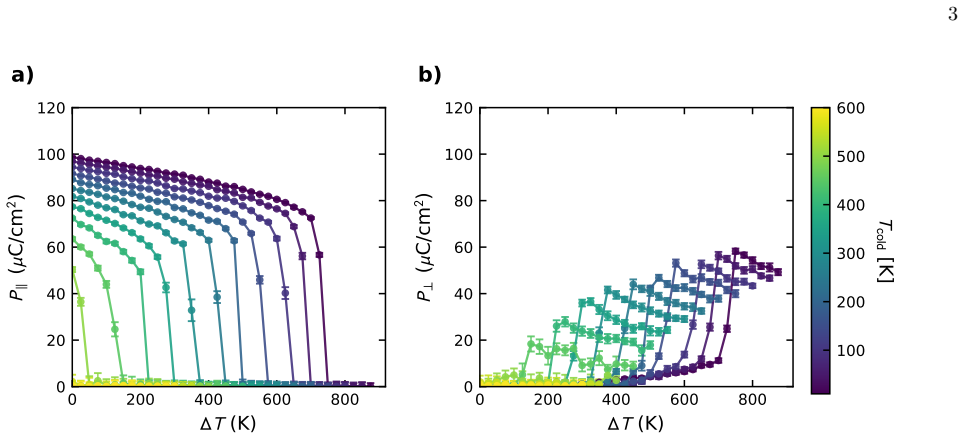
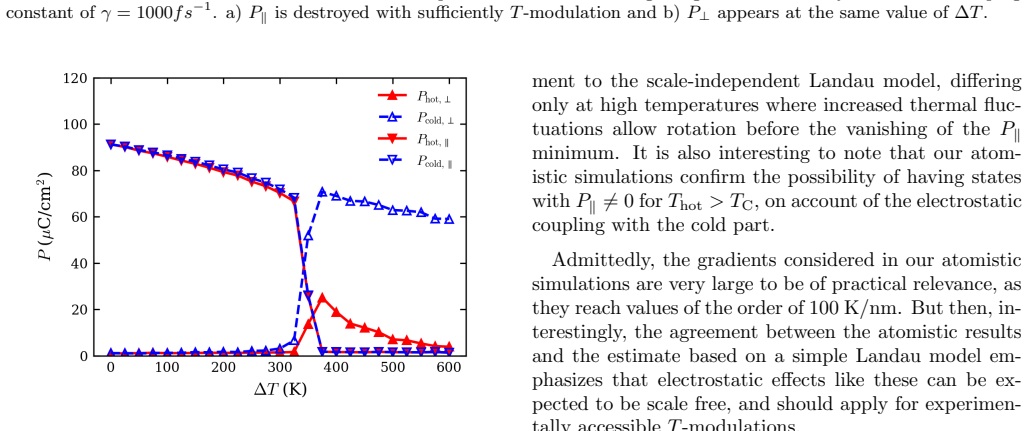
Temperature modulations provide an alternative method for dynamically controlling the ferroelectric state. Temperature modulation can harness the depolarizing field to obtain non-electrical poling. Temperature gradients can be combined with strain to induce persistent polar textures such as multidomain states.
What carries the argument
Temperature modulation that harnesses the depolarizing field through scale-independent Landau potentials and predictive atomistic simulations.
Load-bearing premise
Scale-independent Landau potentials remain accurate under temperature modulations with strong depolarizing fields, and atomistic simulations capture the dynamics without additional adjustments.
What would settle it
Direct experimental observation of non-electrical poling or induced multidomain states in a ferroelectric sample subjected to controlled temperature modulations would confirm the claim; absence of such effects under the simulated conditions would challenge it.
Figures
read the original abstract
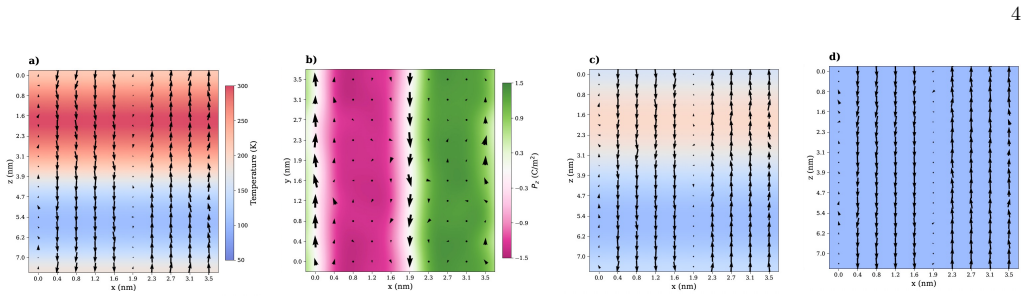
Temperature modulations provide an alternative method for dynamically controlling the ferroelectric state. In this paper, we use scale-independent Landau potentials and predictive atomistic simulations to explore how temperature modulation can harness the depolarizing field to obtain non-electrical poling. We further predict that temperature gradients can be combined with strain to induce persistent polar textures such as multidomain states.
Editorial analysis
A structured set of objections, weighed in public.
Referee Report
Summary. The manuscript claims that temperature modulations can be used to dynamically control ferroelectric states by harnessing the depolarizing field for non-electrical poling, based on scale-independent Landau potentials combined with predictive atomistic simulations. It further predicts that temperature gradients, when combined with strain, can induce persistent polar textures such as multidomain states.
Significance. If the central predictions are substantiated, the work would provide a non-electrical route to poling and domain engineering in ferroelectrics, which could be relevant for low-power device concepts. The explicit combination of continuum Landau modeling with atomistic simulations is a methodological strength that allows direct comparison of effective potentials and dynamics.
major comments (1)
- The central claims rest on the assumption that scale-independent Landau potentials remain accurate and unmodified when temperature is modulated in the presence of strong depolarizing fields. No explicit validation, benchmark against atomistic results, or demonstration that the effective potential is unchanged (or that atomistic simulations reproduce the Landau dynamics without parameter adjustment) is provided for this regime. This assumption is load-bearing for both the non-electrical poling prediction and the multidomain texture claim.
Simulated Author's Rebuttal
We thank the referee for their careful reading and constructive feedback. The single major comment is addressed point-by-point below. We agree that additional explicit validation would strengthen the central claims.
read point-by-point responses
-
Referee: The central claims rest on the assumption that scale-independent Landau potentials remain accurate and unmodified when temperature is modulated in the presence of strong depolarizing fields. No explicit validation, benchmark against atomistic results, or demonstration that the effective potential is unchanged (or that atomistic simulations reproduce the Landau dynamics without parameter adjustment) is provided for this regime. This assumption is load-bearing for both the non-electrical poling prediction and the multidomain texture claim.
Authors: We appreciate the referee highlighting this point. The scale-independent Landau potentials are constructed by design to remain valid across length scales without explicit size dependence, and the atomistic simulations are performed in a predictive mode without parameter fitting to the continuum model. However, we acknowledge that the manuscript does not contain a direct side-by-side benchmark of the effective potential or dynamical trajectories under simultaneous temperature modulation and strong depolarizing fields. To address this, we will add a new supplementary section that compares the polarization evolution obtained from the Landau model and from the atomistic simulations for a representative thin-film geometry under the relevant temperature-modulation protocol. This comparison will be performed without any adjustment of the atomistic parameters. We therefore accept the need for this addition. revision: yes
Circularity Check
No significant circularity detected
full rationale
The abstract and available text describe application of scale-independent Landau potentials and atomistic simulations to temperature-modulated ferroelectric control. No derivation equations, parameter fits, or self-citations are quoted that reduce any claimed prediction to its own inputs by construction. The methods are presented as external tools used for exploration rather than self-defined or fitted to the target outcomes, leaving the chain self-contained against external benchmarks.
Axiom & Free-Parameter Ledger
Reference graph
Works this paper leans on
-
[1]
F. M. Chiabrera, S. Yun, Y. Li, R. T. Dahm, H. Zhang, C. K. Kirchert, D. V. Christensen, F. Trier, T. S. Jes- 5 persen, and N. Pryds, Freestanding perovskite oxide films: Synthesis, challenges, and properties, Annalen der Physik534, 2200084 (2022)
2022
-
[2]
S. S. Hong, M. Gu, M. Verma, V. Harbola, B. Y. Wang, D. Lu, A. Vailionis, Y. Hikita, R. Pentcheva, J. M. Rondinelli,et al., Extreme tensile strain states in la0. 7ca0. 3mno3 membranes, Science368, 71 (2020)
2020
-
[3]
Strukov and A
B. Strukov and A. Davtian, Study of dielectric, elas- tic and pyroelectric properties of tgs crystals placed in nonequilibrium conditions, Ferroelectrics63, 77 (1985)
1985
-
[4]
Choudhury, L
N. Choudhury, L. Walizer, S. Lisenkov, and L. Bellaiche, Geometric frustration in compositionally modulated fer- roelectrics, Nature470, 513 (2011)
2011
-
[5]
J. V. Mantese, N. W. Schubring, A. L. Micheli, and A. B. Catalan, Ferroelectric thin films with polarization gradi- ents normal to the growth surface, Applied physics letters 67, 721 (1995)
1995
-
[6]
J. V. Mantese and S. P. Alpay,Graded ferroelectrics, transpacitors and transponents(Springer, 2005)
2005
-
[7]
X. Xu, T. Wang, P. Chen, C. Zhou, J. Ma, D. Wei, H. Wang, B. Niu, X. Fang, D. Wu,et al., Femtosec- ond laser writing of lithium niobate ferroelectric nan- odomains, Nature609, 496 (2022)
2022
-
[8]
J. D. Jackson,Classical electrodynamics(John Wiley & Sons, 2012)
2012
-
[9]
Pulzone, N
M. Pulzone, N. S. Fedorova, H. Aramberri, and J. ´I˜ niguez-Gonz´ alez, Machine learning landau free-energy potentials for third-principles simulations, Physical Re- view B112, 224113 (2025)
2025
-
[10]
J. C. Wojde l, P. Hermet, M. P. Ljungberg, P. Ghosez, and J. ´I˜ niguez, First-principles model potentials for lattice- dynamical studies: general methodology and example of application to ferroic perovskite oxides, Journal of Physics: Condensed Matter25, 305401 (2013)
2013
-
[11]
Bratkovsky and A
A. Bratkovsky and A. Levanyuk, Formation and rapid evolution of domain structure at phase transitions in slightly inhomogeneous ferroelectrics and ferroelastics, Physical Review B66, 184109 (2002)
2002
-
[12]
D. G. Schlom, L.-Q. Chen, C.-B. Eom, K. M. Rabe, S. K. Streiffer, and J.-M. Triscone, Strain tuning of ferroelec- tric thin films, Annu. Rev. Mater. Res.37, 589 (2007)
2007
-
[13]
Mart´ ınez, S
E. Mart´ ınez, S. Garc´ ıa, E. Marin, O. Vasallo, G. Pena- Rodriguez, A. Calder´ on, and J. Siqueiros, Dielectric and thermal properties of x pbtio3-(1- x) srtio3 polycrystals, Journal of materials Science39, 1233 (2004)
2004
-
[14]
Tsukada, A
S. Tsukada, A. Kanagawa, and K. Ohwada, Temperature-gradient investigation of phase transi- tions in ferroelectrics using cooling and heating stage, Japanese Journal of Applied Physics62, 106501 (2023)
2023
discussion (0)
Sign in with ORCID, Apple, or X to comment. Anyone can read and Pith papers without signing in.