Dispersion Suppression for Wedge-Based Final Cooling at a 10 TeV Muon Collider
Pith reviewed 2026-06-25 19:20 UTC · model grok-4.3
The pith
A dispersion suppressor channel reduces dispersion to ~0.001 m for wedge-based final cooling at a 10 TeV muon collider.
A machine-rendered reading of the paper's core claim, the machinery that carries it, and where it could break.
Core claim
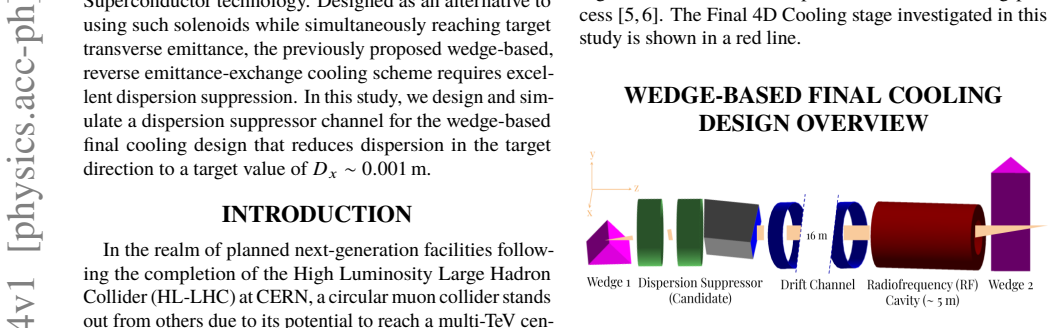
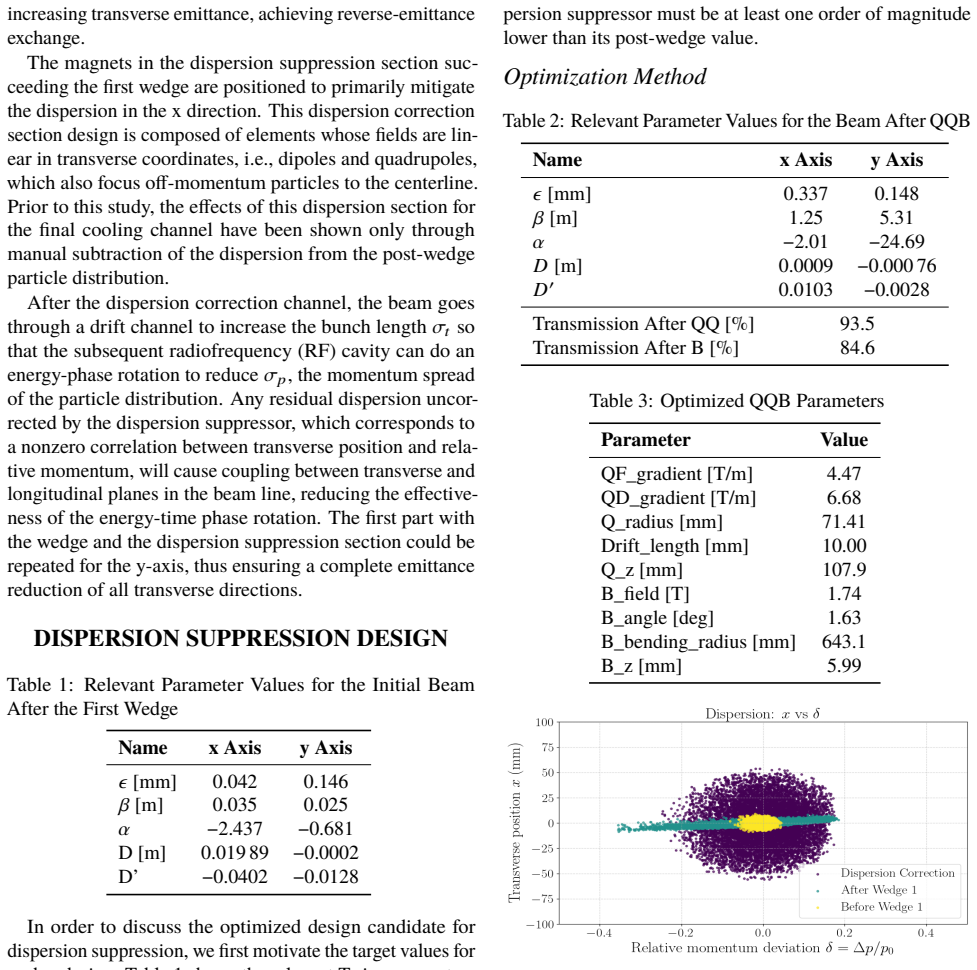
The authors design and simulate a dispersion suppressor channel for the wedge-based final cooling design that reduces dispersion in the target direction to a target value of D_x ~ 0.001 m. This supports the overall ionization cooling process needed for a 10 TeV muon collider to reach the required transverse emittance without relying on extremely high-field solenoids.
What carries the argument
The dispersion suppressor channel, a sequence of beamline elements that cancels dispersion in the horizontal plane down to the required level.
If this is right
- The wedge-based reverse emittance-exchange scheme can advance without 40 T solenoids.
- Dispersion is controlled to the level needed for the final cooling stage to meet its emittance goal.
- The design provides a concrete beamline solution that fits within the overall muon collider cooling chain.
Where Pith is reading between the lines
- Additional optics matching may still be needed between this suppressor and adjacent sections of the cooling channel.
- The same suppressor approach could be adapted for other ionization cooling layouts that require low dispersion.
- Full end-to-end tracking simulations that include this channel would reveal any unforeseen acceptance losses.
Load-bearing premise
Suppressing dispersion to 0.001 m is the dominant remaining requirement that allows the wedge-based scheme to reach the 22 μm transverse emittance target.
What would settle it
A simulation or measurement in which the residual dispersion after the channel is substantially larger than 0.001 m would show that the design does not achieve its stated performance.
Figures
read the original abstract
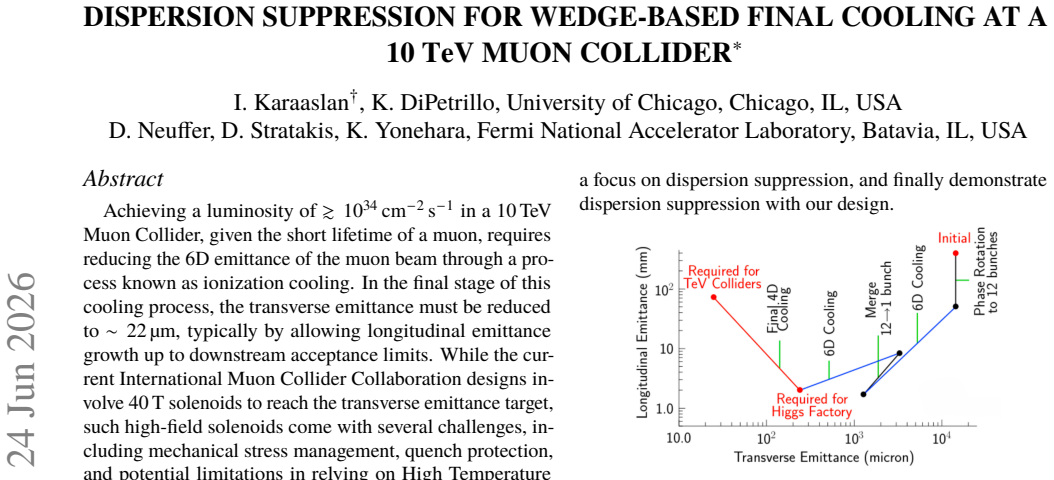
Achieving a luminosity of $\gtrsim 10^{34} cm^{-2} s^{-1}$ in a $10 \text{ } TeV$ Muon Collider, given the short lifetime of a muon, requires reducing the 6D emittance of the muon beam through a process known as ionization cooling. In the final stage of this cooling process, the transverse emittance must be reduced to $22 \text{ } \mu m$, typically by allowing longitudinal emittance growth up to downstream acceptance limits. While the current International Muon Collider Collaboration designs involve $40 \text{ } T$ solenoids to reach the transverse emittance target, such high-field solenoids come with several challenges, including mechanical stress management, quench protection, and potential limitations in relying on High Temperature Superconductor technology. Designed as an alternative to using such solenoids while simultaneously reaching target transverse emittance, the previously proposed wedge-based, reverse emittance-exchange cooling scheme requires excellent dispersion suppression. In this study, we design and simulate a dispersion suppressor channel for the wedge-based final cooling design that reduces dispersion in the target direction to a target value of $D_x \sim 0.001 \text{ } m$.
Editorial analysis
A structured set of objections, weighed in public.
Referee Report
Summary. The manuscript presents the design and simulation of a dispersion suppressor channel intended for the wedge-based reverse emittance-exchange final cooling scheme at a 10 TeV muon collider. The central result is a channel that reduces dispersion in the target direction to D_x ~ 0.001 m, offered as an alternative to 40 T solenoids for reaching the 22 μm transverse emittance target while avoiding associated magnet technology challenges.
Significance. If the reported simulation performance holds under realistic beam conditions, the work supplies a concrete engineering path that could relax the solenoid field requirement in the final cooling stage. This directly addresses mechanical stress, quench protection, and HTS technology risks highlighted in the International Muon Collider Collaboration baseline, thereby contributing a potentially enabling component for the overall luminosity goal of ≳10^34 cm^{-2} s^{-1}.
major comments (1)
- [Simulation results section (inferred from abstract claim)] The manuscript demonstrates dispersion reduction to the stated target in the suppressor channel alone. However, no integrated simulation of the full wedge-based cooling channel (including the suppressor, wedge, and downstream matching) is presented that reaches the 22 μm transverse emittance. This leaves the claim that dispersion suppression is the dominant remaining requirement untested within the manuscript scope.
minor comments (2)
- [Abstract] Notation for dispersion (D_x) and emittance units should be consistently defined on first use; the abstract mixes μm and m without explicit conversion or reference to the 6D emittance definition used elsewhere.
- [Figures] Figure captions for the suppressor lattice and dispersion plots should include the simulation code or tracking tool employed and the number of particles tracked to allow reproducibility assessment.
Simulated Author's Rebuttal
We thank the referee for the positive assessment of the work's significance and for the constructive comment. We respond point-by-point below.
read point-by-point responses
-
Referee: The manuscript demonstrates dispersion reduction to the stated target in the suppressor channel alone. However, no integrated simulation of the full wedge-based cooling channel (including the suppressor, wedge, and downstream matching) is presented that reaches the 22 μm transverse emittance. This leaves the claim that dispersion suppression is the dominant remaining requirement untested within the manuscript scope.
Authors: We agree that the manuscript shows dispersion reduction only within the suppressor channel and does not contain an integrated simulation of the full wedge-based cooling channel (suppressor + wedge + matching) that reaches the 22 μm emittance. The scope of this paper is limited to designing and simulating the suppressor to meet the D_x target previously identified as necessary for the wedge scheme. The manuscript does not claim to have performed or validated the integrated emittance reduction. We will revise the introduction and conclusions to state the paper's scope more explicitly and to note that integrated simulations remain future work. revision: partial
Circularity Check
No circularity: design/simulation result independent of inputs
full rationale
The paper describes the design and simulation of a dispersion suppressor channel that achieves the target D_x ~ 0.001 m for the wedge-based final cooling scheme. No equations, parameter fits, self-citations, or ansatzes are presented that would reduce the reported dispersion suppression result to the inputs by construction. The central claim is an engineering simulation outcome, self-contained against external benchmarks such as the stated target value, with no load-bearing self-referential steps.
Axiom & Free-Parameter Ledger
axioms (1)
- domain assumption Standard models of beam dynamics and ionization cooling apply to the wedge absorber and magnetic channel
Reference graph
Works this paper leans on
-
[1]
D.Schulte,“TheMuonCollider”,inProc. IPAC’22,Bangkok, Thailand, pp. 821–826, Jul. 2022. doi:10.18429/JACoW-IPAC2022-TUIZSP2
-
[2]
TheInternationalMuonColliderCollaboration
D.Schulte,“TheInternationalMuonColliderCollaboration”, inProc. IPAC’21, Campinas, Brazil, May 2021, pp. 3792– 3795, 2021. doi:10.18429/JACoW-IPAC2021-THPAB017
-
[3]
S. Fabbriet al., “Magnets for a muon collider”, inProc. IPAC’23, Venice, Italy, pp. 3712–3715, Sep. 2023. doi:10.18429/JACoW-IPAC2023-WEPM062
-
[4]
Snowmass ac- celerator conveners (af1-af7, itf, ee/mmfora) meeting #17
SI. Bermudez, G. Sabbi, and A. Zlobin, “Snowmass ac- celerator conveners (af1-af7, itf, ee/mmfora) meeting #17”, https://indico.fnal.gov/event/54953/sessions/ 20614/ attachments/156153 /205927/ 2022- 07- 18 _ Snowmass_Summary_AF7Magnets_draft.pdf (visited on 03/11/2026),
2022
-
[5]
A Helical Cooling Channel System for Muon Colliders
K. Yonehara, Y. S. Derbenev, R. P. Johnson, and M. L. Neubauer, “A Helical Cooling Channel System for Muon Colliders”, inProc. IPAC’10, Kyoto, Japan, May 2010, paper MOPD076, pp. 870–872, 2010.http://accelconf.web. cern.ch/IPAC10/papers/MOPD076.pdf
2010
-
[6]
Collectiveeffectsinmuonionizationcooling
K.Yonehara,“Collectiveeffectsinmuonionizationcooling”, presented at the COOL’25 Workshop on Beam Cooling and Related Topics, 2025,doi:10.2172/3018551,
-
[7]
Final Cooling For a High-luminosity High-energy Lepton Collider
D. V. Neuffer, T. L. Hart, D. J. Summers, and H. K. Sayed, “Final Cooling For a High-luminosity High-energy Lepton Collider”,inProc. IPAC’15,Richmond,VA,USA,May2015, pp. 1384–1386, 2015. doi:10.18429/JACoW-IPAC2015-TUBD2
-
[8]
Finalcoolingwiththickwedges for a muon collider
D.NeufferandD.Stratakis,“Finalcoolingwiththickwedges for a muon collider”, inProc. IPAC’24, Nashville, TN, USA, pp. 1684–1686, Jul. 2024. doi:10.18429/JACoW-IPAC2024-TUPS20
-
[9]
D. Stratakis and R. B. Palmer, “Rectilinear six-dimensional ionization cooling channel for a muon collider: a theoretical and numerical study”,Phys. Rev. ST Accel. Beams, vol. 18, no. 3, p. 031003, Mar. 2015. doi:10.1103/PhysRevSTAB.18.031003
-
[10]
More muon cooling, higher luminosity
D. Summers, “More muon cooling, higher luminosity”, Pre- sentation at the Muon Capture and Cooling Working Group, CERN, 12 Nov 2020, Nov. 2020,https : / / indico . cern . ch / event / 961803 / contributions / 4064621 / attachments/2141709/3608895/DS_mu_12Nov.pdf,
arXiv 2020
-
[11]
D. A. Edwards and M. J. Syphers,An Introduction to the Physics of High-Energy Accelerators. New York: Wiley, 1992
1992
-
[12]
Preliminary Design of a Dedicated Synchrotron Radiation Facility
R. Chasman, G. K. Green, and E. M. Rowe, “Preliminary Design of a Dedicated Synchrotron Radiation Facility”, in Proc. PAC’75, Washington D.C., USA, Mar. 1975, pp. 1765– 1768, 1975
1975
-
[13]
DifferentialEvolution–ASimpleand Efficient Heuristic for global Optimization over Continuous Spaces
R.StornandK.Price,“DifferentialEvolution–ASimpleand Efficient Heuristic for global Optimization over Continuous Spaces”,J. Global Optim., vol. 11, no. 4, pp. 341–359, 1997. doi:10.1023/A:1008202821328
-
[14]
doi:https://doi.org/10.1038/s41592-019-0686-2 , adsurl =
P. Virtanenet al., “SciPy 1.0: Fundamental Algorithms for Scientific Computing in Python”,Nature Methods, vol. 17, pp. 261–272, 2020.doi:10.1038/s41592-019-0686-2
-
[15]
A simplex method for function minimization
J. A. Nelder and R. Mead, “A simplex method for function minimization”,Comput. J., vol. 7, no. 4, pp. 308–313, 1965. doi:https://doi.org/10.1093/comjnl/8.1.27
discussion (0)
Sign in with ORCID, Apple, or X to comment. Anyone can read and Pith papers without signing in.