High-Performance Nanophononic Resonators in Self-Suspended WSe₂ Domes and Drums
Pith reviewed 2026-06-25 20:00 UTC · model grok-4.3
The pith
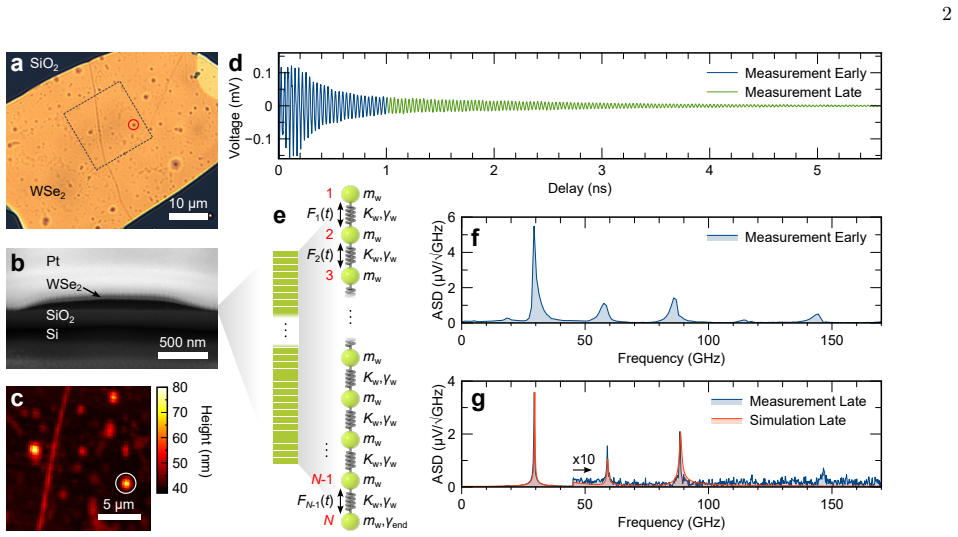
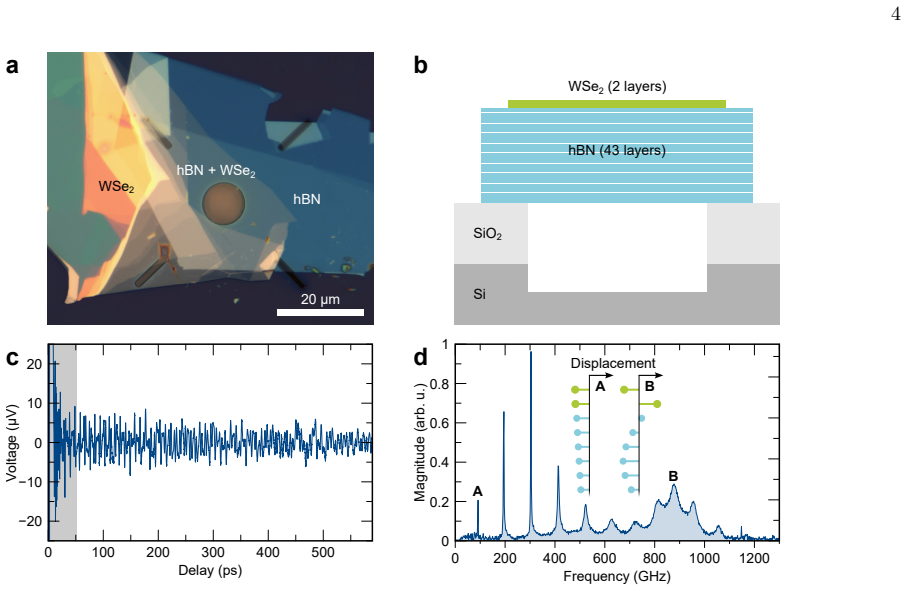
Self-suspended WSe2 nano-domes generate hundreds of 100 GHz resonators while nano-drums exceed 1 THz.
A machine-rendered reading of the paper's core claim, the machinery that carries it, and where it could break.
Core claim
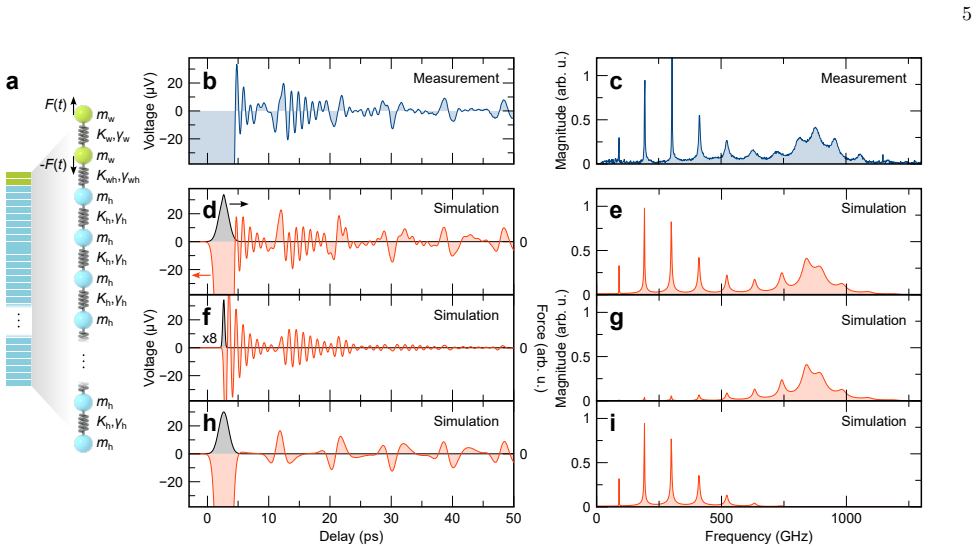
Self-supporting nano-domes of WSe2 act as a scalable platform that simultaneously produces hundreds of high-quality nanoacoustic resonators with frequencies in the 100 GHz range, while self-supporting nano-drums reach record working frequencies beyond 1 THz for 2D-semiconductor transducers; both are characterized by optical pump-probe spectroscopy and photoelastic linear chain model calculations that clarify phononic mode hybridization across heterostructures, center-versus-edge Brillouin-zone behavior, and the temporal structure of the photoelastic response.
What carries the argument
Self-suspended WSe2 nano-domes and nano-drums, whose phononic modes are interpreted through a photoelastic linear chain model.
If this is right
- Nano-domes enable simultaneous fabrication of hundreds of 100 GHz resonators from a single van der Waals flake.
- Nano-drums deliver working frequencies above 1 THz in 2D-semiconductor transducers.
- Both architectures support low-cost nanoacoustic probing applications.
- Both architectures allow ultrafast modulation of quantum emitters in two-dimensional semiconductors.
- The model distinguishes hybridized modes near the Brillouin-zone center from those near the edge and accounts for the observed temporal photoelastic response.
Where Pith is reading between the lines
- The dome geometry may allow dense arrays without individual lithographic patterning of each resonator.
- The same self-suspension approach could be applied to other transition-metal dichalcogenides to access additional frequency bands.
- Understanding of the photoelastic timing structure may guide design of time-resolved acoustic modulators.
Load-bearing premise
The fabricated WSe2 domes and drums remain truly self-suspended with no residual substrate coupling or fabrication artifacts that shift the measured resonances.
What would settle it
Resonance frequencies that deviate from the photoelastic linear chain model predictions only when substrate coupling terms are added would falsify the self-suspension premise.
Figures
read the original abstract
Van der Waals materials are ideally suited for the implementation of high-frequency nanophononic resonators with atomically flat interfaces. Here, we present two versatile van der Waals-based nanophononic architectures: First, we introduce self-supporting nano-domes of WSe$_2$ as a scalable platform for the simultaneous generation of hundreds of high-quality nanoacoustic resonators with resonance frequencies in the 100 GHz range. Second, we engineer self-supporting nano-drums that reach record-high working frequencies for 2D-semiconductor transducers beyond 1 THz. Through optical pump-probe spectroscopy experiments and photoelastic linear chain model calculations, we gain a detailed understanding of the intricate interplay between phononic mode hybridization across heterostructures, the differences between modes close to the center and edge of the acoustic Brillouin zone, and the temporal structure of the photoelastic response. Both architectures have potential applications in low-cost nanoacoustic probing and the ultrafast modulation of quantum emitters in two-dimensional semiconductors. While nano-drums surpass the THz frequency barrier, nano-domes appear as an accessible, low-cost alternative for developing scalable nanophononic technologies.
Editorial analysis
A structured set of objections, weighed in public.
Referee Report
Summary. The manuscript presents two van der Waals nanophononic architectures in WSe2: self-supporting nano-domes enabling simultaneous fabrication of hundreds of high-quality resonators in the 100 GHz range, and self-supporting nano-drums achieving record frequencies beyond 1 THz. Optical pump-probe spectroscopy combined with a photoelastic linear-chain model is used to analyze mode hybridization, center vs. edge Brillouin-zone modes, and the temporal photoelastic response, with suggested applications in nanoacoustic probing and ultrafast modulation of 2D quantum emitters.
Significance. If the self-suspended character is independently verified and the extracted frequencies hold, the work would constitute a notable advance in high-frequency nanophononics by demonstrating scalable, atomically flat 2D-semiconductor resonators that surpass the THz barrier in drums while offering a low-cost dome platform. The combination of experiment and modeling for mode hybridization provides a useful framework for future transducer design.
major comments (1)
- The central frequency claims (100 GHz domes, >1 THz drums) rest on the assumption of truly self-suspended boundary conditions in the photoelastic linear-chain model. No quantitative metric (gap height, adhesion energy, or suspended-vs-supported spectral comparison) is supplied to exclude residual substrate coupling, which would shift resonances and invalidate both the reported values and the 'record' performance assertion.
Simulated Author's Rebuttal
We thank the referee for their positive assessment of the significance of our work and for the constructive major comment. We address the point below.
read point-by-point responses
-
Referee: The central frequency claims (100 GHz domes, >1 THz drums) rest on the assumption of truly self-suspended boundary conditions in the photoelastic linear-chain model. No quantitative metric (gap height, adhesion energy, or suspended-vs-supported spectral comparison) is supplied to exclude residual substrate coupling, which would shift resonances and invalidate both the reported values and the 'record' performance assertion.
Authors: We acknowledge that the manuscript does not include direct quantitative metrics such as measured gap heights or adhesion energies. The self-suspended boundary conditions follow directly from the fabrication protocol (detailed in the Methods section), in which the WSe2 layers are released from the substrate to form domes and drums. The photoelastic linear-chain model is solved with free-surface boundary conditions at both interfaces, and the calculated mode frequencies and hybridization patterns match the experimental pump-probe spectra to high accuracy. Significant residual substrate coupling would increase the effective restoring force and produce systematically higher frequencies than those predicted by the free-boundary model; the observed agreement therefore constitutes indirect but quantitative support for the suspended assumption. We maintain that the reported frequencies and the claim of record performance are therefore justified by the data-model consistency. No revision is required on this point. revision: no
Circularity Check
No circularity in derivation chain; claims rest on experiment and modeling
full rationale
The paper reports experimental resonances from optical pump-probe spectroscopy on fabricated WSe2 structures, interpreted with a photoelastic linear-chain model. No equations, derivations, or parameter-fitting steps are described in the provided abstract or reader summary. Central claims (record frequencies >1 THz, 100 GHz domes) are presented as measured outcomes under assumed free-standing boundary conditions rather than as outputs that reduce by construction to fitted inputs or self-citations. No load-bearing self-citation chains, ansatz smuggling, or renaming of known results are evident. The modeling serves interpretation, not a closed predictive loop equivalent to the data.
Axiom & Free-Parameter Ledger
Reference graph
Works this paper leans on
-
[1]
Morell, A
N. Morell, A. Reserbat-Plantey, I. Tsioutsios, K. G. Schädler, F. Dubin, F. H. L. Koppens, and A. Bach- told, High quality factor mechanical resonators based on WSe2 monolayers, Nano Letters16, 5102 (2016)
2016
-
[2]
H. Xie, S. Jiang, D. A. Rhodes, J. C. Hone, J. Shan, and K. F. Mak, Tunable exciton-optomechanical coupling in suspended monolayer MoSe2, Nano Letters21, 2538 (2021)
2021
-
[3]
Sánchez Arribas, T
I. Sánchez Arribas, T. Taniguchi, K. Watanabe, and E. M. Weig, Radiation pressure backaction on a hexagonal boron nitride nanomechanical resonator, Nano Letters23, 6301 (2023). 7
2023
-
[4]
H.-K. Li, K. Y. Fong, H. Zhu, Q. Li, S. Wang, S. Yang, Y. Wang, and X. Zhang, Valley optomechanics in a mono- layer semiconductor, Nature Photonics13, 397 (2019)
2019
-
[5]
Morell, S
N. Morell, S. Tepsic, A. Reserbat-Plantey, A. Cepellotti, M.Manca, I.Epstein, A.Isacsson, X.Marie, F.Mauri,and A. Bachtold, Optomechanical measurement of thermal transport in two-dimensional MoSe2 lattices, Nano Letters 19, 3143 (2019)
2019
-
[6]
E. D. S. Nysten, M. Weiß, B. Mayer, T. M. Petzak, U. Wurstbauer, and H. J. Krenner, Scanning acousto- optoelectric spectroscopy on a transition metal dichalco- genide monolayer, Advanced Materials36, 2402799 (2024)
2024
-
[7]
R. Peng, A. Ripin, Y. Ye, J. Zhu, C. Wu, S. Lee, H. Li, T. Taniguchi, K. Watanabe, T. Cao, X. Xu, and M. Li, Long-range transport of 2D excitons with acoustic waves, Nature Communications13, 1334 (2022)
2022
-
[8]
D. D. Bühler, M. Weiß, A. Crespo-Poveda, E. D. S. Nys- ten, J. J. Finley, K. Müller, P. V. Santos, M. M. De Lima, and H. J. Krenner, On-chip generation and dynamic piezo- optomechanical rotation of single photons, Nature Com- munications13, 6998 (2022)
2022
-
[9]
Choquer, M
M. Choquer, M. Weis, E. D. S. Nysten, M. Lien- hart, P. Machnikowski, D. Wigger, H. J. Krenner, and G. Moody, Quantum control of optically active artificial atoms with surface acoustic waves, IEEE Transactions on Quantum Engineering3, 1 (2022)
2022
-
[10]
M. Weiß, D. Wigger, M. Nägele, K. Müller, J. J. Finley, T. Kuhn, P. Machnikowski, and H. J. Krenner, Optome- chanical wave mixing by a single quantum dot, Optica8, 291 (2021)
2021
-
[11]
T. Y. Jeong, B. M. Jin, S. H. Rhim, L. Debbichi, J. Park, Y. D. Jang, H. R. Lee, D.-H. Chae, D. Lee, Y.-H. Kim, S. Jung, and K. J. Yee, Coherent lattice vibrations in mono- and few-layer WSe2, ACS Nano10, 5560 (2016)
2016
-
[12]
J. D. G. Greener, A. V. Akimov, V. E. Gusev, Z. R. Kudrynskyi, P. H. Beton, Z. D. Kovalyuk, T. Taniguchi, K. Watanabe, A. J. Kent, and A. Patanè, Coherent acous- tic phonons in van der Waals nanolayers and heterostruc- tures, Physical Review B98, 075408 (2018)
2018
-
[13]
Soubelet, A
P. Soubelet, A. A. Reynoso, A. Fainstein, K. Nogajewski, M. Potemski, C. Faugeras, and A. E. Bruchhausen, The lifetime of interlayer breathing modes of few-layer 2H- MoSe2 membranes, Nanoscale11, 10446 (2019)
2019
-
[14]
S. Wu, Z. Lu, A. Hu, X. Miao, F. Wang, Z. Sun, H. Yan, H. Zhang, and M. Ji, Dichroic photoelasticity in black phosphorus revealed by ultrafast coherent phonon dynam- ics, The Journal of Physical Chemistry Letters12, 5871 (2021)
2021
-
[15]
M. K. Zalalutdinov, J. T. Robinson, J. J. Fonseca, S. W. LaGasse, T. Pandey, L. R. Lindsay, T. L. Reinecke, D. M. Photiadis, J. C. Culbertson, C. D. Cress, and B. H. Hous- ton, Acoustic cavities in 2D heterostructures, Nature Com- munications12, 3267 (2021)
2021
-
[17]
A. D. Carr, C. Ruppert, A. K. Samusev, G. Magnabosco, N. Vogel, T. L. Linnik, A. W. Rushforth, M. Bayer, A. V. Scherbakov, and A. V. Akimov, Enhanced photon–phonon interaction in WSe2 acoustic nanocavities, ACS Photonics 11, 1147 (2024)
2024
-
[18]
Aversa, N
M. Aversa, N. A. Roqueiro, C. Borrazás, J. I. Sangior- gio, H. D. Boggiano, J. Bonaparte, A. Di Donato, M. C. Fuertes, A. V. Bragas, and G. Grinblat, Coherent acoustic phonons in supported and suspended MoS2 nanocavities, ACS Photonics13, 320 (2026)
2026
-
[19]
Cianci, E
S. Cianci, E. Blundo, F. Tuzi, G. Pettinari, K. Olkowska- Pucko, E. Parmenopoulou, D. B. L. Peeters, A. Miri- ametro, T. Taniguchi, K. Watanabe, A. Babinski, M. R. Molas, M. Felici, and A. Polimeni, Spatially controlled single photon emitters in hBN-capped WS2 domes, Ad- vanced Optical Materials11, 2202953 (2023)
2023
-
[20]
Cianci, E
S. Cianci, E. Blundo, M. Felici, A. Polimeni, and G. Pet- tinari, Tailoring the optical properties of 2D transition metal dichalcogenides by strain, Optical Materials125, 112087 (2022)
2022
-
[21]
Esmann, S
M. Esmann, S. C. Wein, and C. Antón-Solanas, Solid- state single-photon sources: recent advances for novel quantum materials, Advanced Functional Materials34, 2315936 (2024)
2024
-
[22]
Shabani, T
S. Shabani, T. P. Darlington, C. Gordon, W. Wu, E. Yanev, J. Hone, X. Zhu, C. E. Dreyer, P. J. Schuck, and A. N. Pasupathy, Ultralocalized optoelectronic properties of nanobubbles in 2D semiconductors, Nano Letters22, 7401 (2022)
2022
- [23]
-
[24]
Castellanos-Gomez, M
A. Castellanos-Gomez, M. Buscema, R. Molenaar, V. Singh, L. Janssen, H. S. J. van der Zant, and G. A. Steele, Deterministic transfer of two-dimensional mate- rials by all-dry viscoelastic stamping, 2D Materials1, 011002 (2014)
2014
-
[25]
Khestanova, F
E. Khestanova, F. Guinea, L. Fumagalli, A. K. Geim, and I. V. Grigorieva, Universal shape and pressure inside bubbles appearing in van der Waals heterostructures, Nature Communications7, 12587 (2016)
2016
-
[26]
D. A. Sanchez, Z. Dai, and N. Lu, 2D material bubbles: fabrication, characterization, and applications, Trends in Chemistry3, 204 (2021)
2021
-
[27]
K. Du, B. Qiao, X. Ding, C. Huang, and H. Hu, Bubbles in 2D materials: formation mechanisms, impacts, and removal strategies for next-generation electronic devices, Nanomaterials15, 1888 (2025)
2025
-
[28]
Ruello and V
P. Ruello and V. E. Gusev, Physical mechanisms of coher- ent acoustic phonons generation by ultrafast laser action, Ultrasonics56, 21 (2015)
2015
-
[29]
Vialla and N
F. Vialla and N. D. Fatti, Time-domain investigations of coherent phonons in van der Waals thin films, Nanomate- rials10, 2543 (2020)
2020
-
[30]
Thomsen, H
C. Thomsen, H. T. Grahn, H. J. Maris, and J. Tauc, Surfacegenerationanddetectionofphononsbypicosecond light pulses, Physical Review B34, 4129 (1986)
1986
-
[32]
Serrano, A
J. Serrano, A. Bosak, R. Arenal, M. Krisch, K. Watan- abe, T. Taniguchi, H. Kanda, A. Rubio, and L. Wirtz, Vibrational properties of hexagonal boron nitride: inelas- tic X-ray scattering andab initiocalculations, Physical Review Letters98, 095503 (2007)
2007
-
[33]
Aspelmeyer, T
M. Aspelmeyer, T. J. Kippenberg, and F. Marquardt, Cavity optomechanics, Reviews of Modern Physics86, 8 1391 (2014)
2014
-
[34]
B. Xu, P. Zhang, J. Zhu, Z. Liu, A. Eichler, X.-Q. Zheng, J. Lee, A. Dash, S. More, S. Wu, Y. Wang, H. Jia, A. Naik, A. Bachtold, R. Yang, P. X.-L. Feng, and Z. Wang, Nanomechanical resonators: toward atomic scale, ACS Nano16, 15545 (2022)
2022
-
[35]
Kanjanaboos, X.-M
P. Kanjanaboos, X.-M. Lin, J. E. Sader, S. M. Rupich, H.M.Jaeger,andJ.R.Guest,Self-assemblednanoparticle drumhead resonators, Nano Letters13, 2158 (2013)
2013
-
[36]
N. L. Abdala, M. Esmann, M. C. Fuertes, P. C. Angelomé, O. Ortiz, A. Bruchhausen, H. Pastoriza, B. Perrin, G. J. A. A. Soler-Illia, and N. D. Lanzillotti-Kimura, Meso- porous thin films for acoustic devices in the gigahertz range, The Journal of Physical Chemistry C124, 17165 (2020)
2020
-
[37]
Stassi, I
S. Stassi, I. Cooperstein, M. Tortello, C. F. Pirri, S. Mag- dassi, and C. Ricciardi, Reaching silicon-based NEMS performances with 3D printed nanomechanical resonators, Nature Communications12, 6080 (2021)
2021
-
[38]
long delays
T. Meier, V. Korakis, B. W. Blankenship, H. Lu, E. Kyri- akou, S. Papamakarios, Z. Vangelatos, M. E. Yildizdag, G. Zyla, X. Xia, X. Zheng, Y. Rho, M. Farsari, and C. P. Grigoropoulos, Scalable phononic metamaterials: Tunable bandgap design and multi-scale experimental validation, Materials & Design252, 113778 (2025). Supporting Information High-Performanc...
2025
-
[39]
C.Thomsen, H.T.Grahn, H.J.Maris,andJ.Tauc,Surface generation and detection of phonons by picosecond light pulses, Physical Review B34, 4129 (1986)
1986
-
[40]
N. D. Lanzillotti-Kimura, A. Fainstein, A. Huynh, B. Per- rin, B. Jusserand, A. Miard, and A. Lemaître, Coherent generation of acoustic phonons in an optical microcavity, Physical Review Letters99, 217405 (2007)
2007
-
[41]
N. D. Lanzillotti-Kimura, A. Fainstein, B. Perrin, and B. Jusserand, Theory of coherent generation and detec- tion of THz acoustic phonons using optical microcavities, Physical Review B84, 064307 (2011)
2011
-
[42]
Vialla and N
F. Vialla and N. D. Fatti, Time-domain investigations of co- herent phonons in van der Waals thin films, Nanomaterials 10, 2543 (2020)
2020
-
[43]
Y. Yoon, Z. Lu, C. Uzundal, R. Qi, W. Zhao, S. Chen, Q. Feng, W. Kim, M. H. Naik, K. Watanabe, T. Taniguchi, S. G. Louie, M. F. Crommie, and F. Wang, Terahertz phonon engineering with van der Waals heterostructures, Nature631, 771 (2024)
2024
discussion (0)
Sign in with ORCID, Apple, or X to comment. Anyone can read and Pith papers without signing in.