Estimating Fidelity to a Reference Quantum State
Pith reviewed 2026-06-25 19:11 UTC · model grok-4.3
The pith
Estimating fidelity to a known rank-r quantum state requires O(r²/ε²) samples to additive error ε.
A machine-rendered reading of the paper's core claim, the machinery that carries it, and where it could break.
Core claim
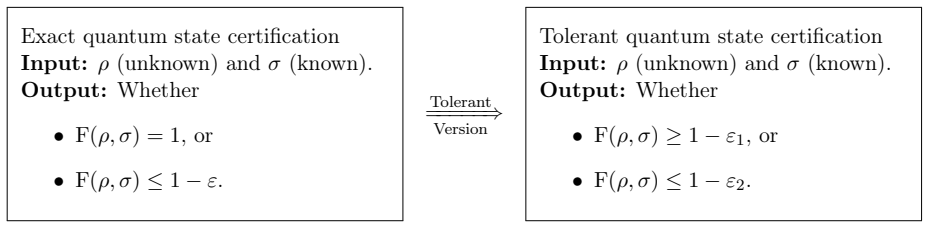
We consider the problem of estimating the fidelity of an unknown quantum state to a known reference state to within additive error ε. We show that the sample complexity is O(r²/ε²) with optimal ε-dependence when the reference state is of rank r, improving the previous best O(r² log²(1/ε)/ε⁴). We also provide a lower bound of Ω(r/ε²), improving the previous best Ω(r/ε + 1/ε²), with implications to quantum query complexity. Moreover, we further consider the case where the unknown state is of rank at most r while the reference state can be arbitrary, for which the sample complexity is shown to be O(r²/ε⁴). As an application, we present an approach to tolerant quantum state certification.
What carries the argument
Upper and lower bounds on sample complexity for fidelity estimation in the i.i.d. copy model when the reference state has known rank r.
If this is right
- The ε-dependence is optimal, removing the log²(1/ε) and 1/ε⁴ factors from prior upper bounds.
- The improved lower bound Ω(r/ε²) has direct consequences for quantum query complexity.
- When the unknown state also has rank at most r the complexity becomes O(r²/ε⁴).
- The method yields a protocol for tolerant quantum state certification that generalizes exact certification.
Where Pith is reading between the lines
- The bound may translate to more efficient protocols for other low-rank quantum estimation tasks.
- The lower bound could serve as a template for hardness results in related distance measures such as trace distance.
- Small-scale experiments on low-rank states could directly test whether the O(r²/ε²) scaling is observed in practice.
Load-bearing premise
The unknown quantum state is provided through independent identical copies and the reference state is known exactly with known rank r.
What would settle it
An explicit algorithm achieving fidelity estimation to additive ε with o(r²/ε²) samples for arbitrary rank-r reference states, or a matching lower bound showing Ω(r²/ε²) samples are required for some states.
Figures
read the original abstract
We consider the problem of estimating the fidelity of an unknown quantum state to a known reference state to within additive error $\varepsilon$. We show that the sample complexity is $O(r^2/\varepsilon^2)$ with optimal $\varepsilon$-dependence when the reference state is of rank $r$, improving the previous best $O(r^2\log^2(1/\varepsilon)/\varepsilon^4)$ due to Utsumi, Nakata, Wang, and Takagi (QIP 2026). We also provide a lower bound of $\Omega(r/\varepsilon^2)$, improving the previous best $\Omega(r/\varepsilon+1/\varepsilon^2)$, with implications to quantum query complexity. Moreover, we further consider the case where the unknown state is of rank at most $r$ while the reference state can be arbitrary, for which the sample complexity is shown to be $O(r^2/\varepsilon^4)$. As an application, we present an approach to tolerant quantum state certification, generalizing the exact certification studied in B\u{a}descu, O'Donnell, and Wright (STOC 2019).
Editorial analysis
A structured set of objections, weighed in public.
Referee Report
Summary. The paper studies sample complexity for estimating fidelity F(ρ, σ) to additive error ε, where σ is a known reference state of rank r and ρ is accessed via iid copies. It claims an upper bound of O(r²/ε²) (optimal in ε) that improves on the prior O(r² log²(1/ε)/ε⁴), a matching lower bound Ω(r/ε²) that improves on Ω(r/ε + 1/ε²), an O(r²/ε⁴) bound when ρ itself has rank ≤ r, and an application to tolerant quantum state certification that generalizes exact certification results.
Significance. If the stated bounds hold, the work tightens the dependence on ε for a core primitive in quantum information processing and supplies a lower bound with direct implications for quantum query complexity. The extension to tolerant certification is a natural and useful application of the fidelity estimator.
minor comments (3)
- Abstract: the claimed upper bound is stated as O(r²/ε²) but the manuscript should explicitly note whether the hidden constant depends on the dimension or other parameters of the reference state.
- The lower-bound construction (presumably in the section deriving Ω(r/ε²)) should include a short remark on whether the Ω(r) factor is expected to be improvable or is an artifact of the reduction technique.
- Notation: ensure that the rank-r assumption on the reference state is restated at the beginning of each technical section so that the two regimes (known-rank reference vs. bounded-rank unknown state) are not conflated.
Simulated Author's Rebuttal
We thank the referee for their positive review, recognition of the significance of the improved sample-complexity bounds, and recommendation to accept the manuscript.
Circularity Check
Minor self-citation to prior baseline result by overlapping author; central bounds derived independently in standard model
full rationale
The paper derives new sample complexity upper bound O(r²/ε²) and lower bound Ω(r/ε²) for fidelity estimation to a known rank-r reference state, improving on the cited prior O(r² log²(1/ε)/ε⁴) result. The cited prior work includes the present author (Wang), constituting a self-citation, but this citation serves only as the baseline being improved upon rather than providing load-bearing justification for the new claims. The derivation relies on the standard iid copy-access model with exactly known reference state and known rank r; no steps reduce by construction to fitted inputs, self-definitions, or ansatzes imported via citation. The result is self-contained against external query models with no evident circular reduction.
Axiom & Free-Parameter Ledger
axioms (2)
- standard math Quantum states are density operators on finite-dimensional Hilbert space; fidelity is the standard trace formula.
- domain assumption Access to the unknown state is via independent copies (standard quantum state model).
Reference graph
Works this paper leans on
-
[1]
Distributed quantum inner product estimation
[ALL22] Anurag Anshu, Zeph Landau, and Yunchao Liu. Distributed quantum inner product estimation. In Proceedings of the 54th Annual ACM SIGACT Symposium on Theory of Computing, pages 44–51, 2022.doi:10.1145/3519935.3519974. 3, 4 [AS25] Srinivasan Arunachalam and Louis Schatzki. Generalized inner product estimation with limited quantum communication. In Pr...
-
[2]
3 [BBC+01] Robert Beals, Harry Buhrman, Richard Cleve, Michele Mosca, and Ronald de Wolf
doi:10.4230/LIPIcs.STACS.2025.11. 3 [BBC+01] Robert Beals, Harry Buhrman, Richard Cleve, Michele Mosca, and Ronald de Wolf. Quantum lower bounds by polynomials.Journal of the ACM, 48(4):778–797,
-
[3]
5 [BCWdW01] Harry Buhrman, Richard Cleve, John Watrous, and Ronald de Wolf
doi:10.1145/502090.502097. 5 [BCWdW01] Harry Buhrman, Richard Cleve, John Watrous, and Ronald de Wolf. Quantum finger- printing. Physical Review Letters, 87(16):167902,
-
[5]
URL:https://www. jstor.org/stable/25047882. 3 [BHMT02] Gilles Brassard, Peter Høyer, Michele Mosca, and Alain Tapp. Quantum amplitude amplification and estimation. In Samuel J. Lomonaco, Jr. and Howard E. Brandt, editors, Quantum Computation and Information, volume 305 ofContemporary Math- ematics, pages 53–74. AMS, 2002.doi:10.1090/conm/305/05215. 5 [BOW...
-
[6]
doi:10.4230/LIPIcs.FSTTCS.2010.145. 5 [CHW07] Andrew M. Childs, Aram W. Harrow, and Pawel Wocjan. Weak Fourier-Schur sam- pling, the hidden subgroup problem, and the quantum collision problem. In Pro- ceedings of the 24th Annual Symposium on Theoretical Aspects of Computer Science, pages 598–609, 2007.doi:10.1007/978-3-540-70918-3_51. 7, 14 17 [CWZ25] Kea...
-
[7]
ArXiv preprint.arXiv: 2512.01971. 4, 5, 6 [FL11] Steven T. Flammia and Yi-Kai Liu. Direct fidelity estimation from few pauli measure- ments. Physical Review Letters, 106(23):230501,
-
[8]
doi:10.1103/PhysRevLett. 106.230501. 3 [FR16] Philippe Faist and Renato Renner. Practical and reliable error bars in quantum to- mography.Physical Review Letters, 117(1):010404, 2016.doi:10.1103/PhysRevLett. 117.010404. 3 [FW25] Wang Fang and Qisheng Wang. Optimal quantum algorithm for estimating fidelity to a pure state. InProceedings of the 33rd Annual ...
-
[9]
3 [GL20] András Gilyén and Tongyang Li
doi:10.1103/ kh2j-jkn6. 3 [GL20] András Gilyén and Tongyang Li. Distributional property testing in a quantum world. In Proceedings of the 11th Innovations in Theoretical Computer Science Conference, pages 25:1–25:19, 2020.doi:10.4230/LIPIcs.ITCS.2020.25. 5 [GP22] András Gilyén and Alexander Poremba. Improved quantum algorithms for fidelity estimation. ArX...
-
[10]
Entanglement detection , journal =
doi:10.1016/j.physrep.2009.02.004. 3 [Hel67] Carl W. Helstrom. Detection theory and quantum mechanics. Information and Con- trol, 10(3):254–291, 1967.doi:10.1016/S0019-9958(67)90302-6. 8 [Hel69] Carl W. Helstrom. Quantum detection and estimation theory. Journal of Statistical Physics, 1(2):231–252, 1969.doi:10.1007/BF01007479. 8 [HHJ+17] Jeongwan Haah, Ar...
-
[11]
doi:10.1038/ s41534-025-00973-7. 3, 5 [NC10] Michael A. Nielsen and Isaac L. Chuang. Quantum Computation and Quantum In- formation. Cambridge University Press, 2010.doi:10.1017/CBO9780511976667. 3 18 [NW99] Ashwin Nayak and Felix Wu. The quantum query complexity of approximating the median and related statistics. InProceedings of the 31st Annual ACM Sympo...
-
[12]
3, 6, 9 [OW21] Ryan O’Donnell and John Wright
doi:10.1145/2897518.2897544. 3, 6, 9 [OW21] Ryan O’Donnell and John Wright. Quantum spectrum testing. Communications in Mathematical Physics, 387(1):1–75, 2021.doi:10.1007/s00220-021-04180-1. 3, 4, 7, 14 [PSTW25] Angelos Pelecanos, Jack Spilecki, Ewin Tang, and John Wright. Mixed state tomog- raphy reduces to pure state tomography. ArXiv preprints, 2025.a...
-
[13]
doi:10.1103/PhysRevA.108.012409. 3 [Rus94] Mary Beth Ruskai. Beyond strong subadditivity? Improved bounds on the contraction of generalized relative entropy. Reviews in Mathematical Physics, 6(5):1147–1161,
-
[14]
8 [SSW25] ThiloScharnhorst, JackSpilecki, andJohnWright
doi:10.1142/S0129055X94000407. 8 [SSW25] ThiloScharnhorst, JackSpilecki, andJohnWright. Optimallowerboundsforquantum state tomography. ArXiv preprints, 2025.arXiv:2510.07699. 3 [TWZ25] Ewin Tang, John Wright, and Mark Zhandry. Conjugate queries can help. ArXiv preprints,
-
[15]
arXiv:2510.07622. 6 [Uhl76] Armin Uhlmann. The “transition probability” in the state space of a *-algebra.Reports on Mathematical Physics, 9(2):273–279, 1976.doi:10.1016/0034-4877(76)90060-4. 3 [UNWT25] Takeru Utsumi, Yoshifumi Nakata, Qisheng Wang, and Ryuji Takagi. Quantum algo- rithms for Uhlmann transformation. ArXiv preprints, 2025.arXiv:2509.03619. ...
work page internal anchor Pith review Pith/arXiv arXiv doi:10.1016/0034-4877(76)90060-4 1976
-
[16]
doi: 10.1109/TIT.2024.3447915. 5 [Wat02] John Watrous. Limits on the power of quantum statistical zero-knowledge. In Pro- ceedings of the 43rd Annual IEEE Symposium on Foundations of Computer Science, pages 459–468, 2002.doi:10.1109/SFCS.2002.1181970. 3 [Wat09] John Watrous. Zero-knowledge against quantum attacks. SIAM Journal on Comput- ing, 39(1):25–58,...
-
[17]
3 [WSR23] Jinzhao Wang, Volkher B
doi: 10.1103/PhysRevLett.122.190401. 3 [WSR23] Jinzhao Wang, Volkher B. Scholz, and Renato Renner. Detecting high-dimensional entanglement in cold-atom quantum simulators.PRX Quantum, 4(4):040338,
-
[18]
3 [WZ24] Qisheng Wang and Zhicheng Zhang
doi:10.1103/PRXQuantum.4.040338. 3 [WZ24] Qisheng Wang and Zhicheng Zhang. Fast quantum algorithms for trace distance estimation. IEEE Transactions on Information Theory, 70(4):2720–2733, 2024.doi: 10.1109/TIT.2023.3321121. 8 [WZ25a] Qisheng Wang and Zhicheng Zhang. Quantum lower bounds by sample-to-query lift- ing. SIAM Journal on Computing, 54(5):1294–1...
-
[19]
doi:10.4230/LIPIcs.ICALP.2026.154. 3 [WZC+23] Qisheng Wang, Zhicheng Zhang, Kean Chen, Ji Guan, Wang Fang, Junyi Liu, and Mingsheng Ying. Quantum algorithm for fidelity estimation.IEEE Transactions on Information Theory, 69(1):273–282, 2023.doi:10.1109/TIT.2022.3203985. 3, 5 [ZWY+25] Congcong Zheng, Kun Wang, Xutao Yu, Ping Xu, and Zaichen Zhang. Distribu...
-
[20]
arXiv:2506.19574. 3 20
discussion (0)
Sign in with ORCID, Apple, or X to comment. Anyone can read and Pith papers without signing in.