Strong photogalvanic effect in Weyl materials due to magnetic resonances
Pith reviewed 2026-06-25 19:07 UTC · model grok-4.3
The pith
A magnetic field produces resonances that enhance the shift current in Weyl semimetals.
A machine-rendered reading of the paper's core claim, the machinery that carries it, and where it could break.
Core claim
Using the Kubo formalism we obtain an analytic expression for the photogalvanic shift current in an ideal Weyl node that remains valid for arbitrary frequency, Fermi level, and magnetic field. The expression exhibits a series of resonances that arise from the magnetic-field-induced Landau level structure. The semiclassical Boltzmann solution, treated non-perturbatively in the field, recovers the same low-frequency resonances and incorporates the effects of finite scattering.
What carries the argument
The non-perturbative analytic expression for the shift current obtained from the Kubo formalism on a Weyl node in a magnetic field, which encodes a ladder of magnetic resonances.
If this is right
- The resonances remain accessible to experiment across a wide range of frequencies and field strengths.
- Finite scattering broadens the resonances but leaves their low-frequency features intact.
- The exact treatment of the magnetic field in the Boltzmann equation captures effects missed by perturbative approaches.
- The result applies for arbitrary Fermi energy without additional approximations.
Where Pith is reading between the lines
- Magnetic fields could provide a practical knob for controlling the strength of photocurrents in topological semimetals.
- The same resonance mechanism may govern other nonlinear optical responses beyond the shift current.
- Experiments could map the current versus magnetic field at fixed light frequency to isolate the resonance ladder.
- The framework invites extension to cases with weak disorder or elevated temperature while retaining the exact magnetic-field solution.
Load-bearing premise
The Weyl node is treated as ideal and perfectly clean at zero temperature in the Kubo calculation while the Boltzmann treatment assumes semiclassical theory remains valid.
What would settle it
Measurement of the frequency-dependent photogalvanic current in a magnetic field that shows no series of resonances at the predicted positions as field strength or frequency is varied.
Figures
read the original abstract
We study the photogalvanic effect in Weyl semimetals under a magnetic field, focusing on the shift current. Using the Kubo formalism for an ideal, clean Weyl node at zero temperature, we derive a general analytic expression valid for arbitrary light frequency, Fermi energy, and magnetic field strength. We identify a series of resonances that can be probed experimentally. To complement the microscopic analysis, we employ the semiclassical Boltzmann approach, which allows us to incorporate finite scattering phenomenologically. Unlike most previous studies using this method, we do not treat the magnetic field perturbatively; instead, we solve the Boltzmann equation for a Weyl node exactly within the limits of validity of the semiclassical theory. Our solution reproduces the low-frequency resonances and elucidates the role of finite scattering.
Editorial analysis
A structured set of objections, weighed in public.
Referee Report
Summary. The paper claims to derive a general analytic expression for the shift-current photogalvanic response of an ideal clean Weyl node at T=0 using the Kubo formalism, valid for arbitrary light frequency ω, Fermi energy E_F, and magnetic field B; it identifies a series of magnetic resonances. This is complemented by a semiclassical Boltzmann treatment that incorporates phenomenological scattering and solves the equation exactly (non-perturbatively) in B, reproducing the low-frequency resonances.
Significance. If the analytic Kubo expression and the claimed reproduction of resonances by the exact-B Boltzmann solution hold, the work would provide parameter-free predictions for photogalvanic resonances in Weyl materials that could be tested experimentally, strengthening the link between microscopic quantum response and semiclassical transport under strong B.
major comments (1)
- [Abstract and Boltzmann section] The central claim that the semiclassical Boltzmann solution reproduces the low-frequency resonances from the Kubo analysis is load-bearing for the complementarity of the two approaches. The Kubo formalism yields discrete inter-Landau-level transitions with energies scaling as √(nB), while the semiclassical Boltzmann equation (with anomalous velocity and Lorentz force) does not quantize levels and is formally valid only when level spacing is negligible. The manuscript must explicitly demonstrate (e.g., via plots or analytic limits as γ→0) that peaks appear at matching frequencies; the abstract alone does not resolve this.
minor comments (1)
- [Abstract] The abstract states that derivations exist but provides no equations, error analysis, or verification steps; the full manuscript should include at least the key Kubo formula and the exact Boltzmann solution to allow checking.
Simulated Author's Rebuttal
We thank the referee for the careful reading and constructive feedback. We address the major comment below and will revise the manuscript to provide the requested explicit demonstration.
read point-by-point responses
-
Referee: [Abstract and Boltzmann section] The central claim that the semiclassical Boltzmann solution reproduces the low-frequency resonances from the Kubo analysis is load-bearing for the complementarity of the two approaches. The Kubo formalism yields discrete inter-Landau-level transitions with energies scaling as √(nB), while the semiclassical Boltzmann equation (with anomalous velocity and Lorentz force) does not quantize levels and is formally valid only when level spacing is negligible. The manuscript must explicitly demonstrate (e.g., via plots or analytic limits as γ→0) that peaks appear at matching frequencies; the abstract alone does not resolve this.
Authors: We agree that an explicit demonstration is necessary to substantiate the claim of complementarity. Although the semiclassical Boltzmann treatment is formally valid only when Landau level spacing is negligible compared to other energy scales, our exact (non-perturbative in B) solution within the semiclassical regime produces resonant features at frequencies that match the low-frequency inter-Landau-level transitions identified in the Kubo calculation. In the revised manuscript we will add direct comparison plots of the photogalvanic response versus frequency from both methods, together with an analytic analysis in the γ→0 limit, to make the matching of peak positions fully transparent. revision: yes
Axiom & Free-Parameter Ledger
axioms (2)
- domain assumption Ideal, clean Weyl node at zero temperature
- domain assumption Validity of semiclassical theory for exact Boltzmann solution
Reference graph
Works this paper leans on
-
[1]
+ (E2 n+1 −E 2 n)(−E2 n+1E2 n +E 2 0 E2 n+1 + 2E2 0 E2 n) (ℏω)4 −2(ℏω) 2(E2n +E 2 n+1) + (E2n −E 2 n+1)2 13 + Θ(εn+1) E2 0 En+1E2n d dζ ζ2(E2 n+1 + 3E2 n)−(E 2 n −E 2 n+1)2 ζ4 −2ζ 2(E2n +E 2 n+1) + (E2n −E 2 n+1)2 ζ→ℏω − ℏω E2nE3 n+1 (ℏω)2E2 n(E2 n+1 −E 2
-
[2]
(16), which is also visualized in Fig
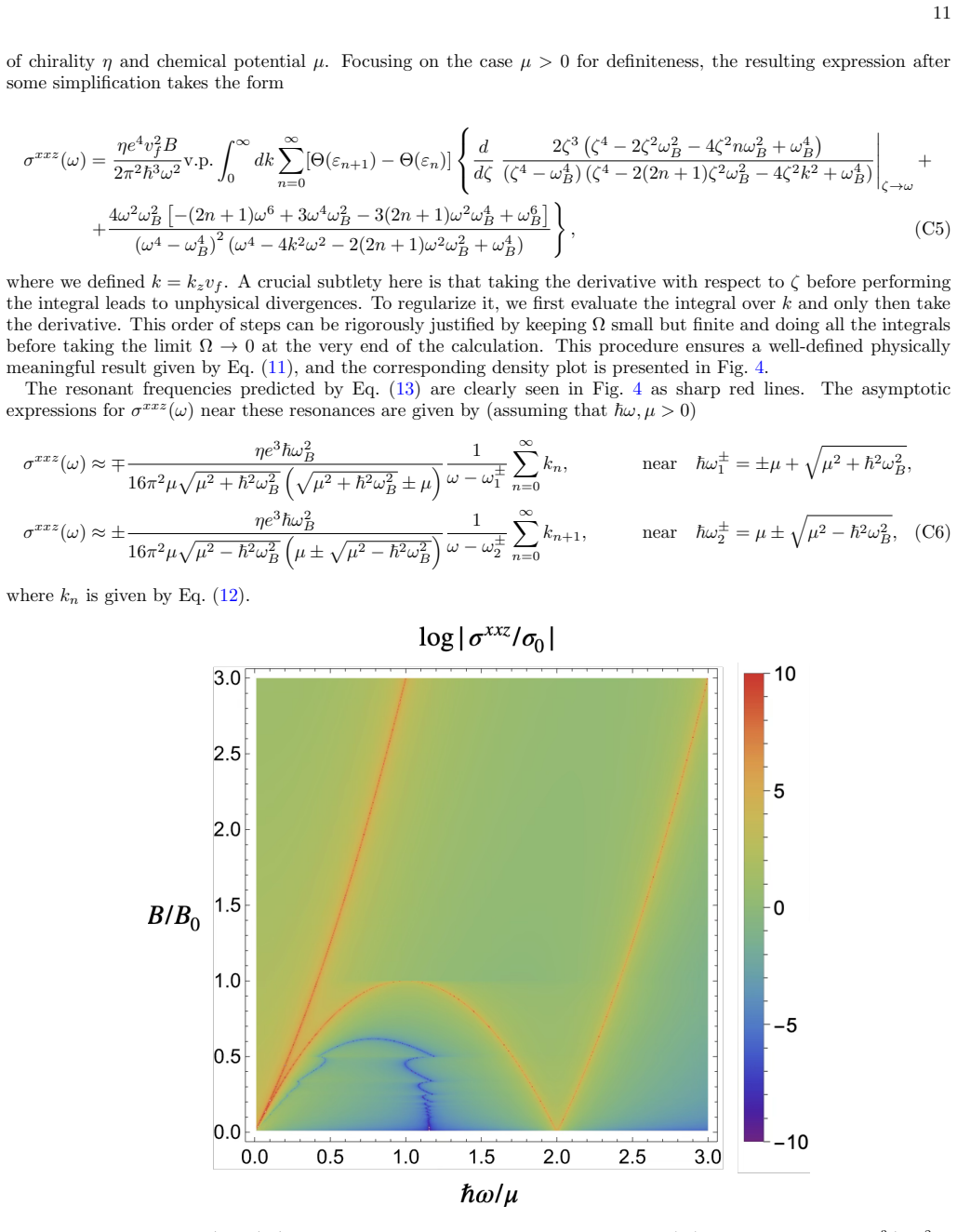
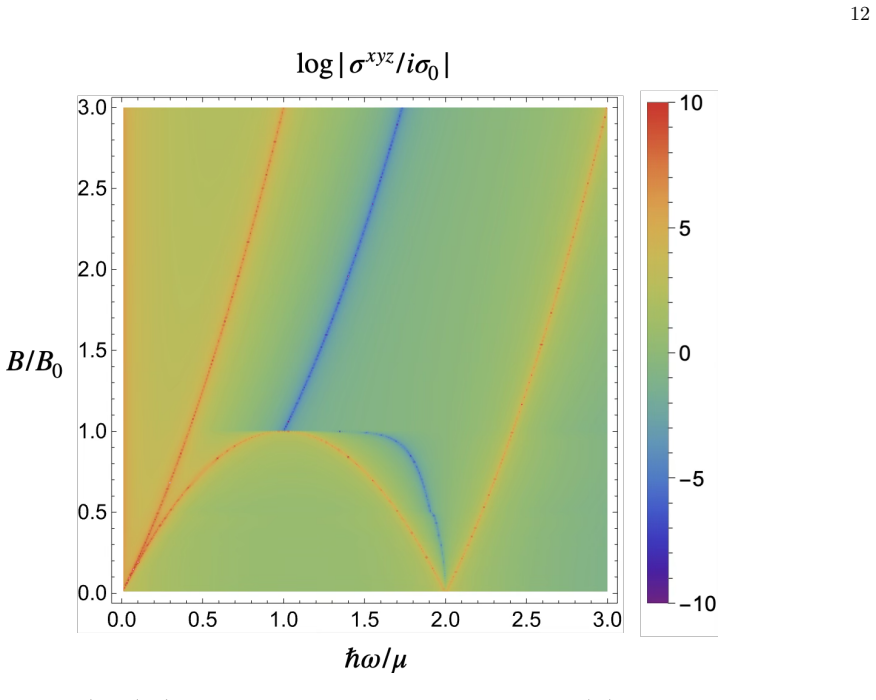
+ (E2 n −E 2 n+1)(−E2 n+1E2 n +E 2 0 E2 n + 2E2 0 E2 n+1) (ℏω)4 −2(ℏω) 2(E2n +E 2 n+1) + (E2n −E 2 n+1)2 .(C9) Performing integration overk z and simplifying the result, we end up with Eq. (16), which is also visualized in Fig. 5. The resonant frequencies ofσ xyz(ω) are given by the same Eq. (13) and can be clearly seen in Fig. 5 as sharp red lines. In th...
-
[3]
Expanding the exact solution in Eq
Low-field limitω B →0 First, we calculate the components of the second-order current in the limit of the vanishing magnetic fieldω B →0. Expanding the exact solution in Eq. (D10) in powers ofω 2 B, we find for the photocurrentj dc 2 : jdc 2 ≈ iηe3ωτ 2 6π2ℏ2(1 +ω 2τ 2)Eω ×E ∗ ω 16 + ηe3ω2 Bτ 2 24π2ℏµ(1 +ω 2τ 2)2 2(ExE∗ z +E ∗ xEz) 2(EyE∗ z +E ∗ y E...
-
[4]
Clean low-field limit,τ→ ∞followed byω B →0 Next, we consider the clean limitτ→ ∞followed by the low-field limitω B →0. Expanding the exact solution to the orderO(1/τ 0) and subsequently to the leading order inω B, we find for the photocurrent: jdc 2 ≈ iηe3 4π2ωℏ2 EyE∗ z −E zE∗ y EzE∗ x −E xE∗ z2 3(ExE∗ y −E yE∗ x) − iηe3ω4 B 20µ2 +ℏ 2ω2 480π2µ4ω3...
-
[5]
Clean low-frequency limit,τ→ ∞followed byω→0 Analogously, we find the asymptotic expressions in the clean limitτ→ ∞followed by the low-frequency limit ω→0. Expanding again the exact solution to the orderO(1/τ 0) and subsequently to the leading order inω, we obtain for the photocurrent: jdc 2 ≈ 3ηe3ω6 Bℏ3 160π2µ5ω2 0 0 |Ez|2 + iηe3 4π2ωℏ2 EyE∗ ...
-
[6]
Asymptotic behavior near resonances To derive asymptotic expressions for the second-order conductivity components near low-frequency resonances ω=ℏω 2 B/(2µ) andω=ℏω 2 B/(4µ), we introduce new dimensionless variables λ≡ℏω B/µ, γ≡ µω ℏω2 B , δ≡ωτ.(D25) We then expand the exact expressions for the current components (D10) atλ→0, keeping the leading nonvanis...
-
[7]
M. L. Brongersma, N. J. Halas, and P. Nordlander, Plasmon-induced hot carrier science and technology, Na- ture Nanotechnology10, 25 (2015)
2015
-
[8]
Nagaosa and T
N. Nagaosa and T. Morimoto, Concept of quantum ge- ometry in optoelectronic processes in solids: Application to solar cells, Advanced Materials29, 1603345 (2017)
2017
-
[9]
J. Liu, F. Xia, D. Xiao, F. J. Garc´ ıa de Abajo, and D. Sun, Semimetals for high-performance photodetec- tion, Nature Materials19, 830 (2020)
2020
-
[10]
A. M. Cook, B. M. Fregoso, F. de Juan, S. Coh, and J. E. Moore, Design principles for shift current photovoltaics, Nature Communications8, 14176 (2017)
2017
-
[11]
M.-M. Yang, D. J. Kim, and M. Alexe, Flexo- photovoltaic effect, Science360, 904 (2018)
2018
-
[12]
L. Z. Tan, F. Zheng, S. M. Young, F. Wang, S. Liu, and A. M. Rappe, Shift current bulk photovoltaic effect in po- lar materials—hybrid and oxide perovskites and beyond, npj Computational Materials2, 16026 (2016)
2016
-
[13]
Morimoto and N
T. Morimoto and N. Nagaosa, Topological nature of nonlinear optical effects in solids, Science Advances2, e1501524 (2016)
2016
-
[14]
M. M. Glazov and S. D. Ganichev, High frequency elec- tric field induced nonlinear effects in graphene, Physics Reports535, 101 (2014)
2014
-
[15]
K. N. Okada, N. Ogawa, R. Yoshimi, A. Tsukazaki, K. S. Takahashi, M. Kawasaki, and Y. Tokura, Enhanced pho- togalvanic current in topological insulators via Fermi en- ergy tuning, Physical Review B93, 081403 (2016)
2016
-
[16]
J. E. Sipe and A. I. Shkrebtii, Second-order optical re- sponse in semiconductors, Physical Review B61, 5337 (2000)
2000
-
[17]
S. M. Young and A. M. Rappe, First principles calcu- lation of the shift current photovoltaic effect in ferro- electrics, Physical Review Letters109, 116601 (2012)
2012
-
[18]
Shockley and H
W. Shockley and H. J. Queisser, Detailed balance limit of efficiency ofp−njunction solar cells, Journal of Applied Physics32, 510 (1961)
1961
-
[19]
Ahn, G.-Y
J. Ahn, G.-Y. Guo, and N. Nagaosa, Low-frequency di- vergence and quantum geometry of the bulk photovoltaic effect in topological semimetals, Phys. Rev. X10, 041041 (2020)
2020
-
[20]
de Juan, A
F. de Juan, A. G. Grushin, T. Morimoto, and J. E. Moore, Quantized circular photogalvanic effect in Weyl semimetals, Nature Communications8, 15995 (2017)
2017
-
[21]
Flicker, F
F. Flicker, F. de Juan, B. Bradlyn, T. Morimoto, M. G. Vergniory, and A. G. Grushin, Chiral optical response of multifold fermions, Phys. Rev. B98, 155145 (2018)
2018
-
[22]
D. Rees, K. Manna, B. Lu, T. Morimoto, H. Bor- rmann, C. Felser, J. E. Moore, D. H. Torchinsky, and J. Orenstein, Helicity-dependent photocurrents in the chiral Weyl semimetal RhSi, Science Advances6(2020)
2020
-
[23]
Rostami and M
H. Rostami and M. Polini, Nonlinear anomalous pho- tocurrents in Weyl semimetals, Phys. Rev. B97, 195151 (2018)
2018
-
[24]
Z. Ji, G. Liu, Z. Addison, W. Liu, P. Yu, H. Gao, Z. Liu, A. M. Rappe, C. L. Kane, E. J. Mele, and R. Agar- wal, Spatially dispersive circular photogalvanic effect in a Weyl semimetal, Nature Materials18, 955 (2019)
2019
-
[25]
Ma, S.-Y
Q. Ma, S.-Y. Xu, C.-K. Chan, C.-L. Zhang, G. Chang, Y. Lin, W. Xie, T. Palacios, H. Lin, S. Jia, P. A. Lee, P. Jarillo-Herrero, and N. Gedik, Direct optical detec- tion of Weyl fermion chirality in a topological semimetal, Nature Physics13, 842 (2017)
2017
-
[26]
G. B. Osterhoudt, L. K. Diebel, M. J. Gray, X. Yang, J. Stanco, X. Huang, B. Shen, N. Ni, P. J. W. Moll, Y. Ran, and K. S. Burch, Colossal mid-infrared bulk photovoltaic effect in a type-I Weyl semimetal, Nature Materials18, 471 (2019)
2019
-
[27]
L. Wu, S. Patankar, T. Morimoto, N. L. Nair, E. Thewalt, A. Little, J. G. Analytis, J. E. Moore, and J. Orenstein, Giant anisotropic nonlinear optical response in transition metal monopnictide Weyl semimetals, Nature Physics 13, 350 (2017)
2017
-
[28]
Li, Y.-Q
Z. Li, Y.-Q. Jin, T. Tohyama, T. Iitaka, J.-X. Zhang, and H. Su, Second harmonic generation in the Weyl semimetal TaAs from a quantum kinetic equation, Phys. Rev. B97, 085201 (2018)
2018
-
[29]
A. A. Zyuzin and A. Y. Zyuzin, Chiral anomaly and second-harmonic generation in Weyl semimetals, Phys. Rev. B95, 085127 (2017)
2017
-
[30]
L. E. Golub, E. L. Ivchenko, and B. Z. Spivak, Photocur- rent in gyrotropic Weyl semimetals, JETP Letters105, 782 (2017)
2017
-
[31]
Zhang, H
Y. Zhang, H. Ishizuka, J. van den Brink, C. Felser, B. Yan, and N. Nagaosa, Photogalvanic effect in Weyl semimetals from first principles, Physical Review B97, 241118 (2018)
2018
-
[32]
C.-K. Chan, N. H. Lindner, G. Refael, and P. A. Lee, Photocurrents in Weyl semimetals, Physical Review B 95, 041104 (2017)
2017
-
[33]
L. E. Golub and E. L. Ivchenko, Circular and magnetoin- duced photocurrents in Weyl semimetals, Phys. Rev. B 98, 075305 (2018)
2018
-
[34]
Yao and A
X. Yao and A. Belyanin, Nonlinear optics of graphene in a strong magnetic field, Journal of Physics: Condensed Matter25, 054203 (2013)
2013
-
[35]
Yao and A
X. Yao and A. Belyanin, Giant optical nonlinearity of graphene in a strong magnetic field, Phys. Rev. Lett.108, 255503 (2012)
2012
-
[36]
Tamashevich, L
Y. Tamashevich, L. D. M. Villari, and M. Ornigotti, Two- dimensional Weyl materials in the presence of constant magnetic fields, Phys. Rev. B107, 245425 (2023)
2023
-
[37]
Bednik and V
G. Bednik and V. Kozii, Magnetic field induces giant non- linear optical response in Weyl semimetals, Phys. Rev. B 109, 045106 (2024)
2024
-
[38]
M. Dzero, M. Khodas, A. Levchenko, and V. Kozii, Non- linear Hall effect in topological Dirac semimetals in par- allel magnetic field, arXiv:2508.20159 (2025)
Pith/arXiv arXiv 2025
-
[39]
Dzero, J
M. Dzero, J. Hasan, and A. Levchenko, Resonant sec- ond harmonic generation in a two-dimensional electron system, Phys. Rev. B112, 045416 (2025)
2025
-
[40]
Avdoshkin, V
A. Avdoshkin, V. Kozii, and J. E. Moore, Interactions re- move the quantization of the chiral photocurrent at Weyl points, Phys. Rev. Lett.124, 196603 (2020)
2020
-
[41]
The analytic continuation symmetric with respect to Ω, iω1 →ω+ Ω/2 +i0 andiω 2 → −ω+ Ω/2 +i0, signifi- cantly simplifies the calculation and automatically elim- inates unphysical contributions to the photocurrent
-
[42]
E. J. K¨ onig, H.-Y. Xie, D. A. Pesin, and A. Levchenko, Photogalvanic effect in Weyl semimetals, Phys. Rev. B 96, 075123 (2017)
2017
-
[43]
Xiao, M.-C
D. Xiao, M.-C. Chang, and Q. Niu, Berry phase effects on 20 electronic properties, Rev. Mod. Phys.82, 1959 (2010)
1959
-
[44]
Morimoto, S
T. Morimoto, S. Zhong, J. Orenstein, and J. E. Moore, Semiclassical theory of nonlinear magneto-optical re- sponses with applications to topological Dirac/Weyl semimetals, Phys. Rev. B94, 245121 (2016)
2016
-
[45]
D. Xiao, J. Shi, and Q. Niu, Berry phase correction to electron density of states in solids, Phys. Rev. Lett.95, 137204 (2005)
2005
-
[46]
Sodemann and L
I. Sodemann and L. Fu, Quantum nonlinear Hall effect induced by Berry curvature dipole in time-reversal in- variant materials, Phys. Rev. Lett.115, 216806 (2015)
2015
-
[47]
Golub and E
L. Golub and E. Ivchenko, Intraband circular photogal- vanic effect in Weyl semimetals, Annals of Physics488, 170415 (2026)
2026
-
[48]
Guo, X.-Y
Z. Guo, X.-Y. Liu, H. Wang, L.-k. Shi, and K. Chang, Dissipation-shaped quantum geometry in nonlinear transport, Phys. Rev. Lett.136, 206303 (2026)
2026
-
[49]
For componentsσ yzx 2ω and other related by symmetry, we only consider the analytic part of the microscopic answer, which is proportional toω 4 B
-
[50]
Belinicher, E
V. Belinicher, E. Ivchenko, and B. Sturman, Kinetic the- ory of the displacement photovoltaic effect in piezoelec- tric, Sov. Phys. JETP56, 359 (1982)
1982
-
[51]
Zhu and A
P. Zhu and A. Alexandradinata, Anomalous shift and optical vorticity in the steady photovoltaic current, Phys. Rev. B110, 115108 (2024)
2024
-
[52]
Z. Rao, H. Li, T. Zhang, S. Tian, C. Li, B. Fu, C. Tang, L. Wang, Z. Li, W. Fan, J. Li, Y. Huang, Z. Liu, Y. Long, C. Fang, H. Weng, Y. Shi, H. Lei, Y. Sun, T. Qian, and H. Ding, Observation of unconventional chiral fermions with long Fermi arcs in CoSi, Nature567, 496 (2019)
2019
-
[53]
Z. Ni, K. Wang, Y. Zhang, O. Pozo, B. Xu, X. Han, K. Manna, J. Paglione, C. Felser, A. G. Grushin, F. de Juan, E. J. Mele, and L. Wu, Giant topological longitudinal circular photo-galvanic effect in the chiral multifold semimetal CoSi, Nature Communications12, 154 (2021)
2021
discussion (0)
Sign in with ORCID, Apple, or X to comment. Anyone can read and Pith papers without signing in.