Clue-Guided Money Laundering Group Discovery
Pith reviewed 2026-06-26 01:49 UTC · model grok-4.3
The pith
Clue2Group recovers complete laundering groups by expanding outward from an initial set of clues in financial networks.
A machine-rendered reading of the paper's core claim, the machinery that carries it, and where it could break.
Core claim
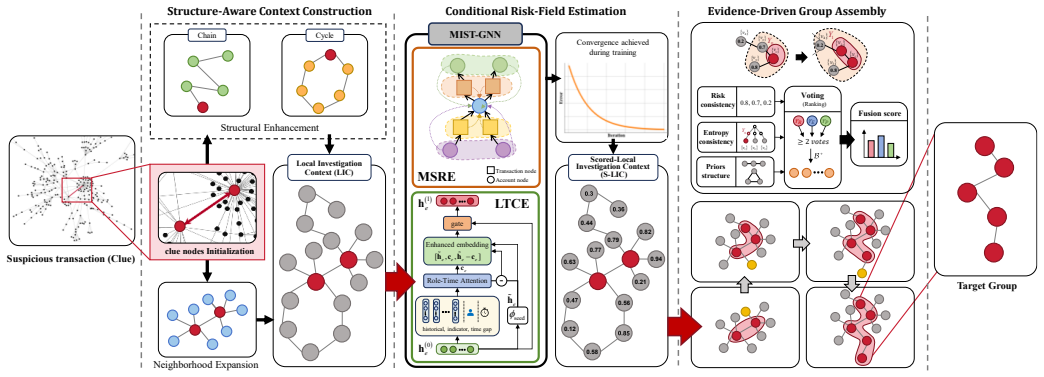
Clue-Guided Group Discovery (CGGD) recovers a laundering group progressively from an initial clue set through analyst interaction. Clue2Group implements this by constructing a compact local investigation context to reduce noise while preserving chain-like and cycle-like structures, estimating a clue-conditioned local risk field with a multi-semantic local-temporal GNN, and integrating risk, structural, and prior-pattern evidence to output a coherent group.
What carries the argument
The Clue2Group framework, which first builds a compact local investigation context from the clue set, then estimates a clue-conditioned local risk field via a multi-semantic local-temporal GNN before integrating multiple evidence types.
If this is right
- Investigators receive a ranked local subgraph instead of isolated alerts, allowing them to expand from known leads without exhaustive search.
- The local context construction step limits computation to relevant structures around clues, preserving laundering chains and cycles.
- Integration of risk scores from the temporal GNN with structural and pattern evidence produces more complete groups than risk scores alone.
- The framework can be used interactively, with analysts supplying new clues during an investigation to refine the recovered group.
Where Pith is reading between the lines
- The same clue-to-group expansion logic could apply to other domains where analysts start from known leads, such as fraud rings or supply-chain investigations.
- If the local risk field can be updated incrementally, the method might support real-time clue addition without rebuilding the entire context.
- Testing the framework on graphs where clues are incomplete or partially incorrect would show how robust the recovery step remains under realistic input noise.
Load-bearing premise
That real AML investigations begin from a concrete clue set and can be expanded outward to recover the responsible group.
What would settle it
A benchmark run in which Clue2Group, given the same initial clues, fails to recover known laundering groups at higher precision or recall than either node-level detection or global group search on the same datasets.
Figures

read the original abstract
Money Laundering Group Discovery (MLGD) aims to identify hidden criminal groups and recover their complete structures in large-scale financial networks. Existing graph anomaly detection methods mainly produce node-level risk alerts, while global group discovery methods passively search for suspicious groups over the whole network. Both are mismatched with real Anti-money-laundering (AML) investigations, where analysts usually start from a concrete clue and gradually expand the investigation to recover the responsible group. To address this gap, we propose Clue-Guided Group Discovery (CGGD), where a laundering group is progressively recovered from an initial clue set through analyst interaction. We further propose Clue2Group, a framework that first constructs a compact local investigation context to reduce noise and preserve chain-like and cycle-like laundering structures. It then estimates a clue-conditioned local risk field with a multi-semantic local-temporal GNN, and finally integrates risk, structural, and prior-pattern evidence to recover a coherent laundering group. Experiments on two large-scale AML benchmarks show that Clue2Group provides a practical clue-driven analysis framework for AML investigations, offering a feasible step toward bridging the gap between graph-based AML research and real investigation workflows.
Editorial analysis
A structured set of objections, weighed in public.
Referee Report
Summary. The manuscript proposes Clue-Guided Group Discovery (CGGD) to address a mismatch between existing graph anomaly detection (node-level alerts) and global group discovery methods versus real AML workflows, which begin from an initial clue set and expand to recover the responsible laundering group. It introduces the Clue2Group framework consisting of local investigation context construction to preserve chain/cycle structures, a multi-semantic local-temporal GNN for estimating a clue-conditioned risk field, and integration of risk/structural/prior-pattern evidence. Experiments on two large-scale AML benchmarks are claimed to demonstrate that Clue2Group provides a practical clue-driven analysis framework bridging graph-based AML research and real investigation workflows.
Significance. If the experimental results hold, the work offers a practically aligned framing for graph ML in AML by shifting from passive global or node-level detection to interactive clue-guided recovery, which could improve usability in analyst workflows. The local context construction and multi-semantic GNN components represent a targeted adaptation to financial network structures.
major comments (1)
- [Abstract] Abstract: The central claim that 'experiments on two large-scale AML benchmarks show that Clue2Group provides a practical clue-driven analysis framework' is unsupported because no performance metrics, baselines, dataset sizes, evaluation protocol, or validation steps are reported, preventing any assessment of whether the framework outperforms existing methods or achieves the claimed practicality.
Simulated Author's Rebuttal
We thank the referee for highlighting the need for concrete support in the abstract. We address the comment below and will revise accordingly.
read point-by-point responses
-
Referee: [Abstract] Abstract: The central claim that 'experiments on two large-scale AML benchmarks show that Clue2Group provides a practical clue-driven analysis framework' is unsupported because no performance metrics, baselines, dataset sizes, evaluation protocol, or validation steps are reported, preventing any assessment of whether the framework outperforms existing methods or achieves the claimed practicality.
Authors: We agree the abstract claim would be stronger with explicit support. The manuscript body (Section 4) details the two AML benchmarks (including sizes, clue sampling protocol, and 5-fold validation), reports F1/precision/recall against node-level and global baselines, and shows Clue2Group's gains in group recovery. To address the concern directly, we will revise the abstract to include a concise summary of key metrics and evaluation setup while preserving length constraints. revision: yes
Circularity Check
No significant circularity
full rationale
The paper's central contribution is a methodological framework (Clue2Group) that constructs local investigation contexts, applies a multi-semantic local-temporal GNN for risk estimation, and integrates multiple evidence types to recover groups from initial clues. No equations, parameter-fitting steps, or self-citations are present in the provided text that would reduce any claimed prediction or result to an input by construction. The motivation (real AML work starts from clues) is stated as an external premise rather than derived internally, and benchmark experiments are presented as empirical validation without any load-bearing self-referential loop.
Axiom & Free-Parameter Ledger
Reference graph
Works this paper leans on
-
[1]
J. He, J. Tian, Y. Wu, X. Cia, K. Zhang, M. Guo, H. Zheng, J. Wu and Y. Ji, “An Efficient Solution to Detect Common Topologies in Money Launderings Based on Coupling and Connection,” IEEE Intelligent Systems, vol. 36, no. 1, pp. 64-74, 2021, doi: 10.1109/mis.2021.3057590
-
[2]
E. A. Akartuna, S. D. Johnson and A. Thornton, “A Holistic Network Analysis of the Money Laundering Threat Landscape: Assessing Criminal Typologies, Resilience and Implications for Disruption,” Journal of Quantitative Criminology, vol. 41, no. 2, pp. 173 -214, Jun, 2025, doi: 10.1007/s10940-024-09594-3
-
[3]
United Nations Office on Drugs and Crime. (n.d.). Money Laundering. [Online]. Available: https://www.unodc.org/unodc/en/money- laundering/overview.html
-
[4]
Artificial intelligence for anti - money laundering: a review and extension,
J. Han, Y. Huang, S. Liu and K. Towey, “Artificial intelligence for anti - money laundering: a review and extension,” Digital Finance, vol. 2, no. 3 -4, pp. 211-239, 2020, doi: 10.1007/s42521-020-00023-1
-
[5]
B. Oztas, D. Cetinkaya, F. Adedoyin, M. Budka, G. Aksu and H. Dogan, “Transaction monitoring in anti-money laundering: A qualitative analysis and points of view from industry,” Future Generation Computer Systems, vol. 159, no., pp. 161-171, 2024, doi: 10.1016/j.future.2024.05.027
-
[6]
Qualifying and raising anti -money laundering alarms with deep learning,
R. I. T. Jensen and A. Iosifidis, “Qualifying and raising anti -money laundering alarms with deep learning,” Expert Systems with Applications, vol. 214, no., pp., 2023, doi: 10.1016/j.eswa.2022.119037
-
[7]
MLaD²: A Semi - Supervised Money Laundering Detection Framework Based on Decoupling Training,
X. Luo, X. Han, W. Zuo, X. Wu and W. Liu, “MLaD²: A Semi - Supervised Money Laundering Detection Framework Based on Decoupling Training,” IEEE Transactions on Information Forensics and Security, vol. 19, no., pp. 4518-4533, 2024, doi: 10.1109/tifs.2024.3380262
-
[8]
L. Han, L. Wang, Z. Cheng, B. Wang, G. Yang, D. Cheng and X. Lin, “Mitigating the Tail Effect in Fraud Detection by Community Enhanced Multi-Relation Graph Neural Networks,” IEEE Transactions on Knowledge and Data Engineering, vol. 37, no. 4, pp. 2029 -2041, 2025, doi: 10.1109/tkde.2025.3530467
-
[9]
F. F. I. E. C. (FFIEC). (2026). Suspicious Activity Reporting —Overview. Available: https://bsaaml.ffiec.gov/manual/AssessingComplianceWithBSARegulatoryRe quirements/04
2026
-
[10]
Multi -View Graph -Based Hierarchical Representation Learning for Money Laundering Group Detection,
Z. Li, X. Yang and C. Jiang, “Multi -View Graph -Based Hierarchical Representation Learning for Money Laundering Group Detection,” IEEE Transactions on Information Forensics and Security, vol. 20, no., pp. 2035 - 2050, 2025, doi: 10.1109/tifs.2025.3529321
-
[11]
Anti -Money Laundering by Group -Aware Deep Graph Learning,
D. Cheng, Y. Ye, S. Xiang, Z. Ma, Y. Zhang and C. Jiang, “Anti -Money Laundering by Group -Aware Deep Graph Learning,” IEEE Transactions on Knowledge and Data Engineering, vol. 35, no. 12, pp. 12444-12457, 2023, doi: 10.1109/tkde.2023.3272396
-
[12]
Flowscope: Spotting money laundering based on graphs,
X. Li, S. Liu, Z. Li, X. Han, C. Shi, B. Hooi, H. Huang and X. Cheng, “Flowscope: Spotting money laundering based on graphs,” in Proceedings of the AAAI conference on artificial intelligence, 2020, pp. 4731-4738. 2
2020
-
[13]
Towards learning to discover money laundering sub -network in massive transaction network,
Z. Chai, Y. Yang, J. Dan, S. Tian, C. Meng, W. Wang and Y. Sun, “Towards learning to discover money laundering sub -network in massive transaction network,” in Proceedings of the AAAI conference on artificial intelligence, 2023, pp. 14153-14160
2023
-
[14]
ICS -GNN: Lightweight Interactive Community Search via Graph Neural Network,
J. Gao, J. Chen, Z. Li and J. Zhang, “ICS -GNN: Lightweight Interactive Community Search via Graph Neural Network,” Proceedings of the VLDB Endowment, vol. 14, no. 6, pp. 1006-1018, 2021, doi: 10.14778/3447689.3447704
-
[15]
ICS -GNN+: lightweight interactive community search via graph neural network,
J. Chen, J. Gao and B. Cui, “ICS -GNN+: lightweight interactive community search via graph neural network,” The VLDB Journal, vol. 32, no. 2, pp. 447-467, 2022, doi: 10.1007/s00778-022-00754-0
-
[16]
Money laundering: the economics of regulation,
D. Masciandaro, “Money laundering: the economics of regulation,” European Journal of Law and Economics, vol. 7, no. 3, pp. 225-240, 1999, doi
1999
-
[17]
Ontology Based Expert- System for Suspicious Transactions Detection,
Q. Rajput, N. S. Khan, A. Larik and S. Haider, “Ontology Based Expert- System for Suspicious Transactions Detection,” Computer and Information Science, vol. 7, no. 1, pp., 2014, doi: 10.5539/cis.v7n1p103
-
[18]
A. I. Canhoto, “Leveraging machine learning in the global fight against money laundering and terrorism financing: An affordances perspective,” Journal of Business Research, vol. 131, no., pp. 441 -452, 2021, doi: 10.1016/j.jbusres.2020.10.012
-
[19]
LaundroGraph: Self -Supervised Graph Representation Learning for Anti -Money Laundering,
M. Cardoso, P. Saleiro and P. Bizarro, “LaundroGraph: Self -Supervised Graph Representation Learning for Anti -Money Laundering,” in Proceedings of the Third ACM International Conference on AI in Finance, 2022, pp. 130 - 138
2022
-
[20]
A label-free heterophily -guided approach for unsupervised graph fraud detection,
J. Pan, Y. Liu, X. Zheng, Y. Zheng, A. W.-C. Liew, F. Li and S. Pan, “A label-free heterophily -guided approach for unsupervised graph fraud detection,” in Proceedings of the AAAI Conference on Artificial Intelligence, 2025, pp. 12443-12451
2025
-
[21]
Enhancing attribute - driven fraud detection with risk -aware graph representation,
S. Xiang, G. Zhang, D. Cheng and Y. Zhang, “Enhancing attribute - driven fraud detection with risk -aware graph representation,” IEEE Transactions on Knowledge and Data Engineering, vol., no., pp., 2025, doi
2025
-
[22]
The LAW theorem: Local reads and linearizable asynchronous replication
X. X. Gou, W. G. Zheng, Y. X. Wang, X. L. Xu and Z. Y. Yu, “A Comprehensive Survey and Experimental Study of Learning -based Community Search,” Proceedings of the Vldb Endowment, vol. 18, no. 9, pp. 2941-2954, May, 2025, doi: 10.14778/3746405.3746419
-
[23]
FATF. (2020). Money Laundering and Terrorist Financing Red Flag Indicators Associated with Virtual Assets. Available: https://www.fatf- gafi.org/en/publications/Methodsandtrends/Virtual-assets-red-flag- indicators.html
2020
-
[24]
S. N, C. K, P. K, J. G, K. K, F. F and M. M, “Virtual Assets and Anti - Money Laundering and Combating the Financing of Terrorism (2): Effective Anti-Money Laundering and Combating the Financing of Terrorism Regulatory and Supervisory Framework —Some Legal and Practical Considerations,” International Monetary Fund, Washington, DC, USA, Rep. NOTE/2021/003, 2021
2021
-
[25]
Gnnexplainer: Generating explanations for graph neural networks,
Z. Ying, D. Bourgeois, J. You, M. Zitnik and J. Leskovec, “Gnnexplainer: Generating explanations for graph neural networks,” Advances in neural information processing systems, vol. 32, no., pp., 2019, doi
2019
-
[26]
Parameterized explainer for graph neural network,
D. Luo, W. Cheng, D. Xu, W. Yu, B. Zong, H. Chen and X. Zhang, “Parameterized explainer for graph neural network,” Advances in neural information processing systems, vol. 33, no., pp. 19620-19631, 2020, doi
2020
-
[27]
Interpreting graph neural networks for NLP with differentiable edge masking,
M. S. Schlichtkrull, N. De Cao and I. Titov, “Interpreting graph neural networks for NLP with differentiable edge masking,” arXiv preprint arXiv:2010.00577, vol., no., pp., 2020, doi
-
[28]
N. Jiang, F. Duan, H. Chen, W. Huang and X. Liu, “MAFI: GNN -Based Multiple Aggregators and Feature Interactions Network for Fraud Detection Over Heterogeneous Graph,” IEEE Transactions on Big Data, vol. 8, no. 4, pp. 905-919, 2022, doi: 10.1109/tbdata.2021.3132672
-
[29]
Heterogeneous graph representation learning via mutual information estimation for fraud detection,
Z. Zhang, X. Su, J. Wu, C. J. Tessone and H. Liao, “Heterogeneous graph representation learning via mutual information estimation for fraud detection,” Journal of Network and Computer Applications, vol. 234, no., pp., 2025, doi: 10.1016/j.jnca.2024.104046
-
[30]
Structural Information and Dynamical Complexity of Networks,
A. Li and Y. Pan, “Structural Information and Dynamical Complexity of Networks,” IEEE Transactions on Information Theory, vol. 62, no. 6, pp. 3290-3339, 2016, doi: 10.1109/tit.2016.2555904
-
[31]
Structural entropy minimization combining graph representation for money laundering identification,
S. Wang, P. Wang, B. Wu, Y. Zhu, W. Luo and Y. Pan, “Structural entropy minimization combining graph representation for money laundering identification,” International Journal of Machine Learning and Cybernetics, vol. 15, no. 9, pp. 3951-3968, 2024, doi: 10.1007/s13042-024-02129-z
-
[32]
Realistic synthetic financial transactions for anti-money laundering models,
E. Altman, J. Blanuša, L. Von Niederhäusern, B. Egressy, A. Anghel and K. Atasu, “Realistic synthetic financial transactions for anti-money laundering models,” Advances in Neural Information Processing Systems, vol. 36, no., pp. 29851-29874, 2023, doi. I. SACC TIME COMPLEXITY
2023
-
[33]
For each clue node VcC , SACC performs a k-hop breadth-first search
Neighborhood expansion. For each clue node VcC , SACC performs a k-hop breadth-first search. Let d be the maximum in -degree/out- degree. The number of nodes visited from one clue node is upper-bounded by () kOd . Therefore, the complexity for all VC clue nodes is: ( ).k VO C d (1)
-
[34]
This stage consists of two procedures: path enumeration and fund-flow consistency verification
Structural enhancement. This stage consists of two procedures: path enumeration and fund-flow consistency verification. Path enumeration. For each clue node, SACC enumerates simple paths and cycles within its k-hop neighborhood, where the length of each path is bounded by maxL and the length of each cycle is bounded by maxC . Let cP denote the number of p...
-
[35]
SACC merges the candidate node set obtained from neighborhood expansion and structural enhancement, and then induces the corresponding subgraph from the original graph
Subgraph induction. SACC merges the candidate node set obtained from neighborhood expansion and structural enhancement, and then induces the corresponding subgraph from the original graph. This step scans the candidate nodes and their associated edges. Its complexity is ( ) ,LIC LICO + (4) which is negligible compared with the previous two stages. Ther...
discussion (0)
Sign in with ORCID, Apple, or X to comment. Anyone can read and Pith papers without signing in.