Federated Hash Projected Latent Factor Learning
Pith reviewed 2026-06-26 01:46 UTC · model grok-4.3
The pith
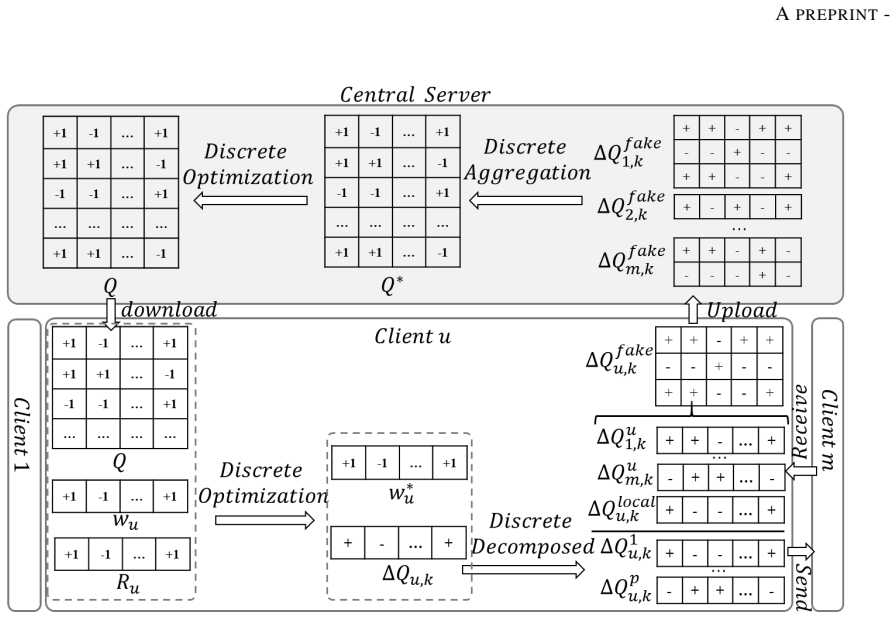
A federated model replaces real-valued gradients with binary matrices and uses projected Hamming distance to cut communication and privacy risks while holding accuracy steady.
A machine-rendered reading of the paper's core claim, the machinery that carries it, and where it could break.
Core claim
The central claim is that a Federated Hash Projected Latent Factor model can maintain competitive accuracy by transmitting only binary gradient-like matrices instead of real-valued ones, by measuring similarity with Projected Hamming Distance that weights bit importance, and by applying a Secure Binary Gradient Reassembly and Privacy-Enhanced Upload step that further limits leakage during transmission.
What carries the argument
Projected Hamming Distance, a bit-weighted similarity measure applied to binary gradient-like matrices that replaces full real-valued gradient exchange.
If this is right
- Communication volume per round drops because only binary matrices are sent instead of full-precision gradients.
- Privacy improves because real-valued parameter updates never leave the local device in recognizable form.
- The same binary replacement and projected distance can be applied to other latent-factor or matrix-factorization tasks inside federated settings.
- Storage and computation at both client and server are reduced by operating directly on binary structures.
Where Pith is reading between the lines
- The binary-gradient approach could be tested on non-latent-factor tasks such as federated image classification to check whether the accuracy trade-off holds outside recommendation-style problems.
- If bit-importance weights learned by the projected distance prove stable across rounds, they might be reused as a lightweight form of client-specific adaptation without extra communication.
- The secure reassembly step might combine with existing secure-aggregation protocols to create hybrid defenses against gradient inversion attacks.
Load-bearing premise
Binary gradient-like matrices can preserve enough of the original real-valued information that model accuracy does not drop substantially.
What would settle it
Run the same four datasets with the identical training protocol; if FHPLF accuracy falls more than a few percent below the best non-binary federated baseline on any dataset, the core claim is falsified.
Figures
read the original abstract
Hash Learning (HL) is an efficient representation learning approach that maps real-valued data into compact binary representations. Traditional HL methods typically require users to upload personal data to a central server, which is incompatible with increasingly stringent data security regulations. Federated Learning (FL) provides a decentralized paradigm for learning globally optimal models without centralizing private data. However, most FL methods rely on transmitting large-scale real-valued gradient information, leading to high communication overhead and potential privacy risks. Integrating HL into FL is a promising solution. Nevertheless, existing HL methods suffer from limited representational capacity of binary codes, which may degrade model accuracy. To address this challenge, we propose a Federated Hash Projected Latent Factor (FHPLF) model. FHPLF introduces three key innovations: (a) replacing real-valued gradient matrices with binary gradient-like matrices, significantly reducing computation, storage, and communication costs while enhancing privacy protection; (b) leveraging Projected Hamming Distance for similarity modeling, which captures the importance of individual binary bits to improve representation capability; and (c) proposing a Secure Binary Gradient Reassembly and Privacy-Enhanced Upload (SBG-PEU) strategy to further reduce the risk of user interaction leakage during transmission. Extensive experiments on four real-world datasets demonstrate that FHPLF consistently outperforms state-of-the-art HL and FL methods, achieving a favorable trade-off among accuracy, efficiency, and privacy preservation.
Editorial analysis
A structured set of objections, weighed in public.
Referee Report
Summary. The paper proposes the Federated Hash Projected Latent Factor (FHPLF) model to integrate hash learning into federated learning. It replaces real-valued gradient matrices with binary gradient-like matrices, uses Projected Hamming Distance to model bit importance for similarity, and introduces a Secure Binary Gradient Reassembly and Privacy-Enhanced Upload (SBG-PEU) strategy. The central claim is that these changes yield consistent outperformance over state-of-the-art HL and FL methods on four real-world datasets while improving the accuracy-efficiency-privacy trade-off.
Significance. If the empirical results are robust, the work could offer a practical route to reduce communication costs and privacy leakage in federated representation learning by leveraging binary codes without substantial accuracy loss. The combination of binarized gradients and weighted Hamming distance is a concrete technical contribution that addresses known limitations in both HL and FL.
major comments (2)
- [Abstract] Abstract: The claim that FHPLF 'consistently outperforms' state-of-the-art methods rests on innovations (a) and (b) preserving sufficient representational capacity after binarization. No derivation, information-theoretic bound, or ablation isolating the effect of replacing real-valued gradients with binary gradient-like matrices on latent-factor convergence or final accuracy is referenced.
- [Abstract] Abstract: The Projected Hamming Distance is asserted to 'capture the importance of individual binary bits' and thereby improve representation capability, yet the manuscript provides no explicit definition of the per-bit weighting scheme or proof that it compensates for the information lost in binarization relative to standard inner-product similarity.
Simulated Author's Rebuttal
We thank the referee for the constructive feedback. We address the two major comments point by point below. Where the comments identify gaps in theoretical support or explicit definitions, we agree that revisions are warranted and will strengthen the manuscript accordingly.
read point-by-point responses
-
Referee: [Abstract] Abstract: The claim that FHPLF 'consistently outperforms' state-of-the-art methods rests on innovations (a) and (b) preserving sufficient representational capacity after binarization. No derivation, information-theoretic bound, or ablation isolating the effect of replacing real-valued gradients with binary gradient-like matrices on latent-factor convergence or final accuracy is referenced.
Authors: We agree that the manuscript would benefit from more direct evidence isolating the effect of binarization. While the work prioritizes practical federated deployment and reports consistent empirical gains across four datasets, we will add a dedicated ablation study in the revised experiments section. This study will compare binary gradient-like matrices against their real-valued counterparts, measuring impacts on convergence behavior and final accuracy to better substantiate the preservation of representational capacity. revision: yes
-
Referee: [Abstract] Abstract: The Projected Hamming Distance is asserted to 'capture the importance of individual binary bits' and thereby improve representation capability, yet the manuscript provides no explicit definition of the per-bit weighting scheme or proof that it compensates for the information lost in binarization relative to standard inner-product similarity.
Authors: The per-bit weighting in the Projected Hamming Distance is introduced in Section 3.2 via a projection matrix that assigns higher weights to bits with greater discriminative power. We will revise the abstract and add an explicit mathematical definition plus a short discussion in the introduction clarifying how the weighting scheme mitigates information loss relative to unweighted Hamming or inner-product similarity. A complete theoretical proof of compensation is not provided in the current work, as the projection is data-driven; however, the empirical results support its practical benefit, and we will note this limitation explicitly. revision: partial
Circularity Check
No circularity; innovations are independently defined and empirically tested
full rationale
The paper proposes three explicit new components—binary gradient-like matrices, Projected Hamming Distance, and SBG-PEU strategy—then reports experimental outperformance on four datasets. No derivation chain reduces any claimed result to a fitted parameter renamed as prediction, a self-citation load-bearing uniqueness theorem, or a self-definitional equivalence. The abstract and described contributions treat the representational-capacity assumption as an empirical claim to be validated by experiments rather than a definitional identity. This is the normal case of a method paper whose central claims rest on external data rather than internal redefinition.
Axiom & Free-Parameter Ledger
Reference graph
Works this paper leans on
-
[1]
Schemarag: A schema-aware retrieval-augmented generation framework for text-to-sql.Proceedings of the ACM on Management of Data, 4(1 (SIGMOD):1–26, 2026
Di Wu, Zetong Tang, Yi He, and Xin Luo. Schemarag: A schema-aware retrieval-augmented generation framework for text-to-sql.Proceedings of the ACM on Management of Data, 4(1 (SIGMOD):1–26, 2026
2026
-
[2]
A review of deep learning-based power load forecasting methods.International Journal of Network Dynamics and Intelligence, 4(4):100027, 2025
Qian Ma, Di Wu, and Xin Luo. A review of deep learning-based power load forecasting methods.International Journal of Network Dynamics and Intelligence, 4(4):100027, 2025
2025
-
[3]
Auto-encoding neural tucker factorization.IEEE Transactions on Knowledge and Data Engineering, 2025
Peng Tang, Xin Luo, and Jim Woodcock. Auto-encoding neural tucker factorization.IEEE Transactions on Knowledge and Data Engineering, 2025
2025
-
[4]
Applying matrix factorization in collaborative filtering recommender systems
R Barathy and P Chitra. Applying matrix factorization in collaborative filtering recommender systems. In2020 6th international conference on advanced computing and communication systems (ICACCS), pages 635–639. IEEE, 2020
2020
-
[5]
Neuromorphic computing in the era of large models.Artificial Intelligence Science and Engineering, 1(1):17–30, 2025
Haoxuan SHAN, Chiyue WEI, Nicolas RAMOS, Xiaoxuan YANG, Cong GUO, Hai LI, and Yiran CHEN. Neuromorphic computing in the era of large models.Artificial Intelligence Science and Engineering, 1(1):17–30, 2025
2025
-
[6]
A survey of cooperative multi-agent reinforcement learning for multi-task scenarios.Artificial Intelligence Science and Engineering, 1(2):98–121, 2025
Jiajun Chai, Zijie Zhao, Yuanheng Zhu, and Dongbin Zhao. A survey of cooperative multi-agent reinforcement learning for multi-task scenarios.Artificial Intelligence Science and Engineering, 1(2):98–121, 2025
2025
-
[7]
A survey on the use of federated learning in privacy-preserving recommender systems.IEEE Open Journal of the Computer Society, 5:227–247, 2024
Christos Chronis, Iraklis Varlamis, Yassine Himeur, Aya N Sayed, Tamim M Al-Hasan, Armstrong Nhlabatsi, Faycal Bensaali, and George Dimitrakopoulos. A survey on the use of federated learning in privacy-preserving recommender systems.IEEE Open Journal of the Computer Society, 5:227–247, 2024
2024
-
[8]
Fan Wang, Weiming Liu, Chaochao Chen, Mengying Zhu, and Xiaolin Zheng. Hcfrec: Hash collaborative filtering via normalized flow with structural consensus for efficient recommendation.arXiv preprint arXiv:2205.12042, 2022
-
[9]
Matrix factorization techniques for recommender systems
Yehuda Koren, Robert Bell, and Chris V olinsky. Matrix factorization techniques for recommender systems. Computer, 42(8):30–37, 2009
2009
-
[10]
A survey of latent factorization of tensor-based model compression: Algorithms, toolboxes and future directions.Neurocomputing, page 133455, 2026
Yaping He, Hao Wu, Weibo Liu, and Xin Luo. A survey of latent factorization of tensor-based model compression: Algorithms, toolboxes and future directions.Neurocomputing, page 133455, 2026
2026
-
[11]
A sampling-neighborhood-regularized latent factorization of tensor for dynamic qos estimation.IEEE Transactions on Network and Service Management, 23:1707–1722, 2025
Xiuqin Xu, Mingwei Lin, Zeshui Xu, and Xin Luo. A sampling-neighborhood-regularized latent factorization of tensor for dynamic qos estimation.IEEE Transactions on Network and Service Management, 23:1707–1722, 2025
2025
-
[12]
Genetic algorithm-based two-step optimization for precise latent factor analysis.IEEE Transactions on Neural Networks and Learning Systems, 2025
Chao Lyu, Jingna Cheng, Xin Luo, and Yuhui Shi. Genetic algorithm-based two-step optimization for precise latent factor analysis.IEEE Transactions on Neural Networks and Learning Systems, 2025
2025
-
[13]
An l 1-and-l 2-norm-oriented latent factor model for recommender systems.IEEE Transactions on Neural Networks and Learning Systems, 33(10):5775–5788, 2021
Di Wu, Mingsheng Shang, Xin Luo, and Zidong Wang. An l 1-and-l 2-norm-oriented latent factor model for recommender systems.IEEE Transactions on Neural Networks and Learning Systems, 33(10):5775–5788, 2021
2021
-
[14]
Latent-factorization-of-tensors-incorporated battery cycle life prediction.IEEE/CAA Journal of Automatica Sinica, 12(3):633–635, 2024
Minzhi Chen, Li Tao, Jungang Lou, and Xin Luo. Latent-factorization-of-tensors-incorporated battery cycle life prediction.IEEE/CAA Journal of Automatica Sinica, 12(3):633–635, 2024
2024
-
[15]
Latent factor analysis model with temporal regularized constraint for road traffic data imputation.IEEE Transactions on Intelligent Transportation Systems, 26(1):724–741, 2024
Hengshuo Yang, Mingwei Lin, Hong Chen, Xin Luo, and Zeshui Xu. Latent factor analysis model with temporal regularized constraint for road traffic data imputation.IEEE Transactions on Intelligent Transportation Systems, 26(1):724–741, 2024
2024
-
[16]
Qu Wang, Hao Wu, and Xin Luo. A convolution bias-incorporated nonnegative latent factorization of tensors model for accurate representation learning to dynamic directed graphs.IEEE Transactions on Systems, Man, and Cybernetics: Systems, 2025
2025
-
[17]
Neural networks-incorporated latent factor analysis for high-dimensional and incomplete data.IEEE Transactions on Systems, Man, and Cybernetics: Systems, 2025
Mingwei Lin, Xingyu Lin, Xiuqin Xu, Zeshui Xu, and Xin Luo. Neural networks-incorporated latent factor analysis for high-dimensional and incomplete data.IEEE Transactions on Systems, Man, and Cybernetics: Systems, 2025
2025
-
[18]
Attention-mechanism-based neural latent-factorization-of- tensors model.ACM Transactions on Knowledge Discovery from Data, 19(4):1–27, 2025
Xiuqin Xu, Mingwei Lin, Zeshui Xu, and Xin Luo. Attention-mechanism-based neural latent-factorization-of- tensors model.ACM Transactions on Knowledge Discovery from Data, 19(4):1–27, 2025
2025
-
[19]
Mingwei Lin, Hengshuo Yang, Xiuqin Xu, Ling Lin, Zeshui Xu, and Xin Luo. Momentum-accelerated and biased unconstrained non-negative latent factor model for handling high-dimensional and incomplete data.ACM Transactions on Knowledge Discovery from Data, 19(3):1–25, 2025
2025
-
[20]
Spatio-temporal traffic data recovery via latent factorization of tensors based on tucker decomposition
Jiajia Mi, Hao Wu, Weiling Li, and Xin Luo. Spatio-temporal traffic data recovery via latent factorization of tensors based on tucker decomposition. In2023 IEEE International Conference on Systems, Man, and Cybernetics (SMC), pages 1512–1517. IEEE, 2023. 11 APREPRINT-
2023
-
[21]
Proximal symmetric non-negative latent factor analysis: A novel approach to highly-accurate representation of undirected weighted networks
Yurong Zhong, Zhe Xie, Weiling Li, and Xin Luo. Proximal symmetric non-negative latent factor analysis: A novel approach to highly-accurate representation of undirected weighted networks. InInternational Conference on Intelligent Computing, pages 64–76. Springer, 2023
2023
-
[22]
Two-stream graph convolutional network-incorporated latent feature analysis.IEEE Transactions on Services Computing, 16(4):3027–3042, 2023
Fanghui Bi, Tiantian He, Yuetong Xie, and Xin Luo. Two-stream graph convolutional network-incorporated latent feature analysis.IEEE Transactions on Services Computing, 16(4):3027–3042, 2023
2023
-
[23]
Position-transitional particle swarm optimization- incorporated latent factor analysis.IEEE Transactions on Knowledge and Data Engineering, 34(8):3958–3970, 2020
Xin Luo, Ye Yuan, Sili Chen, Nianyin Zeng, and Zidong Wang. Position-transitional particle swarm optimization- incorporated latent factor analysis.IEEE Transactions on Knowledge and Data Engineering, 34(8):3958–3970, 2020
2020
-
[24]
A multilayered-and-randomized latent factor model for high-dimensional and sparse matrices.IEEE transactions on big data, 8(3):784–794, 2020
Ye Yuan, Qiang He, Xin Luo, and Mingsheng Shang. A multilayered-and-randomized latent factor model for high-dimensional and sparse matrices.IEEE transactions on big data, 8(3):784–794, 2020
2020
-
[25]
Momentum-incorporated symmetric non-negative latent factor models.IEEE Transactions on Big Data, 8(4):1096–1106, 2020
Yurong Zhong, Long Jin, Mingsheng Shang, and Xin Luo. Momentum-incorporated symmetric non-negative latent factor models.IEEE Transactions on Big Data, 8(4):1096–1106, 2020
2020
-
[26]
Chao Lyu, Ziwen Ma, Xin Luo, and Yuhui Shi. Dynamic stochastic reorientation particle swarm optimization for adaptive latent factor analysis in high-dimensional sparse matrices.IEEE Transactions on Knowledge and Data Engineering, 2025
2025
-
[27]
Robust low-rank latent feature analysis for spatiotemporal signal recovery.IEEE Transactions on Neural Networks and Learning Systems, 36(2):2829–2842, 2023
Di Wu, Zechao Li, Zhikai Yu, Yi He, and Xin Luo. Robust low-rank latent feature analysis for spatiotemporal signal recovery.IEEE Transactions on Neural Networks and Learning Systems, 36(2):2829–2842, 2023
2023
-
[28]
Decomposition for large-scale optimization problems: An overview.Artificial Intelligence Science and Engineering, 1(3):157–174, 2025
Thai Doan Chuong, Chen Liu, and Xinghuo Yu. Decomposition for large-scale optimization problems: An overview.Artificial Intelligence Science and Engineering, 1(3):157–174, 2025
2025
-
[29]
Projected hamming dissimilarity for bit-level importance coding in collaborative filtering
Christian Hansen, Casper Hansen, Jakob Grue Simonsen, and Christina Lioma. Projected hamming dissimilarity for bit-level importance coding in collaborative filtering. InProceedings of the Web Conference 2021, pages 261–269, 2021
2021
-
[30]
A survey on learning to hash.IEEE transactions on pattern analysis and machine intelligence, 40(4):769–790, 2017
Jingdong Wang, Ting Zhang, Nicu Sebe, Heng Tao Shen, et al. A survey on learning to hash.IEEE transactions on pattern analysis and machine intelligence, 40(4):769–790, 2017
2017
-
[31]
Label embedding asymmetric discrete hashing for efficient cross-modal retrieval.Engineering Applications of Artificial Intelligence, 123:106473, 2023
Fan Yang, Meng Han, Fumin Ma, Xiaojian Ding, and Qiaoxi Zhang. Label embedding asymmetric discrete hashing for efficient cross-modal retrieval.Engineering Applications of Artificial Intelligence, 123:106473, 2023
2023
-
[32]
Discrete collaborative filtering
Hanwang Zhang, Fumin Shen, Wei Liu, Xiangnan He, Huanbo Luan, and Tat-Seng Chua. Discrete collaborative filtering. InProceedings of the 39th International ACM SIGIR conference on Research and Development in Information Retrieval, pages 325–334, 2016
2016
-
[33]
Discrete personalized ranking for fast collaborative filtering from implicit feedback
Yan Zhang, Defu Lian, and Guowu Yang. Discrete personalized ranking for fast collaborative filtering from implicit feedback. InProceedings of the AAAI Conference on Artificial Intelligence, volume 31, 2017
2017
-
[34]
Compositional coding for collaborative filtering
Chenghao Liu, Tao Lu, Xin Wang, Zhiyong Cheng, Jianling Sun, and Steven CH Hoi. Compositional coding for collaborative filtering. InProceedings of the 42nd International ACM SIGIR Conference on Research and Development in Information Retrieval, pages 145–154, 2019
2019
-
[35]
Content-aware neural hashing for cold-start recommendation
Casper Hansen, Christian Hansen, Jakob Grue Simonsen, Stephen Alstrup, and Christina Lioma. Content-aware neural hashing for cold-start recommendation. InProceedings of the 43rd International ACM SIGIR Conference on Research and Development in Information Retrieval, pages 971–980, 2020
2020
-
[36]
Hs-gcn: Hamming spatial graph convolutional networks for recommendation.IEEE Transactions on Knowledge and Data Engineering, 35(6):5977–5990, 2022
Han Liu, Yinwei Wei, Jianhua Yin, and Liqiang Nie. Hs-gcn: Hamming spatial graph convolutional networks for recommendation.IEEE Transactions on Knowledge and Data Engineering, 35(6):5977–5990, 2022
2022
-
[37]
Meta matrix factorization for federated rating predictions
Yujie Lin, Pengjie Ren, Zhumin Chen, Zhaochun Ren, Dongxiao Yu, Jun Ma, Maarten de Rijke, and Xiuzhen Cheng. Meta matrix factorization for federated rating predictions. InProceedings of the 43rd International ACM SIGIR Conference on Research and Development in Information Retrieval, pages 981–990, 2020
2020
-
[38]
A differen- tial privacy protection-based federated deep learning framework to fog-embedded architectures.Engineering Applications of Artificial Intelligence, 130:107689, 2024
Norma Gutiérrez, Beatriz Otero, Eva Rodríguez, Gladys Utrera, Sergi Mus, and Ramon Canal. A differen- tial privacy protection-based federated deep learning framework to fog-embedded architectures.Engineering Applications of Artificial Intelligence, 130:107689, 2024
2024
-
[39]
A systematic review of federated learning: Challenges, aggregation methods, and development tools.Journal of Network and Computer Applications, 220:103714, 2023
Badra Souhila Guendouzi, Samir Ouchani, Hiba EL Assaad, and Madeleine EL Zaher. A systematic review of federated learning: Challenges, aggregation methods, and development tools.Journal of Network and Computer Applications, 220:103714, 2023
2023
-
[40]
Federated collaborative filtering for privacy-preserving personalized recommendation system.CoRR, 2019
Elena Ivannikova, Suleiman A Khan, Were Oyomno, Qiang Fu, Kuan Eeik Tan, Adrian Flanagan, et al. Federated collaborative filtering for privacy-preserving personalized recommendation system.CoRR, 2019
2019
-
[41]
Secure federated matrix factorization.IEEE Intelligent Systems, 36(5):11–20, 2020
Di Chai, Leye Wang, Kai Chen, and Qiang Yang. Secure federated matrix factorization.IEEE Intelligent Systems, 36(5):11–20, 2020. 12 APREPRINT-
2020
-
[42]
Evofed: leveraging evolutionary strategies for communication-efficient federated learning.Advances in Neural Information Processing Systems, 36:62428–62441, 2023
Mohammad Mahdi Rahimi, Hasnain Irshad Bhatti, Younghyun Park, Humaira Kousar, and Jaekyun Moon. Evofed: leveraging evolutionary strategies for communication-efficient federated learning.Advances in Neural Information Processing Systems, 36:62428–62441, 2023
2023
-
[43]
Lightfr: Lightweight federated recom- mendation with privacy-preserving matrix factorization.ACM Transactions on Information Systems, 41(4):1–28, 2023
Honglei Zhang, Fangyuan Luo, Jun Wu, Xiangnan He, and Yidong Li. Lightfr: Lightweight federated recom- mendation with privacy-preserving matrix factorization.ACM Transactions on Information Systems, 41(4):1–28, 2023
2023
-
[44]
Mohammad Al-Quraan, Ahsan Khan, Anthony Centeno, Ahmed Zoha, Muhammad Ali Imran, and Lina Mohjazi. Fedratrees: A novel computation-communication efficient federated learning framework investigated in smart grids.Engineering Applications of Artificial Intelligence, 124:106654, 2023
2023
-
[45]
Communication-efficient federated recommen- dation model based on many-objective evolutionary algorithm.Expert Systems with Applications, 201:116963, 2022
Zhihua Cui, Jie Wen, Yang Lan, Zhixia Zhang, and Jianghui Cai. Communication-efficient federated recommen- dation model based on many-objective evolutionary algorithm.Expert Systems with Applications, 201:116963, 2022
2022
-
[46]
Deep leakage from gradients.Advances in neural information processing systems, 32, 2019
Ligeng Zhu, Zhijian Liu, and Song Han. Deep leakage from gradients.Advances in neural information processing systems, 32, 2019
2019
-
[47]
A federated graph neural network framework for privacy-preserving personalization.Nature Communications, 13(1):3091, 2022
Chuhan Wu, Fangzhao Wu, Lingjuan Lyu, Tao Qi, Yongfeng Huang, and Xing Xie. A federated graph neural network framework for privacy-preserving personalization.Nature Communications, 13(1):3091, 2022
2022
-
[48]
A comprehensive review on federated learning for data-sensitive application: Open issues & challenges.Engineering Applications of Artificial Intelligence, 133:108128, 2024
Manu Narula, Jasraj Meena, and Dinesh Kumar Vishwakarma. A comprehensive review on federated learning for data-sensitive application: Open issues & challenges.Engineering Applications of Artificial Intelligence, 133:108128, 2024
2024
-
[49]
Fedrec: Federated recommendation with explicit feedback
Guanyu Lin, Feng Liang, Weike Pan, and Zhong Ming. Fedrec: Federated recommendation with explicit feedback. IEEE Intelligent Systems, 36(5):21–30, 2020
2020
-
[50]
Dual personalization on federated recommendation
Chunxu Zhang, Guodong Long, Tianyi Zhou, Peng Yan, Zijian Zhang, Chengqi Zhang, and Bo Yang. Dual personalization on federated recommendation. InProceedings of the Thirty-Second International Joint Conference on Artificial Intelligence, IJCAI-23, pages 4558–4566, 2023
2023
-
[51]
Wireless communications for collaborative federated learning.IEEE Communications Magazine, 58(12):48–54, 2021
Mingzhe Chen, H Vincent Poor, Walid Saad, and Shuguang Cui. Wireless communications for collaborative federated learning.IEEE Communications Magazine, 58(12):48–54, 2021
2021
-
[52]
An adaptively bias-extended non-negative latent factorization of tensors model for accurately representing the dynamic qos data.IEEE Transactions on Services Computing, 2025
Xiuqin Xu, Mingwei Lin, Xin Luo, and Zeshui Xu. An adaptively bias-extended non-negative latent factorization of tensors model for accurately representing the dynamic qos data.IEEE Transactions on Services Computing, 2025
2025
-
[53]
Yurong Zhong, Kechen Liu, Shangce Gao, and Xin Luo. Alternating-direction-method of multipliers-based adaptive nonnegative latent factor analysis.IEEE Transactions on Emerging Topics in Computational Intelligence, 8(5):3544–3558, 2024
2024
-
[54]
A distributed adaptive second-order latent factor analysis model
Jialiang Wang, Weiling Li, and Xin Luo. A distributed adaptive second-order latent factor analysis model. IEEE/CAA Journal of Automatica Sinica, 11(11):2343–2345, 2024
2024
-
[55]
Neural nonnegative latent factorization of tensors model with acceleration and unconstraint.IEEE Transactions on Systems, Man, and Cybernetics: Systems, 2025
Wenqiang Li, Mingwei Lin, Xiuqin Xu, Ling Lin, Zeshui Xu, and Xin Luo. Neural nonnegative latent factorization of tensors model with acceleration and unconstraint.IEEE Transactions on Systems, Man, and Cybernetics: Systems, 2025
2025
-
[56]
A proportional integral controller-enhanced non-negative latent factor analysis model.IEEE/CAA Journal of Automatica Sinica, 12(6):1246–1259, 2025
Ye Yuan, Siyang Lu, and Xin Luo. A proportional integral controller-enhanced non-negative latent factor analysis model.IEEE/CAA Journal of Automatica Sinica, 12(6):1246–1259, 2025
2025
-
[57]
A fine-grained regularization scheme for non-negative latent factorization of high-dimensional and incomplete tensors.IEEE Transactions on Services Computing, 17(6):3006–3021, 2024
Hao Wu, Yan Qiao, and Xin Luo. A fine-grained regularization scheme for non-negative latent factorization of high-dimensional and incomplete tensors.IEEE Transactions on Services Computing, 17(6):3006–3021, 2024
2024
-
[58]
Weiling Li, Renfang Wang, and Xin Luo. A generalized nesterov-accelerated second-order latent factor model for high-dimensional and incomplete data.IEEE Transactions on Neural Networks and Learning Systems, 36(1):1518–1532, 2023
2023
-
[59]
Wen Qin, Xin Luo, Shuai Li, and MengChu Zhou. Parallel adaptive stochastic gradient descent algorithms for latent factor analysis of high-dimensional and incomplete industrial data.IEEE Transactions on Automation Science and Engineering, 21(3):2716–2729, 2023
2023
-
[60]
Di Wu, Xin Luo, Yi He, and Mengchu Zhou. A prediction-sampling-based multilayer-structured latent factor model for accurate representation to high-dimensional and sparse data.IEEE Transactions on Neural Networks and Learning Systems, 35(3):3845–3858, 2024
2024
-
[61]
A graph-incorporated latent factor analysis model for high-dimensional and sparse data.IEEE Transactions on Emerging Topics in Computing, 11(4):907–917, 2023
Di Wu, Yi He, and Xin Luo. A graph-incorporated latent factor analysis model for high-dimensional and sparse data.IEEE Transactions on Emerging Topics in Computing, 11(4):907–917, 2023. 13 APREPRINT-
2023
-
[62]
An adaptive divergence-based non-negative latent factor model.IEEE Transactions on Systems, Man, and Cybernetics: Systems, 53(10):6475–6487, 2023
Ye Yuan, Renfang Wang, Guangxiao Yuan, and Luo Xin. An adaptive divergence-based non-negative latent factor model.IEEE Transactions on Systems, Man, and Cybernetics: Systems, 53(10):6475–6487, 2023
2023
-
[63]
A fast nonnegative autoencoder-based approach to latent feature analysis on high-dimensional and incomplete data.IEEE Transactions on Services Computing, 17(3):733–746, 2024
Fanghui Bi, Tiantian He, and Xin Luo. A fast nonnegative autoencoder-based approach to latent feature analysis on high-dimensional and incomplete data.IEEE Transactions on Services Computing, 17(3):733–746, 2024
2024
-
[64]
Multimetric autoencoder for representing high-dimensional and incomplete data.IEEE Transactions on Systems, Man, and Cybernetics: Systems, 56(3):1533–1546, 2026
Di Wu, Cheng Liang, Yi He, Yan Qiao, and Xin Luo. Multimetric autoencoder for representing high-dimensional and incomplete data.IEEE Transactions on Systems, Man, and Cybernetics: Systems, 56(3):1533–1546, 2026
2026
-
[65]
Multi-indicator latent factorization of tensors for spatio-temporal signal recovery
Chengjun Yu, Di Wu, Jia Chen, Min Zhou, and Xin Luo. Multi-indicator latent factorization of tensors for spatio-temporal signal recovery. In2025 IEEE 31th International Conference on Parallel and Distributed Systems (ICPADS), pages 1–8. IEEE, 2025
2025
-
[66]
A novel approach to temporal qos estimation via extended kalman filter-incorporated latent feature analysis.IEEE Transactions on Services Computing, 2026
Ye Yuan, Song Wang, Hongxun Zhou, Ling Wang, and Xin Luo. A novel approach to temporal qos estimation via extended kalman filter-incorporated latent feature analysis.IEEE Transactions on Services Computing, 2026
2026
-
[67]
Adaptive pid-incorporated nonnegative latent factor analysis.IEEE Transactions on Systems, Man, and Cybernetics: Systems, 2026
Jinli Li, Ye Yuan, Tiantian He, and Xin Luo. Adaptive pid-incorporated nonnegative latent factor analysis.IEEE Transactions on Systems, Man, and Cybernetics: Systems, 2026
2026
-
[68]
A fuzzy pid-incorporated stochastic gradient descent algorithm for fast and accurate latent factor analysis.IEEE Transactions on Fuzzy Systems, 32(7):4049–4061, 2024
Ye Yuan, Jinli Li, and Xin Luo. A fuzzy pid-incorporated stochastic gradient descent algorithm for fast and accurate latent factor analysis.IEEE Transactions on Fuzzy Systems, 32(7):4049–4061, 2024
2024
-
[69]
Pseudo gradient-adjusted particle swarm optimization for accurate adaptive latent factor analysis.IEEE Transactions on Systems, Man, and Cybernetics: Systems, 54(4):2213–2226, 2024
Xin Luo, Jiufang Chen, Ye Yuan, and Zidong Wang. Pseudo gradient-adjusted particle swarm optimization for accurate adaptive latent factor analysis.IEEE Transactions on Systems, Man, and Cybernetics: Systems, 54(4):2213–2226, 2024
2024
-
[70]
A momentum-accelerated hessian-vector-based latent factor analysis model.IEEE Transactions on Services Computing, 16(2):830–844, 2023
Weiling Li, Xin Luo, Huaqiang Yuan, and MengChu Zhou. A momentum-accelerated hessian-vector-based latent factor analysis model.IEEE Transactions on Services Computing, 16(2):830–844, 2023
2023
-
[71]
A kalman-filter-incorporated latent factor analysis model for temporally dynamic sparse data.IEEE Transactions on Cybernetics, 53(9):5788–5801, 2023
Ye Yuan, Xin Luo, Mingsheng Shang, and Zidong Wang. A kalman-filter-incorporated latent factor analysis model for temporally dynamic sparse data.IEEE Transactions on Cybernetics, 53(9):5788–5801, 2023
2023
-
[72]
A double-space and double-norm ensembled latent factor model for highly accurate web service qos prediction.IEEE Transactions on Services Computing, 16(2):802–814, 2023
Di Wu, Peng Zhang, Yi He, and Xin Luo. A double-space and double-norm ensembled latent factor model for highly accurate web service qos prediction.IEEE Transactions on Services Computing, 16(2):802–814, 2023
2023
-
[73]
Di Wu, Shuai Zhong, Yi He, Xin Luo, and Xinbo Gao. Federated latent factorization of tensors for privacy- preserving representation learning to large-scale dynamic weighted directed network.IEEE Transactions on Dependable and Secure Computing, 2026
2026
-
[74]
Federated latent factor learning for privacy-preserving spatio-temporal signal recovery
Chengjun Yu, Di Wu, Yi He, Jia Chen, and Xin Luo. Federated latent factor learning for privacy-preserving spatio-temporal signal recovery. InProceedings of the ACM Web Conference 2026, pages 2905–2916, 2026
2026
-
[75]
Non-gradient hash factor learning for high-dimensional and incomplete data representation learning.IEEE Transactions on Pattern Analysis and Machine Intelligence, 2026
Di Wu, Shihui Li, Yi He, Xin Luo, and Xinbo Gao. Non-gradient hash factor learning for high-dimensional and incomplete data representation learning.IEEE Transactions on Pattern Analysis and Machine Intelligence, 2026
2026
-
[76]
Communication- efficient learning of deep networks from decentralized data
Brendan McMahan, Eider Moore, Daniel Ramage, Seth Hampson, and Blaise Aguera y Arcas. Communication- efficient learning of deep networks from decentralized data. InArtificial intelligence and statistics, pages 1273–1282. PMLR, 2017
2017
-
[77]
Federated deep latent factor model for privacy- preserving recommendation
JunXiang Gao, Di Wu, Jia Chen, Min Zhou, and Xin Luo. Federated deep latent factor model for privacy- preserving recommendation. In2025 IEEE International Conference on Systems, Man, and Cybernetics (SMC), pages 1689–1694. IEEE, 2025
2025
-
[78]
Fedckic: A federated learning inference attack defense method based on centralized key agreement and integrity verification.Expert Systems with Applications, page 130455, 2025
Yuncan Tang, Lina Ni, Jinquan Zhang, and Yongquan Liang. Fedckic: A federated learning inference attack defense method based on centralized key agreement and integrity verification.Expert Systems with Applications, page 130455, 2025
2025
-
[79]
A review of applications in federated learning.Computers & Industrial Engineering, 149:106854, 2020
Li Li, Yuxi Fan, Mike Tse, and Kuo-Yi Lin. A review of applications in federated learning.Computers & Industrial Engineering, 149:106854, 2020
2020
-
[80]
Federated learning review: Fundamentals, enabling technologies, and future applications.Information processing & management, 59(6):103061, 2022
Syreen Banabilah, Moayad Aloqaily, Eitaa Alsayed, Nida Malik, and Yaser Jararweh. Federated learning review: Fundamentals, enabling technologies, and future applications.Information processing & management, 59(6):103061, 2022
2022
discussion (0)
Sign in with ORCID, Apple, or X to comment. Anyone can read and Pith papers without signing in.