Challenging the p-type Paradigm: Intrinsic n-type Mobility in Antiferromagnetic Cr₂O₃
Pith reviewed 2026-06-26 01:20 UTC · model grok-4.3
The pith
Cr2O3 is intrinsically n-type because computed electron mobility exceeds hole mobility over a wide temperature range.
A machine-rendered reading of the paper's core claim, the machinery that carries it, and where it could break.
Core claim
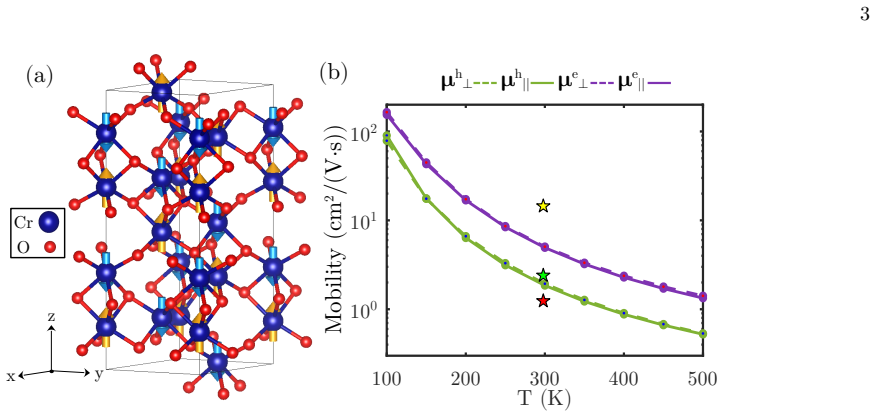
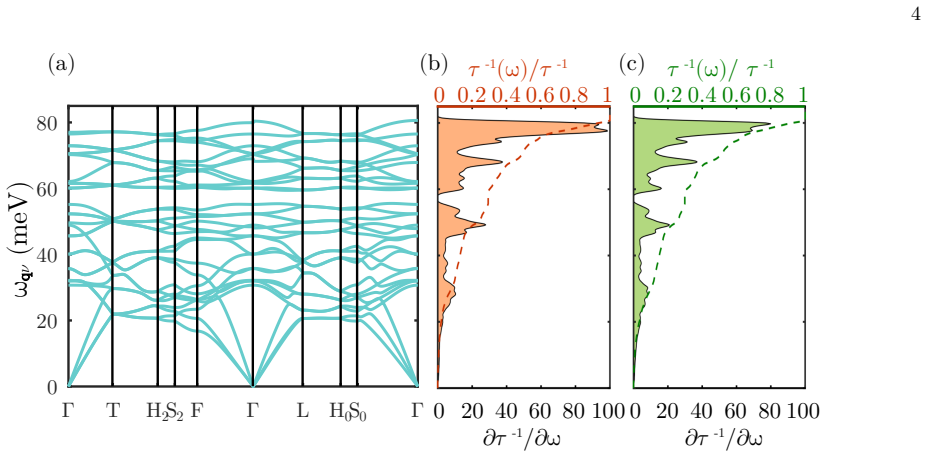
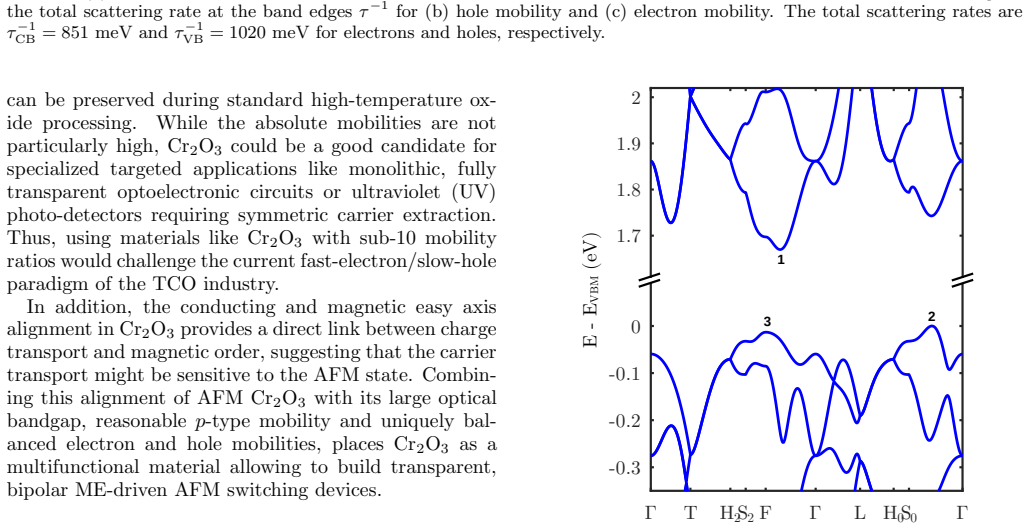
Phonon-limited electron mobility systematically exceeds hole mobility in Cr2O3 over a wide temperature range. The mobility asymmetry originates from the electronic structure, specifically the larger effective mass and multi-valley character of the valence band, while scattering with phonons affects electrons and holes similarly. Cr2O3 is therefore intrinsically n-type, and the commonly observed p-type behavior must be extrinsic.
What carries the argument
Ab initio Boltzmann transport equation calculations of phonon-limited mobilities that isolate the electronic-structure origin of the electron-hole asymmetry.
Load-bearing premise
Phonon-limited mobilities computed via the Boltzmann equation fully set the intrinsic transport character, with defects and other mechanisms not reversing the electron-hole asymmetry.
What would settle it
Direct measurement of temperature-dependent mobilities in high-purity Cr2O3 samples showing hole mobility exceeding electron mobility at any temperature in the computed range would falsify the claim.
Figures
read the original abstract
Chromium oxide (Cr$_2$O$_3$) is widely considered a $p$-type transparent conducting oxide despite ongoing debate regarding its intrinsic transport character. Here, we resolve this question by computing phonon-limited electron and hole mobilities using the ab initio Boltzmann transport equation. We find that electron mobility systematically exceeds hole mobility over a wide temperature range, demonstrating that Cr$_2$O$_3$ is intrinsically $n$-type. Analysis of scattering mechanisms reveals that scattering with phonons affects electrons and holes similarly, and that the mobility asymmetry originates from the electronic structure, namely the larger effective mass and multi-valley character of the valence band. The intrinsic $n$-type character, combined with moderate hole mobility, enables bipolar transport and revises the role of Cr$_2$O$_3$ in transparent electronics. Additionally, our results on mobility complement previous studies on defect formation indicating that the commonly observed $p$-type behavior is extrinsic. These insights provide a complete chemical-transport paradigm for Cr$_2$O$_3$, re-evaluating its role in functional transparent electronic and magneto-optoelectronic applications
Editorial analysis
A structured set of objections, weighed in public.
Referee Report
Summary. The manuscript computes phonon-limited electron and hole mobilities in antiferromagnetic Cr₂O₃ via the ab initio Boltzmann transport equation. It reports that electron mobility exceeds hole mobility over a wide temperature range due to differences in valence-band effective mass and multi-valley character, while phonon scattering affects both carriers similarly. This establishes intrinsic n-type character, with observed p-type behavior attributed to extrinsic defects; the work positions itself as complementary to prior defect-formation studies and relevant for bipolar transport in transparent electronics.
Significance. If the computed mobility asymmetry holds, the result would revise the transport paradigm for Cr₂O₃, enabling a complete intrinsic-plus-extrinsic picture and clarifying its role in magneto-optoelectronic and transparent-conducting applications. The ab initio BTE approach supplies a parameter-free, falsifiable prediction of the electron-hole asymmetry that can be tested against future single-crystal measurements.
minor comments (3)
- Abstract: no numerical mobility values, ratios, or temperature points are stated, making the central claim harder to assess at a glance; adding e.g. μ_e/μ_h at 300 K would strengthen the summary.
- The manuscript should explicitly state convergence criteria for the BTE solution (k/q-grid density, energy cutoff, etc.) and report error estimates on the mobility values to support the claimed systematic asymmetry.
- A brief comparison table or plot against available experimental mobility data (even if limited) would help readers gauge the absolute scale of the computed values.
Simulated Author's Rebuttal
We thank the referee for the positive assessment of our work and the recommendation of minor revision. The summary accurately captures our main findings on the phonon-limited mobilities and the intrinsic n-type character of antiferromagnetic Cr₂O₃. No specific major comments were provided in the report.
Circularity Check
No significant circularity identified
full rationale
The paper's central derivation computes phonon-limited electron and hole mobilities via the ab initio Boltzmann transport equation applied to DFT-derived band structures and phonons. The reported μ_e > μ_h asymmetry is traced explicitly to valence-band effective-mass and multi-valley differences (outputs of the electronic-structure calculation), not to any fitted parameter or self-referential definition. No load-bearing step reduces by construction to the target result; the phonon-scattering analysis is independent of the mobility values themselves. Prior defect-formation studies are cited only as complementary context, not as the justification for the mobility asymmetry. The chain is therefore self-contained against external benchmarks.
Axiom & Free-Parameter Ledger
axioms (1)
- domain assumption The ab initio Boltzmann transport equation with phonon scattering accurately captures the intrinsic electron and hole mobilities.
Reference graph
Works this paper leans on
-
[1]
K. H. Zhang, K. Xi, M. G. Blamire, and R. G. Egdell,p- type transparent conducting oxides, Journal of Physics: Condensed Matter28, 383002 (2016)
2016
-
[2]
Morales-Masis, S
M. Morales-Masis, S. De Wolf, R. Woods-Robinson, J. W. Ager, and C. Ballif, Transparent electrodes for ef- ficient optoelectronics, Advanced Electronic Materials3, 1600529 (2017)
2017
-
[3]
S. C. Dixon, D. O. Scanlon, C. J. Carmalt, and I. P. Parkin,n-type doped transparent conducting binary ox- ides: an overview, Journal of Materials Chemistry C4, 6 6946 (2016)
2016
-
[4]
Rebecchi, N
L. Rebecchi, N. Petrini, I. M. Albo, N. Curreli, and A. Rubino, Transparent conducting metal oxides nanoparticles for solution-processed thin films optoelec- tronics, Optical Materials: X19, 100247 (2023)
2023
-
[5]
Stadler, Transparent conducting oxides—an up-to- date overview, Materials5, 661 (2012)
A. Stadler, Transparent conducting oxides—an up-to- date overview, Materials5, 661 (2012)
2012
-
[6]
Minami, Newn-type transparent conducting oxides, MRS bulletin25, 38 (2000)
T. Minami, Newn-type transparent conducting oxides, MRS bulletin25, 38 (2000)
2000
-
[7]
Zhang, J
N. Zhang, J. Sun, and H. Gong, Transparentp-type semi- conductors: copper-based oxides and oxychalcogenides, Coatings9, 137 (2019)
2019
-
[8]
W. Cui, F. Chen, Y. Li, X. Su, and B. Sun, Status and perspectives of transparent conductive oxide films for sil- icon heterojunction solar cells, Materials Today Nano22, 100329 (2023)
2023
-
[9]
Johnson-Groh, Comprehensive review ofp-andn-type transparent conducting materials, Scilight2021, 341105 (2021)
M. Johnson-Groh, Comprehensive review ofp-andn-type transparent conducting materials, Scilight2021, 341105 (2021)
2021
-
[10]
L. Hu, M. Zhao, S. Liang, D. Song, R. Wei, X. Tang, W. Song, J. Dai, G. He, C. Zhang, X. Zhu, and Y. Sun, Exploring high-performancep-type transparent conduct- ing oxides based on electron correlation in V 2O3 thin films, Phys. Rev. Appl.12, 044035 (2019)
2019
-
[11]
Kawazoe, H
H. Kawazoe, H. Yanagi, K. Ueda, and H. Hosono, Trans- parentp-type conducting oxides: design and fabrication of pn heterojunctions, Mrs Bulletin25, 28 (2000)
2000
-
[12]
Nagarajan, N
R. Nagarajan, N. Duan, M. Jayaraj, J. Li, K. Vanaja, A. Yokochi, A. Draeseke, J. Tate, and A. Sleight,p-type conductivity in the delafossite structure, International Journal of Inorganic Materials3, 265 (2001)
2001
-
[13]
J. Jang, Y. Kang, D. Cha, J. Bae, and S. Lee, Thin-film optical devices based on transparent conducting oxides: Physical mechanisms and applications, Crystals9, 192 (2019)
2019
-
[14]
Moreira, J
M. Moreira, J. Afonso, J. Crepelliere, D. Lenoble, and P. Lunca-Popa, A review on thep-type transparent Cu– Cr–O delafossite materials, Journal of Materials Science 57, 3114 (2022)
2022
-
[15]
A. N. Fioretti and M. Morales-Masis, Bridging thep- type transparent conductive materials gap: synthesis ap- proaches for disperse valence band materials, Journal of Photonics for Energy10, 042002 (2020)
2020
-
[16]
Patel, S
M. Patel, S. Ghosh, J. E. Park, J. Song, D.-W. Kim, and J. Kim, A study of the optical properties of wide bandgap oxides for a transparent photovoltaics platform, Journal of Materials Chemistry C11, 14559 (2023)
2023
-
[17]
Ohta and H
H. Ohta and H. Hosono, Transparent oxide optoelectron- ics, Materials Today7, 42 (2004)
2004
-
[18]
Ozel and A
K. Ozel and A. Yildiz, High-performance transparent AZO UV photodetectors, Optical and Quantum Elec- tronics56, 1258 (2024)
2024
-
[19]
A. K. Rana, J. T. Park, J. Kim, and C.-P. Wong, See- through metal oxide frameworks for transparent photo- voltaics and broadband photodetectors, Nano Energy64, 103952 (2019)
2019
-
[20]
A. B. Kehoe, E. Arca, D. O. Scanlon, I. V. Shvets, and G. W. Watson, Assessing the potential of Mg-doped Cr2O3 as a novelp-type transparent conducting oxide, Journal of Physics: Condensed Matter28, 125501 (2016)
2016
-
[21]
Dabaghmanesh, R
S. Dabaghmanesh, R. Saniz, E. Neyts, and B. Partoens, Sulfur-alloyed Cr2O3: a newp-type transparent conduct- ing oxide host, RSC advances7, 4453 (2017)
2017
-
[22]
Iordanova, M
N. Iordanova, M. Dupuis, and K. M. Rosso, Theoreti- cal characterization of charge transport in chromia (α- Cr2O3), The Journal of chemical physics123(2005)
2005
-
[23]
J. A. Crawford and R. W. Vest, Electrical conductivity of single-crystal Cr 2O3, Journal of Applied Physics35, 2413 (1964)
1964
-
[24]
Mohanapandian, S
K. Mohanapandian, S. S. P. Kamala, P. Periasamy, N. S. Priya, B. Selvakumar, and K. Senthilkannan, Cu 2+ sub- stituted Cr 2O3 nanostructures prepared by microwave- assisted method: an investigation of its structural, mor- phological, optical, and dielectric properties, Journal of Sol-Gel Science and Technology99, 546 (2021)
2021
-
[25]
E. Arca, A. B. Kehoe, T. D. Veal, A. Shmeliov, D. O. Scanlon, C. Downing, D. Daly, D. Mullarkey, I. V. Shvets, V. Nicolosi,et al., Valence band modification of Cr2O3 by Ni-doping: creating a high figure of meritp-type TCO, Journal of Materials Chemistry C5, 12610 (2017)
2017
-
[26]
Uekawa and K
N. Uekawa and K. Kaneko, Dopant reduction inp-type oxide films upon oxygen absorption, The Journal of Phys- ical Chemistry100, 4193 (1996)
1996
-
[27]
E. Arca, K. Fleischer, and I. Shvets, Magnesium, nitrogen codoped Cr 2O3: Ap-type transparent conducting oxide, Applied Physics Letters99(2011)
2011
-
[28]
Jagadish and D
K. Jagadish and D. Kekuda, Performance evaluation of p-type Cr2O3 thin films grown by reactive DC magnetron sputtering for schottky diode applications, Materials Re- search Express11, 105901 (2024)
2024
-
[29]
Park and K
J.-H. Park and K. Natesan, Electronic transport in ther- mally grown Cr 2O3, Oxidation of Metals33, 31 (1990)
1990
-
[30]
Jella, S.-H
V. Jella, S.-H. Kang, S. Pammi, J.-H. Eom, J.-R. Jeong, and S.-G. Yoon, Thermoelectric properties of nanocom- positen-type Cr 2O3/Cr thin films deposited by a reactive sputtering, Vacuum140, 71 (2017)
2017
-
[31]
Holt and P
A. Holt and P. Kofstad, Electrical conductivity of Cr 2O3 doped with TiO 2, Solid state ionics117, 21 (1999)
1999
-
[32]
Su and G
M.-Y. Su and G. Simkovich, Point defect structure of chromium (iii) oxide, inNon-Stoichiometric Com- pounds: Surfaces, Grain Boundaries and Structural De- fects(Springer, 1989) pp. 93–113
1989
-
[33]
Parsa, L
Y. Parsa, L. Latu-Romain, Y. Wouters, S. Mathieu, T. P´ erez, and M. Vilasi, Effect of oxygen partial pres- sure on the semiconducting properties of thermally grown chromia on pure chromium, Corrosion Science141, 46 (2018)
2018
-
[34]
Kofstad and K
P. Kofstad and K. Lillerud, On high temperature oxi- dation of chromium: Ii. properties of and the oxidation mechanism of chromium, Journal of the electrochemical society127, 2410 (1980)
1980
-
[35]
P. F. Newhouse, C.-H. Park, D. A. Keszler, J. Tate, and P. Nyholm, High electron mobility W-doped In 2O3 thin films by pulsed laser deposition, Applied Physics Letters 87(2005)
2005
-
[36]
Ou, C.-Y
C.-W. Ou, C.-Y. Yang, M.-C. Wu, C.-W. Chu,et al., Ambipolar transport behavior in In 2O3/pentacene hy- brid heterostructure and their complementary circuits, Applied Physics Letters93(2008)
2008
-
[37]
de Boer, M
T. de Boer, M. F. Bekheet, A. Gurlo, R. Riedel, and A. Moewes, Band gap and electronic structure of cu- bic, rhombohedral, and orthorhombic In2O3 polymorphs: Experiment and theory, Phys. Rev. B93, 155205 (2016)
2016
-
[38]
Nagata, O
T. Nagata, O. Bierwagen, Z. Galazka, M. Imura, S. Ueda, H. Yoshikawa, Y. Yamashita, and T. Chikyow, Photoelec- tron spectroscopic study of electronic state and surface structure of In 2O3 single crystals, Applied Physics Ex- 7 press10, 011102 (2017)
2017
-
[39]
Z. Li, P. Graziosi, and N. Neophytou, Electron and hole mobility of SnO 2 from full-band electron–phonon and ionized impurity scattering computations, Crystals12, 1591 (2022)
2022
-
[40]
Musztyfaga-Staszuk, Z
M. Musztyfaga-Staszuk, Z. Starowicz, P. Panek, R. Socha, and K. Gawli´ nska-Necek, The influence of material parameters on optical and electrical properties of indium-tin oxide (ITO) layer, inJournal of Physics: Conference Series, Vol. 1534 (IOP Publishing, 2020) p. 012001
2020
-
[41]
Z lotnik, A
S. Z lotnik, A. Pianelli, J. Boguski, M. A. Kojdecki, P. Moszczy´ nski, J. Parka, and J. Wr´ obel, Experimental verification of single-type electron population in indium tin oxide layers, physica status solidi (RRL)–Rapid Re- search Letters16, 2200170 (2022)
2022
-
[42]
S. A. Mun, S. Park, M.-H. Lee, Y. Lee, S. Kang, J. Choi, J. Ham, J. Choi, and C. S. Hwang, Analysis of the am- bipolar conduction of tin monoxide thin-film transistors with indium tin oxide electrodes, ACS Applied Materials & Interfaces17, 23357 (2025)
2025
-
[43]
Hutson, Electronic properties of ZnO, Journal of Physics and Chemistry of Solids8, 467 (1959)
A. Hutson, Electronic properties of ZnO, Journal of Physics and Chemistry of Solids8, 467 (1959)
1959
-
[44]
Mora-Fonz and A
D. Mora-Fonz and A. L. Shluger, Modeling of intrinsic electron and hole trapping in crystalline and amorphous ZnO, Advanced Electronic Materials6, 1900760 (2020)
2020
-
[45]
M. S. Hammer, C. Deibel, J. Pflaum, and V. Dyakonov, Effect of doping of zinc oxide on the hole mobility of poly (3-hexylthiophene) in hybrid transistors, Organic Elec- tronics11, 1569 (2010)
2010
-
[46]
M. R. Ahmad, A. A. Ansari, M. Dhayal, and R. Lv, Bandgap engineering of ZnO nanomaterials for enhanced electrochemical and photocatalytic efficiency, Renewable and Sustainable Energy Reviews219, 115767 (2025)
2025
-
[47]
Zhang, J
L. Zhang, J. Huang, Y. Shen, F. Liu, P. Zhang, D. Wang, K. Wu, and Y. Wei, First principles investigation of elec- tron mobility enhancement ofβ-Ga 2O3 doped with in- dium, Physical Chemistry Chemical Physics27, 3988 (2025)
2025
-
[48]
C. Ma, Z. Wu, Z. Jiang, Y. Chen, W. Ruan, H. Zhang, H. Zhu, G. Zhang, J. Kang, T.-Y. Zhang,et al., Explor- ing the feasibility and conduction mechanisms ofp-type nitrogen-dopedβ-Ga 2O3 with high hole mobility, Journal of Materials Chemistry C10, 6673 (2022)
2022
-
[49]
Peelaers and C
H. Peelaers and C. G. Van de Walle, Sub-band-gap ab- sorption in Ga 2O3, Applied Physics Letters111(2017)
2017
-
[50]
Y. Shin, S. T. Kim, K. Kim, M. Y. Kim, S. Oh, and J. K. Jeong, The mobility enhancement of indium gallium zinc oxide transistors via low-temperature crystallization us- ing a tantalum catalytic layer, Scientific reports7, 10885 (2017)
2017
-
[51]
D. C. Hays, B. Gila, S. Pearton, and F. Ren, Energy band offsets of dielectrics on InGaZnO4, Applied Physics Reviews4(2017)
2017
-
[52]
S. Li, X. Zhang, P. Zhang, X. Sun, H. Zheng, and W. Zhang, Preparation and characterization of solution- processed nanocrystallinep-type CuAlO 2 thin-film tran- sistors, Nanoscale research letters13, 259 (2018)
2018
-
[53]
Z. Yao, B. He, L. Zhang, C. Zhuang, T. Ng, S. Liu, M. Vogel, A. Kumar, W. Zhang, C. Lee,et al., Energy band engineering and controlledp-type conductivity of CuAlO2 thin films by nonisovalent Cu−O alloying, Ap- plied Physics Letters100(2012)
2012
-
[54]
Pellicer-Porres, A
J. Pellicer-Porres, A. Segura, A. Gilliland, A. Munoz, P. Rodr´ ıguez-Hern´ andez, D. Kim, M. Lee, and T. Kim, On the band gap of CuAlO 2 delafossite, Applied physics letters88(2006)
2006
-
[55]
M. G. Chae, J. Kim, H. W. Jang, B. K. Park, T.-M. Chung, S. K. Kim, and J. H. Han, High field-effect mo- bility and on/off current ratio of p-type ALD SnO thin- film transistor, ACS Applied Electronic Materials5, 1992 (2023)
1992
-
[56]
Y. Ogo, H. Hiramatsu, K. Nomura, H. Yanagi, T. Kamiya, M. Hirano, and H. Hosono, p-channel thin- film transistor using p-type oxide semiconductor, SnO, Applied Physics Letters93(2008)
2008
-
[57]
Ponc´ e, W
S. Ponc´ e, W. Li, S. Reichardt, and F. Giustino, First- principles calculations of charge carrier mobility and con- ductivity in bulk semiconductors and two-dimensional materials, Reports on Progress in Physics83, 036501 (2020)
2020
-
[58]
Claes, S
R. Claes, S. Ponc´ e, G.-M. Rignanese, and G. Hautier, Phonon-limited electronic transport through first princi- ples, Nature Reviews Physics7, 73–90 (2025)
2025
-
[59]
´A. A. Carrasco ´Alvarez, M. Giantomassi, J. Lihm, G. E. Allemand, M. Mignolet, M. Verstraete, and S. Ponc´ e, Electron-phonon coupling in magnetic mate- rials using the local spin density approximation (2025), arXiv:2510.11350 [cond-mat.mtrl-sci]
Pith/arXiv arXiv 2025
-
[60]
´A. A. Carrasco ´Alvarez and S. Ponc´ e, Challenging the p-type paradigm: Intrinsicn-type mobility in antiferro- magnetic Cr2O3 (2026)
2026
-
[61]
Giannozzi, S
P. Giannozzi, S. Baroni, N. Bonini, M. Calandra, R. Car, C. Cavazzoni, D. Ceresoli, G. L. Chiarotti, M. Cococ- cioni, I. Dabo, A. Dal Corso, S. de Gironcoli, S. Fabris, G. Fratesi, R. Gebauer, U. Gerstmann, C. Gougoussis, A. Kokalj, M. Lazzeri, L. Martin-Samos, N. Marzari, F. Mauri, R. Mazzarello, S. Paolini, A. Pasquarello, L. Paulatto, C. Sbraccia, S. S...
2009
-
[62]
Giannozzi, O
P. Giannozzi, O. Andreussi, T. Brumme, O. Bunau, M. Buongiorno Nardelli, M. Calandra, R. Car, C. Cavaz- zoni, D. Ceresoli, M. Cococcioni, N. Colonna, I. Carn- imeo, A. Dal Corso, S. de Gironcoli, P. Delugas, R. A. DiStasio, A. Ferretti, A. Floris, G. Fratesi, G. Fugallo, R. Gebauer, U. Gerstmann, F. Giustino, T. Gorni, J. Jia, M. Kawamura, H.-Y. Ko, A. Ko...
2017
-
[63]
D. R. Hamann, Optimized norm-conserving vanderbilt pseudopotentials, Physical Review B88, 085117 (2013)
2013
-
[64]
van Setten, M
M. van Setten, M. Giantomassi, E. Bousquet, M. Ver- straete, D. Hamann, X. Gonze, and G.-M. Rignanese, The pseudodojo: Training and grading a 85 element opti- mized norm-conserving pseudopotential table, Computer Physics Communications226, 39–54 (2018)
2018
-
[65]
J. P. Perdew, K. Burke, and M. Ernzerhof, Generalized gradient approximation made simple, Physical Review 8 Letters77, 3865–3868 (1996)
1996
-
[66]
Abdullah, F
M. Abdullah, F. M. Rajab, and S. M. Al-Abbas, Struc- tural and optical characterization of Cr 2O3 nanostruc- tures: Evaluation of its dielectric properties, Aip Ad- vances4(2014)
2014
-
[67]
Baroni, P
S. Baroni, P. Giannozzi, and A. Testa, Green’s-function approach to linear response in solids, Physical Review Letters58, 1861–1864 (1987)
1987
-
[68]
S. Y. Savrasov, Linear response calculations of lattice dy- namics using muffin-tin basis sets, Physical Review Let- ters69, 2819–2822 (1992)
1992
-
[69]
Gonze and C
X. Gonze and C. Lee, Dynamical matrices, born effective charges, dielectric permittivity tensors, and interatomic force constants from density-functional perturbation the- ory, Physical Review B55, 10355–10368 (1997)
1997
-
[70]
Baroni, S
S. Baroni, S. de Gironcoli, A. Dal Corso, and P. Gi- annozzi, Phonons and related crystal properties from density-functional perturbation theory, Reviews of Mod- ern Physics73, 515–562 (2001)
2001
-
[71]
Pizzi, V
G. Pizzi, V. Vitale, R. Arita, S. Bl¨ ugel, F. Freimuth, G. G´ eranton, M. Gibertini, D. Gresch, C. Johnson, T. Koretsune, J. Iba˜ nez-Azpiroz, H. Lee, J.-M. Lihm, D. Marchand, A. Marrazzo, Y. Mokrousov, J. I. Mustafa, Y. Nohara, Y. Nomura, L. Paulatto, S. Ponc´ e, T. Pon- weiser, J. Qiao, F. Th¨ ole, S. S. Tsirkin, M. Wierzbowska, N. Marzari, D. Vanderbi...
2020
-
[72]
H. Lee, S. Ponc´ e, K. Bushick, S. Hajinazar, J. Lafuente- Bartolome, J. Leveillee, C. Lian, J.-M. Lihm, F. Macheda, H. Mori, H. Paudyal, W. H. Sio, S. Tiwari, M. Zacharias, X. Zhang, N. Bonini, E. Kioupakis, E. R. Margine, and F. Giustino, Electron–phonon physics from first principles using the epw code, npj Computational Materials9, 156 (2023)
2023
-
[73]
W. Yang, S. Tiwari, F. Giustino, and Y.-W. Son, First-principles electron-phonon interactions with self- consistent hubbard interaction: Application to transpar- ent conducting oxides, Phys. Rev. B112, 075203 (2025)
2025
-
[74]
Ponc´ e, E
S. Ponc´ e, E. R. Margine, and F. Giustino, Towards pre- dictive many-body calculations of phonon-limited car- rier mobilities in semiconductors, Physical Review B97, 121201 (2018)
2018
-
[75]
Gurevich, O
V. Gurevich, O. Kuskov, N. Smirnova, K. Gavrichev, and A. Markin, Thermodynamic functions of eskolaite Cr2O3 (c) at 0–1800 K, Geochemistry International47, 1170 (2009)
2009
-
[76]
C. T. Anderson, The heat capacities of chromium, chromic oxide, chromous chloride and chromic chloride at low temperatures1, Journal of the American Chemical Society59, 488 (1937)
1937
-
[77]
A. P. Singh Rathod, A. Mishra, W. Ahmad, and S. Ku- mar, Green synthesis of Cr 2O3 nanoparticles for en- hanced otft performance compared to pentacene-based organic thin film transistor devices, Nanochemistry Re- search10, 137 (2025)
2025
-
[78]
Qiu, X.-S
Y.-H. Qiu, X.-S. Qiu, and C.-W. Huang, Eco-friendly and recyclable liquid metal synthesis of two-dimensional Cr2O3 and CrN nanosheets for photoresponse and field effect transistors, ACS Applied Electronic Materials6, 7003 (2024)
2024
-
[79]
E. G. Bittle, J. I. Basham, T. N. Jackson, O. D. Jurch- escu, and D. J. Gundlach, Mobility overestimation due to gated contacts in organic field-effect transistors, Nature communications7, 10908 (2016)
2016
-
[80]
Y. Hu, G. Li, and Z. Chen, The importance of contact resistance in high-mobility organic field-effect transistors studied by scanning kelvin probe microscopy, IEEE Elec- tron Device Letters39, 276 (2017)
2017
discussion (0)
Sign in with ORCID, Apple, or X to comment. Anyone can read and Pith papers without signing in.