Unbiased Canonical Set-Valued Oracles Via Lattice Theory
Pith reviewed 2026-06-30 09:23 UTC · model grok-4.3
The pith
Reporting the Knaster-Tarski least fixed point of an isotone operator on closed credal sets produces a canonical self-consistent answer to performative probability queries.
A machine-rendered reading of the paper's core claim, the machinery that carries it, and where it could break.
Core claim
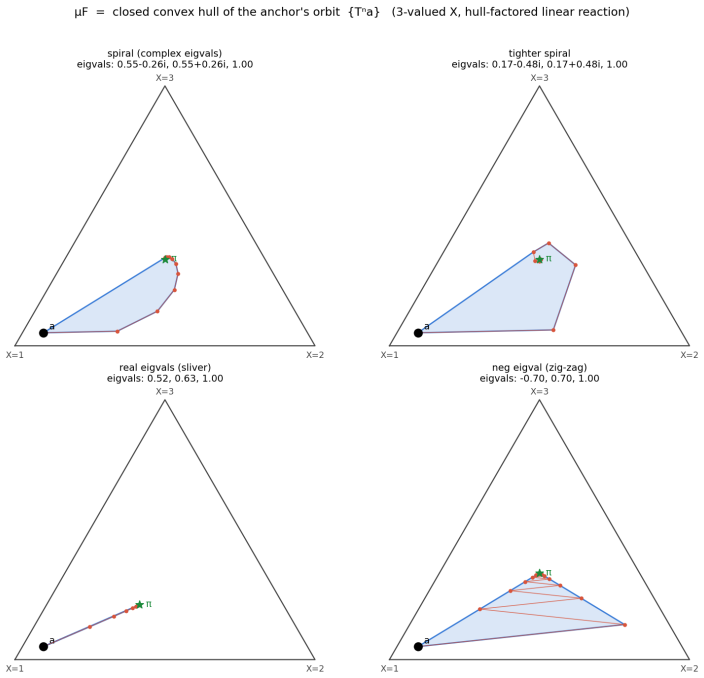
Reporting a credal set instead of a single probability distribution, we lift the reaction to an isotone operator on the complete lattice of closed credal sets, whose fixed points are self-consistent, and report its Knaster-Tarski least fixed point as a canonical, rule-determined answer; a variant reports instead the least fixed point that contains every self-consistent point estimate. We prove existence, self-consistency, and nonemptiness; show that the construction reduces to the classical point answer when the question is non-performative; and show that for a binary event the answer is, under a natural hull-factoring assumption, an interval.
What carries the argument
The isotone operator on the complete lattice of closed credal sets whose fixed points are the self-consistent credal sets, with selection of its Knaster-Tarski least fixed point as the canonical report.
If this is right
- The reported credal set is always nonempty and self-consistent by construction.
- When the underlying query is non-performative the least fixed point reduces to a single probability distribution.
- A variant construction yields the smallest fixed point that contains every self-consistent point estimate.
- Existence and uniqueness properties follow directly from the Knaster-Tarski theorem on complete lattices.
Where Pith is reading between the lines
- The same lattice-lift technique could be applied to performative forecasts in economics or policy where multiple self-fulfilling equilibria exist.
- Replacing the least-fixed-point rule with other lattice operations might produce different canonical reports while retaining self-consistency.
- The method supplies a formal way to keep an AI predictor's output stable under its own influence without introducing external selection criteria.
Load-bearing premise
The hull-factoring assumption is needed to conclude that the canonical answer for a binary event is an interval.
What would settle it
A concrete performative binary query whose induced isotone operator on closed credal sets has a least fixed point that is not an interval when the hull-factoring condition holds.
Figures
read the original abstract
A non-agentic "oracle" that reports probabilities of future events is performative: once its answer is learned and acted upon, it can change the very probability it was asked to report. Performativity is not in itself the difficulty -- one consults an oracle precisely in order to be informed, and hence influenced, by it. The difficulty is agency. The requirement that a report be self-consistent, still holding once announced, may be met by many different values -- the classical non-uniqueness of self-fulfilling prophecies -- and any rule the system uses to choose among them is a lever for goal-directed steering. We remove the choice rather than the performativity. Reporting a credal set instead of a single probability distribution, we lift the reaction to an isotone operator on the complete lattice of closed credal sets, whose fixed points are self-consistent, and report its Knaster--Tarski least fixed point as a canonical, rule-determined answer; a variant reports instead the least fixed point that contains every self-consistent point estimate. We prove existence, self-consistency, and nonemptiness; show that the construction reduces to the classical point answer when the question is non-performative; and show that for a binary event the answer is, under a natural hull-factoring assumption, an interval.
Editorial analysis
A structured set of objections, weighed in public.
Referee Report
Summary. The paper addresses performative oracles by reporting credal sets rather than point probabilities. It lifts the reaction to an isotone operator on the complete lattice of closed credal sets, takes the Knaster-Tarski least fixed point as a canonical self-consistent answer (with a variant containing all self-consistent points), proves existence/self-consistency/nonemptiness, shows reduction to the classical point answer when non-performative, and shows that for binary events the answer is an interval under a natural hull-factoring assumption.
Significance. If the results hold, the construction supplies a parameter-free, rule-determined canonical answer to performative queries via standard lattice theory, avoiding arbitrary selection among self-consistent values. The use of the Knaster-Tarski theorem for a clean existence proof on the lattice of closed credal sets, together with the reduction to the non-performative case, is a clear strength.
major comments (1)
- [Abstract] Abstract: the claim that the answer is an interval for a binary event rests on the hull-factoring assumption. This assumption is external to the isotonicity and completeness properties used for the Knaster-Tarski fixed point; the manuscript must define the assumption precisely (e.g., in the section deriving the binary case) and show either that it follows from the lattice construction or that its scope is limited in a way that preserves the main result.
minor comments (1)
- The operator and the precise topology on the space of closed credal sets should be defined before the statement of the main theorems to make the isotonicity argument fully self-contained.
Simulated Author's Rebuttal
We thank the referee for the careful reading and constructive suggestion regarding the hull-factoring assumption. We will revise the manuscript to address this point explicitly while preserving the core lattice-theoretic contributions.
read point-by-point responses
-
Referee: [Abstract] Abstract: the claim that the answer is an interval for a binary event rests on the hull-factoring assumption. This assumption is external to the isotonicity and completeness properties used for the Knaster-Tarski fixed point; the manuscript must define the assumption precisely (e.g., in the section deriving the binary case) and show either that it follows from the lattice construction or that its scope is limited in a way that preserves the main result.
Authors: We agree that the hull-factoring assumption is external to the isotonicity and completeness properties underlying the Knaster-Tarski application and must be stated precisely. In the revised manuscript we will add an explicit definition of the assumption in the section deriving the binary-event result. We will also clarify that the assumption does not follow from the lattice construction alone but is a natural, mild condition specific to the binary case that permits the credal set to be represented as a closed interval; the general theorems on existence, self-consistency, non-emptiness, and reduction to the non-performative point estimate remain unaffected and do not rely on it. The scope of the assumption is thereby limited to the illustrative binary case. revision: yes
Circularity Check
No significant circularity; standard lattice theorem applied with explicit extra assumption
full rationale
The central derivation applies the Knaster-Tarski theorem (an external, well-known result on complete lattices) to the lattice of closed credal sets to obtain the least fixed point. This is not self-referential or fitted. The interval claim for binary events is explicitly conditioned on a separate 'natural hull-factoring assumption' that is not derived from isotonicity or the fixed-point operator; the paper does not claim the lattice construction alone forces an interval. No self-citations, ansatzes smuggled via citation, or renamings of known results appear in the provided text. The construction reduces to the classical point answer when non-performative, as stated, without circularity.
Axiom & Free-Parameter Ledger
axioms (1)
- domain assumption hull-factoring assumption
Reference graph
Works this paper leans on
-
[1]
Good and safe uses of AI Oracles
S. Armstrong and X. O'Rorke. Good and safe uses of AI oracles. arXiv:1711.05541, 2018
work page internal anchor Pith review Pith/arXiv arXiv 2018
-
[2]
Balke and J
A. Balke and J. Pearl. Counterfactual probabilities: Computational methods, bounds and applications. In Proc.\ Uncertainty in Artificial Intelligence (UAI-94), pages 46--54, 1994
1994
-
[3]
Y. Bengio et al. Superintelligent agents pose catastrophic risks: Can Scientist AI offer a safer path? arXiv:2502.15657, 2025
-
[4]
Y. Bengio et al. Can a Bayesian oracle prevent harm from an agent? arXiv:2408.05284, 2025
-
[5]
Fornasiere et al
D. Fornasiere et al. The Scientist AI: Safe by design, by not desiring. LawZero technical report, 2026. https://lawzero.org/en/publication/scientist-ai-safe-design-not-desiring
2026
-
[6]
E. Grunberg and F. Modigliani. The predictability of social events. Journal of Political Economy, 62(6):465--478, 1954. doi:10.1086/257604
-
[7]
M. Hardt and C. Mendler-D\"unner. Performative prediction: Past and future. Statistical Science, 2025. doi:10.1214/25-STS986. arXiv:2310.16608
-
[8]
D. Krueger, T. Maharaj, and J. Leike. Hidden incentives for auto-induced distributional shift. arXiv:2009.09153, 2020
-
[9]
C. F. Manski. Partial Identification of Probability Distributions. Springer, New York, 2003
2003
-
[10]
C. Mendler-D\"unner et al. Revisiting the predictability of performative, social events. arXiv:2503.11713, 2025
-
[11]
R. K. Merton. The self-fulfilling prophecy. The Antioch Review, 8(2):193--210, 1948
1948
-
[12]
Milgrom and J
P. Milgrom and J. Roberts. Rationalizability, learning, and equilibrium in games with strategic complementarities. Econometrica, 58(6):1255--1277, 1990
1990
-
[13]
Morgenstern
O. Morgenstern. Wirtschaftsprognose: Eine Untersuchung ihrer Voraussetzungen und M\"oglichkeiten. Springer, Vienna, 1928
1928
-
[14]
J. F. Muth. Rational expectations and the theory of price movements. Econometrica, 29(3):315--335, 1961
1961
- [15]
-
[16]
K. R. Popper. The Poverty of Historicism. Routledge, London, 1957
1957
-
[17]
Seidenfeld, M
T. Seidenfeld, M. J. Schervish, and J. B. Kadane. Forecasting with imprecise probabilities. International Journal of Approximate Reasoning, 53(8):1248--1261, 2012
2012
-
[18]
H. A. Simon. Bandwagon and underdog effects and the possibility of election predictions. Public Opinion Quarterly, 18(3):245--253, 1954
1954
-
[19]
A. Tarski. A lattice-theoretical fixpoint theorem and its applications. Pacific Journal of Mathematics, 5(2):285--309, 1955. doi:10.2140/pjm.1955.5.285
- [20]
-
[21]
P. Walley. Statistical Reasoning with Imprecise Probabilities. Chapman & Hall, London, 1991
1991
discussion (0)
Sign in with ORCID, Apple, or X to comment. Anyone can read and Pith papers without signing in.