Unitarity Cuts, t-channel Divergences and the KLN Theorem for Unstable Particles
Pith reviewed 2026-06-26 04:49 UTC · model grok-4.3
The pith
The KLN theorem cancels t-channel divergences by summing over degenerate processes in models with unstable particles.
A machine-rendered reading of the paper's core claim, the machinery that carries it, and where it could break.
Core claim
In an illustrative model exhibiting a t-channel divergence, the KLN theorem guarantees that summing over all physically-degenerate processes cancels the divergences, yielding finite inclusive observables, with the cancellations holding across several regularization schemes and relating to the complex-analytic structure of the underlying amplitudes.
What carries the argument
The KLN theorem applied within an illustrative model with t-channel divergence, which isolates and resolves the technical obstacles of disconnected diagrams and regulator dependence for inclusive observables.
If this is right
- Inclusive t-channel collider observables become finite at fixed order once all physically degenerate processes are summed.
- Cancellations of divergences hold intricately and consistently across multiple regularization schemes.
- The cancellations relate directly to the complex-analytic structure of the amplitudes.
Where Pith is reading between the lines
- The prescriptions may extend to processes involving multiple species of unstable particles where t-channel singularities arise.
- The link to analytic structure could guide choices of regulators that preserve the cancellation at higher perturbative orders.
Load-bearing premise
The illustrative model with t-channel divergence captures the essential technical obstacles that appear in realistic collider processes involving unstable particles.
What would settle it
An explicit computation in the model of a summed inclusive t-channel observable that retains a nonzero divergence after all degenerate contributions are included would falsify the cancellation claim.
Figures
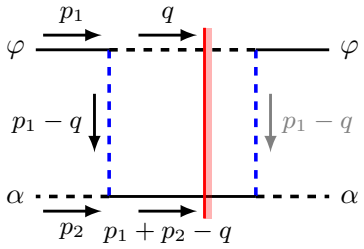
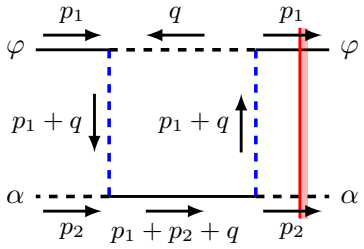
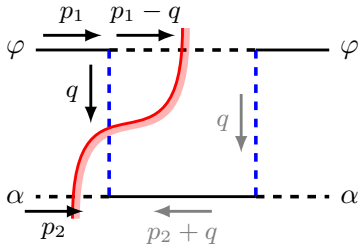
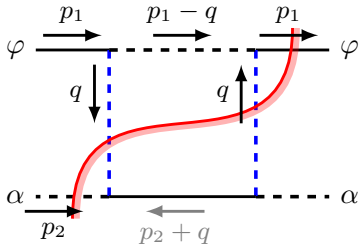

read the original abstract
Many phenomenological calculations involving massless or unstable particles suffer from divergences as mediating particles go on-shell. One way to deal with these divergences is via the Kinoshita-Lee-Nauenberg (KLN) theorem, which guarantees that by summing over all physically-degenerate processes, the divergences cancel and inclusive observables remain finite. However, actually implementing this theorem in practice requires handling disconnected diagrams, ill-defined distributional objects, threshold behavior and subtle regulator dependence. In this work, we formulate practical prescriptions for dealing with some of these issues by studying the KLN cancellation in an illustrative model exhibiting a t-channel divergence. We demonstrate intricate cancellations across several regularization schemes, connect our results to the complex-analytic structure of the underlying amplitudes, and take steps towards constructing a finite, fixed-order, inclusive t-channel collider observable. This work highlights both the utility of the KLN theorem, and also the technical subtleties and open questions involved with applying it in practice.
Editorial analysis
A structured set of objections, weighed in public.
Referee Report
Summary. The paper studies the KLN theorem applied to t-channel divergences arising from unstable particles. Using an illustrative model, it formulates prescriptions for handling disconnected diagrams, distributional objects, threshold behavior and regulator dependence; demonstrates explicit cancellations across multiple regularization schemes; connects the cancellations to the complex-analytic structure of the amplitudes; and outlines steps toward a finite fixed-order inclusive t-channel collider observable.
Significance. If the cancellations and prescriptions hold in the chosen model, the work supplies concrete technical guidance for implementing inclusive observables involving unstable particles, a recurring issue in collider phenomenology. The explicit multi-scheme checks and analytic-structure linkage constitute a strength; the manuscript also correctly flags open questions rather than claiming a complete solution.
major comments (1)
- The central demonstration is performed in a scalar illustrative model. The skeptic correctly notes that gauge quantum numbers and multi-leg amplitudes introduce additional cut structures and Ward-identity constraints that may alter the cancellation pattern. Because the paper positions the model as capturing the essential obstacles (disconnected diagrams, distributional objects, regulator dependence), a dedicated subsection should compare the analytic structure found here with the corresponding cuts in a gauge-theory example (e.g., a toy electroweak process) to substantiate transferability.
minor comments (2)
- Notation for the distributional objects (principal-value prescriptions, delta-function handling) should be introduced once with an explicit equation rather than redefined in each regularization scheme.
- The abstract states that 'intricate cancellations' are shown; the corresponding figures or tables should be cross-referenced in the text so the reader can locate the numerical or analytic evidence without searching.
Simulated Author's Rebuttal
We thank the referee for the constructive report and positive assessment of the manuscript's technical contributions. We address the single major comment below.
read point-by-point responses
-
Referee: The central demonstration is performed in a scalar illustrative model. The skeptic correctly notes that gauge quantum numbers and multi-leg amplitudes introduce additional cut structures and Ward-identity constraints that may alter the cancellation pattern. Because the paper positions the model as capturing the essential obstacles (disconnected diagrams, distributional objects, regulator dependence), a dedicated subsection should compare the analytic structure found here with the corresponding cuts in a gauge-theory example (e.g., a toy electroweak process) to substantiate transferability.
Authors: We agree that transferability to gauge theories merits explicit discussion, given the paper's framing of the scalar model. In the revised manuscript we will add a dedicated subsection (new Section 5.3) that compares the cut structures and distributional features identified in the scalar model with the corresponding structures in a minimal gauge-theory toy model (a simplified electroweak process with unstable vector bosons). The subsection will (i) map the t-channel on-shell cuts, (ii) note how Ward identities constrain the residues but do not remove the KLN cancellation mechanism, and (iii) flag that multi-leg amplitudes introduce additional phase-space regions whose treatment follows the same regulator-independent logic. A complete numerical implementation in the gauge case lies outside the present scope and is noted as future work; the added subsection therefore substantiates the model's role without overclaiming universality. revision: partial
Circularity Check
No significant circularity in derivation chain
full rationale
The paper performs explicit calculations of unitarity cuts and KLN cancellations within a chosen illustrative model, demonstrating regulator-dependent cancellations and connections to analytic structure through direct amplitude evaluation. No load-bearing step reduces a claimed result to a fitted parameter, self-definition, or self-citation chain; the work is self-contained as a technical study of the model's specific obstacles without renaming known results or importing uniqueness theorems from prior author work.
Axiom & Free-Parameter Ledger
Reference graph
Works this paper leans on
-
[1]
R. J. Eden, P. V. Landshoff, D. I. Olive, and J. C. Polkinghorne,The Analytic S-Matrix. Cambridge University Press, Cambridge, 1966
1966
-
[2]
t-channel singularities in cosmology and particle physics,
B. Grzadkowski, M. Iglicki, and S. Mr´ owczy´ nski, “t-channel singularities in cosmology and particle physics,”Nucl. Phys. B984(2022) 115967,arXiv:2108.01757 [hep-ph]
arXiv 2022
-
[3]
Possible Mechanism for the Pion-Nucleon Second Resonance,
R. F. Peierls, “Possible Mechanism for the Pion-Nucleon Second Resonance,”Phys. Rev. Lett.6(1961) 641–643
1961
-
[4]
Initial particle instability in muon collisions,
I. F. Ginzburg, “Initial particle instability in muon collisions,”Nucl. Phys. B Proc. Suppl. 51(1996) 85–89,arXiv:hep-ph/9601272
Pith/arXiv arXiv 1996
-
[5]
Relic density computations at NLO: infrared finiteness and thermal correction,
M. Beneke, F. Dighera, and A. Hryczuk, “Relic density computations at NLO: infrared finiteness and thermal correction,”JHEP10(2014) 045,arXiv:1409.3049 [hep-ph]. [Erratum: JHEP 07, 106 (2016)]
Pith/arXiv arXiv 2014
-
[6]
Dark matter freeze-in from non-equilibrium QFT: towards a consistent treatment of thermal effects,
M. Becker, E. Copello, J. Harz, and C. Tamarit, “Dark matter freeze-in from non-equilibrium QFT: towards a consistent treatment of thermal effects,”JCAP03(2025) 071,arXiv:2312.17246 [hep-ph]
arXiv 2025
-
[7]
Freeze-in and freeze-out of sterile neutrino dark matter,
R. Coy and M. A. Schmidt, “Freeze-in and freeze-out of sterile neutrino dark matter,” JCAP08(2022) 070,arXiv:2204.08795 [hep-ph]. [Erratum: JCAP 04, E01 (2023)]
arXiv 2022
-
[8]
B. Garbrecht, F. Glowna, and M. Herranen, “Right-Handed Neutrino Production at Finite Temperature: Radiative Corrections, Soft and Collinear Divergences,”JHEP04(2013) 099, arXiv:1302.0743 [hep-ph]
Pith/arXiv arXiv 2013
-
[9]
B. Garbrecht, F. Glowna, and P. Schwaller, “Scattering Rates For Leptogenesis: Damping of Lepton Flavour Coherence and Production of Singlet Neutrinos,”Nucl. Phys. B877(2013) 1–35,arXiv:1303.5498 [hep-ph]
Pith/arXiv arXiv 2013
-
[10]
Asymptotic conditions and infrared divergences in quantum electrodynamics,
P. P. Kulish and L. D. Faddeev, “Asymptotic conditions and infrared divergences in quantum electrodynamics,”Theor. Math. Phys.4(1970) 745
1970
-
[11]
IR finite S-matrix by gauge invariant dressed states,
H. Hirai and S. Sugishita, “IR finite S-matrix by gauge invariant dressed states,”JHEP02 (2021) 025,arXiv:2009.11716 [hep-th]
arXiv 2021
-
[12]
On the need for soft dressing,
D. Carney, L. Chaurette, D. Neuenfeld, and G. Semenoff, “On the need for soft dressing,” JHEP09(2018) 121,arXiv:1803.02370 [hep-th]. 55
Pith/arXiv arXiv 2018
-
[13]
IR Finite S Matrix in the QCD Coherent State Basis,
G. Giavarini and G. Marchesini, “IR Finite S Matrix in the QCD Coherent State Basis,” Nucl. Phys. B296(1988) 546–556
1988
-
[14]
Theory of the asymptotic S matrix for massless particles,
H. F. Contopanagos and M. B. Einhorn, “Theory of the asymptotic S matrix for massless particles,”Phys. Rev. D45(1992) 1291–1321
1992
-
[15]
Infrared finite amplitudes for massless gauge theories,
D. A. Forde and A. Signer, “Infrared finite amplitudes for massless gauge theories,”Nucl. Phys. B684(2004) 125–161,arXiv:hep-ph/0311059
Pith/arXiv arXiv 2004
-
[16]
H. Hannesdottir and M. D. Schwartz, “FiniteSmatrix,”Phys. Rev. D107no. 2, (2023) L021701,arXiv:1906.03271 [hep-th]
arXiv 2023
-
[17]
Asymptotic charges and coherent states in QCD,
R. Gonzo, T. Mc Loughlin, D. Medrano, and A. Spiering, “Asymptotic charges and coherent states in QCD,”Phys. Rev. D104no. 2, (2021) 025019,arXiv:1906.11763 [hep-th]
arXiv 2021
-
[18]
Modifying the Dyson series for unstable particles and resonances,
P. Matak, “Modifying the Dyson series for unstable particles and resonances,”Phys. Rev. D 105no. 7, (2022) 076019,arXiv:2203.01253 [hep-ph]
arXiv 2022
-
[19]
e +e− →e −¯νeu ¯dfrom LEP to linear collider energies,
Y. Kurihara, D. Perret-Gallix, and Y. Shimizu, “e +e− →e −¯νeu ¯dfrom LEP to linear collider energies,”Phys. Lett. B349(1995) 367–374,arXiv:hep-ph/9412215
Pith/arXiv arXiv 1995
-
[20]
Stable calculations for unstable particles: Restoring gauge invariance,
E. N. Argyres, W. Beenakker, G. J. van Oldenborgh, A. Denner, S. Dittmaier, J. Hoogland, R. Kleiss, C. G. Papadopoulos, and G. Passarino, “Stable calculations for unstable particles: Restoring gauge invariance,”Phys. Lett. B358(1995) 339–346,arXiv:hep-ph/9507216
Pith/arXiv arXiv 1995
-
[21]
Dyson summation without violating Ward identities and the Goldstone boson equivalence theorem,
A. Denner and S. Dittmaier, “Dyson summation without violating Ward identities and the Goldstone boson equivalence theorem,”Phys. Rev. D54(1996) 4499–4514, arXiv:hep-ph/9603341
Pith/arXiv arXiv 1996
-
[22]
2PI effective action and gauge invariance problems,
M. E. Carrington, G. Kunstatter, and H. Zaraket, “2PI effective action and gauge invariance problems,”Eur. Phys. J. C42(2005) 253–259,arXiv:hep-ph/0309084
Pith/arXiv arXiv 2005
-
[23]
M. Iglicki, “Thermal regularization of t-channel singularities in cosmology and particle physics: the general case,”JHEP06(2023) 006,arXiv:2212.00561 [hep-ph]
arXiv 2023
-
[24]
M. C. O’Brien and O. P. Sushkov, “Colossal quasiparticle radiation in the Lifshitz spin liquid phase of a two-dimensional quantum antiferromagnet,”Phys. Rev. B101no. 18, (2020) 184408,arXiv:2003.03936 [cond-mat.str-el]
arXiv 2020
-
[25]
M. C. O’Brien and O. P. Sushkov, “Anomalous thermal broadening from an infrared catastrophe in two-dimensional quantum antiferromagnets,”Phys. Rev. B101no. 6, (2020) 064431,arXiv:2001.02339 [cond-mat.str-el]
arXiv 2020
-
[26]
Evolution of charm-meson ratios in an expanding hadron gas,
E. Braaten, R. Bruschini, L.-P. He, K. Ingles, and J. Jiang, “Evolution of charm-meson ratios in an expanding hadron gas,”Phys. Rev. D107no. 7, (2023) 076006, arXiv:2209.04972 [hep-ph]
arXiv 2023
-
[27]
Charm-Mesont-channel Singularities in an Expanding Hadron Gas,
E. Braaten, R. Bruschini, L.-P. He, K. Ingles, and J. Jiang, “Charm-Mesont-channel Singularities in an Expanding Hadron Gas,”Phys. Rev. D108no. 7, (2023) 076012, arXiv:2307.07470 [hep-ph]
arXiv 2023
-
[28]
K. Melnikov and V. G. Serbo, “Processes with the T channel singularity in the physical region: Finite beam sizes make cross-sections finite,”Nucl. Phys. B483(1997) 67–82, arXiv:hep-ph/9601290. [Erratum: Nucl.Phys.B 662, 409 (2003)]
Pith/arXiv arXiv 1997
-
[29]
New type of beam size effect and theWboson production at µ+µ− colliders,
K. Melnikov and V. G. Serbo, “New type of beam size effect and theWboson production at µ+µ− colliders,”Phys. Rev. Lett.76(1996) 3263–3266,arXiv:hep-ph/9601221. 56
Pith/arXiv arXiv 1996
-
[30]
Singular cross-sections in muon colliders,
C. Dams and R. Kleiss, “Singular cross-sections in muon colliders,”Eur. Phys. J. C29 (2003) 11–17,arXiv:hep-ph/0212301
Pith/arXiv arXiv 2003
-
[31]
Muon colliders, Monte Carlo and gauge invariance,
C. Dams and R. Kleiss, “Muon colliders, Monte Carlo and gauge invariance,”Eur. Phys. J. C36(2004) 177–181,arXiv:hep-ph/0309336
Pith/arXiv arXiv 2004
-
[32]
Analytic prescription for t-channel singularities,
K. Asai, N. Hiroshima, J. Sato, R. Sato, and M. J. S. Yang, “Analytic prescription for t-channel singularities,”Phys. Rev. D112no. 7, (2025) 076020,arXiv:2505.10890 [hep-ph]
arXiv 2025
-
[33]
H. S. Hannesdottir and S. Mizera,What is the iεfor the S-matrix?SpringerBriefs in Physics. Springer, 1, 2023.arXiv:2204.02988 [hep-th]
arXiv 2023
-
[34]
Mass singularities of Feynman amplitudes,
T. Kinoshita, “Mass singularities of Feynman amplitudes,”J. Math. Phys.3(1962) 650–677
1962
-
[35]
Degenerate Systems and Mass Singularities,
T. D. Lee and M. Nauenberg, “Degenerate Systems and Mass Singularities,”Phys. Rev.133 (1964) B1549–B1562
1964
-
[36]
Infrared Finiteness and Forward Scattering,
C. Frye, H. Hannesdottir, N. Paul, M. D. Schwartz, and K. Yan, “Infrared Finiteness and Forward Scattering,”Phys. Rev. D99no. 5, (2019) 056015,arXiv:1810.10022 [hep-ph]
Pith/arXiv arXiv 2019
-
[37]
Collinearity, convergence and cancelling infrared divergences,
M. Lavelle and D. McMullan, “Collinearity, convergence and cancelling infrared divergences,”JHEP03(2006) 026,arXiv:hep-ph/0511314
Pith/arXiv arXiv 2006
-
[38]
Note on the Radiation Field of the electron,
F. Bloch and A. Nordsieck, “Note on the Radiation Field of the electron,”Phys. Rev.52 (1937) 54–59
1937
-
[39]
Principal Landau determinants,
C. Fevola, S. Mizera, and S. Telen, “Principal Landau determinants,”Comput. Phys. Commun.303(2024) 109278,arXiv:2311.16219 [math-ph]
arXiv 2024
-
[40]
J. C. Collins,Renormalization : An Introduction to Renormalization, the Renormalization Group and the Operator-Product Expansion, vol. 26 ofCambridge Monographs on Mathematical Physics. Cambridge University Press, Cambridge, 1984
1984
-
[41]
Tod, or not tod: recent developments and comparisons of regularization schemes,
C. Gnendigeret al., “Tod, or not tod: recent developments and comparisons of regularization schemes,”Eur. Phys. J. C77no. 7, (2017) 471,arXiv:1705.01827 [hep-ph]
Pith/arXiv arXiv 2017
-
[42]
Aspects of perturbative unitarity,
D. Anselmi, “Aspects of perturbative unitarity,”Phys. Rev. D94(2016) 025028, arXiv:1606.06348 [hep-th]
Pith/arXiv arXiv 2016
-
[43]
Augmenting the residue theorem with boundary terms in finite-density calculations,
T. Gorda, J. ¨Osterman, and S. S¨ appi, “Augmenting the residue theorem with boundary terms in finite-density calculations,”Phys. Rev. D106no. 10, (2022) 105026, arXiv:2208.14479 [hep-th]
arXiv 2022
-
[44]
Cutting-edge tools for cutting edges,
R. Britto, C. Duhr, H. S. Hannesdottir, and S. Mizera, “Cutting-edge tools for cutting edges,” inEncyclopedia of Mathematical Physics (Second Edition), R. Szabo and M. Bojowald, eds., pp. 595–620. Academic Press, Oxford, second edition ed., 2025. arXiv:2402.19415 [hep-th]
arXiv 2025
-
[45]
On the formulation of quantized field theories,
H. Lehmann, K. Symanzik, and W. Zimmermann, “On the formulation of quantized field theories,”Nuovo Cim.1(1955) 205–225
1955
-
[46]
A new approach to the LSZ reduction formula,
J. Collins, “A new approach to the LSZ reduction formula,”arXiv:1904.10923 [hep-ph]
Pith/arXiv arXiv 1904
-
[47]
Weinberg,The Quantum Theory of Fields
S. Weinberg,The Quantum Theory of Fields. Vol. 1: Foundations. Cambridge University Press, 6, 2005
2005
-
[48]
DIAGRAMMAR,
G. ’t Hooft and M. J. G. Veltman, “DIAGRAMMAR,”NATO Sci. Ser. B4(1974) 177–322. 57
1974
-
[49]
M. J. G. Veltman,Diagrammatica: The Path to Feynman Rules, vol. 4. Cambridge University Press, 5, 2012
2012
-
[50]
Singularities and discontinuities of Feynman amplitudes,
R. E. Cutkosky, “Singularities and discontinuities of Feynman amplitudes,”J. Math. Phys. 1(1960) 429–433
1960
-
[51]
M. D. Schwartz,Quantum Field Theory and the Standard Model. Cambridge University Press, 3, 2014
2014
-
[52]
Sequential Discontinuities of Feynman Integrals and the Monodromy Group,
J. L. Bourjaily, H. Hannesdottir, A. J. McLeod, M. D. Schwartz, and C. Vergu, “Sequential Discontinuities of Feynman Integrals and the Monodromy Group,”JHEP01(2021) 205, arXiv:2007.13747 [hep-th]
arXiv 2021
-
[53]
Cuts from residues: the one-loop case,
S. Abreu, R. Britto, C. Duhr, and E. Gardi, “Cuts from residues: the one-loop case,”JHEP 06(2017) 114,arXiv:1702.03163 [hep-th]
Pith/arXiv arXiv 2017
-
[54]
Unitarity and causality in a renormalizable field theory with unstable particles,
M. J. G. Veltman, “Unitarity and causality in a renormalizable field theory with unstable particles,”Physica29(1963) 186–207
1963
-
[55]
Tracking discontinuities in parameter space,
R. Britto and H. S. Hannesdottir, “Tracking discontinuities in parameter space,”JHEP02 (2026) 094,arXiv:2510.14087 [hep-th]
arXiv 2026
-
[56]
Positive integrands from Feynman integrals in the Minkowski regime,
S. Jones, A. Olsson, and T. Stone, “Positive integrands from Feynman integrals in the Minkowski regime,”JHEP10(2025) 068,arXiv:2506.24073 [hep-ph]
arXiv 2025
-
[57]
External leg corrections as an origin of large logarithms,
H. Bahl, J. Braathen, and G. Weiglein, “External leg corrections as an origin of large logarithms,”JHEP02(2022) 159,arXiv:2112.11419 [hep-ph]
arXiv 2022
-
[58]
Predictions for all processese +e− → 4 fermions +γ,
A. Denner, S. Dittmaier, M. Roth, and D. Wackeroth, “Predictions for all processese +e− → 4 fermions +γ,”Nucl. Phys. B560(1999) 33–65,arXiv:hep-ph/9904472
Pith/arXiv arXiv 1999
-
[59]
A. Denner, S. Dittmaier, M. Roth, and L. H. Wieders, “Electroweak corrections to charged-currente +e− →4 fermion processes: Technical details and further results,”Nucl. Phys. B724(2005) 247–294,arXiv:hep-ph/0505042. [Erratum: Nucl.Phys.B 854, 504–507 (2012)]
Pith/arXiv arXiv 2005
-
[60]
Scattering of very light charged particles,
J. C. Taylor, “Scattering of very light charged particles,”Phys. Rev. D54(1996) 2975–2977, arXiv:hep-ph/9306234
Pith/arXiv arXiv 1996
-
[61]
Reply to ’Scattering of very light charged particles’,
H. F. Contopanagos and M. B. Einhorn, “Reply to ’Scattering of very light charged particles’,”Phys. Rev. D54(1996) 2978–2979
1996
-
[62]
Thermal axion production at hard and soft momenta,
K. Bouzoud and J. Ghiglieri, “Thermal axion production at hard and soft momenta,”JHEP 01(2025) 163,arXiv:2404.06113 [hep-ph]
arXiv 2025
-
[63]
ALP production from abelian gauge bosons: beyond hard thermal loops,
M. Becker, J. Harz, E. Morgante, C. Puchades-Ib´ a˜ nez, and P. Schwaller, “ALP production from abelian gauge bosons: beyond hard thermal loops,”JHEP06(2025) 160, arXiv:2502.01729 [hep-ph]
arXiv 2025
-
[64]
Taming forward scattering singularities in partial waves,
M. Fuentes Zamoro, B. Grinstein, and P. Qu´ ılez, “Taming forward scattering singularities in partial waves,”arXiv:2510.08784 [hep-ph]
-
[65]
From multiple unitarity cuts to the coproduct of Feynman integrals,
S. Abreu, R. Britto, C. Duhr, and E. Gardi, “From multiple unitarity cuts to the coproduct of Feynman integrals,”JHEP10(2014) 125,arXiv:1401.3546 [hep-th]
Pith/arXiv arXiv 2014
-
[66]
Charged Particle Decay at Finite Temperature,
A. Czarnecki, M. Kamionkowski, S. K. Lee, and K. Melnikov, “Charged Particle Decay at Finite Temperature,”Phys. Rev. D85(2012) 025018,arXiv:1110.2171 [hep-ph]. 58
Pith/arXiv arXiv 2012
-
[67]
Electron - Positron Annihilation in Thermal QCD,
Y. Gabellini, T. Grandou, and D. Poizat, “Electron - Positron Annihilation in Thermal QCD,”Annals Phys.202(1990) 436–466
1990
-
[68]
Cancellation of infrared and collinear singularities in relativistic thermal field theories,
T. Grandou, M. Le Bellac, and D. Poizat, “Cancellation of infrared and collinear singularities in relativistic thermal field theories,”Nucl. Phys. B358(1991) 408–432
1991
-
[69]
Finite Temperature Radiative Corrections to Early Universe Neutron - Proton Ratio: Cancellation of Infrared and Mass Singularities,
R. Baier, E. Pilon, B. Pire, and D. Schiff, “Finite Temperature Radiative Corrections to Early Universe Neutron - Proton Ratio: Cancellation of Infrared and Mass Singularities,” Nucl. Phys. B336(1990) 157–183
1990
-
[70]
On Infrared and Mass Singularities of Perturbative QCD in a Quark - Gluon Plasma,
T. Altherr, P. Aurenche, and T. Becherrawy, “On Infrared and Mass Singularities of Perturbative QCD in a Quark - Gluon Plasma,”Nucl. Phys. B315(1989) 436–464
1989
-
[71]
R. S. Strichartz,A Guide to Distribution Theory and Fourier Transforms. WORLD SCIENTIFIC, 2003
2003
-
[72]
S. Weinzierl,Feynman Integrals. A Comprehensive Treatment for Students and Researchers. UNITEXT for Physics. Springer, 2022.arXiv:2201.03593 [hep-th]
arXiv 2022
-
[73]
C. Bogner and S. Weinzierl, “Feynman graph polynomials,”Int. J. Mod. Phys. A25(2010) 2585–2618,arXiv:1002.3458 [hep-ph]
Pith/arXiv arXiv 2010
-
[74]
Cheng and T
H. Cheng and T. T. Wu,Expanding Protons: Scattering at High Energies. MIT Press, Cambridge, Massachusetts, 1987
1987
-
[75]
External leg corrections in the unitarity method,
R. Britto and E. Mirabella, “External leg corrections in the unitarity method,”JHEP01 (2012) 045,arXiv:1109.5106 [hep-ph]. 59
Pith/arXiv arXiv 2012
discussion (0)
Sign in with ORCID, Apple, or X to comment. Anyone can read and Pith papers without signing in.