Validating the ICCF-Cut Method with Simultaneous Photometric and Spectroscopic Hα Reverberation Mapping of NGC 4151 and UGC 3374
Pith reviewed 2026-06-26 04:08 UTC · model grok-4.3
The pith
The ICCF-Cut method extracts Hα light curves from photometry that closely match spectroscopic results and yield consistent lags in two Seyfert galaxies.
A machine-rendered reading of the paper's core claim, the machinery that carries it, and where it could break.
Core claim
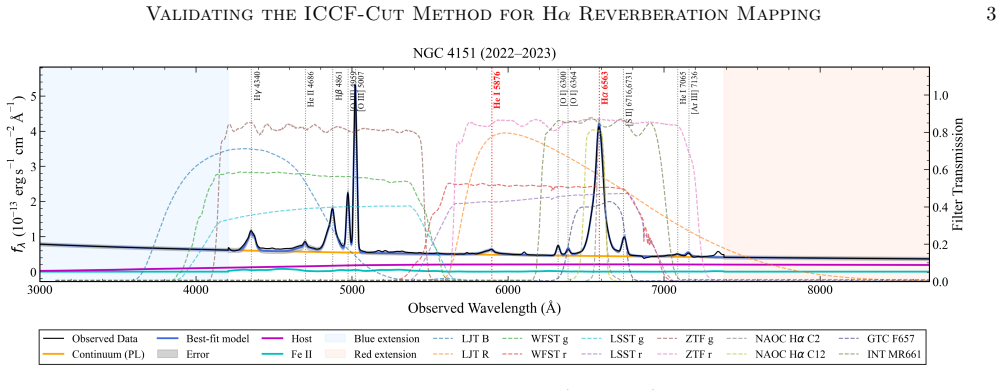
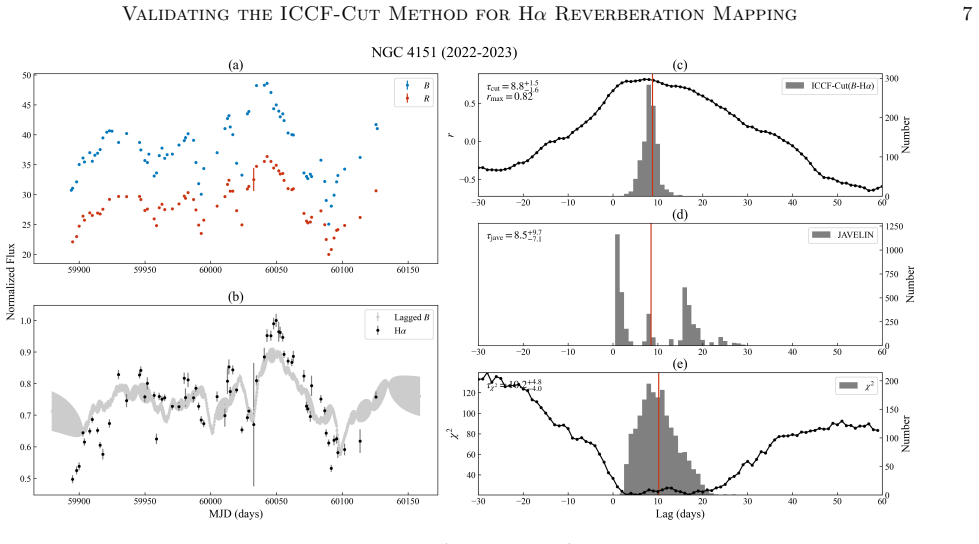
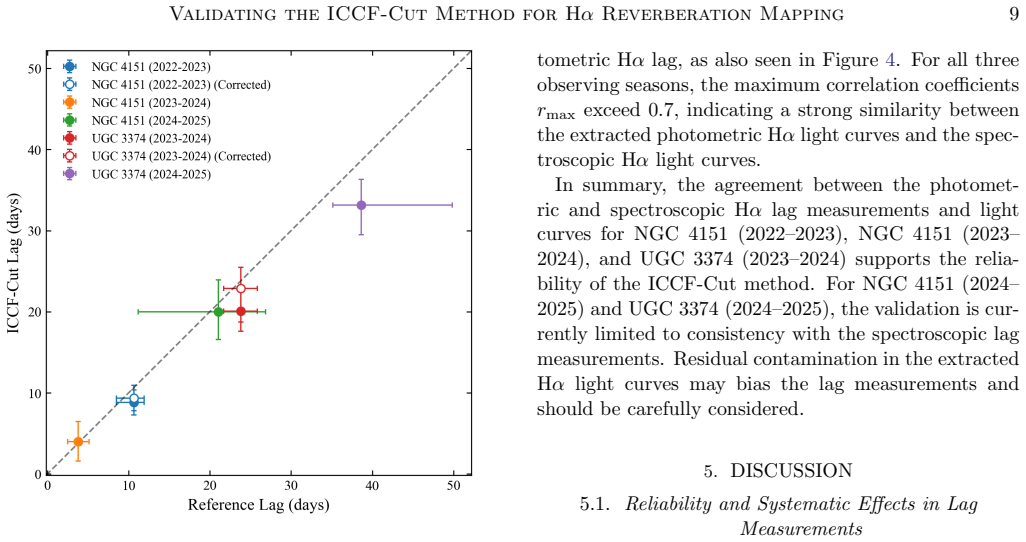
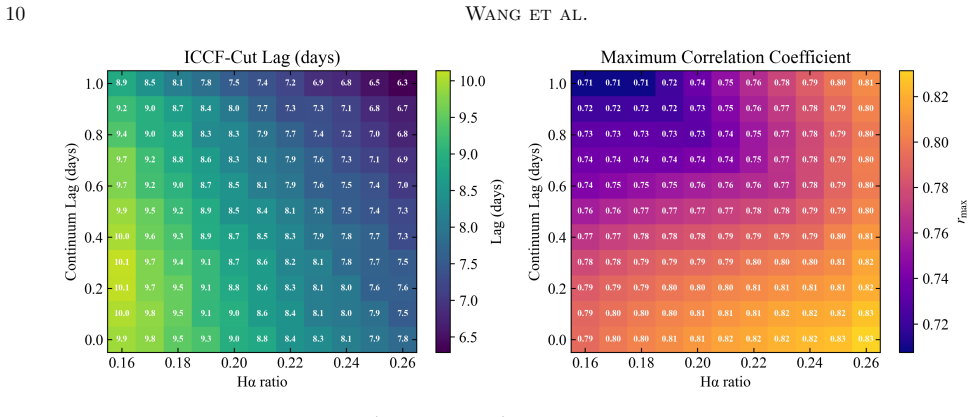
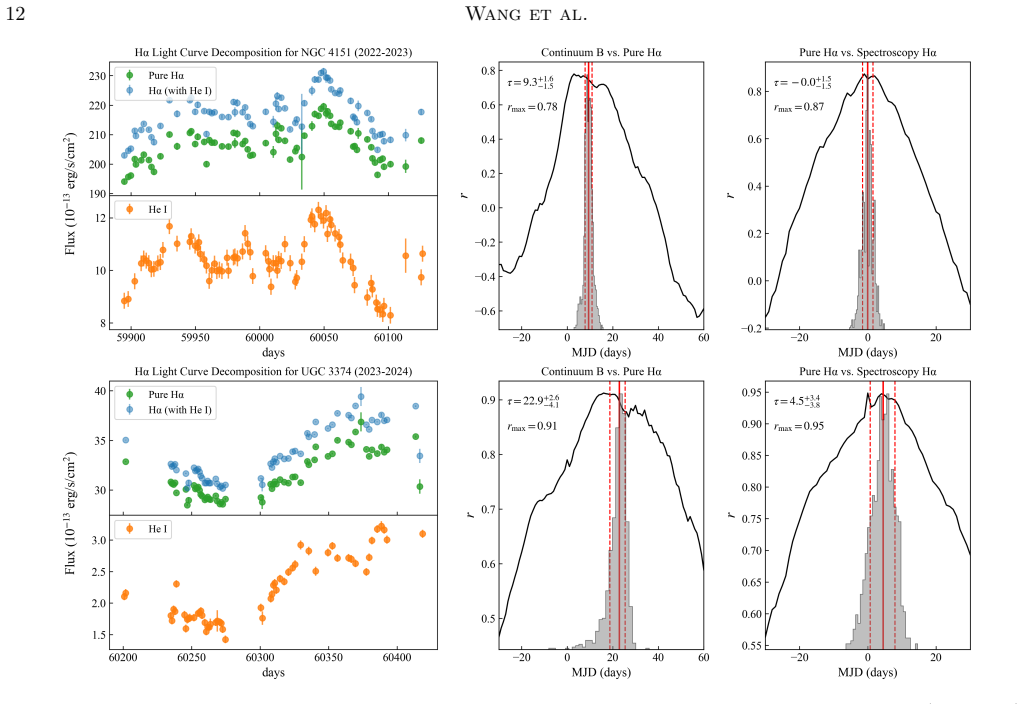
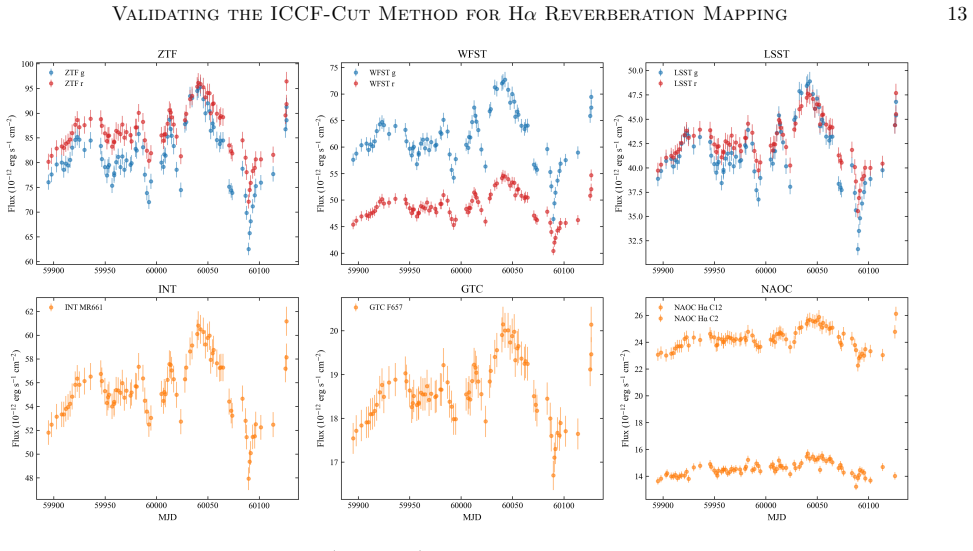
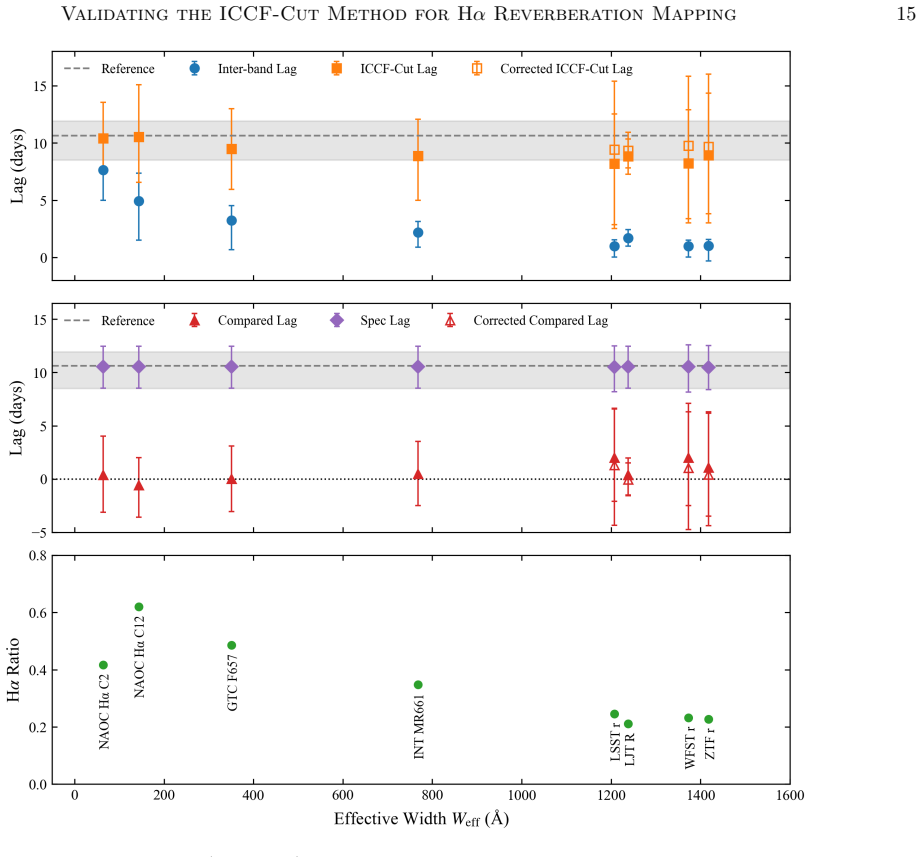
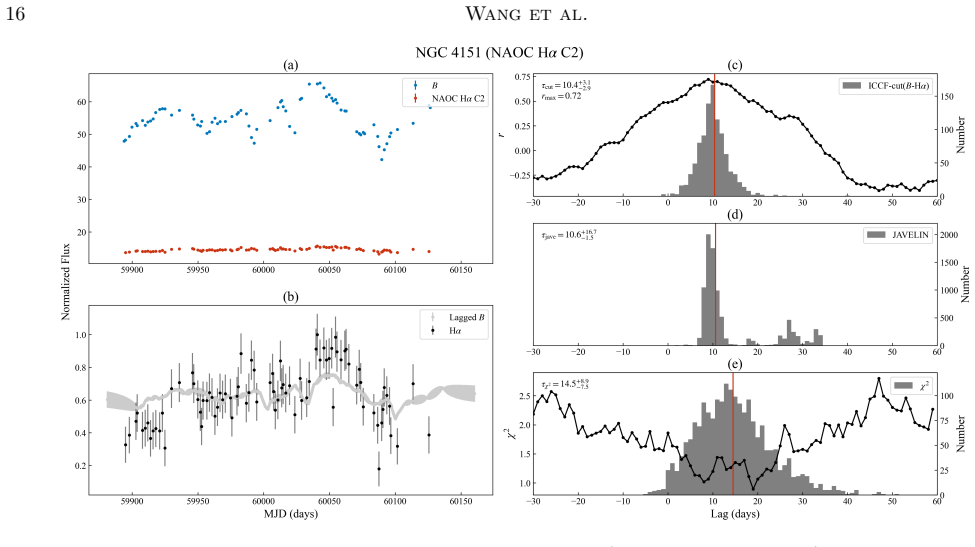
By directly comparing the photometric and spectroscopic RM results in each season, the extracted Hα light curves using the ICCF-Cut method closely resemble those derived from spectroscopy. The photometric Hα lags are also generally consistent with the spectroscopic Hα lags within the uncertainties. For several seasons where the photometric Hα lags are slightly underestimated, residual He I contamination in the extracted Hα light curves is identified as the cause, and correcting for this contamination brings the photometric lag measurements into closer agreement with the spectroscopic results. The method recovers the emission-line variability and lag measurements broadly consistent with the s
What carries the argument
The ICCF-Cut method, which isolates Hα emission-line variability from broadband photometric light curves to measure time lags.
If this is right
- The ICCF-Cut method can serve as a reliable alternative to full spectroscopic monitoring for estimating broad-line region sizes in active galaxies.
- Photometric reverberation mapping produces usable Hα light curves and lags across multiple observing seasons for nearby Seyfert galaxies.
- Accounting for residual He I contamination resolves underestimates in some photometric lag measurements.
- The method recovers expected variability and lags in simulations that vary filter bandwidth.
Where Pith is reading between the lines
- This validation could support using photometry alone to monitor larger samples of AGNs than spectroscopy permits.
- The approach might extend to other emission lines if similar contamination corrections can be developed.
- Routine adoption would lower the telescope resources needed for reverberation mapping campaigns on additional objects.
Load-bearing premise
That any remaining discrepancies after ICCF-Cut extraction can be fully attributed to and corrected for residual He I contamination without introducing new systematic bias into the lag measurements.
What would settle it
A season in which photometric and spectroscopic Hα lags remain significantly different even after the He I correction step, or a simulation in which the input lag is not recovered within uncertainties.
Figures
read the original abstract
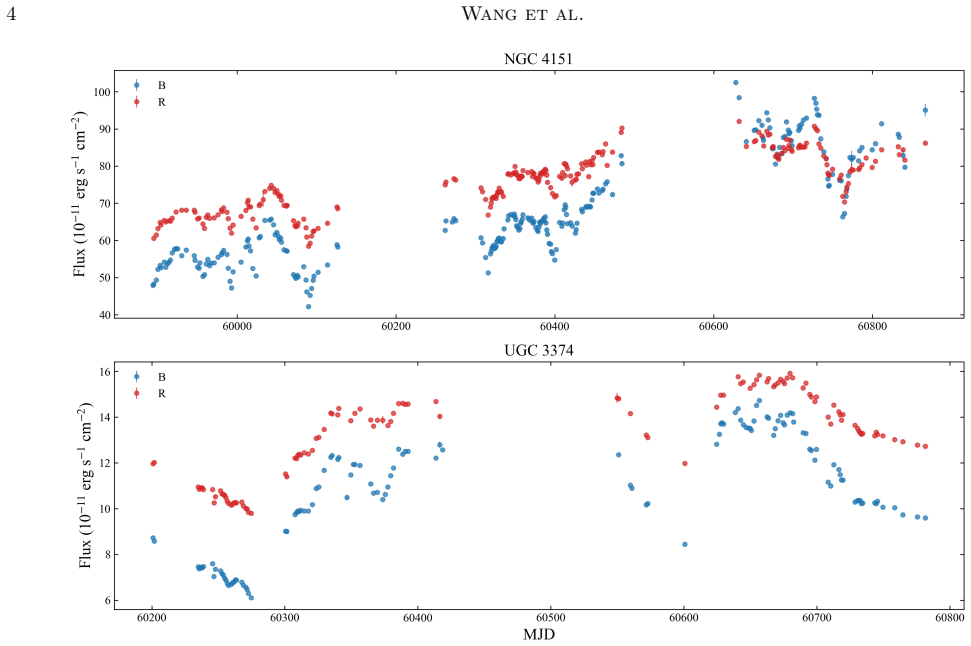
Photometric reverberation mapping (RM) provides an efficient alternative to spectroscopic RM for probing the broad-line region (BLR) sizes in AGNs. In our previous work, we proposed the ICCF-Cut method, which extracts H$\alpha$ emission-line variability from broadband photometric light curves and measures the lags to estimate the BLR sizes. To further assess the reliability of this method, we conduct simultaneous photometric and spectroscopic monitoring of two nearby Seyfert galaxies, NGC 4151 and UGC 3374, over multiple observing seasons using the Lijiang 2.4 m telescope. By directly comparing the photometric and spectroscopic RM results in each season, we find that the extracted H$\alpha$ light curves using the ICCF-Cut method closely resemble those derived from spectroscopy. The photometric H$\alpha$ lags are also generally consistent with the spectroscopic H$\alpha$ lags within the uncertainties. For several seasons where the photometric H$\alpha$ lags are slightly underestimated, we find that the discrepancy may be caused by residual He\,\textsc{i} contamination in the extracted H$\alpha$ light curves. After correcting for this contamination, the photometric lag measurements become more consistent with the spectroscopic results. We further explore the performance of the ICCF-Cut method using the simulated light curves with different filter bandwidths. For our observational and simulated cases, the method can successfully recover the emission-line variability and lag measurements broadly consistent with the spectroscopic results. This provides further support for the applicability of the ICCF-Cut method in photometric RM.
Editorial analysis
A structured set of objections, weighed in public.
Referee Report
Summary. The paper claims to validate the ICCF-Cut method for extracting Hα light curves from photometric data by comparing it to simultaneous spectroscopic RM observations of NGC 4151 and UGC 3374 across multiple seasons. The extracted photometric light curves resemble spectroscopic ones, and the lags are generally consistent within uncertainties. Discrepancies are attributed to He I contamination and corrected to achieve better agreement, with simulations further supporting the method.
Significance. If the central claims hold, the work offers a direct empirical validation of a photometric RM technique against spectroscopic benchmarks, which could facilitate larger-scale studies of AGN broad-line regions. The season-by-season comparison is a positive aspect of the experimental design.
major comments (1)
- [He I contamination correction (Results/Discussion)] The identification and correction for residual He I contamination, used to explain and resolve underestimates in photometric lags for several seasons, is presented without quantitative details on the procedure or tests for systematic bias in the lag measurements. This step is load-bearing for the claim that the method produces results consistent with spectroscopy after correction.
minor comments (2)
- [Abstract] The abstract states that the correction makes the measurements 'more consistent' but does not provide any quantitative information on the correction method or its impact.
- [Simulations section] Details on the specific filter bandwidths used in the simulations and how they compare to the observational setup would improve clarity.
Simulated Author's Rebuttal
We thank the referee for their careful reading and for highlighting the potential significance of our empirical validation of the ICCF-Cut method. We address the single major comment below and will revise the manuscript to strengthen the presentation of the He I correction.
read point-by-point responses
-
Referee: [He I contamination correction (Results/Discussion)] The identification and correction for residual He I contamination, used to explain and resolve underestimates in photometric lags for several seasons, is presented without quantitative details on the procedure or tests for systematic bias in the lag measurements. This step is load-bearing for the claim that the method produces results consistent with spectroscopy after correction.
Authors: We agree that the current manuscript lacks sufficient quantitative detail on the He I correction procedure and its validation. In the revised version we will expand the Results/Discussion section with: (1) a step-by-step description of how residual He I contamination was identified and quantified (using the available simultaneous spectra and filter transmission curves); (2) the explicit correction formula or scaling applied to the photometric light curves; (3) the numerical changes in lag values before and after correction for each affected season; and (4) Monte Carlo tests that inject varying levels of He I contamination into simulated light curves to quantify any systematic bias introduced into the ICCF-Cut lag recovery. These additions will make the correction transparent and will directly address the concern that this step is load-bearing for the consistency claim. revision: yes
Circularity Check
Minor self-citation to prior ICCF-Cut proposal; validation uses independent spectroscopic benchmark
full rationale
The paper validates ICCF-Cut by direct season-by-season comparison of photometric Hα light curves and lags to simultaneous spectroscopic RM results on NGC 4151 and UGC 3374. This benchmark is external to any fit performed on the photometric data alone. The sole self-citation is the reference to 'our previous work' proposing the method; it is not load-bearing for the consistency claim, which rests on the new simultaneous observations. No equations, fitted parameters, or corrections are shown to reduce the reported lags to quantities defined by the same photometric fit. The He I correction is invoked post-hoc to address specific discrepancies but does not redefine the primary results or create a self-referential loop.
Axiom & Free-Parameter Ledger
axioms (2)
- domain assumption Spectroscopic RM provides an unbiased reference measurement of the true Hα lag against which photometric results can be judged.
- ad hoc to paper Residual He I contamination is the dominant source of any observed lag discrepancy and can be corrected without new systematic error.
Reference graph
Works this paper leans on
-
[1]
Reverberation Mapping of Two Variable Active Galactic Nuclei: Probing the Distinct Characteristics of the Inner and Outer Broad-line Regions. , keywords =. doi:10.3847/1538-4357/ad9c71 , archivePrefix =. 2412.02204 , primaryClass =
-
[2]
Measuring Reddening with Sloan Digital Sky Survey Stellar Spectra and Recalibrating SFD. , keywords =. doi:10.1088/0004-637X/737/2/103 , archivePrefix =. 1012.4804 , primaryClass =
work page internal anchor Pith review Pith/arXiv arXiv doi:10.1088/0004-637x/737/2/103
-
[3]
The Most Luminous H Reverberation Mapping of E1821+643 Indicates the Lower Boundary of the Radius─Luminosity Relation. , keywords =. doi:10.3847/1538-4357/ae3de1 , archivePrefix =. 2601.18269 , primaryClass =
-
[4]
The Lick AGN Monitoring Project: Reverberation Mapping of Optical Hydrogen and Helium Recombination Lines. , keywords =. doi:10.1088/0004-637X/716/2/993 , archivePrefix =. 1004.2922 , primaryClass =
work page internal anchor Pith review Pith/arXiv arXiv doi:10.1088/0004-637x/716/2/993
-
[5]
Discovery of a Luminosity-dependent Continuum Lag in NGC 4151 from Photometric and Spectroscopic Continuum Reverberation Mapping. , keywords =. doi:10.3847/1538-4357/ae30db , archivePrefix =. 2512.18276 , primaryClass =
-
[6]
The First Swift Intensive AGN Accretion Disk Reverberation Mapping Survey
The First Swift Intensive AGN Accretion Disk Reverberation Mapping Survey. , keywords =. doi:10.3847/1538-4357/aaf3b4 , archivePrefix =. 1811.07956 , primaryClass =
work page internal anchor Pith review Pith/arXiv arXiv doi:10.3847/1538-4357/aaf3b4
-
[7]
Quantifying the Diffuse Continuum Contribution of BLR Clouds to AGN Continuum Inter-band Delays
Quantifying the diffuse continuum contribution of BLR Clouds to AGN Continuum Inter-band Delays. , keywords =. doi:10.1093/mnras/sty2242 , archivePrefix =. 1808.04798 , primaryClass =
work page internal anchor Pith review Pith/arXiv arXiv doi:10.1093/mnras/sty2242
-
[8]
Accretion Disk Reverberation with Hubble Space Telescope Observations of NGC 4593: Evidence for Diffuse Continuum Lags. , keywords =. doi:10.3847/1538-4357/aab4f7 , archivePrefix =. 1712.04025 , primaryClass =
work page internal anchor Pith review Pith/arXiv arXiv doi:10.3847/1538-4357/aab4f7
-
[9]
Nature Astronomy , year = 2019, month = jan, volume =
Direct evidence of non-disk optical continuum emission around an active black hole. Nature Astronomy , year = 2019, month = jan, volume =. doi:10.1038/s41550-018-0659-x , adsurl =
-
[10]
Non-Blackbody Disks Can Help Explain Inferred AGN Accretion Disk Sizes
Non-blackbody Disks Can Help Explain Inferred AGN Accretion Disk Sizes. , keywords =. doi:10.3847/1538-4357/aaa768 , archivePrefix =. 1705.05467 , primaryClass =
work page internal anchor Pith review Pith/arXiv arXiv doi:10.3847/1538-4357/aaa768
-
[11]
S., Dov c iak, M., Papadakis, I
UV/Optical Disk Thermal Reverberation in Active Galactic Nuclei: An In-depth Study with an Analytic Prescription for Time-lag Spectra. , keywords =. doi:10.3847/1538-4357/abcb93 , archivePrefix =. 2011.08563 , primaryClass =
-
[12]
N., et al.\ 2020a, , 891, 2, 178
Corona-heated Accretion-disk Reprocessing: A Physical Model to Decipher the Melody of AGN UV/Optical Twinkling. , keywords =. doi:10.3847/1538-4357/ab789e , archivePrefix =. 2002.08564 , primaryClass =
-
[13]
Quantifying the impact of variable BLR diffuse continuum contributions on measured continuum interband delays. , keywords =. doi:10.1093/mnras/stz2330 , archivePrefix =. 1908.07757 , primaryClass =
-
[14]
Unprecedented Continuum Time Delay Variation Phenomenon in an Active Supermassive Black Hole. , keywords =. doi:10.3847/1538-4357/add468 , archivePrefix =. 2408.11292 , primaryClass =
-
[15]
Velocity-resolved Reverberation Mapping of Changing-look AGN NGC 2617. , keywords =. doi:10.3847/1538-4357/abefe0 , archivePrefix =. 2103.03508 , primaryClass =
-
[16]
Velocity-resolved Reverberation Mapping of Changing-look Active Galactic Nucleus NGC 4151 during Outburst Stage. II. Results of Four Seasons of Observation. , keywords =. doi:10.3847/1538-4357/ad8568 , archivePrefix =. 2409.01637 , primaryClass =
-
[17]
H reverberation mapping from broad-band photometry of dwarf type 1 Seyfert galaxy NGC 4395. , keywords =. doi:10.1093/mnras/stae1063 , archivePrefix =. 2404.11495 , primaryClass =
-
[18]
H Time Delays of Active Galactic Nuclei from the Zwicky Transient Facility Broadband Photometry. , keywords =. doi:10.3847/1538-4357/ad34d6 , archivePrefix =. 2403.10223 , primaryClass =
-
[19]
The H Broadband Photometric Reverberation Mapping of Four Seyfert 1 Galaxies. , keywords =. doi:10.3847/1538-4357/acc4c1 , archivePrefix =. 2303.10362 , primaryClass =
-
[20]
The Emission-Line Properties of Low-Redshift Quasi-stellar Objects. , keywords =. doi:10.1086/191661 , adsurl =
-
[21]
PyQSOFit: Python code to fit the spectrum of quasars
-
[22]
Prior-informed Active Galactic Nucleus Host Spectral Decomposition Using PyQSOFit. , keywords =. doi:10.3847/1538-4357/ad6e76 , archivePrefix =. 2406.17598 , primaryClass =
-
[23]
Maps of Dust IR Emission for Use in Estimation of Reddening and CMBR Foregrounds
Maps of Dust Infrared Emission for Use in Estimation of Reddening and Cosmic Microwave Background Radiation Foregrounds. , keywords =. doi:10.1086/305772 , archivePrefix =. astro-ph/9710327 , primaryClass =
work page internal anchor Pith review Pith/arXiv arXiv doi:10.1086/305772
-
[24]
An Analysis of the Shapes of Ultraviolet Extinction Curves. III. an Atlas of Ultraviolet Extinction Curves. , keywords =. doi:10.1086/191413 , adsurl =
-
[25]
Polar Dust, Nuclear Obscuration and IR SED Diversity in Type-1 AGNs
Polar Dust, Nuclear Obscuration, and IR SED Diversity in Type-1 AGNs. , keywords =. doi:10.3847/1538-4357/aae075 , archivePrefix =. 1809.03080 , primaryClass =
work page internal anchor Pith review Pith/arXiv arXiv doi:10.3847/1538-4357/aae075
-
[26]
Quasi-simultaneous Spectroscopic and Multiband Photometric Observations of Blazar S5 0716+714 During 2018-2019. , keywords =. doi:10.3847/1538-4357/ab594b , archivePrefix =. 1911.08667 , primaryClass =
-
[27]
Velocity-resolved Reverberation Mapping of Changing-look Active Galactic Nucleus NGC 4151 during Outburst Stage: Evidence for Kinematics Evolution of Broad-line Region. , keywords =. doi:10.3847/1538-4357/ac8745 , archivePrefix =. 2208.02966 , primaryClass =
-
[28]
Quasar Cartography: from Black Hole to Broad Line Region Scales
Quasar Cartography: From Black Hole to Broad-line Region Scales. , keywords =. doi:10.1088/0004-637X/769/2/124 , archivePrefix =. 1305.6499 , primaryClass =
work page internal anchor Pith review Pith/arXiv arXiv doi:10.1088/0004-637x/769/2/124
-
[29]
Photometric Reverberation Mapping of the Broad Emission Line Region in Quasars
Photometric Reverberation Mapping of the Broad Emission Line Region in Quasars. , keywords =. doi:10.1088/0004-637X/747/1/62 , archivePrefix =. 1105.5312 , primaryClass =
work page internal anchor Pith review Pith/arXiv arXiv doi:10.1088/0004-637x/747/1/62
-
[30]
On Uncertainties in Cross-Correlation Lags and the Reality of Wavelength-dependent Continuum Lags in Active Galactic Nuclei. , keywords =. doi:10.1086/316177 , archivePrefix =. astro-ph/9802103 , primaryClass =
work page internal anchor Pith review Pith/arXiv arXiv doi:10.1086/316177
-
[31]
The Accuracy of Cross-Correlation Estimates of Quasar Emission-Line Region Sizes. , keywords =. doi:10.1086/191216 , adsurl =
-
[32]
Comments on Cross-Correlation Methodology in Variability Studies of Active Galactic Nuclei. , keywords =. doi:10.1086/133456 , adsurl =
-
[33]
, year = 1981, month = jan, volume =
The Shape and Variability of the Nonthermal Component of the Optical Spectra of Active Galaxies. , year = 1981, month = jan, volume =
1981
-
[34]
Photometric reverberation mapping of 3C120
Photometric reverberation mapping of 3C 120. , keywords =. doi:10.1051/0004-6361/201219107 , archivePrefix =. 1303.3506 , primaryClass =
work page internal anchor Pith review Pith/arXiv arXiv doi:10.1051/0004-6361/201219107
-
[35]
Variability studies of seyfert galaxies - I. Broad-band optical photometry. , keywords =. doi:10.1093/mnras/257.4.659 , adsurl =
-
[36]
Central Masses and Broad-Line Region Sizes of Active Galactic Nuclei. II. A Homogeneous Analysis of a Large Reverberation-Mapping Database. , keywords =. doi:10.1086/423269 , archivePrefix =. astro-ph/0407299 , primaryClass =
work page internal anchor Pith review Pith/arXiv arXiv doi:10.1086/423269
-
[37]
An Alternative Approach To Measuring Reverberation Lags in Active Galactic Nuclei
An Alternative Approach to Measuring Reverberation Lags in Active Galactic Nuclei. , keywords =. doi:10.1088/0004-637X/735/2/80 , archivePrefix =. 1008.0641 , primaryClass =
work page internal anchor Pith review Pith/arXiv arXiv doi:10.1088/0004-637x/735/2/80
-
[38]
Is Quasar Optical Variability a Damped Random Walk?
Is Quasar Optical Variability a Damped Random Walk?. , keywords =. doi:10.1088/0004-637X/765/2/106 , archivePrefix =. 1202.3783 , primaryClass =
work page internal anchor Pith review Pith/arXiv arXiv doi:10.1088/0004-637x/765/2/106
-
[39]
Application of Stochastic Modeling to Analysis of Photometric Reverberation Mapping Data
Application of Stochastic Modeling to Analysis of Photometric Reverberation Mapping Data. , keywords =. doi:10.3847/0004-637X/819/2/122 , archivePrefix =. 1310.6774 , primaryClass =
work page internal anchor Pith review Pith/arXiv arXiv doi:10.3847/0004-637x/819/2/122
-
[40]
Towards equation of state of dark energy from quasar monitoring: Reverberation strategy
Towards equation of state of dark energy from quasar monitoring: Reverberation strategy. , keywords =. doi:10.1051/0004-6361/201220832 , archivePrefix =. 1212.0472 , primaryClass =
work page internal anchor Pith review Pith/arXiv arXiv doi:10.1051/0004-6361/201220832
-
[41]
The Sloan Digital Sky Survey Reverberation Mapping Project: H and H Reverberation Measurements from First-year Spectroscopy and Photometry. , keywords =. doi:10.3847/1538-4357/aa98dc , archivePrefix =. 1711.03114 , primaryClass =
work page internal anchor Pith review Pith/arXiv arXiv doi:10.3847/1538-4357/aa98dc
-
[42]
The Sloan Digital Sky Survey Reverberation Mapping Project: Mg II Lag Results from Four Years of Monitoring. , keywords =. doi:10.3847/1538-4357/ababa9 , archivePrefix =. 2005.03663 , primaryClass =
-
[43]
Space Telescope and Optical Reverberation Mapping Project. III. Optical Continuum Emission and Broadband Time Delays in NGC 5548. , keywords =. doi:10.3847/0004-637X/821/1/56 , archivePrefix =. 1510.05648 , primaryClass =
work page internal anchor Pith review Pith/arXiv arXiv doi:10.3847/0004-637x/821/1/56
-
[44]
The Ultraviolet/Optical Continuum Reverberation Mapping of Eight Active Galactic Nuclei with Swift: Further Evidence for the Outer Component. , keywords =. doi:10.3847/1538-4357/ae1034 , archivePrefix =. 2511.05792 , primaryClass =
-
[45]
Least-Squares Frequency Analysis of Unequally Spaced Data. , keywords =. doi:10.1007/BF00648343 , adsurl =
-
[46]
Studies in astronomical time series analysis. II. Statistical aspects of spectral analysis of unevenly spaced data. , keywords =. doi:10.1086/160554 , adsurl =
-
[47]
Wavelets for period analysis of unevenly sampled time series. , keywords =. doi:10.1086/118137 , adsurl =
-
[48]
A Method of Computing Periods of Cyclic Phenomena. , keywords =. doi:10.1007/BF00656321 , adsurl =
-
[49]
Measuring the rotation period distribution of field M-dwarfs with Kepler
Measuring the rotation period distribution of field M dwarfs with Kepler. , keywords =. doi:10.1093/mnras/stt536 , archivePrefix =. 1303.6787 , primaryClass =
work page internal anchor Pith review Pith/arXiv arXiv doi:10.1093/mnras/stt536
-
[50]
wwz: Weighted wavelet z-transform code
-
[51]
Quasi-periodic oscillation analysis for a sample of blazars at the optical band. , keywords =. doi:10.1051/0004-6361/202347593 , adsurl =
-
[52]
Generating artificial light curves: Revisited and updated
Generating artificial light curves: revisited and updated. , keywords =. doi:10.1093/mnras/stt764 , archivePrefix =. 1305.0304 , primaryClass =
work page internal anchor Pith review Pith/arXiv arXiv doi:10.1093/mnras/stt764
-
[53]
Broad-line Region Characterization in Dozens of Active Galactic Nuclei Using Small-aperture Telescopes. , keywords =. doi:10.3847/1538-4365/ad9474 , archivePrefix =. 2411.07847 , primaryClass =
-
[54]
Medium-band Photometry Reverberation Mapping of Nearby Active Galactic Nuclei. , keywords =. doi:10.3847/1538-4357/ab40cd , archivePrefix =. 1910.01061 , primaryClass =
-
[55]
Automatized Photometric Monitoring of Active Galactic Nuclei with the 46cm Telescope of the Wise Observatory. , keywords =. doi:10.1088/1538-3873/aa7a55 , archivePrefix =. 1706.05463 , primaryClass =
work page internal anchor Pith review Pith/arXiv arXiv doi:10.1088/1538-3873/aa7a55
-
[56]
Photometric AGN reverberation mapping - an efficient tool for BLR sizes, black hole masses, and host-subtracted AGN luminosities. , keywords =. doi:10.1051/0004-6361/201117325 , archivePrefix =. 1109.1848 , primaryClass =
work page internal anchor Pith review Pith/arXiv arXiv doi:10.1051/0004-6361/201117325
-
[57]
Reverberation mapping of active galactic nuclei: from X-ray corona to dusty torus. iScience , keywords =. doi:10.1016/j.isci.2021.102557 , archivePrefix =. 2105.06926 , primaryClass =
-
[58]
, year = 1969, month = aug, volume =
Galactic Nuclei as Collapsed Old Quasars. , year = 1969, month = aug, volume =. doi:10.1038/223690a0 , adsurl =
-
[59]
Reverberation Mapping of Active Galactic Nuclei. , keywords =. doi:10.1086/133140 , adsurl =
-
[60]
Reverberation mapping of the emission line regions of Seyfert galaxies and quasars. , keywords =. doi:10.1086/159843 , adsurl =
-
[61]
The Radius-Luminosity Relationship for Active Galactic Nuclei: The Effect of Host-Galaxy Starlight on Luminosity Measurements. II. The Full Sample of Reverberation-Mapped AGNs. , keywords =. doi:10.1088/0004-637X/697/1/160 , archivePrefix =. 0812.2283 , primaryClass =
work page internal anchor Pith review Pith/arXiv arXiv doi:10.1088/0004-637x/697/1/160
-
[62]
The Low-Luminosity End of the Radius-Luminosity Relationship for Active Galactic Nuclei
The Low-luminosity End of the Radius-Luminosity Relationship for Active Galactic Nuclei. , keywords =. doi:10.1088/0004-637X/767/2/149 , archivePrefix =. 1303.1742 , primaryClass =
work page internal anchor Pith review Pith/arXiv arXiv doi:10.1088/0004-637x/767/2/149
-
[63]
The Lick AGN Monitoring Project: Broad-line Region Radii and Black Hole Masses from Reverberation Mapping of H. , keywords =. doi:10.1088/0004-637X/705/1/199 , archivePrefix =. 0908.0003 , primaryClass =
work page internal anchor Pith review Pith/arXiv arXiv doi:10.1088/0004-637x/705/1/199
-
[64]
The Lick AGN Monitoring Project 2011: Spectroscopic Campaign and Emission-Line Light Curves
The Lick AGN Monitoring Project 2011: Spectroscopic Campaign and Emission-line Light Curves. , keywords =. doi:10.1088/0067-0049/217/2/26 , archivePrefix =. 1503.01146 , primaryClass =
work page internal anchor Pith review Pith/arXiv arXiv doi:10.1088/0067-0049/217/2/26 2011
-
[65]
The Lick AGN Monitoring Project 2016: Velocity-resolved H Lags in Luminous Seyfert Galaxies. , keywords =. doi:10.3847/1538-4357/ac3d26 , archivePrefix =. 2111.14849 , primaryClass =
-
[66]
Supermassive Black Holes with High Accretion Rates in Active Galactic Nuclei. IX. 10 New Observations of Reverberation Mapping and Shortened H Lags. , keywords =. doi:10.3847/1538-4357/aaae6b , archivePrefix =. 1802.03022 , primaryClass =
work page internal anchor Pith review Pith/arXiv arXiv doi:10.3847/1538-4357/aaae6b
-
[67]
Supermassive Black Holes with High Accretion Rates in Active Galactic Nuclei. V. A New Size-Luminosity Scaling Relation for the Broad-line Region. , keywords =. doi:10.3847/0004-637X/825/2/126 , archivePrefix =. 1604.06218 , primaryClass =
work page internal anchor Pith review Pith/arXiv arXiv doi:10.3847/0004-637x/825/2/126
-
[68]
Supermassive Black Holes with High Accretion Rates in Active Galactic Nuclei. IV. H Time Lags and Implications for Super-Eddington Accretion. , keywords =. doi:10.1088/0004-637X/806/1/22 , archivePrefix =. 1504.01844 , primaryClass =
work page internal anchor Pith review Pith/arXiv arXiv doi:10.1088/0004-637x/806/1/22
-
[69]
Supermassive Black Holes with High Accretion Rates in Active Galactic Nuclei. I. First Results from a New Reverberation Mapping Campaign. , keywords =. doi:10.1088/0004-637X/782/1/45 , archivePrefix =. 1310.4107 , primaryClass =
work page internal anchor Pith review Pith/arXiv arXiv doi:10.1088/0004-637x/782/1/45
-
[70]
Monitoring AGNs with H Asymmetry. I. First Results: Velocity-resolved Reverberation Mapping. , keywords =. doi:10.3847/1538-4357/aaed2c , archivePrefix =. 1810.11996 , primaryClass =
work page internal anchor Pith review Pith/arXiv arXiv doi:10.3847/1538-4357/aaed2c
-
[71]
Monitoring AGNs with H Asymmetry. III. Long-term Reverberation Mapping Results of 15 Palomar-Green Quasars. , keywords =. doi:10.3847/1538-4365/ac7beb , archivePrefix =. 2207.00297 , primaryClass =
-
[72]
Monitoring AGNs with H Asymmetry. II. Reverberation Mapping of Three Seyfert Galaxies Historically Displaying H Profiles with Changing Asymmetry: Mrk 79, NGC 3227, and Mrk 841. , keywords =. doi:10.3847/1538-4357/abc2d2 , archivePrefix =. 2011.05902 , primaryClass =
-
[73]
Monitoring AGNs with H Asymmetry. IV. First Reverberation Mapping Results of 14 Active Galactic Nuclei. , keywords =. doi:10.3847/1538-4365/ad3bad , archivePrefix =. 2404.07343 , primaryClass =
-
[74]
The Sloan Digital Sky Survey Reverberation Mapping Project: Technical Overview
The Sloan Digital Sky Survey Reverberation Mapping Project: Technical Overview. , keywords =. doi:10.1088/0067-0049/216/1/4 , archivePrefix =. 1408.5970 , primaryClass =
work page internal anchor Pith review Pith/arXiv arXiv doi:10.1088/0067-0049/216/1/4
-
[75]
The Sloan Digital Sky Survey Reverberation Mapping Project: Sample Characterization
The Sloan Digital Sky Survey Reverberation Mapping Project: Sample Characterization. , keywords =. doi:10.3847/1538-4365/ab074f , archivePrefix =. 1810.01447 , primaryClass =
work page internal anchor Pith review Pith/arXiv arXiv doi:10.3847/1538-4365/ab074f
-
[76]
The Sloan Digital Sky Survey Reverberation Mapping Project: First Broad-line H and Mg II Lags at z 0.3 from Six-month Spectroscopy. , keywords =. doi:10.3847/0004-637X/818/1/30 , archivePrefix =. 1510.02802 , primaryClass =
work page internal anchor Pith review Pith/arXiv arXiv doi:10.3847/0004-637x/818/1/30
-
[77]
The Sloan Digital Sky Survey Reverberation Mapping Project: Key Results. , keywords =. doi:10.3847/1538-4365/ad3936 , archivePrefix =. 2305.01014 , primaryClass =
-
[78]
The Sloan Digital Sky Survey Reverberation Mapping Project: Initial C IV Lag Results from Four Years of Data. , keywords =. doi:10.3847/1538-4357/ab4ea5 , archivePrefix =. 1904.03199 , primaryClass =
-
[79]
The Sloan Digital Sky Survey Reverberation Mapping Project: Accretion Disk Sizes from Continuum Lags. , keywords =. doi:10.3847/1538-4357/ab2638 , archivePrefix =. 1806.08360 , primaryClass =
-
[80]
OzDES Reverberation Mapping of Active Galactic Nuclei: Final Data Release, Black-Hole Mass Results, & Scaling Relations. arXiv e-prints , keywords =. doi:10.48550/arXiv.2512.01261 , archivePrefix =. 2512.01261 , primaryClass =
work page internal anchor Pith review Pith/arXiv arXiv doi:10.48550/arxiv.2512.01261
discussion (0)
Sign in with ORCID, Apple, or X to comment. Anyone can read and Pith papers without signing in.