Conservation law of super-Lorentz charges
Pith reviewed 2026-06-26 04:05 UTC · model grok-4.3
The pith
Super-Lorentz charges conserve between future and past spatial infinity and are non-locally fixed by Bondi-Sachs fields.
A machine-rendered reading of the paper's core claim, the machinery that carries it, and where it could break.
Core claim
Under assumptions compatible with generic gravitational scattering, the vacuum relativistic gravitational field is entirely determined at leading order in the large radius expansion at spatial infinity by its supermomentum, its dual supermomentum and its global supertranslation frame. At subleading order, the gravitational field is determined by three additional sets of charges: the super-Lorentz charges, the leading tail charges and the leading peeling-breaking charges. The authors give a supertranslation-invariant definition of these charges in terms of asymptotic Bondi-Sachs fields and derive the conservation law of super-Lorentz charges between the future and past of spatial infinity, ob
What carries the argument
Super-Lorentz charges, obtained from solutions of wave equations on the boundary de Sitter spacetime and expressed invariantly through the asymptotic Bondi-Sachs fields.
If this is right
- The super-Lorentz aspects cannot be extracted locally from the asymptotic fields but require a non-local construction.
- The same charges admit an invariant definition in the Beig-Schmidt formalism that is also invariant under logarithmic translations.
- The leading-order field is fixed solely by the supermomenta and the global supertranslation frame.
- Subleading data include separate leading tail charges and leading peeling-breaking charges in addition to the super-Lorentz set.
Where Pith is reading between the lines
- The conservation relation supplies a global constraint that any complete scattering map must satisfy.
- The non-local definition may link the super-Lorentz sector to integrated memory effects measured at null infinity.
- The same wave-equation techniques could be applied to derive conservation statements for the tail and peeling-breaking charges.
Load-bearing premise
The vacuum relativistic gravitational field is entirely determined at leading order in the large radius expansion at spatial infinity by its supermomentum, its dual supermomentum and its global supertranslation frame.
What would settle it
An explicit evaluation of the super-Lorentz charges constructed from the same Bondi-Sachs data at past and future spatial infinity that yields unequal values.
Figures
read the original abstract
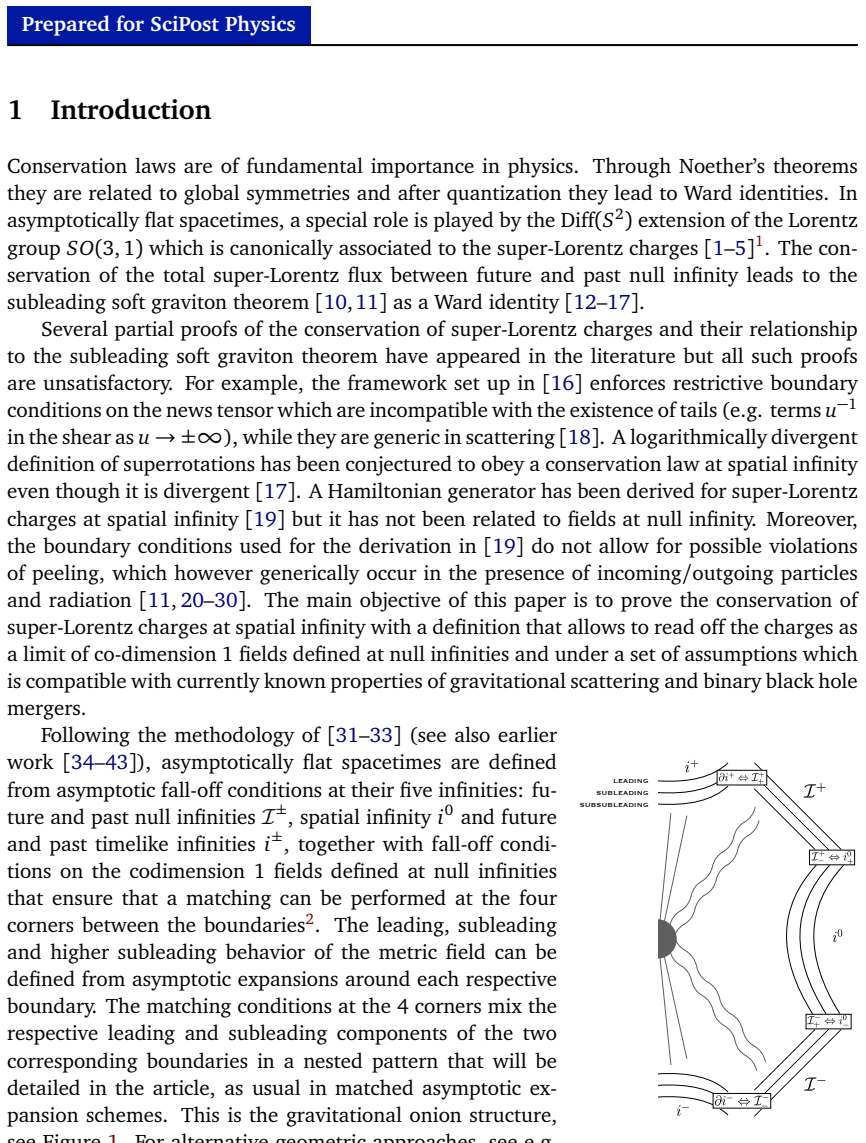
Under assumptions compatible with generic gravitational scattering, the vacuum relativistic gravitational field is entirely determined at leading order in the large radius expansion at spatial infinity by its supermomentum, its dual supermomentum and its global supertranslation frame. At subleading order, the gravitational field is determined by three additional sets of charges: the super-Lorentz charges, the leading tail charges and the leading peeling-breaking charges. In this work we provide a supertranslation-invariant definition of these charges in terms of asymptotic Bondi-Sachs fields as well as a corresponding supertranslation and logarithmic translation invariant definition of these charges in terms of Beig-Schmidt fields. Using the properties of homogeneous and inhomogeneous solutions to relevant wave equations over the boundary de Sitter spacetime at spatial infinity, we derive the conservation law of super-Lorentz charges between the future and past of spatial infinity. We obtain that the super-Lorentz aspects are non-locally defined from the Bondi-Sachs fields.
Editorial analysis
A structured set of objections, weighed in public.
Referee Report
Summary. The paper claims that, under assumptions compatible with generic gravitational scattering, the vacuum relativistic gravitational field is entirely determined at leading order in the large-radius expansion at spatial infinity by its supermomentum, dual supermomentum, and global supertranslation frame. At subleading order the field is determined by three additional sets of charges (super-Lorentz, leading tail, and leading peeling-breaking). It supplies supertranslation-invariant definitions of these charges in Bondi-Sachs and Beig-Schmidt gauges and, using properties of homogeneous and inhomogeneous solutions to wave equations on the boundary de Sitter spacetime, derives the conservation law of the super-Lorentz charges between future and past of spatial infinity, obtaining that the super-Lorentz aspects are non-locally defined from the Bondi-Sachs fields.
Significance. If the result holds, the work would establish a conservation law for super-Lorentz charges across spatial infinity and supply invariant definitions of subleading charges, extending the asymptotic-symmetry framework with potential relevance to gravitational scattering and memory effects. The use of wave-equation analysis on the de Sitter boundary provides a systematic route to matching future and past data.
major comments (2)
- [Abstract] Abstract, first sentence: the load-bearing claim that the vacuum field is 'entirely determined' at leading order by supermomentum, dual supermomentum, and global supertranslation frame must be accompanied by an explicit demonstration that the general solution of the linearized Einstein equations on the de Sitter boundary admits no additional independent homogeneous or inhomogeneous solutions beyond these three sets of data. Any incompleteness would directly undermine the subsequent supertranslation-invariant definitions of the subleading charges and the conservation law.
- [Wave-equation analysis] Derivation section (wave-equation analysis): the conservation law between future and past rests on the asserted properties of homogeneous and inhomogeneous solutions to the relevant wave equations over boundary de Sitter spacetime. The manuscript must supply the explicit boundary conditions, a complete characterization of the solution space, and error estimates confirming that the matching exhausts all degrees of freedom without residual contributions.
minor comments (1)
- [Definitions] Clarify the precise relation between 'charges' and 'aspects' in the definitions, as the terminology shifts between Bondi-Sachs and Beig-Schmidt formulations.
Simulated Author's Rebuttal
We thank the referee for their careful reading of the manuscript and for highlighting points that require clarification. We address each major comment below and will revise the manuscript accordingly to strengthen the presentation.
read point-by-point responses
-
Referee: [Abstract] Abstract, first sentence: the load-bearing claim that the vacuum field is 'entirely determined' at leading order by supermomentum, dual supermomentum, and global supertranslation frame must be accompanied by an explicit demonstration that the general solution of the linearized Einstein equations on the de Sitter boundary admits no additional independent homogeneous or inhomogeneous solutions beyond these three sets of data. Any incompleteness would directly undermine the subsequent supertranslation-invariant definitions of the subleading charges and the conservation law.
Authors: We agree that the abstract claim is load-bearing and requires an explicit demonstration. The wave-equation analysis in the manuscript solves the linearized Einstein equations on the boundary de Sitter spacetime and shows that the leading-order data are fixed by the supermomentum, dual supermomentum, and global supertranslation frame, with the solution space exhausted by these quantities. To make this fully explicit as requested, we will add a dedicated paragraph in the derivation section (or a short appendix) that writes the general solution, identifies the independent data, and confirms the absence of additional homogeneous or inhomogeneous contributions at this order. This will directly support the subsequent supertranslation-invariant definitions. revision: yes
-
Referee: [Wave-equation analysis] Derivation section (wave-equation analysis): the conservation law between future and past rests on the asserted properties of homogeneous and inhomogeneous solutions to the relevant wave equations over boundary de Sitter spacetime. The manuscript must supply the explicit boundary conditions, a complete characterization of the solution space, and error estimates confirming that the matching exhausts all degrees of freedom without residual contributions.
Authors: The conservation law is derived from the properties of homogeneous and inhomogeneous solutions to the wave equations on the de Sitter boundary, with boundary conditions fixed by asymptotic flatness. The manuscript already uses these properties to match future and past data and obtain the non-local relation for the super-Lorentz aspects. We acknowledge that a more self-contained presentation would benefit readers. In the revision we will expand the relevant section to state the boundary conditions explicitly, give the complete characterization of the solution space (including how homogeneous and inhomogeneous parts are matched), and include a brief discussion of why the matching exhausts the degrees of freedom (with a qualitative error estimate based on the decay properties of the solutions). revision: yes
Circularity Check
No circularity: leading-order field determination stated as assumption; conservation law follows from wave-equation properties.
full rationale
The paper opens by stating the leading-order determination of the vacuum field by supermomentum, dual supermomentum and global supertranslation frame as an explicit assumption 'compatible with generic gravitational scattering.' The conservation law of super-Lorentz charges is then obtained from the properties of homogeneous and inhomogeneous solutions to wave equations on the de Sitter boundary at spatial infinity. No step reduces a claimed prediction to a fitted parameter, renames a known result, or rests on a self-citation whose content is itself unverified within the paper. The non-local definition of super-Lorentz aspects is presented as a derived output, not an input. The derivation chain is therefore self-contained against the stated assumptions and external wave-equation analysis.
Axiom & Free-Parameter Ledger
axioms (1)
- domain assumption Assumptions compatible with generic gravitational scattering allow the vacuum field at spatial infinity to be fixed at leading order by supermomentum, dual supermomentum and global supertranslation frame.
invented entities (3)
-
super-Lorentz charges
no independent evidence
-
leading tail charges
no independent evidence
-
leading peeling-breaking charges
no independent evidence
Reference graph
Works this paper leans on
-
[1]
New symmetries for the Gravitational S-matrix,
[1]M. Campiglia and A. Laddha, “New symmetries for the Gravitational S-matrix,”JHEP 04(2015) 076,1502.02318. [2]G. Compère, A. Fiorucci, and R. Ruzziconi, “Superboost transitions, refraction memory and super-Lorentz charge algebra,”JHEP11(2018) 200,1810.00377.[Erratum: JHEP 04, 172 (2020)]. [3]É. É. Flanagan, K. Prabhu, and I. Shehzad, “Extensions of the ...
Pith/arXiv arXiv 2015
-
[2]
Proof of the classical soft graviton theorem inD= 4,
[11]A. P . Saha, B. Sahoo, and A. Sen, “Proof of the classical soft graviton theorem inD= 4,”JHEP06(2020) 153,1912.06413. [12]D. Kapec, V . Lysov, S. Pasterski, and A. Strominger, “Semiclassical Virasoro symmetry of the quantum gravityS-matrix,”JHEP08(2014) 058,1406.3312. [13]M. Campiglia and A. Laddha, “Asymptotic symmetries and subleading soft graviton ...
arXiv 2020
-
[3]
Peeling or not peeling—is that the question?,
[23]H. Friedrich, “Peeling or not peeling—is that the question?,”Class. Quant. Grav.35 (2018), no. 8, 083001,1709.07709. [24]L. M. A. Kehrberger, “The Case Against Smooth Null Infinity I: Heuristics and Counter-Examples,”Annales Henri Poincare23(2022), no. 3, 829–921,2105.08079. [25]L. M. A. Kehrberger, “The case against smooth null infinity II: A logarit...
Pith/arXiv arXiv 2018
-
[4]
A proof of conservation laws in gravitational scattering: tails and breaking of peeling,
[33]G. Compère and S. Robert, “A proof of conservation laws in gravitational scattering: tails and breaking of peeling,”2603.08705. [34]R. Geroch, “Structure of the Gravitational Field at Spatial Infinity,”Journal of Mathematical Physics13(July ,
-
[5]
956–968. [35]A. Ashtekar and R. O. Hansen, “A unified treatment of null and spatial infinity in general relativity . I - Universal structure, asymptotic symmetries, and conserved quantities at spatial infinity,”J. Math. Phys.19(1978) 1542–1566. [36]R. Beig and B. G. Schmidt, “Einstein’s equations near spatial infinity ,”Communications in Mathematical Phys...
Pith/arXiv arXiv 1978
-
[6]
The partial Bondi gauge: Further enlarging the asymptotic structure of gravity,
605–616. [54]M. Geiller and C. Zwikel, “The partial Bondi gauge: Further enlarging the asymptotic structure of gravity,”SciPost Phys.13(2022) 108,2205.11401. [55]M. Geiller, A. Laddha, and C. Zwikel, “Symmetries of the gravitational scattering in the absence of peeling,”JHEP12(2024) 081,2407.07978. [56]J. A. V . Kroon, “Conserved quantities for polyhomoge...
arXiv 2022
-
[7]
Gravitational waves in general relativity , vii. waves from axi-symmetric isolated system,
[62]H. Bondi, M. G. J. Van der Burg, and A. Metzner, “Gravitational waves in general relativity , vii. waves from axi-symmetric isolated system,”Proceedings of the Royal Society of London. Series A. Mathematical and Physical Sciences269(1962), no. 1336, 21–52. [63]R. Sachs, “Gravitational waves in general relativity . vi. the outgoing radiation condition,...
arXiv 1962
-
[8]
Celestialw 1+∞ charges and the subleading structure of asymptotically-flat spacetimes,
[70]M. Geiller, “Celestialw 1+∞ charges and the subleading structure of asymptotically-flat spacetimes,”SciPost Phys.18(2025), no. 1, 023,2403.05195. [71]T . Mädler and J. Winicour, “Bondi-sachs formalism,”Scholarpedia11(2016), no. 12, 33528. [72]A. P . Saha, B. Sahoo, and A. Sen, “Proof of the classical soft graviton theorem in d=4,”
arXiv 2025
-
[9]
Asymptotic behavior of massless fields and the memory effect,
[73]G. Satishchandran and R. M. Wald, “Asymptotic behavior of massless fields and the memory effect,”Phys. Rev. D99(2019), no. 8, 084007,1901.05942. [74]K. Prabhu, “Conservation of asymptotic charges from past to future null infinity: Supermomentum in general relativity,”JHEP03(2019) 148,1902.08200. [75]M. Magdy and J. A. V . Kroon, “Asymptotic charges fo...
Pith/arXiv arXiv 2019
-
[10]
The Poincaré and BMS flux-balance laws with application to binary systems,
2168–2178. [80]G. Compère, R. Oliveri, and A. Seraj, “The Poincaré and BMS flux-balance laws with application to binary systems,”JHEP10(2020) 116,1912.03164. [81]L. Freidel and D. Pranzetti, “Gravity from symmetry: duality and impulsive waves,” JHEP04(2022) 125,2109.06342. [82]L. Freidel, S. F . Moosavian, and D. Pranzetti, “On the definition of the spin ...
arXiv 2020
-
[11]
Mass Positivity from Focussing and the Structure of io,
[91]A. Ashtekar and R. Penrose, “Mass Positivity from Focussing and the Structure of io,” Twistor Newsletter31(1991). [92]A. Ashtekar and A. Magnon-Ashtekar, “Energy-momentum in general relativity .,”Phys. Rev. Lett.43(Aug,
1991
-
[12]
Asymptotic symmetries and charges at spatial infinity in general relativity,
83–163. [95]K. Prabhu and I. Shehzad, “Asymptotic symmetries and charges at spatial infinity in general relativity,”Class. Quant. Grav.37(2020), no. 16, 165008,1912.04305. [96]U. Kol and M. Porrati, “Properties of Dual Supertranslation Charges in Asymptotically Flat Spacetimes,”Phys. Rev. D100(2019), no. 4, 046019,1907.00990. [97]B. Sahoo and A. Sen, “Cla...
arXiv 2020
-
[13]
Multipole expansion of gravitational waves: memory effects and Bondi aspects,
123–125. [104]L. Blanchet, G. Compère, G. Faye, R. Oliveri, and A. Seraj, “Multipole expansion of gravitational waves: memory effects and Bondi aspects,”2303.07732. [105]G. Compère, R. Oliveri, and A. Seraj, “Metric reconstruction from celestial multipoles,” JHEP11(2022) 001,2206.12597. [106]A. M. Grant and D. A. Nichols, “Persistent gravitational wave ob...
arXiv 2022
-
[14]
Loop corrections to soft theorems in gauge theories and gravity ,
[108]S. He, Y.-t. Huang, and C. Wen, “Loop corrections to soft theorems in gauge theories and gravity ,”Journal of High Energy Physics2014(Dec., 2014). [109]L. Donnay , K. Nguyen, and R. Ruzziconi, “Loop-corrected subleading soft theorem and the celestial stress tensor,”Journal of High Energy Physics2022(2022), no. 9,. [110]F . Alessio and P . D. Vecchia,...
2014
-
[15]
[111]A. Strominger, “w 1+∞ Algebra and the Celestial Sphere: Infinite Towers of Soft Graviton, Photon, and Gluon Symmetries,”Phys. Rev. Lett.127(2021), no. 22, 221601,2105.14346. 44
arXiv 2021
discussion (0)
Sign in with ORCID, Apple, or X to comment. Anyone can read and Pith papers without signing in.