Appearance-Preserving Refinement of Generated 3D Assets for Monochromatic Fabrication
Pith reviewed 2026-06-30 10:23 UTC · model grok-4.3
The pith
GenMF refines generated 3D assets so monochromatic fabrication retains more visual details by encoding texture cues as geometry shading.
A machine-rendered reading of the paper's core claim, the machinery that carries it, and where it could break.
Core claim
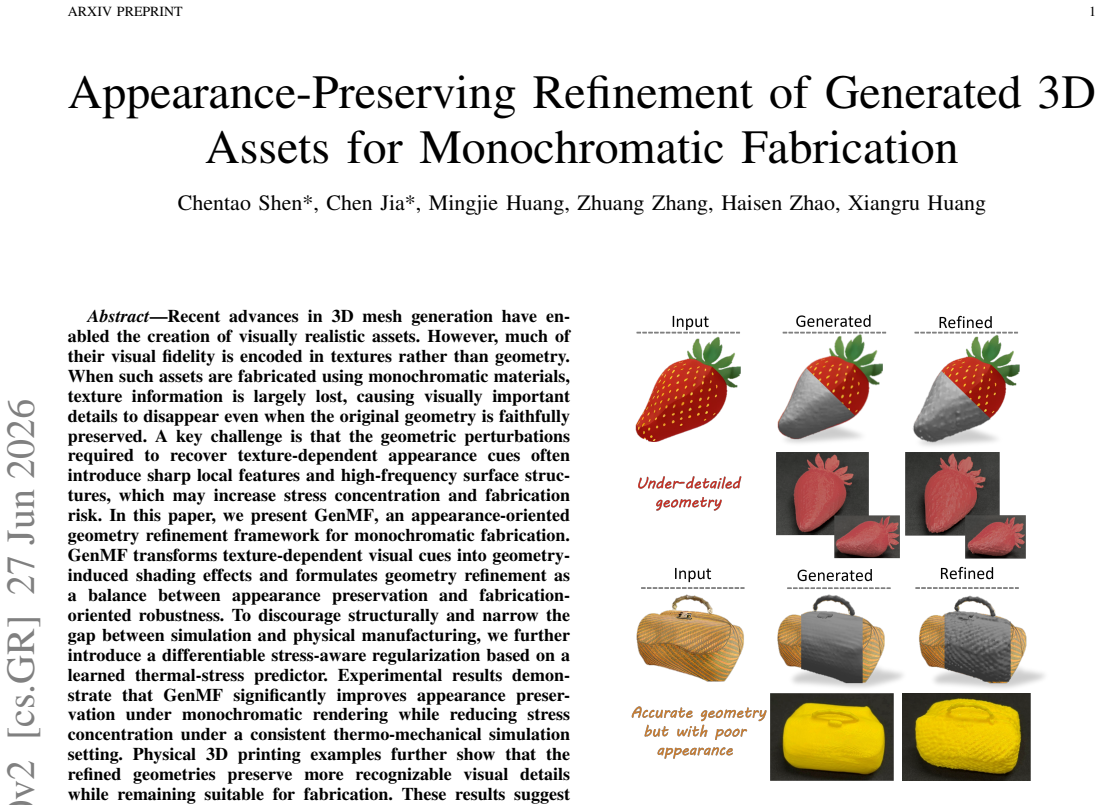
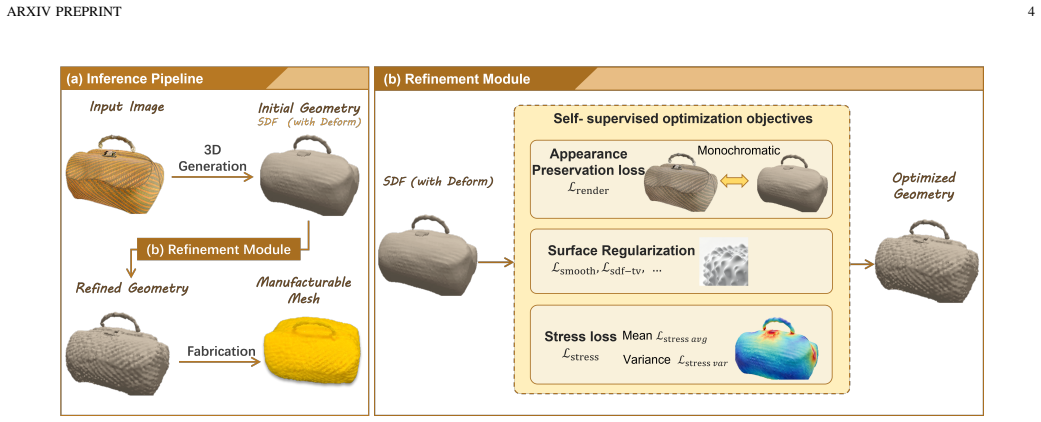
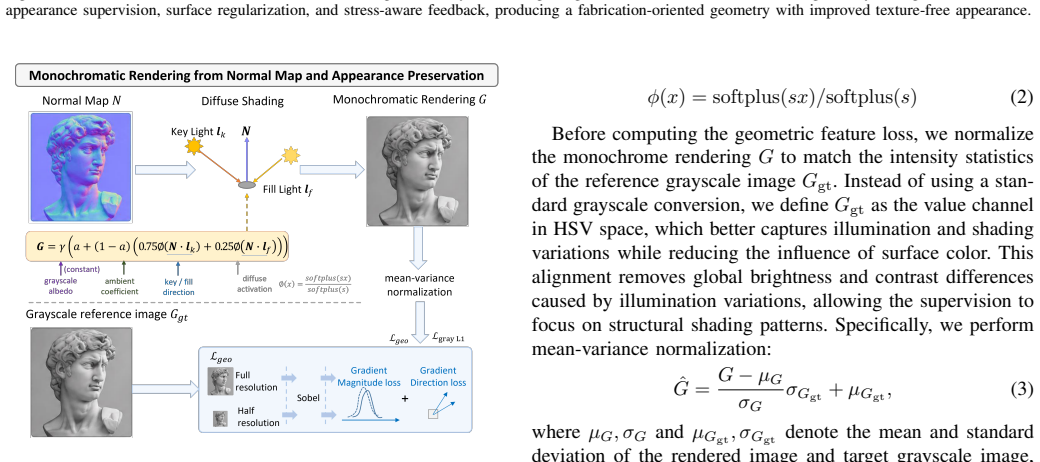
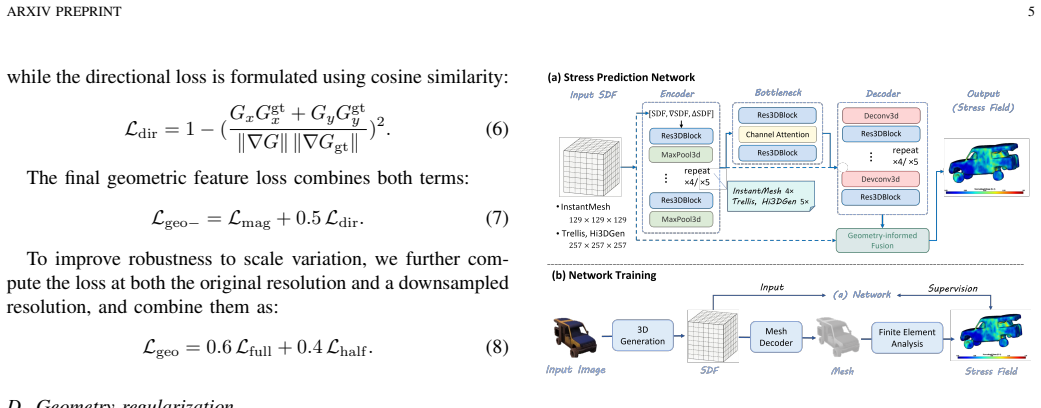
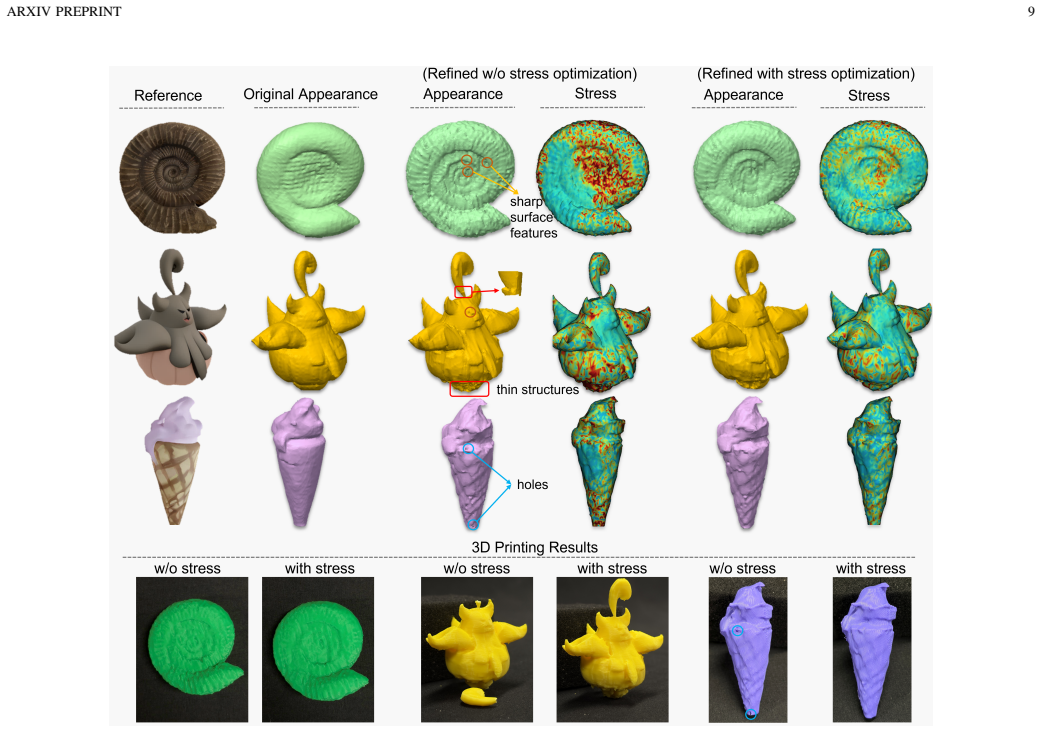
GenMF transforms texture-dependent visual cues into geometry-induced shading effects and formulates geometry refinement as a balance between appearance preservation and fabrication-oriented robustness. It further introduces a differentiable stress-aware regularization based on a learned thermal-stress predictor to discourage structurally weak features and narrow the gap between simulation and physical manufacturing.
What carries the argument
GenMF, an appearance-oriented geometry refinement framework that encodes texture cues as geometry shading while applying differentiable stress-aware regularization via a learned thermal-stress predictor.
If this is right
- Refined geometries preserve more recognizable visual details under monochromatic rendering than the original generated meshes.
- Stress concentration decreases under consistent thermo-mechanical simulation settings for the refined shapes.
- Physical prints of the refined models remain suitable for fabrication while retaining more visual information than baseline versions.
Where Pith is reading between the lines
- The same refinement idea could be applied to other single-material processes such as laser cutting or CNC milling where texture information is also lost.
- Embedding GenMF directly inside generative 3D pipelines might allow creation of models that are ready for fabrication without a separate refinement stage.
- The learned thermal-stress predictor could be retrained on additional manufacturing constraints to handle different materials or printing technologies.
Load-bearing premise
The geometric perturbations needed to recover texture appearance can be balanced with fabrication robustness without introducing sharp local features that the regularization cannot keep under control.
What would settle it
Physical 3D prints of the refined models that show no improvement in recognizable detail retention or that break more often than unrefined versions under the same printing conditions would falsify the central claim.
Figures
read the original abstract
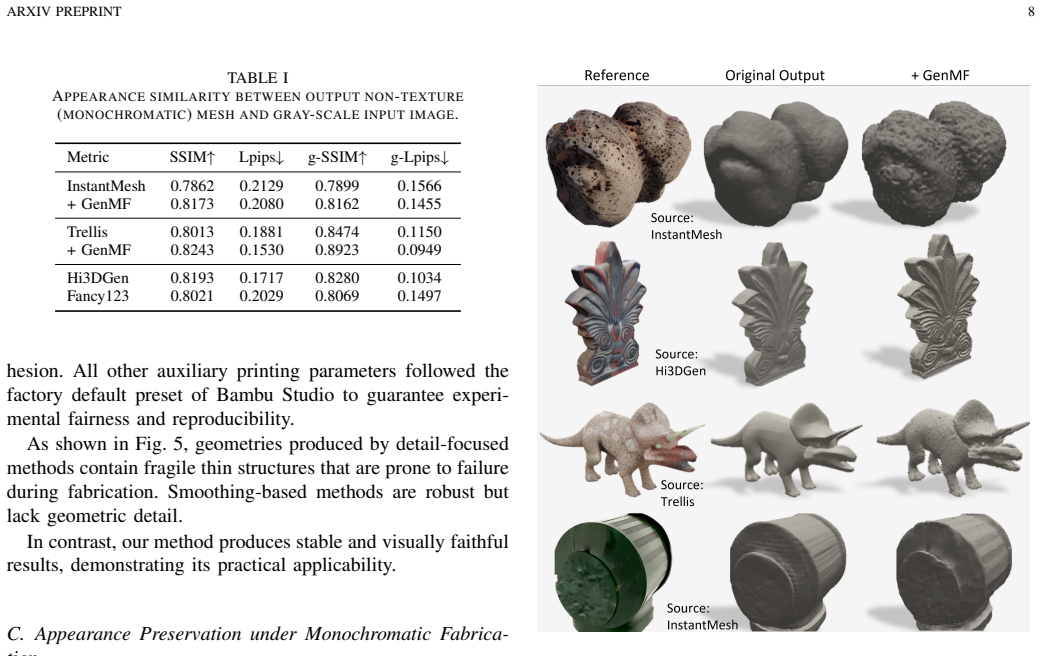
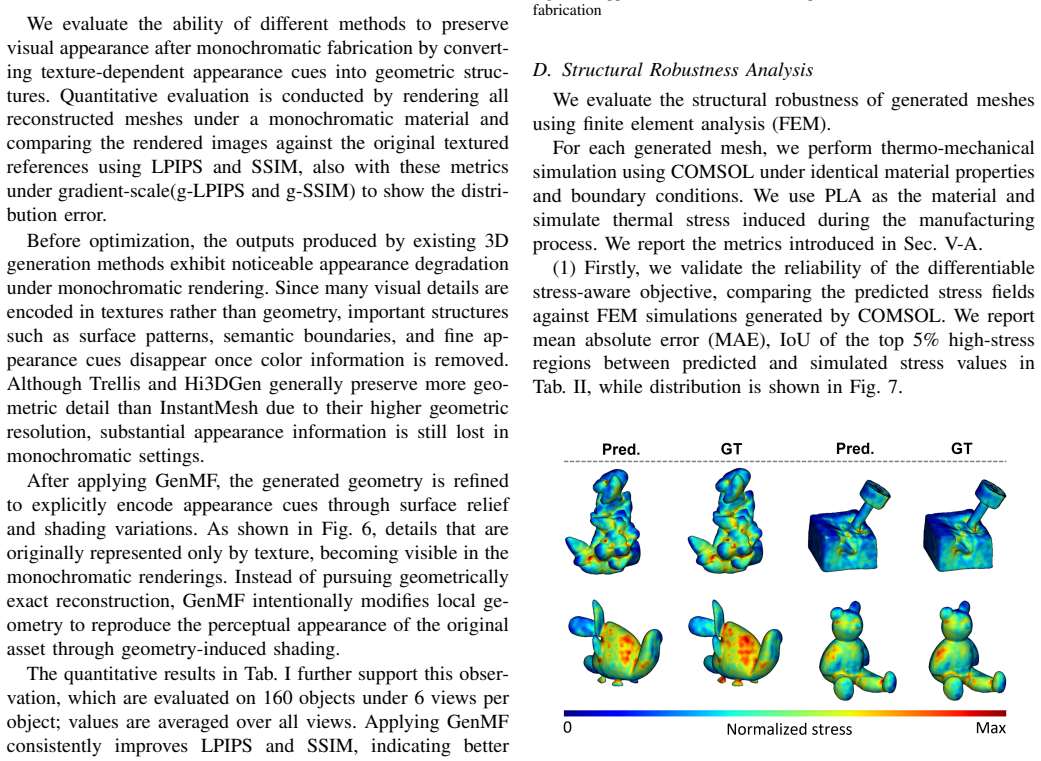
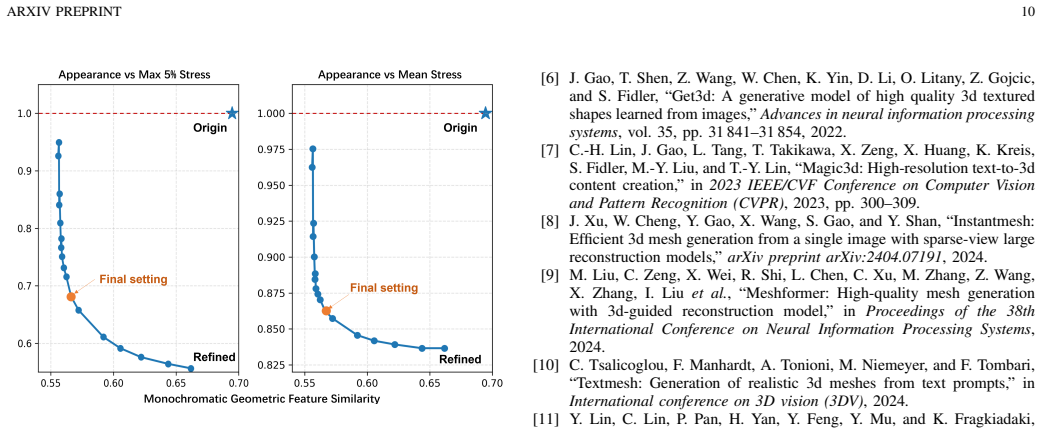
Recent advances in 3D mesh generation have enabled the creation of visually realistic assets. However, much of their visual fidelity is encoded in textures rather than geometry. When such assets are fabricated using monochromatic materials, texture information is largely lost, causing visually important details to disappear even when the original geometry is faithfully preserved. A key challenge is that the geometric perturbations required to recover texture-dependent appearance cues often introduce sharp local features and high-frequency surface structures, which may increase stress concentration and fabrication risk. In this paper, we present GenMF, an appearance-oriented geometry refinement framework for monochromatic fabrication. GenMF transforms texture-dependent visual cues into geometry-induced shading effects and formulates geometry refinement as a balance between appearance preservation and fabrication-oriented robustness. To discourage structurally and narrow the gap between simulation and physical manufacturing, we further introduce a differentiable stress-aware regularization based on a learned thermal-stress predictor. Experimental results demonstrate that GenMF significantly improves appearance preservation under monochromatic rendering while reducing stress concentration under a consistent thermo-mechanical simulation setting. Physical 3D printing examples further show that the refined geometries preserve more recognizable visual details while remaining suitable for fabrication. These results suggest that appearance-aware geometry refinement provides an effective bridge between generated 3D assets and fabrication-ready monochromatic objects.
Editorial analysis
A structured set of objections, weighed in public.
Referee Report
Summary. The paper introduces GenMF, a geometry refinement framework that converts texture-dependent appearance cues in generated 3D assets into geometry-induced shading effects for monochromatic fabrication. It formulates refinement as an optimization balancing appearance preservation against fabrication robustness and introduces a differentiable stress-aware regularization term based on a learned thermal-stress predictor to penalize high-stress regions. The central claims are supported by simulation results under a fixed thermo-mechanical protocol and qualitative physical 3D printing examples showing better detail preservation without compromising fabricability.
Significance. If the results hold, the work addresses a practical gap between 3D generative models and monochromatic fabrication by providing an appearance-preserving refinement step that maintains visual recognizability while controlling stress. The explicit use of a learned predictor for regularization and the inclusion of physical print validation are positive elements that could influence downstream applications in graphics and manufacturing.
major comments (1)
- [Abstract] Abstract and results: The claims that GenMF 'significantly improves appearance preservation' and 'reducing stress concentration' are presented without any quantitative metrics, baselines, error analysis, or statistical comparisons. This is load-bearing for the central claim of an effective appearance-robustness trade-off and prevents evaluation of whether the regularization successfully balances the objectives.
minor comments (2)
- [Abstract] Abstract: The sentence 'To discourage structurally and narrow the gap' appears incomplete or contains a typographical error.
- The description of the learned thermal-stress predictor would benefit from an early, explicit statement of its input features and loss formulation to improve clarity.
Simulated Author's Rebuttal
We thank the referee for the constructive feedback on strengthening the evaluation of our central claims. We address the major comment below.
read point-by-point responses
-
Referee: [Abstract] Abstract and results: The claims that GenMF 'significantly improves appearance preservation' and 'reducing stress concentration' are presented without any quantitative metrics, baselines, error analysis, or statistical comparisons. This is load-bearing for the central claim of an effective appearance-robustness trade-off and prevents evaluation of whether the regularization successfully balances the objectives.
Authors: We agree that the abstract and results would be strengthened by explicit quantitative metrics, baselines, error analysis, and statistical comparisons to support the claims of improved appearance preservation and reduced stress concentration. The current version presents simulation results under a fixed thermo-mechanical protocol and qualitative physical prints, but does not include numerical metrics (e.g., appearance similarity scores under monochromatic rendering or peak stress values) or formal baseline comparisons. In the revised manuscript we will add these elements, including quantitative metrics for both objectives, comparisons to relevant baselines, and appropriate analysis to evaluate the appearance-robustness trade-off. revision: yes
Circularity Check
No significant circularity in derivation chain
full rationale
The paper formulates GenMF as an explicit optimization balancing appearance preservation (via geometry-induced shading) against fabrication robustness (via differentiable stress-aware regularization from a learned predictor). No quoted derivation, equation, or self-citation reduces the central result to a tautology, fitted input renamed as prediction, or self-referential uniqueness theorem. Claims rest on reported simulation metrics and physical prints under fixed protocols rather than any self-definitional step. The method is self-contained against external benchmarks.
Axiom & Free-Parameter Ledger
Reference graph
Works this paper leans on
-
[1]
Structured 3d latents for scalable and versatile 3d generation,
J. Xiang, Z. Lv, S. Xu, Y . Deng, R. Wang, B. Zhang, D. Chen, X. Tong, and J. Yang, “Structured 3d latents for scalable and versatile 3d generation,” in2025 IEEE/CVF Conference on Computer Vision and Pattern Recognition (CVPR), 2025, pp. 21 469–21 480
2025
-
[2]
Multi-material additive manufacturing: A systematic review of design, properties, applications, challenges, and 3d printing of materials and cellular metamaterials,
A. Nazir, O. Gokcekaya, K. Md Masum Billah, O. Ertugrul, J. Jiang, J. Sun, and S. Hussain, “Multi-material additive manufacturing: A systematic review of design, properties, applications, challenges, and 3d printing of materials and cellular metamaterials,”Materials & Design, vol. 226, p. 111661, 2023. [Online]. Available: https: //www.sciencedirect.com/s...
2023
-
[3]
R. Tara. (2024) Realistic full color 3d print- ing exists, so why isn’t everyone using it? Fab- baloo. [Online]. Available: https://www.fabbaloo.com/news/ realistic-full-color-3d-printing-exists-so-why-isnt-everyone-using-it
2024
-
[4]
Deep geometric texture synthesis,
A. Hertz, R. Hanocka, R. Giryes, and D. Cohen-Or, “Deep geometric texture synthesis,”ACM Trans. Graph., vol. 39, no. 4, Aug. 2020. [Online]. Available: https://doi.org/10.1145/3386569.3392471
-
[5]
Quantitative surface characterisation and stress concentration of additively manufactured niti lattice struts,
M. Zheng, K. Ghabraie, Y .-s. Yang, J. Elambasseril, W. Xu, and Y . Wang, “Quantitative surface characterisation and stress concentration of additively manufactured niti lattice struts,”The International Journal of Advanced Manufacturing Technology, vol. 130, pp. 4861–4882, 1 2024, open access
2024
-
[6]
Get3d: A generative model of high quality 3d textured shapes learned from images,
J. Gao, T. Shen, Z. Wang, W. Chen, K. Yin, D. Li, O. Litany, Z. Gojcic, and S. Fidler, “Get3d: A generative model of high quality 3d textured shapes learned from images,”Advances in neural information processing systems, vol. 35, pp. 31 841–31 854, 2022
2022
-
[7]
Magic3d: High-resolution text-to-3d content creation,
C.-H. Lin, J. Gao, L. Tang, T. Takikawa, X. Zeng, X. Huang, K. Kreis, S. Fidler, M.-Y . Liu, and T.-Y . Lin, “Magic3d: High-resolution text-to-3d content creation,” in2023 IEEE/CVF Conference on Computer Vision and Pattern Recognition (CVPR), 2023, pp. 300–309
2023
-
[8]
J. Xu, W. Cheng, Y . Gao, X. Wang, S. Gao, and Y . Shan, “Instantmesh: Efficient 3d mesh generation from a single image with sparse-view large reconstruction models,”arXiv preprint arXiv:2404.07191, 2024
work page internal anchor Pith review Pith/arXiv arXiv 2024
-
[9]
Meshformer: High-quality mesh generation with 3d-guided reconstruction model,
M. Liu, C. Zeng, X. Wei, R. Shi, L. Chen, C. Xu, M. Zhang, Z. Wang, X. Zhang, I. Liuet al., “Meshformer: High-quality mesh generation with 3d-guided reconstruction model,” inProceedings of the 38th International Conference on Neural Information Processing Systems, 2024
2024
-
[10]
Textmesh: Generation of realistic 3d meshes from text prompts,
C. Tsalicoglou, F. Manhardt, A. Tonioni, M. Niemeyer, and F. Tombari, “Textmesh: Generation of realistic 3d meshes from text prompts,” in International conference on 3D vision (3DV), 2024
2024
-
[11]
Partcrafter: Structured 3d mesh generation via compositional latent diffusion transformers,
Y . Lin, C. Lin, P. Pan, H. Yan, Y . Feng, Y . Mu, and K. Fragkiadaki, “Partcrafter: Structured 3d mesh generation via compositional latent diffusion transformers,” inProceedings of the 38th International Con- ference on Neural Information Processing Systems, 2025
2025
-
[12]
Dreamfusion: Text-to-3d using 2d diffusion,
B. Poole, A. Jain, J. T. Barron, and B. Mildenhall, “Dreamfusion: Text-to-3d using 2d diffusion,” inThe Eleventh International Conference on Learning Representations, 2023. [Online]. Available: https://openreview.net/forum?id=FjNys5c7VyY
2023
-
[13]
Mvdream: Multi-view diffusion for 3d generation,
Y . Shi, P. Wang, J. Ye, L. Mai, K. Li, and X. Yang, “Mvdream: Multi-view diffusion for 3d generation,” inInternational Conference on Learning Representations, B. Kim, Y . Yue, S. Chaudhuri, K. Fragkiadaki, M. Khan, and Y . Sun, Eds., vol. 2024, 2024, pp. 39 838– 39 859. [Online]. Available: https://proceedings.iclr.cc/paper files/paper/ 2024/file/adbe936...
2024
-
[14]
Wonder3d: Single image to 3d using cross-domain diffusion,
X. Long, Y .-C. Guo, C. Lin, Y . Liu, Z. Dou, L. Liu, Y . Ma, S.-H. Zhang, M. Habermann, C. Theobaltet al., “Wonder3d: Single image to 3d using cross-domain diffusion,” inProceedings of the IEEE/CVF conference on computer vision and pattern recognition, 2024, pp. 9970–9980
2024
-
[15]
Prolificdreamer: High-fidelity and diverse text-to-3d generation with variational score distillation,
Z. Wang, C. Lu, Y . Wang, F. Bao, C. LI, H. Su, and J. Zhu, “Prolificdreamer: High-fidelity and diverse text-to-3d generation with variational score distillation,” inProceedings of the 36th International Conference on Neural Information Processing Systems, A. Oh, T. Naumann, A. Globerson, K. Saenko, M. Hardt, and S. Levine, Eds., vol. 36. Curran Associate...
2023
-
[16]
Gaussiandreamer: Fast generation from text to 3d gaussians by bridging 2d and 3d diffusion models,
T. Yi, J. Fang, J. Wang, G. Wu, L. Xie, X. Zhang, W. Liu, Q. Tian, and X. Wang, “Gaussiandreamer: Fast generation from text to 3d gaussians by bridging 2d and 3d diffusion models,” inProceedings of the IEEE/CVF conference on computer vision and pattern recognition, 2024, pp. 6796–6807
2024
-
[17]
DreamGaussian: Generative Gaussian Splatting for Efficient 3D Content Creation
J. Tang, J. Ren, H. Zhou, Z. Liu, and G. Zeng, “Dreamgaussian: Generative gaussian splatting for efficient 3d content creation,”arXiv preprint arXiv:2309.16653, 2023
work page internal anchor Pith review Pith/arXiv arXiv 2023
-
[18]
Lgm: Large multi-view gaussian model for high-resolution 3d content creation,
J. Tang, Z. Chen, X. Chen, T. Wang, G. Zeng, and Z. Liu, “Lgm: Large multi-view gaussian model for high-resolution 3d content creation,” in European Conference on Computer Vision. Springer, 2024, pp. 1–18
2024
-
[19]
Make-it-3d: High-fidelity 3d creation from a single image with diffu- sion prior,
J. Tang, T. Wang, B. Zhang, T. Zhang, R. Yi, L. Ma, and D. Chen, “Make-it-3d: High-fidelity 3d creation from a single image with diffu- sion prior,” inProceedings of the IEEE/CVF international conference on computer vision, 2023, pp. 22 819–22 829
2023
-
[20]
Direct3d: Scalable image-to-3d generation via 3d latent diffusion transformer,
S. Wu, Y . Lin, Y . Zeng, F. Zhang, J. Xu, P. Torr, X. Cao, and Y . Yao, “Direct3d: Scalable image-to-3d generation via 3d latent diffusion transformer,” inThe Thirty-eighth Annual Conference on Neural Information Processing Systems, 2024. [Online]. Available: https://openreview.net/forum?id=vCOgjBIZuL
2024
-
[21]
Direct3d-s2: Gigascale 3d generation made easy with spatial sparse attention,
S. Wu, Y . Lin, F. Zhang, Y . Zeng, Y . Yang, yajie bao, J. Qian, S. Zhu, X. Cao, P. Torr, and Y . Yao, “Direct3d-s2: Gigascale 3d generation made easy with spatial sparse attention,” inThe Thirty-ninth Annual Conference on Neural Information Processing Systems, 2025. [Online]. Available: https://openreview.net/forum?id=ZYHzcZFEGD
2025
-
[22]
Ln3diff++: Scalable latent neural fields diffusion for speedy 3d generation,
Y . Lan, F. Hong, S. Zhou, S. Yang, X. Meng, Y . Chen, Z. Lyu, B. Dai, X. Pan, and C. C. Loy, “Ln3diff++: Scalable latent neural fields diffusion for speedy 3d generation,”IEEE Transactions on Pattern Analysis and Machine Intelligence, 2025
2025
-
[23]
Magic123: One image to high-quality 3d object generation using ARXIV PREPRINT 11 both 2d and 3d diffusion priors,
G. Qian, J. Mai, A. Hamdi, J. Ren, A. Siarohin, B. Li, H.-Y . Lee, I. Skorokhodov, P. Wonka, S. Tulyakov, and B. Ghanem, “Magic123: One image to high-quality 3d object generation using ARXIV PREPRINT 11 both 2d and 3d diffusion priors,” inThe Twelfth International Conference on Learning Representations (ICLR), 2024. [Online]. Available: https://openreview...
2024
-
[24]
Fantasia3d: Disentangling geometry and appearance for high-quality text-to-3d content creation,
R. Chen, Y . Chen, N. Jiao, and K. Jia, “Fantasia3d: Disentangling geometry and appearance for high-quality text-to-3d content creation,” inProceedings of the IEEE/CVF International Conference on Computer Vision (ICCV), October 2023, pp. 22 246–22 256
2023
-
[25]
Fancy123: One image to high-quality 3d mesh generation via plug-and- play deformation,
Q. Yu, X. Li, Y . Tang, X. Han, L. Hu, Y . Hao, and M. Chen, “Fancy123: One image to high-quality 3d mesh generation via plug-and- play deformation,” inProceedings of the Computer Vision and Pattern Recognition Conference, 2025, pp. 595–604
2025
-
[26]
Craftsman3d: High-fidelity mesh generation with 3d native diffusion and interactive geometry refiner,
W. Li, J. Liu, H. Yan, R. Chen, Y . Liang, X. Chen, P. Tan, and X. Long, “Craftsman3d: High-fidelity mesh generation with 3d native diffusion and interactive geometry refiner,” inProceedings of the Computer Vision and Pattern Recognition Conference, 2025, pp. 5307–5317
2025
-
[27]
Hi3dgen: High-fidelity 3d geometry generation from images via normal bridging,
C. Ye, Y . Wu, Z. Lu, J. Chang, X. Guo, J. Zhou, H. Zhao, and X. Han, “Hi3dgen: High-fidelity 3d geometry generation from images via normal bridging,” inProceedings of the IEEE/CVF International Conference on Computer Vision, 2025, pp. 25 050–25 061
2025
-
[28]
Hf-neus: improved surface reconstruction using high-frequency details,
Y . Wang, I. Skorokhodov, and P. Wonka, “Hf-neus: improved surface reconstruction using high-frequency details,” inProceedings of the 36th International Conference on Neural Information Processing Systems, ser. NIPS ’22. Red Hook, NY , USA: Curran Associates Inc., 2022
2022
-
[29]
D2im-net: Learning detail disentangled implicit fields from single images,
M. Li and H. Zhang, “D2im-net: Learning detail disentangled implicit fields from single images,” in2021 IEEE/CVF Conference on Computer Vision and Pattern Recognition (CVPR), 2021, pp. 10 241–10 250
2021
-
[30]
Geometry-consistent neural shape representation with implicit displacement fields,
W. Yifan, L. Rahmann, and O. Sorkine-hornung, “Geometry-consistent neural shape representation with implicit displacement fields,” inInter- national Conference on Learning Representations, 2022
2022
-
[31]
Mesh quilting for geometric texture synthesis,
K. Zhou, X. Huang, X. Wang, Y . Tong, M. Desbrun, B. Guo, and H.-Y . Shum, “Mesh quilting for geometric texture synthesis,”ACM Trans. Graph., vol. 25, no. 3, p. 690–697, Jul. 2006. [Online]. Available: https://doi.org/10.1145/1141911.1141942
-
[32]
Stress relief: improving structural strength of 3d printable objects,
O. Stava, J. Vanek, B. Benes, N. Carr, and R. M ˇech, “Stress relief: improving structural strength of 3d printable objects,”ACM Trans. Graph., vol. 31, no. 4, Jul. 2012. [Online]. Available: https://doi.org/10.1145/2185520.2185544
-
[33]
Worst-case structural analysis,
Q. Zhou, J. Panetta, and D. Zorin, “Worst-case structural analysis,” ACM Trans. Graph., vol. 32, no. 4, Jul. 2013. [Online]. Available: https://doi.org/10.1145/2461912.2461967
-
[34]
Build-to-last: strength to weight 3d printed objects,
L. Lu, A. Sharf, H. Zhao, Y . Wei, Q. Fan, X. Chen, Y . Savoye, C. Tu, D. Cohen-Or, and B. Chen, “Build-to-last: strength to weight 3d printed objects,”ACM Trans. Graph., vol. 33, no. 4, Jul. 2014. [Online]. Available: https://doi.org/10.1145/2601097.2601168
-
[35]
A system for high-resolution topology optimization,
J. Wu, C. Dick, and R. Westermann, “A system for high-resolution topology optimization,”IEEE Transactions on Visualization and Computer Graphics, vol. 22, no. 3, p. 1195–1208, Mar. 2016. [Online]. Available: https://doi.org/10.1109/TVCG.2015.2502588
-
[36]
Staged: Stress-tensor assisted global–local-global solver for interactive elastic shape design,
L. Ruan, B. Wang, T. Liu, and B. Chen, “Staged: Stress-tensor assisted global–local-global solver for interactive elastic shape design,” Computer Graphics Forum, vol. n/a, no. n/a, p. e70402. [Online]. Available: https://onlinelibrary.wiley.com/doi/abs/10.1111/cgf.70402
-
[37]
Deep Blending for Free-Viewpoint Image-Based Rendering,
C. Schumacher, J. Zehnder, and M. B ¨acher, “Set-in-stone: worst- case optimization of structures weak in tension,”ACM Trans. Graph., vol. 37, no. 6, Dec. 2018. [Online]. Available: https: //doi.org/10.1145/3272127.3275085
-
[38]
Stress-based topology optimization of thermoelastic structures considering self-support constraints,
J. Zheng, G. Zhang, and C. Jiang, “Stress-based topology optimization of thermoelastic structures considering self-support constraints,” Computer Methods in Applied Mechanics and Engineering, vol. 408, p. 115957, 2023. [Online]. Available: https://www.sciencedirect.com/ science/article/pii/S0045782523000804
2023
-
[39]
Temperature-constrained topology optimization of thermo-mechanical coupled problems,
X. Zhu, C. Zhao, X. Wang, Y . Zhou, P. Hu, and Z.-D. Ma, “Temperature-constrained topology optimization of thermo-mechanical coupled problems,”Engineering Optimization, vol. 51, no. 10, pp. 1687–1709, 2019. [Online]. Available: https://doi.org/10.1080/ 0305215X.2018.1554065
-
[40]
Multi-material topology optimization for maximizing structural stability under thermo-mechanical loading,
Y . Wang and O. Sigmund, “Multi-material topology optimization for maximizing structural stability under thermo-mechanical loading,” Computer Methods in Applied Mechanics and Engineering, vol. 407, p. 115938, 2023. [Online]. Available: https://www.sciencedirect.com/ science/article/pii/S0045782523000610
2023
-
[41]
Stress field prediction in fiber-reinforced composite materials using a deep learning approach,
A. Bhaduri, A. Gupta, and L. Graham-Brady, “Stress field prediction in fiber-reinforced composite materials using a deep learning approach,” Composites Part B: Engineering, vol. 238, p. 109879, 2022. [Online]. Available: https://www.sciencedirect.com/science/article/pii/ S135983682200258X
2022
-
[42]
Deep learning prediction of stress fields in additively manufactured metals with intricate defect networks,
B. P. Croom, M. Berkson, R. K. Mueller, M. Presley, and S. Storck, “Deep learning prediction of stress fields in additively manufactured metals with intricate defect networks,”Mechanics of Materials, vol. 165, p. 104191, 2022. [Online]. Available: https://www.sciencedirect.com/science/article/pii/S0167663621004026
2022
-
[43]
Prediction of local elasto- plastic stress and strain fields in a two-phase composite microstructure using a deep convolutional neural network,
I. Saha, A. Gupta, and L. Graham-Brady, “Prediction of local elasto- plastic stress and strain fields in a two-phase composite microstructure using a deep convolutional neural network,”Computer Methods in Applied Mechanics and Engineering, vol. 421, p. 116816, 2024. [Online]. Available: https://www.sciencedirect.com/science/article/pii/ S0045782524000720
2024
-
[44]
Comparison of deep learning techniques for prediction of stress distribution in stiffened panels,
N. Mokhtari, Y . Cai, and J. Jelovica, “Comparison of deep learning techniques for prediction of stress distribution in stiffened panels,” Thin-Walled Structures, vol. 215, p. 113494, 2025. [Online]. Available: https://www.sciencedirect.com/science/article/pii/S0263823125005877
2025
-
[45]
Stressgan: A generative deep learning model for two-dimensional stress distribution prediction,
H. Jiang, Z. Nie, R. Yeo, A. B. Farimani, and L. B. Kara, “Stressgan: A generative deep learning model for two-dimensional stress distribution prediction,”Journal of Applied Mechanics, vol. 88, no. 5, p. 051005, 02 2021. [Online]. Available: https://doi.org/10.1115/1.4049805
-
[46]
Conditional generative adversarial network enabled localized stress recovery of periodic composites,
C. Xu, X. Wang, Y . Li, G. Wang, and H. Zhang, “Conditional generative adversarial network enabled localized stress recovery of periodic composites,”CMES - Computer Modeling in Engineering and Sciences, vol. 140, no. 1, pp. 957–974, 2024. [Online]. Available: https://www.sciencedirect.com/science/article/pii/S1526149224001346
2024
-
[47]
Rapid evaluation and prediction of cure-induced residual stress of composites based on cgan deep learning model,
X. Hui, Y . Xu, J. Niu, and W. Zhang, “Rapid evaluation and prediction of cure-induced residual stress of composites based on cgan deep learning model,”Composite Structures, vol. 330, p. 117827, 2024. [Online]. Available: https://www.sciencedirect.com/science/article/pii/ S026382232301173X
2024
-
[48]
Rp-cgan for microscale stress- strain field mapping in frp with interphase-aware learning,
J. Wu, J. Yu, X. Wang, and Z. Huang, “Rp-cgan for microscale stress- strain field mapping in frp with interphase-aware learning,”Materials Today Communications, vol. 50, p. 114434, 2026. [Online]. Available: https://www.sciencedirect.com/science/article/pii/S2352492825029460
2026
-
[49]
Deep learning approach for predicting multi-component stress fields in fiber-reinforced composites under different load paths,
X. Peng, Q. Yao, B. Yi, J. Xie, J. Li, and S. Jiang, “Deep learning approach for predicting multi-component stress fields in fiber-reinforced composites under different load paths,”Composites Science and Technology, vol. 267, p. 111198, 2025. [Online]. Available: https://www.sciencedirect.com/science/article/pii/S0266353825001666
2025
-
[50]
Learning mesh-based simulation with graph networks,
T. Pfaff, M. Fortunato, A. Sanchez-Gonzalez, and P. W. Battaglia, “Learning mesh-based simulation with graph networks,” inInternational Conference on Learning Representations, 2021
2021
-
[51]
Predicting stress, strain and defor- mation fields in materials and structures with graph neural networks,
M. Maurizi, C. Gao, and F. Berto, “Predicting stress, strain and defor- mation fields in materials and structures with graph neural networks,” Scientific Reports, vol. 12, no. 1, p. 21834, 2022
2022
-
[52]
Stress predictions in polycrystal plasticity using graph neural networks with subgraph training,
H. Zhai, “Stress predictions in polycrystal plasticity using graph neural networks with subgraph training,”Computational Mechanics, vol. 76, pp. 387–408, 2025
2025
-
[53]
Meshgraphnet-transformer: Scalable mesh-based learned simulation for solid mechanics,
M. M. Iparraguirre, I. Alfaro, D. Gonz ´alez, and E. Cueto, “Meshgraphnet-transformer: Scalable mesh-based learned simulation for solid mechanics,”ArXiv, vol. abs/2601.23177, 2026. [Online]. Available: https://api.semanticscholar.org/CorpusID:285240999
-
[54]
A physics-informed deep learning framework for inversion and surrogate modeling in solid mechanics,
E. Haghighat, M. Raissi, A. Moure, H. Gomez, and R. Juanes, “A physics-informed deep learning framework for inversion and surrogate modeling in solid mechanics,”Computer Methods in Applied Mechanics and Engineering, vol. 379, p. 113741, 2021. [Online]. Available: https://www.sciencedirect.com/science/article/pii/S0045782521000773
2021
-
[55]
Physics informed neural network for dynamic stress prediction,
H. Bolandi, G. Sreekumar, X. Li, N. Lajnef, and V . N. Boddeti, “Physics informed neural network for dynamic stress prediction,”Applied Intel- ligence, vol. 53, pp. 26 313–26 328, 2023
2023
-
[56]
Thermo-mechanical physics-informed deep learning for prediction of thermal stress evolution in laser metal deposition,
R. Sharma and Y . Guo, “Thermo-mechanical physics-informed deep learning for prediction of thermal stress evolution in laser metal deposition,”Engineering Applications of Artificial Intelligence, vol. 157, p. 111554, 2025. [Online]. Available: https://www.sciencedirect. com/science/article/pii/S0952197625015568
2025
-
[57]
Fourier Neural Operator for Parametric Partial Differential Equations
Z.-Y . Li, N. B. Kovachki, K. Azizzadenesheli, B. Liu, K. Bhattacharya, A. M. Stuart, and A. Anandkumar, “Fourier neural operator for para- metric partial differential equations,”ArXiv, vol. abs/2010.08895, 2020
work page internal anchor Pith review Pith/arXiv arXiv 2010
-
[58]
Learning the stress-strain fields in digital composites using fourier neural operator,
M. M. Rashid, T. Pittie, S. Chakraborty, and N. A. Krishnan, “Learning the stress-strain fields in digital composites using fourier neural operator,”iScience, vol. 25, no. 11, p. 105452, 2022. [Online]. Available: https://www.sciencedirect.com/science/article/pii/S2589004222017242
2022
-
[59]
Learning nonlinear operators via deeponet based on the universal approximation theorem of operators,
L. Lu, P. Jin, G. Pang, Z. Zhang, and G. E. Karniadakis, “Learning nonlinear operators via deeponet based on the universal approximation theorem of operators,”Nature Machine Intelligence, vol. 3, pp. 218–229, 2021
2021
-
[60]
Novel deeponet architecture to predict stresses in elastoplastic structures with ARXIV PREPRINT 12 variable complex geometries and loads,
J. He, S. Koric, S. Kushwaha, J. Park, D. Abueidda, and I. Jasiuk, “Novel deeponet architecture to predict stresses in elastoplastic structures with ARXIV PREPRINT 12 variable complex geometries and loads,”Computer Methods in Applied Mechanics and Engineering, vol. 415, p. 116277, 2023. [Online]. Available: https://www.sciencedirect.com/science/article/pi...
2023
-
[61]
Graph neural operator: A deeponet-based framework for learning thermo-mechanical distortion in metallic additive manufacturing,
Z. Chen, H. Mu, Z. Zhang, L. Yuan, D. Ding, H. Zhu, N. Ma, and Z. Pan, “Graph neural operator: A deeponet-based framework for learning thermo-mechanical distortion in metallic additive manufacturing,” Additive Manufacturing, vol. 115, p. 105063, 2026. [Online]. Available: https://www.sciencedirect.com/science/article/pii/S2214860425004282
2026
-
[62]
IDArb: Intrinsic decomposition for arbitrary number of input views and illuminations,
Z. Li, T. Wu, J. Tan, M. Zhang, J. Wang, and D. Lin, “IDArb: Intrinsic decomposition for arbitrary number of input views and illuminations,” inThe Thirteenth International Conference on Learning Representations, 2025. [Online]. Available: https: //openreview.net/forum?id=uuef1HP6X7
2025
discussion (0)
Sign in with ORCID, Apple, or X to comment. Anyone can read and Pith papers without signing in.