An ultralow-loss integrated photonic platform for discrete-variable quantum information processing
Pith reviewed 2026-06-26 04:48 UTC · model grok-4.3
The pith
Silicon nitride chip integrates sources and fusion circuits to produce four-photon GHZ states at 27 Hz with 0.943 fidelity.
A machine-rendered reading of the paper's core claim, the machinery that carries it, and where it could break.
Core claim
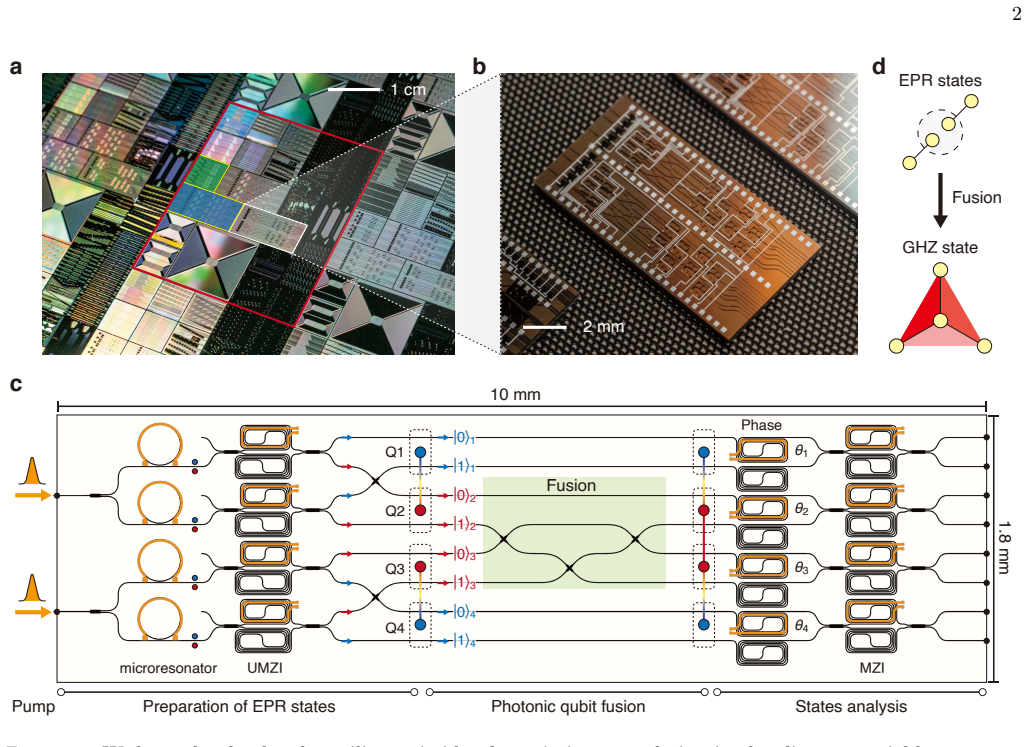
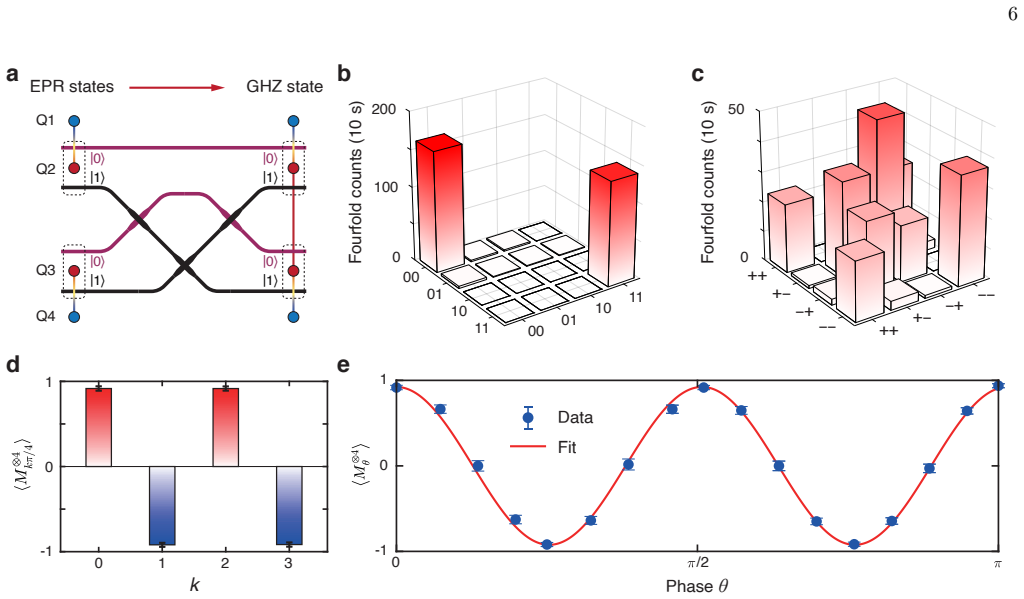
The architecture seamlessly integrates narrowband photon-pair sources with low-loss qubit-fusion circuits and reconfigurable state-analysis interferometers on a monolithic silicon nitride chip. EPR states reach fidelity 0.9875 with near-unity indistinguishability. On-chip fusion of two EPR states then produces four-photon GHZ states at fidelity 0.943 and a fourfold count rate of 27 Hz, more than two orders of magnitude above prior silicon-photonic results. Standard CMOS-compatible fabrication on 150-mm wafers makes the platform manufacturable for larger processors.
What carries the argument
The monolithic ultralow-loss silicon nitride circuit that places EPR sources, fusion gates, and analyzers on one chip to keep loss and distinguishability low across the full path.
If this is right
- Multiphoton experiments can run at usable rates without exponential slowdown as circuit size grows.
- The same fabrication process supports building larger entangled states on a single wafer.
- Reconfigurable analyzers allow the platform to test different quantum protocols on the same chip.
- The high count rate opens the door to real-time quantum networking demonstrations that were previously too slow.
Where Pith is reading between the lines
- If loss stays low when more stages are added, the platform could support error-corrected photonic quantum computing.
- The approach might be combined with other quantum technologies such as superconducting detectors on the same wafer.
- A direct test would be to measure eight-photon rates on an extended version of the same circuit design.
Load-bearing premise
Placing all components on the same chip does not add enough loss or photon distinguishability to erase the reported rate and fidelity gains.
What would settle it
A measurement on a deeper circuit with extra fusion or analysis stages that shows the fourfold rate falling below 5 Hz or fidelity below 0.9 would show the integration does not preserve the claimed performance.
Figures
read the original abstract
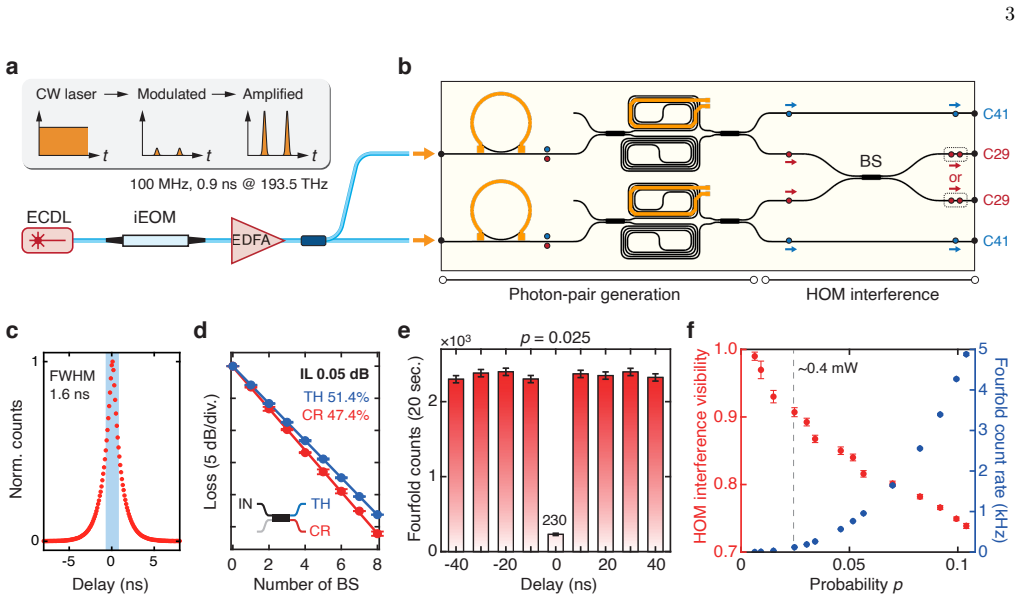
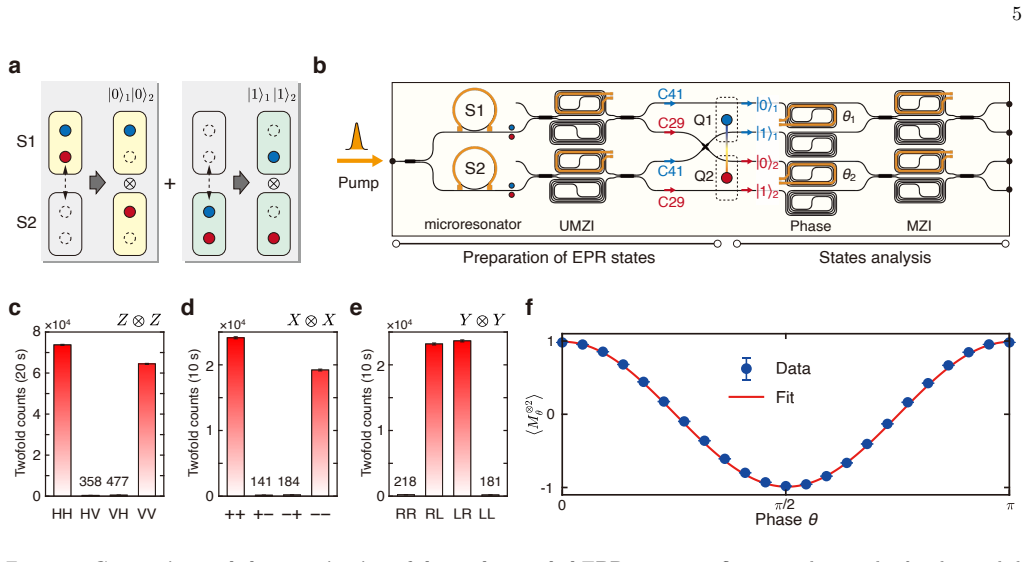
Photonic integrated circuits offer a scalable and robust route toward quantum information technologies by consolidating photon sources and linear optical networks onto compact, wafer-manufacturable chips. Although silicon photonics has enabled diverse discrete-variable quantum breakthroughs -- spanning multiphoton entanglement, quantum networking, and photonic qubit fusion for quantum computing -- scaling these platforms beyond proof-of-principle demonstrations remains severely constrained by a critical system-level bottleneck. Optical loss compounds rapidly across photon generation, routing, and state analysis, causing multiphoton generation probabilities to plummet exponentially as circuit depth and complexity grow. Here we overcome this rate-loss barrier by demonstrating a monolithic, ultralow-loss silicon nitride (Si$_3$N$_4$) integrated photonic platform engineered for high-performance discrete-variable quantum information processing. Our architecture seamlessly integrates narrowband photon-pair sources with low-loss qubit-fusion circuits and reconfigurable state-analysis interferometers. The on-chip sources prepare Einstein-Podolsky-Rosen (EPR) states with a fidelity of 0.9875(3) and exhibit near-unity photon indistinguishability, yielding a heralded Hong-Ou-Mandel interference visibility of 0.990(6). By executing on-chip fusion of two EPR states, we synthesize and characterize four-photon Greenberger-Horne-Zeilinger states with a record fidelity of 0.943(8) and a fourfold count rate of 27 Hz -- more than two orders of magnitude higher than previous silicon-photonic implementations. Combined with standard CMOS-compatible fabrication on 150-mm-diameter wafers, these results establish ultralow-loss Si$_3$N$_4$ integrated photonics as a definitive, manufacturable platform for deployable, large-scale quantum information processors.
Editorial analysis
A structured set of objections, weighed in public.
Referee Report
Summary. The manuscript demonstrates a monolithic ultralow-loss Si3N4 integrated photonic platform that integrates narrowband EPR photon-pair sources, qubit-fusion circuits, and reconfigurable state-analysis interferometers on a single chip. It reports EPR-state fidelity of 0.9875(3), heralded HOM visibility of 0.990(6), and on-chip fusion of two EPR states to produce four-photon GHZ states with fidelity 0.943(8) at a fourfold coincidence rate of 27 Hz, more than two orders of magnitude above prior silicon-photonic results, together with CMOS-compatible 150-mm wafer fabrication.
Significance. If the integration preserves the reported component-level metrics, the work would establish Si3N4 as a manufacturable platform capable of overcoming the exponential rate-loss barrier for multiphoton discrete-variable quantum information processing.
major comments (1)
- [Abstract and architecture description] Abstract and architecture description: the headline claim of record GHZ fidelity and count rate requires that the source EPR fidelity, HOM visibility, and waveguide loss remain intact once sources, fusion gates, and analyzers share the same chip. The manuscript reports only end-to-end results and does not supply an explicit loss budget or separate characterization of the fused device to confirm that integration introduces neither additional propagation loss nor mode mismatch at the fusion couplers.
minor comments (1)
- The abstract states 'standard CMOS-compatible fabrication on 150-mm-diameter wafers' without specifying process parameters, layer thicknesses, or measured propagation-loss values at the operating wavelength.
Simulated Author's Rebuttal
We thank the referee for their careful review and constructive feedback on our manuscript. We address the major comment point-by-point below, providing the strongest honest defense of our results while agreeing to strengthen the presentation where warranted.
read point-by-point responses
-
Referee: the headline claim of record GHZ fidelity and count rate requires that the source EPR fidelity, HOM visibility, and waveguide loss remain intact once sources, fusion gates, and analyzers share the same chip. The manuscript reports only end-to-end results and does not supply an explicit loss budget or separate characterization of the fused device to confirm that integration introduces neither additional propagation loss nor mode mismatch at the fusion couplers.
Authors: We agree that an explicit loss budget and component-level verification of the integrated device would strengthen the manuscript and directly address concerns about whether integration preserves the reported metrics. While the high end-to-end fidelities (EPR 0.9875(3), HOM 0.990(6), GHZ 0.943(8)) and >100x rate improvement already provide strong evidence that no significant additional loss or mode mismatch was introduced—otherwise the exponential rate penalty would have precluded the observed 27 Hz fourfold rate—we will add a dedicated loss-budget section in the revised manuscript. This will include independent measurements from test structures on the same 150 mm wafer (propagation loss, coupler splitting ratios, and fusion-gate mode overlap) together with a breakdown showing that on-chip integration contributes negligibly beyond the separately characterized source and analyzer losses. These additions will make the preservation of component performance explicit without altering the core claims. revision: yes
Circularity Check
No circularity: purely experimental measurements with no derivations
full rationale
The paper reports direct experimental characterization of an integrated Si3N4 photonic device: EPR state fidelity 0.9875(3), HOM visibility 0.990(6), four-photon GHZ fidelity 0.943(8), and fourfold rate 27 Hz. These are measured outcomes from device fabrication and quantum state tomography, not predictions derived from equations or parameters fitted to the same data. No load-bearing derivations, self-citations of uniqueness theorems, or ansatzes appear in the abstract or architecture description. The integration claim is an engineering assertion tested by the end-to-end results rather than a mathematical reduction. This is the standard case of an experimental paper whose central claims rest on hardware performance, not on any circular chain.
Axiom & Free-Parameter Ledger
axioms (2)
- standard math Standard quantum mechanics and linear optical transformations govern the photon states and interference measurements.
- domain assumption The reported device losses and photon indistinguishability are preserved under monolithic integration on the 150 mm wafer process.
Reference graph
Works this paper leans on
-
[1]
Satellite testing of a gravitationally induced quantum decoherence model , volume=. Science , author=. 2019 , pages=. doi:10.1126/science.aay5820 , number=
-
[2]
, title =
Zeilinger, A. , title =. American Journal of Physics , volume =. 1981 , month =
1981
-
[3]
Experimental Ten-Photon Entanglement , author =. Phys. Rev. Lett. , volume =. 2016 , month =. doi:10.1103/PhysRevLett.117.210502 , url =
-
[4]
Nature Materials , author=
Large-scale quantum dot–lithium niobate hybrid integrated photonic circuits enabling on-chip quantum networking , ISSN=. Nature Materials , author=. 2025 , month=nov, language=
2025
-
[5]
A versatile single-photon-based quantum computing platform , volume=. Nature Photonics , author=. 2024 , month=june, pages=. doi:10.1038/s41566-024-01403-4 , number=
-
[6]
Heralded quantum interference in integrated lithium niobate nanophotonics , volume=. Optica Quantum , author=. 2026 , month=apr, pages=. doi:10.1364/OPTICAQ.578936 , number=
-
[7]
Quantum states generation and manipulation in a programmable silicon-photonic four-qubit system with high-fidelity and purity , volume=. APL Photonics , author=. 2024 , month=july, pages=. doi:10.1063/5.0207714 , number=
-
[8]
Nature Communications , author=
Programmable four-photon graph states on a silicon chip , volume=. Nature Communications , author=. 2019 , month=aug, pages=. doi:10.1038/s41467-019-11489-y , number=
-
[9]
Nature Communications , author=
Near-ideal spontaneous photon sources in silicon quantum photonics , volume=. Nature Communications , author=. 2020 , month=dec, pages=. doi:10.1038/s41467-020-16187-8 , number=
-
[10]
Observation of quantum nonlocality in greenberger-horne-zeilinger entanglement on a silicon chip , volume=. Optics Express , author=. 2024 , month=apr, pages=. doi:10.1364/OE.515070 , number=
-
[11]
Nature Communications , author=
On-chip detection of non-classical light by scalable integration of single-photon detectors , volume=. Nature Communications , author=. 2015 , month=jan, pages=. doi:10.1038/ncomms6873 , abstractNote=
-
[12]
Nature Communications , author=
High-speed and high-efficiency travelling wave single-photon detectors embedded in nanophotonic circuits , volume=. Nature Communications , author=. 2012 , month=dec, pages=. doi:10.1038/ncomms2307 , abstractNote=
-
[13]
Otfried Gühne and Géza Tóth , keywords =. Entanglement detection , journal =. 2009 , issn =. doi:https://doi.org/10.1016/j.physrep.2009.02.004 , url =
-
[14]
and Pennings, E.C.M
Soldano, L.B. and Pennings, E.C.M. , journal=. Optical multi-mode interference devices based on self-imaging: principles and applications , year=
-
[15]
and Horne, Michael A
Greenberger, Daniel M. and Horne, Michael A. and Shimony, Abner and Zeilinger, Anton , title =. American Journal of Physics , volume =. 1990 , month =
1990
-
[16]
Efficient multiparty quantum-secret-sharing schemes , author =. Phys. Rev. A , volume =. 2004 , month =. doi:10.1103/PhysRevA.69.052307 , url =
-
[17]
Heralded entanglement distribution between two absorptive quantum memories , volume=. Nature , author=. 2021 , pages=. doi:10.1038/s41586-021-03505-3 , number=
-
[18]
Nature , author=
Long-lived remote ion-ion entanglement for scalable quantum repeaters , ISSN=. Nature , author=. 2026 , language=
2026
-
[19]
Lu, Bo-Wei and Yang, Chao-Wei and Wang, Run-Qi and Gao, Bo-Feng and Zhen, Yi-Zheng and Wang, Zhen-Gang and Shi, Jia-Kai and Ren, Zhong-Qi and Hahn, Thomas A. and Tan, Ernest Y.-Z. and Xie, Xiu-Ping and Zheng, Ming-Yang and Jiang, Xiao and Zhang, Jun and Xu, Feihu and Zhang, Qiang and Bao, Xiao-Hui and Pan, Jian-Wei , year=. Device-independent quantum key ...
-
[20]
Measurement of subpicosecond time intervals between two photons by interference , author =. Phys. Rev. Lett. , volume =. 1987 , month =. doi:10.1103/PhysRevLett.59.2044 , url =
-
[21]
Experimental Quantum Secret Sharing and Third-Man Quantum Cryptography , author =. Phys. Rev. Lett. , volume =. 2005 , month =. doi:10.1103/PhysRevLett.95.200502 , url =
-
[22]
Secret Sharing of a Quantum State , author =. Phys. Rev. Lett. , volume =. 2016 , month =. doi:10.1103/PhysRevLett.117.030501 , url =
-
[23]
Multiparty entanglement in graph states , author =. Phys. Rev. A , volume =. 2004 , month =. doi:10.1103/PhysRevA.69.062311 , url =
-
[24]
Multichip multidimensional quantum networks with entanglement retrievability , volume=. Science , author=. 2023 , pages=. doi:10.1126/science.adg9210 , number=
-
[25]
Silverstone and Qihuang Gong and Antonio Acín and Karsten Rottwitt and Leif K
Jianwei Wang and Stefano Paesani and Yunhong Ding and Raffaele Santagati and Paul Skrzypczyk and Alexia Salavrakos and Jordi Tura and Remigiusz Augusiak and Laura Mančinska and Davide Bacco and Damien Bonneau and Joshua W. Silverstone and Qihuang Gong and Antonio Acín and Karsten Rottwitt and Leif K. Oxenløwe and Jeremy L. O’Brien and Anthony Laing and Ma...
2018
-
[26]
On-Chip Generation and Collectively Coherent Control of the Superposition of the Whole Family of Dicke States , author =. Phys. Rev. Lett. , volume =. 2023 , month =. doi:10.1103/PhysRevLett.130.223601 , url =
-
[27]
High-Photon-Loss Threshold Quantum Computing Using GHZ-State Measurements , author =. Phys. Rev. Lett. , volume =. 2024 , month =. doi:10.1103/PhysRevLett.133.050604 , url =
-
[28]
Nature Communications , author=
Fusion-based quantum computation , volume=. Nature Communications , author=. 2023 , month=feb, pages=. doi:10.1038/s41467-023-36493-1 , abstractNote=
-
[29]
Loss Tolerance in One-Way Quantum Computation via Counterfactual Error Correction , author =. Phys. Rev. Lett. , volume =. 2006 , month =. doi:10.1103/PhysRevLett.97.120501 , url =
-
[30]
Distributed quantum phase estimation with entangled photons , volume=. Nature Photonics , author=. 2021 , month=feb, pages=. doi:10.1038/s41566-020-00718-2 , number=
-
[31]
A scheme for efficient quantum computation with linear optics , volume=. Nature , author=. 2001 , month=jan, pages=. doi:10.1038/35051009 , abstractNote=
-
[32]
Advances in quantum metrology , volume=. Nature Photonics , author=. 2011 , month=apr, pages=. doi:10.1038/nphoton.2011.35 , number=
-
[33]
O'Brien and Keiji Sasaki and Shigeki Takeuchi , title =
Tomohisa Nagata and Ryo Okamoto and Jeremy L. O'Brien and Keiji Sasaki and Shigeki Takeuchi , title =. Science , volume =. 2007 , doi =
2007
-
[34]
Optical Quantum Metrology , author =. PRX Quantum , volume =. 2022 , month =. doi:10.1103/PRXQuantum.3.010202 , url =
-
[35]
Integrated photonic quantum technologies,
Integrated photonic quantum technologies , volume=. Nature Photonics , author=. 2020 , month=may, pages=. doi:10.1038/s41566-019-0532-1 , number=
-
[36]
Gaussian boson sampling with 1,024 squeezed states in 8,176 modes , volume=. Nature , author=. 2026 , month=may, pages=. doi:10.1038/s41586-026-10523-6 , number=
-
[37]
Photonic quantum information processing: a review , volume=
Flamini, Fulvio and Spagnolo, Nicolò and Sciarrino, Fabio , year=. Photonic quantum information processing: a review , volume=. Reports on Progress in Physics , publisher=. doi:10.1088/1361-6633/aad5b2 , number=
-
[38]
Interference at the Single Photon Level Along Satellite-Ground Channels , author =. Phys. Rev. Lett. , volume =. 2016 , month =. doi:10.1103/PhysRevLett.116.253601 , url =
-
[39]
Can Quantum-Mechanical Description of Physical Reality Be Considered Complete? , author =. Phys. Rev. , volume =. 1935 , month =. doi:10.1103/PhysRev.47.777 , url =
-
[40]
Significant-Loophole-Free Test of Bell's Theorem with Entangled Photons , author =. Phys. Rev. Lett. , volume =. 2015 , month =. doi:10.1103/PhysRevLett.115.250401 , url =
-
[41]
Strong Loophole-Free Test of Local Realism , author =. Phys. Rev. Lett. , volume =. 2015 , month =. doi:10.1103/PhysRevLett.115.250402 , url =
-
[42]
New High-Intensity Source of Polarization-Entangled Photon Pairs , author =. Phys. Rev. Lett. , volume =. 1995 , month =. doi:10.1103/PhysRevLett.75.4337 , url =
-
[43]
Ultralow-Loss Integrated Photonics Enables Bright, Narrowband, Photon-Pair Sources , author =. Phys. Rev. Lett. , volume =. 2024 , month =. doi:10.1103/PhysRevLett.133.083803 , url =
-
[45]
Quantum cryptography based on Bell's theorem , author =. Phys. Rev. Lett. , volume =. 1991 , month =. doi:10.1103/PhysRevLett.67.661 , url =
-
[46]
Teleporting an unknown quantum state via dual classical and Einstein-Podolsky-Rosen channels , author =. Phys. Rev. Lett. , volume =. 1993 , month =. doi:10.1103/PhysRevLett.70.1895 , url =
-
[47]
Ground-to-satellite quantum teleportation , volume=. Nature , author=. 2017 , pages=. doi:10.1038/nature23675 , number=
-
[48]
Li, Bohan and Yuan, Zhiquan and Williams, James and Jin, Warren and Beckert, Adrian and Xie, Tian and Guo, Joel and Feshali, Avi and Paniccia, Mario and Faraon, Andrei and Bowers, John and Marandi, Alireza and Vahala, Kerry , title=. Nature , year=. doi:10.1038/s41586-025-08662-3 , url=
-
[49]
Quantum Light Generation Based on GaN Microring toward Fully On-Chip Source , author =. Phys. Rev. Lett. , volume =. 2024 , month =. doi:10.1103/PhysRevLett.132.133603 , url =
-
[50]
Brida, G. and Genovese, M. and Ruo Berchera, I. , title=. Nature Photonics , year=. doi:10.1038/nphoton.2010.29 , url=
-
[51]
Nature Reviews Physics , year=
Erhard, Manuel and Krenn, Mario and Zeilinger, Anton , title=. Nature Reviews Physics , year=. doi:10.1038/s42254-020-0193-5 , url=
-
[52]
Visible nonlinear photonics via high-order-mode dispersion engineering , volume=. Optica , author=. 2020 , pages=. doi:10.1364/OPTICA.7.000135 , number=
-
[53]
Space compatibility of emerging, wide-bandgap, ultralow-loss integrated photonics
Yue Hu and Xue Bai and Baoqi Shi and Jiahao Sun and Yafei Ding and Zhenyuan Shang and Hanke Feng and Liping Zhou and Bingcheng Yang and Shuting Kang and Yuan Chen and Shuyi Li and Jinbao Long and Chen Shen and Fang Bo and Xin Ou and Cheng Wang and Junqiu Liu. Space compatibility of emerging, wide-bandgap, ultralow-loss integrated photonics. 2025
2025
-
[54]
2025 , journal =
Jinbao Long and Xiaoying Yan and Sanli Huang and Wei Sun and Hao Tan and Zeying Zhong and Zhenyuan Shang and Jiahao Sun and Baoqi Shi and Chen Shen and Yi-Han Luo and Junqiu Liu , title =. 2025 , journal =
2025
-
[55]
2025 , journal =
Shoichiro Yasui and Tomohiro Inaba and Hidetaka Nishi and Reina Kaji and Satoru Adachi and Xuejun Xu and Haruki Sanada , title =. 2025 , journal =
2025
-
[57]
Walls, D. F. and Milburn, Gerard J. , title=. 2025 , publisher=. doi:10.1007/978-3-031-84177-4 , url=
-
[58]
Science , volume=
Satellite-based entanglement distribution over 1200 kilometers , author=. Science , volume=. 2017 , url=
2017
-
[59]
Nature , volume=
Satellite-to-ground quantum key distribution , author=. Nature , volume=. 2017 , url=
2017
-
[60]
Single-photon interference over 8.4 km urban atmosphere: toward testing quantum effects in curved spacetime with photons , author=. Phys. Rev. Lett. , volume=. 2024 , url =
2024
-
[61]
Secure quantum key distribution with realistic devices , author =. Rev. Mod. Phys. , volume =. 2020 , month =. doi:10.1103/RevModPhys.92.025002 , url =
-
[62]
Bell Test over Extremely High-Loss Channels: Towards Distributing Entangled Photon Pairs between Earth and the Moon , author =. Phys. Rev. Lett. , volume =. 2018 , month =. doi:10.1103/PhysRevLett.120.140405 , url =
-
[63]
Bourgoin, J-P and Meyer-Scott, E and Higgins, B L and Helou, B and Erven, C and Hübel, H and Kumar, B and Hudson, D and D'Souza, I and Girard, R and Laflamme, R and Jennewein, T , title =. 2013 , month =. doi:10.1088/1367-2630/15/2/023006 , url =
-
[64]
Shi, Baoqi and Zheng, Ming-Yang and Hu, Yue and Zhao, Yunkai and Shang, Zhenyuan and Zhong, Zeying and Chen, Zhen and Luo, Yi-Han and Long, Jinbao and Sun, Wei and Ma, Wenbo and Xie, Xiu-Ping and Gao, Lan and Shen, Chen and Wang, Anting and Liang, Wei and Zhang, Qiang and Liu, Junqiu , title=. Nat. Commun. , year=. doi:10.1038/s41467-025-61970-0 , url=
-
[65]
Pang, Yiming and Castro, Joshua E. and Steiner, Trevor J. and Duan, Liao and Tagliavacche, Noemi and Borghi, Massimo and Thiel, Lillian and Lewis, Nicholas and Bowers, John E. and Liscidini, Marco and Moody, Galan , journal =. Versatile Chip-Scale Platform for High-Rate Entanglement Generation Using an. 2025 , month =. doi:10.1103/PRXQuantum.6.010338 , url =
-
[66]
Larsen, M. V. and Bourassa, J. E. and Kocsis, S. and Tasker, J. F. and Chadwick, R. S. and González-Arciniegas, C. and Hastrup, J. and Lopetegui-González, C. E. and Miatto, F. M. and Motamedi, A. and Noro, R. and Roeland, G. and others , year=. Integrated photonic source of gottesman–kitaev–preskill qubits , ISSN=. doi:10.1038/s41586-025-09044-5 , journal=
-
[67]
Continuous-variable multipartite entanglement in an integrated microcomb , ISSN=
Jia, Xinyu and Zhai, Chonghao and Zhu, Xuezhi and You, Chang and Cao, Yunyun and Zhang, Xuguang and Zheng, Yun and Fu, Zhaorong and Mao, Jun and Dai, Tianxiang and Chang, Lin and Su, Xiaolong and Gong, Qihuang and Wang, Jianwei , year=. Continuous-variable multipartite entanglement in an integrated microcomb , ISSN=. doi:10.1038/s41586-025-08602-1 , journal=
-
[68]
Aghaee Rad, H. and Ainsworth, T. and Alexander, R. N. and Altieri, B. and Askarani, M. F. and Baby, R. and Banchi, L. and Baragiola, B. Q. and Bourassa, J. E. and Chadwick, R. S. and Charania, I. and Chen, H. and Collins, M. J. and others , year=. Scaling and networking a modular photonic quantum computer , volume=. doi:10.1038/s41586-024-08406-9 , journal=
-
[69]
A manufacturable platform for photonic quantum computing , journal=. 2025 , month=. doi:10.1038/s41586-025-08820-7 , url=
-
[70]
, journal=
Marcuse, D. , journal=. Loss analysis of single-mode fiber splices , year=
-
[71]
Entangled photon pair generation in an integrated SiC platform , volume=. Light Sci. Appl. , author=. 2024 , month=may, pages=. doi:10.1038/s41377-024-01443-z , number=
-
[72]
InGaP quantum nanophotonic integrated circuits with 1.5\ volume =
Mengdi Zhao and Kejie Fang , journal =. InGaP quantum nanophotonic integrated circuits with 1.5\ volume =. 2022 , url =
2022
-
[73]
Ultrabright Entanglement Based Quantum Key Distribution over a 404 km Optical Fiber , author =. Phys. Rev. Lett. , volume =. 2025 , month =. doi:10.1103/PhysRevLett.134.230801 , url =
-
[74]
Electrically Pumped Ultrabright Entangled Photons on Chip , author =. Phys. Rev. Lett. , volume =. 2025 , month =. doi:10.1103/sfj2-dcx1 , url =
-
[75]
High Quality Entangled Photon Pair Generation in Periodically Poled Thin-Film Lithium Niobate Waveguides , author =. Phys. Rev. Lett. , volume =. 2020 , month =. doi:10.1103/PhysRevLett.124.163603 , url =
-
[76]
Saunders and Hao Tang and Joshua Nunn and Ian A
Xiao-Ling Pang and Ai-Lin Yang and Jian-Peng Dou and Hang Li and Chao-Ni Zhang and Eilon Poem and Dylan J. Saunders and Hao Tang and Joshua Nunn and Ian A. Walmsley and Xian-Min Jin , title =. Sci. Adv. , volume =. 2020 , doi =
2020
-
[77]
Harper and Emily Y
Nathan A. Harper and Emily Y. Hwang and Ryoto Sekine and Luis Ledezma and Christian Perez and Alireza Marandi and Scott K. Cushing , journal =. Highly efficient visible and near-IR photon pair generation with thin-film lithium niobate , volume =. 2024 , url =
2024
-
[78]
Spontaneous four-wave mixing in lossy microring resonators , author =. Phys. Rev. A , volume =. 2015 , month =. doi:10.1103/PhysRevA.91.053802 , url =
-
[79]
Low-frequency modes in vitreous silica , author =. Phys. Rev. B , volume =. 1986 , month =. doi:10.1103/PhysRevB.34.5665 , url =
-
[80]
Sidhu, Jasminder S. and Joshi, Siddarth K. and Gündoğan, Mustafa and Brougham, Thomas and Lowndes, David and Mazzarella, Luca and Krutzik, Markus and Mohapatra, Sonali and Dequal, Daniele and Vallone, Giuseppe and Villoresi, Paolo and Ling, Alexander and Jennewein, Thomas and Mohageg, Makan and Rarity, John G. and Fuentes, Ivette and Pirandola, Stefano an...
-
[81]
Microsatellite-based real-time quantum key distribution , volume=. Nature , author=. 2025 , month=apr, pages=. doi:10.1038/s41586-025-08739-z , number=
-
[82]
Wildfeuer and Douglas Griffin and Daniel K
Aitor Villar and Alexander Lohrmann and Xueliang Bai and Tom Vergoossen and Robert Bedington and Chithrabhanu Perumangatt and Huai Ying Lim and Tanvirul Islam and Ayesha Reezwana and Zhongkan Tang and Rakhitha Chandrasekara and Subash Sachidananda and Kadir Durak and Christoph F. Wildfeuer and Douglas Griffin and Daniel K. L. Oi and Alexander Ling , journ...
2020
discussion (0)
Sign in with ORCID, Apple, or X to comment. Anyone can read and Pith papers without signing in.