Spin-orbit coupling driven topological superconductivity in twisted bilayer graphene-WSe₂ heterostructures
Pith reviewed 2026-06-26 02:19 UTC · model grok-4.3
The pith
Proximity-induced spin-orbit couplings generate topological superconducting phases with effective p-wave pairing and nonzero Chern numbers in twisted bilayer graphene.
A machine-rendered reading of the paper's core claim, the machinery that carries it, and where it could break.
Core claim
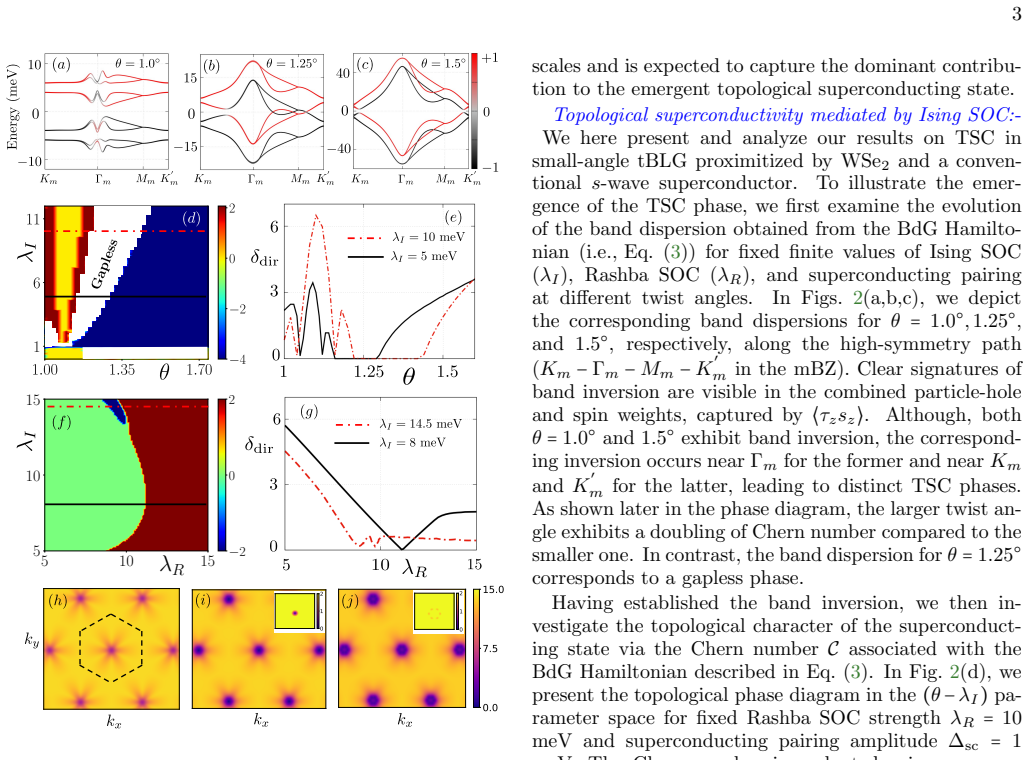
Commencing from the low-energy Bistritzer-MacDonald continuum model of twisted bi-layer graphene with proximity-induced Ising, Rashba, and intrinsic spin-orbit couplings, the corresponding Bogoliubov-de Gennes Hamiltonian with conventional s-wave pairing hosts topological superconducting phases bearing an effective p-wave pairing profile and exhibiting inverted band dispersion. These phases are protected by a bulk gap and are topologically characterized by Chern numbers. In the absence of intrinsic SOC, variation of the twist angle and other SOC strengths yield extended gapless, trivial, and topological phases with phase boundaries exactly matching the closing of direct band gaps. The topolo
What carries the argument
The Bogoliubov-de Gennes Hamiltonian obtained by adding Ising, Rashba, and intrinsic spin-orbit coupling terms plus s-wave pairing to the Bistritzer-MacDonald continuum model, which produces effective p-wave pairing and Chern-number topology.
If this is right
- Variation of twist angle and SOC strengths produces extended regions of topological superconductivity when intrinsic SOC is absent.
- The topological regime always shows band inversion in the combined particle-hole and spin space.
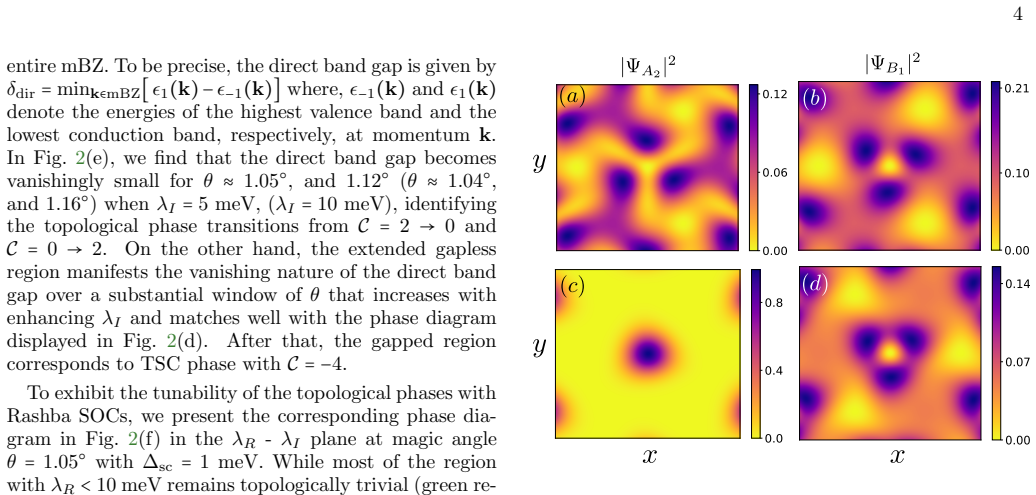
- Bloch localization profiles differ distinctly between topological and trivial phases.
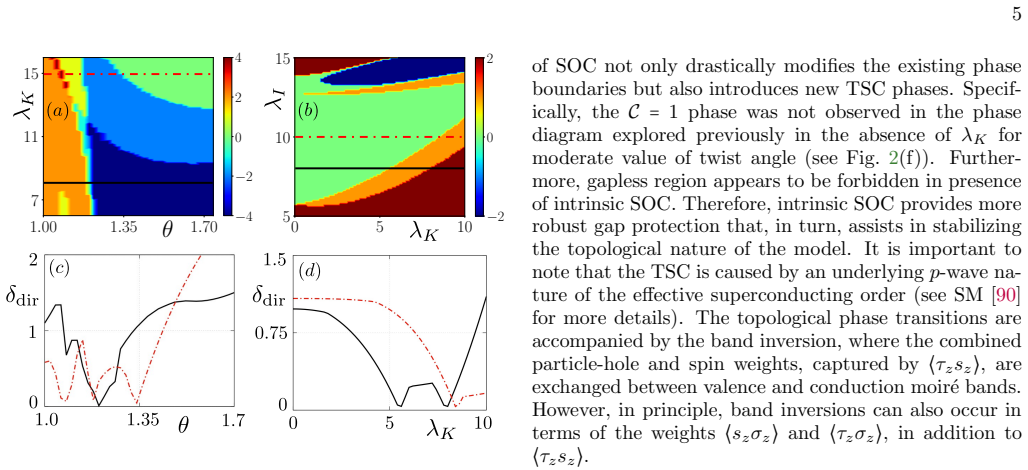
- Intrinsic SOC both adds topological phases and removes the gapless regime entirely.
Where Pith is reading between the lines
- The same SOC-augmented model could be applied to other moiré graphene systems to search for similar topological regimes.
- Experimental tuning via gate voltage or twist angle in tBLG-Nb-WSe2 stacks offers a direct test of the predicted phase boundaries.
- The effective p-wave character implies that defect or edge modes may appear in the topological regime, though the paper does not compute their spectra.
Load-bearing premise
The proximity-induced Ising, Rashba, and intrinsic spin-orbit couplings can be faithfully represented by simple additive terms inside the low-energy continuum model without significant renormalization or interface-specific corrections.
What would settle it
Spectroscopic or transport data showing no band inversion and no edge-state signatures consistent with nonzero Chern numbers in the parameter regimes where the model predicts topological phases.
Figures
read the original abstract
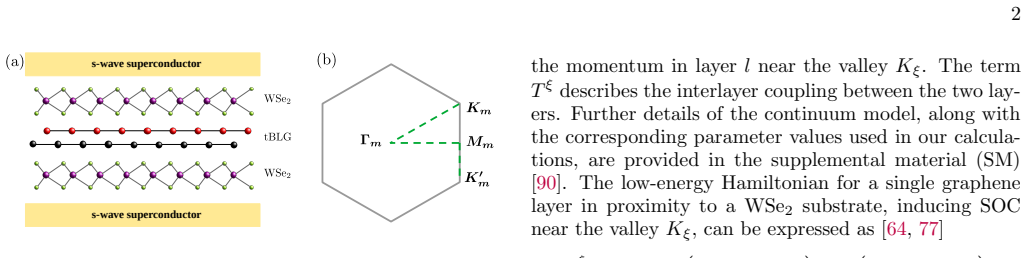
Commencing from the low-energy Bistritzer-MacDonald continuum model of twisted bi-layer graphene (tBLG) with proximity-induced Ising, Rashba, and intrinsic spin-orbit couplings (SOCs), we construct the corresponding Bogoliubov-de Gennes Hamiltonian with conventional $s$-wave pairing and theoretically investigate the emergence of topological superconductivity in it. The latter can possibly be experimentally demonstrated in tBLG, Niobium and tungsten diselenide heterostructures. The topological superconducting phases, bearing an effective $p$-wave pairing profile and exhibiting inverted band dispersion, are protected by a bulk gap and are topologically characterized by Chern numbers. In the absence of intrinsic SOC, variation of the twist angle and other SOC strengths yield extended gapless, trivial, and topological phases, with phase boundaries exactly matching the closing of direct band gaps. The topological regime exhibits clear band inversion in the combined particle-hole and spin space, along with distinct Bloch localization profiles compared to the trivial phase. Including intrinsic SOC generates additional topological phases and eliminates the gapless phase, indicating the enhanced stability of the gapped topological superconducting regime in tBLG.
Editorial analysis
A structured set of objections, weighed in public.
Referee Report
Summary. The manuscript constructs the Bogoliubov-de Gennes Hamiltonian starting from the low-energy Bistritzer-MacDonald continuum model of twisted bilayer graphene, augmented by constant proximity-induced Ising, Rashba, and intrinsic spin-orbit coupling terms together with conventional s-wave pairing. It reports the existence of gapped topological superconducting phases that exhibit effective p-wave pairing, band inversion in particle-hole and spin space, and non-zero Chern numbers. Phase boundaries are stated to coincide exactly with the closing of direct gaps; in the absence of intrinsic SOC the phase diagram contains extended gapless regions, while intrinsic SOC eliminates the gapless phase and adds further topological regions. The results are presented as functions of twist angle and the three SOC strengths.
Significance. If the model construction is accepted, the work supplies a controlled theoretical prediction for the appearance of Chern-number-protected topological superconductivity in an experimentally relevant tBLG-WSe2 heterostructure platform. The explicit demonstration that intrinsic SOC both removes the gapless regime and enlarges the topological area is a concrete, falsifiable outcome of the calculation. The study is a standard continuum-model analysis whose conclusions follow directly from diagonalization of the stated Hamiltonian.
minor comments (2)
- [Abstract] Abstract: the statement that phase boundaries 'exactly match the closing of direct band gaps' would be strengthened by an explicit reference to the relevant figure or equation that demonstrates this coincidence for the full parameter scan.
- The manuscript would benefit from a brief statement, perhaps in the model section, of the numerical method used to compute the Chern numbers (e.g., Fukui-Hatsugai-Suzuki discretization or Wilson-loop approach) and the k-space mesh density employed.
Simulated Author's Rebuttal
We thank the referee for their positive and accurate summary of our manuscript, as well as for the recommendation to accept. The referee's description correctly reflects the construction of the BdG Hamiltonian, the role of the various SOC terms, the identification of topological phases via Chern numbers, and the effect of intrinsic SOC on eliminating gapless regions.
Circularity Check
No significant circularity; model study is self-contained
full rationale
The paper constructs a BdG Hamiltonian by augmenting the standard Bistritzer-MacDonald continuum model with three constant SOC terms and s-wave pairing, then computes band structures, gap closings, and Chern numbers by direct diagonalization while varying twist angle and SOC strengths. All reported phases, band inversions, and topological invariants are explicit numerical consequences of this fixed Hamiltonian; no parameter is fitted to the target observables and then re-predicted, no self-citation supplies a load-bearing uniqueness theorem, and no ansatz is smuggled in. The derivation chain therefore remains independent of its own outputs.
Axiom & Free-Parameter Ledger
free parameters (2)
- twist angle
- SOC strengths (Ising, Rashba, intrinsic)
axioms (2)
- domain assumption The low-energy physics of tBLG is captured by the Bistritzer-MacDonald continuum model.
- domain assumption Proximity-induced SOCs from WSe2 can be added as simple momentum-dependent terms without interface reconstruction.
Reference graph
Works this paper leans on
-
[1]
Graphene bilayer with a twist: Electronic structure,
J. M. B. Lopes dos Santos, N. M. R. Peres, and A. H. Castro Neto, “Graphene bilayer with a twist: Electronic structure,” Phys. Rev. Lett.99, 256802 (2007)
2007
-
[2]
Quan- tum interference at the twist boundary in graphene,
S. Shallcross, S. Sharma, and O. A. Pankratov, “Quan- tum interference at the twist boundary in graphene,” Phys. Rev. Lett.101, 056803 (2008)
2008
-
[3]
Moir´ e bands in twisted double-layer graphene,
R. Bistritzer and A. H. MacDonald, “Moir´ e bands in twisted double-layer graphene,” Proceedings of the Na- tional Academy of Sciences108, 12233–12237 (2011)
2011
-
[4]
Maximally localized wannier orbitals and the extended hubbard model for twisted bilayer graphene,
M. Koshino, N. F. Q. Yuan, T. Koretsune, M. Ochi, K. Kuroki, and L. Fu, “Maximally localized wannier orbitals and the extended hubbard model for twisted bilayer graphene,” Phys. Rev. X8, 031087 (2018)
2018
-
[5]
Unconventional su- perconductivity in magic-angle graphene superlattices,
Y. Cao, V. Fatemi, S. Fang, K. Watanabe, T. Taniguchi, E. Kaxiras, and P. Jarillo-Herrero, “Unconventional su- perconductivity in magic-angle graphene superlattices,” Nature556, 43–50 (2018)
2018
-
[6]
Correlated insulator behaviour at half-filling in magic-angle graphene superlattices,
Y. Cao, V. Fatemi, A. Demir, S. Fang, S. L. Tomarken, J. Y. Luo, J. D. Sanchez-Yamagishi, K. Watanabe, T. Taniguchi, E. Kaxiras, R. C. Ashoori, and P. Jarillo- Herrero, “Correlated insulator behaviour at half-filling in magic-angle graphene superlattices,” Nature556, 80– 84 (2018)
2018
-
[7]
Evidence for unconventional superconductivity in twisted bilayer graphene,
M. Oh, K. P. Nuckolls, D. Wong, R. L. Lee, X. Liu, K. Watanabe, T. Taniguchi, and A. Yazdani, “Evidence for unconventional superconductivity in twisted bilayer graphene,” Nature600, 240–245 (2021)
2021
-
[8]
Strongly correlated chern insulators in magic-angle twisted bilayer graphene,
K. P. Nuckolls, M. Oh, D. Wong, B. Lian, K. Watan- abe, T. Taniguchi, B. A. Bernevig, and A. Yazdani, “Strongly correlated chern insulators in magic-angle twisted bilayer graphene,” Nature588, 610–615 (2020)
2020
-
[9]
Electrically tunable flat bands and magnetism in twisted bilayer graphene,
T. M. R. Wolf, J. L. Lado, G. Blatter, and O. Zilber- berg, “Electrically tunable flat bands and magnetism in twisted bilayer graphene,” Phys. Rev. Lett.123, 096802 (2019)
2019
-
[10]
Nature of the correlated insulator states in twisted bilayer graphene,
M. Xie and A. H. MacDonald, “Nature of the correlated insulator states in twisted bilayer graphene,” Phys. Rev. Lett.124, 097601 (2020)
2020
-
[11]
Ori- gin of mott insulating behavior and superconductivity in twisted bilayer graphene,
H. C. Po, L. Zou, A. Vishwanath, and T. Senthil, “Ori- gin of mott insulating behavior and superconductivity in twisted bilayer graphene,” Phys. Rev. X8, 031089 (2018)
2018
-
[12]
Chern insulators, van hove singularities and topological flat bands in magic-angle twisted bilayer graphene,
S. Wu, Z. Zhang, K. Watanabe, T. Taniguchi, and E. Y. Andrei, “Chern insulators, van hove singularities and topological flat bands in magic-angle twisted bilayer graphene,” Nature Materials20, 488–494 (2021)
2021
-
[13]
All magic angles in twisted bilayer graphene are topological,
Z. Song, Z. Wang, W. Shi, G. Li, C. Fang, and B. A. Bernevig, “All magic angles in twisted bilayer graphene are topological,” Phys. Rev. Lett.123, 036401 (2019)
2019
-
[14]
Origin of magic angles in twisted bilayer graphene,
G. Tarnopolsky, A. J. Kruchkov, and A. Vishwanath, “Origin of magic angles in twisted bilayer graphene,” Phys. Rev. Lett.122, 106405 (2019)
2019
-
[15]
Magic-angle twisted bilayer graphene as a topological heavy fermion prob- lem,
Z.-D. Song and B. A. Bernevig, “Magic-angle twisted bilayer graphene as a topological heavy fermion prob- lem,” Phys. Rev. Lett.129, 047601 (2022)
2022
-
[16]
Electrical switch- ing of magnetic order in an orbital chern insulator,
H. Polshyn, J. Zhu, M. A. Kumar, Y. Zhang, F. Yang, C. L. Tschirhart, M. Serlin, K. Watanabe, T. Taniguchi, A. H. MacDonald, and A. F. Young, “Electrical switch- ing of magnetic order in an orbital chern insulator,” Na- ture588, 66–70 (2020)
2020
-
[17]
Tunable strongly coupled supercon- ductivity in magic-angle twisted trilayer graphene,
J. M. Park, Y. Cao, K. Watanabe, T. Taniguchi, and P. Jarillo-Herrero, “Tunable strongly coupled supercon- ductivity in magic-angle twisted trilayer graphene,” Na- ture590, 249–255 (2021)
2021
-
[18]
Tunable spin-polarized correlated states in twisted double bilayer graphene,
X. Liu, Z. Hao, E. Khalaf, J. Y. Lee, Y. Ronen, H. Yoo, D. Haei Najafabadi, K. Watanabe, T. Taniguchi, A. Vishwanath, and P. Kim, “Tunable spin-polarized correlated states in twisted double bilayer graphene,” Nature583, 221–225 (2020)
2020
-
[19]
Correlated insulating states in twisted double bilayer graphene,
G. W. Burg, J. Zhu, T. Taniguchi, K. Watanabe, A. H. MacDonald, and E. Tutuc, “Correlated insulating states in twisted double bilayer graphene,” Phys. Rev. Lett.123, 197702 (2019)
2019
-
[20]
Symmetry breaking in twisted double bilayer graphene,
M. He, Y. Li, J. Cai, Y. Liu, K. Watanabe, T. Taniguchi, X. Xu, and M. Yankowitz, “Symmetry breaking in twisted double bilayer graphene,” Nature Physics17, 26–30 (2021)
2021
-
[21]
Ther- moelectric properties of magic angle twisted bilayer graphene–superconductor heterojunction: Effect of val- ley polarization and trigonal warping,
K. Bera, P. Chatterjee, P. Mohan, and A. Saha, “Ther- moelectric properties of magic angle twisted bilayer graphene–superconductor heterojunction: Effect of val- ley polarization and trigonal warping,” Phys. Rev. B 112, 165416 (2025)
2025
-
[22]
Tunable bandwidths and gaps in twisted double bilayer graphene on the verge of correlations,
P. C. Adak, S. Sinha, U. Ghorai, L. D. V. Sangani, K. Watanabe, T. Taniguchi, R. Sensarma, and M. M. Deshmukh, “Tunable bandwidths and gaps in twisted double bilayer graphene on the verge of correlations,” Phys. Rev. B101, 125428 (2020)
2020
-
[23]
Nonlinear anomalous hall effects probe topological phase-transitions in twisted double bilayer graphene,
A. Chakraborty, K. Das, S. Sinha, P. C. Adak, M. M. Deshmukh, and A. Agarwal, “Nonlinear anomalous hall effects probe topological phase-transitions in twisted double bilayer graphene,” 2D Materials9, 045020 (2022)
2022
-
[24]
Berry curvature dipole senses topological transition in a moir´ e superlattice,
S. Sinha, P. C. Adak, A. Chakraborty, K. Das, K. Deb- nath, L. D. V. Sangani, K. Watanabe, T. Taniguchi, U. V. Waghmare, A. Agarwal, and M. M. Deshmukh, “Berry curvature dipole senses topological transition in a moir´ e superlattice,” Nature Physics18, 765–770 (2022)
2022
-
[25]
Tailoring topologi- cal band properties of twisted double bilayer graphene: Effects due to spin-orbit coupling,
K. Bera, P. Mohan, and A. Saha, “Tailoring topologi- cal band properties of twisted double bilayer graphene: Effects due to spin-orbit coupling,” Phys. Rev. B111, 045434 (2025)
2025
-
[26]
Topological insulators in twisted transition 7 metal dichalcogenide homobilayers,
F. Wu, T. Lovorn, E. Tutuc, I. Martin, and A. H. Mac- Donald, “Topological insulators in twisted transition 7 metal dichalcogenide homobilayers,” Phys. Rev. Lett. 122, 086402 (2019)
2019
-
[27]
Non-hermitian band topology in twisted bilayer graphene aligned with hexagonal boron nitride,
K. Bera, D. Mondal, A. Saha, and D. Chowd- hury, “Non-hermitian band topology in twisted bilayer graphene aligned with hexagonal boron nitride,” Phys. Rev. B112, 155411 (2025)
2025
-
[28]
Evidence of a gate-tunable mott insu- lator in a trilayer graphene moir´ e superlattice,
G. Chen, L. Jiang, S. Wu, B. Lyu, H. Li, B. L. Chittari, K. Watanabe, T. Taniguchi, Z. Shi, J. Jung, Y. Zhang, and F. Wang, “Evidence of a gate-tunable mott insu- lator in a trilayer graphene moir´ e superlattice,” Nature Physics15, 237–241 (2019)
2019
-
[29]
Chiral topological su- perconductivity in twisted bilayer and twisted double bilayer graphene,
K. Bera, T. Nag, and A. Saha, “Chiral topological su- perconductivity in twisted bilayer and twisted double bilayer graphene,” Phys. Rev. B113, 245418 (2026)
2026
-
[30]
Emergent topology of flat bands in a twisted bilayer α−T3 lattice,
G. Paul, S. Lahiri, K. Bhattacharyya, and S. Basu, “Emergent topology of flat bands in a twisted bilayer α−T3 lattice,” Phys. Rev. B113, 035145 (2026)
2026
-
[31]
Topological insulators and superconductors,
X.-L. Qi and S.-C. Zhang, “Topological insulators and superconductors,” Rev. Mod. Phys.83, 1057–1110 (2011)
2011
-
[32]
Topological superconductors: a review,
M. Sato and Y. Ando, “Topological superconductors: a review,” Reports on Progress in Physics80, 076501 (2017)
2017
-
[33]
Non-abelian anyons and topological quantum computation,
C. Nayak, S. H. Simon, A. Stern, M. Freedman, and S. Das Sarma, “Non-abelian anyons and topological quantum computation,” Rev. Mod. Phys.80, 1083–1159 (2008)
2008
-
[34]
Classification of topological insulators and su- perconductors in three spatial dimensions,
A. P. Schnyder, S. Ryu, A. Furusaki, and A. W. W. Ludwig, “Classification of topological insulators and su- perconductors in three spatial dimensions,” Phys. Rev. B78, 195125 (2008)
2008
-
[35]
Chiral superconductors,
C. Kallin and J. Berlinsky, “Chiral superconductors,” Reports on Progress in Physics79, 054502 (2016)
2016
-
[36]
Periodic table for topological insulators and superconductors,
A. Kitaev, “Periodic table for topological insulators and superconductors,” inAIP conference proceedings, Vol. 1134 (American Institute of Physics, 2009) pp. 22–30
2009
-
[37]
Ma- jorana fermions and a topological phase transition in semiconductor-superconductor heterostructures,
R. M. Lutchyn, J. D. Sau, and S. Das Sarma, “Ma- jorana fermions and a topological phase transition in semiconductor-superconductor heterostructures,” Phys. Rev. Lett.105, 077001 (2010)
2010
-
[38]
Helical liquids and majorana bound states in quantum wires,
Y. Oreg, G. Refael, and F. von Oppen, “Helical liquids and majorana bound states in quantum wires,” Phys. Rev. Lett.105, 177002 (2010)
2010
-
[39]
Majorana edge states in interacting one- dimensional systems,
S. Gangadharaiah, B. Braunecker, P. Simon, and D. Loss, “Majorana edge states in interacting one- dimensional systems,” Phys. Rev. Lett.107, 036801 (2011)
2011
-
[40]
Spin and majo- rana polarization in topological superconducting wires,
D. Sticlet, C. Bena, and P. Simon, “Spin and majo- rana polarization in topological superconducting wires,” Phys. Rev. Lett.108, 096802 (2012)
2012
-
[41]
En- gineering anomalous floquet majorana modes and their time evolution in a helical shiba chain,
D. Mondal, A. K. Ghosh, T. Nag, and A. Saha, “En- gineering anomalous floquet majorana modes and their time evolution in a helical shiba chain,” Phys. Rev. B 108, L081403 (2023)
2023
-
[42]
Topo- logical characterization and stability of floquet majo- rana modes in rashba nanowires,
D. Mondal, A. K. Ghosh, T. Nag, and A. Saha, “Topo- logical characterization and stability of floquet majo- rana modes in rashba nanowires,” Phys. Rev. B107, 035427 (2023)
2023
-
[43]
Signa- tures of majorana fermions in hybrid superconductor- semiconductor nanowire devices,
V. Mourik, K. Zuo, S. M. Frolov, S. R. Plissard, E. P. A. M. Bakkers, and L. P. Kouwenhoven, “Signa- tures of majorana fermions in hybrid superconductor- semiconductor nanowire devices,” Science336, 1003– 1007 (2012)
2012
-
[44]
Zero-bias peaks and splitting in an al– inas nanowire topological superconductor as a signa- ture of majorana fermions,
A. Das, Y. Ronen, Y. Most, Y. Oreg, M. Heiblum, and H. Shtrikman, “Zero-bias peaks and splitting in an al– inas nanowire topological superconductor as a signa- ture of majorana fermions,” Nature Physics8, 887–895 (2012)
2012
-
[45]
From andreev to majorana bound states in hybrid superconductor– semiconductor nanowires,
E. Prada, P. San-Jose, M. W. A. de Moor, A. Geresdi, E. J. H. Lee, J. Klinovaja, D. Loss, J. Nyg˚ ard, R. Aguado, and L. P. Kouwenhoven, “From andreev to majorana bound states in hybrid superconductor– semiconductor nanowires,” Nature Reviews Physics2, 575–594 (2020)
2020
-
[46]
Proposal for realizing majorana fermions in chains of magnetic atoms on a superconductor,
S. Nadj-Perge, I. K. Drozdov, B. A. Bernevig, and A. Yazdani, “Proposal for realizing majorana fermions in chains of magnetic atoms on a superconductor,” Phys. Rev. B88, 020407 (2013)
2013
-
[47]
Topo- logical superconducting phase in helical shiba chains,
F. Pientka, L. I. Glazman, and F. von Oppen, “Topo- logical superconducting phase in helical shiba chains,” Phys. Rev. B88, 155420 (2013)
2013
-
[48]
Topological superconductivity and majorana fermions in rkky systems,
J. Klinovaja, P. Stano, A. Yazdani, and D. Loss, “Topological superconductivity and majorana fermions in rkky systems,” Phys. Rev. Lett.111, 186805 (2013)
2013
-
[49]
Bound states at impurities as a probe of topological superconductivity in nanowires,
J. D. Sau and E. Demler, “Bound states at impurities as a probe of topological superconductivity in nanowires,” Phys. Rev. B88, 205402 (2013)
2013
-
[50]
Majorana bound state localization and energy oscilla- tions for magnetic impurity chains on conventional su- perconductors,
A. Theiler, K. Bj¨ ornson, and A. M. Black-Schaffer, “Majorana bound state localization and energy oscilla- tions for magnetic impurity chains on conventional su- perconductors,” Phys. Rev. B100, 214504 (2019)
2019
-
[51]
Observation of majorana fermions in ferromag- netic atomic chains on a superconductor,
S. Nadj-Perge, I. K. Drozdov, J. Li, H. Chen, S. Jeon, J. Seo, A. H. MacDonald, B. A. Bernevig, and A. Yaz- dani, “Observation of majorana fermions in ferromag- netic atomic chains on a superconductor,” Science346, 602–607 (2014)
2014
-
[52]
Topo- logical shiba bands in artificial spin chains on supercon- ductors,
L. Schneider, P. Beck, T. Posske, D. Crawford, E. Mas- cot, S. Rachel, R. Wiesendanger, and J. Wiebe, “Topo- logical shiba bands in artificial spin chains on supercon- ductors,” Nature Physics17, 943–948 (2021)
2021
-
[53]
Non-abelian topological order ins-wave superfluids of ultracold fermionic atoms,
M. Sato, Y. Takahashi, and S. Fujimoto, “Non-abelian topological order ins-wave superfluids of ultracold fermionic atoms,” Phys. Rev. Lett.103, 020401 (2009)
2009
-
[54]
Generic new platform for topological quantum com- putation using semiconductor heterostructures,
J. D. Sau, R. M. Lutchyn, S. Tewari, and S. Das Sarma, “Generic new platform for topological quantum com- putation using semiconductor heterostructures,” Phys. Rev. Lett.104, 040502 (2010)
2010
-
[55]
Majorana fermions in s-wave noncentrosymmetric superconductor with dres- selhaus (110) spin-orbit coupling,
J. You, C. H. Oh, and V. Vedral, “Majorana fermions in s-wave noncentrosymmetric superconductor with dres- selhaus (110) spin-orbit coupling,” Phys. Rev. B87, 054501 (2013)
2013
-
[56]
Zero-energy modes from coalescing andreev states in a two-dimensional semiconductor-superconductor hybrid platform,
H. J. Suominen, M. Kjaergaard, A. R. Hamilton, J. Sha- bani, C. J. Palmstrøm, C. M. Marcus, and F. Nichele, “Zero-energy modes from coalescing andreev states in a two-dimensional semiconductor-superconductor hybrid platform,” Phys. Rev. Lett.119, 176805 (2017)
2017
-
[57]
Scaling of majorana zero-bias conductance peaks,
F. Nichele, A. C. C. Drachmann, A. M. Whiticar, E. C. T. O’Farrell, H. J. Suominen, A. Fornieri, T. Wang, G. C. Gardner, C. Thomas, A. T. Hatke, P. Krogstrup, M. J. Manfra, K. Flensberg, and C. M. Marcus, “Scaling of majorana zero-bias conductance peaks,” Phys. Rev. Lett.119, 136803 (2017)
2017
-
[58]
Majorana fermions in spin-orbit-coupled ferromagnetic josephson junc- tions,
A. M. Black-Schaffer and J. Linder, “Majorana fermions in spin-orbit-coupled ferromagnetic josephson junc- tions,” Phys. Rev. B84, 180509(R) (2011)
2011
-
[59]
Topological superconductivity in a planar josephson junction,
F. Pientka, A. Keselman, E. Berg, A. Yacoby, A. Stern, and B. I. Halperin, “Topological superconductivity in a planar josephson junction,” Phys. Rev. X7, 021032 8 (2017)
2017
-
[60]
Evidence of topological superconductiv- ity in planar josephson junctions,
A. Fornieri, A. M. Whiticar, F. Setiawan, E. Por- tol´ es, A. C. C. Drachmann, A. Keselman, S. Gronin, C. Thomas, T. Wang, R. Kallaher, G. C. Gardner, E. Berg, M. J. Manfra, A. Stern, C. M. Marcus, and F. Nichele, “Evidence of topological superconductiv- ity in planar josephson junctions,” Nature569, 89–92 (2019)
2019
-
[61]
Majorana zero modes in graphene,
P. San-Jose, J. L. Lado, R. Aguado, F. Guinea, and J. Fern´ andez-Rossier, “Majorana zero modes in graphene,” Phys. Rev. X5, 041042 (2015)
2015
-
[62]
Chiral majorana fermions in graphene from proximity-induced superconductivity,
P. H¨ ogl, T. Frank, D. Kochan, M. Gmitra, and J. Fabian, “Chiral majorana fermions in graphene from proximity-induced superconductivity,” Phys. Rev. B 101, 245441 (2020)
2020
-
[63]
Topological superconductor with a large chern number and a large bulk excitation gap in single-layer graphene,
L. Wang and M. W. Wu, “Topological superconductor with a large chern number and a large bulk excitation gap in single-layer graphene,” Phys. Rev. B93, 054502 (2016)
2016
-
[64]
Majorana bound states in encapsulated bilayer graphene,
F. Pe˜ naranda, R. Aguado, E. Prada, and P. San- Jose, “Majorana bound states in encapsulated bilayer graphene,” SciPost Phys.14, 075 (2023)
2023
-
[66]
Topological superconductivity in monolayer transi- tion metal dichalcogenides,
Y.-T. Hsu, A. Vaezi, M. H. Fischer, and E.-A. Kim, “Topological superconductivity in monolayer transi- tion metal dichalcogenides,” Nature Communications8, 14985 (2017)
2017
-
[67]
Superconducting states and majorana modes in transition-metal dichalco- genides under inhomogeneous strain,
M.-X. Deng, G. Y. Qi, W. Luo, R. Ma, R.-Q. Wang, R. Shen, L. Sheng, and D. Y. Xing, “Superconducting states and majorana modes in transition-metal dichalco- genides under inhomogeneous strain,” Phys. Rev. B99, 085106 (2019)
2019
-
[68]
Spin–orbit proximity effect in graphene,
A. Avsar, J. Y. Tan, T. Taychatanapat, J. Balakrish- nan, G. K. W. Koon, Y. Yeo, J. Lahiri, A. Carvalho, A. S. Rodin, E. C. T. O’Farrell, G. Eda, A. H. Cas- tro Neto, and B. ¨Ozyilmaz, “Spin–orbit proximity effect in graphene,” Nature Communications5, 4875 (2014)
2014
-
[69]
Quantum spin hall states in graphene in- teracting with ws2 or wse2,
T. P. Kaloni, L. Kou, T. Frauenheim, and U. Schwin- genschl¨ ogl, “Quantum spin hall states in graphene in- teracting with ws2 or wse2,” Applied Physics Letters 105, 233112 (2014)
2014
-
[70]
Graphene on transition- metal dichalcogenides: A platform for proximity spin- orbit physics and optospintronics,
M. Gmitra and J. Fabian, “Graphene on transition- metal dichalcogenides: A platform for proximity spin- orbit physics and optospintronics,” Phys. Rev. B92, 155403 (2015)
2015
-
[71]
Strong interface-induced spin–orbit interaction in graphene on ws2,
Z. Wang, D.-K. Ki, H. Chen, H. Berger, A. H. MacDon- ald, and A. F. Morpurgo, “Strong interface-induced spin–orbit interaction in graphene on ws2,” Nature Communications6, 8339 (2015)
2015
-
[72]
Giant spin lifetime anisotropy in graphene induced by proximity effects,
A. W. Cummings, J. H. Garcia, J. Fabian, and S. Roche, “Giant spin lifetime anisotropy in graphene induced by proximity effects,” Phys. Rev. Lett.119, 206601 (2017)
2017
-
[73]
Strongly anisotropic spin relaxation in graphene– transition metal dichalcogenide heterostructures at room temperature,
L. A. Ben´ ıtez, J. F. Sierra, W. Savero Torres, A. Ar- righi, F. Bonell, M. V. Costache, and S. O. Valenzuela, “Strongly anisotropic spin relaxation in graphene– transition metal dichalcogenide heterostructures at room temperature,” Nature Physics14, 303–308 (2018)
2018
-
[74]
Coupled spin and valley physics in monolayers of mos2 and other group-vi dichalcogenides,
D. Xiao, G.-B. Liu, W. Feng, X. Xu, and W. Yao, “Coupled spin and valley physics in monolayers of mos2 and other group-vi dichalcogenides,” Phys. Rev. Lett. 108, 196802 (2012)
2012
-
[75]
Ising superconductivity and majorana fermions in transition-metal dichalcogenides,
B. T. Zhou, N. F. Q. Yuan, H.-L. Jiang, and K. T. Law, “Ising superconductivity and majorana fermions in transition-metal dichalcogenides,” Phys. Rev. B93, 180501(R) (2016)
2016
-
[76]
Evidence for two-dimensional ising superconductivity in gated mos¡sub¿2¡/sub¿,
J. M. Lu, O. Zheliuk, I. Leermakers, N. F. Q. Yuan, U. Zeitler, K. T. Law, and J. T. Ye, “Evidence for two-dimensional ising superconductivity in gated mos¡sub¿2¡/sub¿,” Science350, 1353–1357 (2015)
2015
-
[77]
Topo- logical flat bands, valley polarization, and interband su- perconductivity in magic-angle twisted bilayer graphene with proximitized spin-orbit couplings,
Y.-Z. Chou, Y. Tan, F. Wu, and S. Das Sarma, “Topo- logical flat bands, valley polarization, and interband su- perconductivity in magic-angle twisted bilayer graphene with proximitized spin-orbit couplings,” Phys. Rev. B 110, L041108 (2024)
2024
-
[78]
Spin-orbit–driven ferromagnetism at half moir´ e filling in magic-angle twisted bilayer graphene,
J.-X. Lin, Y.-H. Zhang, E. Morissette, Z. Wang, S. Liu, D. Rhodes, K. Watanabe, T. Taniguchi, J. Hone, and J. I. A. Li, “Spin-orbit–driven ferromagnetism at half moir´ e filling in magic-angle twisted bilayer graphene,” Science375, 437–441 (2022)
2022
-
[79]
Superconductivity in metallic twisted bilayer graphene stabilized by wse2,
H. S. Arora, R. Polski, Y. Zhang, A. Thomson, Y. Choi, H. Kim, Z. Lin, I. Z. Wilson, X. Xu, J.-H. Chu, K. Watanabe, T. Taniguchi, J. Alicea, and S. Nadj- Perge, “Superconductivity in metallic twisted bilayer graphene stabilized by wse2,” Nature583, 379–384 (2020)
2020
-
[80]
Superconductivity in twisted double bilayer graphene stabilized by wse2,
R. Su, M. Kuiri, K. Watanabe, T. Taniguchi, and J. Folk, “Superconductivity in twisted double bilayer graphene stabilized by wse2,” Nature Materials22, 1332–1337 (2023)
2023
-
[81]
Chiralp-wave superconductivity in twisted bilayer graphene from dynamical mean field theory,
B. Pahlevanzadeh, P. Sahebsara, and D. S´ en´ echal, “Chiralp-wave superconductivity in twisted bilayer graphene from dynamical mean field theory,” SciPost Phys.11, 017 (2021)
2021
discussion (0)
Sign in with ORCID, Apple, or X to comment. Anyone can read and Pith papers without signing in.