Index saddle for the D1-D5-P black string and its decoupling limit
Pith reviewed 2026-06-26 03:04 UTC · model grok-4.3
The pith
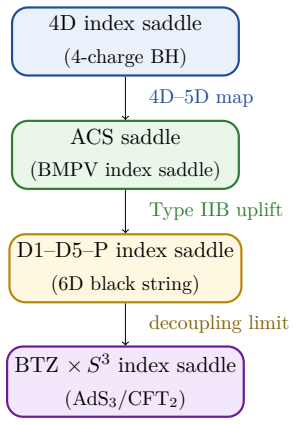
A four-charge index saddle in the STU model uplifts via 4D-5D connection and dualities to the D1-D5-P black string, then decouples to a BTZ × S³ saddle for the dual CFT index.
A machine-rendered reading of the paper's core claim, the machinery that carries it, and where it could break.
Core claim
We construct a four-charge index saddle in the four-dimensional STU model as the BPS limit of the non-extremal four-charge black hole, show that it exhibits the new form of attraction, uplift it successively to five and six dimensions via the 4D-5D connection and a chain of string dualities to obtain the gravitational index saddle for the D1-D5-P black string, and take a systematic decoupling limit of this index saddle to obtain the BTZ × S³ saddle that computes the index of the D1-D5 CFT.
What carries the argument
The four-charge index saddle, defined as the BPS limit of the non-extremal four-charge black hole in the STU model, which carries the index property through successive uplifts and the decoupling limit to BTZ × S³.
If this is right
- The index saddle obtained in four dimensions survives the BPS limit and the 4D-5D uplift while retaining its index property.
- String dualities map the five-dimensional index saddle to the six-dimensional D1-D5-P black string saddle without losing the index.
- The systematic decoupling limit produces a BTZ × S³ geometry that serves as the gravitational dual for the CFT index.
- The same saddle construction applies to the D1-D5-P system as it did to the earlier five-dimensional black-string examples.
Where Pith is reading between the lines
- The method may extend to black strings carrying different charge combinations by choosing appropriate BPS limits in the lower-dimensional supergravity.
- If the BTZ × S³ saddle correctly reproduces the index, similar decoupling procedures could be applied to other near-extremal string geometries.
- The construction supplies a concrete gravitational object whose thermodynamics could be compared term-by-term with the CFT index expansion.
Load-bearing premise
The BPS limit of the non-extremal four-charge black hole preserves the index property under the uplifts and the subsequent decoupling limit.
What would settle it
A direct mismatch between the value of the index computed from the on-shell action of the decoupled BTZ × S³ saddle and the known index of the D1-D5 CFT would show the construction does not work.
Figures
read the original abstract
Boruch, Emparan, Iliesiu, and Murthy recently discussed index saddles for 5d black strings, showing that the black string saddle admits a decoupling limit to a complex, finite-temperature BTZ \times S^2 saddle that computes the index of the dual CFT. In this paper, we pursue an analogous construction for the D1-D5-P black string. We construct a four-charge index saddle in the four-dimensional STU model as the BPS limit of the non-extremal four-charge black hole, and show that it exhibits the new form of attraction. We then uplift it successively to five and six dimensions, via the 4D-5D connection and a chain of string dualities, to obtain the gravitational index saddle for the D1-D5-P black string. We take a systematic decoupling limit of this index saddle and obtain the BTZ \times S^3 saddle that computes the index of the D1-D5 CFT.
Editorial analysis
A structured set of objections, weighed in public.
Referee Report
Summary. The paper constructs a four-charge index saddle in the four-dimensional STU model as the BPS limit of the non-extremal four-charge black hole and shows that it exhibits the new form of attraction. The saddle is uplifted successively to five and six dimensions via the 4D-5D connection and string dualities to obtain the gravitational index saddle for the D1-D5-P black string. A systematic decoupling limit is then taken to obtain the BTZ × S³ saddle that computes the index of the D1-D5 CFT.
Significance. If the construction is valid, this work extends index saddles to the D1-D5-P system, providing an explicit gravitational dual for the supersymmetric index of the D1-D5 CFT and demonstrating the new attractor mechanism in a higher-dimensional setting. The use of established dualities and the 4D-5D connection links different dimensions consistently and offers a concrete route to index computations via the decoupling limit to BTZ × S³.
major comments (2)
- [§2] §2 (4D STU construction): The central step defines the index saddle via the BPS limit of the non-extremal four-charge solution, but no explicit verification is given that the resulting chemical potentials or on-shell action match the supersymmetric index ensemble (rather than the ordinary partition function). This step is load-bearing for the claim that the uplifted 6D saddle computes the CFT index.
- [§4] §4 (decoupling limit): The systematic decoupling limit yielding the BTZ × S³ saddle is described, yet the paper does not provide a quantitative matching of the saddle parameters (temperature, chemical potentials) to the known requirements of the D1-D5 CFT index computation.
minor comments (2)
- [§3] The notation for the four charges in the STU model and their uplift is introduced piecemeal; a summary table at the start of §3 would improve clarity.
- [Introduction] A brief recap of the new form of attraction (referenced from Boruch et al.) in the introduction would help readers who have not read the prior work.
Simulated Author's Rebuttal
We thank the referee for their careful reading of the manuscript and for highlighting the significance of extending index saddles to the D1-D5-P system. We address the two major comments below, agreeing that additional explicit verifications will strengthen the presentation. Revisions will be incorporated in the next version.
read point-by-point responses
-
Referee: [§2] §2 (4D STU construction): The central step defines the index saddle via the BPS limit of the non-extremal four-charge solution, but no explicit verification is given that the resulting chemical potentials or on-shell action match the supersymmetric index ensemble (rather than the ordinary partition function). This step is load-bearing for the claim that the uplifted 6D saddle computes the CFT index.
Authors: We agree that an explicit check would make the construction more transparent. The BPS limit is taken by setting the non-extremality parameter to zero while keeping the charges fixed, which enforces the supersymmetric relations among the chemical potentials by construction. However, to address the concern directly, we will add a short calculation in the revised §2 showing that the resulting chemical potentials satisfy the index ensemble conditions (e.g., imaginary parts aligned with the supersymmetry constraints) and that the on-shell action reproduces the expected form for the index rather than the ordinary partition function. This verification will be performed before the uplift steps. revision: yes
-
Referee: [§4] §4 (decoupling limit): The systematic decoupling limit yielding the BTZ × S³ saddle is described, yet the paper does not provide a quantitative matching of the saddle parameters (temperature, chemical potentials) to the known requirements of the D1-D5 CFT index computation.
Authors: We concur that quantitative matching to the CFT index requirements would clarify the connection. In the revised manuscript we will expand the decoupling limit discussion in §4 to include explicit expressions for the resulting temperature and chemical potentials of the BTZ × S³ saddle. These will be shown to match the standard values used in the literature for the D1-D5 CFT index (specifically, the relations that place the saddle in the supersymmetric ensemble with the appropriate imaginary shifts). The matching will be presented both analytically and with reference to the known CFT index formulas. revision: yes
Circularity Check
Derivation chain is self-contained; no circular reductions identified
full rationale
The paper explicitly constructs the 4D index saddle by taking the BPS limit of the known non-extremal four-charge STU black hole, then applies standard 4D-5D uplift and string dualities (external to the paper) before performing a decoupling limit to BTZ × S³. This follows the structure of the cited Boruch et al. work by other authors without self-citation load-bearing, fitted inputs renamed as predictions, or self-definitional loops. The central steps rely on established connections and explicit limits rather than reducing to the paper's own inputs by construction.
Axiom & Free-Parameter Ledger
Reference graph
Works this paper leans on
-
[1]
Microscopic Origin of the Bekenstein-Hawking Entropy
A. Strominger and C. Vafa, “Microscopic origin of the Bekenstein-Hawking entropy,” Phys. Lett. B379, 99-104 (1996) doi:10.1016/0370-2693(96)00345-0 [arXiv:hep-th/9601029 [hep- th]]
work page internal anchor Pith review Pith/arXiv arXiv doi:10.1016/0370-2693(96)00345-0 1996
-
[2]
Black Hole Entropy Function, Attractors and Precision Counting of Microstates
A. Sen, “Black Hole Entropy Function, Attractors and Precision Counting of Microstates,” Gen. Rel. Grav.40, 2249-2431 (2008) doi:10.1007/s10714-008-0626-4 [arXiv:0708.1270 [hep- th]]
work page internal anchor Pith review Pith/arXiv arXiv doi:10.1007/s10714-008-0626-4 2008
-
[3]
Microscopic origin of the Bekenstein-Hawking entropy of supersymmetric AdS5 black holes,
A. Cabo-Bizet, D. Cassani, D. Martelli and S. Murthy, “Microscopic origin of the Bekenstein-Hawking entropy of supersymmetric AdS 5 black holes,” JHEP10(2019), 062 doi:10.1007/JHEP10(2019)062 [arXiv:1810.11442 [hep-th]]
-
[4]
Supersymmetric indices factorize,
L. V. Iliesiu, M. Kologlu and G. J. Turiaci, “Supersymmetric indices factorize,” JHEP05 (2023), 032 doi:10.1007/JHEP05(2023)032 [arXiv:2107.09062 [hep-th]]
-
[5]
New forms of attraction: Attractor saddles for the black hole index,
J. Boruch, L. V. Iliesiu, S. Murthy and G. J. Turiaci, “New forms of attraction: Attractor saddles for the black hole index,” [arXiv:2310.07763 [hep-th]]
-
[6]
The gravitational index of 5d black holes and black strings,
J. Boruch, R. Emparan, L. V. Iliesiu and S. Murthy, “The gravitational index of 5d black holes and black strings,” JHEP06, 145 (2025) doi:10.1007/JHEP06(2025)145 [arXiv:2501.17909 [hep-th]]. 40
-
[7]
Revisiting logarithmic correction to five dimensional BPS black hole entropy,
A. H. Anupam, C. Chowdhury and A. Sen, “Revisiting logarithmic correction to five di- mensional BPS black hole entropy,” JHEP05, 070 (2024) doi:10.1007/JHEP05(2024)070 [arXiv:2308.00038 [hep-th]]
-
[8]
Killing spinors for finite temperature Euclidean solutions at the BPS bound,
S. Hegde and A. Virmani, “Killing spinors for finite temperature Euclidean solutions at the BPS bound,” JHEP02, 203 (2024) doi:10.1007/JHEP02(2024)203 [arXiv:2311.09427 [hep-th]]
-
[9]
Attractor saddle for 5D black hole index
S. Adhikari, P. Dharanipragada, K. Goswami and A. Virmani, “Attractor saddle for 5D black hole index,” JHEP03, 180 (2025) doi:10.1007/JHEP03(2025)180 [arXiv:2411.12413 [hep-th]]
work page internal anchor Pith review Pith/arXiv arXiv doi:10.1007/jhep03(2025)180 2025
-
[10]
Localization of the 5D supergravity action and Euclidean saddles for the black hole index,
D. Cassani, A. Ruip´ erez and E. Turetta, “Localization of the 5D supergravity action and Euclidean saddles for the black hole index,” JHEP12, 086 (2024) doi:10.1007/JHEP12(2024)086 [arXiv:2409.01332 [hep-th]]
-
[11]
Supersymmetric index for half BPS black holes in N=2 supergravity with higher curvature corrections,
S. Hegde, A. Sen, P. Shanmugapriya and A. Virmani, “Supersymmetric index for half BPS black holes in N=2 supergravity with higher curvature corrections,” JHEP02, 131 (2025) doi:10.1007/JHEP02(2025)131 [arXiv:2411.08260 [hep-th]]
-
[12]
BPS solutions of 4d Euclidean N= 2 supergravity with higher derivative interactions,
S. Adhikari, A. Bhattacharjee and A. Virmani, “BPS solutions of 4d Euclidean N= 2 supergravity with higher derivative interactions,” JHEP03, 136 (2026) doi:10.1007/JHEP03(2026)136 [arXiv:2511.18771 [hep-th]]
-
[13]
Bubbling saddles of the gravitational index,
D. Cassani, A. Ruip´ erez and E. Turetta, “Bubbling saddles of the gravitational index,” SciPost Phys.19, no.5, 134 (2025) doi:10.21468/SciPostPhys.19.5.134 [arXiv:2507.12650 [hep-th]]
-
[14]
The gravita- tional index of a small black ring,
S. Bandyopadhyay, G. S. Punia, Y. K. Srivastava and A. Virmani, “The gravita- tional index of a small black ring,” JHEP07, 200 (2025) doi:10.1007/JHEP07(2025)200 [arXiv:2504.09982 [hep-th]]
-
[15]
Novel black saddles for 5d gravitational indices and the index enigma,
J. Boruch, R. Emparan, L. V. Iliesiu and S. Murthy, “Novel black saddles for 5d gravitational indices and the index enigma,” [arXiv:2510.23699 [hep-th]]
-
[16]
Multicentered black hole saddles for supersymmetric indices,
J. Boruch, L. V. Iliesiu, S. Murthy and G. J. Turiaci, “Multicentered black hole saddles for supersymmetric indices,” [arXiv:2507.07166 [hep-th]]
-
[17]
Index saddle for supersymmetric F1-P black ring
P. Dharanipragada, G. S. Punia and A. Virmani, “Index saddle for supersymmetric F1-P black ring,” JHEP05, 190 (2026) doi:10.1007/JHEP05(2026)190 [arXiv:2601.04624 [hep- th]]. 41
work page internal anchor Pith review Pith/arXiv arXiv doi:10.1007/jhep05(2026)190 2026
-
[18]
Quantum black holes: supersymmetry and exact results,
D. Cassani and S. Murthy, “Quantum black holes: supersymmetry and exact results,” [arXiv:2502.15360 [hep-th]]
-
[19]
New Connections Between 4D and 5D Black Holes
D. Gaiotto, A. Strominger and X. Yin, “New connections between 4-D and 5-D black holes,” JHEP02, 024 (2006) doi:10.1088/1126-6708/2006/02/024 [arXiv:hep-th/0503217 [hep-th]]
work page internal anchor Pith review Pith/arXiv arXiv doi:10.1088/1126-6708/2006/02/024 2006
-
[20]
Black Hole Entropy in M-Theory
J. M. Maldacena, A. Strominger and E. Witten, “Black hole entropy in M theory,” JHEP 12, 002 (1997) doi:10.1088/1126-6708/1997/12/002 [arXiv:hep-th/9711053 [hep-th]]
work page internal anchor Pith review Pith/arXiv arXiv doi:10.1088/1126-6708/1997/12/002 1997
-
[21]
Complex BPS Black Holes in AdS 3×S3,
F. Larsen and K. Sharma, “Complex BPS Black Holes in AdS 3×S3,” [arXiv:2605.28737 [hep-th]]
-
[22]
Statistical description of rotating Kaluza-Klein black holes
R. Emparan and A. Maccarrone, “Statistical description of rotating Kaluza-Klein black holes”, Phys. Rev D75(2007) 084006 doi:10.1103/PhysRevD.75.084006 [arXiv:hep- th/0701150 [hep-th]]
-
[23]
Seed for general rotating non-extremal black holes of N=8 supergravity
D. D. K. Chow and G. Comp` ere, “Seed for general rotating non-extremal black holes ofN= 8 supergravity,” Class. Quant. Grav.31(2014), 022001 doi:10.1088/0264-9381/31/2/022001 [arXiv:1310.1925 [hep-th]]
work page internal anchor Pith review Pith/arXiv arXiv doi:10.1088/0264-9381/31/2/022001 2014
-
[24]
Black holes in N=8 supergravity from SO(4,4) hid- den symmetries,
D. D. K. Chow and G. Comp` ere, “Black holes in N=8 supergravity from SO(4,4) hid- den symmetries,” Phys. Rev. D90(2014) no.2, 025029 doi:10.1103/PhysRevD.90.025029 [arXiv:1404.2602 [hep-th]]
-
[25]
Entropy of nonextreme charged rotating black holes in string theory,
M. Cvetic and D. Youm, “Entropy of nonextreme charged rotating black holes in string theory,” Phys. Rev. D54, 2612-2620 (1996) doi:10.1103/PhysRevD.54.2612 [arXiv:hep- th/9603147 [hep-th]]
-
[26]
Charged Rotating Black Holes in Four-Dimensional Gauged and Ungauged Supergravities
Z. W. Chong, M. Cvetic, H. Lu and C. N. Pope, “Charged rotating black holes in four- dimensional gauged and ungauged supergravities,” Nucl. Phys. B717, 246-271 (2005) doi:10.1016/j.nuclphysb.2005.03.034 [arXiv:hep-th/0411045 [hep-th]]
work page internal anchor Pith review Pith/arXiv arXiv doi:10.1016/j.nuclphysb.2005.03.034 2005
-
[27]
Stationary solutions of N=2 supergravity
K. Behrndt, D. Lust and W. A. Sabra, “Stationary solutions of N=2 supergravity,” Nucl. Phys. B510(1998), 264-288 doi:10.1016/S0550-3213(97)00633-0 [arXiv:hep-th/9705169 [hep-th]]
work page internal anchor Pith review Pith/arXiv arXiv doi:10.1016/s0550-3213(97)00633-0 1998
-
[28]
Exact solutions for supersymmetric stationary black hole composites
B. Bates and F. Denef, “Exact solutions for supersymmetric stationary black hole compos- ites,” JHEP11, 127 (2011) doi:10.1007/JHEP11(2011)127 [arXiv:hep-th/0304094 [hep-th]]
work page internal anchor Pith review Pith/arXiv arXiv doi:10.1007/jhep11(2011)127 2011
-
[29]
Gravitational index of the heterotic string,
Y. Chen, S. Murthy and G. J. Turiaci, “Gravitational index of the heterotic string,” JHEP 09(2024), 041 doi:10.1007/JHEP09(2024)041 [arXiv:2402.03297 [hep-th]]. 42
-
[30]
Black hole entropy, special geometry and strings,
T. Mohaupt, “Black hole entropy, special geometry and strings,” Fortsch. Phys.49, 3- 161 (2001) doi:10.1002/1521-3978(200102)49:1/3<3::AID-PROP3>3.0.CO;2-# [arXiv:hep- th/0007195 [hep-th]]
-
[31]
Stationary BPS Solutions in N=2 Supergravity with R^2-Interactions
G. Lopes Cardoso, B. de Wit, J. Kappeli and T. Mohaupt, “Stationary BPS solutions in N=2 supergravity with R**2 interactions,” JHEP12(2000), 019 doi:10.1088/1126- 6708/2000/12/019 [arXiv:hep-th/0009234 [hep-th]]
work page internal anchor Pith review Pith/arXiv arXiv doi:10.1088/1126- 2000
-
[32]
Bubbling Supertubes and Foaming Black Holes
I. Bena and N. P. Warner, “Bubbling supertubes and foaming black holes,” Phys. Rev. D 74, 066001 (2006) doi:10.1103/PhysRevD.74.066001 [arXiv:hep-th/0505166 [hep-th]]
work page internal anchor Pith review Pith/arXiv arXiv doi:10.1103/physrevd.74.066001 2006
-
[33]
Black Holes, Black Rings and their Microstates
I. Bena and N. P. Warner, “Black holes, black rings and their microstates,” Lect. Notes Phys.755, 1-92 (2008) doi:10.1007/978-3-540-79523-0 1 [arXiv:hep-th/0701216 [hep-th]]
work page internal anchor Pith review Pith/arXiv arXiv doi:10.1007/978-3-540-79523-0 2008
-
[34]
R. Emparan and H. S. Reall, “Black Rings,” Class. Quant. Grav.23, R169 (2006) doi:10.1088/0264-9381/23/20/R01 [arXiv:hep-th/0608012 [hep-th]]
work page internal anchor Pith review Pith/arXiv arXiv doi:10.1088/0264-9381/23/20/r01 2006
-
[35]
One Ring to Rule Them All ... and in the Darkness Bind Them?
I. Bena and N. P. Warner, “One ring to rule them all ... and in the darkness bind them?,” Adv. Theor. Math. Phys.9, no.5, 667-701 (2005) doi:10.4310/ATMP.2005.v9.n5.a1 [arXiv:hep-th/0408106 [hep-th]]
work page internal anchor Pith review Pith/arXiv arXiv doi:10.4310/atmp.2005.v9.n5.a1 2005
-
[36]
Black rings, supertubes, and a stringy resolution of black hole nonuniqueness,
H. Elvang and R. Emparan, “Black rings, supertubes, and a stringy resolution of black hole nonuniqueness,” JHEP11, 035 (2003) doi:10.1088/1126-6708/2003/11/035 [arXiv:hep- th/0310008 [hep-th]]
-
[37]
The Rotating Dyonic Black Holes Of Kaluza-Klein Theory
D. Rasheed, “The Rotating dyonic black holes of Kaluza-Klein theory,” Nucl. Phys. B454, 379-401 (1995) doi:10.1016/0550-3213(95)00396-A [arXiv:hep-th/9505038 [hep-th]]
work page internal anchor Pith review Pith/arXiv arXiv doi:10.1016/0550-3213(95)00396-a 1995
-
[38]
Rotating Kaluza-Klein Black Holes
F. Larsen, “Rotating Kaluza-Klein black holes,” Nucl. Phys. B575, 211-230 (2000) doi:10.1016/S0550-3213(00)00064-X [arXiv:hep-th/9909102 [hep-th]]
work page internal anchor Pith review Pith/arXiv arXiv doi:10.1016/s0550-3213(00)00064-x 2000
-
[39]
A General Black String and its Microscopics
G. Compere, S. de Buyl, S. Stotyn and A. Virmani, “A General Black String and its Microscopics,” JHEP11, 133 (2010) doi:10.1007/JHEP11(2010)133 [arXiv:1006.5464 [hep- th]]
work page internal anchor Pith review Pith/arXiv arXiv doi:10.1007/jhep11(2010)133 2010
-
[40]
Holographic description of non-supersymmetric orbifolded D1-D5-P solutions
B. Chakrabarty, D. Turton and A. Virmani, “Holographic description of non-supersymmetric orbifolded D1-D5-P solutions,” JHEP11, 063 (2015) doi:10.1007/JHEP11(2015)063 [arXiv:1508.01231 [hep-th]]
work page internal anchor Pith review Pith/arXiv arXiv doi:10.1007/jhep11(2015)063 2015
-
[41]
J. M. Maldacena, “Black holes in string theory,” [arXiv:hep-th/9607235 [hep-th]]. 43
-
[42]
Near Horizon Geometry of Rotating Black Holes in Five Dimensions
M. Cvetic and F. Larsen, “Near horizon geometry of rotating black holes in five- dimensions,” Nucl. Phys. B531, 239-255 (1998) doi:10.1016/S0550-3213(98)00604-X [arXiv:hep-th/9805097 [hep-th]]
work page internal anchor Pith review Pith/arXiv arXiv doi:10.1016/s0550-3213(98)00604-x 1998
-
[43]
Microscopic entropy of AdS 3 black holes revisited,
F. Larsen and S. Lee, “Microscopic entropy of AdS 3 black holes revisited,” JHEP07, 038 (2021) doi:10.1007/JHEP07(2021)038 [arXiv:2101.08497 [hep-th]]
-
[44]
Instability of black holes inAdS 3×S3,
F. Larsen and S. Lee, “Instability of black holes inAdS 3×S3,” Nucl. Phys. B1024, 117370 (2026) doi:10.1016/j.nuclphysb.2026.117370 [arXiv:2507.04131 [hep-th]]
-
[45]
Wick Rotation and the Positivity of Energy in Quantum Field Theory,
M. Kontsevich and G. Segal, “Wick Rotation and the Positivity of Energy in Quantum Field Theory,” Quart. J. Math. Oxford Ser.72, no.1-2, 673-699 (2021) doi:10.1093/qmath/haab027 [arXiv:2105.10161 [hep-th]]
-
[46]
A Note On Complex Spacetime Metrics,
E. Witten, “A Note On Complex Spacetime Metrics,” [arXiv:2111.06514 [hep-th]]
-
[47]
How to tame your (black hole) saddles: Lessons from the Lorentzian Gravitational Path Integral,
M. Kolanowski and D. Marolf, “How to tame your (black hole) saddles: Lessons from the Lorentzian Gravitational Path Integral,” [arXiv:2603.24681 [hep-th]]
-
[48]
A brief note on complex AdS-Schwarzschild black holes,
R. Mahajan and K. Singhi, “A brief note on complex AdS-Schwarzschild black holes,” JHEP 11, 164 (2025) doi:10.1007/JHEP11(2025)164 [arXiv:2509.08883 [hep-th]]
-
[49]
K. Singhi, “Complex Kerr-AdS black holes,” JHEP02, 138 (2026) doi:10.1007/JHEP02(2026)138 [arXiv:2510.01313 [hep-th]]
-
[50]
Complex saddles of charged-AdS gravitational partition function,
M. Ailiga, S. Mallik and G. Narain, “Complex saddles of charged-AdS gravitational partition function,” JHEP02, 054 (2026) doi:10.1007/JHEP02(2026)054 [arXiv:2510.25396 [hep-th]]
-
[51]
Non-supersymmetric smooth geometries and D1-D5-P bound states
V. Jejjala, O. Madden, S. F. Ross and G. Titchener, “Non-supersymmetric smooth geometries and D1-D5-P bound states,” Phys. Rev. D71, 124030 (2005) doi:10.1103/PhysRevD.71.124030 [arXiv:hep-th/0504181 [hep-th]]
work page internal anchor Pith review Pith/arXiv arXiv doi:10.1103/physrevd.71.124030 2005
-
[52]
General Rotating Five Dimensional Black Holes of Toroidally Compactified Heterotic String
M. Cvetic and D. Youm, “General rotating five-dimensional black holes of toroidally compactified heterotic string,” Nucl. Phys. B476, 118-132 (1996) doi:10.1016/0550- 3213(96)00355-0 [arXiv:hep-th/9603100 [hep-th]]. 44
work page internal anchor Pith review Pith/arXiv arXiv doi:10.1016/0550- 1996
discussion (0)
Sign in with ORCID, Apple, or X to comment. Anyone can read and Pith papers without signing in.