Learning Climate Variability from Scarce Data with Diffusion Models: A Test Case for ENSO
Pith reviewed 2026-06-26 01:55 UTC · model grok-4.3
The pith
Pre-training on climate simulations lets diffusion models recover accurate ENSO patterns from far fewer real observations than direct training needs.
A machine-rendered reading of the paper's core claim, the machinery that carries it, and where it could break.
Core claim
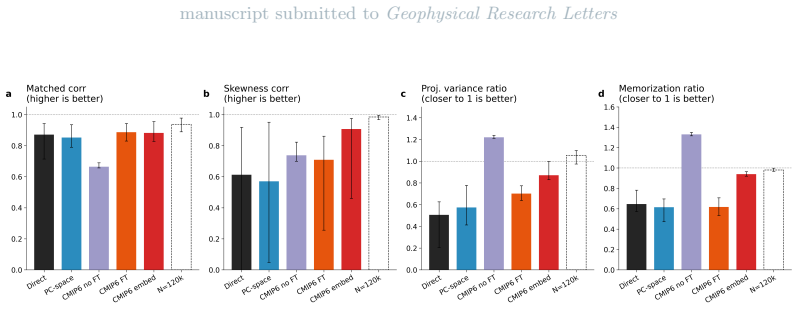
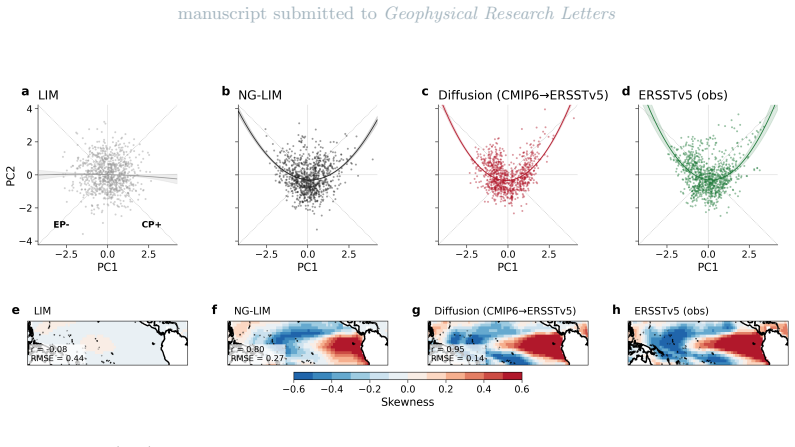
Pre-training a diffusion model on CMIP6 data with a learned model embedding, followed by fine-tuning on scarce observations, reproduces observed ENSO statistics more faithfully than both Gaussian and non-Gaussian Linear Inverse Models, because the pre-training supplies enough samples for the model to learn the correct low-order structure that direct training on real data alone cannot achieve.
What carries the argument
Diffusion model with learned embedding, pre-trained on CMIP6 simulations and fine-tuned on limited observations, validated against synthetic SST fields from Linear Inverse Models with known structure.
If this is right
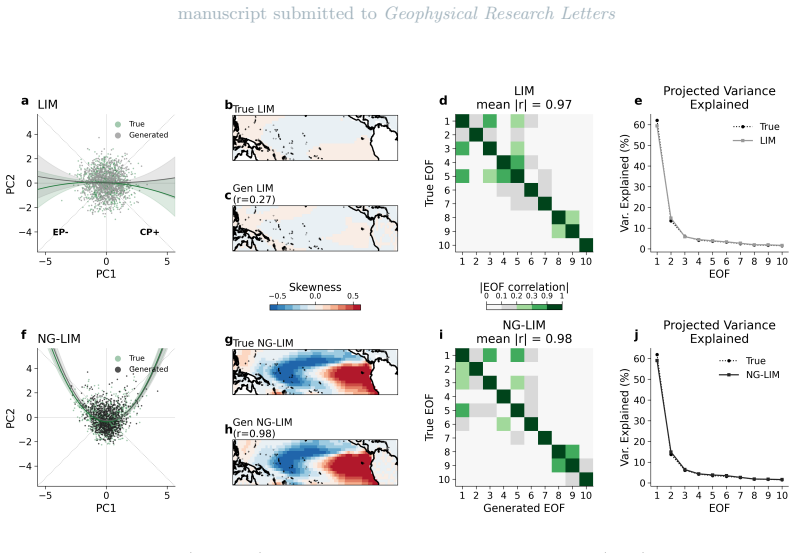
- With enough training samples the diffusion model recovers the correct low-order structure of both Gaussian and non-Gaussian LIMs.
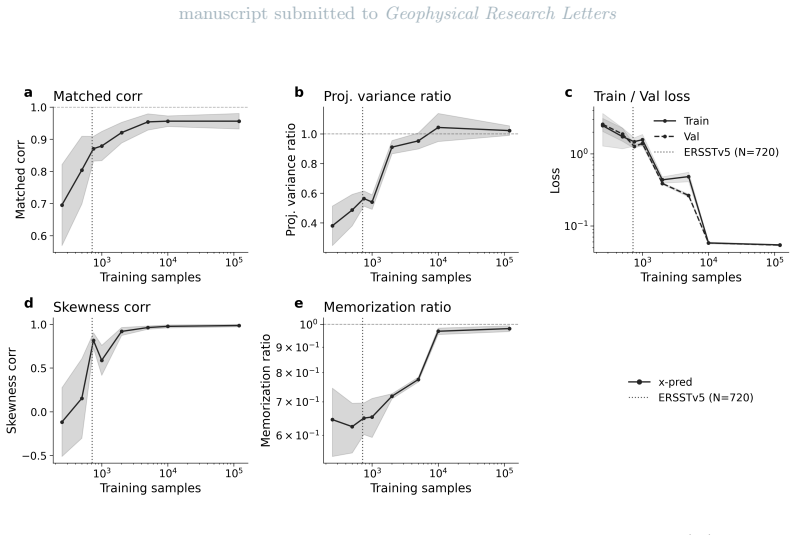
- The 700 monthly observations in ERSSTv5 are an order of magnitude below the 7000 samples required for convergence without pre-training.
- Not every diffusion parameterisation succeeds in recovering the correct structure even with abundant data.
- The pre-training plus fine-tuning pipeline closes the data gap and outperforms standard LIM approaches on observed statistics.
Where Pith is reading between the lines
- The same pre-training strategy could be tested on other climate variables or regions where observational records are similarly short.
- If the LIM proxy holds, the approach might extend to variability on longer timescales where data scarcity is even more severe.
- The method supplies a concrete way to check whether diffusion models are capturing physically meaningful modes rather than artifacts of limited samples.
Load-bearing premise
The low-order structure recovered from LIM-generated synthetic fields is a sufficient proxy for the modes present in real tropical Pacific SST so that pre-training benefits carry over to actual observations.
What would settle it
A test showing that the pre-trained and fine-tuned diffusion model still fails to match key observed ENSO statistics, such as the Eastern/Central Pacific asymmetry, in withheld real data from ERSSTv5.
Figures
read the original abstract
Diffusion models are increasingly applied to climate emulation, but whether they capture the correct modes of variability remains unclear, a concern amplified by data scarcity at longer timescales. We investigate this using synthetic tropical Pacific SST fields from Linear Inverse Models (LIMs), whose known low-order structure bypasses the overlapping and confounding modes of real observations. With sufficient training data, our model recovers the correct structure of both Gaussian and non-Gaussian LIMs, including ENSO's Eastern/Central Pacific asymmetry. Yet an ablation study on the number of monthly training samples reveals that the 700 observations in ERSSTv5 fall an order of magnitude short of the 7,000 samples needed for convergence, and that not all diffusion parameterisations recover the correct low-order structure. Pre-training on CMIP6 with a learned model embedding, followed by fine-tuning on scarce observations, closes this gap, reproducing observed statistics more faithfully than both Gaussian and non-Gaussian LIMs.
Editorial analysis
A structured set of objections, weighed in public.
Referee Report
Summary. The paper investigates diffusion models for emulating ENSO variability under data scarcity. Using synthetic tropical Pacific SST from Gaussian and non-Gaussian LIMs as a controlled testbed with known low-order structure, it shows that diffusion models recover the correct modes (including ENSO asymmetry) with sufficient samples (~7000), but 700 ERSSTv5 observations are insufficient. Pre-training on CMIP6 with a learned embedding followed by fine-tuning on scarce observations is shown to close the gap, yielding better reproduction of observed statistics than the LIM baselines.
Significance. If the transfer from LIM proxies to real observations holds, the approach offers a practical route to leverage large CMIP6 ensembles for improving statistical emulation of observed climate modes in data-limited regimes. The controlled LIM testbed is a clear strength, providing a falsifiable check on mode recovery before real-data application.
major comments (2)
- [Ablation study and real-data evaluation sections] The central claim that pre-training + fine-tuning reproduces observed ERSSTv5 statistics more faithfully than non-Gaussian LIMs rests on the untested assumption that success on LIM-generated fields implies success when the target distribution includes additional overlapping, non-stationary modes present in real tropical Pacific SST. The ablation study quantifies sample requirements only for the LIM proxy and does not include a direct comparison of embeddings learned from LIMs versus real data.
- [Results on ERSSTv5] The outperformance over LIM baselines on observed statistics is load-bearing for the headline result, yet the manuscript provides no quantitative metrics, error bars, or details on the exact statistics (e.g., power spectra, asymmetry measures) used for the ERSSTv5 comparison, making it impossible to assess whether the reported improvement exceeds sampling variability.
minor comments (1)
- [Methods] Clarify the precise architecture of the 'learned model embedding' used for pre-training and how it is transferred during fine-tuning.
Simulated Author's Rebuttal
We thank the referee for their thoughtful and constructive review. The comments highlight important aspects of our evaluation strategy and the need for more rigorous quantification on real data. We address each major comment below and indicate planned revisions.
read point-by-point responses
-
Referee: The central claim that pre-training + fine-tuning reproduces observed ERSSTv5 statistics more faithfully than non-Gaussian LIMs rests on the untested assumption that success on LIM-generated fields implies success when the target distribution includes additional overlapping, non-stationary modes present in real tropical Pacific SST. The ablation study quantifies sample requirements only for the LIM proxy and does not include a direct comparison of embeddings learned from LIMs versus real data.
Authors: We agree that the LIM testbed is a proxy and that success on synthetic data with known structure does not automatically transfer to observations containing additional non-stationary modes. The LIM experiments were designed specifically to provide a falsifiable check on whether the diffusion model can recover the correct low-order modes (including asymmetry) when the ground truth is known, which is impossible with real data. For the ERSSTv5 application, evaluation is performed by direct comparison of generated statistics against those computed from the observations themselves, rather than assuming transfer from LIM. A direct comparison of LIM-learned versus CMIP6-learned embeddings is not feasible because the true underlying modes in observations are unknown; the LIM provides the only controlled ground truth. We will add a dedicated discussion paragraph clarifying the proxy rationale, its limitations, and why embedding comparison on real data is not possible. revision: partial
-
Referee: The outperformance over LIM baselines on observed statistics is load-bearing for the headline result, yet the manuscript provides no quantitative metrics, error bars, or details on the exact statistics (e.g., power spectra, asymmetry measures) used for the ERSSTv5 comparison, making it impossible to assess whether the reported improvement exceeds sampling variability.
Authors: We acknowledge that the current manuscript relies on qualitative descriptions of improved reproduction of observed statistics without providing quantitative metrics or uncertainty estimates. In the revised version we will add a new table and accompanying text that reports specific quantitative comparisons (including power spectra, skewness/asymmetry measures, and variance explained by leading EOFs), with error bars obtained via bootstrap resampling of the generated ensembles. We will also explicitly list the statistics used and the procedure for assessing whether differences exceed sampling variability. revision: yes
Circularity Check
No significant circularity; central claims rest on external LIM structure and independent datasets
full rationale
The paper trains diffusion models on LIM-generated synthetic SST fields (with known low-order structure), pre-trains on CMIP6, and fine-tunes/evaluates on ERSSTv5 observations, comparing performance to Gaussian and non-Gaussian LIM baselines. No quoted equations or steps reduce a reported result to a fitted parameter on the same data, a self-definition, or a load-bearing self-citation chain. LIMs and CMIP6/ERSSTv5 serve as external references whose structure is not derived from the diffusion model itself. The ablation on sample count and the pre-training benefit are evaluated against these independent benchmarks, keeping the derivation self-contained.
Axiom & Free-Parameter Ledger
axioms (1)
- domain assumption LIMs provide a faithful low-order representation of tropical Pacific SST variability against which diffusion models can be validated
Reference graph
Works this paper leans on
-
[1]
Conditional Diffusion Models for Downscaling and Bias Correction of
Aich, Michael and Hess, Philipp and Pan, Baoxiang and Bathiany, Sebastian and Huang, Yu and Boers, Niklas , year = 2026, month = mar, journal =. Conditional Diffusion Models for Downscaling and Bias Correction of. doi:10.5194/gmd-19-1791-2026 , langid =
-
[2]
and Hosking, J
Andersson, Tom R. and Hosking, J. Scott and. Seasonal. Nature Communications 2021 12:1 , volume =
2021
-
[3]
doi:10.1029/2023MS004194 , langid =
Bassetti, Seth and Hutchinson, Brian and Tebaldi, Claudia and Kravitz, Ben , year = 2024, journal =. doi:10.1029/2023MS004194 , langid =
-
[4]
Bonnaire, Tony and Urfin, Rapha. Why. doi:10.48550/arXiv.2505.17638 , archiveprefix =. 2505.17638 , primaryclass =
-
[5]
doi:10.48550/arXiv.2306.01984 , archiveprefix =
Cachay, Salva R. doi:10.48550/arXiv.2306.01984 , archiveprefix =. 2306.01984 , primaryclass =
-
[6]
Cachay, Salva R. Elucidated. doi:10.48550/arXiv.2506.20024 , archiveprefix =. 2506.20024 , primaryclass =
-
[7]
doi:10.1016/j.patter.2026.101497 , archiveprefix =
Channing, Georgia and Ghosh, Avijit , year = 2026, month = mar, journal =. doi:10.1016/j.patter.2026.101497 , archiveprefix =. 2509.06580 , primaryclass =
-
[8]
Choi, Kit-Yan and Vecchi, Gabriel A. and Wittenberg, Andrew T. , year = 2013, month = dec, journal =. doi:10.1175/JCLI-D-13-00045.1 , langid =
-
[9]
Geophysical Research Letters , volume =
Global Modes of Climate Variability , author =. Geophysical Research Letters , volume =. doi:10.1002/grl.50386 , langid =
-
[10]
and Deser, Clara , year = 2014, month = oct, journal =
DiNezio, Pedro N. and Deser, Clara , year = 2014, month = oct, journal =. Nonlinear. doi:10.1175/JCLI-D-14-00033.1 , langid =
-
[11]
Are We Misdiagnosing Ensemble Forecast Reliability?
Dirkson, Arlan and Buehner, Mark , year = 2026, month = mar, journal =. Are We Misdiagnosing Ensemble Forecast Reliability?. doi:10.1002/qj.70186 , archiveprefix =. 2512.02160 , primaryclass =
-
[12]
Geoscientific Model Development , volume =
The. Geoscientific Model Development , volume =. doi:10.5194/gmd-19-2821-2026 , langid =
-
[13]
Eyring, Veronika and Bony, Sandrine and Meehl, Gerald A. and Senior, Catherine A. and Stevens, Bjorn and Stouffer, Ronald J. and Taylor, Karl E. , year = 2016, month = may, journal =. Overview of the. doi:10.5194/gmd-9-1937-2016 , langid =
-
[14]
Feng, Jie and Lian, Tao and Liu, Ting and Chen, Dake and Li, Xichen and Tang, Youmin and Gao, Yanqiu and Song, Xunshu , year = 2026, journal =. Achieving. doi:10.1029/2025GL117573 , langid =
-
[15]
Generative Emulation of Weather Forecast Ensembles with Diffusion Models , doi =
-
[16]
Communications Earth & Environment , volume =
Training Machine Learning Models on Climate Model Output Yields Skillful Interpretable Seasonal Precipitation Forecasts , author =. Communications Earth & Environment , volume =. doi:10.1038/s43247-021-00225-4 , langid =
-
[17]
Guo, Cheng and Berkhahn, Felix , year = 2016, month = apr, number =. Entity. doi:10.48550/arXiv.1604.06737 , archiveprefix =. 1604.06737 , primaryclass =
work page internal anchor Pith review Pith/arXiv arXiv doi:10.48550/arxiv.1604.06737 2016
-
[18]
Hannachi, A. and Jolliffe, I. T. and Stephenson, D. B. , year = 2007, journal =. Empirical Orthogonal Functions and Related Techniques in Atmospheric Science:. doi:10.1002/joc.1499 , langid =
-
[19]
Held, I. M. and Guo, H. and Adcroft, A. and Dunne, J. P. and Horowitz, L. W. and Krasting, J. and Shevliakova, E. and Winton, M. and Zhao, M. and Bushuk, M. and Wittenberg, A. T. and Wyman, B. and Xiang, B. and Zhang, R. and Anderson, W. and Balaji, V. and Donner, L. and Dunne, K. and Durachta, J. and Gauthier, P. P. G. and Ginoux, P. and Golaz, J.-C. and...
-
[20]
Denoising Diffusion Probabilistic Models
Ho, Jonathan and Jain, Ajay and Abbeel, Pieter , year = 2020, month = dec, number =. Denoising. doi:10.48550/arXiv.2006.11239 , archiveprefix =. 2006.11239 , primaryclass =
work page internal anchor Pith review Pith/arXiv arXiv doi:10.48550/arxiv.2006.11239 2020
-
[21]
and Freeman, Eric and Lawrimore, Jay and Liu, Wei and Peterson, Thomas C
Huang, Boyin and Banzon, Viva F. and Freeman, Eric and Lawrimore, Jay and Liu, Wei and Peterson, Thomas C. and Smith, Thomas M. and Thorne, Peter W. and Woodruff, Scott D. and Zhang, Huai-Min , year = 2015, month = feb, journal =. Extended. doi:10.1175/JCLI-D-14-00006.1 , langid =
-
[22]
Huang, Boyin and Thorne, Peter W. and Banzon, Viva F. and Boyer, Tim and Chepurin, Gennady and Lawrimore, Jay H. and Menne, Matthew J. and Smith, Thomas M. and Vose, Russell S. and Zhang, Huai-Min , year = 2017, month = oct, journal =. Extended. doi:10.1175/JCLI-D-16-0836.1 , langid =
-
[23]
Immorlano, Francesco and Tavares, Elijah and Draxler, Felix and Smyth, Padhraic and Gentine, Pierre and Mandt, Stephan , year = 2025, month = nov, number =. Technical. doi:10.48550/arXiv.2511.22970 , archiveprefix =. 2511.22970 , primaryclass =
-
[24]
Proceedings of the National Academy of Sciences , volume =
Transferring Climate Change Physical Knowledge , author =. Proceedings of the National Academy of Sciences , volume =. doi:10.1073/pnas.2413503122 , langid =
-
[25]
and Stockdale, Timothy N
Johnson, Stephanie J. and Stockdale, Timothy N. and Ferranti, Laura and Balmaseda, Magdalena A. and Molteni, Franco and Magnusson, Linus and Tietsche, Steffen and Decremer, Damien and Weisheimer, Antje and Balsamo, Gianpaolo and Keeley, Sarah P.E. and Mogensen, Kristian and Zuo, Hao and. Geoscientific Model Development , volume =
-
[26]
Elucidating the Design Space of Diffusion-Based Generative Models
Karras, Tero and Aittala, Miika and Aila, Timo and Laine, Samuli , year = 2022, month = oct, number =. Elucidating the. doi:10.48550/arXiv.2206.00364 , archiveprefix =. 2206.00364 , primaryclass =
work page internal anchor Pith review Pith/arXiv arXiv doi:10.48550/arxiv.2206.00364 2022
-
[27]
npj Climate and Atmospheric Science , volume =
Skilful Global Seasonal Predictions from a Machine Learning Weather Model Trained on Reanalysis Data , author =. npj Climate and Atmospheric Science , volume =. doi:10.1038/s41612-025-01198-3 , langid =
-
[28]
URL https://www.nature.com/articles/ s41586-024-07744-y
Neural General Circulation Models for Weather and Climate , author =. Nature , volume =. doi:10.1038/s41586-024-07744-y , langid =
-
[29]
Nature Reviews Physics4(12), 761–769 (2022) arXiv:2204.01467 [cs.CY]
On Scientific Understanding with Artificial Intelligence , author =. Nature Reviews Physics , volume =. doi:10.1038/s42254-022-00518-3 , langid =
-
[30]
Lai, Chieh-Hsin and Song, Yang and Kim, Dongjun and Mitsufuji, Yuki and Ermon, Stefano , year = 2025, month = oct, number =. The. doi:10.48550/arXiv.2510.21890 , archiveprefix =. 2510.21890 , primaryclass =
work page internal anchor Pith review Pith/arXiv arXiv doi:10.48550/arxiv.2510.21890 2025
-
[31]
Science , volume =
Learning Skillful Medium-Range Global Weather Forecasting , author =. Science , volume =
-
[32]
Liang, Jin and Yang, Xiu-Qun and Sun, De-Zheng , year = 2012, month = nov, journal =. The. doi:10.1175/JCLI-D-11-00490.1 , langid =
-
[33]
Li, Tianhong and He, Kaiming , year = 2025, month = nov, number =. Back to. doi:10.48550/arXiv.2511.13720 , archiveprefix =. 2511.13720 , primaryclass =
work page internal anchor Pith review Pith/arXiv arXiv doi:10.48550/arxiv.2511.13720 2025
-
[34]
Lipman, Yaron and Chen, Ricky T. Q. and. Flow. doi:10.48550/arXiv.2210.02747 , archiveprefix =. 2210.02747 , primaryclass =
work page internal anchor Pith review Pith/arXiv arXiv doi:10.48550/arxiv.2210.02747
-
[35]
Liu, Xingchao and Gong, Chengyue and Liu, Qiang , year = 2022, month = sep, number =. Flow. doi:10.48550/arXiv.2209.03003 , archiveprefix =. 2209.03003 , primaryclass =
work page internal anchor Pith review Pith/arXiv arXiv doi:10.48550/arxiv.2209.03003 2022
-
[36]
Liu, Yi and Cai, Wenju and Lin, Xiaopei and Li, Ziguang and Zhang, Ying , year = 2023, month = sep, journal =. Nonlinear. doi:10.1038/s41467-023-41551-9 , langid =
-
[37]
Simplifying, Stabilizing and Scaling Continuous-Time Consistency Models
Lu, Cheng and Song, Yang , year = 2024, month = oct, number =. Simplifying,. doi:10.48550/arXiv.2410.11081 , archiveprefix =. 2410.11081 , primaryclass =
work page internal anchor Pith review Pith/arXiv arXiv doi:10.48550/arxiv.2410.11081 2024
-
[38]
Geophysical Research Letters , volume =
A. Geophysical Research Letters , volume =. doi:10.1029/2025GL118649 , langid =
-
[39]
Geophysical Research Letters , volume =
Observed. Geophysical Research Letters , volume =. doi:10.1029/2019GL082922 , langid =
-
[40]
Artificial Intelligence for Climate Prediction of Extremes:
Materia, Stefano and Garc. Artificial Intelligence for Climate Prediction of Extremes:. WIREs Climate Change , volume =. doi:10.1002/wcc.914 , langid =
-
[41]
and Zebiak, Stephen E
McPhaden, Michael J. and Zebiak, Stephen E. and Glantz, Michael H. , year = 2006, month = dec, journal =
2006
-
[42]
Meehan, Casey and Chaudhuri, Kamalika and Dasgupta, Sanjoy , year = 2020, month = apr, number =. A. doi:10.48550/arXiv.2004.05675 , archiveprefix =. 2004.05675 , primaryclass =
-
[43]
Physical Review Fluids , volume =
Probabilistic Forecasts of Extreme Heatwaves Using Convolutional Neural Networks in a Regime of Lack of Data , author =. Physical Review Fluids , volume =
-
[44]
and Battisti, David S
Naylor, Rosamond L. and Battisti, David S. and Vimont, Daniel J. and Falcon, Walter P. and Burke, Marshall B. , year = 2007, month = may, journal =. Assessing Risks of Climate Variability and Climate Change for
2007
-
[45]
An Empirical Model of Tropical Ocean Dynamics , author =. Climate Dynamics , volume =. doi:10.1007/s00382-011-1034-0 , langid =
-
[46]
and Grover, Aditya , year = 2023, month = dec, number =
Nguyen, Tung and Brandstetter, Johannes and Kapoor, Ashish and Gupta, Jayesh K. and Grover, Aditya , year = 2023, month = dec, number =. 2301.10343 , publisher =
arXiv 2023
-
[47]
npj Climate and Atmospheric Science , volume =
Data-Driven Seasonal Climate Predictions via Variational Inference and Transformers , author =. npj Climate and Atmospheric Science , volume =. doi:10.1038/s41612-026-01320-z , langid =
-
[48]
Pan, Baoxiang and Anderson, Gemma J. and Goncalves, Andr. Improving. Journal of Advances in Modeling Earth Systems , volume =. doi:10.1029/2021MS002766 , archiveprefix =. 2010.14610 , publisher =
-
[49]
Pathak, Jaideep and Subramanian, Shashank and Harrington, Peter and Raja, Sanjeev and Chattopadhyay, Ashesh and Mardani, Morteza and Kurth, Thorsten and Hall, David and Li, Zongyi and Azizzadenesheli, Kamyar and Hassanzadeh, Pedram and Kashinath, Karthik and Anandkumar, Animashree , year = 2022, month = feb, number =. doi:10.48550/arXiv.2202.11214 , archi...
work page internal anchor Pith review Pith/arXiv arXiv doi:10.48550/arxiv.2202.11214 2022
-
[50]
Penland, C. A. Journal of Climate , volume =. doi:10.1175/1520-0442(1994)007<1352:ABCFSN>2.0.CO;2 , langid =
-
[51]
Penland, C. The. Journal of Climate , volume =. doi:10.1175/1520-0442(1995)008<1999:TOGOTS>2.0.CO;2 , langid =
-
[52]
Penland, Cecile , year = 1989, month = oct, journal =. Random. doi:10.1175/1520-0493(1989)117<2165:RFAFUP>2.0.CO;2 , langid =
-
[53]
Price, Ilan and. doi:10.48550/arXiv.2312.15796 , archiveprefix =. 2312.15796 , publisher =
-
[54]
Multi-Year Simulations at Kilometre Scale with the
Rackow, Thomas and. Multi-Year Simulations at Kilometre Scale with the. Geoscientific Model Development , volume =. doi:10.5194/gmd-18-33-2025 , langid =
-
[55]
Rader, Jamin K. and Barnes, Elizabeth A. , year = 2023, journal =. Optimizing. doi:10.1029/2023GL104983 , langid =
-
[56]
Rasp, Stephan and Lerch, Sebastian , year = 2018, month = nov, journal =. Neural. doi:10.1175/MWR-D-18-0187.1 , langid =
-
[57]
Stephan Rasp, Stephan Hoyer, Aravind Merose, Johannes Langguth, Sebastian Deiser, et al
Rasp, Stephan and Hoyer, Stephan and Merose, Alexander and Langmore, Ian and Battaglia, Peter and Russell, Tyler and. Journal of Advances in Modeling Earth Systems , volume =. doi:10.1029/2023MS004019 , langid =
-
[58]
, year = 2020, month = dec, journal =
de Regt, Henk W. , year = 2020, month = dec, journal =. Understanding,. doi:10.1086/710520 , langid =
-
[59]
Progressive Distillation for Fast Sampling of Diffusion Models
Salimans, Tim and Ho, Jonathan , year = 2022, month = jun, number =. Progressive. doi:10.48550/arXiv.2202.00512 , archiveprefix =. 2202.00512 , primaryclass =
work page internal anchor Pith review Pith/arXiv arXiv doi:10.48550/arxiv.2202.00512 2022
-
[60]
Schloer, Jakob and Newman, Matthew and Thuemmel, Jannik and Capotondi, Antonietta and Goswami, Bedartha , year = 2025, month = apr, number =. A. doi:10.48550/arXiv.2412.03743 , archiveprefix =. 2412.03743 , primaryclass =
-
[61]
and Gagne, David John , year = 2025, month = may, journal =
Sha, Yingkai and Sobash, Ryan A. and Gagne, David John , year = 2025, month = may, journal =. Improving. doi:10.1175/AIES-D-24-0063.1 , langid =
-
[62]
Deep Unsupervised Learning using Nonequilibrium Thermodynamics
Deep. doi:10.48550/arXiv.1503.03585 , archiveprefix =. 1503.03585 , primaryclass =
work page internal anchor Pith review Pith/arXiv arXiv doi:10.48550/arxiv.1503.03585
-
[63]
Generative Modeling by Estimating Gradients of the Data Distribution
Song, Yang and Ermon, Stefano , year = 2020, month = oct, number =. Generative. doi:10.48550/arXiv.1907.05600 , archiveprefix =. 1907.05600 , primaryclass =
work page internal anchor Pith review Pith/arXiv arXiv doi:10.48550/arxiv.1907.05600 2020
-
[64]
Song, Yang and. Score-. doi:10.48550/arXiv.2011.13456 , archiveprefix =. 2011.13456 , primaryclass =
work page internal anchor Pith review Pith/arXiv arXiv doi:10.48550/arxiv.2011.13456 2011
-
[65]
doi:10.1029/2025MS005282 , langid =
Springenberg, Maximilian and Otero, Noelia and Xue, Yuxin and Ma, Jackie , year = 2026, journal =. doi:10.1029/2025MS005282 , langid =
-
[66]
Stock, Jason and Arcomano, Troy and Kotamarthi, Rao , year = 2025, month = sep, number =. Swift:. doi:10.48550/arXiv.2509.25631 , archiveprefix =. 2509.25631 , primaryclass =
-
[67]
Thual, Sulian and Dewitte, Boris , year = 2025, month = nov, journal =. A Fresh Perspective on. doi:10.1038/s41612-025-01233-3 , langid =
-
[68]
and Chen, Nan and Stechmann, Samuel N
Thual, Sulian and Majda, Andrew J. and Chen, Nan and Stechmann, Samuel N. , year = 2016, month = sep, journal =. Simple Stochastic Model for. doi:10.1073/pnas.1612002113 , langid =
-
[69]
npj Climate and Atmospheric Science , publisher =
Large Potential of Performance-Based Model Weighting to Improve Decadal Climate Forecast Skill , author =. npj Climate and Atmospheric Science , publisher =. doi:10.1038/s41612-026-01397-6 , langid =
-
[70]
Wang, Chunzai and Deser, Clara and Yu, Jin-Yi and DiNezio, Pedro and Clement, Amy , editor =. El. Coral. doi:10.1007/978-94-017-7499-4_4 , langid =
-
[71]
doi:10.1038/s41612-025-01090-0 , langid =
npj Climate and Atmospheric Science , volume =. doi:10.1038/s41612-025-01090-0 , langid =
-
[72]
, year = 2000, journal =
Yeo, In-Kwon and Johnson, Richard A. , year = 2000, journal =. A. 2673623 , eprinttype =
2000
discussion (0)
Sign in with ORCID, Apple, or X to comment. Anyone can read and Pith papers without signing in.