Application of LLMs to Threat Assessment of Foreign Peacekeeping Missions
Pith reviewed 2026-06-26 03:34 UTC · model grok-4.3
The pith
LLMs extract peacekeeping mission threats from media with high agreement to human judgment.
A machine-rendered reading of the paper's core claim, the machinery that carries it, and where it could break.
Core claim
The paper claims that its LLM pipeline for mapping media contents to mission-relevant threats produces results with high agreement to human judgment on core aspects including threat presence and mission relevance, indicating that LLMs offer a workable method to support threat assessment in peacekeeping operations.
What carries the argument
The LLM-supported threat extraction pipeline that combines an interdisciplinary risk-model with OSINT media collection and additional processing steps to map contents to structured threats.
If this is right
- The workflow can generate structured threat information from media that aligns with analyst assessments on key dimensions.
- Additional LLM processing steps after initial extraction improve the grounding and relevance of the outputs.
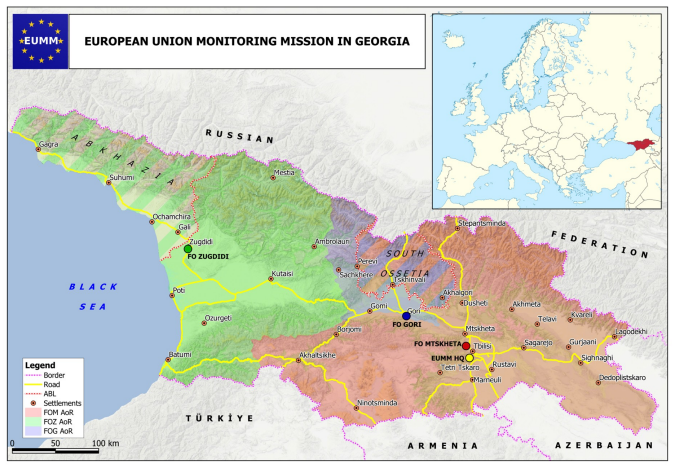
- The method is demonstrated on the EU Monitoring Mission in Georgia and can be applied to similar foreign peacekeeping contexts.
- High agreement on core aspects suggests the pipeline can reduce the manual effort required for initial threat screening.
Where Pith is reading between the lines
- The same pipeline structure could be tested on missions in different regions to check if agreement levels remain stable.
- Integrating the output with existing analyst tools might allow faster updating of risk assessments as new media appears.
- If the mapping holds across larger document sets, it could support monitoring of multiple missions simultaneously.
- Extending the evaluation to measure time savings for analysts would clarify operational impact beyond agreement scores.
Load-bearing premise
Media contents can be reliably mapped to mission-relevant threats by the LLM pipeline without substantial hallucination, bias, or loss of context.
What would settle it
A fresh collection of media documents on the same mission where independent human reviewers find low agreement with the pipeline outputs on threat identification and relevance.
Figures

read the original abstract
We present a novel approach for applying Large Language Models (LLMs) to threat assessment in the context of foreign peacekeeping missions. Building on the PINPOINT project and its use case, the EU Monitoring Mission in Georgia, we combine an interdisciplinary risk-model with OSINT-based media collection and LLM-supported threat extraction. The proposed workflow maps media contents to mission-relevant threats, extracts structured information and applies several additional LLM-based processing steps to improve relevance and grounding. An evaluation of threats extracted from media documents shows high agreement between automatically generated results and human judgment for core aspects such as threat and mission relevance. These results indicate that LLMs provide a promising approach to support analysts in the context of peacekeeping missions.
Editorial analysis
A structured set of objections, weighed in public.
Referee Report
Summary. The manuscript presents a workflow for threat assessment in foreign peacekeeping missions that integrates an interdisciplinary risk model, OSINT media collection, and a sequence of LLM-supported steps for mapping media to mission-relevant threats, structured extraction, and relevance refinement. The case study is the EU Monitoring Mission in Georgia (building on the PINPOINT project). The central empirical claim is that an evaluation of threats extracted from media documents demonstrates high agreement between the LLM pipeline outputs and human judgment on core aspects such as threat identification and mission relevance, suggesting LLMs as a promising support tool for analysts.
Significance. If the evaluation can be substantiated with the missing quantitative details, the work could provide a concrete demonstration of LLM utility in a high-stakes applied security setting, potentially aiding efficiency in processing open-source information for peacekeeping operations. The grounding in a specific real-world use case and the multi-step LLM pipeline are strengths that distinguish it from generic LLM application papers.
major comments (1)
- [Abstract] Abstract (and Evaluation section): The claim that 'an evaluation of threats extracted from media documents shows high agreement between automatically generated results and human judgment for core aspects such as threat and mission relevance' supplies no sample size, document count, agreement metric (e.g., Cohen's kappa, F1, or percentage), inter-rater reliability, human annotation protocol, exclusion criteria, or controls for LLM hallucination, prompt sensitivity, or context loss. This information is required to establish that the observed agreement reflects pipeline fidelity rather than evaluation artifacts, and its absence is load-bearing for the paper's primary conclusion.
Simulated Author's Rebuttal
We thank the referee for the constructive feedback. The primary concern regarding missing quantitative details in the abstract and evaluation section is valid, and we will revise the manuscript to address it directly.
read point-by-point responses
-
Referee: [Abstract] Abstract (and Evaluation section): The claim that 'an evaluation of threats extracted from media documents shows high agreement between automatically generated results and human judgment for core aspects such as threat and mission relevance' supplies no sample size, document count, agreement metric (e.g., Cohen's kappa, F1, or percentage), inter-rater reliability, human annotation protocol, exclusion criteria, or controls for LLM hallucination, prompt sensitivity, or context loss. This information is required to establish that the observed agreement reflects pipeline fidelity rather than evaluation artifacts, and its absence is load-bearing for the paper's primary conclusion.
Authors: We agree that the current abstract and evaluation section do not provide the requested quantitative details. In the revised manuscript we will expand the evaluation section (and update the abstract) to report the sample size (number of media documents and extracted threats), the agreement metric(s) employed, inter-rater reliability, the human annotation protocol, exclusion criteria, and any controls implemented for LLM hallucination, prompt sensitivity, or context loss. These additions will allow readers to assess whether the observed agreement reflects pipeline performance. revision: yes
Circularity Check
No circularity: evaluation claim rests on independent human comparison with no fitted parameters or self-referential definitions
full rationale
The paper presents an LLM-based workflow for threat extraction from media and reports an empirical evaluation showing high agreement with human judgment on threat and mission relevance. No equations, fitted parameters, or predictions appear. The central result is framed as an external human comparison rather than a quantity derived from the pipeline itself by construction. No self-citation chains or uniqueness theorems are invoked to support the agreement claim. The derivation is therefore self-contained against external benchmarks.
Axiom & Free-Parameter Ledger
axioms (1)
- domain assumption The interdisciplinary risk-model from the PINPOINT project correctly identifies mission-relevant threats
Reference graph
Works this paper leans on
-
[1]
Open source intelligence investigation: From strategy to implementation , pages=
Fusion of OSINT and non-OSINT data , author=. Open source intelligence investigation: From strategy to implementation , pages=. 2016 , publisher=
2016
-
[2]
2018 , publisher=
Defining second generation open source intelligence (OSINT) for the defense enterprise , author=. 2018 , publisher=
2018
-
[3]
Security and Human Rights , volume=
Analysis for Peace The Evolving Data Tools of UN and OSCE Field Operations , author=. Security and Human Rights , volume=. 2020 , publisher=
2020
-
[4]
Proceedings of the 10th International Conference on e-Business , year=
Open Source Intelligence for Traditional- and Social Media Sources , author=. Proceedings of the 10th International Conference on e-Business , year=
-
[5]
CROWD OSInfo
Wissensentwicklung mit "CROWD OSInfo" : eine Innovation des Cyber Documentation & Research Center (CDRC) der Zentraldokumentation (ZentDok), Landesverteidigungsakadmie (LVAK) , author=. 2015 , publisher=
2015
-
[6]
Proceedings of the Intelligence 2023 Conference of the Australian Institute of Professional Intelligence Officers, forthcoming , year=
Open Source Intelligence for Traditional- and Social Media Sources , author=. Proceedings of the Intelligence 2023 Conference of the Australian Institute of Professional Intelligence Officers, forthcoming , year=
2023
-
[7]
Advances in Neural Information Processing Systems , volume=
Judging LLM-as-a-judge with MT-bench and Chatbot Arena , author=. Advances in Neural Information Processing Systems , volume=
-
[8]
Procedia Engineering , volume =
New Artificial Intelligence Tools for Deep Conflict Resolution and Humanitarian Response , author =. Procedia Engineering , volume =. 2015 , publisher =. doi:10.1016/j.proeng.2015.06.083 , url =
-
[9]
Pasligh , title =
Hendrik A. Pasligh , title =
-
[10]
2025 , eprint =
On the Military Applications of Large Language Models , author =. 2025 , eprint =
2025
-
[11]
Stat , volume=
On Large Language Models in National Security Applications , author=. Stat , volume=. 2025 , publisher=
2025
-
[12]
2024 , publisher =
Hands-On Large Language Models: Language Understanding and Generation , author =. 2024 , publisher =
2024
-
[13]
Sentence-BERT: Sentence Embeddings using Siamese BERT-Networks
Nils Reimers and Iryna Gurevych , title =. CoRR , volume =. 2019 , url =. 1908.10084 , timestamp =
work page internal anchor Pith review Pith/arXiv arXiv 2019
-
[14]
Gerhard Backfried and Dorothea Thomas-Aniola and Diego Pilutti and Martin Boyer and Rüdiger Hein and Amir Tatabaei and Michael Zinkanell and Michael Suker and Philipp Agathonos , title =. Proceedings of Conference on Cognitive and Computational Aspects of Situation Management 2023 , editor =. doi:10.29007/vnzb , pages =
-
[15]
doi:10.1787/9789264043466-en , isbn =
Handbook on Constructing Composite Indicators: Methodology and User Guide , year =. doi:10.1787/9789264043466-en , isbn =
discussion (0)
Sign in with ORCID, Apple, or X to comment. Anyone can read and Pith papers without signing in.