Investigation on the temperature dependence of substrate-induced in-plane uniaxial magnetic anisotropy in Ni thin films grown on 128{deg} Y-cut LiNbO3
Pith reviewed 2026-06-26 03:02 UTC · model grok-4.3
The pith
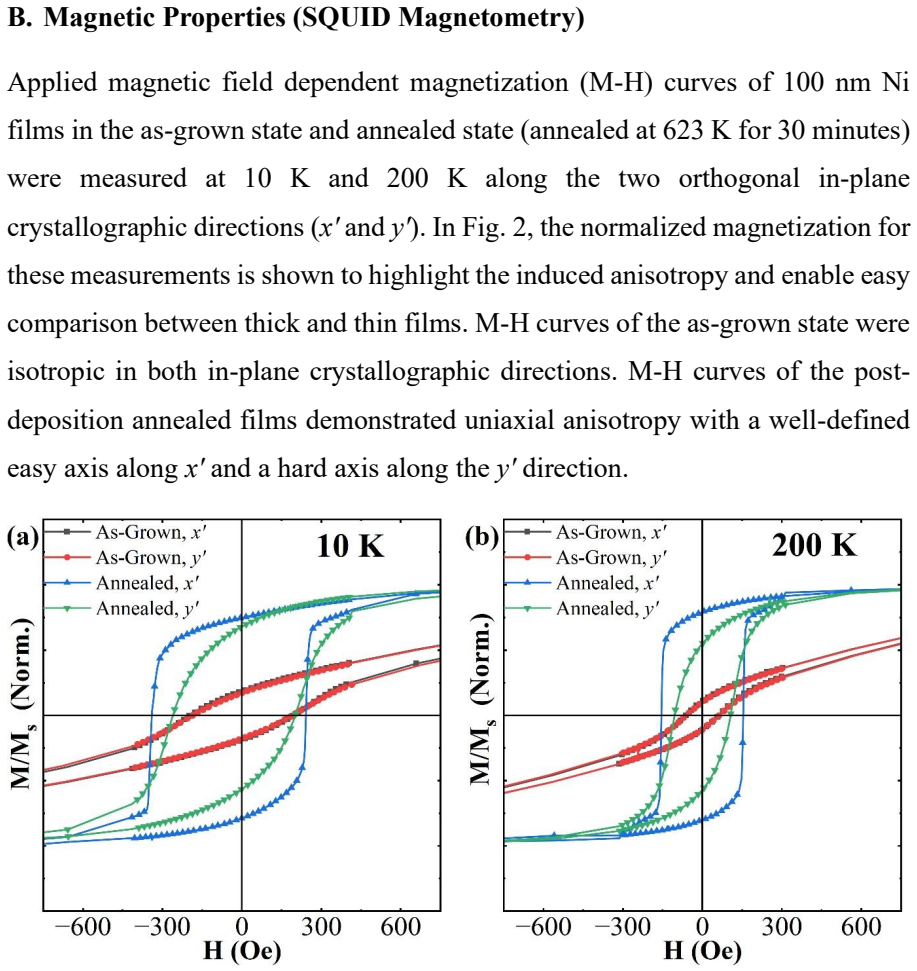
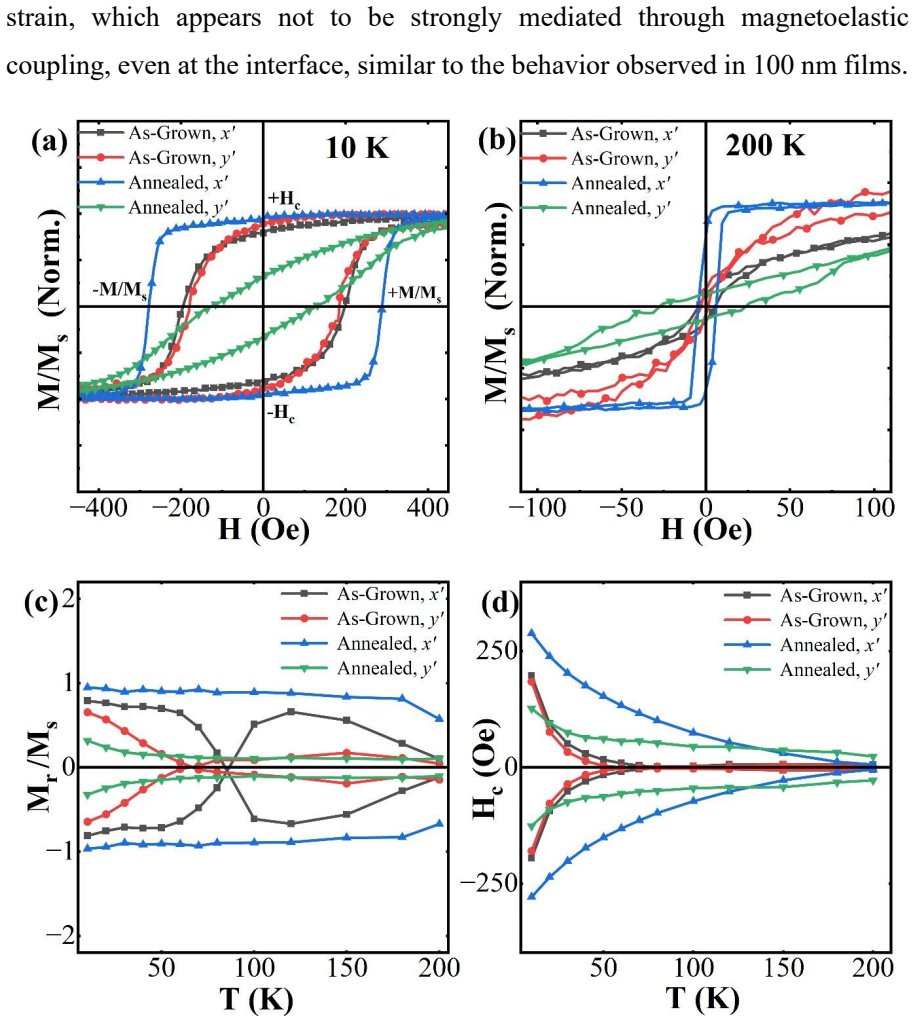
Post-deposition annealing induces temperature-dependent uniaxial magnetic anisotropy in Ni films on 128° Y-cut LiNbO3 through residual strain from lattice and CTE mismatch.
A machine-rendered reading of the paper's core claim, the machinery that carries it, and where it could break.
Core claim
Post-deposition annealing establishes uniaxial anisotropy with well-defined easy and hard axes whose strength evolves with temperature due to the nature of residual strain governed by both lattice mismatch and coefficient of thermal expansion mismatch between the Ni film and the 128° Y-cut substrate, independent of film thickness for both 5 nm and 100 nm films; the emergence of this anisotropy indicates enhanced magnetoelastic coupling at the film-substrate interface as the magnetic response follows the anisotropic strain imposed by the mismatches.
What carries the argument
residual strain from lattice mismatch and CTE mismatch acting through magnetoelastic coupling at the Ni/LiNbO3 interface
If this is right
- Annealed films exhibit no hysteresis branch crossing over the measured temperature range, unlike as-grown films.
- The uniaxial anisotropy appears after annealing in both 5 nm and 100 nm films, showing thickness independence.
- The magnetic response in annealed films tracks the anisotropic strain imposed by the substrate mismatches.
- Enhanced magnetoelastic coupling at the interface occurs after annealing.
Where Pith is reading between the lines
- Device structures that rely on this anisotropy could require post-growth annealing to achieve stable easy-axis behavior across operating temperatures.
- Similar mismatch-driven anisotropy might appear in other ferromagnetic metals deposited on the same substrate orientation if the magnetoelastic coefficients are comparable.
- Mapping the strain state in situ with X-ray diffraction at multiple temperatures would provide an independent check on the magnetoelastic origin.
Load-bearing premise
The temperature evolution of the anisotropy arises exclusively from residual strain produced by lattice and CTE mismatch through magnetoelastic coupling, without meaningful contributions from interface chemistry, defects, or measurement artifacts.
What would settle it
A direct measurement showing that the anisotropy energy density does not scale with the calculated biaxial strain from the known lattice constants and CTE values across the same temperature range would falsify the claim.
Figures
read the original abstract
We report the temperature dependence of the substrate-induced magnetic anisotropy in continuous Ni thin films deposited at room temperature using magnetron sputtering on a 128{\deg} Y-cut LiNbO3 substrate. Ultrathin films exhibit a pronounced temperature dependence in magnetization, with as-grown films showing isotropic behavior and an unconventional hysteresis branch crossing at relatively low temperatures, whereas no branch crossing is observed in annealed films over the investigated temperature range, indicating suppression of the underlying mechanism. Temperature-dependent magnetization measurements show that post-deposition annealing establishes uniaxial anisotropy with well-defined easy and hard axes, whose strength evolves with temperature due to the nature of residual strain governed by both lattice mismatch and coefficient of thermal expansion (CTE) mismatch between the Ni film and the 128{\deg} Y-cut substrate, independent of film thickness for both 5 nm and 100 nm films. The emergence of this anisotropy following annealing indicates enhanced magnetoelastic coupling at the film-substrate interface, as the magnetic response begins to follow the anisotropic strain imposed by lattice mismatch and CTE mismatch.
Editorial analysis
A structured set of objections, weighed in public.
Referee Report
Summary. The manuscript reports experimental measurements of magnetization vs. temperature and field for Ni thin films (5 nm and 100 nm) sputtered on 128° Y-cut LiNbO3. As-grown films are described as isotropic with an unconventional hysteresis branch crossing at low temperatures; post-deposition annealing induces uniaxial in-plane anisotropy with well-defined easy/hard axes whose strength varies with temperature. The authors attribute this temperature evolution exclusively to residual strain arising from lattice mismatch and CTE mismatch between film and substrate, acting through magnetoelastic coupling, and claim the effect is thickness-independent.
Significance. If the mechanism were quantitatively verified, the work would add to the literature on magnetoelastic anisotropy in Ni films on piezoelectric substrates, with possible relevance to temperature-tunable magnetic devices. The experimental focus on annealing effects and thickness independence is potentially useful, but the absence of direct strain data or exclusion of alternatives limits the immediate impact.
major comments (2)
- [Abstract] Abstract: The central claim that temperature evolution of the anisotropy 'evolves with temperature due to the nature of residual strain governed by both lattice mismatch and coefficient of thermal expansion (CTE) mismatch' and occurs 'independent of film thickness' is presented without any reported strain measurements (XRD, Raman, or equivalent), without numerical comparison of observed anisotropy fields to the magnetoelastic expression (3/2)λσ, and without controls that would exclude interface chemistry, oxidation, or defect contributions.
- [Abstract] Abstract: The statement that annealing 'establishes uniaxial anisotropy ... indicating enhanced magnetoelastic coupling at the film-substrate interface' is load-bearing for the interpretation yet rests on qualitative hysteresis observations; no quantitative anisotropy constants, error bars on temperature-dependent data, or discussion of how strain relaxation would (or would not) differ between 5 nm and 100 nm films is supplied to support the thickness-independence assertion.
minor comments (1)
- [Abstract] Abstract: The phrase 'unconventional hysteresis branch crossing' is used without definition or reference to a figure or prior literature, making the description of as-grown film behavior difficult to interpret.
Simulated Author's Rebuttal
We thank the referee for the constructive feedback. We address the two major comments point by point below, indicating where revisions will be made to strengthen the manuscript while noting limitations in the existing dataset.
read point-by-point responses
-
Referee: [Abstract] Abstract: The central claim that temperature evolution of the anisotropy 'evolves with temperature due to the nature of residual strain governed by both lattice mismatch and coefficient of thermal expansion (CTE) mismatch' and occurs 'independent of film thickness' is presented without any reported strain measurements (XRD, Raman, or equivalent), without numerical comparison of observed anisotropy fields to the magnetoelastic expression (3/2)λσ, and without controls that would exclude interface chemistry, oxidation, or defect contributions.
Authors: We acknowledge the absence of direct strain measurements such as XRD or Raman spectroscopy in the current work; these would require additional experiments not present in our dataset. The central claim is instead supported by the observed temperature dependence of the magnetic anisotropy extracted from hysteresis loops, which follows the expected thermal evolution from CTE mismatch between Ni and LiNbO3 (using literature CTE values). We will add a revised discussion section that includes numerical estimates of the magnetoelastic anisotropy field using (3/2)λσ with published magnetostriction constants for Ni and estimated residual stress from CTE mismatch over the measured temperature range. On alternative mechanisms, the post-annealing onset combined with identical temperature trends in both 5 nm and 100 nm films is inconsistent with bulk oxidation or defect contributions (which would scale differently with thickness); we will expand the text to explicitly address this point and note that interface chemistry cannot be fully ruled out without additional surface-sensitive probes. revision: partial
-
Referee: [Abstract] Abstract: The statement that annealing 'establishes uniaxial anisotropy ... indicating enhanced magnetoelastic coupling at the film-substrate interface' is load-bearing for the interpretation yet rests on qualitative hysteresis observations; no quantitative anisotropy constants, error bars on temperature-dependent data, or discussion of how strain relaxation would (or would not) differ between 5 nm and 100 nm films is supplied to support the thickness-independence assertion.
Authors: The uniaxial anisotropy is quantified via the difference in saturation fields and remanence between easy- and hard-axis loops; we will add explicit values of the anisotropy constant K_u (extracted from the area between loops or from the anisotropy field) together with error bars on all temperature-dependent plots. Regarding thickness independence, lattice-mismatch strain is expected to relax more readily in the 100 nm film while CTE-driven strain remains largely thickness-independent for continuous films in this range; the similar temperature evolution observed in both thicknesses supports dominance of the CTE term. We will insert a dedicated paragraph in the discussion section comparing expected relaxation lengths to the observed data and will include the quantitative K_u(T) values with uncertainties. revision: yes
- Direct experimental strain measurements (XRD, Raman, or equivalent) are not available in the present dataset and cannot be added without new experiments.
Circularity Check
No circularity; experimental attribution of anisotropy to strain mismatch is interpretive, not derived by construction
full rationale
The manuscript is an experimental study reporting magnetization vs. temperature/field data for Ni films on 128° Y-cut LiNbO3. The central claim attributes post-anneal uniaxial anisotropy and its temperature dependence to residual strain from lattice/CTE mismatch acting through magnetoelastic coupling. This is an interpretive conclusion drawn from observed hysteresis behavior and thickness independence, with no equations, fitted parameters, or derivations that reduce the reported anisotropy values to inputs defined by the same measurements. No self-citations, ansatzes, or uniqueness theorems appear in the load-bearing steps. The work is self-contained against external benchmarks as direct observation.
Axiom & Free-Parameter Ledger
axioms (1)
- domain assumption Magnetoelastic coupling is the dominant mechanism linking residual strain to in-plane uniaxial anisotropy in Ni films.
Reference graph
Works this paper leans on
-
[1]
Uniaxial in -plane magnetic anisotropy mechanism in Ni, Fe, and Ni-Fe alloy films deposited on single crystal Y-cut 128° LiNbO3 using ma gnetron sputtering,
1 M. Ito, S. Ono, H. Fukui, K. Kogirima, N. Maki, T. Hikage, T. Kato, T. Ohkochi, A. Yamaguchi, M. Shima, and K. Yamada, “Uniaxial in -plane magnetic anisotropy mechanism in Ni, Fe, and Ni-Fe alloy films deposited on single crystal Y-cut 128° LiNbO3 using ma gnetron sputtering,” Journal of Magnetism and Magnetic Materials 564, 170177 (2022). 2 S.A. Mathew...
2022
-
[2]
Physics and technology of magnetron sputtering discharges,
36 J.T. Gudmundsson, “Physics and technology of magnetron sputtering discharges,” Plasma Sources Sci. Technol. 29(11), 113001 (2020). 37 V .I. Shapovalov, A.E. Komlev, A.S. Bondarenko, P.B. Baykov, and V .V . Karzin, “Substrate heating and cooling during magnetron sputtering of copper target,” Physics Letters A 380(7–8), 882–885 (2016)
2020
discussion (0)
Sign in with ORCID, Apple, or X to comment. Anyone can read and Pith papers without signing in.