Parsec-scale polarimetry and kinematics of a spine-sheath jet in the neutrino-blazar TXS 0506+056
Pith reviewed 2026-06-29 01:22 UTC · model grok-4.3
The pith
VLBI observations reveal a spine-sheath structure in the jet of the neutrino blazar TXS 0506+056.
A machine-rendered reading of the paper's core claim, the machinery that carries it, and where it could break.
Core claim
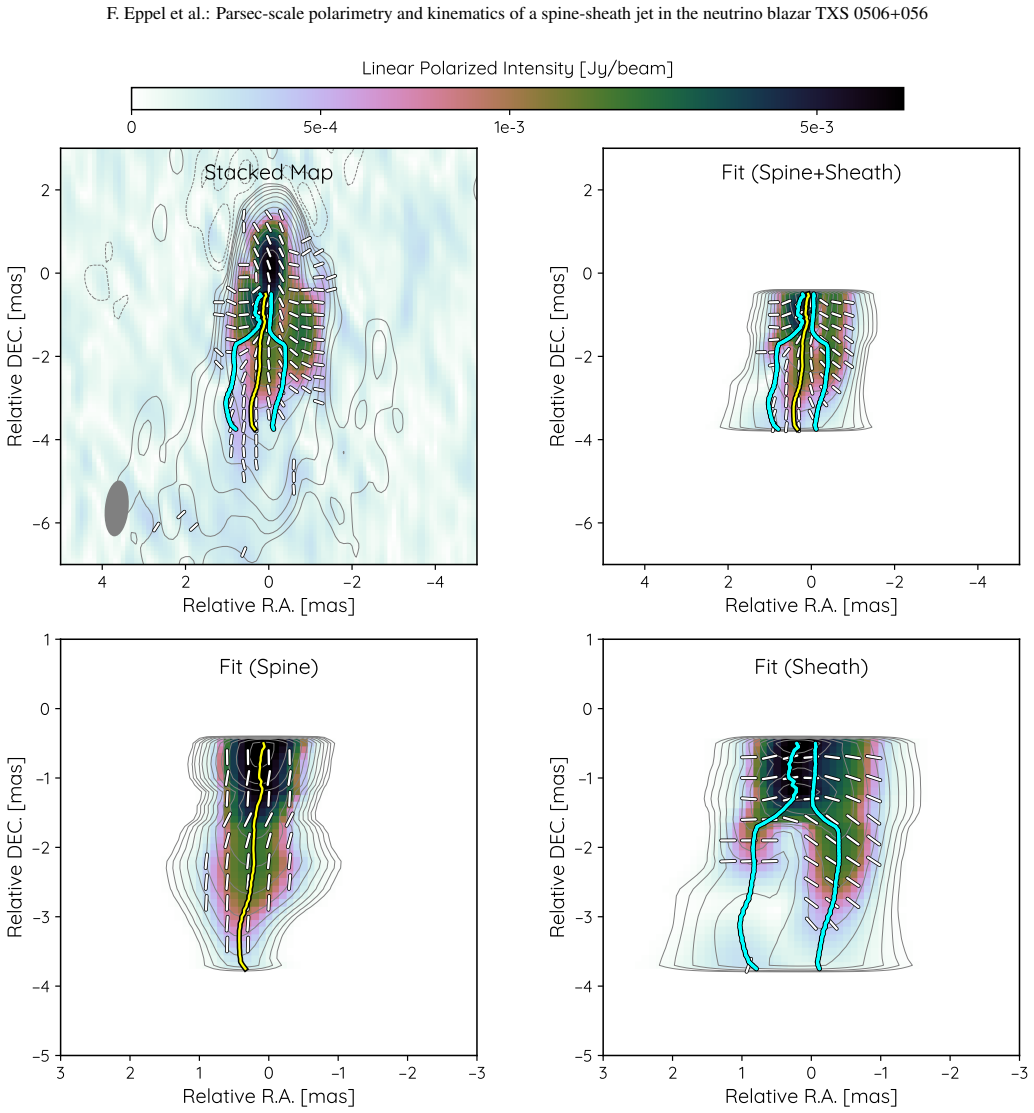
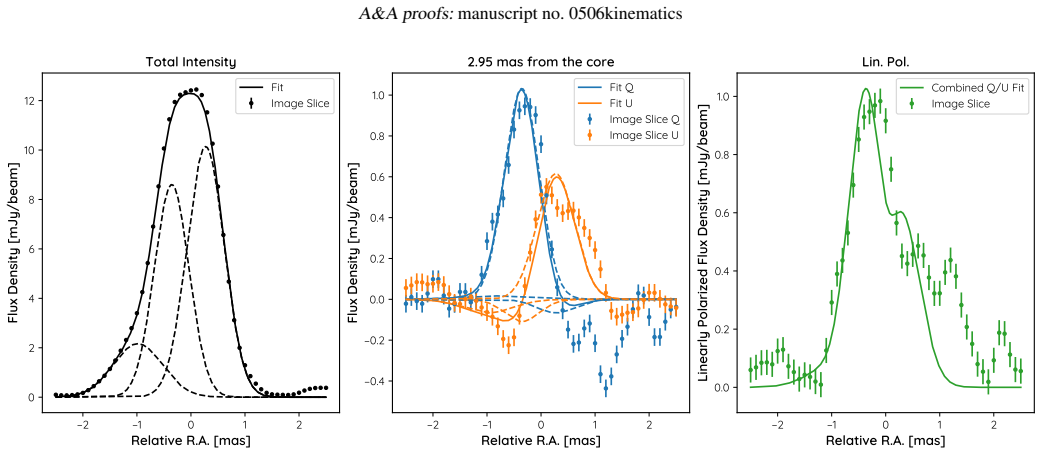
The stacked polarization map is consistent with a stratified spine-sheath jet structure: an inner spine with EVPA aligned with the jet, surrounded by a sheath layer with perpendicular EVPA. Variability in total intensity and polarization indicates interaction between these layers, and the multi-layered jet is consistent with models explaining the neutrino emission.
What carries the argument
The spine-sheath jet structure identified through the stacked polarization map, where the inner spine shows EVPA aligned with the jet direction and the outer sheath shows perpendicular EVPA, which accounts for the observed polarization patterns and flares.
If this is right
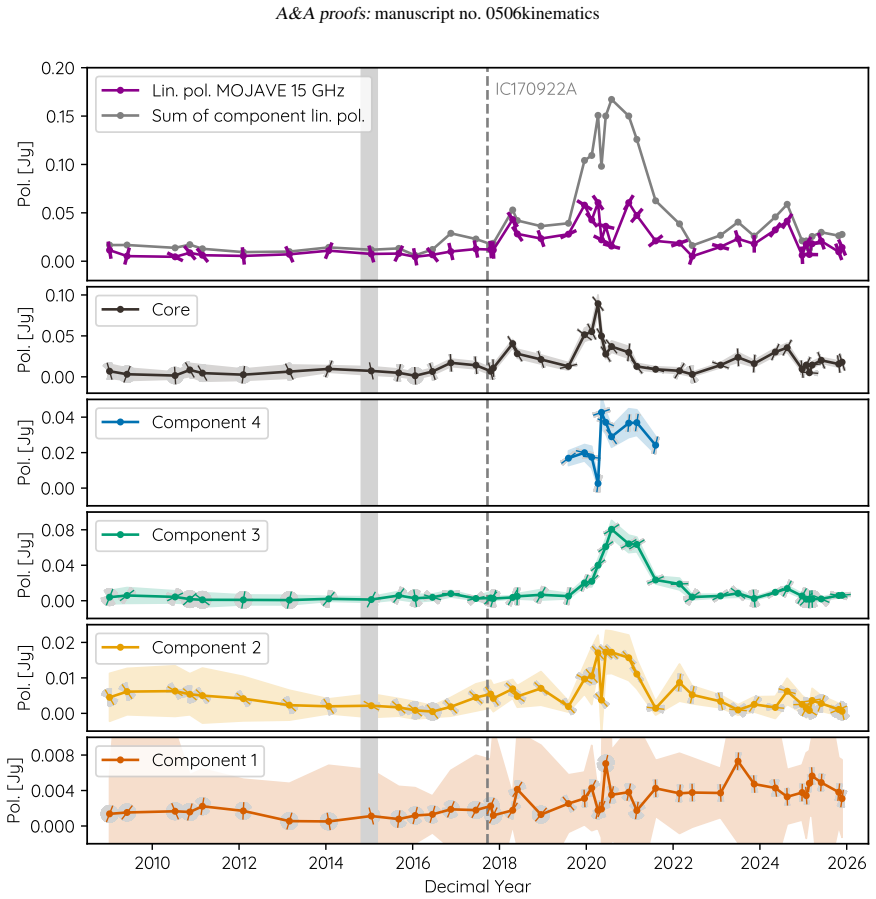
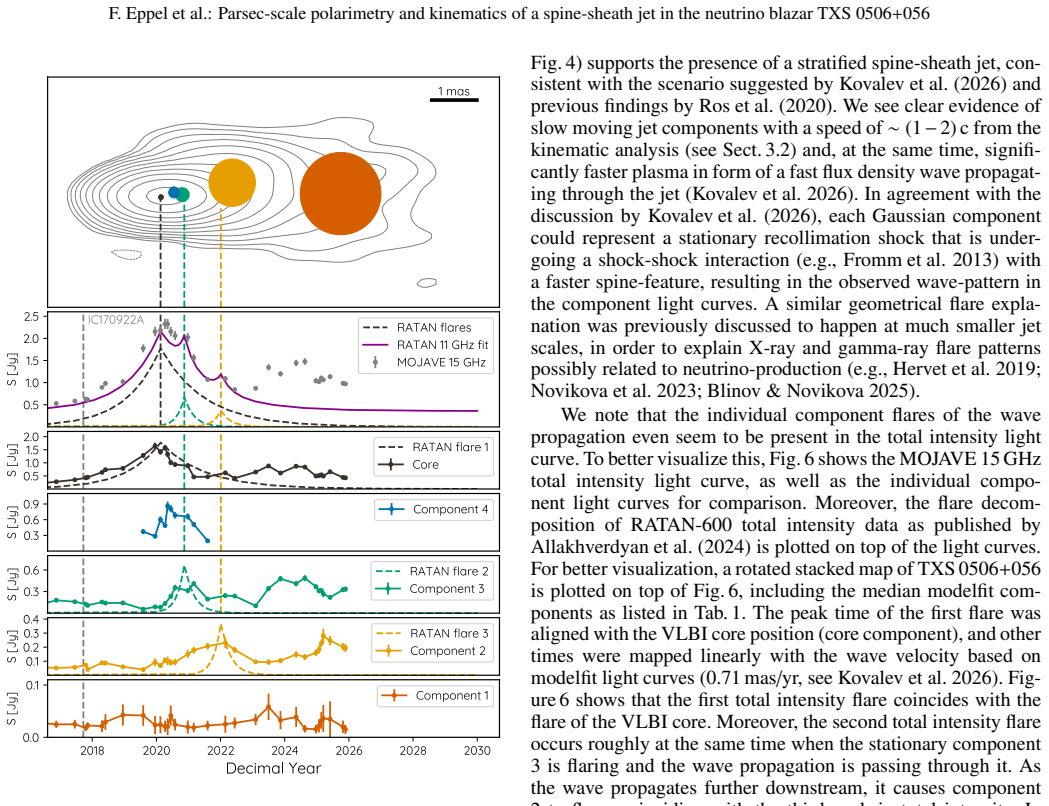
- The interaction between spine and sheath produces linear polarization flares associated with EVPA rotations in quasi-stationary components.
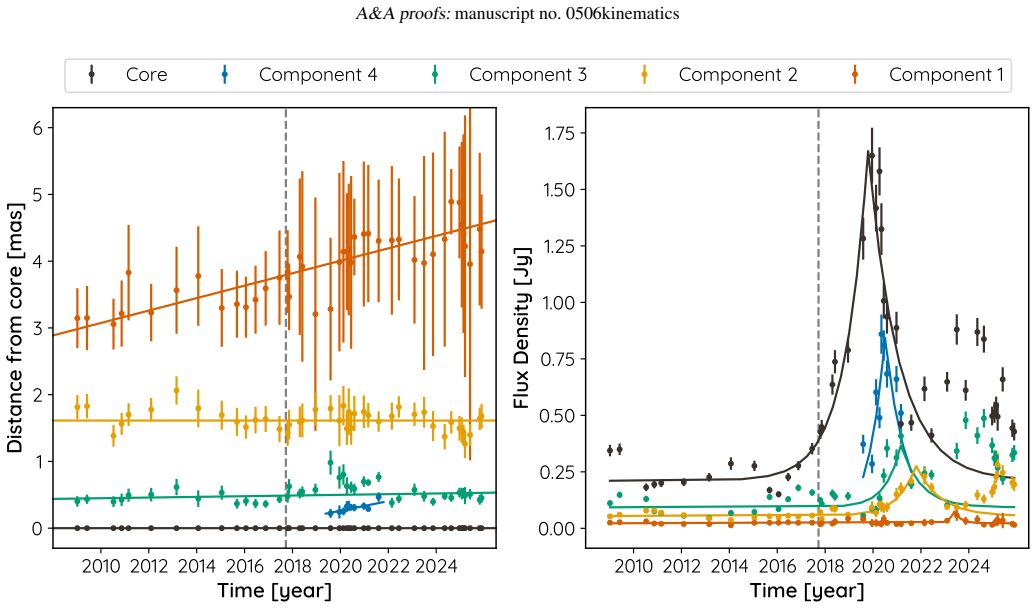
- A new jet component was ejected contemporaneously with the 2017 neutrino event.
- The configuration explains the neutrino emission via the spine-sheath structure.
- TXS 0506+056 represents an archetypal case where similar polarization signatures may appear in other neutrino-emitting sources.
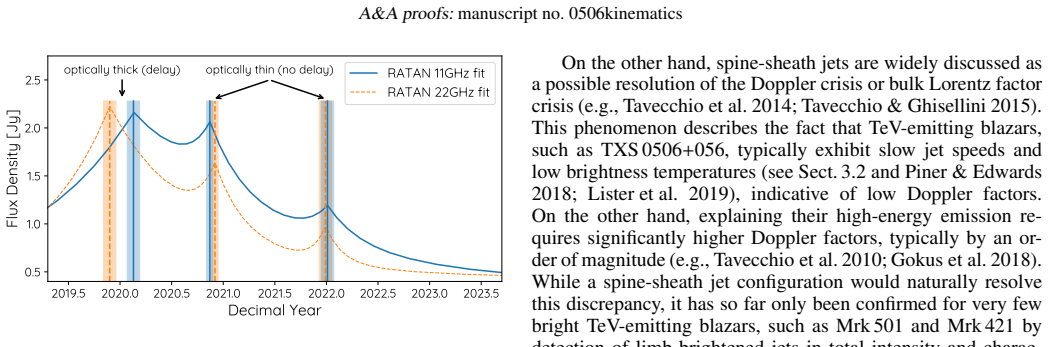
- This may offer a solution to the Doppler-crisis phenomenon in TeV-emitting blazars.
Where Pith is reading between the lines
- If the spine-sheath model holds, targeted polarization monitoring of other IceCube-associated blazars could identify candidates with similar layered jets.
- The quasi-stationary components likely mark sites of layer interaction where particle acceleration for neutrinos occurs.
- Higher-resolution or multi-frequency observations could map the radial extent of the sheath layer to test the stratification depth.
Load-bearing premise
The EVPA orientations and variability are caused by the spine-sheath geometry instead of projection effects, Faraday rotation, or other propagation effects.
What would settle it
If higher-frequency VLBI observations show EVPA patterns that do not match the expected perpendicular sheath or if Faraday rotation measures vary strongly across the jet in a way inconsistent with the layers.
Figures
read the original abstract
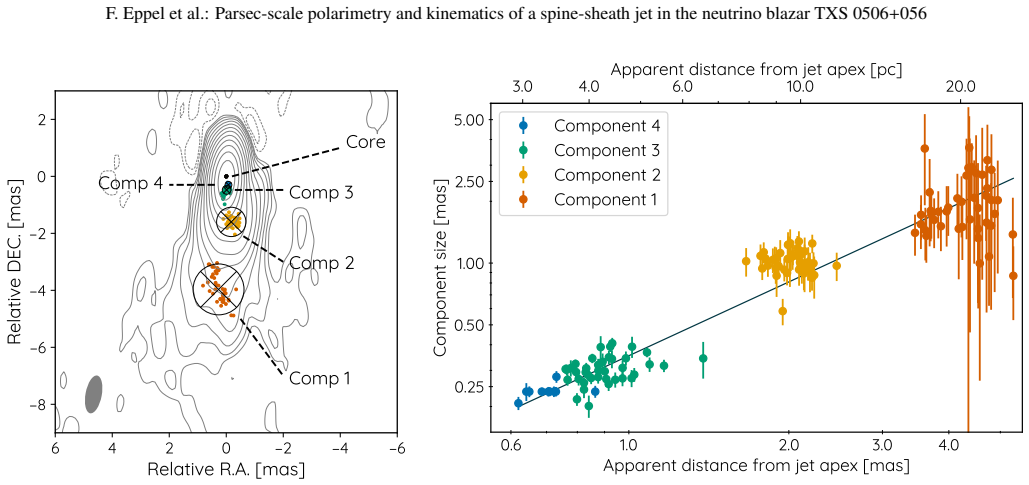
In 2017, the blazar TXS 0506+056 showed a remarkable gamma-ray outburst simultaneously with a high-energy neutrino detection by IceCube from the same sky region. The significance of this association was found to be on the order of 3 sigma thus providing a strong link between the neutrino emission and the blazar flare. The high-energy flare in TXS 0506+056 was followed by a delayed radio flare, peaking in $\sim2020$ in the aftermath of the neutrino event. We investigate the parsec-scale jet structure and dynamics of TXS 0506+056 using 15 GHz full-polarization VLBI observations obtained between 2009 and 2025 with the Very Long Baseline Array. Our kinematic analysis reveals moderate superluminal jet speeds of $\sim(1-2)$c and two quasi-stationary components. A new jet component with comparable speed was ejected contemporaneously with the 2017 IceCube neutrino event. The stacked polarization map is consistent with a stratified spine-sheath jet structure: an inner spine with EVPA aligned with the jet, surrounded by a sheath layer with perpendicular EVPA. Variability in total intensity and polarization further indicates interaction between these layers, particularly evident in characteristic linear polarization flares, associated with EVPA rotations of the quasi-stationary components. The multi-layered jet configuration is consistent with previous studies that were able to explain the neutrino emission in this TXS 0506+056 through a spine-sheath jet structure. We suggest that TXS 0506+056 represents an archetypal case and that similar polarization signatures and geometric light curve flares may be present in other neutrino-emitting sources, potentially offering a solution to the Doppler-crisis phenomenon observed in TeV-emitting blazars.
Editorial analysis
A structured set of objections, weighed in public.
Referee Report
Summary. The paper analyzes 15 GHz VLBA full-polarization observations of TXS 0506+056 from 2009–2025. Kinematic modeling identifies moderate superluminal speeds (∼1–2 c), two quasi-stationary components, and a new component ejected near the 2017 neutrino event. The stacked polarization map is presented as evidence for a stratified spine-sheath structure (inner spine with EVPA parallel to the jet axis, outer sheath with perpendicular EVPA). Variability in total intensity and polarization is interpreted as indicating interactions between the layers, consistent with prior spine-sheath models invoked to explain the neutrino emission; the source is proposed as archetypal for similar signatures in other neutrino blazars.
Significance. If the polarization interpretation survives scrutiny of propagation effects, the multi-epoch dataset supplies direct observational constraints on jet stratification in a neutrino-associated blazar, reinforcing the spine-sheath scenario previously used to address the Doppler crisis in TeV sources. The timing coincidence between component ejection and the IceCube event adds a temporal dimension to the structural claim.
major comments (2)
- [stacked polarization map and its interpretation] The central claim that the stacked polarization map demonstrates a spine-sheath geometry rests on mapping the observed EVPA orientations directly to the underlying B-field (parallel in spine, toroidal in sheath). At a single frequency of 15 GHz, differential Faraday rotation (RM gradients of 10^3–10^4 rad m^{-2} typical in blazar cores) can rotate the observed EVPA by tens of degrees without any change in the intrinsic field geometry, potentially producing the reported 90° flip. No multi-frequency observations, RM synthesis, or explicit test against plausible RM values are reported to exclude this alternative.
- [kinematic analysis] The kinematic analysis reports moderate superluminal speeds and a new component ejected contemporaneously with the 2017 neutrino event, but the paper does not quantify the uncertainty in component identification criteria or proper-motion fitting that would be required to establish the ejection timing as statistically robust rather than coincidental.
minor comments (2)
- [variability discussion] The abstract refers to 'characteristic linear polarization flares' associated with EVPA rotations; the main text should define the quantitative criteria used to identify these flares and report their measured amplitudes and timescales.
- [polarization results] Notation for EVPA and jet position angle should be stated explicitly once in the methods or results section to avoid ambiguity when comparing spine and sheath regions.
Simulated Author's Rebuttal
We thank the referee for the constructive and detailed report. We address each major comment below and indicate the revisions we will make to the manuscript.
read point-by-point responses
-
Referee: [stacked polarization map and its interpretation] The central claim that the stacked polarization map demonstrates a spine-sheath geometry rests on mapping the observed EVPA orientations directly to the underlying B-field (parallel in spine, toroidal in sheath). At a single frequency of 15 GHz, differential Faraday rotation (RM gradients of 10^3–10^4 rad m^{-2} typical in blazar cores) can rotate the observed EVPA by tens of degrees without any change in the intrinsic field geometry, potentially producing the reported 90° flip. No multi-frequency observations, RM synthesis, or explicit test against plausible RM values are reported to exclude this alternative.
Authors: We acknowledge that single-frequency 15 GHz data alone cannot exclude differential Faraday rotation as a contributor to the observed EVPA pattern. The stacked map is formed from multiple epochs spanning 2009–2025 and shows a spatially consistent orientation, which we interpret as favoring an intrinsic spine-sheath geometry over transient propagation effects. Nevertheless, we agree that this alternative cannot be ruled out without additional data. We will revise the manuscript to add an explicit discussion of possible RM effects, cite typical RM values in blazar cores, and state that multi-frequency observations would be required to confirm the magnetic-field interpretation. revision: yes
-
Referee: [kinematic analysis] The kinematic analysis reports moderate superluminal speeds and a new component ejected contemporaneously with the 2017 neutrino event, but the paper does not quantify the uncertainty in component identification criteria or proper-motion fitting that would be required to establish the ejection timing as statistically robust rather than coincidental.
Authors: We agree that a quantitative assessment of uncertainties is necessary to support the claimed ejection timing. In the revised version we will expand the kinematic section to describe the component identification criteria in detail, report the formal uncertainties from the model fits, and include a statistical evaluation of the ejection epoch relative to the 2017 neutrino event. revision: yes
Circularity Check
No circularity: purely observational VLBI analysis with no derivations or self-referential fits
full rationale
The paper reports direct results from 15 GHz VLBI observations (kinematic component tracking, stacked polarization maps, light-curve variability) without any equations, parameter fitting that is then re-used as a prediction, or mathematical derivations. All claims are empirical comparisons of images and time series to the data themselves and to external prior literature. No self-citation is load-bearing for a central premise, no ansatz is introduced, and no quantity is defined in terms of itself. The analysis is therefore self-contained as an observational report.
Axiom & Free-Parameter Ledger
axioms (1)
- domain assumption Standard VLBI calibration, imaging, and polarization analysis techniques are reliable and unbiased for this source
Reference graph
Works this paper leans on
-
[1]
Structured jets in BL Lac objects: efficient PeV neutrino factories?
Structured Jets in BL Lac Objects: Efficient PeV Neutrino Factories?. , keywords =. doi:10.1088/2041-8205/793/1/L18 , archivePrefix =. 1407.0907 , primaryClass =
work page internal anchor Pith review Pith/arXiv arXiv doi:10.1088/2041-8205/793/1/l18 2041
-
[2]
Probing the Galactic Neutrino Flux at Neutrino Energies above 200 TeV with the Baikal Gigaton Volume Detector. , keywords =. doi:10.3847/1538-4357/adb630 , archivePrefix =. 2411.05608 , primaryClass =
-
[3]
Galactic Contribution to the High-energy Neutrino Flux Found in Track-like IceCube Events. , keywords =. doi:10.3847/2041-8213/aca1ae , archivePrefix =. 2208.08423 , primaryClass =
-
[4]
On-sky scattering and dynamics
Studies of stationary features in jets: 3C 279 quasar: I. On-sky scattering and dynamics. , keywords =. doi:10.1051/0004-6361/202555927 , archivePrefix =. 2506.12457 , primaryClass =
-
[5]
Trajectory reversals and superluminal speeds on sub-parsec scales
Studies of stationary features in jets: BL Lacertae: II. Trajectory reversals and superluminal speeds on sub-parsec scales. , keywords =. doi:10.1051/0004-6361/202451406 , archivePrefix =. 2404.18330 , primaryClass =
-
[6]
Studies of stationary features in jets: BL Lacertae. I. The dynamics and brightness asymmetry on sub-parsec scales. , keywords =. doi:10.1051/0004-6361/202037968 , archivePrefix =. 2003.08181 , primaryClass =
-
[7]
Looking into the jet cone of the neutrino-associated very high-energy blazar PKS 1424+240. , keywords =. doi:10.1051/0004-6361/202555400 , archivePrefix =. 2504.09287 , primaryClass =
-
[8]
Living Reviews in Relativity , keywords =
Fundamental physics opportunities with the next-generation Event Horizon Telescope. Living Reviews in Relativity , keywords =. doi:10.1007/s41114-025-00057-0 , archivePrefix =. 2312.02130 , primaryClass =
-
[9]
Proceedings of the 16th EVN Symposium , year = 2024, editor =
The Global Millimetre VLBI Array: Current Capabilities and Future Enhancements. Proceedings of the 16th EVN Symposium , year = 2024, editor =
2024
-
[10]
The Jets of TeV Blazars at Higher Resolution: 43 GHz and Polarimetric VLBA Observations from 2005 to 2009. , keywords =. doi:10.1088/0004-637X/723/2/1150 , archivePrefix =. 1009.2269 , primaryClass =
work page internal anchor Pith review Pith/arXiv arXiv doi:10.1088/0004-637x/723/2/1150 2005
-
[11]
Dual-high-frequency VLBI study of blazar-jet brightness-temperature gradients and collimation profiles. , keywords =. doi:10.1051/0004-6361/202142363 , archivePrefix =. 2112.04403 , primaryClass =
-
[12]
Rapid jet ejection from PKS 0215+015 coincident with a high-energy neutrino event
Rapid jet ejection from PKS 0215+015 coincident with a high-energy neutrino event. , keywords =. doi:10.1051/0004-6361/202558593 , archivePrefix =. 2603.02325 , primaryClass =
work page internal anchor Pith review Pith/arXiv arXiv doi:10.1051/0004-6361/202558593
-
[13]
The dynamics of the parsec-scale jet in the neutrino blazar PKS 0735+178. , keywords =. doi:10.1051/0004-6361/202452111 , archivePrefix =. 2505.13876 , primaryClass =
-
[14]
, year = 1984, month = jan, volume =
The Origin of Ultra-High-Energy Cosmic Rays. , year = 1984, month = jan, volume =. doi:10.1146/annurev.aa.22.090184.002233 , adsurl =
-
[15]
Jet opening angles and gamma-ray brightness of AGN
Jet opening angles and gamma-ray brightness of AGN. , keywords =. doi:10.1051/0004-6361/200913422 , archivePrefix =. 0910.1813 , primaryClass =
work page internal anchor Pith review Pith/arXiv arXiv doi:10.1051/0004-6361/200913422
-
[16]
AIP Conference Proceedings , volume=
Nested Sampling , author=. AIP Conference Proceedings , volume=. 2004 , doi=
2004
-
[17]
Speagle, J. S. , journal=. 2020 , doi=
2020
-
[18]
Monitoring Of Jets in Active Galactic Nuclei with VLBA Experiments. XVIII. Kinematics and Inner Jet Evolution of Bright Radio-loud Active Galaxies. , keywords =. doi:10.3847/1538-4357/ac230f , archivePrefix =. 2108.13358 , primaryClass =
-
[19]
A transition from parabolic to conical shape as a common effect in nearby AGN jets. , keywords =. doi:10.1093/mnras/staa1121 , archivePrefix =. 1907.01485 , primaryClass =
-
[20]
Linear Polarization Imaging with Very Long Baseline Interferometry at High Frequencies. , keywords =. doi:10.1086/117706 , adsurl =
-
[21]
Ultra-relativistic wave propagation in the neutrino-associated blazar TXS 0506+056. in prep. , keywords =
-
[22]
High-energy neutrino-induced cascade from the direction of the flaring radio blazar TXS 0506 + 056 observed by Baikal-GVD in 2021. , keywords =. doi:10.1093/mnras/stad3653 , archivePrefix =. 2210.01650 , primaryClass =
-
[23]
Kinematics of Parsec-scale Jets of Gamma-Ray Blazars at 43 GHz within the VLBA-BU-BLAZAR Program. , keywords =. doi:10.3847/1538-4357/aa8407 , archivePrefix =. 1711.03983 , primaryClass =
work page internal anchor Pith review Pith/arXiv arXiv doi:10.3847/1538-4357/aa8407
-
[24]
Polarimetric Observations of 15 Active Galactic Nuclei at High Frequencies: Jet Kinematics from Bimonthly Monitoring with the Very Long Baseline Array. , keywords =. doi:10.1086/444593 , archivePrefix =. astro-ph/0502501 , primaryClass =
work page internal anchor Pith review Pith/arXiv arXiv doi:10.1086/444593
-
[25]
The Parsec-scale Jet of the Neutrino-emitting Blazar TXS 0506+056. , keywords =. doi:10.3847/1538-4357/ab8f9f , archivePrefix =. 2005.00300 , primaryClass =
-
[26]
Sub-Milliarcsecond Imaging of Quasars and Active Galactic Nuclei. IV. Fine-Scale Structure. , keywords =. doi:10.1086/497430 , archivePrefix =. astro-ph/0505536 , primaryClass =
work page internal anchor Pith review Pith/arXiv arXiv doi:10.1086/497430
-
[27]
Relativistic Outflow Drives Gamma-Ray Emission in 3C345
Relativistic outflow drives -ray emission in 3C 345. , keywords =. doi:10.1051/0004-6361/201117705 , archivePrefix =. 1111.2045 , primaryClass =
work page internal anchor Pith review Pith/arXiv arXiv doi:10.1051/0004-6361/201117705 2045
-
[28]
The nuclear jet and core of TXS 0506+056 could be gravitationally lensed. , keywords =. doi:10.1051/0004-6361/202452530 , adsurl =
-
[29]
MOJAVE: Monitoring of Jets in Active Galactic Nuclei with VLBA Experiments. I. First-Epoch 15 GHz Linear Polarization Images. , keywords =. doi:10.1086/432969 , archivePrefix =. astro-ph/0503152 , primaryClass =
work page internal anchor Pith review Pith/arXiv arXiv doi:10.1086/432969
-
[30]
Attridge, Joanne M. and Roberts, David H. and Wardle, John F. C. , title =. The Astrophysical Journal , abstract =. 1999 , month =. doi:10.1086/312078 , url =
-
[31]
Blazars in the Fermi Era: The OVRO 40-m Telescope Monitoring Program
Blazars in the Fermi Era: The OVRO 40 m Telescope Monitoring Program. , keywords =. doi:10.1088/0067-0049/194/2/29 , archivePrefix =. 1011.3111 , primaryClass =
work page internal anchor Pith review Pith/arXiv arXiv doi:10.1088/0067-0049/194/2/29
-
[32]
Opacity, variability and kinematics of AGN jets
Opacity, variability, and kinematics of AGN jets. , keywords =. doi:10.1093/mnras/stz885 , archivePrefix =. 1809.05536 , primaryClass =
work page internal anchor Pith review Pith/arXiv arXiv doi:10.1093/mnras/stz885
-
[33]
2004, MNRAS, 349, 476, doi:10.1111/j.1365-2966.2004.07508.x Light Cone Strong Lensing 17
Spine-sheath polarization structures in four active galactic nuclei jets. , keywords =. doi:10.1111/j.1365-2966.2004.08535.x , adsurl =
-
[34]
MOJAVE: Monitoring of Jets in Active Galactic Nuclei with VLBA Experiments. V. Multi-Epoch VLBA Images. , keywords =. doi:10.1088/0004-6256/137/3/3718 , archivePrefix =. 0812.3947 , primaryClass =
work page internal anchor Pith review Pith/arXiv arXiv doi:10.1088/0004-6256/137/3/3718
-
[35]
MOJAVE: Monitoring of Jets in Active Galactic Nuclei with VLBA Experiments. VIII. Faraday Rotation in Parsec-scale AGN Jets. , keywords =. doi:10.1088/0004-6256/144/4/105 , archivePrefix =. 1205.6746 , primaryClass =
work page internal anchor Pith review Pith/arXiv arXiv doi:10.1088/0004-6256/144/4/105
-
[36]
Symmetry breaking in repeating fast radio bursts. , keywords =. doi:10.1093/mnras/stac3078 , archivePrefix =. 2209.01700 , primaryClass =
-
[37]
The Northern High Time Resolution Universe Pulsar Survey I: Setup and initial discoveries
The Northern High Time Resolution Universe pulsar survey - I. Setup and initial discoveries. , keywords =. doi:10.1093/mnras/stt1440 , archivePrefix =. 1308.0378 , primaryClass =
work page internal anchor Pith review Pith/arXiv arXiv doi:10.1093/mnras/stt1440
-
[38]
FETCH: A deep-learning based classifier for fast transient classification. , keywords =. doi:10.1093/mnras/staa1856 , archivePrefix =. 1902.06343 , primaryClass =
-
[39]
doi:10.5281/zenodo.3905437 , url =
Devansh Agarwal and Kshitij Aggarwal , title =. doi:10.5281/zenodo.3905437 , url =
-
[40]
PRESTO: PulsaR Exploration and Search TOolkit
-
[41]
2023 XXXVth General Assembly and Scientific Symposium of the International Union of Radio Science (URSI GASS) , year = 2023, month = aug, eid =
The Effelsberg Direct Digitisation System. 2023 XXXVth General Assembly and Scientific Symposium of the International Union of Radio Science (URSI GASS) , year = 2023, month = aug, eid =
2023
-
[42]
Identifying the Origin of Fast Radio Burst Associated X-Ray Bursts with X-Ray Polarization. , keywords =. doi:10.3847/1538-4357/ad83ba , archivePrefix =. 2410.03167 , primaryClass =
-
[43]
Astronomical Data Analysis Software and Systems (ADASS) XIII , year = 2004, editor =
The XMM-Newton SAS - Distributed Development and Maintenance of a Large Science Analysis System: A Critical Analysis. Astronomical Data Analysis Software and Systems (ADASS) XIII , year = 2004, editor =
2004
-
[44]
Description and access to the data
The eROSITA upper limits. Description and access to the data. , keywords =. doi:10.1051/0004-6361/202346773 , archivePrefix =. 2401.17305 , primaryClass =
-
[45]
The Astronomer's Telegram , keywords =
First Swift Observations of the Repeating FRB20240114A. The Astronomer's Telegram , keywords =
-
[46]
Planck 2018 results. VI. Cosmological parameters. , keywords =. doi:10.1051/0004-6361/201833910 , archivePrefix =. 1807.06209 , primaryClass =
work page internal anchor Pith review Pith/arXiv arXiv doi:10.1051/0004-6361/201833910 2018
-
[47]
A link between repeating and non-repeating fast radio bursts through their energy distributions. Nature Astronomy , keywords =. doi:10.1038/s41550-023-02153-z , archivePrefix =. 2306.15505 , primaryClass =
-
[48]
One-off and Repeating Fast Radio Bursts: A Statistical Analysis. , keywords =. doi:10.3847/1538-4357/ac958a , archivePrefix =. 2209.13943 , primaryClass =
-
[49]
A bright millisecond-duration radio burst from a Galactic magnetar. , keywords =. doi:10.1038/s41586-020-2863-y , archivePrefix =. 2005.10324 , primaryClass =
-
[50]
Hyperflares of SGRs as an engine for millisecond extragalactic radio bursts
Hyperflares of SGRs as an engine for millisecond extragalactic radio bursts. Evolution of Cosmic Objects through their Physical Activity , year = 2010, editor =. doi:10.48550/arXiv.0710.2006 , archivePrefix =. 0710.2006 , primaryClass =
work page internal anchor Pith review Pith/arXiv arXiv doi:10.48550/arxiv.0710.2006 2010
-
[51]
A unified picture of Galactic and cosmological fast radio bursts. , keywords =. doi:10.1093/mnras/staa2450 , archivePrefix =. 2005.06736 , primaryClass =
-
[52]
Implications of a Fast Radio Burst from a Galactic Magnetar. , keywords =. doi:10.3847/2041-8213/abac57 , archivePrefix =. 2005.05283 , primaryClass =
-
[53]
Total Flux Density Variations in Extragalactic Radio Sources. III. Doppler Boosting Factors, Lorentz Factors, and Viewing Angles for Active Galactic Nuclei. , keywords =. doi:10.1086/307587 , adsurl =
-
[54]
Resolution limits in astronomical images
arXiv e-prints , keywords =. doi:10.48550/arXiv.astro-ph/0503225 , archivePrefix =. astro-ph/0503225 , primaryClass =
work page internal anchor Pith review Pith/arXiv arXiv doi:10.48550/arxiv.astro-ph/0503225
-
[55]
The relativistic parsec-scale jets of the blazars TXS 0506+056 and PKS 0502+049 and their possible association with gamma-ray flares and neutrino production. , keywords =. doi:10.1093/mnras/stab3022 , archivePrefix =. 2112.08858 , primaryClass =
-
[56]
Intrinsic Brightness Temperatures of AGN Jets
Intrinsic Brightness Temperatures of AGN Jets. , keywords =. doi:10.1086/504715 , archivePrefix =. astro-ph/0603837 , primaryClass =
work page internal anchor Pith review Pith/arXiv arXiv doi:10.1086/504715
-
[57]
Wavelet-based decomposition and analysis of structural patterns in astronomical images
Wavelet-based decomposition and analysis of structural patterns in astronomical images. , keywords =. doi:10.1051/0004-6361/201424566 , archivePrefix =. 1410.3732 , primaryClass =
work page internal anchor Pith review Pith/arXiv arXiv doi:10.1051/0004-6361/201424566
-
[58]
Science with an ngVLA: The ngVLA Science Case and Associated Science Requirements
The ngVLA Science Case and Associated Science Requirements. Science with a Next Generation Very Large Array , year = 2018, editor =. doi:10.48550/arXiv.1810.07524 , archivePrefix =. 1810.07524 , primaryClass =
work page internal anchor Pith review Pith/arXiv arXiv doi:10.48550/arxiv.1810.07524 2018
-
[59]
Advancing Astrophysics with the Square Kilometre Array (AASKA14) , year = 2015, month = apr, eid =
Advancing Astrophysics with the Square Kilometre Array. Advancing Astrophysics with the Square Kilometre Array (AASKA14) , year = 2015, month = apr, eid =. doi:10.22323/1.215.0174 , adsurl =
-
[60]
Extreme Jet Beaming Observed in Neutrino-associated Blazars. , keywords =. doi:10.3847/1538-4357/adf54f , archivePrefix =. 2503.08667 , primaryClass =
-
[61]
A distance measurement for blazar TXS 0506+056 using its radio variability and very long baseline interferometry images. , keywords =. doi:10.1051/0004-6361/202554088 , archivePrefix =. 2512.04327 , primaryClass =
-
[62]
Decomposing blazar spectra into lepto-hadronic emission components
Decomposing blazar spectra into lepto-hadronic emission components. Astronomische Nachrichten , keywords =. doi:10.1002/asna.201813500 , archivePrefix =. 1808.05540 , primaryClass =
work page internal anchor Pith review Pith/arXiv arXiv doi:10.1002/asna.201813500
-
[63]
Are spine-sheath polarization structures in the jets of active galactic nuclei associated with helical magnetic fields?. , keywords =. doi:10.1093/mnras/stu1381 , archivePrefix =. 1410.6653 , primaryClass =
work page internal anchor Pith review Pith/arXiv arXiv doi:10.1093/mnras/stu1381
-
[64]
Ray-tracing in relativistic jet simulations: A polarimetric study of magnetic field morphology and electron scaling relations. , keywords =. doi:10.1051/0004-6361/202141454 , archivePrefix =. 2109.03514 , primaryClass =
-
[65]
High-energy cosmic neutrinos from spine-sheath BL Lac jets
High-energy cosmic neutrinos from spine-sheath BL Lac jets. , keywords =. doi:10.1093/mnras/stv1023 , archivePrefix =. 1411.2783 , primaryClass =
work page internal anchor Pith review Pith/arXiv arXiv doi:10.1093/mnras/stv1023
-
[66]
MOJAVE. XVII. Jet Kinematics and Parent Population Properties of Relativistically Beamed Radio-loud Blazars. , keywords =. doi:10.3847/1538-4357/ab08ee , archivePrefix =. 1902.09591 , primaryClass =
work page internal anchor Pith review Pith/arXiv arXiv doi:10.3847/1538-4357/ab08ee 1902
-
[67]
Multimessenger observations of a flaring blazar coincident with high-energy neutrino IceCube-170922A. Science , keywords =. doi:10.1126/science.aat1378 , archivePrefix =. 1807.08816 , primaryClass =
-
[68]
TELAMON: Effelsberg monitoring of AGN jets with very-high-energy astroparticle emission. I. Program description and sample characterization. , keywords =. doi:10.1051/0004-6361/202348262 , archivePrefix =. 2401.06296 , primaryClass =
-
[69]
Kinematics of Parsec-scale Jets of Gamma-Ray Blazars at 43 GHz during 10 yr of the VLBA-BU-BLAZAR Program. , keywords =. doi:10.3847/1538-4365/ac589c , archivePrefix =. 2202.12290 , primaryClass =
-
[70]
MOJAVE. XV. VLBA 15 GHz Total Intensity and Polarization Maps of 437 Parsec-scale AGN Jets from 1996 to 2017. , keywords =. doi:10.3847/1538-4365/aa9c44 , archivePrefix =. 1711.07802 , primaryClass =
work page internal anchor Pith review Pith/arXiv arXiv doi:10.3847/1538-4365/aa9c44 1996
-
[71]
Astronomical Data Analysis Software and Systems XV , year = 2006, editor =
ParselTongue: AIPS Talking Python. Astronomical Data Analysis Software and Systems XV , year = 2006, editor =
2006
-
[72]
Acquisition, Processing and Archiving of Astronomical Images , year = 1990, editor =
The Astronomical Image Processing System. Acquisition, Processing and Archiving of Astronomical Images , year = 1990, editor =
1990
-
[73]
CASA, the Common Astronomy Software Applications for Radio Astronomy. , keywords =. doi:10.1088/1538-3873/ac9642 , archivePrefix =. 2210.02276 , primaryClass =
work page internal anchor Pith review Pith/arXiv arXiv doi:10.1088/1538-3873/ac9642
-
[74]
Polarization calibration techniques for the new-generation VLBI. , keywords =. doi:10.1051/0004-6361/202039527 , archivePrefix =. 2012.05581 , primaryClass =
-
[75]
Residual Entropy as a Diagnostic and Stopping Metric for CLEAN. , keywords =. doi:10.3847/1538-3881/ad0beb , archivePrefix =. 2311.05427 , primaryClass =
-
[76]
Astronomical Data Analysis Software and Systems VI , year = 1997, editor =
Difmap: an Interactive Program for Synthesis Imaging. Astronomical Data Analysis Software and Systems VI , year = 1997, editor =
1997
-
[77]
Calibration and imaging of 7 mm VLBA observations of the AGN jet in M 87
rPICARD: A CASA-based calibration pipeline for VLBI data. Calibration and imaging of 7 mm VLBA observations of the AGN jet in M 87. , keywords =. doi:10.1051/0004-6361/201935181 , archivePrefix =. 1905.01905 , primaryClass =
-
[78]
Legacy , year = 1993, month = may, volume =
PIMMS and Viewing: proposal preparation tools. Legacy , year = 1993, month = may, volume =
1993
-
[79]
HI4PI: A full-sky HI survey based on EBHIS and GASS
HI4PI: A full-sky H I survey based on EBHIS and GASS. , keywords =. doi:10.1051/0004-6361/201629178 , archivePrefix =. 1610.06175 , primaryClass =
work page internal anchor Pith review Pith/arXiv arXiv doi:10.1051/0004-6361/201629178
-
[80]
pwkit: Astronomical utilities in Python
discussion (0)
Sign in with ORCID, Apple, or X to comment. Anyone can read and Pith papers without signing in.