Unified Zero-Shot Time Series Forecasting: A Darts Foundation
Pith reviewed 2026-06-29 01:24 UTC · model grok-4.3
The pith
Darts now wraps multiple foundation models in one class so users can run zero-shot time series forecasts by changing only the model name.
A machine-rendered reading of the paper's core claim, the machinery that carries it, and where it could break.
Core claim
A unified FoundationModel class collection (covering Chronos-2, TimesFM 2.5, TiRex, and PatchTST-FM) supplies standardized full-cycle forecasting interfaces with minimal external dependencies, allowing foundation models to be dropped into Darts pipelines for zero-shot or fine-tuned forecasting, uncertainty estimation, and backtesting alongside the library's existing data-processing and evaluation tooling.
What carries the argument
The FoundationModel class collection that provides a single standardized interface across multiple foundation models.
If this is right
- Existing Darts pipelines can adopt foundation models by changing only the model instantiation line.
- New pipelines gain zero-shot and fine-tuned forecasting options inside the same code base used for data preparation and evaluation.
- Uncertainty estimates and backtesting routines become directly available for the wrapped models without separate tooling.
- Joint evaluation across multiple foundation models and traditional Darts models becomes straightforward within one framework.
Where Pith is reading between the lines
- Practitioners could more readily test pre-trained models against their own data without building custom adapters.
- Library maintainers might face pressure to keep the wrappers updated as new foundation models appear.
- Side-by-side accuracy comparisons of foundation models against classical methods could become easier to reproduce.
Load-bearing premise
The wrapped foundation models supply complete forecasting interfaces that integrate into Darts without requiring substantial extra code or breaking existing pipelines.
What would settle it
Attempting to replace a standard Darts model with one of the new FoundationModel classes in an existing pipeline and finding that more than a name change plus the usual Darts calls is required would falsify the unification claim.
Figures
read the original abstract
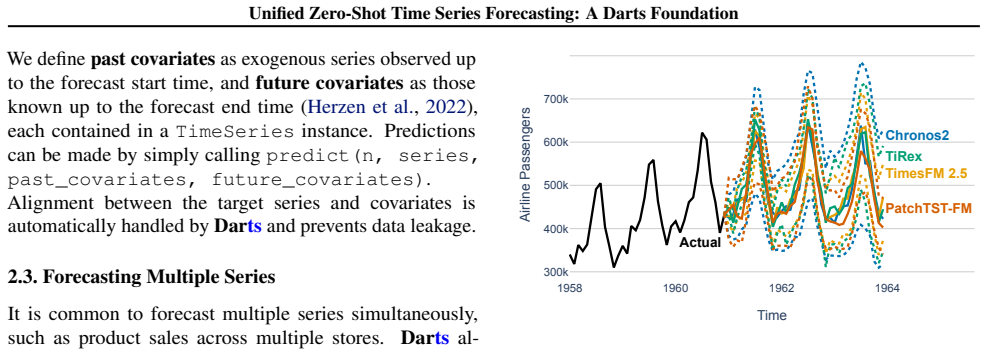
Since its initial release in 2020, Darts has become a widely used open-source Python library for time series analysis. A series of foundation models have recently claimed accuracy improvements in zero-shot forecasting, promising a paradigm shift from training custom models to harnessing pre-trained general-purpose forecasters. Foundation models, however, are often released as isolated packages with fragmented interfaces and limited interoperability with common tooling, making joint evaluation and integration within complete pipelines difficult. In Darts, we developed a unified $\texttt{FoundationModel}$ class collection (Chronos-2, TimesFM 2.5, TiRex, PatchTST-FM) that provides standardized, full-cycle forecasting interfaces with minimal external dependencies for integrating foundation models into the ecosystem. Existing Darts pipelines can now use foundation models with only a name change; new pipelines can use them for zero-shot or fine-tuned forecasting, uncertainty estimation, and backtesting, combined with data processing and evaluation tooling, all within a unified framework.
Editorial analysis
A structured set of objections, weighed in public.
Referee Report
Summary. The manuscript announces the development of a unified FoundationModel class collection inside the Darts library, wrapping Chronos-2, TimesFM 2.5, TiRex, and PatchTST-FM. The wrappers are claimed to supply standardized full-cycle interfaces supporting zero-shot and fine-tuned forecasting, uncertainty estimation, and backtesting, with minimal external dependencies, so that existing Darts pipelines can adopt them via a simple name change while new pipelines gain access to the full Darts data-processing and evaluation tooling.
Significance. If the claimed interfaces are correctly implemented, the work lowers the barrier to using recent foundation models inside a widely adopted time-series library, reducing interface fragmentation and enabling reproducible end-to-end pipelines that combine foundation-model forecasts with Darts’ existing preprocessing, backtesting, and evaluation utilities.
major comments (1)
- [Abstract] Abstract: the central claim that the wrappers deliver “standardized, full-cycle forecasting interfaces with minimal external dependencies” is stated without any description of the exposed API, the dependency list, the handling of model-specific tokenization or input shapes, or verification that existing Darts functionality remains unbroken. Because this claim is the sole contribution, the absence of even a minimal interface sketch or dependency table is load-bearing.
minor comments (1)
- The title emphasizes “Zero-Shot” while the abstract also highlights fine-tuning; a short clarifying sentence on the supported modes would improve precision.
Simulated Author's Rebuttal
We thank the referee for the constructive feedback and the recommendation of minor revision. We address the single major comment below and will revise the manuscript to strengthen the abstract.
read point-by-point responses
-
Referee: [Abstract] Abstract: the central claim that the wrappers deliver “standardized, full-cycle forecasting interfaces with minimal external dependencies” is stated without any description of the exposed API, the dependency list, the handling of model-specific tokenization or input shapes, or verification that existing Darts functionality remains unbroken. Because this claim is the sole contribution, the absence of even a minimal interface sketch or dependency table is load-bearing.
Authors: We agree that the abstract would benefit from additional detail to substantiate the central claim. In the revised manuscript we will expand the abstract to briefly describe the exposed API (standard Darts methods such as fit, predict, backtest, and predict with uncertainty), note the minimal external dependencies (the original model packages plus Darts core), clarify that model-specific tokenization and input-shape handling are encapsulated inside each wrapper, and state that compatibility with existing Darts pipelines has been verified through the library test suite. These additions will make the contribution more self-contained while preserving the abstract’s brevity. revision: yes
Circularity Check
No significant circularity
full rationale
The manuscript is a software-engineering description of wrapper classes that expose foundation-model interfaces inside the existing Darts library. No equations, fitted parameters, or predictive claims appear; the text simply states that a new FoundationModel collection supplies standardized methods for zero-shot use, fine-tuning, uncertainty, and backtesting. Because the work contains no derivation chain that could reduce to its own inputs, none of the enumerated circularity patterns apply.
Axiom & Free-Parameter Ledger
Reference graph
Works this paper leans on
-
[1]
Ekambaram, Vijay and Jati, Arindam and Dayama, Pankaj and Mukherjee, Sumanta and Nguyen, Nam H. and Gifford, Wesley M. and Reddy, Chandra and Kalagnanam, Jayant , booktitle =. Tiny Time Mixers (TTMs): Fast Pre-trained Models for Enhanced Zero/Few-Shot Forecasting of Multivariate Time Series , url =. doi:10.52202/079017-2359 , editor =
-
[2]
Proceedings of the 41st International Conference on Machine Learning , articleno =
Goswami, Mononito and Szafer, Konrad and Choudhry, Arjun and Cai, Yifu and Li, Shuo and Dubrawski, Artur , title =. Proceedings of the 41st International Conference on Machine Learning , articleno =. 2024 , publisher =
2024
-
[3]
2024 , url=
Taha Aksu and Gerald Woo and Juncheng Liu and Xu Liu and Chenghao Liu and Silvio Savarese and Caiming Xiong and Doyen Sahoo , booktitle=. 2024 , url=
2024
-
[4]
arXiv preprint arXiv:2603.04791 , year=
Timer-S1: A Billion-Scale Time Series Foundation Model with Serial Scaling , author=. arXiv preprint arXiv:2603.04791 , year=
-
[5]
Thirty-fifth Conference on Neural Information Processing Systems Datasets and Benchmarks Track (Round 2) , year=
Monash Time Series Forecasting Archive , author=. Thirty-fifth Conference on Neural Information Processing Systems Datasets and Benchmarks Track (Round 2) , year=
-
[6]
arXiv preprint arXiv:2510.15821 , year =
Chronos-2: From Univariate to Universal Forecasting , author =. arXiv preprint arXiv:2510.15821 , year =
-
[7]
Transactions on Machine Learning Research , issn=
Chronos: Learning the Language of Time Series , author=. Transactions on Machine Learning Research , issn=. 2024 , url=
2024
-
[8]
2023 , eprint=
TimeGPT-1 , author=. 2023 , eprint=
2023
-
[9]
Proceedings of the 41st International Conference on Machine Learning , articleno =
Woo, Gerald and Liu, Chenghao and Kumar, Akshat and Xiong, Caiming and Savarese, Silvio and Sahoo, Doyen , title =. Proceedings of the 41st International Conference on Machine Learning , articleno =. 2024 , publisher =
2024
-
[10]
Proceedings of the 41st International Conference on Machine Learning , articleno =
Das, Abhimanyu and Kong, Weihao and Sen, Rajat and Zhou, Yichen , title =. Proceedings of the 41st International Conference on Machine Learning , articleno =. 2024 , publisher =
2024
-
[11]
The Thirty-Ninth Annual Conference on Neural Information Processing Systems , year =
Andreas Auer and Patrick Podest and Daniel Klotz and Sebastian B. The Thirty-Ninth Annual Conference on Neural Information Processing Systems , year =
-
[12]
Shchur, Oleksandr and Ansari, Abdul Fatir and Turkmen, Caner and Stella, Lorenzo and Erickson, Nick and Guerron, Pablo and Bohlke-Schneider, Michael and Wang, Yuyang , year=. 2509.26468 , archivePrefix=
-
[13]
The Eleventh International Conference on Learning Representations , year=
TimesNet: Temporal 2D-Variation Modeling for General Time Series Analysis , author=. The Eleventh International Conference on Learning Representations , year=
-
[14]
Recent Advances in Time Series Foundation Models Have We Reached the 'BERT Moment'? , year=
FlowState: Sampling-Rate Invariant Time Series Foundation Model with Dynamic Forecasting Horizons , author=. Recent Advances in Time Series Foundation Models Have We Reached the 'BERT Moment'? , year=
-
[15]
2026 , eprint=
Revisiting the Generic Transformer: Deconstructing a Strong Baseline for Time Series Foundation Models , author=. 2026 , eprint=
2026
-
[16]
GitHub repository , howpublished =
ECDC Respiratory Diseases Forecasting Hub - Syndromic indicators , year =. GitHub repository , howpublished =
-
[17]
The TSFM Showdown: Who’s Winning the Forecasting Battle at Decathlon? , url=
Vianney Bruned , year=. The TSFM Showdown: Who’s Winning the Forecasting Battle at Decathlon? , url=. Medium , publisher=
-
[18]
Enhancing time series foundation models at Decathlon: from covariates to robust ensembling , url=
Baptiste Pokrzywa , year=. Enhancing time series foundation models at Decathlon: from covariates to robust ensembling , url=. Medium , publisher=
-
[19]
Jiayi Zhang and Farzam Farbiz and Mehdi Jafary-Zadeh and Swee Leong Sing , keywords =. From detection to forecasting: Utilizing time-series foundation models to anticipate defects in metal additive manufacturing , journal =. 2025 , issn =. doi:https://doi.org/10.1016/j.jmapro.2025.06.056 , url =
-
[20]
Journal of Machine Learning Research , year =
Julien Herzen and Francesco Lässig and Samuele Giuliano Piazzetta and Thomas Neuer and Léo Tafti and Guillaume Raille and Tomas Van Pottelbergh and Marek Pasieka and Andrzej Skrodzki and Nicolas Huguenin and Maxime Dumonal and Jan Kościsz and Dennis Bader and Frédérick Gusset and Mounir Benheddi and Camila Williamson and Michal Kosinski and Matej Petrik a...
-
[21]
Foresight: The International Journal of Applied Forecasting , volume=
Llms and foundational models: Not (yet) as good as hoped , author=. Foresight: The International Journal of Applied Forecasting , volume=. 2024 , publisher=
2024
-
[22]
Are Time Series Foundation Models Ready to Revolutionize Predictive Building Analytics? , year =
Mulayim, Ozan Baris and Quan, Pengrui and Han, Liying and Ouyang, Xiaomin and Hong, Dezhi and Berg\'. Are Time Series Foundation Models Ready to Revolutionize Predictive Building Analytics? , year =. Proceedings of the 11th ACM International Conference on Systems for Energy-Efficient Buildings, Cities, and Transportation , pages =. doi:10.1145/3671127.369...
-
[23]
2026 , eprint=
Reverso: Efficient Time Series Foundation Models for Zero-shot Forecasting , author=. 2026 , eprint=
2026
-
[24]
arXiv preprint arXiv:1909.07872 , year=
sktime: A unified interface for machine learning with time series , author=. arXiv preprint arXiv:1909.07872 , year=
arXiv 1909
-
[25]
2023 , url=
Shchur, Oleksandr and Turkmen, Caner and Erickson, Nick and Shen, Huibin and Shirkov, Alexander and Hu, Tony and Wang, Yuyang , booktitle=. 2023 , url=
2023
-
[26]
2026 , license =
Amat Rodrigo, Joaquin and Escobar Ortiz, Javier , title =. 2026 , license =
2026
-
[27]
aeon: a Python Toolkit for Learning from Time Series , journal =
Matthew Middlehurst and Ali Ismail-Fawaz and Antoine Guillaume and Christopher Holder and David Guijo-Rubio and Guzal Bulatova and Leonidas Tsaprounis and Lukasz Mentel and Martin Walter and Patrick Sch. aeon: a Python Toolkit for Learning from Time Series , journal =. 2024 , volume =
2024
-
[28]
Olivares and Cristian Challú and Federico Garza and Max Mergenthaler Canseco and Artur Dubrawski , title =
Kin G. Olivares and Cristian Challú and Federico Garza and Max Mergenthaler Canseco and Artur Dubrawski , title =. 2022 , howpublished=
2022
-
[29]
GitHub repository , howpublished =
Jan Beitner , title =. GitHub repository , howpublished =. 2020 , publisher =
2020
-
[30]
2025 , eprint=
TimeCopilot , author=. 2025 , eprint=
2025
-
[31]
Thomas Wolf and Lysandre Debut and Victor Sanh and Julien Chaumond and Clement Delangue and Anthony Moi and Pierric Cistac and Tim Rault and Rémi Louf and Morgan Funtowicz and Joe Davison and Sam Shleifer and Patrick von Platen and Clara Ma and Yacine Jernite and Julien Plu and Canwen Xu and Teven Le Scao and Sylvain Gugger and Mariama Drame and Quentin L...
2020
-
[32]
URL:https://github.com/Lightning-AI/ lightning, doi:10.5281/zenodo.3828935
Falcon, William and. doi:10.5281/zenodo.3828935 , license =
-
[33]
Harris, Charles R. and Millman, K. Jarrod and van der Walt, Stéfan J and Gommers, Ralf and Virtanen, Pauli and Cournapeau, David and Wieser, Eric and Taylor, Julian and Berg, Sebastian and Smith, Nathaniel J. and Kern, Robert and Picus, Matti and Hoyer, Stephan and van Kerkwijk, Marten H. and Brett, Matthew and Haldane, Allan and Fernández del Río, Jaime ...
-
[34]
2020 , url =. doi:10.5281/zenodo.3509134 , license =
-
[35]
GitHub repository , howpublished =
Safetensors , year =. GitHub repository , howpublished =
-
[36]
GitHub repository , howpublished =
Hugging Face Hub , year =. GitHub repository , howpublished =
-
[37]
Forecasting and control , author=
Time series analysis. Forecasting and control , author=. Holden-Day Series in Time Series Analysis , year=
-
[38]
2025 , eprint=
This Time is Different: An Observability Perspective on Time Series Foundation Models , author=. 2025 , eprint=
2025
-
[39]
Financial Fine-Tuning a Large Time Series Model , year=
Fu, Xinghong and Hirano, Masanori and Imajo, Kentaro , booktitle=. Financial Fine-Tuning a Large Time Series Model , year=. doi:10.1109/CiFer64978.2025.10975735 , url=
-
[40]
Python Documentation , howpublished =
fnmatch — Unix filename pattern matching , year =. Python Documentation , howpublished =
-
[41]
Edward J Hu and yelong shen and Phillip Wallis and Zeyuan Allen-Zhu and Yuanzhi Li and Shean Wang and Lu Wang and Weizhu Chen , booktitle=. Lo. 2022 , url=
2022
-
[42]
International Journal of Forecasting 37, 1748–1764
Bryan Lim and Sercan O. Arık and Nicolas Loeff and Tomas Pfister , keywords =. Temporal Fusion Transformers for interpretable multi-horizon time series forecasting , journal =. 2021 , issn =. doi:https://doi.org/10.1016/j.ijforecast.2021.03.012 , url =
-
[43]
Beyond Fit & Predict: Forecasting
Franz J Kir. Beyond Fit & Predict: Forecasting. 1st ICLR Workshop on Time Series in the Age of Large Models , year=
-
[44]
A Unified Approach to Interpreting Model Predictions , url =
Lundberg, Scott M and Lee, Su-In , booktitle =. A Unified Approach to Interpreting Model Predictions , url =
-
[45]
Proceedings of the 34th International Conference on Machine Learning , pages =
Learning Important Features Through Propagating Activation Differences , author =. Proceedings of the 34th International Conference on Machine Learning , pages =. 2017 , editor =
2017
-
[46]
Proceedings of the 34th International Conference on Machine Learning , pages =
Axiomatic Attribution for Deep Networks , author =. Proceedings of the 34th International Conference on Machine Learning , pages =. 2017 , editor =
2017
-
[47]
2021 , publisher=
Forecasting: principles and practice , author=. 2021 , publisher=
2021
discussion (0)
Sign in with ORCID, Apple, or X to comment. Anyone can read and Pith papers without signing in.