Collider Probes of Dark Energy Microphysics
Pith reviewed 2026-06-29 01:58 UTC · model grok-4.3
The pith
Collider measurements of mediator resonances can probe the sound speed of dark energy perturbations.
A machine-rendered reading of the paper's core claim, the machinery that carries it, and where it could break.
Core claim
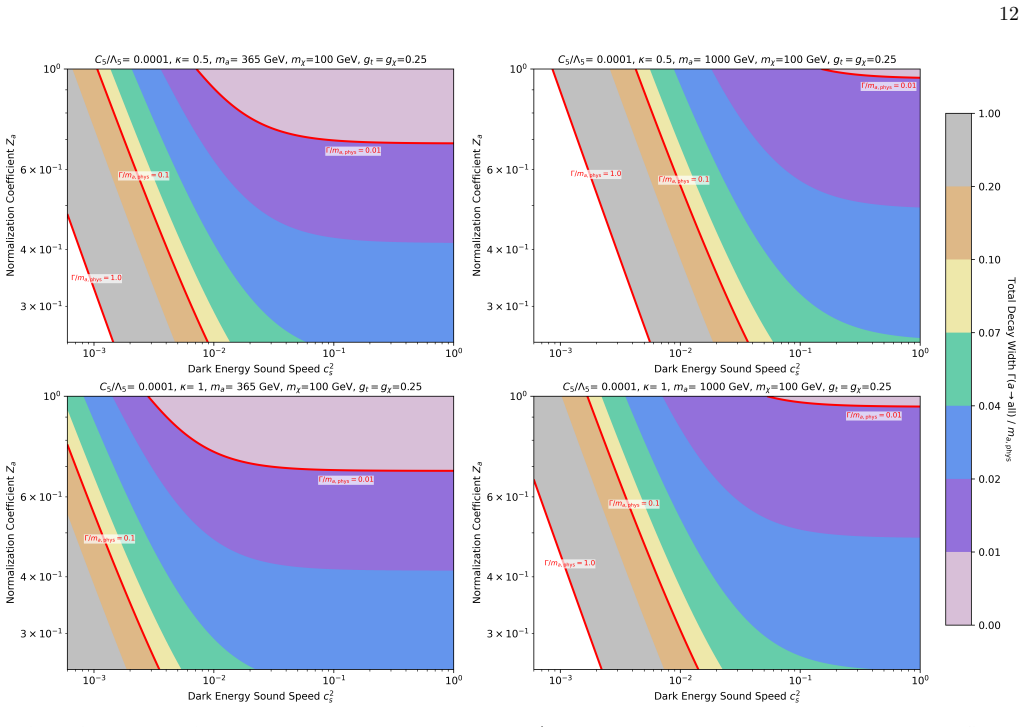
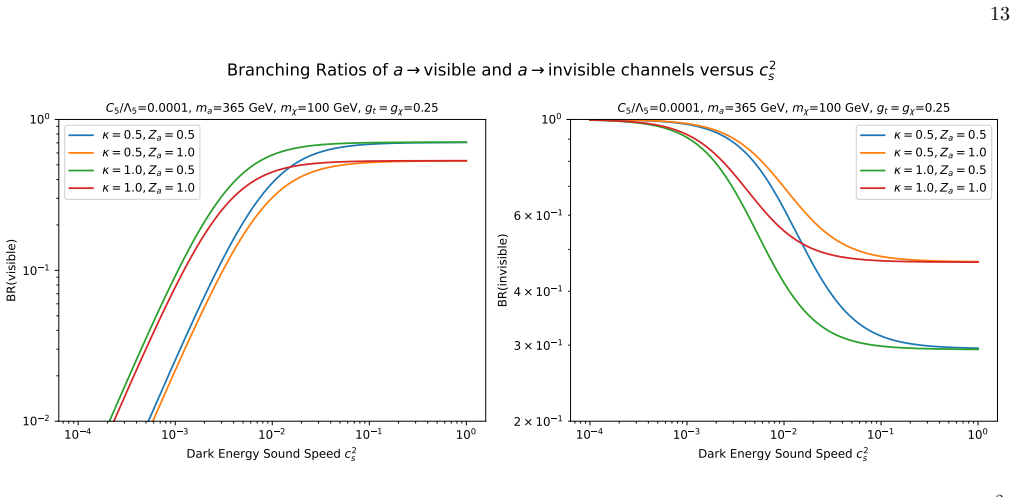
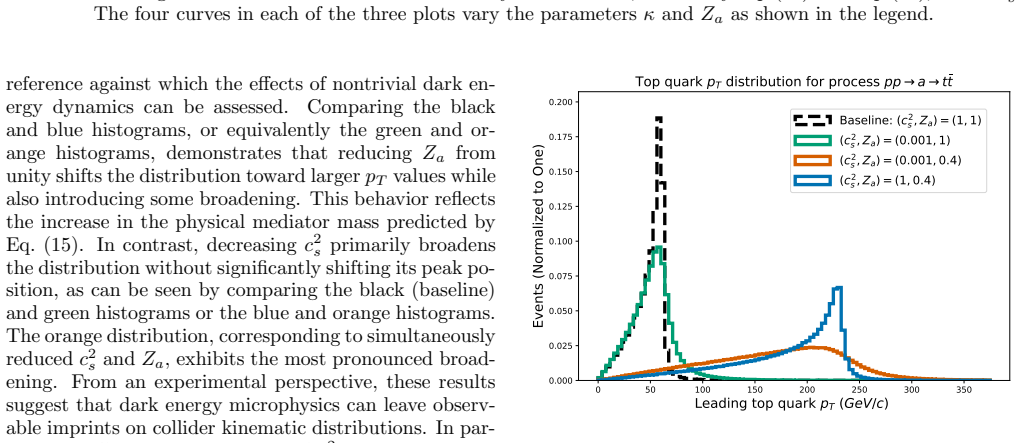
In the unified effective-field-theory framework, symmetry-motivated derivative interactions between a dynamical dark energy scalar and a pseudoscalar mediator in the 2HDM+a model induce invisible decays and modify the mediator's propagation in a dark energy background, rendering the mediator resonance's decay widths, branching ratios, and kinematic structure sensitive to the sound speed of dark energy fluctuations.
What carries the argument
The unified effective-field-theory framework coupling a dynamical dark energy scalar to a pseudoscalar mediator through derivative interactions, which alters resonance properties according to the sound speed of dark energy fluctuations.
If this is right
- Mediator decay widths become directly sensitive to the sound speed of dark energy perturbations.
- Branching ratios and kinematic distributions of the resonance encode information about dark energy propagation.
- Models sharing the same equation-of-state parameter but differing in sound speed can be experimentally distinguished.
- High-energy collider data acquire the capacity to test the microphysics underlying cosmic acceleration.
Where Pith is reading between the lines
- The same derivative-coupling mechanism could be applied to other scalar or pseudoscalar extensions beyond the 2HDM+a.
- Future high-luminosity LHC runs or proposed colliders might place competitive bounds on dark energy parameters.
- If the effect is observed, it would demonstrate that particle-physics experiments can access information about the largest-scale dynamics in the universe.
Load-bearing premise
The symmetry-motivated derivative interactions between the dynamical dark energy scalar and the pseudoscalar mediator will produce measurable distortions in resonance properties at colliders such as the LHC.
What would settle it
A precision measurement at the LHC showing that the mediator resonance's width, branching ratios, and kinematics remain independent of the assumed dark energy sound speed would falsify the claimed sensitivity.
Figures
read the original abstract
The physical origin of dark energy remains one of the most profound open questions in modern physics. Although cosmological observations tightly constrain the equation of state parameter $w$, this information alone does not reveal the underlying microphysics, as many distinct theoretical models can reproduce the same expansion history. A key discriminator among these models is the sound speed of dark energy perturbations, yet this quantity remains largely unconstrained by current astrophysical observations. In this work, we propose a fundamentally new approach: using collider measurements of beyond-the-Standard-Model (BSM) mediator resonances as a probe of dark energy microphysics. We construct a unified effective-field-theory framework in which a dynamical dark energy scalar is coupled, through symmetry-motivated derivative interactions, to a pseudoscalar mediator in the 2HDM+$a$ model. These interactions naturally induce invisible decays and modify the propagation of the BSM mediator in a dark energy background, leading to measurable distortions of resonance properties at colliders such as the LHC. We show that the decay widths, branching ratios, and kinematic structure of the mediator resonance become sensitive to the propagation properties of dark energy fluctuations, in particular the sound speed. As a result, collider observables provide a direct and complementary handle on dark energy microphysics, with the potential to distinguish between models that are otherwise indistinguishable through cosmology alone. Our results establish a new paradigm in which high-energy collider experiments can probe the physics of cosmic acceleration, revealing a connection between the smallest and largest scales in nature and opening a novel experimental pathway to uncover the fundamental origin of dark energy.
Editorial analysis
A structured set of objections, weighed in public.
Referee Report
Summary. The paper proposes constructing a unified EFT in which a dynamical dark energy scalar couples via symmetry-motivated derivative interactions to a pseudoscalar mediator within the 2HDM+a framework. These couplings are claimed to induce invisible decays and modify mediator propagation in a dark-energy background, rendering LHC resonance observables (decay widths, branching ratios, kinematic structure) sensitive to the dark-energy sound speed and thereby distinguishing models that are degenerate under cosmological equation-of-state constraints alone.
Significance. If the claimed sensitivity is realized, the work would establish a new experimental channel linking high-energy collider data to the microphysics of cosmic acceleration, complementary to astrophysical probes. The symmetry-based construction of the interactions is a conceptual strength, but the overall impact depends on whether the effects produce observable distortions at realistic collider luminosities and energies.
major comments (1)
- [Abstract] Abstract: the statement that the interactions 'lead to measurable distortions of resonance properties' and that 'we show that the decay widths, branching ratios, and kinematic structure ... become sensitive to ... the sound speed' is load-bearing for the central claim, yet the manuscript provides neither the explicit Lagrangian, the modified mediator propagator in the DE background, nor any numerical evaluation of the resulting width or branching-ratio shifts.
minor comments (1)
- The abstract would benefit from a brief statement of the expected size of the sound-speed-induced shifts relative to Standard Model or 2HDM+a backgrounds.
Simulated Author's Rebuttal
We thank the referee for their careful reading of our manuscript and for highlighting the need for explicit support of the abstract claims. We address the major comment below and will revise the manuscript to include the requested details.
read point-by-point responses
-
Referee: [Abstract] Abstract: the statement that the interactions 'lead to measurable distortions of resonance properties' and that 'we show that the decay widths, branching ratios, and kinematic structure ... become sensitive to ... the sound speed' is load-bearing for the central claim, yet the manuscript provides neither the explicit Lagrangian, the modified mediator propagator in the DE background, nor any numerical evaluation of the resulting width or branching-ratio shifts.
Authors: We agree that the abstract claims require direct substantiation. The revised manuscript will explicitly include: (i) the full Lagrangian with the symmetry-motivated derivative couplings between the dark energy scalar and the pseudoscalar mediator; (ii) the derivation of the modified mediator propagator arising from propagation through the dark energy background; and (iii) numerical evaluations of the resulting shifts in decay widths, branching ratios, and kinematic distributions, computed for representative LHC energies and luminosities. These additions will be placed in the model-construction and phenomenology sections, with a brief reference added to the abstract for clarity. revision: yes
Circularity Check
No significant circularity identified
full rationale
The manuscript advances a forward proposal to link an EFT with symmetry-motivated derivative couplings between a dynamical dark energy scalar and a pseudoscalar mediator (in the 2HDM+a framework) to collider resonance observables. The central claim requires only that such couplings exist and induce sensitivity to the DE sound speed; no quantitative threshold is asserted as a completed result, and no derivation reduces by construction to fitted parameters, self-citations, or renamed inputs. The abstract and described framework remain self-contained against external benchmarks with no load-bearing self-referential steps.
Axiom & Free-Parameter Ledger
Reference graph
Works this paper leans on
-
[1]
A. G. e. a. Riess, Observational evidence from super- novae for an accelerating universe and a cosmological constant, Astron. J.116, 1009 (1998)
1998
-
[2]
S. e. a. Perlmutter, Measurements of omega and lambda from 42 high-redshift supernovae, Astrophys. J.517, 565 (1999)
1999
-
[3]
D. H. Weinberg, M. J. Mortonson, D. J. Eisenstein, C. Hirata, A. G. Riess, and E. Rozo, Observational probes of cosmic acceleration, Phys. Rept.530, 87 (2013)
2013
-
[4]
E. J. Copeland, M. Sami, and S. Tsujikawa, Dynamics of dark energy, Int. J. Mod. Phys. D15, 1753 (2006)
2006
-
[5]
Amendola and S
L. Amendola and S. Tsujikawa,Dark Energy: Theory and Observations(Cambridge University Press, 2010)
2010
-
[6]
ATLAS Collaboration, Observation of a new particle in the search for the standard model higgs boson with the atlas detector at the lhc, Phys. Lett. B716, 1 (2012)
2012
-
[7]
CMS Collaboration, Observation of a new boson at a mass of 125 gev with the cms experiment at the lhc, Phys. Lett. B716, 30 (2012)
2012
-
[8]
S. M. Carroll, Quintessence and the rest of the world: Suppressing long-range interactions, Phys. Rev. Lett. 81, 3067 (1998)
1998
-
[9]
P. G. Ferreira and M. Joyce, Cosmology with a primor- dial scaling field, Phys. Rev. D58, 023503 (1998)
1998
-
[10]
Burrage and J
C. Burrage and J. Sakstein, Tests of chameleon gravity, Living Rev. Relativ.21, 1 (2018)
2018
-
[11]
P. Brax, C. van de Bruck, A.-C. Davis, J. Khoury, and A. Weltman, Detecting dark energy in orbit: The cos- mological chameleon, Phys. Rev. D70, 123518 (2004)
2004
-
[12]
A. G. Riesset al.(Supernova Search Team), Observa- tional evidence from supernovae for an accelerating uni- verse and a cosmological constant, Astron. J.116, 1009 (1998), arXiv:astro-ph/9805201
Pith/arXiv arXiv 1998
-
[13]
O. Avsajanishvili, G. Y. Chitov, T. Kahniashvili, S. Mandal, and L. Samushia, Observational Constraints on Dynamical Dark Energy Models, Universe2024, 10.3390/universe10030122 (2024), arXiv:2310.16911 [astro-ph.CO]
-
[14]
M. Li, X.-D. Li, S. Wang, and Y. Wang, Dark Energy: A Brief Review, Front. Phys. (Beijing)8, 828 (2013), arXiv:1209.0922 [astro-ph.CO]
Pith/arXiv arXiv 2013
-
[15]
M. Li, X.-D. Li, S. Wang, and Y. Wang, Dark Energy, Commun. Theor. Phys.56, 525 (2011), arXiv:1103.5870 [astro-ph.CO]
Pith/arXiv arXiv 2011
-
[16]
M. J. Mortonson, D. H. Weinberg, and M. White, Dark Energy: A Short Review (2013), arXiv:1401.0046 [astro- ph.CO]
Pith/arXiv arXiv 2013
-
[17]
D. Huterer and D. L. Shafer, Dark energy two decades after: Observables, probes, consistency tests, Rept. Prog. Phys.81, 016901 (2018), arXiv:1709.01091 [astro- ph.CO]
Pith/arXiv arXiv 2018
-
[18]
C. Cheung, P. Creminelli, A. L. Fitzpatrick, J. Kaplan, and L. Senatore, The Effective Field Theory of Inflation, JHEP03, 014, arXiv:0709.0293 [hep-th]
-
[19]
Gubitosi, F
G. Gubitosi, F. Piazza, and F. Vernizzi, The effective field theory of dark energy, Journal of Cosmology and Astroparticle Physics2013(02), 032
-
[20]
S. Vagnozzi, L. Visinelli, P. Brax, A.-C. Davis, and J. Sakstein, Direct detection of dark energy: The XENON1T excess and future prospects, Phys. Rev. D 104, 063023 (2021), arXiv:2103.15834 [hep-ph]
arXiv 2021
-
[21]
S. A. Adil, U. Mukhopadhyay, A. A. Sen, and S. Vagnozzi, Dark energy in light of the early JWST ob- servations: case for a negative cosmological constant?, JCAP10, 072, arXiv:2307.12763 [astro-ph.CO]
-
[22]
E. Di Valentino, S. Gariazzo, O. Mena, and S. Vagnozzi, Soundness of Dark Energy properties, JCAP07(07), 045, arXiv:2005.02062 [astro-ph.CO]
arXiv 2005
-
[23]
S. Nojiri and S. D. Odintsov, Unified cosmic history in modified gravity: from F(R) theory to Lorentz non-invariant models, Phys. Rept.505, 59 (2011), arXiv:1011.0544 [gr-qc]
Pith/arXiv arXiv 2011
-
[24]
S. Nojiri and S. D. Odintsov, Introduction to modified gravity and gravitational alternative for dark energy, eConfC0602061, 06 (2006), arXiv:hep-th/0601213
Pith/arXiv arXiv 2006
-
[25]
Gumjudpai, T
B. Gumjudpai, T. Naskar, M. Sami, and S. Tsujikawa, Coupled dark energy: towards a general description of the dynamics, Journal of Cosmology and Astroparticle Physics2005(06), 007
-
[26]
G´ omez-Valent, V
A. G´ omez-Valent, V. Pettorino, and L. Amendola, Up- date on coupled dark energy and the h 0 tension, Phys- ical Review D101, 123513 (2020)
2020
-
[27]
B. J. Barros, Kinetically coupled dark energy, Physical Review D99, 064051 (2019)
2019
-
[28]
Xia, Constraint on coupled dark energy mod- els from observations, Physical Review D—Particles, Fields, Gravitation, and Cosmology80, 103514 (2009)
J.-Q. Xia, Constraint on coupled dark energy mod- els from observations, Physical Review D—Particles, Fields, Gravitation, and Cosmology80, 103514 (2009)
2009
-
[29]
A. V. Macci` o, C. Quercellini, R. Mainini, L. Amendola, and S. A. Bonometto, Coupled dark energy: Parameter constraints from n-body simulations, Physical Review D69, 123516 (2004)
2004
-
[30]
Armendariz-Picon, V
C. Armendariz-Picon, V. Mukhanov, and P. J. Stein- hardt, Essentials of k-essence, Physical Review D63, 103510 (2001)
2001
-
[31]
Malquarti, E
M. Malquarti, E. J. Copeland, A. R. Liddle, and M. Trodden, A new view of k-essence, Physical Review D67, 123503 (2003)
2003
-
[32]
Armendariz-Picon and E
C. Armendariz-Picon and E. A. Lim, Haloes of k-essence, Journal of Cosmology and Astroparticle Physics2005(08), 007
-
[33]
C. Ahn, C. Kim, and E. V. Linder, Dark energy proper- ties in dbi theory, Physical Review D—Particles, Fields, Gravitation, and Cosmology80, 123016 (2009)
2009
-
[34]
L. P. Chimento, R. Lazkoz, and I. Sendra, Dbi mod- els for the unification of dark matter and dark energy, General Relativity and Gravitation42, 1189 (2010)
2010
-
[35]
Cai and S.-J
R.-G. Cai and S.-J. Wang, Dark matter superfluid and dbi dark energy, Physical Review D93, 023515 (2016)
2016
-
[36]
Chattopadhyay and U
S. Chattopadhyay and U. Debnath, Interaction between dbi-essence and other dark energies, International Jour- nal of Theoretical Physics49, 1465 (2010)
2010
-
[37]
Calcagni and A
G. Calcagni and A. R. Liddle, Tachyon dark energy models: Dynamics and constraints, Physical Review D—Particles, Fields, Gravitation, and Cosmology74, 043528 (2006)
2006
-
[38]
Bagla, H
J. Bagla, H. K. Jassal, and T. Padmanabhan, Cosmol- ogy with tachyon field as dark energy, Physical Review D67, 063504 (2003)
2003
-
[39]
E. J. Copeland, M. R. Garousi, M. Sami, and S. Tsu- jikawa, What is needed of a tachyon if it is to be the dark energy?, Physical Review D—Particles, Fields, Gravita- 16 tion, and Cosmology71, 043003 (2005)
2005
-
[40]
S. M. Micheletti, Observational constraints on holo- graphic tachyonic dark energy in interaction with dark matter, Journal of Cosmology and Astroparticle Physics 2010(05), 009
2010
-
[41]
Sheykhi, M
A. Sheykhi, M. Sadegh Movahed, and E. Ebrahimi, Tachyon reconstruction of ghost dark energy, Astro- physics and Space Science339, 93 (2012)
2012
-
[42]
J. Kehayias and R. J. Scherrer, New generic evolution fork-essence dark energy withw≈ −1, Phys. Rev. D 100, 023525 (2019), arXiv:1905.05628 [gr-qc]
Pith/arXiv arXiv 2019
-
[43]
T. Chiba, S. Dutta, and R. J. Scherrer, Slow- roll k-essence, Phys. Rev. D80, 043517 (2009), arXiv:0906.0628 [astro-ph.CO]
Pith/arXiv arXiv 2009
-
[44]
R. Das, T. W. Kephart, and R. J. Scherrer, Tracking quintessence and k-essence in a general cosmological background, Phys. Rev. D74, 103515 (2006), arXiv:gr- qc/0609014
arXiv 2006
-
[45]
N. Frusciante and L. Perenon, Effective field theory of dark energy: A review, Phys. Rept.857, 1 (2020), arXiv:1907.03150 [astro-ph.CO]
arXiv 2020
-
[46]
E. V. Linder, G. Seng¨ or, and S. Watson, Is the effective field theory of dark energy effective?, Journal of Cos- mology and Astroparticle Physics2016(05), 053
-
[47]
Bloomfield, ´E
J. Bloomfield, ´E. ´E. Flanagan, M. Park, and S. Watson, Dark energy or modified gravity? an effective field the- ory approach, Journal of Cosmology and Astroparticle Physics2013(08), 010
-
[48]
Liang, Y
J.-H. Liang, Y. Liao, X.-D. Ma, and H.-L. Wang, Dark sector effective field theory, Journal of High Energy Physics2023, 1 (2023)
2023
-
[49]
Frusciante, M
N. Frusciante, M. Raveri, and A. Silvestri, Effective field theory of dark energy: a dynamical analysis, Journal of Cosmology and Astroparticle Physics2014(02), 026
-
[50]
A. Gurrola, R. J. Scherrer, and O. Trivedi, Probing the Sound Speed of Dark Energy with a Lunar Laser Inter- ferometer (2026), arXiv:2601.22084 [astro-ph.CO]
arXiv 2026
-
[51]
A. Gurrola, R. J. Scherrer, and O. Trivedi, Probing Dark Energy on the Moon (2026), arXiv:2603.04841 [astro- ph.CO]
arXiv 2026
-
[52]
Aghanim, T
N. Aghanim, T. Ghosh, J. J. Bock, B. P. Crill, O. Dor´ e, S. R. Hildebrandt, G. Rocha, K. M. G´ orski, C. R. Lawrence, S. Mitra, G. Roudier, and P. Collaboration, Planck 2018 results. vi. cosmological parameters, As- tronomy and Astrophysics641, Art. No. A6 (2020)
2018
-
[53]
Hannestad, Constraints on the sound speed of dark energy, Phys
S. Hannestad, Constraints on the sound speed of dark energy, Phys. Rev. D71, 103519 (2005), arXiv:astro- ph/0504017
arXiv 2005
-
[54]
de Putter, D
R. de Putter, D. Huterer, and E. V. Linder, Measuring the speed of dark: Detecting dark energy perturbations, Physical Review D—Particles, Fields, Gravitation, and Cosmology81, 103513 (2010)
2010
-
[55]
Ballesteros and J
G. Ballesteros and J. Lesgourgues, Dark energy with non-adiabatic sound speed: initial conditions and de- tectability, Journal of Cosmology and Astroparticle Physics2010(10), 014
-
[56]
M. S. Linton, A. Pourtsidou, R. Crittenden, and R. Maartens, Variable sound speed in interacting dark energy models, Journal of Cosmology and Astroparticle Physics2018(04), 043
-
[57]
Bean and O
R. Bean and O. Dore, Probing dark energy perturba- tions: the dark energy equation of state and speed of sound as measured by wmap, Physical Review D69, 083503 (2004)
2004
-
[58]
D. J. Eisenstein, Dark energy and cosmic sound, New Astronomy Reviews49, 360 (2005)
2005
-
[59]
Sergijenko and B
O. Sergijenko and B. Novosyadlyj, Sound speed of scalar field dark energy: weak effects and large uncertainties, Physical Review D91, 083007 (2015)
2015
-
[60]
Y.-F. Shen, A. Gurrola, F. Romeo, D. Rathjens, and A. Fl´ orez, Heavy Neutrinos across the Electroweak- to-Multi-TeV Frontier via Novel ML-Enhanced Probes (2026), arXiv:2601.09095 [hep-ph]
arXiv 2026
-
[61]
Y.-F. Shen and A. Gurrola, Large-Width New Physics at Colliders: A Gauge-Invariant Resummation Ap- proach (2025), arXiv:2511.15114 [hep-ph]
arXiv 2025
-
[62]
U. S. Qureshi, A. Gurrola, and A. Fl´ orez, Probing compressed mass spectrum supersymmetry at the high- luminosity LHC with the vector boson fusion topology, Eur. Phys. J. C85, 1208 (2025), arXiv:2411.13837 [hep- ph]
arXiv 2025
-
[63]
U. S. Qureshi, A. Gurrola, A. Fl´ orez, and C. Ro- driguez, Probing light scalars and vector-like quarks at the high-luminosity LHC, Eur. Phys. J. C85, 379 (2025), arXiv:2410.17854 [hep-ph]
arXiv 2025
-
[64]
D. Barbosa, F. D´ ıaz, L. Quintero, A. Fl´ orez, M. Sanchez, A. Gurrola, E. Sheridan, and F. Romeo, Probing a Z ′ with non-universal fermion couplings through top quark fusion, decays to bottom quarks, and machine learning techniques, Eur. Phys. J. C83, 413 (2023), arXiv:2210.15813 [hep-ph]
arXiv 2023
-
[65]
A. Gurrola and J. D. Ruiz- ´Alvarez, Quarkophobic W’ for LHC searches, in20th Conference on Flavor Physics and CP Violation(2022) arXiv:2208.01861 [hep-ph]
arXiv 2022
- [66]
-
[67]
N. Cardona, F. Andr´ es, G. Alfredo, J. Will, S. Paul, and T. cheng, Long-term LHC discovery reach for com- pressed Supersymmetry models using VBF processes, JHEP11, 026, arXiv:2102.10194 [hep-ph]
-
[68]
A. Fl´ orez, A. Gurrola, W. Johns, P. Sheldon, E. Sheri- dan, K. Sinha, and B. Soubasis, Probing axionlike par- ticles withγγfinal states from vector boson fusion pro- cesses at the LHC, Phys. Rev. D103, 095001 (2021), arXiv:2101.11119 [hep-ph]
arXiv 2021
-
[69]
A. Fl´ orez, A. Gurrola, W. Johns, J. Maruri, P. Sheldon, K. Sinha, and S. R. Starko, Anapole Dark Matter via Vector Boson Fusion Processes at the LHC, Phys. Rev. D100, 016017 (2019), arXiv:1902.01488 [hep-ph]
arXiv 2019
-
[70]
A. Fl´ orez, Y. Guo, A. Gurrola, W. Johns, O. Ray, P. Sheldon, and S. Starko, Probing heavy spin-2 bosons withγγfinal states from vector boson fusion pro- cesses at the LHC, Phys. Rev. D99, 035034 (2019), arXiv:1812.06824 [hep-ph]
Pith/arXiv arXiv 2019
-
[71]
R. Leonardi, O. Panella, F. Romeo, A. Gurrola, H. Sun, and S.-S. Xue, Phenomenology at the LHC of compos- ite particles from strongly interacting Standard Model fermions via four-fermion operators of NJL type, Eur. Phys. J. C80, 309 (2020), arXiv:1810.11420 [hep-ph]
arXiv 2020
-
[72]
C. Avila, A. Fl´ orez, A. Gurrola, D. Julson, and S. Starko, Connecting particle physics and cosmology: Measuring the dark matter relic density in compressed supersymmetry models at the LHC, Phys. Dark Univ. 27, 100430 (2020), arXiv:1801.03966 [hep-ph]. 17
Pith/arXiv arXiv 2020
-
[73]
A. Fl´ orez, K. Gui, A. Gurrola, C. Pati˜ no, and D. Restrepo, Expanding the Reach of Heavy Neutrino Searches at the LHC, Phys. Lett. B778, 94 (2018), arXiv:1708.03007 [hep-ph]
Pith/arXiv arXiv 2018
-
[74]
A. Fl´ orez, A. Gurrola, W. Johns, Y. D. Oh, P. Shel- don, D. Teague, and T. Weiler, Searching for New Heavy Neutral Gauge Bosons using Vector Boson Fusion Pro- cesses at the LHC, Phys. Lett. B767, 126 (2017), arXiv:1609.09765 [hep-ph]
Pith/arXiv arXiv 2017
-
[75]
A. Fl´ orez, L. Bravo, A. Gurrola, C. ´Avila, M. Segura, P. Sheldon, and W. Johns, Probing the stau-neutralino coannihilation region at the LHC with a soft tau lepton and a jet from initial state radiation, Phys. Rev. D94, 073007 (2016), arXiv:1606.08878 [hep-ph]
Pith/arXiv arXiv 2016
-
[76]
B. Dutta, A. Gurrola, K. Hatakeyama, W. Johns, T. Kamon, P. Sheldon, K. Sinha, S. Wu, and Z. Wu, Probing Compressed Bottom Squarks with Boosted Jets and Shape Analysis, Phys. Rev. D92, 095009 (2015), arXiv:1507.01001 [hep-ph]
Pith/arXiv arXiv 2015
-
[77]
B. Dutta, T. Ghosh, A. Gurrola, W. Johns, T. Ka- mon, P. Sheldon, K. Sinha, K. Wang, and S. Wu, Prob- ing Compressed Sleptons at the LHC using Vector Bo- son Fusion Processes, Phys. Rev. D91, 055025 (2015), arXiv:1411.6043 [hep-ph]
Pith/arXiv arXiv 2015
-
[78]
B. Dutta, W. Flanagan, A. Gurrola, W. Johns, T. Ka- mon, P. Sheldon, K. Sinha, K. Wang, and S. Wu, Prob- ing compressed top squark scenarios at the LHC at 14 TeV, Phys. Rev. D90, 095022 (2014), arXiv:1312.1348 [hep-ph]
Pith/arXiv arXiv 2014
-
[79]
B. Dutta, A. Gurrola, W. Johns, T. Kamon, P. Shel- don, and K. Sinha, Vector Boson Fusion Processes as a Probe of Supersymmetric Electroweak Sectors at the LHC, Phys. Rev. D87, 035029 (2013), arXiv:1210.0964 [hep-ph]
Pith/arXiv arXiv 2013
-
[80]
B. Dutta, A. Gurrola, T. Kamon, A. Krislock, A. B. La- hanas, N. E. Mavromatos, and D. V. Nanopoulos, Su- persymmetry Signals of Supercritical String Cosmology at the Large Hadron Collider, Phys. Rev. D79, 055002 (2009), arXiv:0808.1372 [hep-ph]
Pith/arXiv arXiv 2009
discussion (0)
Sign in with ORCID, Apple, or X to comment. Anyone can read and Pith papers without signing in.