The one-point charge correlator in deep inelastic scattering
Pith reviewed 2026-06-29 01:55 UTC · model grok-4.3
The pith
A one-point charge correlator defined in the Breit frame for deep inelastic scattering is infrared and collinear safe and corresponds directly to transverse momentum dependent distributions in the back-to-back limit.
A machine-rendered reading of the paper's core claim, the machinery that carries it, and where it could break.
Core claim
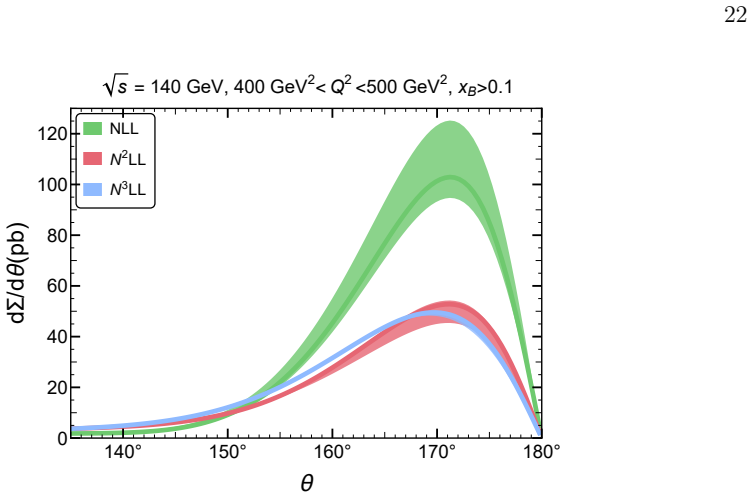
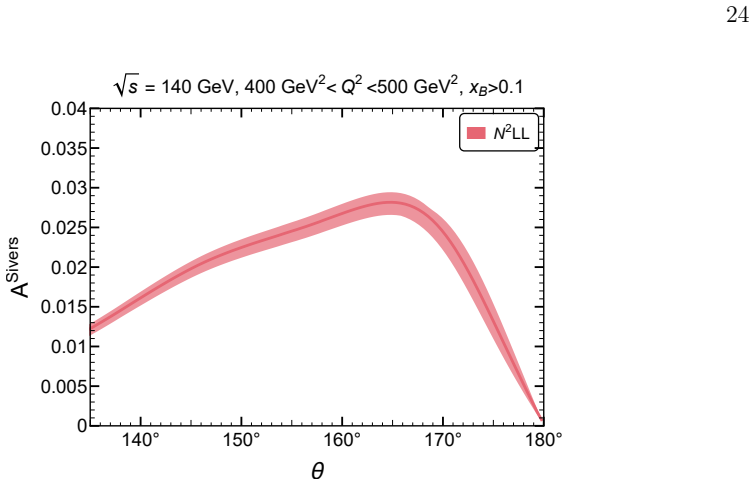
The one-point charge correlator is defined in the Breit frame for DIS and shown to be IRC safe. In the forward limit it introduces the nucleon charge correlator as a novel non-perturbative object encoding the multi-dimensional microscopic structure of the nucleon. In the back-to-back limit it establishes a direct correspondence with TMDs, with singular distributions derived in SCET and verified by full QCD to O(alpha_s^2); collinear logarithms are resummed to NLL while TMD logarithms are resummed to N3LL for the unpolarized case and N2LL for the Sivers asymmetry.
What carries the argument
The one-point charge correlator (QC) in the Breit frame, which maps to TMD factorization in the back-to-back limit and to a new nucleon charge correlator in the forward limit.
If this is right
- The QC is perturbatively calculable because it is IRC safe.
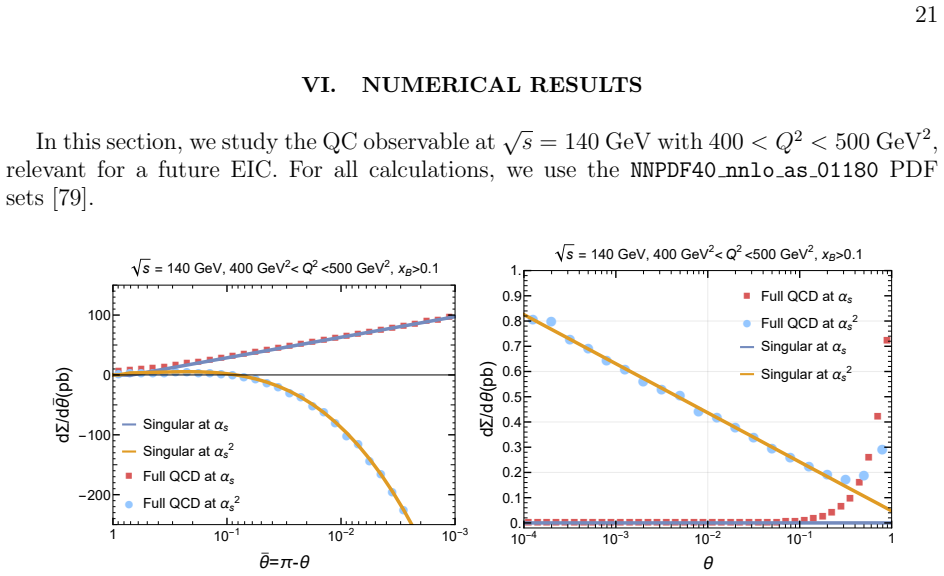
- Singular distributions obtained in SCET match full QCD through O(alpha_s^2).
- Collinear logarithms can be resummed to NLL accuracy.
- TMD logarithms can be resummed to N3LL (unpolarized) or N2LL (Sivers).
- The forward limit supplies a new non-perturbative object for nucleon structure studies.
Where Pith is reading between the lines
- Measurements of the QC at future DIS facilities could furnish an independent experimental handle on TMDs.
- The construction may be extended to other hard processes where similar one-point observables can be defined.
- If power corrections remain small, the QC offers a concrete route to test factorization theorems that link inclusive and differential observables.
Load-bearing premise
SCET factorization in the forward and back-to-back limits captures all relevant physics without power-suppressed corrections that would invalidate the claimed direct correspondence to TMDs or the nucleon charge correlator.
What would settle it
A full QCD calculation of the one-point charge correlator at order alpha_s^3 that produces singular terms differing from the SCET result beyond the stated accuracy.
Figures
read the original abstract
In this work, we propose a novel definition of the one-point charge correlator (QC) adapted to the Breit frame in deep-inelastic scattering (DIS). We demonstrate that this observable is infrared and collinear (IRC) safe, ensuring its perturbative calculability. Utilizing soft-collinear effective theory (SCET), we systematically analyze the QC in both the forward and back-to-back limits. In the forward limit, we introduce the nucleon charge correlator as a novel non-perturbative object that encodes the multi-dimensional microscopic structure of the nucleon. In the back-to-back limit, the QC establishes a direct correspondence with transverse momentum-dependent distributions (TMDs), enabling its description within the standard TMD factorization formalism. The singular distributions are derived within SCET and are verified by the full QCD calculations up to $\mathcal{O}(\alpha_s^2)$. The corresponding collinear logarithms are resummed to all orders with the accuracy of NLL (${\cal{O}}(\alpha_s^n L^{n-1})$), while the transverse momentum-dependent logarithms are resummed to all orders with the accuracy of $N^3$LL for the unpolarized distribution and N$^2$LL for the Sivers asymmetry.
Editorial analysis
A structured set of objections, weighed in public.
Referee Report
Summary. The manuscript proposes a novel one-point charge correlator (QC) adapted to the Breit frame in deep-inelastic scattering. It demonstrates that the QC is infrared and collinear safe and thus perturbatively calculable. SCET is used to analyze the QC in the forward limit, where a new non-perturbative nucleon charge correlator is introduced, and in the back-to-back limit, where the QC corresponds directly to TMDs and can be described by standard TMD factorization. Singular distributions are derived in SCET and verified by full QCD calculations to O(α_s²). Collinear logarithms are resummed to NLL accuracy while TMD logarithms are resummed to N³LL (unpolarized) and N²LL (Sivers).
Significance. If the central claims hold, the work introduces an IRC-safe observable that links DIS to TMD physics and defines a new non-perturbative object (nucleon charge correlator) for nucleon structure. The O(α_s²) verification against full QCD and the stated resummation accuracies constitute concrete calculational advances that could support phenomenological studies. The SCET treatment of the two kinematic limits is a clear organizational strength.
major comments (1)
- [Abstract] Abstract (back-to-back limit paragraph): the claim of a 'direct correspondence' to standard TMD factorization is load-bearing for the central result, yet the manuscript provides no explicit power-counting argument or bound showing that O(Λ/Q) or O(k_T/Q) corrections remain negligible in the claimed regime; the O(α_s²) fixed-order verification alone does not establish that higher-power terms can be neglected for the all-order resummations.
minor comments (1)
- The abstract introduces the QC and its limits without a brief statement of the precise operator definition or the kinematic variables used in the Breit frame; adding one sentence would improve accessibility before the SCET analysis begins.
Simulated Author's Rebuttal
We thank the referee for their careful reading of the manuscript and for identifying an important point regarding the presentation of the back-to-back limit. We address the comment below and will incorporate revisions to strengthen the discussion of power counting.
read point-by-point responses
-
Referee: [Abstract] Abstract (back-to-back limit paragraph): the claim of a 'direct correspondence' to standard TMD factorization is load-bearing for the central result, yet the manuscript provides no explicit power-counting argument or bound showing that O(Λ/Q) or O(k_T/Q) corrections remain negligible in the claimed regime; the O(α_s²) fixed-order verification alone does not establish that higher-power terms can be neglected for the all-order resummations.
Authors: The SCET derivation in the manuscript establishes the factorization at leading power in the expansion parameter λ ∼ k_T/Q ∼ Λ/Q, with the QC matching onto standard TMD factorization in this limit; higher-power corrections are parametrically suppressed by O(λ). The O(α_s²) verification confirms the leading singular structure obtained from SCET. We agree, however, that an explicit statement of this power counting and the associated regime of validity is not sufficiently highlighted in the abstract. We will revise the abstract to qualify the correspondence as holding at leading power and add a short clarifying paragraph in the main text (near the discussion of the back-to-back limit) that recalls the SCET power counting and the suppression of O(Λ/Q) and O(k_T/Q) terms. revision: yes
Circularity Check
No significant circularity; derivation introduces new observable with external verification
full rationale
The paper defines a novel one-point charge correlator adapted to the Breit frame, demonstrates its IRC safety, and analyzes its behavior in forward and back-to-back limits via SCET. The back-to-back correspondence to TMDs is presented as a derived property within standard TMD factorization, with singular distributions explicitly calculated in SCET and cross-verified against full QCD to O(α_s²). Resummations follow established accuracy orders. No self-definitional reductions, fitted inputs renamed as predictions, or load-bearing self-citations appear in the provided text; the central claims rest on independent perturbative calculations and matching rather than circular equivalence to inputs.
Axiom & Free-Parameter Ledger
axioms (1)
- domain assumption SCET factorization applies in both forward and back-to-back limits of the defined correlator
Reference graph
Works this paper leans on
-
[1]
We have used the superscript OPE to denote that this is the leading contribution in the expansion
and collinear PDFs: JOPE f,Q (b, µ, ν) = X j Z 1 0 dω QjDf j ω, b ω , µ, ν ,(72) BOPE f /p (x, b, µ, ν) = X i Z 1 x dz z If i b, x z , µ, ν fi/p(z, µ).(73) 17 Df j andI f i are perturbatively calculable Wilson coefficients andf i/p denotes the usual collinear PDFs. We have used the superscript OPE to denote that this is the leading contribution in the exp...
-
[2]
R. Abdul Khalek et al., Nucl. Phys. A1026, 122447 (2022), 2103.05419
Pith/arXiv arXiv 2022
-
[3]
C. L. Basham, L. S. Brown, S. D. Ellis, and S. T. Love, Phys. Rev. D19, 2018 (1979)
2018
-
[4]
C. L. Basham, L. S. Brown, S. D. Ellis, and S. T. Love, Phys. Rev. Lett.41, 1585 (1978)
1978
-
[5]
C. L. Basham, L. S. Brown, S. D. Ellis, and S. T. Love, Phys. Rev. D17, 2298 (1978)
1978
-
[6]
F. R. Ore, Jr. and G. F. Sterman, Nucl. Phys. B165, 93 (1980)
1980
-
[7]
N. A. Sveshnikov and F. V. Tkachov, Phys. Lett. B382, 403 (1996), hep-ph/9512370
Pith/arXiv arXiv 1996
-
[8]
G. P. Korchemsky, G. Oderda, and G. F. Sterman, AIP Conf. Proc.407, 988 (1997), hep- ph/9708346
arXiv 1997
-
[9]
G. P. Korchemsky and G. F. Sterman, Nucl. Phys. B555, 335 (1999), hep-ph/9902341
Pith/arXiv arXiv 1999
-
[10]
A. V. Belitsky, G. P. Korchemsky, and G. F. Sterman, Phys. Lett. B515, 297 (2001), hep- ph/0106308
arXiv 2001
-
[11]
C. Lee and G. F. Sterman, Phys. Rev. D75, 014022 (2007), hep-ph/0611061
Pith/arXiv arXiv 2007
-
[12]
D. M. Hofman and J. Maldacena, JHEP05, 012 (2008), 0803.1467
Pith/arXiv arXiv 2008
- [13]
-
[14]
M.-S. Gao, Z.-B. Kang, W. Li, and D. Y. Shao, Phys. Rev. Lett.136, 151902 (2026), 2509.15809
Pith/arXiv arXiv 2026
-
[15]
Y.-K. Song, S.-Y. Wei, L. Yang, and J. Zhou, Phys. Rev. Lett.136, 131901 (2026), 2509.14960
arXiv 2026
-
[16]
Z.-B. Kang, A. Metz, D. Pitonyak, and C. Zhang, (2026), 2604.28131
Pith/arXiv arXiv 2026
- [17]
-
[18]
Z.-B. Kang, K. Lee, D. Y. Shao, and F. Zhao, JHEP03, 153 (2024), 2310.15159
arXiv 2024
-
[19]
Z.-B. Kang, J. Penttala, and C. Zhang, (2024), 2410.21435
arXiv 2024
-
[20]
S. Bhattacharya, Z.-B. Kang, D. Padilla, and J. Penttala, (2025), 2504.10475
arXiv 2025
-
[21]
J. Gao, H. T. Li, and Y. J. Zhu, Phys. Rev. D113, 034028 (2026), 2509.17596. 28
Pith/arXiv arXiv 2026
- [22]
- [23]
-
[24]
H. Cao, X. Liu, and H. X. Zhu, Phys. Rev. D107, 114008 (2023), 2303.01530
arXiv 2023
- [25]
- [26]
-
[27]
Y. J. Zhu, Phys. Rev. D113, 014025 (2026), 2509.01652
arXiv 2026
-
[28]
H.-Y. Liu, X. Liu, J.-C. Pan, F. Yuan, and H. X. Zhu, Phys. Rev. Lett.130, 181901 (2023), 2301.01788
arXiv 2023
-
[29]
D. Chicherin, J. M. Henn, E. Sokatchev, and K. Yan, JHEP02, 053 (2021), 2001.10806
arXiv 2021
- [30]
-
[31]
C. W. Bauer, S. Fleming, and M. E. Luke, Phys.Rev.D63, 014006 (2000), hep-ph/0005275
Pith/arXiv arXiv 2000
-
[32]
C. W. Bauer, S. Fleming, D. Pirjol, and I. W. Stewart, Phys.Rev.D63, 114020 (2001), hep-ph/0011336
Pith/arXiv arXiv 2001
-
[33]
C. W. Bauer and I. W. Stewart, Phys.Lett.B516, 134 (2001), hep-ph/0107001
Pith/arXiv arXiv 2001
-
[34]
C. W. Bauer, D. Pirjol, and I. W. Stewart, Phys.Rev.D65, 054022 (2002), hep-ph/0109045
Pith/arXiv arXiv 2002
-
[35]
C. W. Bauer, S. Fleming, D. Pirjol, I. Z. Rothstein, and I. W. Stewart, Phys.Rev.D66, 014017 (2002), hep-ph/0202088
Pith/arXiv arXiv 2002
- [36]
-
[37]
T. Sj¨ ostrandet al., Comput. Phys. Commun.191, 159 (2015), 1410.3012
Pith/arXiv arXiv 2015
-
[38]
C. Bierlich et al., SciPost Phys. Codeb.2022, 8 (2022), 2203.11601
Pith/arXiv arXiv 2022
-
[39]
S. Catani and M. Grazzini, Phys. Lett. B446, 143 (1999), hep-ph/9810389
Pith/arXiv arXiv 1999
-
[40]
G. P. Salam and J. Rojo, Comput. Phys. Commun.180, 120 (2009), 0804.3755
Pith/arXiv arXiv 2009
-
[41]
V. Bertone, S. Carrazza, and J. Rojo, Comput. Phys. Commun.185, 1647 (2014), 1310.1394
Pith/arXiv arXiv 2014
-
[42]
Bertone, PoSDIS2017, 201 (2018), 1708.00911
V. Bertone, PoSDIS2017, 201 (2018), 1708.00911
Pith/arXiv arXiv 2018
-
[43]
D. W. Sivers, Phys. Rev. D41, 83 (1990)
1990
-
[44]
J. C. Collins, Phys. Lett. B536, 43 (2002), hep-ph/0204004
Pith/arXiv arXiv 2002
-
[45]
X.-d. Ji, J.-p. Ma, and F. Yuan, Phys. Rev. D71, 034005 (2005), hep-ph/0404183
Pith/arXiv arXiv 2005
-
[46]
P. F. Monni, G. Vita, Z. Xu, and H. X. Zhu, (2025), 2508.00977
arXiv 2025
-
[47]
Idilbi, X
A. Idilbi, X. Ji, and F. Yuan, Nuclear Physics B753, 42 (2006)
2006
-
[48]
T. Becher, M. Neubert, and B. D. Pecjak, JHEP01, 076 (2007), hep-ph/0607228
Pith/arXiv arXiv 2007
- [49]
-
[50]
T. Gehrmann, T. Lubbert, and L. L. Yang, Phys. Rev. Lett.109, 242003 (2012), 1209.0682
Pith/arXiv arXiv 2012
-
[51]
Gehrmann, T
T. Gehrmann, T. L¨ ubbert, and L. L. Yang, Journal of High Energy Physics2014(2014)
2014
-
[52]
L¨ ubbert, J
T. L¨ ubbert, J. Oredsson, and M. Stahlhofen, Journal of High Energy Physics2016(2016)
2016
-
[53]
M. G. Echevarria, I. Scimemi, and A. Vladimirov, Journal of High Energy Physics2016 (2016)
2016
- [54]
-
[55]
Luo et al., JHEP10, 083 (2019), 1908.03831
M.-X. Luo et al., JHEP10, 083 (2019), 1908.03831
arXiv 2019
- [56]
- [57]
-
[58]
xing Luo, T.-Z
M. xing Luo, T.-Z. Yang, H. X. Zhu, and Y. J. Zhu, Journal of High Energy Physics2021 (2021)
2021
-
[59]
J. M. Henn, G. P. Korchemsky, and B. Mistlberger, JHEP04, 018 (2020), 1911.10174
arXiv 2020
- [60]
-
[61]
J. C. Collins, D. E. Soper, and G. F. Sterman, Nucl. Phys. B250, 199 (1985)
1985
-
[62]
Z.-B. Kang and A. Prokudin, Phys. Rev. D85, 074008 (2012), 1201.5427
Pith/arXiv arXiv 2012
-
[63]
Bacchetta et al., JHEP02, 093 (2007), hep-ph/0611265
A. Bacchetta et al., JHEP02, 093 (2007), hep-ph/0611265
Pith/arXiv arXiv 2007
-
[64]
M. Anselmino et al., Eur. Phys. J. A39, 89 (2009), 0805.2677
Pith/arXiv arXiv 2009
-
[65]
M. G. Echevarria, Z.-B. Kang, and J. Terry, JHEP01, 126 (2021), 2009.10710
arXiv 2021
- [66]
-
[67]
X. Ji, J.-w. Qiu, W. Vogelsang, and F. Yuan, Phys. Rev. D73, 094017 (2006), hep-ph/0604023
Pith/arXiv arXiv 2006
-
[68]
Y. Koike, W. Vogelsang, and F. Yuan, Phys. Lett. B659, 878 (2008), 0711.0636
Pith/arXiv arXiv 2008
-
[69]
Z.-B. Kang, B.-W. Xiao, and F. Yuan, Phys. Rev. Lett.107, 152002 (2011), 1106.0266
Pith/arXiv arXiv 2011
- [70]
-
[71]
L.-Y. Dai, Z.-B. Kang, A. Prokudin, and I. Vitev, Phys. Rev. D92, 114024 (2015), 1409.5851
Pith/arXiv arXiv 2015
-
[72]
I. Scimemi, A. Tarasov, and A. Vladimirov, JHEP05, 125 (2019), 1901.04519
Pith/arXiv arXiv 2019
-
[73]
M. G. Echevarria, A. Idilbi, Z.-B. Kang, and I. Vitev, Phys. Rev. D89, 074013 (2014), 1401.5078
Pith/arXiv arXiv 2014
-
[74]
Z.-B. Kang and J.-W. Qiu, Phys. Lett. B713, 273 (2012), 1205.1019
Pith/arXiv arXiv 2012
-
[75]
H. T. Li, Y. Makris, and I. Vitev, Phys. Rev. D103, 094005 (2021), 2102.05669
arXiv 2021
-
[76]
P. Sun, J. Isaacson, C. P. Yuan, and F. Yuan, Int. J. Mod. Phys. A33, 1841006 (2018), 1406.3073
Pith/arXiv arXiv 2018
-
[77]
A. Bacchetta, F. Delcarro, C. Pisano, M. Radici, and A. Signori, JHEP06, 081 (2017), 1703.10157, [Erratum: JHEP 06, 051 (2019)]
Pith/arXiv arXiv 2017
- [78]
-
[79]
J. Gao, C. Liu, X. Shen, H. Xing, and Y. Zhao, Phys. Rev. D110, 114019 (2024), 2407.04422
arXiv 2024
-
[80]
NNPDF, R. D. Ball et al., Eur. Phys. J. C82, 428 (2022), 2109.02653
arXiv 2022
discussion (0)
Sign in with ORCID, Apple, or X to comment. Anyone can read and Pith papers without signing in.