Benchmarking Multi-Modal Graph-based Social Media Popularity Prediction
Pith reviewed 2026-06-29 00:43 UTC · model grok-4.3
The pith
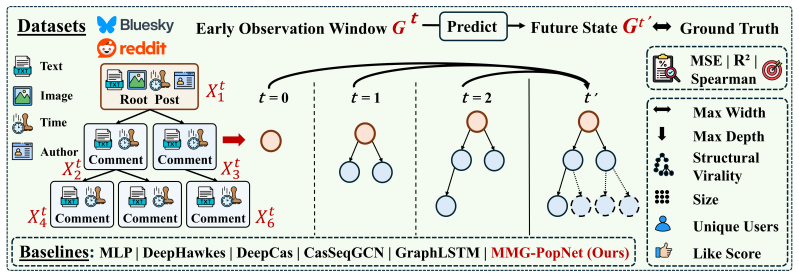
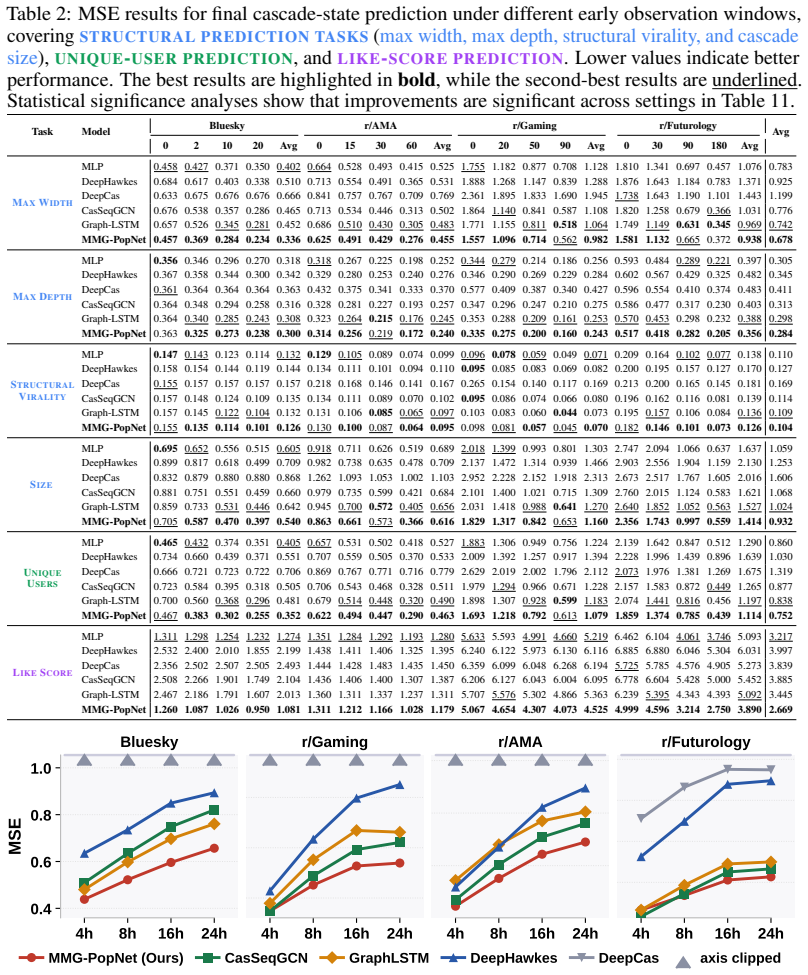
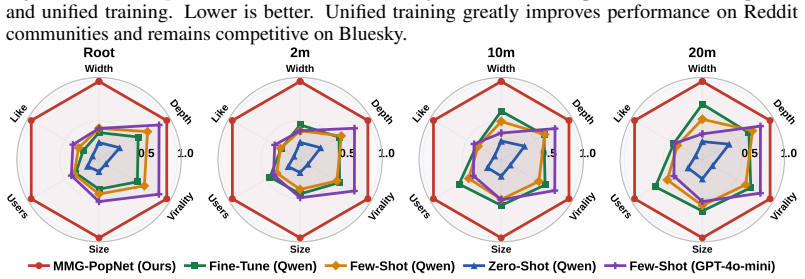
MMG-PopNet jointly models multi-modal signals and graph-structured social interactions to outperform baselines on four social media datasets.
A machine-rendered reading of the paper's core claim, the machinery that carries it, and where it could break.
Core claim
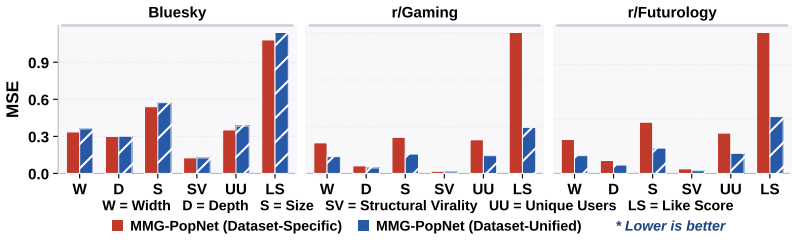
MMG-PopNet jointly models multi-modal signals and graph-structured social interactions, demonstrating superior performance on four datasets and yielding new insights into cross-platform training generalization, multi-task prediction benefits, multi-modality contributions, and LLM prediction limitation.
What carries the argument
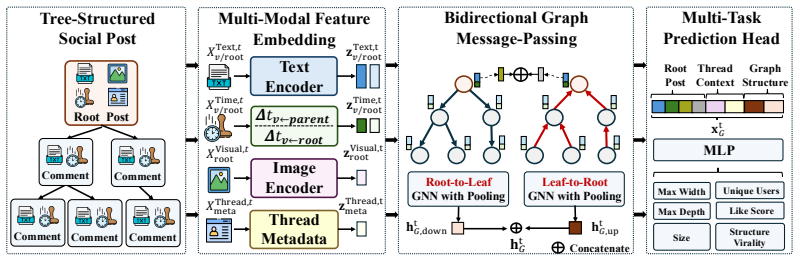
MMG-PopNet, a unified multi-modal graph-based network that jointly models multi-modal signals and graph-structured social interactions.
If this is right
- MMG-PopNet achieves higher prediction accuracy than representative baselines on the four unified datasets.
- Training across platforms improves generalization to new data.
- Multi-task setups provide measurable prediction benefits over single-task training.
- Different modalities contribute unequally to final accuracy.
- Large language models alone show clear limitations compared with the graph-based approach.
Where Pith is reading between the lines
- The standardized protocol could be applied to additional platforms to test whether the performance edge persists.
- The graph modeling of interactions suggests that social network structure may be more predictive than content alone in many cases.
- The benchmark setup enables direct testing of whether adding new modalities or signals further improves results.
- Insights on cross-platform transfer could guide deployment of one model across multiple sites without full retraining.
Load-bearing premise
The selected datasets, observation windows, prediction targets, and baselines under the standardized protocol are sufficiently representative to support general claims about multi-modal and graph-based popularity prediction across platforms.
What would settle it
Evaluating MMG-PopNet and the baselines on a held-out dataset from an unseen platform under the same protocol and finding no accuracy gain or reversed insights on generalization and modality contributions.
Figures
read the original abstract
Social media popularity prediction aims to forecast the future reach or influence of online content from early-stage observations. Accurate prediction enables key downstream applications, such as advertising optimization and strategic content planning by users, creators, and platforms. Despite substantial progress, existing popularity prediction works often fail to jointly consider multimodal content and temporal social interaction signals. Moreover, the literature remains highly fragmented across datasets, modalities, observation windows, prediction targets, and evaluation protocols. This fragmentation prevents fair comparison and obscures a systematic understanding of how textual, visual, temporal, and interaction-based signals jointly shape popularity dynamics. To address these challenges, we introduce MMG-Pop, a Multi-modal Graph-based Popularity Prediction benchmark, which unifies datasets, modalities, temporal interaction signals, and representative baselines under a standardized evaluation protocol. Furthermore, we propose MMG-PopNet, a unified multi-modal graph-based network that jointly models the aforementioned multi-modal signals and graph-structured social interactions. Extensive experiments on MMG-Pop, comprising four datasets across Bluesky and Reddit platforms, demonstrate the superior performance of MMG-PopNet and yield new insights into cross-platform training generalization, multi-task prediction benefits, multi-modality contributions, and LLM prediction limitation. These findings establish a unified foundation for future research on social dynamics modeling and intervention under heterogeneous modalities and socially-aware agentic ecosystem paradigms.
Editorial analysis
A structured set of objections, weighed in public.
Referee Report
Summary. The paper introduces MMG-Pop, a benchmark that unifies four datasets from Bluesky and Reddit under a standardized protocol for multi-modal graph-based social media popularity prediction, and proposes MMG-PopNet, a model jointly modeling multi-modal content signals and graph-structured social interactions. Experiments on the benchmark claim that MMG-PopNet achieves superior performance and yields insights into cross-platform generalization, multi-task prediction benefits, multi-modality contributions, and LLM limitations.
Significance. If the experimental claims hold under rigorous verification, the standardized benchmark addresses fragmentation in the popularity prediction literature and could enable more systematic comparisons across modalities and interaction graphs. The joint modeling approach in MMG-PopNet represents a concrete step toward integrating heterogeneous signals, and the cross-platform experiments provide a starting point for studying generalization, though the limited platform coverage constrains broader applicability.
major comments (2)
- [§5] §5 (Experiments and Results): The claims of 'superior performance' and 'new insights' rest on comparisons that omit error bars, standard deviations across runs, statistical significance tests (e.g., paired t-tests or Wilcoxon), and explicit details on baseline re-implementations, hyperparameter tuning, and data exclusion rules. Without these, it is impossible to assess whether reported gains are robust or attributable to implementation differences.
- [§4] §4 (Datasets and Protocol): The central claims about cross-platform training generalization and multi-modality contributions are derived from only two platforms (Bluesky, Reddit) and four datasets under a single observation-window/prediction-target protocol. No quantitative coverage argument, diversity metrics across platforms, or sensitivity analysis to alternative windows/targets is provided, which directly limits the transferability of the reported insights.
minor comments (2)
- [§3] Notation for modalities and graph construction should be defined more explicitly in §3 to avoid ambiguity when comparing to prior single-modality baselines.
- [Figures/Tables in §5] Figure captions for performance tables could include the exact number of runs and random seeds used, improving reproducibility.
Simulated Author's Rebuttal
We thank the referee for the constructive feedback on experimental rigor and benchmark scope. We address each major comment below and will update the manuscript to strengthen the presentation of results and clarify limitations.
read point-by-point responses
-
Referee: [§5] §5 (Experiments and Results): The claims of 'superior performance' and 'new insights' rest on comparisons that omit error bars, standard deviations across runs, statistical significance tests (e.g., paired t-tests or Wilcoxon), and explicit details on baseline re-implementations, hyperparameter tuning, and data exclusion rules. Without these, it is impossible to assess whether reported gains are robust or attributable to implementation differences.
Authors: We agree that these statistical details are necessary to substantiate the performance claims. In the revised version we will report mean performance and standard deviations over multiple random seeds, include paired t-tests (and Wilcoxon where appropriate) for significance, and add explicit sections detailing baseline re-implementations, hyperparameter search ranges and selection criteria, and data exclusion rules. revision: yes
-
Referee: [§4] §4 (Datasets and Protocol): The central claims about cross-platform training generalization and multi-modality contributions are derived from only two platforms (Bluesky, Reddit) and four datasets under a single observation-window/prediction-target protocol. No quantitative coverage argument, diversity metrics across platforms, or sensitivity analysis to alternative windows/targets is provided, which directly limits the transferability of the reported insights.
Authors: We acknowledge the limited platform coverage. Bluesky and Reddit were chosen because they supply aligned multi-modal and interaction data under comparable collection conditions; we will add quantitative platform descriptors (e.g., activity distributions, content-type statistics) and dataset-diversity metrics. We will also run sensitivity experiments with alternative observation windows and prediction horizons. Broader platform coverage remains future work due to data-access constraints. revision: partial
Circularity Check
No circularity: empirical benchmarking without derivation chain
full rationale
The paper is an empirical benchmarking study introducing MMG-Pop and MMG-PopNet, evaluated via experiments on four datasets from Bluesky and Reddit. The abstract and description contain no equations, derivations, fitted parameters renamed as predictions, or self-citation chains that reduce claims to inputs by construction. All central claims rest on comparative performance metrics under a standardized protocol, which are externally falsifiable via replication on the datasets. This matches the default expectation for non-circular empirical work; the reader's score of 1.0 is consistent with minor framing but no load-bearing circular steps exist.
Axiom & Free-Parameter Ledger
axioms (1)
- domain assumption Standard assumptions of graph neural networks and multi-modal fusion techniques apply to social media data.
Reference graph
Works this paper leans on
-
[1]
Social dynamics
UNESCO. Social dynamics. https://www.unesco.org/en/tags/social-dynamics-0
-
[2]
Social dynamics management: What is it and why is it important for intervention?Journal of Emotional and Behavioral Disorders, 2018
Thomas W Farmer, Betsy Talbott, Molly Dawes, Heartley B Huber, Debbie S Brooks, and Emily E Powers. Social dynamics management: What is it and why is it important for intervention?Journal of Emotional and Behavioral Disorders, 2018
2018
-
[3]
Discrete choice with social interactions.The Review of Economic Studies, 2001
William A Brock and Steven N Durlauf. Discrete choice with social interactions.The Review of Economic Studies, 2001
2001
-
[4]
The spread of behavior in an online social network experiment.science, 2010
Damon Centola. The spread of behavior in an online social network experiment.science, 2010
2010
-
[5]
The structure of scientific collaboration networks.Proceedings of the national academy of sciences, 2001
Mark EJ Newman. The structure of scientific collaboration networks.Proceedings of the national academy of sciences, 2001
2001
-
[6]
A survey of information cascade analysis: Models, predictions, and recent advances.ACM Computing Surveys (CSUR), 2021
Fan Zhou, Xovee Xu, Goce Trajcevski, and Kunpeng Zhang. A survey of information cascade analysis: Models, predictions, and recent advances.ACM Computing Surveys (CSUR), 2021
2021
-
[7]
Exposure to opposing views on social media can increase political polarization.Proceedings of the National Academy of Sciences, 2018
Christopher A Bail, Lisa P Argyle, Taylor W Brown, John P Bumpus, Haohan Chen, MB Fallin Hunzaker, Jaemin Lee, Marcus Mann, Friedolin Merhout, and Alexander V olfovsky. Exposure to opposing views on social media can increase political polarization.Proceedings of the National Academy of Sciences, 2018
2018
-
[8]
Combining interventions to reduce the spread of viral misinformation.Nature Human Behaviour, 2022
Joseph B Bak-Coleman, Ian Kennedy, Morgan Wack, Andrew Beers, Joseph S Schafer, Emma S Spiro, Kate Starbird, and Jevin D West. Combining interventions to reduce the spread of viral misinformation.Nature Human Behaviour, 2022
2022
-
[9]
Enquiring minds: Early detection of rumors in social media from enquiry posts
Zhe Zhao, Paul Resnick, and Qiaozhu Mei. Enquiring minds: Early detection of rumors in social media from enquiry posts. InProceedings of the 24th international conference on world wide web, 2015
2015
-
[10]
The spread of low-credibility content by social bots.Nature communications, 2018
Chengcheng Shao, Giovanni Luca Ciampaglia, Onur Varol, Kai-Cheng Yang, Alessandro Flammini, and Filippo Menczer. The spread of low-credibility content by social bots.Nature communications, 2018
2018
-
[11]
Any- one can become a troll: Causes of trolling behavior in online discussions
Justin Cheng, Michael Bernstein, Cristian Danescu-Niculescu-Mizil, and Jure Leskovec. Any- one can become a troll: Causes of trolling behavior in online discussions. InProceedings of the 2017 ACM conference on computer supported cooperative work and social computing, 2017
2017
-
[12]
Early prediction of hate speech propagation
Ken-Yu Lin, Roy Ka-Wei Lee, Wei Gao, and Wen-Chih Peng. Early prediction of hate speech propagation. In2021 International Conference on Data Mining Workshops (ICDMW). IEEE, 2021
2021
-
[13]
Using a model of social dynamics to predict popularity of news
Kristina Lerman and Tad Hogg. Using a model of social dynamics to predict popularity of news. InProceedings of the 19th international conference on World wide web, 2010
2010
-
[14]
A multimodal approach to predict social media popularity
Mayank Meghawat, Satyendra Yadav, Debanjan Mahata, Yifang Yin, Rajiv Ratn Shah, and Roger Zimmermann. A multimodal approach to predict social media popularity. In2018 IEEE conference on multimedia information processing and retrieval (MIPR), 2018
2018
-
[15]
Predicting the popularity of online content.Commu- nications of the ACM, 2010
Gabor Szabo and Bernardo A Huberman. Predicting the popularity of online content.Commu- nications of the ACM, 2010
2010
-
[16]
Using early view patterns to predict the popularity of youtube videos
Henrique Pinto, Jussara M Almeida, and Marcos A Gonçalves. Using early view patterns to predict the popularity of youtube videos. InProceedings of the sixth ACM international conference on Web search and data mining, 2013
2013
-
[17]
Algorithmic censorship by social platforms: Power and resistance
Jennifer Cobbe. Algorithmic censorship by social platforms: Power and resistance. 2021
2021
-
[18]
Popularity prediction of facebook videos for higher quality streaming
Linpeng Tang, Qi Huang, Amit Puntambekar, Ymir Vigfusson, Wyatt Lloyd, and Kai Li. Popularity prediction of facebook videos for higher quality streaming. In2017 USENIX Annual Technical Conference (USENIX ATC 17), 2017. 10
2017
-
[19]
Accurate and novel recommendations: an algorithm based on popularity forecasting.ACM Transactions on Intelligent Systems and Technology (TIST), 2014
Amin Javari and Mahdi Jalili. Accurate and novel recommendations: an algorithm based on popularity forecasting.ACM Transactions on Intelligent Systems and Technology (TIST), 2014
2014
-
[20]
Multimodal popularity prediction of brand-related social media posts
Masoud Mazloom, Robert Rietveld, Stevan Rudinac, Marcel Worring, and Willemijn Van Dolen. Multimodal popularity prediction of brand-related social media posts. InProceedings of the 24th ACM international conference on Multimedia, 2016
2016
-
[21]
How to become instagram famous: Post popularity prediction with dual-attention
Zhongping Zhang, Tianlang Chen, Zheng Zhou, Jiaxin Li, and Jiebo Luo. How to become instagram famous: Post popularity prediction with dual-attention. In2018 IEEE international conference on big data (big data). IEEE, 2018
2018
-
[22]
Toward predicting popularity of social marketing messages
Bei Yu, Miao Chen, and Linchi Kwok. Toward predicting popularity of social marketing messages. InInternational conference on social computing, behavioral-cultural modeling, and prediction. Springer, 2011
2011
-
[23]
Who is leading the campaign charts? comparing individual popularity on old and new media.Information, communication & society, 2017
Peter Van Aelst, Patrick Van Erkel, Evelien D’heer, and Raymond A Harder. Who is leading the campaign charts? comparing individual popularity on old and new media.Information, communication & society, 2017
2017
-
[24]
Predicting the speed, scale, and range of information diffusion in twitter
Jiang Yang and Scott Counts. Predicting the speed, scale, and range of information diffusion in twitter. InProceedings of the International AAAI Conference on Web and Social Media, 2010
2010
-
[25]
What’s in a name? understanding the interplay between titles, content, and communities in social media
Himabindu Lakkaraju, Julian McAuley, and Jure Leskovec. What’s in a name? understanding the interplay between titles, content, and communities in social media. InProceedings of the international AAAI conference on web and social media, 2013
2013
-
[26]
What makes an image popular? In Proceedings of the 23rd international conference on World wide web, pages 867–876, 2014
Aditya Khosla, Atish Das Sarma, and Raffay Hamid. What makes an image popular? In Proceedings of the 23rd international conference on World wide web, pages 867–876, 2014
2014
-
[27]
Seismic: A self-exciting point process model for predicting tweet popularity
Qingyuan Zhao, Murat A Erdogdu, Hera Y He, Anand Rajaraman, and Jure Leskovec. Seismic: A self-exciting point process model for predicting tweet popularity. InProceedings of the 21th ACM SIGKDD international conference on knowledge discovery and data mining, 2015
2015
-
[28]
Modelling structure and predicting dynamics of discussion threads in online boards.Journal of Complex Networks, 2019
Alexey N Medvedev, Jean-Charles Delvenne, and Renaud Lambiotte. Modelling structure and predicting dynamics of discussion threads in online boards.Journal of Complex Networks, 2019
2019
-
[29]
Deephawkes: Bridging the gap between prediction and understanding of information cascades
Qi Cao, Huawei Shen, Keting Cen, Wentao Ouyang, and Xueqi Cheng. Deephawkes: Bridging the gap between prediction and understanding of information cascades. InProceedings of the 2017 ACM on Conference on Information and Knowledge Management, 2017
2017
-
[30]
Deepcas: An end-to-end predictor of information cascades
Cheng Li, Jiaqi Ma, Xiaoxiao Guo, and Qiaozhu Mei. Deepcas: An end-to-end predictor of information cascades. InProceedings of the 26th international conference on World Wide Web, pages 577–586, 2017
2017
-
[31]
Casseqgcn: Combining network structure and temporal sequence to predict information cascades.Expert Systems with Applications, 2022
Yansong Wang, Xiaomeng Wang, Yijun Ran, Radosław Michalski, and Tao Jia. Casseqgcn: Combining network structure and temporal sequence to predict information cascades.Expert Systems with Applications, 2022
2022
-
[32]
Content matters: A gnn-based model combined with text semantics for social network cascade prediction
Yujia Liu, Kang Zeng, Haiyang Wang, Xin Song, and Bin Zhou. Content matters: A gnn-based model combined with text semantics for social network cascade prediction. InPacific-Asia Conference on Knowledge Discovery and Data Mining. Springer, 2021
2021
-
[33]
Conversation modeling on reddit using a graph-structured lstm.Transactions of the Association for Computational Linguistics, 6:121–132, 2018
Victoria Zayats and Mari Ostendorf. Conversation modeling on reddit using a graph-structured lstm.Transactions of the Association for Computational Linguistics, 6:121–132, 2018
2018
-
[34]
User-guided hierarchical attention network for multi-modal social image popularity prediction
Wei Zhang, Wen Wang, Jun Wang, and Hongyuan Zha. User-guided hierarchical attention network for multi-modal social image popularity prediction. InProceedings of the 2018 world wide web conference, 2018
2018
-
[35]
Micro-video popularity prediction via multi- modal variational information bottleneck.IEEE Transactions on Multimedia, 2021
Jiayi Xie, Yaochen Zhu, and Zhenzhong Chen. Micro-video popularity prediction via multi- modal variational information bottleneck.IEEE Transactions on Multimedia, 2021. 11
2021
-
[36]
Predict- ing micro-video popularity via multi-modal retrieval augmentation
Ting Zhong, Jian Lang, Yifan Zhang, Zhangtao Cheng, Kunpeng Zhang, and Fan Zhou. Predict- ing micro-video popularity via multi-modal retrieval augmentation. InProceedings of the 47th International ACM SIGIR Conference on Research and Development in Information Retrieval, 2024
2024
-
[37]
Multi-modal variational auto-encoder model for micro-video popularity prediction
Zhuoran Zhang, Shibiao Xu, Li Guo, and Wenke Lian. Multi-modal variational auto-encoder model for micro-video popularity prediction. InProceedings of the 8th International Conference on Communication and Information Processing, 2022
2022
-
[38]
The pulse of news in social media: Forecasting popularity
Roja Bandari, Sitaram Asur, and Bernardo Huberman. The pulse of news in social media: Forecasting popularity. InProceedings of the International AAAI Conference on Web and Social Media, 2012
2012
-
[39]
What’s in a hashtag? content based prediction of the spread of ideas in microblogging communities
Oren Tsur and Ari Rappoport. What’s in a hashtag? content based prediction of the spread of ideas in microblogging communities. InProceedings of the fifth ACM international conference on Web search and data mining, 2012
2012
-
[40]
Image popularity prediction in social media using sentiment and context features
Francesco Gelli, Tiberio Uricchio, Marco Bertini, Alberto Del Bimbo, and Shih-Fu Chang. Image popularity prediction in social media using sentiment and context features. InProceedings of the 23rd ACM international conference on Multimedia, 2015
2015
-
[41]
Social media popularity prediction: A mul- tiple feature fusion approach with deep neural networks
Keyan Ding, Ronggang Wang, and Shiqi Wang. Social media popularity prediction: A mul- tiple feature fusion approach with deep neural networks. InProceedings of the 27th ACM International Conference on Multimedia, 2019
2019
-
[42]
Understanding popu- larity, reputation, and social influence in the twitter society.Policy & Internet, 9(3):343–364, 2017
David Garcia, Pavlin Mavrodiev, Daniele Casati, and Frank Schweitzer. Understanding popu- larity, reputation, and social influence in the twitter society.Policy & Internet, 9(3):343–364, 2017
2017
-
[43]
Generative models of online discussion threads: state of the art and research challenges.Journal of Internet Services and Applications, 2017
Pablo Aragón, Vicenç Gómez, David García, and Andreas Kaltenbrunner. Generative models of online discussion threads: state of the art and research challenges.Journal of Internet Services and Applications, 2017
2017
-
[44]
Conversations gone awry: Detecting early signs of conversational failure
Justine Zhang, Jonathan Chang, Cristian Danescu-Niculescu-Mizil, Lucas Dixon, Yiqing Hua, Dario Taraborelli, and Nithum Thain. Conversations gone awry: Detecting early signs of conversational failure. InProceedings of the 56th Annual Meeting of the Association for Computational Linguistics (Volume 1: Long Papers), 2018
2018
-
[45]
Analysing how people orient to and spread rumours in social media by looking at conversational threads.PloS one, 2016
Arkaitz Zubiaga, Maria Liakata, Rob Procter, Geraldine Wong Sak Hoi, and Peter Tolmie. Analysing how people orient to and spread rumours in social media by looking at conversational threads.PloS one, 2016
2016
-
[46]
Yijun Liu, Wu Liu, Xiaoyan Gu, Allen He, Weiping Wang, and Yongdong Zhang. Popsim: So- cial network simulation for social media popularity prediction.arXiv preprint arXiv:2512.02533, 2025
-
[47]
arXiv preprint arXiv:2411.11581 , year=
Ziyi Yang, Zaibin Zhang, Zirui Zheng, Yuxian Jiang, Ziyue Gan, Zhiyu Wang, Zijian Ling, Jinsong Chen, Martz Ma, Bowen Dong, et al. Oasis: Open agent social interaction simulations with one million agents.arXiv preprint arXiv:2411.11581, 2024
-
[48]
Yuhao Zheng, Chenghua Gong, Rui Sun, Juyuan Zhang, Liming Pan, and Linyuan Lv. Autocas: Autoregressive cascade predictor in social networks via large language models.arXiv preprint arXiv:2502.18040, 2025
-
[49]
Forecasting the buzz: Enriching hashtag popularity prediction with llm reasoning
Yifei Xu, Jiaying Wu, Herun Wan, Yang Li, Zhen Hou, and Min-Yen Kan. Forecasting the buzz: Enriching hashtag popularity prediction with llm reasoning. InProceedings of the 34th ACM International Conference on Information and Knowledge Management, 2025
2025
-
[50]
Smtpd: A new benchmark for temporal prediction of social media popularity
Yijie Xu, Bolun Zheng, Wei Zhu, Hangjia Pan, Yuchen Yao, Ning Xu, Anan Liu, Quan Zhang, and Chenggang Yan. Smtpd: A new benchmark for temporal prediction of social media popularity. InProceedings of the Computer Vision and Pattern Recognition Conference, 2025. 12
2025
-
[51]
Smp challenge: An overview and analysis of social media prediction challenge
Bo Wu, Peiye Liu, Wen-Huang Cheng, Bei Liu, Zhaoyang Zeng, Jia Wang, Qiushi Huang, and Jiebo Luo. Smp challenge: An overview and analysis of social media prediction challenge. In Proceedings of the 31st ACM International Conference on Multimedia, 2023
2023
-
[52]
Predicting the popularity of news articles
Yaser Keneshloo, Shuguang Wang, Eui-Hong Han, and Naren Ramakrishnan. Predicting the popularity of news articles. InProceedings of the 2016 SIAM international conference on data mining. SIAM, 2016
2016
-
[53]
A comparison of methods for cascade prediction
Ruocheng Guo and Paulo Shakarian. A comparison of methods for cascade prediction. In2016 IEEE/ACM International Conference on Advances in Social Networks Analysis and Mining (ASONAM). IEEE, 2016
2016
-
[54]
The anatomy of a large-scale hypertextual web search engine
Sergey Brin and Lawrence Page. The anatomy of a large-scale hypertextual web search engine. Computer networks and ISDN systems, 1998
1998
-
[55]
The spread of true and false news online.science, 2018
Soroush V osoughi, Deb Roy, and Sinan Aral. The spread of true and false news online.science, 2018
2018
-
[56]
The structural virality of online diffusion.Management science, 2016
Sharad Goel, Ashton Anderson, Jake Hofman, and Duncan J Watts. The structural virality of online diffusion.Management science, 2016
2016
-
[57]
Conspiracy vs science: A large-scale analysis of online discussion cascades.World wide web, 2021
Yafei Zhang, Lin Wang, Jonathan JH Zhu, and Xiaofan Wang. Conspiracy vs science: A large-scale analysis of online discussion cascades.World wide web, 2021
2021
-
[58]
A measurement-driven analysis of information propagation in the flickr social network
Meeyoung Cha, Alan Mislove, and Krishna P Gummadi. A measurement-driven analysis of information propagation in the flickr social network. InProceedings of the 18th international conference on World wide web, 2009
2009
-
[59]
A survey on predicting the popularity of web content.Journal of Internet Services and Applications, 2014
Alexandru Tatar, Marcelo Dias De Amorim, Serge Fdida, and Panayotis Antoniadis. A survey on predicting the popularity of web content.Journal of Internet Services and Applications, 2014
2014
-
[60]
i’m in the bluesky tonight
Andrea Failla and Giulio Rossetti. “i’m in the bluesky tonight”: insights from a year worth of social data.PloS one, 2024
2024
-
[61]
The pushshift reddit dataset
Jason Baumgartner, Savvas Zannettou, Brian Keegan, Megan Squire, and Jeremy Blackburn. The pushshift reddit dataset. InProceedings of the international AAAI conference on web and social media, volume 14, pages 830–839, 2020
2020
-
[62]
Learning transferable visual models from natural language supervision
Alec Radford, Jong Wook Kim, Chris Hallacy, Aditya Ramesh, Gabriel Goh, Sandhini Agarwal, Girish Sastry, Amanda Askell, Pamela Mishkin, Jack Clark, et al. Learning transferable visual models from natural language supervision. InInternational conference on machine learning, pages 8748–8763. PmLR, 2021
2021
-
[63]
Statistical physics of social dynamics
Claudio Castellano, Santo Fortunato, and Vittorio Loreto. Statistical physics of social dynamics. Reviews of modern physics, 2009
2009
-
[64]
Models of social influence: Towards the next frontiers.Journal of Artificial Societies and Social Simulation, 2017
Andreas Flache, Michael Mäs, Thomas Feliciani, Edmund Chattoe-Brown, Guillaume Deffuant, Sylvie Huet, and Jan Lorenz. Models of social influence: Towards the next frontiers.Journal of Artificial Societies and Social Simulation, 2017
2017
-
[65]
Dynamic models of segregation.Journal of mathematical sociology, 1971
Thomas C Schelling. Dynamic models of segregation.Journal of mathematical sociology, 1971
1971
-
[66]
Threshold models of collective behavior.American journal of sociology, 1978
Mark Granovetter. Threshold models of collective behavior.American journal of sociology, 1978
1978
-
[67]
A simple model of global cascades on random networks.Proceedings of the National Academy of Sciences, 99, 2002
Duncan J Watts. A simple model of global cascades on random networks.Proceedings of the National Academy of Sciences, 99, 2002
2002
-
[68]
Reaching a consensus.Journal of the American Statistical association, 69(345):118–121, 1974
Morris H DeGroot. Reaching a consensus.Journal of the American Statistical association, 69(345):118–121, 1974
1974
-
[69]
Social influence and opinions.Journal of mathematical sociology, 15(3-4):193–206, 1990
Noah E Friedkin and Eugene C Johnsen. Social influence and opinions.Journal of mathematical sociology, 15(3-4):193–206, 1990. 13
1990
-
[70]
Information diffusion in online social networks: A survey.ACM Sigmod Record, 42(2):17–28, 2013
Adrien Guille, Hakim Hacid, Cecile Favre, and Djamel A Zighed. Information diffusion in online social networks: A survey.ACM Sigmod Record, 42(2):17–28, 2013
2013
-
[71]
Large Language Model based Multi-Agents: A Survey of Progress and Challenges
Taicheng Guo, Xiuying Chen, Yaqi Wang, Ruidi Chang, Shichao Pei, Nitesh V Chawla, Olaf Wiest, and Xiangliang Zhang. Large language model based multi-agents: A survey of progress and challenges.arXiv preprint arXiv:2402.01680, 2024
work page internal anchor Pith review Pith/arXiv arXiv 2024
-
[72]
Exploring the limits of weakly supervised pretraining
Dhruv Mahajan, Ross Girshick, Vignesh Ramanathan, Kaiming He, Manohar Paluri, Yixuan Li, Ashwin Bharambe, and Laurens Van Der Maaten. Exploring the limits of weakly supervised pretraining. InProceedings of the European conference on computer vision (ECCV), 2018
2018
-
[73]
Inductive representation learning on large graphs.Advances in neural information processing systems, 2017
Will Hamilton, Zhitao Ying, and Jure Leskovec. Inductive representation learning on large graphs.Advances in neural information processing systems, 2017
2017
-
[74]
Chapman and Hall/CRC, 1994
Bradley Efron and Robert J Tibshirani.An introduction to the bootstrap. Chapman and Hall/CRC, 1994
1994
-
[75]
Grad-sam: Explaining transformers via gradient self-attention maps
Oren Barkan, Edan Hauon, Avi Caciularu, Ori Katz, Itzik Malkiel, Omri Armstrong, and Noam Koenigstein. Grad-sam: Explaining transformers via gradient self-attention maps. InProceedings of the 30th ACM International Conference on Information & Knowledge Management, pages 2882–2887, 2021
2021
-
[76]
Grad-cam: visual explanations from deep networks via gradient-based localization.International journal of computer vision, 128, 2020
Ramprasaath R Selvaraju, Michael Cogswell, Abhishek Das, Ramakrishna Vedantam, Devi Parikh, and Dhruv Batra. Grad-cam: visual explanations from deep networks via gradient-based localization.International journal of computer vision, 128, 2020
2020
-
[77]
Jacob Gildenblat and contributors. Pytorch library for cam methods.https://github.com/ jacobgil/pytorch-grad-cam, 2021. 14 Appendix Table of Contents A Dataset Details 16 A.1 Curation Details . . . . . . . . . . . . . . . . . . . . . . . . . . . . . . . . . 16 A.1.1 Cascade construction. . . . . . . . . . . . . . . . . . . . . . . . . . . 16 A.1.2 Node at...
discussion (0)
Sign in with ORCID, Apple, or X to comment. Anyone can read and Pith papers without signing in.