Beyond MoCap: Scaling Motion Tokenizers with Synthetic Human Motion for Generative Modeling
Pith reviewed 2026-06-29 01:52 UTC · model grok-4.3
The pith
Scaling the training data with synthetic human motion allows motion tokenizers to learn richer vocabularies and improve generative modeling performance.
A machine-rendered reading of the paper's core claim, the machinery that carries it, and where it could break.
Core claim
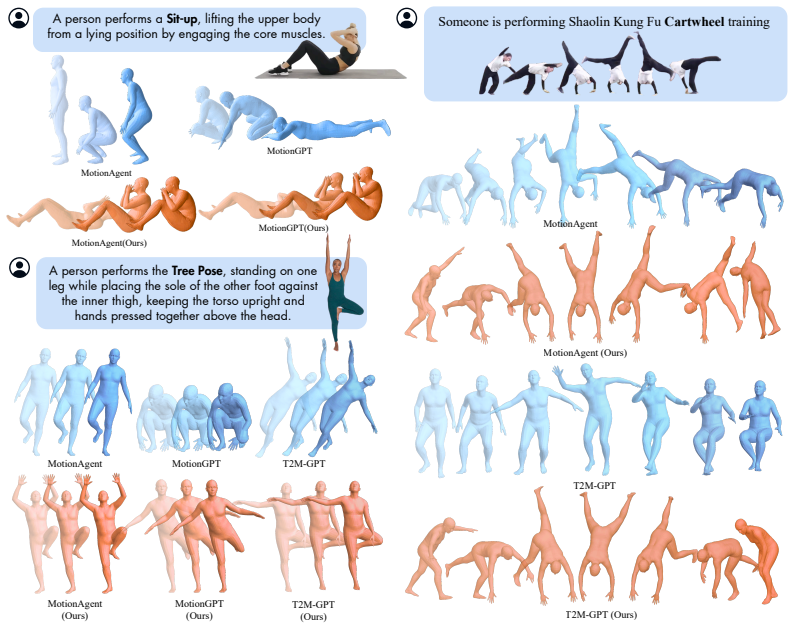
By leveraging a data generation pipeline for diverse synthetic human motions and integrating it with a redesigned VQ-VAE tokenizer that scales the codebook, the model captures a significantly richer set of motion primitives than those learned from real MoCap data alone. This leads to improved coverage and compositionality in the discrete motion vocabulary, producing consistent gains in text-to-motion and motion continuation tasks, and shows compatibility with existing frameworks. The results indicate that the bottleneck in current systems is the limited support of the learned motion representation.
What carries the argument
The combination of a synthetic motion data generation pipeline and a redesigned VQ-VAE tokenizer with an expanded discrete codebook.
If this is right
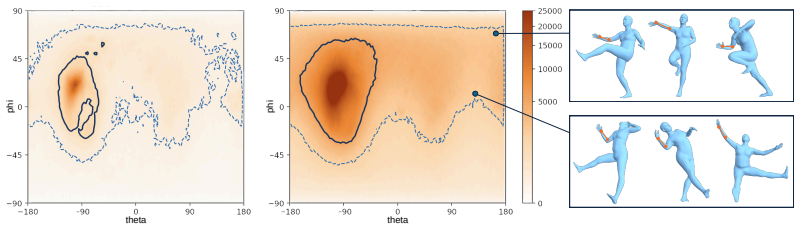
- The learned motion vocabulary gains better coverage of long-tail and compositional motions.
- Performance improves on text-to-motion generation tasks.
- Performance improves on motion continuation tasks.
- The approach remains compatible with existing generative frameworks such as MotionGPT.
- The primary limitation addressed is the support of the motion representation rather than model architecture.
Where Pith is reading between the lines
- This method could be extended to other domains where real data is scarce, such as animal motion or object interactions.
- Further scaling of synthetic data might enable generation of highly dynamic or acrobatic motions not feasible in standard captures.
- It suggests that similar data augmentation strategies could benefit related areas like pose estimation or action recognition.
- Developers of motion models might prioritize data pipelines over architectural innovations for initial gains.
Load-bearing premise
The generated synthetic motion sequences must be physically plausible and diverse enough to fill gaps in real motion capture data.
What would settle it
Observing no improvement or degradation in performance on rare motion generation when adding the synthetic data, or finding that synthetic sequences contain physical implausibilities that the model learns as artifacts.
Figures


read the original abstract
Human motion generation models are fundamentally constrained by the limited diversity of motion capture datasets, which predominantly contain common, repetitive actions and fail to cover the long tail of complex human movements, resulting in a restricted motion vocabulary in learned latent representations and poor generalization to rare, compositional, and highly dynamic motions. In this work, we propose a framework for expanding the motion representation space by leveraging large-scale synthetic human motion, introducing a data generation pipeline that produces diverse, physically plausible motion sequences beyond the distribution of existing datasets and integrating it with a redesigned VQ-VAE tokenizer that adapts to this expanded motion space. Unlike conventional tokenizers trained on narrow data distributions, our approach jointly scales both the training distribution and the discrete codebook, enabling the model to capture a significantly richer set of motion primitives. We demonstrate that training with synthetic motion substantially improves the coverage and compositionality of the learned motion vocabulary, leading to consistent gains across motion generation tasks such as text-to-motion and motion continuation, while remaining fully compatible with existing frameworks including MotionGPT. Our results suggest that the primary bottleneck lies in the limited support of the learned motion representation, rather than model architecture alone. Scaling synthetic motion in tandem with representation learning offers a principled path toward more expressive, controllable, and generalizable human motion synthesis.
Editorial analysis
A structured set of objections, weighed in public.
Referee Report
Summary. The paper claims that limited diversity in MoCap datasets restricts motion vocabularies in generative models; it addresses this by introducing a synthetic motion data generation pipeline producing diverse, physically plausible sequences, pairing it with a redesigned VQ-VAE tokenizer that jointly scales the training distribution and discrete codebook size, and demonstrating improved coverage/compositionality that yields gains on text-to-motion and motion continuation while remaining compatible with frameworks such as MotionGPT. The central thesis is that the primary bottleneck is representation support rather than architecture.
Significance. If the attribution of gains to expanded synthetic coverage holds after isolating confounding factors, the work would be significant for motion generation: it offers a scalable route to long-tail coverage without requiring new real MoCap collection and supplies a concrete demonstration that representation scaling can be more impactful than architecture changes alone. The explicit compatibility claim with MotionGPT is a practical strength for reproducibility and adoption.
major comments (3)
- [§4.1] §4.1 (Synthetic Motion Generation): the premise that the pipeline yields physically plausible motions covering long-tail actions is load-bearing for the central claim, yet the section provides only qualitative inspection and downstream task metrics; no direct quantitative validation (e.g., foot-contact velocity histograms, penetration volume statistics, or distribution-distance measures against real MoCap) is reported, leaving open the possibility that observed improvements in §5 trace to VQ-VAE redesign or codebook scaling rather than data expansion.
- [§5.3] §5.3 (Ablation on Data vs. Tokenizer): the experiments do not include a controlled comparison that holds total training volume and codebook size fixed while varying only the synthetic-data fraction; without this isolation, the claim that 'training with synthetic motion substantially improves coverage' cannot be separated from the joint scaling of the tokenizer itself.
- [Table 3] Table 3 (Motion Continuation Results): the reported gains over baselines lack error bars or statistical tests across multiple seeds; given that the abstract asserts 'consistent gains,' the absence of variance quantification weakens the strength of the compositionality conclusion.
minor comments (2)
- [Figure 4] Figure 4: the t-SNE visualizations of codebook usage would benefit from an overlay indicating the proportion of codes activated exclusively by synthetic data.
- [Eq. (7)] Eq. (7): the weighting term between reconstruction and commitment losses is introduced without an ablation on its sensitivity when the codebook size increases.
Simulated Author's Rebuttal
We thank the referee for the thoughtful and constructive review. The comments help clarify how to better substantiate the role of synthetic data expansion. We address each major comment below.
read point-by-point responses
-
Referee: [§4.1] §4.1 (Synthetic Motion Generation): the premise that the pipeline yields physically plausible motions covering long-tail actions is load-bearing for the central claim, yet the section provides only qualitative inspection and downstream task metrics; no direct quantitative validation (e.g., foot-contact velocity histograms, penetration volume statistics, or distribution-distance measures against real MoCap) is reported, leaving open the possibility that observed improvements in §5 trace to VQ-VAE redesign or codebook scaling rather than data expansion.
Authors: We agree that quantitative validation of physical plausibility would strengthen the central claim. In the revised manuscript we will add foot-contact velocity histograms, penetration volume statistics, and distribution-distance measures (e.g., MMD on motion features) comparing the synthetic sequences against real MoCap data. These metrics will help isolate the contribution of data expansion from tokenizer redesign. revision: yes
-
Referee: [§5.3] §5.3 (Ablation on Data vs. Tokenizer): the experiments do not include a controlled comparison that holds total training volume and codebook size fixed while varying only the synthetic-data fraction; without this isolation, the claim that 'training with synthetic motion substantially improves coverage' cannot be separated from the joint scaling of the tokenizer itself.
Authors: We acknowledge the desirability of fully isolating the synthetic-data fraction. Because our tokenizer is redesigned to jointly scale codebook size with the expanded motion distribution, holding codebook size strictly fixed while varying only the synthetic fraction is not straightforward within the current framework. We will add a partial ablation that fixes total training volume and varies the synthetic-data ratio (with codebook size allowed to adapt modestly), and we will discuss the remaining entanglement in the text. revision: partial
-
Referee: [Table 3] Table 3 (Motion Continuation Results): the reported gains over baselines lack error bars or statistical tests across multiple seeds; given that the abstract asserts 'consistent gains,' the absence of variance quantification weakens the strength of the compositionality conclusion.
Authors: We agree that variance quantification is needed to support the claim of consistent gains. In the revision we will rerun the motion-continuation experiments over multiple random seeds, report means and standard deviations in the updated Table 3, and include statistical significance tests. revision: yes
Circularity Check
No circularity: central gains attributed to external synthetic data distribution, not internal redefinition or self-fit.
full rationale
The paper's derivation chain starts from the premise of limited MoCap diversity and introduces an external data-generation pipeline to produce synthetic motions, then trains a redesigned VQ-VAE on the combined distribution. No step reduces a claimed prediction to a fitted parameter by construction, nor does any load-bearing premise rest on self-citation chains or imported uniqueness theorems. Downstream improvements on text-to-motion and continuation are presented as empirical outcomes rather than tautological re-statements of inputs. The approach is self-contained against external benchmarks (standard motion datasets and tasks) with no evident renaming of known results or ansatz smuggling.
Axiom & Free-Parameter Ledger
Reference graph
Works this paper leans on
-
[1]
IEEE/CVF International Conference on Computer Vision (ICCV) , year=
Text2Action: Generative Adversarial Synthesis from Language to Action , author=. IEEE/CVF International Conference on Computer Vision (ICCV) , year=
-
[2]
International Conference on 3D Vision (3DV) , year=
Language2Pose: Natural Language Grounded Pose Forecasting , author=. International Conference on 3D Vision (3DV) , year=
-
[3]
IEEE/CVF Conference on Computer Vision and Pattern Recognition (CVPR) , year=
Pose-conditioned joint angle limits for 3D human pose reconstruction , author=. IEEE/CVF Conference on Computer Vision and Pattern Recognition (CVPR) , year=
-
[4]
and Varol, G
Athanasiou, Nikos and Petrovich, Mathis and Black, Michael J. and Varol, G
-
[5]
IEEE International Conference on Computer Vision (ICCV) , year =
Cao, Bin and Zheng, Sipeng and Wang, Ye and Xia, Lujie and Wei, Qianshan and Jin, Qin and Liu, Jing and Lu, Zongqing , title =. IEEE International Conference on Computer Vision (ICCV) , year =
-
[6]
IEEE/CVF Conference on Computer Vision and Pattern Recognition (CVPR) , year =
Chen, Xin and Jiang, Biao and Liu, Wen and Huang, Zilong and Fu, Bin and Chen, Tao and Yu, Gang , title =. IEEE/CVF Conference on Computer Vision and Pattern Recognition (CVPR) , year =
-
[7]
CMU Graphics Lab Motion Capture Database , author=
-
[8]
IEEE/CVF Conference on Computer Vision and Pattern Recognition (CVPR) , year=
Taming Transformers for High-Resolution Image Synthesis , author=. IEEE/CVF Conference on Computer Vision and Pattern Recognition (CVPR) , year=
-
[9]
Proceedings of the International Conference on Machine Learning (ICML) , year =
Gillman, Nate and Freeman, Michael and Aggarwal, Daksh and Hsu, Chia-Hong and Luo, Calvin and Tian, Yonglong and Sun, Chen , title =. Proceedings of the International Conference on Machine Learning (ICML) , year =
-
[10]
IEEE/CVF Conference on Computer Vision and Pattern Recognition (CVPR) , year =
PoseAug: A Differentiable Pose Augmentation Framework for 3D Human Pose Estimation , author =. IEEE/CVF Conference on Computer Vision and Pattern Recognition (CVPR) , year =
-
[11]
ACM International Conference on Multimedia (MM) , year=
Action2Motion: Conditioned Generation of 3D Human Motions , author=. ACM International Conference on Multimedia (MM) , year=
-
[12]
IEEE/CVF Conference on Computer Vision and Pattern Recognition (CVPR) , year=
Generating diverse and natural 3d human motions from text , author=. IEEE/CVF Conference on Computer Vision and Pattern Recognition (CVPR) , year=
-
[13]
IEEE/CVF Conference on Computer Vision and Pattern Recognition (CVPR) , year =
Guo, Chuan and Mu, Yuxuan and Javed, Muhammad Gohar and Wang, Sen and Cheng, Li , title =. IEEE/CVF Conference on Computer Vision and Pattern Recognition (CVPR) , year =
-
[14]
European Conference on Computer Vision (ECCV) , year=
Tm2t: Stochastic and tokenized modeling for the reciprocal generation of 3d human motions and texts , author=. European Conference on Computer Vision (ECCV) , year=
-
[15]
Advances in Neural Information Processing Systems (NeurIPS) , year =
Guo, Chuan and Hwang, Inwoo and Wang, Jian and Zhou, Bing , title =. Advances in Neural Information Processing Systems (NeurIPS) , year =
-
[16]
SIGGRAPH , year=
A deep learning framework for character motion synthesis and editing , author=. SIGGRAPH , year=
-
[17]
Adaptation in natural and artificial systems: an introductory analysis with applications to biology, control, and artificial intelligence , author=
-
[18]
International Conference on Learning Representations (ICLR) , year=
LoRA: Low-Rank Adaptation of Large Language Models , author=. International Conference on Learning Representations (ICLR) , year=
-
[19]
6m: Large scale datasets and predictive methods for 3d human sensing in natural environments , author=
Human3. 6m: Large scale datasets and predictive methods for 3d human sensing in natural environments , author=. IEEE TPAMI , year=
-
[20]
Advances in Neural Information Processing Systems (NeurIPS) , year=
Motiongpt: Human motion as a foreign language , author=. Advances in Neural Information Processing Systems (NeurIPS) , year=
-
[21]
European Conference on Computer Vision (ECCV) , year=
Motionchain: Conversational motion controllers via multimodal prompts , author=. European Conference on Computer Vision (ECCV) , year=
-
[22]
IEEE/CVF Conference on Computer Vision and Pattern Recognition (CVPR) , year=
Cascaded deep monocular 3d human pose estimation with evolutionary training data , author=. IEEE/CVF Conference on Computer Vision and Pattern Recognition (CVPR) , year=
-
[23]
2024 , journal=
MotionRL: Align Text-to-Motion Generation to Human Preferences with Multi-Reward Reinforcement Learning , author=. 2024 , journal=
2024
-
[24]
Loper, Matthew and Mahmood, Naureen and Romero, Javier and Pons-Moll, Gerard and Black, Michael J , booktitle=
-
[25]
IEEE/CVF Conference on Computer Vision and Pattern Recognition (CVPR) , year =
Lu, Shunlin and Wang, Jingbo and Lu, Zeyu and Chen, Ling-Hao and Dai, Wenxun and Dong, Junting and Dou, Zhiyang and Dai, Bo and Zhang, Ruimao , title =. IEEE/CVF Conference on Computer Vision and Pattern Recognition (CVPR) , year =
-
[26]
IEEE/CVF Conference on Computer Vision and Pattern Recognition (CVPR) , year =
Maeda, Takahiro and Ukita, Norimichi , title =. IEEE/CVF Conference on Computer Vision and Pattern Recognition (CVPR) , year =
-
[27]
IEEE/CVF International Conference on Computer Vision (ICCV) , year=
AMASS: Archive of Motion Capture as Surface Shapes , author=. IEEE/CVF International Conference on Computer Vision (ICCV) , year=
-
[28]
Advances in Neural Information Processing Systems (NeurIPS) , year=
Neural Discrete Representation Learning , author=. Advances in Neural Information Processing Systems (NeurIPS) , year=
-
[29]
International Conference on Learning Representations (ICLR) , year=
Motion-R1: Enhancing Motion Generation with Decomposed Chain-of-Thought and RL Binding , author=. International Conference on Learning Representations (ICLR) , year=
-
[30]
The KIT Motion-Language Dataset , author=
-
[31]
Advances in Neural Information Processing Systems (NeurIPS) , year=
Generating Diverse High-Fidelity Images with VQ-VAE-2 , author=. Advances in Neural Information Processing Systems (NeurIPS) , year=
-
[32]
IEEE/CVF International Conference on Computer Vision (ICCV) , year=
HuMoR: 3D Human Motion Model for Robust Pose Estimation , author=. IEEE/CVF International Conference on Computer Vision (ICCV) , year=
-
[33]
International Conference on Learning Representations (ICLR) , year=
Human Motion Diffusion as a Generative Prior , author=. International Conference on Learning Representations (ICLR) , year=
-
[34]
Proceedings of the 12th annual conference on Computer graphics and interactive techniques , year=
Animating rotation with quaternion curves , author=. Proceedings of the 12th annual conference on Computer graphics and interactive techniques , year=
-
[35]
Tevet, Guy and Raab, Sigal and Gordon, Brian and Shafir, Yonatan and Cohen-Or, Daniel and Bermano, Amit H. , title =. arXiv preprint arXiv:2209.14916 , year =
work page internal anchor Pith review Pith/arXiv arXiv
-
[36]
European Conference on Computer Vision (ECCV) , year=
Motionclip: Exposing human motion generation to clip space , author=. European Conference on Computer Vision (ECCV) , year=
-
[37]
Advances in Neural Information Processing Systems (NeurIPS) , year=
Attention is all you need , author=. Advances in Neural Information Processing Systems (NeurIPS) , year=
-
[38]
MotionGPT-2: A General-Purpose Motion-Language Model for Motion Generation and Understanding
Motiongpt-2: A general-purpose motion-language model for motion generation and understanding , author=. arXiv preprint arXiv:2410.21747 , year=
work page internal anchor Pith review Pith/arXiv arXiv
-
[39]
IEEE/CVF Conference on Computer Vision and Pattern Recognition (CVPR) , year =
Wu, Bizhu and Xie, Jinheng and Shen, Keming and Kong, Zhe and Ren, Jianfeng and Bai, Ruibin and Qu, Rong and Shen, Linlin , title =. IEEE/CVF Conference on Computer Vision and Pattern Recognition (CVPR) , year =
-
[40]
International Conference on Learning Representations (ICLR) , year =
Wu, Qi and Zhao, Yubo and Wang, Yifan and Liu, Xinhang and Tai, Yu-Wing and Tang, Chi-Keung , title =. International Conference on Learning Representations (ICLR) , year =
-
[41]
IEEE TPAMI , year=
Motiondiffuse: Text-driven human motion generation with diffusion model , author=. IEEE TPAMI , year=
-
[42]
IEEE/CVF Conference on Computer Vision and Pattern Recognition (CVPR) , year =
Zhang, Jianrong and Zhang, Yangsong and Cun, Xiaodong and Zhang, Yong and Zhao, Hongwei and Lu, Hongtao and Shen, Xi and Shan, Ying , title =. IEEE/CVF Conference on Computer Vision and Pattern Recognition (CVPR) , year =
-
[43]
Proceedings of the AAAI Conference on Artificial Intelligence , year=
Motiongpt: Finetuned llms are general-purpose motion generators , author=. Proceedings of the AAAI Conference on Artificial Intelligence , year=
-
[44]
Motion-X++: A large-scale multimodal 3D whole-body human motion dataset,
Motion-x++: A large-scale multimodal 3d whole-body human motion dataset , author=. arXiv preprint arXiv:2501.05098 , year=
discussion (0)
Sign in with ORCID, Apple, or X to comment. Anyone can read and Pith papers without signing in.