Multiphoton Fingerprints of Altermagnetic Spin Splittings
Pith reviewed 2026-06-29 00:39 UTC · model grok-4.3
The pith
The angular harmonic of altermagnetic spin splitting sets the lowest multiphoton order for a symmetry-selective optical response.
A machine-rendered reading of the paper's core claim, the machinery that carries it, and where it could break.
Core claim
The angular harmonic of the altermagnetic spin splitting fixes the lowest optical absorption at which a symmetry-selective response appears: two-photon absorption for d-wave order, four-photon absorption for g-wave order, and six-photon absorption for i-wave order. In each case, there exists a polarization channel locked to the symmetry harmonic of the altermagnetic texture in which the direct n-photon contribution to the transition matrix element is absent. This changes the frequency scaling of the absorption rate relative to other polarization channels and provides a direct optical fingerprint of the underlying altermagnetic harmonic.
What carries the argument
Polarization-resolved multiphoton absorption in which the angular harmonic of the spin splitting selects both the photon order of the selective response and the channel where the direct matrix-element contribution is absent.
If this is right
- Two-photon absorption in the matched polarization channel reveals d-wave order through modified frequency scaling.
- Four-photon absorption does the same for g-wave order.
- Six-photon absorption fingerprints i-wave order.
- The hierarchy distinguishes d-, g-, and i-wave altermagnetic spin splittings via the onset photon number and polarization dependence.
- The signatures appear only in nonlinear response and are absent in linear optics.
Where Pith is reading between the lines
- The same polarization-locking mechanism could be used to read altermagnetic textures all-optically in proposed devices.
- Higher photon orders or mixed harmonics would shift the lowest selective order upward in a predictable way.
- The approach may generalize to other nonlinear optical processes such as harmonic generation for additional symmetry readout.
- Experimental tests require only standard polarization control and frequency-tunable lasers on thin-film samples.
Load-bearing premise
The altermagnetic spin splitting can be treated as a pure angular harmonic without mixing from other orders or higher-order effects that would alter the polarization channels or frequency scaling.
What would settle it
In a material known to host d-wave altermagnetic order, measure the intensity scaling of absorption versus frequency in the polarization channel matched to the d-wave harmonic and check whether the rate follows the modified scaling expected when the direct two-photon term is absent rather than the conventional two-photon scaling.
Figures
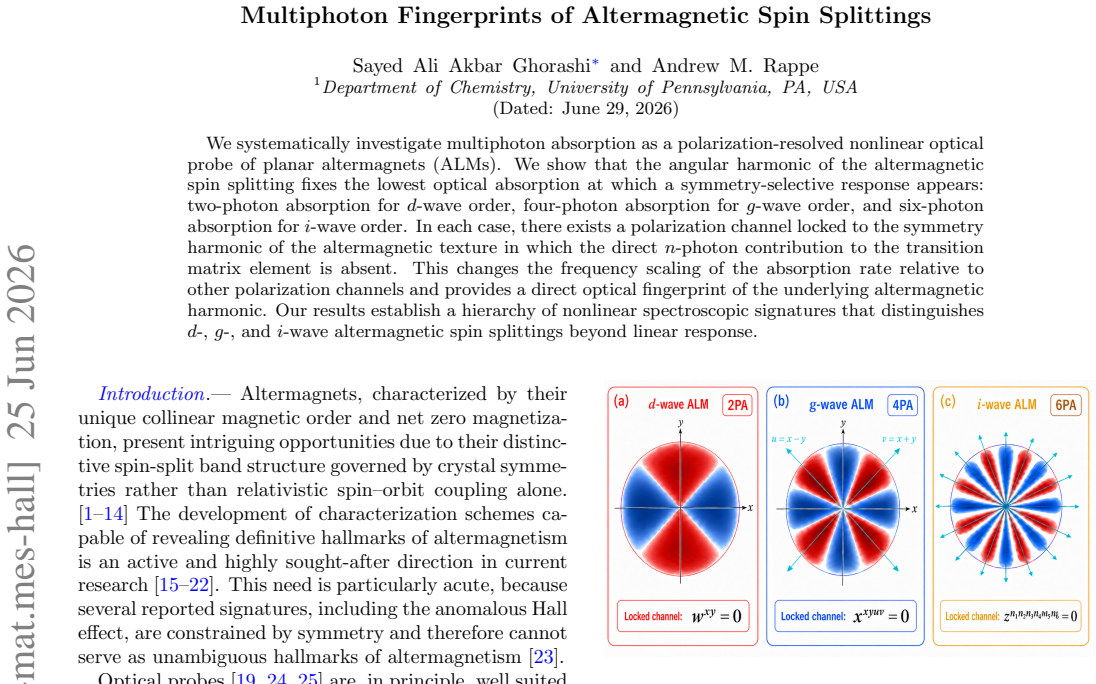
read the original abstract
We systematically investigate multiphoton absorption as a polarization-resolved nonlinear optical probe of planar altermagnets (ALMs). We show that the angular harmonic of the altermagnetic spin splitting fixes the lowest optical absorption at which a symmetry-selective response appears: two-photon absorption for $d$-wave order, four-photon absorption for $g$-wave order, and six-photon absorption for $i$-wave order. In each case, there exists a polarization channel locked to the symmetry harmonic of the altermagnetic texture in which the direct $n$-photon contribution to the transition matrix element is absent. This changes the frequency scaling of the absorption rate relative to other polarization channels and provides a direct optical fingerprint of the underlying altermagnetic harmonic. Our results establish a hierarchy of nonlinear spectroscopic signatures that distinguishes $d$-, $g$-, and $i$-wave altermagnetic spin splittings beyond linear response.
Editorial analysis
A structured set of objections, weighed in public.
Referee Report
Summary. The manuscript investigates multiphoton absorption in planar altermagnets as a polarization-resolved nonlinear optical probe. It claims that the angular harmonic of the altermagnetic spin splitting (d-, g-, or i-wave) determines the lowest multiphoton order at which a symmetry-selective response appears (two-photon for d-wave, four-photon for g-wave, six-photon for i-wave). In a polarization channel locked to the altermagnetic texture, the direct n-photon contribution to the transition matrix element vanishes by symmetry, altering the frequency scaling of the absorption rate relative to other channels and providing an optical fingerprint of the underlying harmonic.
Significance. If the symmetry-based selection rules and resulting frequency scalings hold under realistic conditions, the work would establish a hierarchy of nonlinear spectroscopic signatures that distinguish different altermagnetic orders beyond linear response, offering a potentially useful experimental tool for characterizing altermagnets.
major comments (2)
- [Symmetry arguments and transition matrix elements (likely §3 or §4)] The central claim that the direct n-photon matrix element vanishes in one polarization channel (leading to modified frequency scaling) rests on treating the altermagnetic spin splitting as a pure angular harmonic. The manuscript should explicitly demonstrate that weak admixtures of other harmonics or higher-order terms in the Hamiltonian do not lift this vanishing at the same perturbative order; otherwise the claimed change in scaling is not robust. This is load-bearing for the fingerprinting hierarchy.
- [Multiphoton absorption rate calculations] The frequency scaling of the absorption rate in the 'absent' channel is asserted to differ due to the missing direct contribution. The derivation of the leading-order process (e.g., via virtual intermediate states or effective higher-order terms) needs to be shown explicitly, including any dependence on the altermagnetic strength or band parameters, to confirm the scaling is indeed distinct and observable.
minor comments (2)
- [Figure captions and §2] Clarify the definition of the polarization channels (e.g., linear vs. circular) and how they lock to the specific harmonics (d-wave ~kx ky, etc.) in the figures or text.
- [Introduction] Include a brief comparison to conventional antiferromagnets or ferromagnets to highlight what is unique to the altermagnetic case.
Simulated Author's Rebuttal
We thank the referee for their careful reading of our manuscript and for the constructive comments. We respond to each major comment below and will make the suggested revisions to strengthen the presentation of our results.
read point-by-point responses
-
Referee: [Symmetry arguments and transition matrix elements (likely §3 or §4)] The central claim that the direct n-photon matrix element vanishes in one polarization channel (leading to modified frequency scaling) rests on treating the altermagnetic spin splitting as a pure angular harmonic. The manuscript should explicitly demonstrate that weak admixtures of other harmonics or higher-order terms in the Hamiltonian do not lift this vanishing at the same perturbative order; otherwise the claimed change in scaling is not robust. This is load-bearing for the fingerprinting hierarchy.
Authors: We agree with the referee that the robustness of the symmetry selection rule against perturbations is crucial for the proposed fingerprinting scheme. Our analysis is based on the leading angular harmonic of the altermagnetic spin splitting, which defines the d-, g-, and i-wave orders. In realistic systems, any weak admixtures would enter as small corrections. To address this explicitly, we will add a discussion in the revised manuscript showing that the vanishing of the direct n-photon matrix element in the locked polarization channel persists to first order in the admixture strength, as the symmetry-forbidden term is not generated until higher orders in the perturbation. This preserves the distinct frequency scaling as a leading effect. revision: yes
-
Referee: [Multiphoton absorption rate calculations] The frequency scaling of the absorption rate in the 'absent' channel is asserted to differ due to the missing direct contribution. The derivation of the leading-order process (e.g., via virtual intermediate states or effective higher-order terms) needs to be shown explicitly, including any dependence on the altermagnetic strength or band parameters, to confirm the scaling is indeed distinct and observable.
Authors: We thank the referee for this suggestion. The modified scaling in the absent channel follows from the absence of the direct n-photon term, requiring the leading process to involve additional virtual transitions or effective higher-order operators. In the revised version, we will include an explicit derivation of this leading-order contribution, detailing its dependence on the altermagnetic splitting strength and band parameters. This will demonstrate that the scaling differs from the direct channels and remains observable under typical experimental conditions. revision: yes
Circularity Check
No significant circularity; symmetry-based claims are self-contained.
full rationale
The paper derives its central claims (hierarchy of multiphoton absorption thresholds locked to d/g/i-wave harmonics) directly from symmetry selection rules applied to the assumed pure angular-harmonic form of the altermagnetic spin splitting. No equations, fitted parameters, or self-citations are invoked in the provided text to reduce any prediction to an input by construction. The derivation chain is independent of prior fitted values or author-specific uniqueness theorems, making the result externally falsifiable via symmetry arguments alone.
Axiom & Free-Parameter Ledger
axioms (1)
- domain assumption Altermagnets exhibit planar spin splittings characterized by pure d-, g-, or i-wave angular harmonics.
Reference graph
Works this paper leans on
-
[1]
ˇSmejkal, J
L. ˇSmejkal, J. Sinova, and T. Jungwirth, Beyond conven- tional ferromagnetism and antiferromagnetism: A phase with nonrelativistic spin and crystal rotation symmetry, Phys. Rev. X12, 031042 (2022)
2022
-
[2]
ˇSmejkal, J
L. ˇSmejkal, J. Sinova, and T. Jungwirth, Emerging re- search landscape of altermagnetism, Phys. Rev. X12, 040501 (2022)
2022
-
[3]
L. Bai, W. Feng, S. Liu, L. ˇSmejkal, Y. Mokrousov, and Y. Yao, Altermagnetism: Exploring new frontiers in mag- 5 netism and spintronics, Advanced Functional Materials 34, 2409327 (2024)
2024
-
[4]
C. Song, H. Bai, Z. Zhou, L. Han, H. Reichlova, J. H. Dil, J. Liu, X. Chen, and F. Pan, Altermagnets as a new class of functional materials, Nature Reviews Materials , 1 (2025)
2025
-
[5]
Jungwirth, R
T. Jungwirth, R. M. Fernandes, E. Fradkin, A. H. Mac- Donald, J. Sinova, and L. ˇSmejkal, Altermagnetism: An unconventional spin-ordered phase of matter, Newton1 (2025)
2025
-
[6]
S. A. A. Ghorashi, T. L. Hughes, and J. Cano, Altermag- netic routes to majorana modes in zero net magnetiza- tion, Phys. Rev. Lett.133, 106601 (2024)
2024
- [7]
-
[8]
P. A. McClarty and J. G. Rau, Landau theory of alter- magnetism, Phys. Rev. Lett.132, 176702 (2024)
2024
-
[9]
A. Hadjipaschalis, S. A. A. Ghorashi, and J. Cano, Ma- joranas with a twist: Tunable majorana zero modes in altermagnetic heterostructures (2025), arXiv:2507.00119 [cond-mat.mes-hall]
-
[10]
Z. Liu, H. Kikuchi, Z. Wei, S. Asai, M. Enderle, U. B. Hansen, V. O. Garlea, M. D. Le, G. J. Nilsen, I. A. Zal- iznyak, and T. Masuda, Observation of switchable chiral magnons in an altermagnet, Phys. Rev. Lett.136, 236705 (2026)
2026
- [11]
-
[12]
S. A. A. Ghorashi and Q. Li, Dynamical generation of higher-order spin-orbit coupling, topology, and persistent spin texture in light-irradiated altermagnets, Phys. Rev. Lett.135, 236702 (2025)
2025
-
[13]
X. Duan, J. Zhang, Z. Zhu, Y. Liu, Z. Zhang, I. ˇZuti´ c, and T. Zhou, Antiferroelectric altermagnets: Antiferro- electricity alters magnets, Phys. Rev. Lett.134, 106801 (2025)
2025
-
[14]
M. Gu, Y. Liu, H. Zhu, K. Yananose, X. Chen, Y. Hu, A. Stroppa, and Q. Liu, Ferroelectric switchable alter- magnetism, Phys. Rev. Lett.134, 106802 (2025)
2025
-
[15]
Jungwirth, J
T. Jungwirth, J. Sinova, R. M. Fernandes, Q. Liu, H. Watanabe, S. Murakami, S. Nakatsuji, and L.ˇSmejkal, Symmetry, microscopy and spectroscopy signatures of al- termagnetism, Nature649, 837 (2026)
2026
-
[16]
Takahashi, C
K. Takahashi, C. R. W. Steward, M. Ogata, R. M. Fer- nandes, and J. Schmalian, Elasto-hall conductivity and the anomalous hall effect in altermagnets, Phys. Rev. B 111, 184408 (2025)
2025
-
[17]
Aoyama and K
T. Aoyama and K. Ohgushi, Piezomagnetic properties in altermagnetic mnte, Phys. Rev. Mater.8, L041402 (2024)
2024
-
[18]
Y. Fang, J. Cano, and S. A. A. Ghorashi, Quantum geom- etry induced nonlinear transport in altermagnets, Phys. Rev. Lett.133, 106701 (2024)
2024
-
[19]
Yang and L
L. Yang and L. Liang, Nonlinear optomagnetic signature ofd-wave altermagnets, Phys. Rev. Lett.136, 226702 (2026)
2026
-
[20]
Sunko and J
V. Sunko and J. Orenstein, Linear magneto-birefringence as a probe of altermagnetism, npj Quantum Materials (2026)
2026
-
[21]
T. A. Maier and S. Okamoto, Weak-coupling theory of neutron scattering as a probe of altermagnetism, Phys. Rev. B108, L100402 (2023)
2023
- [22]
-
[23]
J. Ding, Z. Jiang, X. Chen, Z. Tao, Z. Liu, T. Li, J. Liu, J. Sun, J. Cheng, J. Liu, Y. Yang, R. Zhang, L. Deng, W. Jing, Y. Huang, Y. Shi, M. Ye, S. Qiao, Y. Wang, Y. Guo, D. Feng, and D. Shen, Large band splitting in g-wave altermagnet crsb, Phys. Rev. Lett.133, 206401 (2024)
2024
-
[24]
I. Gray, Q. Deng, Q. Tian, M. Chilcote, J. S. Dodge, M. Brahlek, and L. Wu, Time-resolved magneto-optical effects in the altermagnet candidate mnte, Applied Physics Letters125(2024)
2024
-
[25]
M. Vila, V. Sunko, and J. E. Moore, Orbital-spin locking and its optical signatures in altermagnets, Phys. Rev. B 112, L020401 (2025)
2025
-
[26]
Nathan, A
V. Nathan, A. H. Guenther, and S. S. Mitra, Review of multiphoton absorption in crystalline solids, Journal of the Optical Society of America B2, 294 (1985)
1985
-
[27]
Hayat, A
A. Hayat, A. Nevet, P. Ginzburg, and M. Orenstein, Ap- plications of two-photon processes in semiconductor pho- tonic devices: invited review, Semiconductor science and technology26, 083001 (2011)
2011
-
[28]
G. S. He, L.-S. Tan, Q. Zheng, and P. N. Prasad, Mul- tiphoton absorbing materials: molecular designs, char- acterizations, and applications, Chemical reviews108, 1245 (2008)
2008
-
[29]
A. B. Hellenes, T. Jungwirth, R. Jaeschke-Ubiergo, A. Chakraborty, J. Sinova, and L. ˇSmejkal, P-wave mag- nets (2024), arXiv:2309.01607 [cond-mat.mes-hall]
work page internal anchor Pith review Pith/arXiv arXiv 2024
-
[30]
Brekke, P
B. Brekke, P. Sukhachov, H. G. Giil, A. Brataas, and J. Linder, Minimal models and transport properties of unconventionalp-wave magnets, Phys. Rev. Lett.133, 236703 (2024)
2024
-
[31]
Q. Song, S. Stavri´ c, P. Barone, A. Droghetti, D. S. An- tonenko, J. W. Venderbos, C. A. Occhialini, B. Ilyas, E. Erge¸ cen, N. Gedik,et al., Electrical switching of ap- wave magnet, Nature642, 64 (2025)
2025
-
[32]
Yamada, M
R. Yamada, M. T. Birch, P. R. Baral, S. Okumura, R. Nakano, S. Gao, M. Ezawa, T. Nomoto, J. Masell, Y. Ishihara,et al., A metallic p-wave magnet with com- mensurate spin helix, Nature646, 837 (2025). END MA TTER The degenerate four-photon absorption (4PA) rate is written as Γ(4)(ω)∝ Z π −π dkx Z π −π dky M abcd cv,sym(k, ω) 2 δη(Ecv(k)−4ω). (11) HereM abc...
2025
discussion (0)
Sign in with ORCID, Apple, or X to comment. Anyone can read and Pith papers without signing in.