Fault tolerant computation of the static structure factor and finite size effects
Pith reviewed 2026-06-29 04:59 UTC · model grok-4.3
The pith
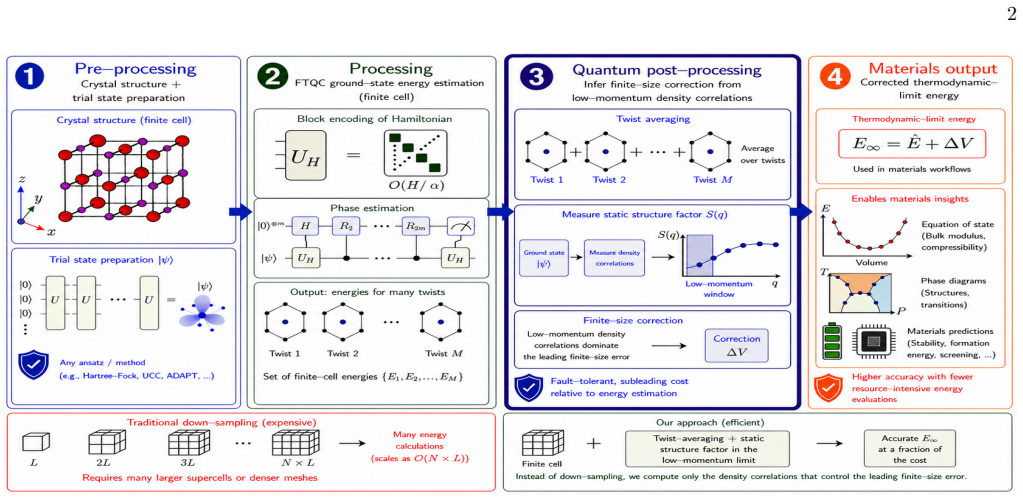
Quantum post-processing of the static structure factor corrects the leading two-body finite-size error in periodic ground-state calculations after twist averaging.
A machine-rendered reading of the paper's core claim, the machinery that carries it, and where it could break.
Core claim
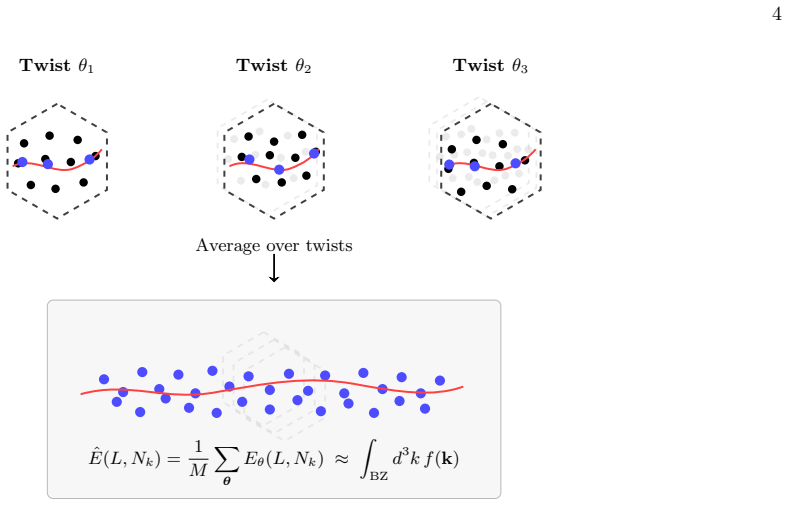
After twist averaging suppresses one-body shell effects, the leading two-body finite-size correction is obtained from the ground-state expectation value of the static structure factor operator S(q) at small momentum, formulated in the Bloch-orbital basis, block-encoded via the density operator, and measured by amplified Hadamard test; the procedure requires only adaptive infrared-window searches and incurs subleading cost relative to energy estimation.
What carries the argument
The small-momentum static structure factor S(q), block-encoded through the density operator and measured by amplified Hadamard test.
If this is right
- The two-body correction can be computed without repeating the full ground-state energy estimation on successively larger supercells.
- The qubit and gate cost of the correction remains subleading to the primary energy-estimation algorithm.
- The method replaces down-sampling with targeted infrared density-correlation measurements.
- Only tilde O(N_b N_k) logical qubits are needed instead of the larger plane-wave basis required for Hamiltonian simulation.
Where Pith is reading between the lines
- The same block-encoding and Hadamard-test machinery could be reused to measure other two-body density correlators that appear in finite-size or embedding corrections.
- The adaptive binary-search procedure for the fitting window may extend to other infrared extrapolations that arise in periodic quantum simulations.
- Because the correction is obtained after the main energy estimation, it can be applied as a post-processing step to any fault-tolerant algorithm that already produces the ground state in the Bloch basis.
Load-bearing premise
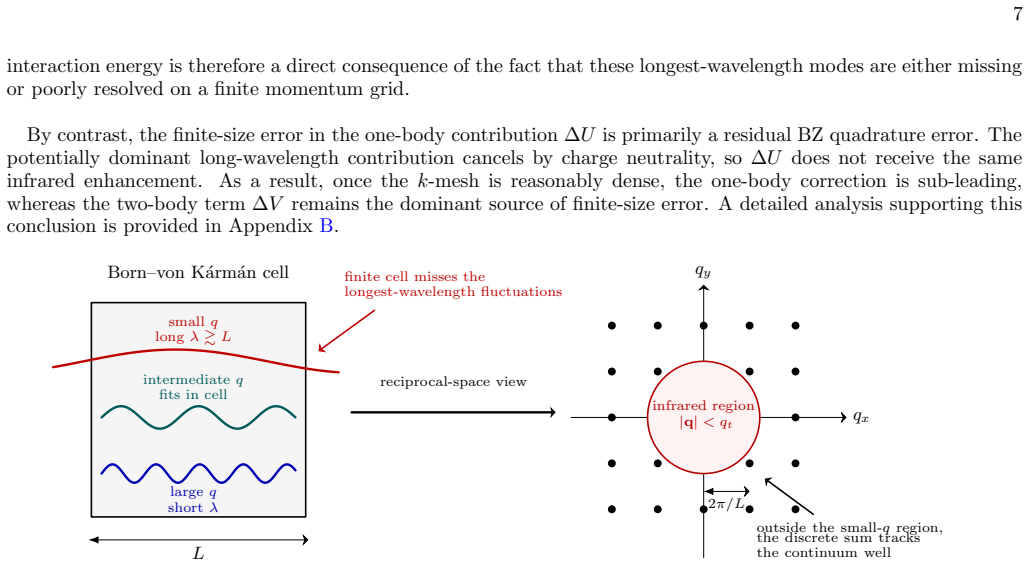
Once one-body shell effects are removed by twist averaging, the remaining finite-size error is dominated by long-wavelength density fluctuations captured by S(q).
What would settle it
A direct numerical comparison, on a small periodic system with known exact finite-size error, showing that the S(q)-based correction fails to reproduce the difference between finite-cell and thermodynamic-limit energies.
Figures
read the original abstract
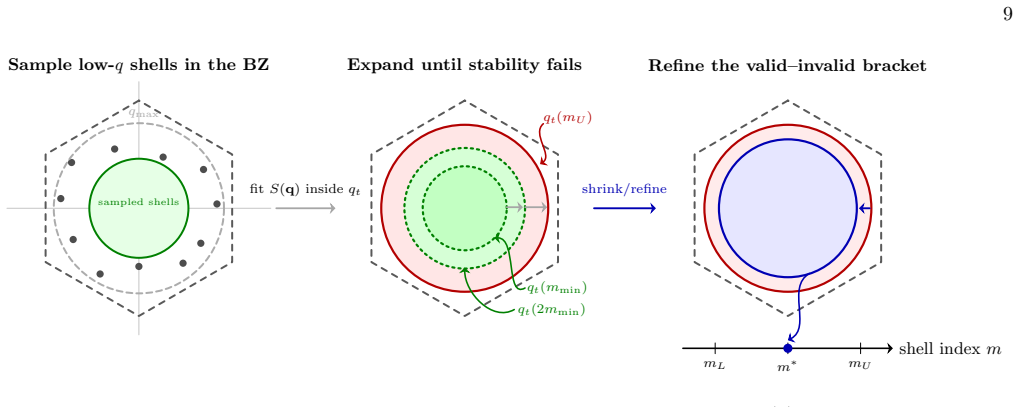
Fault-tolerant quantum algorithms offer a promising pathway for estimating the ground-state energies of periodic materials that are beyond the practical reach of classical electronic-structure methods. A remaining challenge is finite-size mitigation: quantum algorithms evaluate a finite supercell or finite Brillouin-zone mesh, while materials properties are defined in the thermodynamic limit. In this work we develop a quantum post-processing strategy for the leading two-body finite-size correction. After one-body shell effects are reduced by twist averaging, the dominant residual error is controlled by long-wavelength density fluctuations, which are encoded in the small-momentum static structure factor $S(q)$. We formulate the corresponding operator in a Bloch-orbital basis, construct its block encoding through the density operator, and estimate its ground-state expectation value using an amplified Hadamard test. We also introduce adaptive global and local binary search procedures for identifying the infrared fitting window used to reconstruct the two-body finite size error correction. The resulting cost remains subleading relative to the main ground-state energy estimation routine: the structure-factor correction has leading $\tilde{O}(N_bN_k)^3$ dependence on the Bloch-orbital basis size, avoids the large plane-wave prefactor of full Hamiltonian simulation, and requires only $\tilde{O}(N_bN_k)$ logical qubits. This provides a fault-tolerant alternative to down-sampling, replacing repeated energy calculations on larger cells with targeted measurements of the infrared density correlations that control the finite-size effects.
Editorial analysis
A structured set of objections, weighed in public.
Referee Report
Summary. The manuscript proposes a quantum post-processing method to compute the leading two-body finite-size correction for ground-state energies of periodic materials. After twist averaging mitigates one-body shell effects, the residual error is asserted to be dominated by long-wavelength density fluctuations captured by the small-q static structure factor S(q). The authors formulate the corresponding operator in a Bloch-orbital basis, construct its block encoding from the density operator, estimate its ground-state expectation value via an amplified Hadamard test, and introduce adaptive global/local binary searches to identify the infrared fitting window. The claimed cost is sub-leading: ilde{O}((N_b N_k)^3) gate complexity with only ilde{O}(N_b N_k) logical qubits, providing a fault-tolerant alternative to repeated larger-cell simulations.
Significance. If the central premise and cost analysis hold, the approach supplies a targeted, low-overhead correction that avoids the plane-wave prefactors of full Hamiltonian simulation and reduces the need for down-sampling. This would be a practical addition to the fault-tolerant quantum electronic-structure toolkit, particularly for systems where finite-size errors are dominated by infrared density correlations.
major comments (2)
- [Abstract and finite-size mitigation section] Abstract and § on finite-size mitigation: the claim that twist averaging leaves two-body S(q) fluctuations as the dominant residual error is presented without bounds, counter-example analysis, or conditions of validity (e.g., gapped vs. metallic systems, incomplete Bloch basis). If this premise fails, the sub-leading cost no longer guarantees the correct thermodynamic-limit correction.
- [Abstract] Abstract: no derivations of the block encoding, no error analysis for the amplified Hadamard test, no numerical validation on model systems, and no explicit operator constructions are supplied, so the stated ilde{O}((N_b N_k)^3) scaling and qubit count cannot be verified from the text.
minor comments (2)
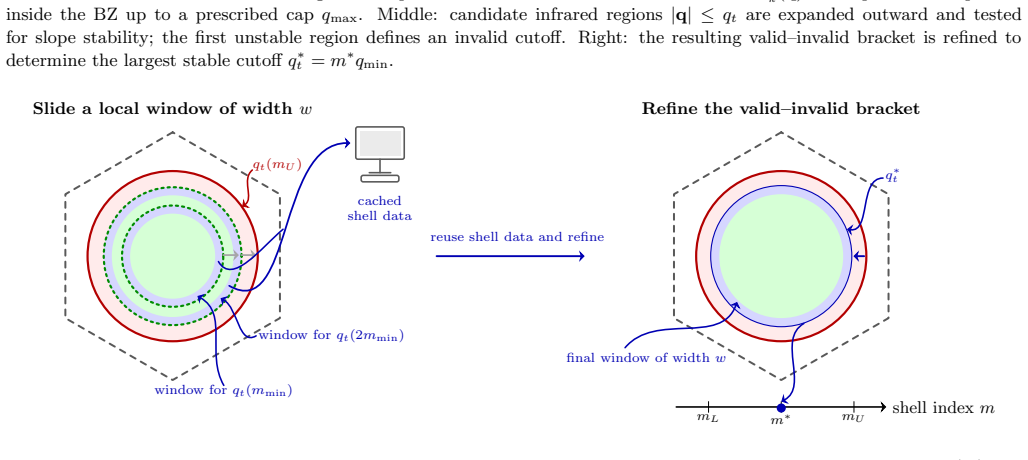
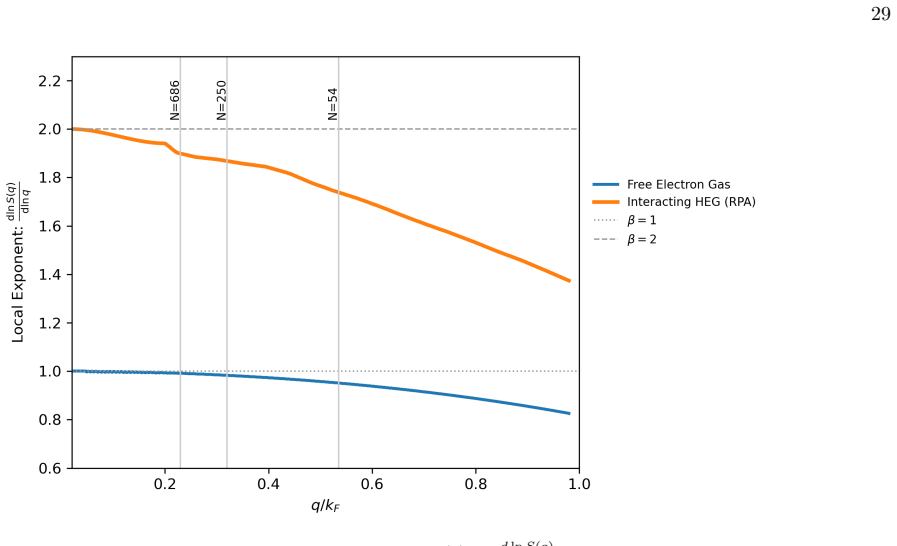
- [Adaptive binary search procedures] Define the infrared fitting window and the precise functional form assumed for S(q) at small q (constant vs. 1/q^2) with an equation reference.
- [Operator construction] Clarify whether the Bloch-orbital basis size N_b N_k already incorporates the plane-wave cutoff or is strictly the number of occupied bands times k-points.
Simulated Author's Rebuttal
We thank the referee for the constructive comments and the opportunity to clarify our manuscript. Below we respond point-by-point to the major comments, indicating revisions where appropriate to strengthen the presentation and scope of the claims.
read point-by-point responses
-
Referee: [Abstract and finite-size mitigation section] Abstract and § on finite-size mitigation: the claim that twist averaging leaves two-body S(q) fluctuations as the dominant residual error is presented without bounds, counter-example analysis, or conditions of validity (e.g., gapped vs. metallic systems, incomplete Bloch basis). If this premise fails, the sub-leading cost no longer guarantees the correct thermodynamic-limit correction.
Authors: We agree that the conditions of validity for the dominance of two-body S(q) fluctuations after twist averaging merit explicit discussion. The claim draws from established results in the classical periodic electronic-structure literature, but the manuscript does not provide bounds or counter-examples. In revision we will add a dedicated paragraph in the finite-size mitigation section stating the assumptions (sufficiently dense k-mesh, gapped systems with complete Bloch basis) and noting that metallic or strongly correlated cases may require additional corrections. This clarifies the regime in which the sub-leading cost applies without altering the algorithm. revision: yes
-
Referee: [Abstract] Abstract: no derivations of the block encoding, no error analysis for the amplified Hadamard test, no numerical validation on model systems, and no explicit operator constructions are supplied, so the stated ilde{O}((N_b N_k)^3) scaling and qubit count cannot be verified from the text.
Authors: The abstract is intentionally concise. The full manuscript contains the block-encoding construction (via the density operator in the Bloch basis), the error analysis for the amplified Hadamard test (including precision and amplification overhead), and the explicit operator definitions. However, we acknowledge that these elements are not cross-referenced from the abstract and that no numerical validation on model systems is currently included. In revision we will (i) add explicit cross-references in the abstract, (ii) expand the methods section with a concise derivation summary and qubit-count derivation, and (iii) include a short numerical demonstration on the uniform electron gas to illustrate the scaling. These additions will make the cost claims directly verifiable. revision: yes
Circularity Check
No circularity: derivation measures external physical quantity S(q) via standard quantum primitives
full rationale
The paper's central claim is a fault-tolerant algorithm to estimate the static structure factor S(q) in a Bloch basis and use its small-q behavior to correct finite-size errors after twist averaging. This is framed as an independent measurement of an external observable (density fluctuations) using block encoding of the density operator and amplified Hadamard test; no equation reduces the claimed correction to a fitted parameter, self-referential definition, or prior self-citation. The cost scaling and qubit count are derived from standard quantum simulation primitives without importing uniqueness theorems or ansatzes from the authors' prior work. The premise that twist averaging leaves two-body S(q) as dominant is an assumption about physics, not a definitional loop. No load-bearing step collapses by construction.
Axiom & Free-Parameter Ledger
axioms (1)
- domain assumption Dominant residual finite-size error after twist averaging arises from long-wavelength density fluctuations encoded in small-momentum S(q)
Reference graph
Works this paper leans on
-
[1]
To this end, we define the walk operator ˆQW = PREP·SEL·PREP † ,(F2) following the prepare–select framework of Ref
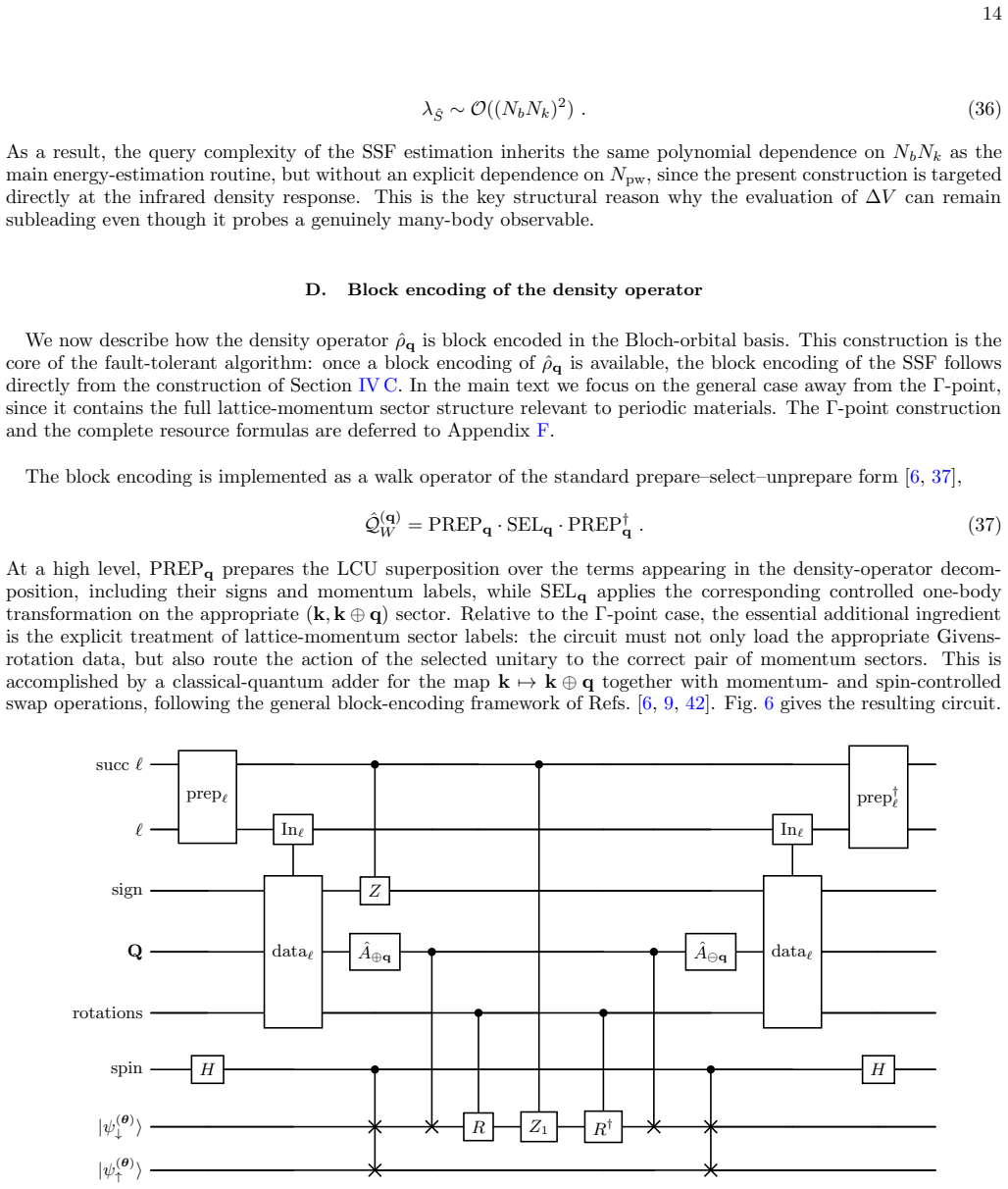
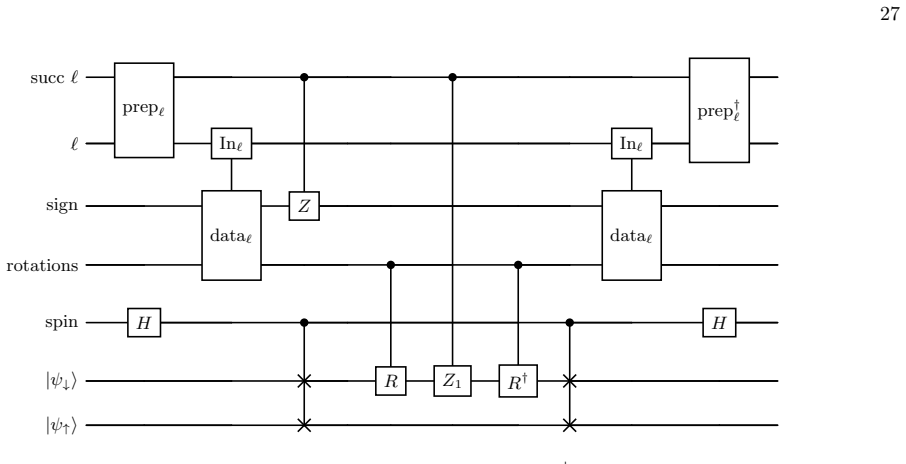
At theΓ-point At the Γ-point we consider only the modeQ=k= 0, so the density operator in the LCU representation reduces to ˆρq Γ ≡ˆρ= 1 2 X J=0,1 Nb/2X i=1 sign(f(J) i )|f(J) i | ˆU(J) Z(J) i ˆU(J)† .(F1) Our goal is to encode this operator as a block of a larger unitary matrix. To this end, we define the walk operator ˆQW = PREP·SEL·PREP † ,(F2) followin...
-
[2]
Away from theΓ-point We now turn to the general density operator for fixed nonzero momentum transferq. The corresponding walk operator is ˆQ(q) W = PREPq ·SEL q ·PREP † q .(F19) Relative to the Γ-point case, the key changes are that the LCU superposition must now include an explicit crystal- momentum label, and the select operation must route the controll...
-
[3]
S. Lee, J. Lee, H. Zhai, Y. Tong, A. M. Dalzell, A. Kumar, P. Helms, J. Gray, Z.-H. Cui, W. Liu, M. Kastoryano, R. Babbush, J. Preskill, D. R. Reichman, E. T. Campbell, E. F. Valeev, L. Lin, and G. K.-L. Chan, Evaluating the evidence for exponential quantum advantage in ground-state quantum chemistry, Nature Communications14, 10.1038/s41467-023- 37587-6 (2023)
-
[4]
H. Gundlach, K. Sharkey, J. Lynch, V. Hazoglou, K.-C. Hsu, C. Dukatz, E. Crane, K. Walczyk, M. Bodziak, J. Galatsanos- Dueck, and N. Thompson, Quantum advantage in computational chemistry? (2025), arXiv:2508.20972 [quant-ph]
- [5]
-
[6]
Y. Cao, J. Romero, J. P. Olson, M. Degroote, P. D. Johnson, M. Kieferov´ a, I. D. Kivlichan, T. Menke, B. Peropadre, N. P. D. Sawaya, S. Sim, L. Veis, and A. Aspuru-Guzik, Quantum chemistry in the age of quantum computing, Chemical 30 Reviews119, 10856–10915 (2019)
2019
-
[7]
Schleich, L
P. Schleich, L. M. Calder´ on, C. Sun, M. Bagherimehrab, A. Aldossary, J. S. Kottmann, and A. Aspuru-Guzik,Quantum Computing for Quantum Chemistry(American Chemical Society, Washington, DC, USA, 2025)
2025
-
[8]
Babbush, C
R. Babbush, C. Gidney, D. W. Berry, N. Wiebe, J. McClean, A. Paler, A. Fowler, and H. Neven, Encoding electronic spectra in quantum circuits with linear t complexity, Phys. Rev. X8, 041015 (2018)
2018
-
[9]
J. Lee, D. W. Berry, C. Gidney, W. J. Huggins, J. R. McClean, N. Wiebe, and R. Babbush, Even more efficient quantum computations of chemistry through tensor hypercontraction, PRX Quantum2, 030305 (2021)
2021
-
[10]
G. H. Low and I. L. Chuang, Hamiltonian simulation by qubitization, Quantum3, 163 (2019)
2019
-
[11]
N. C. Rubin, D. W. Berry, F. D. Malone, A. F. White, T. Khattar, A. E. DePrince, S. Sicolo, M. K¨ uehn, M. Kaicher, J. Lee, and R. Babbush, Fault-tolerant quantum simulation of materials using bloch orbitals, PRX Quantum4, 040303 (2023)
2023
- [12]
-
[13]
R. Bhardwaj, A. R. Mu˜ noz, T. E. Jones, and J. Golden, Fault-tolerant simulation of the electronic structure using Projector Augmented-Waves and Bloch orbitals, arXiv preprint arXiv:2604.12142 (2026), arXiv:2604.12142 [quant-ph]
work page internal anchor Pith review Pith/arXiv arXiv 2026
-
[14]
Poilblanc, Twisted boundary conditions in cluster calculations of the optical conductivity in two-dimensional lattice models, Physical Review B44, 9562 (1991)
D. Poilblanc, Twisted boundary conditions in cluster calculations of the optical conductivity in two-dimensional lattice models, Physical Review B44, 9562 (1991)
1991
-
[15]
C. Lin, F. H. Zong, and D. M. Ceperley, Twist-averaged boundary conditions in continuum quantum monte carlo algorithms, Physical Review E64, 10.1103/physreve.64.016702 (2001)
-
[16]
Shimazaki and S
T. Shimazaki and S. Hirata, On the brillouin-zone integrations in second-order many-body perturbation calculations for extended systems of one-dimensional periodicity, International Journal of Quantum Chemistry109, 2953 (2009)
2009
-
[17]
A. A. Shukri, F. Bruneval, and L. Reining, Ab initio electronic stopping power of protons in bulk materials, Phys. Rev. B 93, 035128 (2016)
2016
-
[18]
Taheridehkordi, M
A. Taheridehkordi, M. Schlipf, Z. Sukurma, M. Humer, A. Gr¨ uneis, and G. Kresse, Phaseless auxiliary field quantum monte carlo with projector-augmented wave method for solids, The Journal of Chemical Physics159, 044109 (2023)
2023
-
[19]
M. Holzmann, R. C. Clay, M. A. Morales, N. M. Tubman, D. M. Ceperley, and C. Pierleoni, Theory of finite size effects for electronic quantum monte carlo calculations of liquids and solids, Physical Review B94, 10.1103/physrevb.94.035126 (2016)
-
[20]
Troyer and U.-J
M. Troyer and U.-J. Wiese, Computational complexity and fundamental limitations to fermionic quantum monte carlo simulations, Physical Review Letters94, 170201 (2005)
2005
-
[21]
E. Y. Loh, J. E. Gubernatis, R. T. Scalettar, S. R. White, D. J. Scalapino, and R. L. Sugar, Sign problem in the numerical simulation of many-electron systems, Physical Review B41, 9301 (1990)
1990
-
[22]
W. M. C. Foulkes, L. Mitas, R. J. Needs, and G. Rajagopal, Quantum monte carlo simulations of solids, Reviews of Modern Physics73, 33 (2001)
2001
-
[23]
F. F. Assaad and H. G. Evertz, World-line and determinantal quantum monte carlo methods for spins, phonons and electrons, inComputational Many-Particle Physics, Lecture Notes in Physics, Vol. 739 (Springer, 2008) pp. 277–356
2008
-
[24]
A. V. Ivanov, C. S¨ underhauf, N. Holzmann, T. Ellaby, R. N. Kerber, G. Jones, and J. Camps, Quantum computation for periodic solids in second quantization, Physical Review Research5, 10.1103/physrevresearch.5.013200 (2023)
-
[25]
J. J. Shepherd, G. E. Scuseria, and J. S. Spencer, Sign problem in full configuration interaction quantum monte carlo: Linear and sublinear representation regimes for the exact wave function, Phys. Rev. B90, 155130 (2014)
2014
-
[26]
Liao and A
K. Liao and A. Gr¨ uneis, Communication: Finite size correction in periodic coupled cluster theory calculations of solids, The Journal of Chemical Physics145, 141102 (2016)
2016
-
[27]
Shi and S
H. Shi and S. Zhang, Some recent developments in auxiliary-field quantum monte carlo for real materials, The Journal of Chemical Physics154, 024107 (2021)
2021
-
[28]
Azadi and W
S. Azadi and W. M. C. Foulkes, Efficient method for grand-canonical twist averaging in quantum monte carlo calculations, Phys. Rev. B100, 245142 (2019)
2019
-
[29]
Annaberdiyev, P
A. Annaberdiyev, P. Ganesh, and J. T. Krogel, Enhanced twist-averaging technique for magnetic metals: Applications using quantum monte carlo, Journal of Chemical Theory and Computation20, 2786–2797 (2024)
2024
-
[30]
Dobardˇ zi´ c, M
E. Dobardˇ zi´ c, M. V. Milovanovi´ c, and N. Regnault, Geometrical description of fractional chern insulators based on static structure factor calculations, Phys. Rev. B88, 115117 (2013)
2013
-
[31]
R. G. Pereira, J. Sirker, J.-S. Caux, R. Hagemans, J. M. Maillet, S. R. White, and I. Affleck, Dynamical structure factor at small q for the xxz spin-1/2 chain, Journal of Statistical Mechanics: Theory and Experiment2007, P08022 (2007)
2007
-
[32]
Shukla, Ab initio hartree-fock computation of the electronic static structure factor for crystalline insulators: Benchmark results on lif, Phys
A. Shukla, Ab initio hartree-fock computation of the electronic static structure factor for crystalline insulators: Benchmark results on lif, Phys. Rev. B60, 4539 (1999)
1999
-
[33]
N. D. Drummond, R. J. Needs, A. Sorouri, and W. M. C. Foulkes, Finite-size errors in continuum quantum monte carlo calculations, Phys. Rev. B78, 125106 (2008)
2008
-
[34]
Chiesa, D
S. Chiesa, D. M. Ceperley, R. M. Martin, and M. Holzmann, Random phase approximation and the finite size errors in many body simulations, AIP Conference Proceedings918, 284 (2007)
2007
-
[35]
T. Dornheim and J. Vorberger, Overcoming finite-size effects in electronic structure simulations at extreme conditions, The Journal of Chemical Physics154, 10.1063/5.0045634 (2021)
-
[36]
Chiesa, D
S. Chiesa, D. M. Ceperley, R. M. Martin, and M. Holzmann, Finite-size error in many-body simulations with long-range interactions, Phys. Rev. Lett.97, 076404 (2006)
2006
-
[37]
Gaudoin, I
R. Gaudoin, I. G. Gurtubay, and J. M. Pitarke, Momentum-space finite-size corrections for quantum monte carlo calcula- 31 tions, Phys. Rev. B85, 125125 (2012)
2012
-
[38]
Y. Tong, D. An, N. Wiebe, and L. Lin, Fast inversion, preconditioned quantum linear system solvers, fast green’s-function computation, and fast evaluation of matrix functions, Phys. Rev. A104, 032422 (2021)
2021
-
[39]
L. Lin, Lecture notes on quantum algorithms for scientific computation (2022), arXiv:2201.08309 [quant-ph]
-
[40]
Marteau, Ground state preparation via qubitization (2023), arXiv:2306.14993 [quant-ph]
C. Marteau, Ground state preparation via qubitization (2023), arXiv:2306.14993 [quant-ph]
-
[41]
Y. Dong, L. Lin, and Y. Tong, Ground-state preparation and energy estimation on early fault-tolerant quantum computers via quantum eigenvalue transformation of unitary matrices, PRX Quantum3, 040305 (2022)
2022
-
[42]
S. Fomichev, K. Hejazi, M. S. Zini, M. Kiser, J. Fraxanet, P. A. M. Casares, A. Delgado, J. Huh, A.-C. Voigt, J. E. Mueller, and J. M. Arrazola, Initial state preparation for quantum chemistry on quantum computers, PRX Quantum5, 10.1103/prxquantum.5.040339 (2024)
-
[43]
Pathak, A
S. Pathak, A. E. Russo, S. K. Seritan, and A. D. Baczewski, Quantifyingt-gate-count improvements for ground-state-energy estimation with near-optimal state preparation, Phys. Rev. A107, L040601 (2023)
2023
-
[44]
C. Gidney, A classical-quantum adder with constant workspace and linear gates (2025), arXiv:2507.23079 [quant-ph]
-
[45]
Dagrada, S
M. Dagrada, S. Karakuzu, V. L. Vildosola, M. Casula, and S. Sorella, Exact special twist method for quantum monte carlo simulations, Physical Review B94, 245108 (2016)
2016
-
[46]
T. N. Mihm, A. R. McIsaac, and J. J. Shepherd, An optimized twist angle to find the twist-averaged correlation energy applied to the uniform electron gas, The Journal of Chemical Physics150, 191101 (2019)
2019
-
[47]
T. N. Mihm, W. Z. Van Benschoten, and J. J. Shepherd, Accelerating convergence to the thermodynamic limit with twist angle selection applied to methods beyond many-body perturbation theory, The Journal of Chemical Physics154, 024113 (2021)
2021
-
[48]
T. N. Mihm, T. Sch¨ afer, S. K. Ramadugu, L. Weiler, A. Gr¨ uneis, and J. J. Shepherd, A shortcut to the thermodynamic limit for quantum many-body calculations of metals, Nature Computational Science1, 801 (2021)
2021
-
[49]
Zaklama, D
T. Zaklama, D. Luo, and L. Fu, Structure factor and topological bound of twisted bilayer semiconductors at fractional fillings, Phys. Rev. B112, L041115 (2025)
2025
-
[50]
Watanabe, H
N. Watanabe, H. Hayashi, Y. Udagawa, S. L. Ten-no, and S. Iwata, Static structure factor and electron correlation effects studied by inelastic x-ray scattering spectroscopy, Journal of Chemical Physics108, 4545 (1998)
1998
-
[51]
Mazzone, F
G. Mazzone, F. Sacchetti, and V. Contini, Static structure factor and electron-electron correlations in be. a comparison of experiment with electron-gas theory, Phys. Rev. B28, 1772 (1983)
1983
-
[52]
E. C. Svensson, V. F. Sears, A. D. B. Woods, and P. Martel, Neutron-diffraction study of the static structure factor and pair correlations in liquid 4He, Phys. Rev. B21, 3638 (1980)
1980
-
[53]
L. N. Trefethen and J. A. C. Weideman, The exponentially convergent trapezoidal rule, SIAM Review56, 385 (2014), https://doi.org/10.1137/130932132
-
[54]
Y. Kazashi, Y. Suzuki, and T. Goda, Suboptimality of gauss–hermite quadrature and optimality of the trapezoidal rule for functions with finite smoothness, SIAM Journal on Numerical Analysis61, 1426 (2023), https://doi.org/10.1137/22M1480276
-
[55]
J. Dick, C. Irrgeher, G. Leobacher, and F. Pillichshammer, On the optimal order of integration in hermite spaces with finite smoothness (2017), arXiv:1608.06061 [math.NA]
work page internal anchor Pith review Pith/arXiv arXiv 2017
-
[56]
Lindhard, On the properties of a gas of charged particles, Kgl
J. Lindhard, On the properties of a gas of charged particles, Kgl. Danske Videnskab. Selskab Mat.-fys. Medd.Vol: 28, No. 8(1954)
1954
discussion (0)
Sign in with ORCID, Apple, or X to comment. Anyone can read and Pith papers without signing in.