Confined exciton polaron in MoS₂ on twisted-hBN
Pith reviewed 2026-06-29 03:41 UTC · model grok-4.3
The pith
Spatially varying electric fields from twisted hBN produce quantized charged-exciton emission in MoS2 via exciton polarons rather than trions.
A machine-rendered reading of the paper's core claim, the machinery that carries it, and where it could break.
Core claim
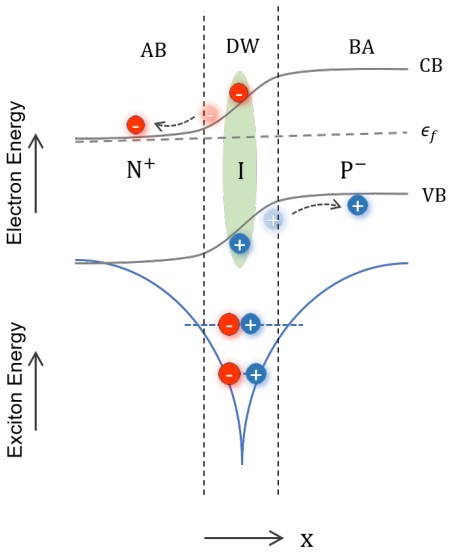
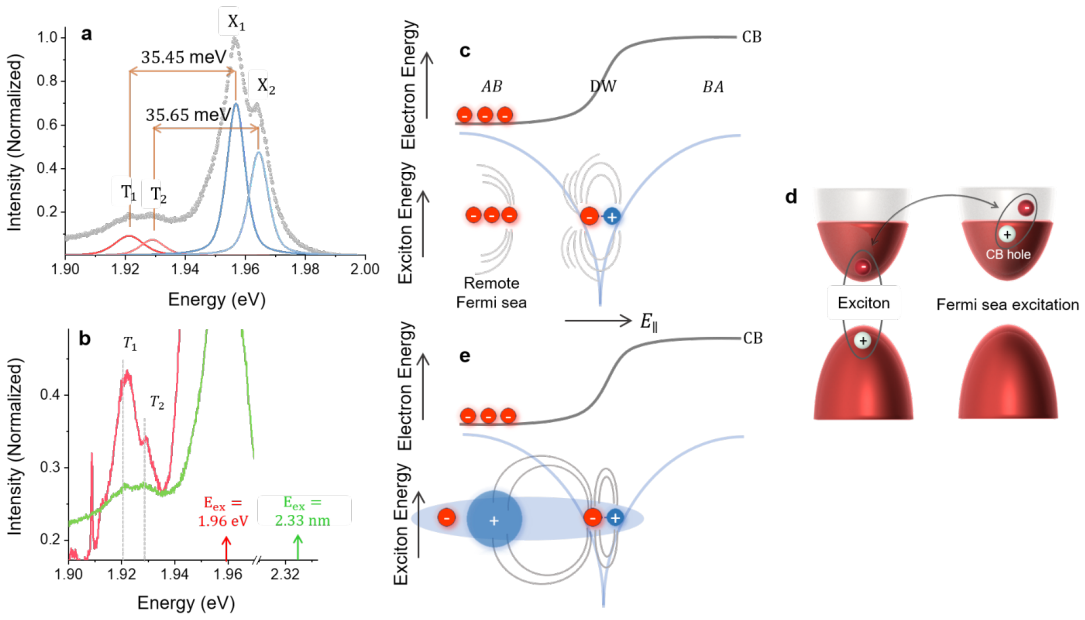
Quantized charged-exciton emission persists in a domain-wall region where the electric field depletes free carriers and should forbid trion formation; the emission is therefore attributed to exciton polarons formed when a conduction-band hole attractively binds the polarized exciton and the electron Fermi sea.
What carries the argument
Exciton polaron: a many-body state in which a conduction-band hole binds the polarized exciton to the Fermi sea.
If this is right
- Quantized charged-exciton lines appear even when free carriers are removed from the confinement region.
- The inter-level spacing of the charged lines replicates the spacing of the neutral confined excitons.
- Exciton polarons can be localized by the same potential that localizes neutral excitons.
- Emission signatures alone cannot distinguish polarons from trions without an independent control on carrier density.
Where Pith is reading between the lines
- Similar domain-wall confinement in other transition-metal dichalcogenides could isolate polaron states for spectroscopic study.
- Gate-tuning the Fermi sea while keeping the domain-wall field fixed would provide a direct test of the polaron binding picture.
- The approach may generalize to other many-body quasiparticles whose formation depends on carrier availability.
Load-bearing premise
The electric field around the domain wall depletes free carriers sufficiently to block ordinary trion formation.
What would settle it
Detection of charged-exciton emission without the matching quantized splitting, or in regions away from the domain wall where carrier depletion is absent, would indicate conventional trions instead.
Figures
read the original abstract
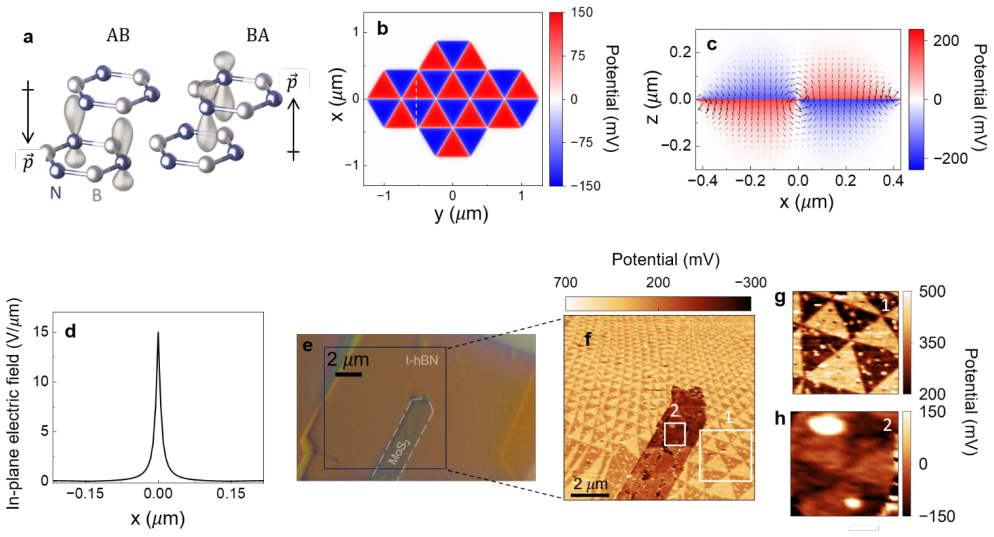
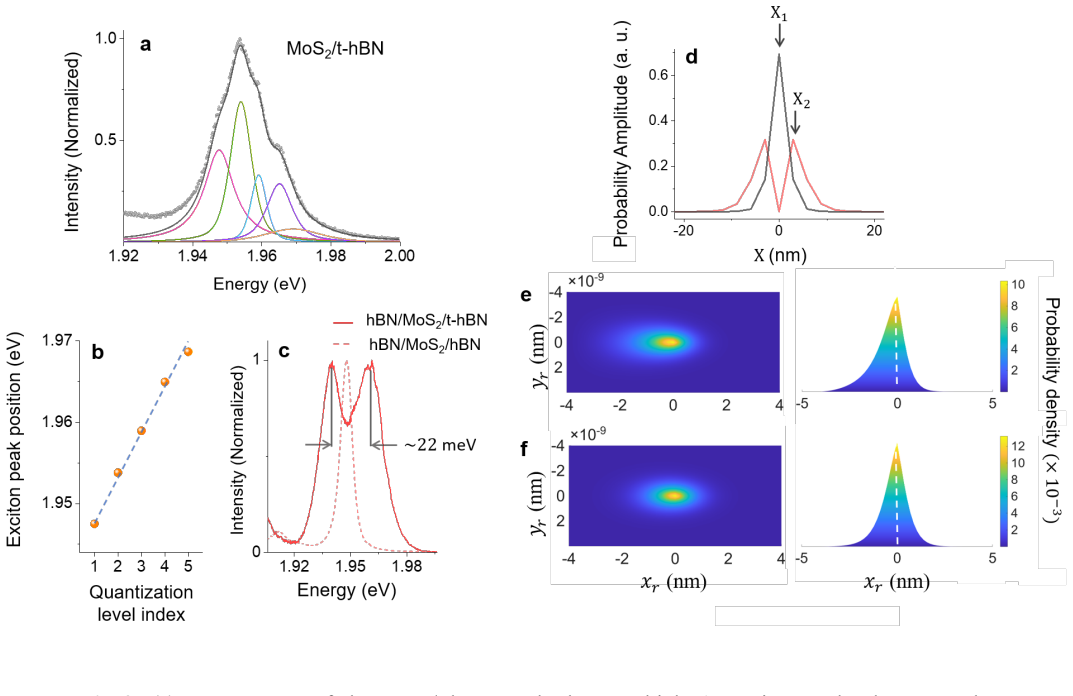
The simple electrostatic picture of a trion is that of an excess charge inducing an exciton polarization and binding closer (farther) to the hole (electron) side of it. Trion formation can be forbidden when such spontaneous rearrangement of charges is not allowed by the application of external perturbation, such as electric field. Here we test this hypothesis experimentally using a non-monotonic electric field. We realize this scenario by imprinting the ferroelectric domains at the AA-stacked twisted-hBN (t-hBN) interface onto a monolayer of MoS2 placed over it. The spatially varying in-plane electric field around the domain wall serves the dual purpose of (a) confining and polarizing the 2D exciton in the domain wall, and (b) depleting the free charge carriers from the domain wall. We observe a large quantized exciton splitting confirming strong exciton confinement in the domain wall. Forced by the confining potential, the electron side of the polarized exciton lies closer to the domain with accumulated free electrons, which should ideally prevent any trion formation. Contrary to the laid hypothesis, we observe signatures of quantized charged exciton emission, with an inter-level splitting that mimics the level-splitting of the quantized excitons. This paradox is explained using the many-body picture of exciton polaron, where a conduction band hole attractively binds the polarized exciton and the electron Fermi sea. The results provide a definitive way to unambiguously discern exciton polaron from trion.
Editorial analysis
A structured set of objections, weighed in public.
Referee Report
Summary. The manuscript reports experimental observations of quantized exciton emission and charged-exciton emission in monolayer MoS2 on twisted hBN, where the ferroelectric domain walls impose a spatially varying in-plane electric field. This field is claimed to confine and polarize excitons (producing large quantized splitting) while depleting free carriers to prevent conventional trion formation; the persistence of quantized charged-exciton lines with matching inter-level splitting is then interpreted as evidence for an exciton polaron in which a conduction-band hole binds the polarized exciton to the electron Fermi sea.
Significance. If the carrier-depletion premise and polaron assignment hold, the work supplies a concrete experimental route to discriminate exciton polarons from trions via electrostatic confinement, which would be a useful addition to the 2D many-body exciton literature. The reported quantized splitting itself demonstrates strong lateral confinement at the domain wall, an observation of independent interest.
major comments (2)
- [Abstract] Abstract: The central claim that the domain-wall field 'depletes the free charge carriers from the domain wall' and thereby 'should ideally prevent any trion formation' is load-bearing for preferring the exciton-polaron interpretation over a confined trion. No estimate of the resulting local carrier density, Fermi energy, or comparison against the ~10^11 cm^{-2} threshold for trion stability is supplied.
- [Abstract] Abstract (and results section): No gate-voltage-dependent spectra, control measurements on ungated or uniformly doped regions, or spatially resolved doping maps are described that would demonstrate the charged-exciton feature vanishes when residual carriers are removed, leaving the exclusion of conventional trions unverified.
minor comments (1)
- [Abstract] The abstract introduces the 'exciton polaron' picture without a concise definition or citation to the relevant many-body literature that would allow a reader to distinguish it immediately from a trion.
Simulated Author's Rebuttal
We thank the referee for their careful reading of the manuscript and for highlighting these important points regarding the carrier-depletion argument. We address each major comment below.
read point-by-point responses
-
Referee: [Abstract] Abstract: The central claim that the domain-wall field 'depletes the free charge carriers from the domain wall' and thereby 'should ideally prevent any trion formation' is load-bearing for preferring the exciton-polaron interpretation over a confined trion. No estimate of the resulting local carrier density, Fermi energy, or comparison against the ~10^11 cm^{-2} threshold for trion stability is supplied.
Authors: We agree that a quantitative estimate would strengthen the central claim. In the revised manuscript we will add a simple electrostatic calculation that uses the known out-of-plane polarization of twisted hBN to estimate the in-plane field profile and the resulting local carrier depletion at the domain wall. The calculation yields a residual density well below 10^{10} cm^{-2} (corresponding to E_F ≪ 1 meV), which lies below the reported trion-stability threshold in MoS2. This addition directly addresses the load-bearing aspect of the argument. revision: yes
-
Referee: [Abstract] Abstract (and results section): No gate-voltage-dependent spectra, control measurements on ungated or uniformly doped regions, or spatially resolved doping maps are described that would demonstrate the charged-exciton feature vanishes when residual carriers are removed, leaving the exclusion of conventional trions unverified.
Authors: The experiment relies on the built-in, non-monotonic in-plane field imposed by the ferroelectric domain walls rather than external gating; consequently the devices were not fabricated with gate electrodes and no gate-dependent data exist in the present data set. We will expand the discussion section to clarify why the observed spatial localization of the quantized charged-exciton lines exclusively to the domain walls, together with the identical inter-level spacing for neutral and charged features, is inconsistent with a conventional confined trion. We also note that future gated devices could provide an independent test, but such measurements lie outside the scope of the current work. revision: partial
Circularity Check
No significant circularity; experimental observations and interpretation are independent
full rationale
The paper reports experimental signatures of quantized charged-exciton emission in a domain-wall-confined MoS2 system and interprets the result via the exciton-polaron many-body picture. No mathematical derivation chain, fitted-parameter prediction, or self-citation load-bearing step exists that reduces any claimed result to its own inputs by construction. The carrier-depletion assumption is an unverified premise but does not constitute a circular reduction in any equation or prediction.
Axiom & Free-Parameter Ledger
axioms (1)
- domain assumption Excitons in monolayer TMDs form bound electron-hole pairs whose energy levels respond to local electric fields in the manner described by 2D hydrogenic models.
invented entities (1)
-
exciton polaron
no independent evidence
Reference graph
Works this paper leans on
-
[3]
Suris, R. A. Correlation Between Trion and Hole in Fermi Distribution in Process of Trion Photo-Excitation in Doped QWs. Opt. Prop. 2D Syst. with Interact. Electrons 111–124 (2003) doi:10.1007/978-94-010-0078-9_9
-
[4]
Sidler, M. et al. Fermi polaron-polaritons in charge-tunable atomically thin semiconductors. Nat. Phys. 13, 255–261 (2017)
2017
-
[5]
K., Laird, E
Efimkin, D. K., Laird, E. K., Levinsen, J., Parish, M. M. & Macdonald, A. H. Electron-exciton interactions in the exciton-polaron problem. Phys. Rev. B 103, 1–15 (2021)
2021
-
[6]
Liu, E. et al. Exciton-polaron Rydberg states in monolayer MoSe2 and WSe2. Nat. Commun. 12, 1–8 (2021)
2021
-
[7]
F., Xu, X., Crooker, S
Van Tuan, D., Shi, S. F., Xu, X., Crooker, S. A. & Dery, H. Six-Body and Eight-Body Exciton States in Monolayer WSe2. Phys. Rev. Lett. 129, 76801 (2022)
2022
- [8]
-
[9]
& Schmidt, R
Imamoglu, A., Cotlet, O. & Schmidt, R. Comptes Rendus Physique. Comptes Rendus Phys. 22, 89–96 (2021)
2021
-
[10]
Kim, D. S. et al. Electrostatic moiré potential from twisted hexagonal boron nitride layers. Nat. Mater. 23, 65–70 (2024)
2024
-
[11]
& Yao, W
Zhao, P., Xiao, C. & Yao, W. Universal superlattice potential for 2D materials from twisted interface inside h-BN substrate. npj 2D Mater. Appl. 5, 1–7 (2021)
2021
-
[12]
Gilbert, S. M. et al. Alternative stacking sequences in hexagonal boron nitride. 2D Mater. 6, (2019)
2019
-
[13]
& Jarillo-Herrero, P
Yasuda, K., Wang, X., Watanabe, K., Taniguchi, T. & Jarillo-Herrero, P. Stacking-engineered ferroelectricity in bilayer boron nitride. Science (80-. ). 372, 1458–1462 (2021)
2021
-
[14]
Woods, C. R. et al. Charge-polarized interfacial superlattices in marginally twisted hexagonal boron nitride. Nat. Commun. 12, 1–7 (2021)
2021
-
[15]
Kim, D. S. et al. Moiré ferroelectricity modulates light emission from a semiconductor monolayer. Sci. Adv. 11, 1–8 (2025)
2025
-
[16]
Pedersen, T. G. Exciton Stark shift and electroabsorption in monolayer transition-metal dichalcogenides. Phys. Rev. B 94, 125424 (2016)
2016
-
[17]
Thureja, D. et al. Electrically tunable quantum confinement of neutral excitons. Nature 606, 298–304 (2022)
2022
-
[18]
Lian, Z. et al. Stark Effects of Rydberg Excitons in a Monolayer WSe2 P-N Junction. Nano Lett. 24, 3935–3941 (2024). Fig 1: The interface of an AA-stacked hBN reconstructs atomically into lower energy AB and BA domains. (a) In these domains, the vertically aligned 2p? orbitals of boron and nitrogen hybridize. The asymmetric distribution of the hybridized ...
2024
-
[19]
Lian, Z. et al. Stark Effects of Rydberg Excitons in a Monolayer WSe2 P-N Junction. Nano Lett. 24, 3935–3941 (2024)
2024
-
[20]
Efimkin, D. K. & MacDonald, A. H. Many-body theory of trion absorption features in two-dimensional semiconductors. Phys. Rev. B 95, 1–10 (2017)
2017
-
[21]
Huang, D. et al. Quantum Dynamics of Attractive and Repulsive Polarons in a Doped MoSe2 Monolayer. Phys. Rev. X 13, 11029 (2023)
2023
discussion (0)
Sign in with ORCID, Apple, or X to comment. Anyone can read and Pith papers without signing in.