Industry-ready spin-photon interfaces for hybrid photonic quantum computing
Pith reviewed 2026-06-29 04:53 UTC · model grok-4.3
The pith
Thousands of pilot-line fabricated quantum-dot devices achieve near-unity photon purity, record Wigner negativity, and seven-partite spin-photon entanglement.
A machine-rendered reading of the paper's core claim, the machinery that carries it, and where it could break.
Core claim
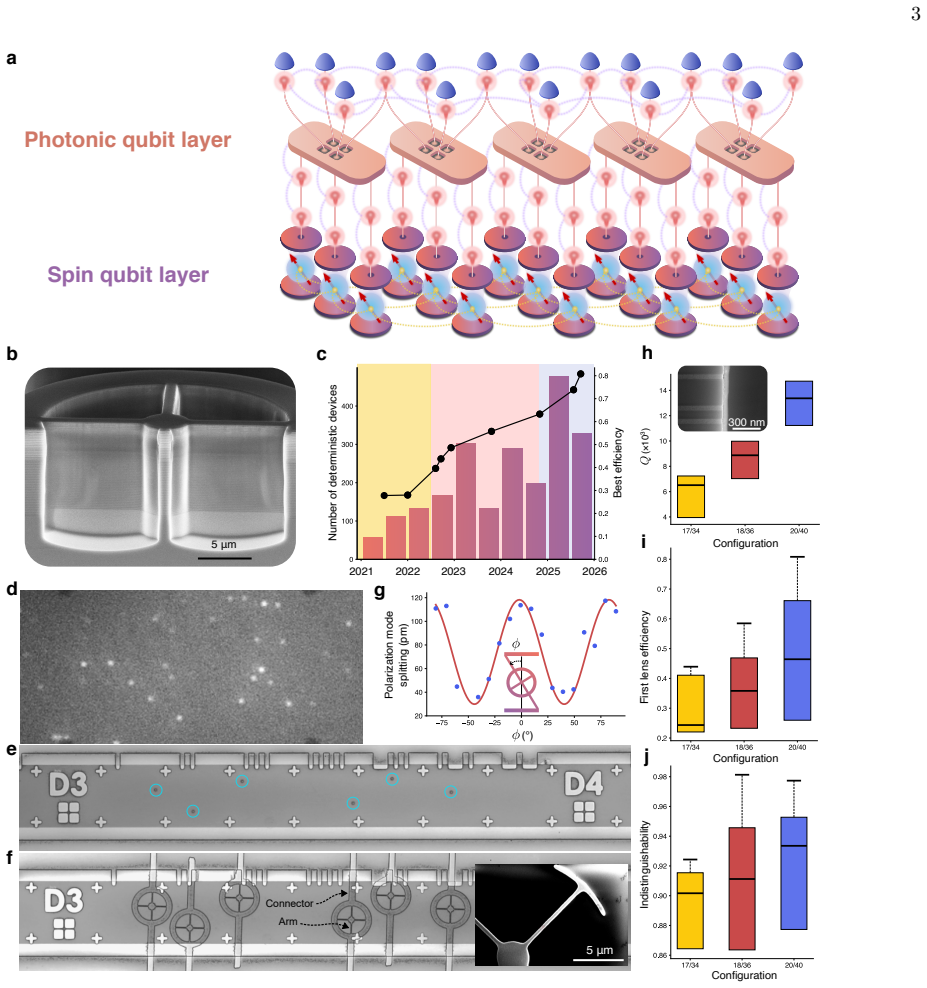
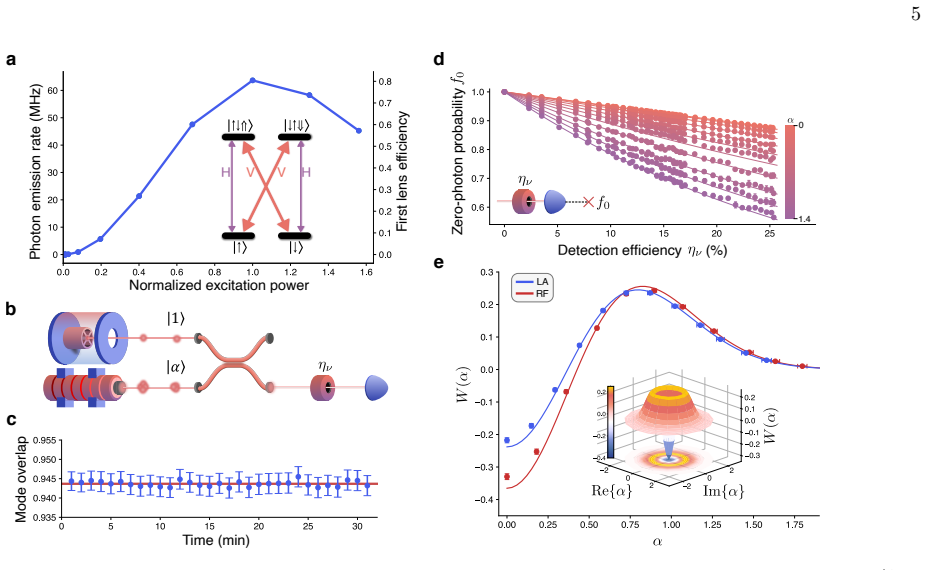
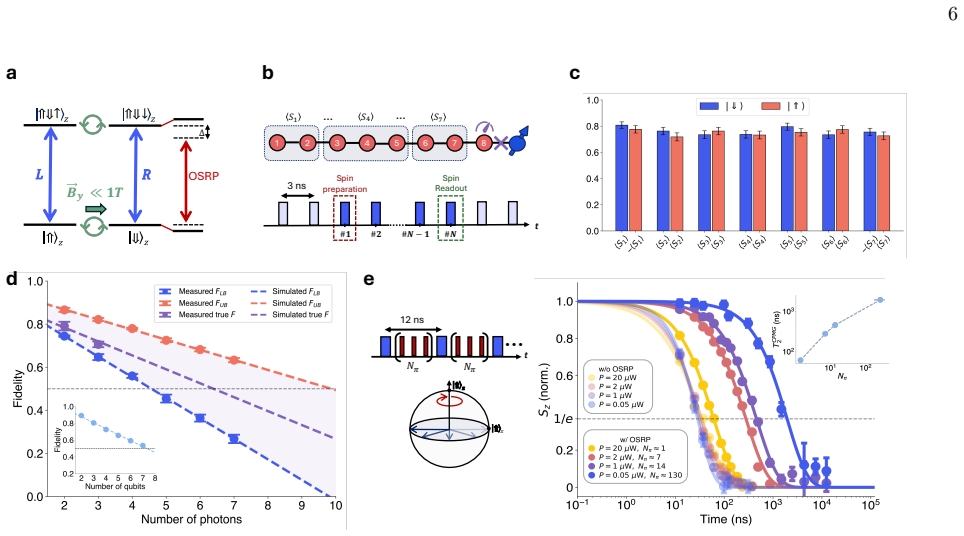
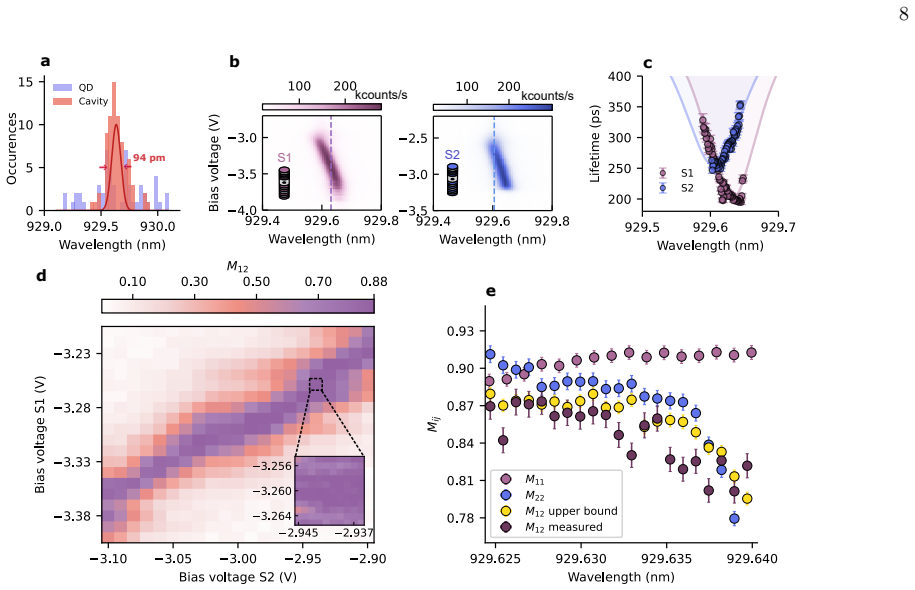
Thousands of monolithic semiconductor quantum-dot devices fabricated using a III-V pilot production-line process achieve state-of-the-art efficiency, near-unity photon quantum purity stable over tens of minutes, a record single-photon Wigner-function negativity, seven-partite spin-multi-photon entanglement, microsecond spin coherence, and indistinguishability between photons from distant sources equivalent to successive emission from one source.
What carries the argument
Cavity-coupled quantum dots that serve as spin-photon interfaces for on-demand single-photon generation and multi-partite entanglement.
If this is right
- Optical losses in hybrid systems can be lowered below error-correction thresholds by tuning the same source parameters.
- Distant devices can be treated as interchangeable photon sources in networked architectures.
- Spin coherence in the low-field regime is long enough to support microsecond-scale gate operations.
- The foundry process supplies the reproducibility needed for arrays of thousands of interfaces.
Where Pith is reading between the lines
- Integration with on-chip waveguides or other photonic components could test whether the reported metrics survive full system assembly.
- The same fabrication flow might be adapted to produce devices at different wavelengths for multi-color quantum networks.
- If the entanglement verification holds without post-selection, these sources could directly feed linear-optical gates.
- Extending the pilot-line yield data to larger wafer batches would indicate the cost scaling for error-corrected processors.
Load-bearing premise
The field-quadrature state reconstruction and entanglement verification protocols extract the reported efficiency, purity, and correlations without hidden biases from detectors, timing, or post-selection.
What would settle it
A measurement in which the same devices, under identical drive conditions, yield joint efficiency and purity values below fault-tolerance thresholds when the reconstruction protocol is replaced by direct photon counting.
Figures
read the original abstract
Hybrid photonic quantum computers, combining stationary matter qubits and flying photonic qubits, offer an intrinsically networked and resource-efficient route to large-scale, error-corrected quantum computation. Their core components are cavity-coupled matter qubits that act as light--matter interfaces, enabling: high-efficiency on-demand single-photon generation, stable near-unity photon indistinguishability and spin--multi-photon entanglement. Semiconductor quantum dots in microcavities are a leading platform for realizing such devices. Yet reaching the performance, reproducibility and spin-coherence thresholds for large-scale error correction remains a major challenge requiring industrial fabrication and control. Here we report thousands of monolithic semiconductor quantum-dot devices fabricated using a III--V pilot production-line process compatible with large-scale deployment. Systematic control of source parameters yields state-of-the-art efficiency and supports a path to optical losses below fault-tolerance thresholds. Using field-quadrature state reconstruction as a stringent joint test of efficiency and indistinguishability, we observe near-unity photon quantum purity stable over tens of minutes and a record single-photon Wigner-function negativity. We further demonstrate seven-partite spin--multi-photon entanglement and spin coherence extendable to microsecond timescales in the low-magnetic-field regime. Finally, photons from distant sources are as indistinguishable as photons emitted successively by a single source. These results establish foundry-compatible III--V quantum dots as a scalable platform for hybrid photonic quantum computing.
Editorial analysis
A structured set of objections, weighed in public.
Referee Report
Summary. The manuscript reports the fabrication of thousands of monolithic semiconductor quantum-dot devices via a III-V pilot production-line process. It claims state-of-the-art efficiency, near-unity photon quantum purity stable over tens of minutes, a record single-photon Wigner-function negativity, seven-partite spin-multi-photon entanglement, microsecond spin coherence in the low-magnetic-field regime, and photon indistinguishability between distant sources equivalent to successive emission from a single source, positioning the platform for hybrid photonic quantum computing.
Significance. If the reported metrics are substantiated, the work would be significant for hybrid quantum computing by demonstrating industrial-scale reproducibility of high-performance spin-photon interfaces. The scale of device fabrication (thousands) and the use of field-quadrature state reconstruction as a joint test of efficiency and indistinguishability are concrete strengths that directly address reproducibility and performance thresholds for error correction.
major comments (2)
- [Field-quadrature state reconstruction section] Field-quadrature state reconstruction section: The central claims of near-unity purity, record Wigner negativity, and joint efficiency rest on this protocol. The manuscript does not detail explicit corrections or error budgets for timing jitter, detector inefficiency mismatch, or post-selection on coincidence windows, leaving open the possibility that reported values exceed the true physical performance and alter relevance to fault-tolerance thresholds.
- [Entanglement verification section] Entanglement verification section: The seven-partite spin-multi-photon entanglement claim depends on the verification protocol. Without explicit description of how the witness accounts for experimental imperfections (e.g., finite detector efficiency or timing jitter) or provision of the full analysis pipeline, it is not possible to confirm that the reported correlations are free of undetected biases that would change the interpretation.
Simulated Author's Rebuttal
We thank the referee for the constructive feedback. The two major comments both request additional methodological detail on error accounting. We will revise the manuscript to supply these details explicitly, thereby strengthening the substantiation of the reported metrics without altering the underlying claims.
read point-by-point responses
-
Referee: [Field-quadrature state reconstruction section] Field-quadrature state reconstruction section: The central claims of near-unity purity, record Wigner negativity, and joint efficiency rest on this protocol. The manuscript does not detail explicit corrections or error budgets for timing jitter, detector inefficiency mismatch, or post-selection on coincidence windows, leaving open the possibility that reported values exceed the true physical performance and alter relevance to fault-tolerance thresholds.
Authors: We agree that an explicit error budget is required for full substantiation. The revised manuscript will add a dedicated subsection (or supplementary note) that quantifies the contributions from timing jitter, detector inefficiency mismatch, and coincidence-window post-selection, together with the propagated uncertainties on purity, Wigner negativity, and efficiency. This will demonstrate that the reported values remain above the relevant fault-tolerance thresholds after correction. revision: yes
-
Referee: [Entanglement verification section] Entanglement verification section: The seven-partite spin-multi-photon entanglement claim depends on the verification protocol. Without explicit description of how the witness accounts for experimental imperfections (e.g., finite detector efficiency or timing jitter) or provision of the full analysis pipeline, it is not possible to confirm that the reported correlations are free of undetected biases that would change the interpretation.
Authors: We accept that the witness analysis must be presented with explicit accounting for imperfections. The revised version will expand the entanglement-verification section to include (i) the precise form of the witness operator, (ii) how finite detector efficiency and timing jitter are folded into the expectation-value calculation, and (iii) either the full analysis code or a step-by-step pipeline description in the supplement. This will allow independent verification that no undetected bias alters the seven-partite entanglement conclusion. revision: yes
Circularity Check
No circularity: direct experimental report with no derivations or self-referential steps
full rationale
This is a pure experimental paper reporting fabrication yields, measured efficiencies, photon purities, Wigner negativities, and entanglement witnesses from quantum-dot devices. No equations, predictions, or ansatzes are presented that could reduce to fitted inputs, self-citations, or self-definitions. Field-quadrature reconstruction and entanglement verification are standard data-analysis protocols applied to raw measurements; they do not constitute a derivation chain whose outputs are forced by the paper's own inputs. The central claims rest on empirical observations, not on any load-bearing theoretical step that loops back to itself.
Axiom & Free-Parameter Ledger
Reference graph
Works this paper leans on
-
[1]
J. Wang, F. Sciarrino, A. Laing, and M. G. Thompson, Nature photonics14, 273 (2020)
2020
-
[2]
Bartolucci, P
S. Bartolucci, P. Birchall, H. Bombin, H. Cable, C. Daw- son, M. Gimeno-Segovia, E. Johnston, K. Kieling, N. Nickerson, M. Pant,et al., Nature Communications 14, 912 (2023)
2023
-
[3]
PsiQuantum team, Nature641, 876 (2025)
2025
-
[4]
Knill, R
E. Knill, R. Laflamme, and G. J. Milburn, Nature409, 46 (2001)
2001
-
[5]
D. E. Browne and T. Rudolph, Physical Review Letters 95, 010501 (2005)
2005
-
[6]
Y. Li, P. C. Humphreys, G. J. Mendoza, and S. C. Ben- jamin, Physical Review X5, 041007 (2015)
2015
-
[7]
S. C. Wein, T. Goubault de Brugière, L. Music, P. Senel- lart, B. Bourdoncle, and S. Mansfield, PRX Quantum6, 040362 (2025)
2025
-
[8]
S. X. Chen, M. C. Löbl, M. L. Chan, A. S. Sørensen, and S. Paesani, npj Quantum Information 10.1038/s41534- 026-01233-y (2026)
-
[9]
N. Manohar, A. Danageozian, E. Takou, E. Barnes, and S. E. Economou, Protocol for efficient generation of fusion-based quantum computing resource states from quantum emitters (2026), arXiv:2605.09325 [quant-ph]
Pith/arXiv arXiv 2026
-
[10]
G. d. Gliniasty, P. Hilaire, P.-E. Emeriau, S. C. Wein, A. Salavrakos, and S. Mansfield, Quantum8, 1423 (2024)
2024
-
[11]
T. Dessertaine, B. Bourdoncle, A. Denys, G. d. Gliniasty, P. C. d’Istria, G. Valentí-Rojas, S. Mansfield, and P. Hi- laire, Enhanced Fault-tolerance in Photonic Quantum Computing: Comparing the Honeycomb Floquet Code and the Surface Code in Tailored Architecture (2026), arXiv:2410.07065 [quant-ph]
arXiv 2026
-
[12]
M. L. Chan, A. A. Capatos, P. Lodahl, A. S. Sørensen, and S. Paesani, Practical blueprint for low-depth pho- tonic quantum computing with quantum dots (2025), 2507.16152 [quant-ph]
Pith/arXiv arXiv 2025
-
[13]
Lodahl, S
P. Lodahl, S. Mahmoodian, and S. Stobbe, Rev. Mod. Phys.87, 347 (2015)
2015
-
[14]
Senellart, G
P. Senellart, G. Solomon, and A. White, Nature Nan- otechnology12, 1026 (2017)
2017
-
[15]
M. H. Appel, A. Tiranov, A. Javadi, M. C. Löbl, Y. Wang, S. Scholz, A. D. Wieck, A. Ludwig, R. J. Warburton, and P. Lodahl, Physical Review Letters126, 013602 (2021)
2021
-
[16]
Coste, M
N. Coste, M. Gundin, D. A. Fioretto, S. E. Thomas, C. Millet, E. Mehdi, N. Somaschi, M. Morassi, M. Pont, A. Lemaître, N. Belabas, O. Krebs, L. Lanco, and P. Senellart, Quantum Sci. Technol.8, 025021 (2023)
2023
-
[17]
M. R. Hogg, N. O. Antoniadis, M. A. Marczak, G. N. Nguyen, T. L. Baltisberger, A. Javadi, R. Schott, S. R. Valentin, A. D. Wieck, A. Ludwig, and R. J. Warburton, Nature Physics21, 1475 (2025). 10
2025
-
[18]
Mehdi, M
E. Mehdi, M. Gundín, C. Millet, N. Somaschi, A. Lemaître, I. Sagnes, L. Le Gratiet, D. A. Fioretto, N. Belabas, O. Krebs, P. Senellart, and L. Lanco, Nature Communications15, 598 (2024)
2024
-
[19]
Somaschi, V
N. Somaschi, V. Giesz, L. De Santis, J. C. Loredo, M. P. Almeida, G. Hornecker, S. L. Portalupi, T. Grange, C. Antón, J. Demory, C. Gómez, I. Sagnes, N. D. Lanzillotti-Kimura, A. Lemaítre, A. Auffeves, A. G. White, L. Lanco, and P. Senellart, Nature Photonics10, 340 (2016), publisher: Nature Publishing Group
2016
-
[20]
Wang, Y.-M
H. Wang, Y.-M. He, T.-H. Chung, H. Hu, Y. Yu, S. Chen, X. Ding, M.-C. Chen, J. Qin, X. Yang, R.-Z. Liu, Z.- C. Duan, J.-P. Li, S. Gerhardt, K. Winkler, J. Jurkat, L.-J. Wang, N. Gregersen, Y.-H. Huo, Q. Dai, S. Yu, S. Höfling, C.-Y. Lu, and J.-W. Pan, Nature Photonics 13, 770–775 (2019)
2019
-
[21]
N. Tomm, A. Javadi, N. O. Antoniadis, D. Najer, M. C. Löbl, A. R. Korsch, R. Schott, S. R. Valentin, A. D. Wieck, A. Ludwig, and R. J. Warburton, Nature Nan- otechnology16, 399–403 (2021)
2021
-
[22]
Thomas, M
S. Thomas, M. Billard, N. Coste, S. Wein, Priya, H. Ol- livier, O. Krebs, L. Tazaïrt, A. Harouri, A. Lemaitre, I. Sagnes, C. Anton, L. Lanco, N. Somaschi, J. Loredo, and P. Senellart, Physical Review Letters126, 233601 (2021)
2021
-
[23]
Ding, Y.-P
X. Ding, Y.-P. Guo, M.-C. Xu, R.-Z. Liu, G.-Y. Zou, J.- Y. Zhao, Z.-X. Ge, Q.-H. Zhang, H.-L. Liu, L.-J. Wang, M.-C. Chen, H. Wang, Y.-M. He, Y.-H. Huo, C.-Y. Lu, and J.-W. Pan, Nature Photonics , 1 (2025), publisher: Nature Publishing Group
2025
-
[24]
J. C. Loredo, L. Stefan, B. Krogh, R. Jensen, I. Suleiman, S. Krüger, M. Bergamin, H. Thyrrestrup, S. Budtz, J. Roulund, Z. Liu, X. Zhao, L. Vertchenko, A. Lud- wig, O. A. D. Sandberg, and P. Lodahl, Applied Physics Reviews13, 011326 (2026)
2026
-
[25]
N. H. Lindner and T. Rudolph, Phys. Rev. Lett.103, 113602 (2009)
2009
-
[26]
Cogan, Z.-E
D. Cogan, Z.-E. Su, O. Kenneth, and D. Gershoni, Na- ture Photonics17, 324 (2023)
2023
-
[27]
Z.-E. Su, B. Taitler, I. Schwartz, D. Cogan, I. Nassar, O. Kenneth, N. H. Lindner, and D. Gershoni, Rep. Prog. Phys.87, 077601 (2024)
2024
-
[28]
Coste, D
N. Coste, D. A. Fioretto, N. Belabas, S. C. Wein, P. Hi- laire, R. Frantzeskakis, M. Gundin, B. Goes, N. So- maschi, M. Morassi, A. Lemaître, I. Sagnes, A. Harouri, S. E. Economou, A. Auffeves, O. Krebs, L. Lanco, and P. Senellart, Nature Photonics17, 582 (2023), publisher: Nature Publishing Group
2023
-
[29]
H. Huet, P. R. Ramesh, S. C. Wein, N. Coste, P. Hi- laire, N. Somaschi, M. Morassi, A. Lemaître, I. Sagnes, M. F. Doty, O. Krebs, L. Lanco, D. A. Fioretto, and P. Senellart, Nature Communications16, 1 (2025), pub- lisher: Nature Publishing Group
2025
-
[30]
M. H. Appel, A. Tiranov, S. Pabst, M. L. Chan, C. Starup, Y. Wang, L. Midolo, K. Tiurev, S. Scholz, A. D. Wieck, A. Ludwig, A. S. Sørensen, and P. Lodahl, Physical Review Letters128, 233602 (2022)
2022
-
[31]
Y. Meng, M. L. Chan, R. B. Nielsen, M. H. Appel, Z. Liu, Y. Wang, N. Bart, A. D. Wieck, A. Ludwig, L. Midolo, A. Tiranov, A. S. Sørensen, and P. Lodahl, Nature Com- munications15, 7774 (2024)
2024
-
[32]
Y.Meng, C.F.D.Faurby, M.L.Chan, R.B.Nielsen, P.I. Sund, Z. Liu, Y. Wang, N. Bart, A. D. Wieck, A. Ludwig, L. Midolo, A. S. Sørensen, S. Paesani, and P. Lodahl, Nature Communications16, 7602 (2025)
2025
-
[33]
P. Laccotripes, J. Huang, G. Shooter, A. Barbiero, M. S. Winnel, D.A.Ritchie, A.J.Shields, T.Muller,andR.M. Stevenson, An entangled photon source for the telecom C-band based on a semiconductor-confined spin (2025), arXiv:2507.01648 [quant-ph]
arXiv 2025
-
[34]
Laccotripes, T
P. Laccotripes, T. Müller, R. M. Stevenson, J. Skiba- Szymanska, D. A. Ritchie, and A. J. Shields, Nature Communications15, 9740 (2024)
2024
-
[35]
S. X. Chen, M. C. Löbl, M. L. Chan, A. S. Sørensen, and S. Paesani, npj Quantum Information (2026)
2026
-
[36]
Dousse, L
A. Dousse, L. Lanco, J. Suffczyński, E. Semenova, A. Mi- ard, A. Lemaître, I. Sagnes, C. Roblin, J. Bloch, and P. Senellart, Physical Review Letters101, 267404 (2008)
2008
-
[37]
A. M. Barth, S. Lüker, A. Vagov, D. E. Reiter, T. Kuhn, and V. M. Axt, Phys. Rev. B94, 045306 (2016)
2016
-
[38]
Cosacchi, F
M. Cosacchi, F. Ungar, M. Cygorek, A. Vagov, and V. M. Axt, Phys. Rev. Lett.123, 017403 (2019)
2019
-
[39]
C. Gustin and S. Hughes, Advanced Quantum Technologies3, 1900073 (2020), https://advanced.onlinelibrary.wiley.com/doi/pdf/10.1002/qute.201900073
-
[40]
Wigner, Physical Review40, 749–759 (1932)
E. Wigner, Physical Review40, 749–759 (1932)
1932
-
[41]
Hillery, R
M. Hillery, R. O’Connell, M. Scully, and E. Wigner, Physics Reports106, 121–167 (1984)
1984
-
[42]
A. I. Lvovsky and M. G. Raymer, Reviews of Modern Physics81, 299–332 (2009)
2009
-
[43]
Royer, Physical Review Letters55, 2745–2748 (1985)
A. Royer, Physical Review Letters55, 2745–2748 (1985)
1985
-
[44]
Banaszek and K
K. Banaszek and K. Wódkiewicz, Physical Review Let- ters76, 4344–4347 (1996)
1996
-
[45]
Bertet, A
P. Bertet, A. Auffeves, P. Maioli, S. Osnaghi, T. Meunier, M. Brune, J. M. Raimond, and S. Haroche, Physical Re- view Letters89, 200402 (2002)
2002
-
[46]
Laiho, M
K. Laiho, M. Avenhaus, K. N. Cassemiro, and C. Silber- horn, New Journal of Physics11, 043012 (2009)
2009
-
[47]
Laiho, K
K. Laiho, K. N. Cassemiro, D. Gross, and C. Silberhorn, Physical Review Letters105, 253603 (2010)
2010
-
[48]
Zambra, A
G. Zambra, A. Andreoni, M. Bondani, M. Gramegna, M. Genovese, G. Brida, A. Rossi, and M. G. A. Paris, Physical Review Letters95, 063602 (2005)
2005
-
[49]
A. R. Rossi, S. Olivares, and M. G. A. Paris, Physical Review A70, 10.1103/physreva.70.055801 (2004)
-
[50]
Allevi, A
A. Allevi, A. Andreoni, M. Bondani, G. Brida, M. Gen- ovese, M. Gramegna, P. Traina, S. Olivares, M. G. A. Paris, and G. Zambra, Physical Review A80, 022114 (2009)
2009
-
[51]
S. Zhang, X. Zou, C. Li, C. Jin, and G. Guo, Physical Review A80, 10.1103/physreva.80.043807 (2009)
-
[52]
Leonhardt, Measuring the Quantum State of Light (Cambridge University Press, Cambridge, 1997)
U. Leonhardt, Measuring the Quantum State of Light (Cambridge University Press, Cambridge, 1997)
1997
-
[53]
Ourjoumtsev, R
A. Ourjoumtsev, R. Tualle-Brouri, and P. Grangier, Physical Review Letters96, 213601 (2006), publisher: American Physical Society
2006
-
[54]
Nehra, A
R. Nehra, A. Win, M. Eaton, R. Shahrokhshahi, N. Srid- har, T. Gerrits, A. Lita, S. W. Nam, and O. Pfister, Op- tica6, 1356 (2019), publisher: Optica Publishing Group
2019
- [55]
-
[56]
Tóth and O
G. Tóth and O. Gühne, Physical Review A72, 022340 (2005)
2005
-
[57]
B. Urbaszek, X. Marie, T. Amand, O. Krebs, P. Voisin, P. Maletinsky, A. Hogele, and A. Imamoglu, Reviews of Modern Physics85, 79 (2013), arXiv:1202.4637 [cond- mat]. 11
Pith/arXiv arXiv 2013
-
[58]
Bechtold, D
A. Bechtold, D. Rauch, F. Li, T. Simmet, P.-L. Ardelt, A. Regler, K. Müller, N. A. Sinitsyn, and J. J. Finley, Nature Physics11, 1005 (2015)
2015
-
[59]
Press, K
D. Press, K. De Greve, P. L. McMahon, T. D. Ladd, B. Friess, C. Schneider, M. Kamp, S. Höfling, A. Forchel, and Y. Yamamoto, Nature Photonics4, 367 (2010), num- ber: 6
2010
-
[60]
Zaporski, N
L. Zaporski, N. Shofer, J. H. Bodey, S. Manna, G.Gillard, M.H.Appel, C.Schimpf, S.F.CovredaSilva, J. Jarman, G. Delamare, G. Park, U. Haeusler, E. A. Chekhovich, A. Rastelli, D. A. Gangloff, M. Atatüre, and C. Le Gall, Nature Nanotechnology18, 257 (2023)
2023
-
[61]
H. Y. Carr and E. M. Purcell, Physical Review94, 630 (1954)
1954
-
[62]
L. Cywinski, R. M. Lutchyn, C. P. Nave, and S. D. Sarma, Physical Review B77, 174509 (2008), arXiv:0712.2225 [cond-mat, physics:quant-ph]
Pith/arXiv arXiv 2008
-
[63]
L. Zhai, G. N. Nguyen, C. Spinnler, J. Ritzmann, M. C. Löbl, A. D. Wieck, A. Ludwig, A. Javadi, and R. J. War- burton, Nature Nanotechnology17, 829 (2022), number: 8
2022
-
[64]
Surpassing the en- ergy resolution limit with ferromagnetic torque sensors,
T. Grange, N. Somaschi, C. Antón, L. De Santis, G. Cop- pola, V. Giesz, A. Lemaître, I. Sagnes, A. Auffèves, and P. Senellart, Physical Review Letters118, 10.1103/phys- revlett.118.253602 (2017)
discussion (0)
Sign in with ORCID, Apple, or X to comment. Anyone can read and Pith papers without signing in.