Unraveling the Imprints of Fluctuation-dynamo on the Intracluster Medium with the SKA
Pith reviewed 2026-06-29 03:53 UTC · model grok-4.3
The pith
Fluctuation dynamo in galaxy cluster gas produces filamentary magnetic fields whose synchrotron emission SKA-Mid can detect above 3 GHz to measure turbulence scales.
A machine-rendered reading of the paper's core claim, the machinery that carries it, and where it could break.
Core claim
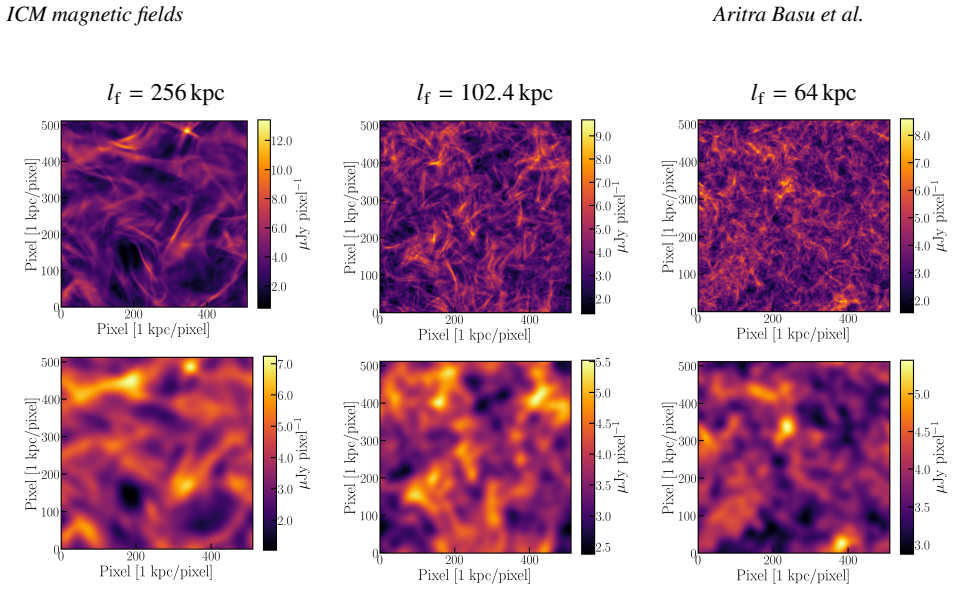
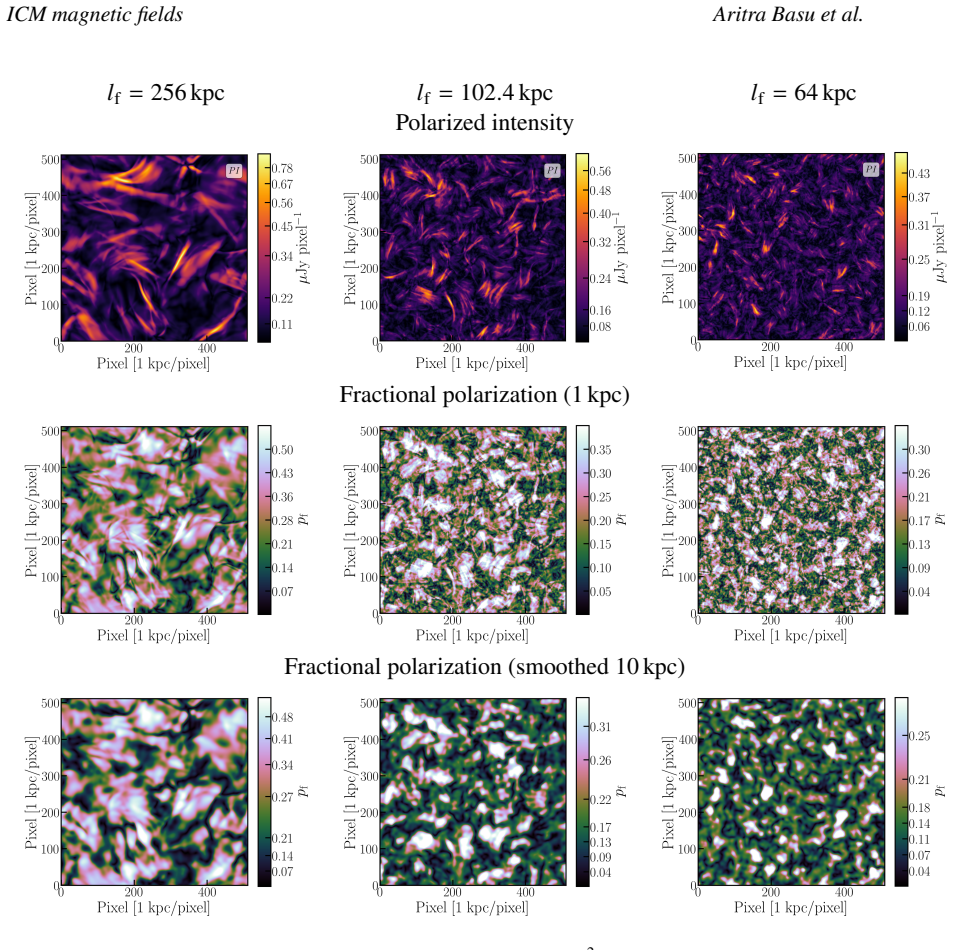
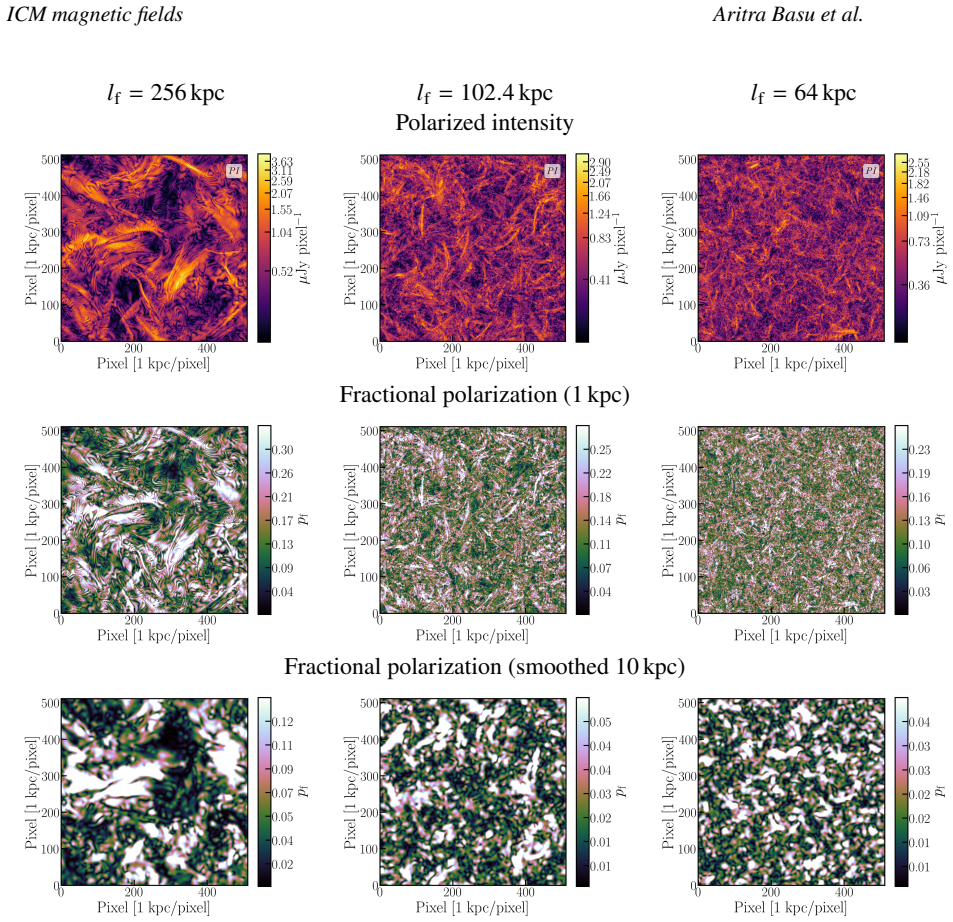
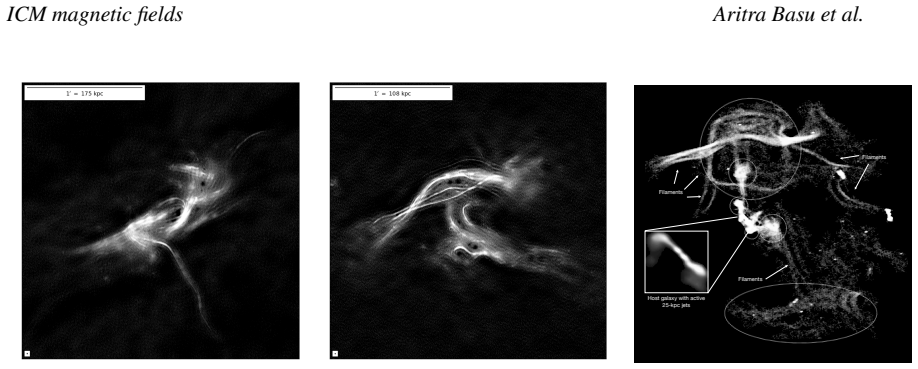
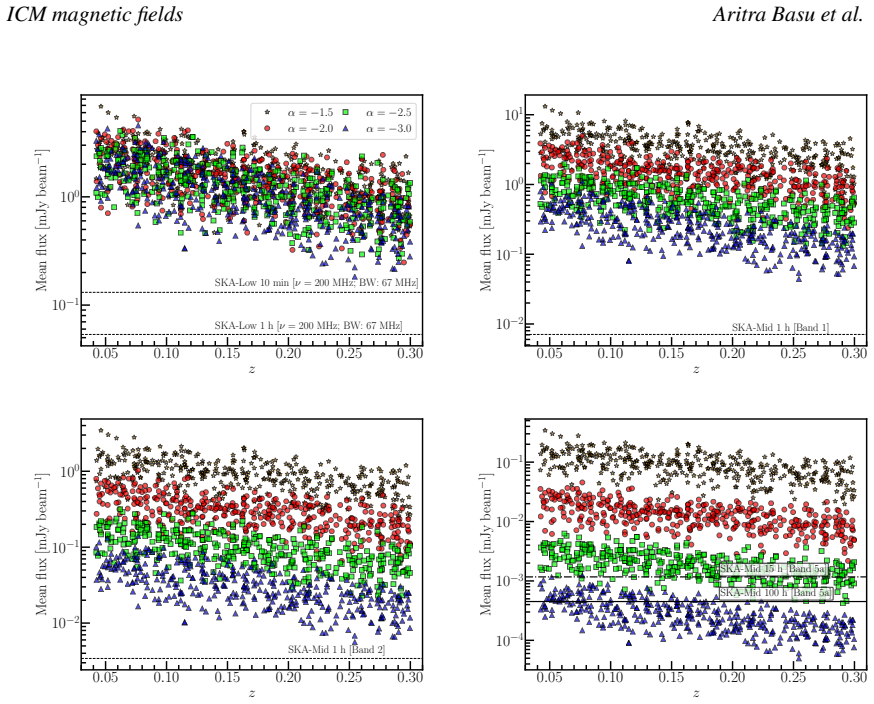
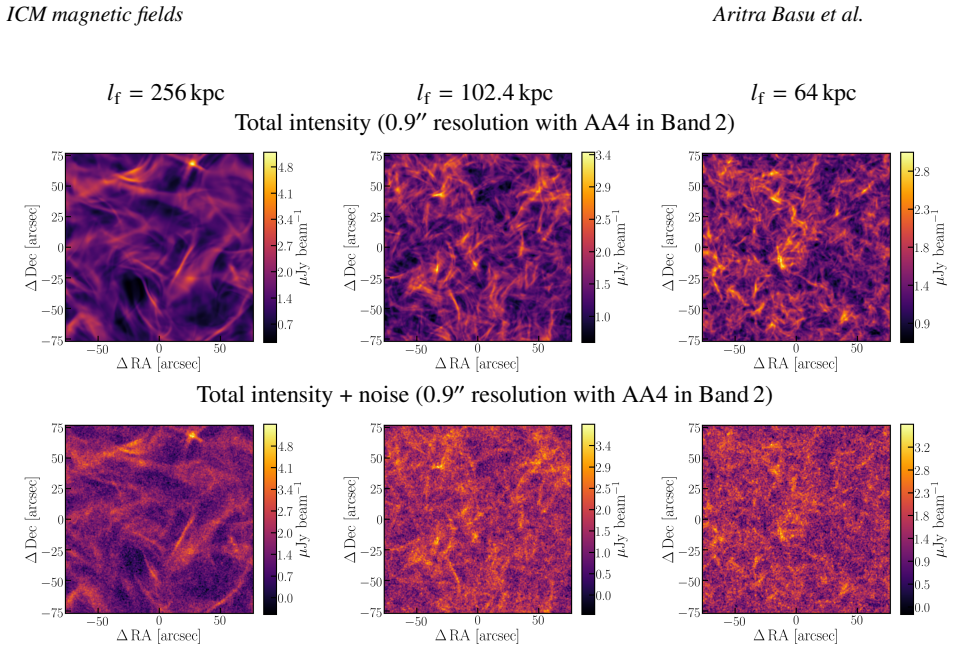
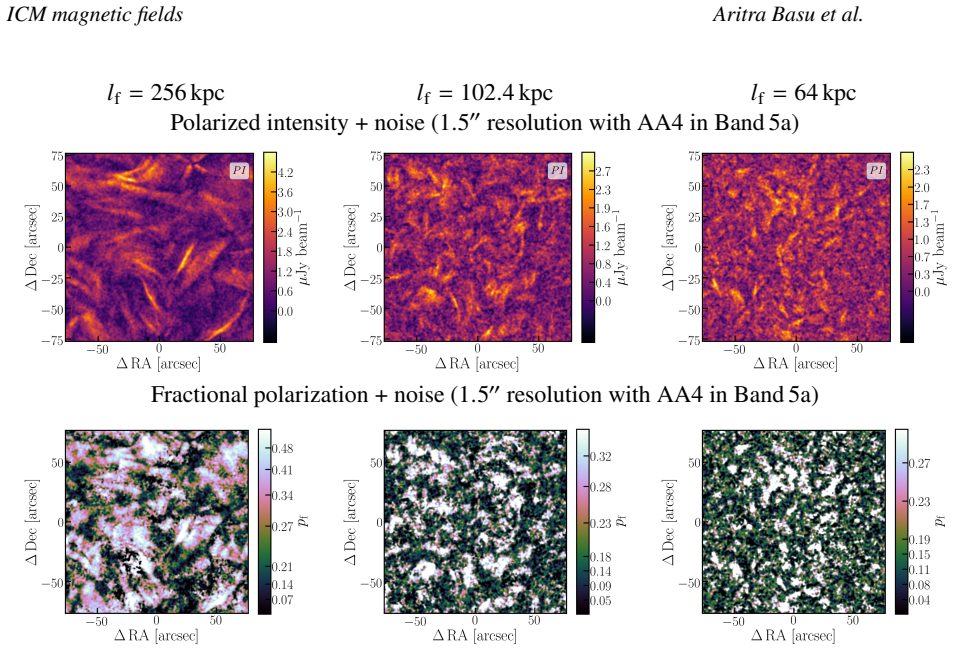
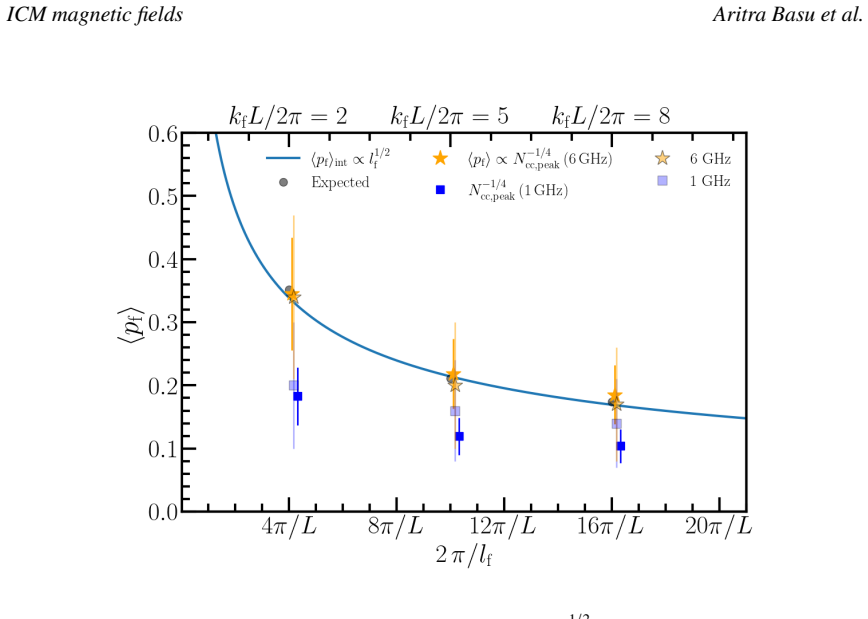
Fluctuation dynamo action in the ICM generates ubiquitous filamentary and sheet-like magnetic field structures. The associated synchrotron emission projected in the plane of the sky appears highly filamentary and can span hundreds of kiloparsecs. Such filaments can be robustly identified and quantified through high angular resolution (≲1″) and sensitive (0.25–1 μJy beam−1) observations above about 3 GHz, a niche for the SKA-Mid in Band 5a. Statistical properties of the polarized emission and morphological measures such as Minkowski functionals can then be used to infer the turbulence driving scales in the ICM.
What carries the argument
synthetic maps over broad bandwidths generated from high-resolution magnetohydrodynamic simulations of fluctuation dynamo, which predict the observable polarized synchrotron morphology and coherence scales.
If this is right
- Filaments spanning hundreds of kiloparsecs can be identified and quantified with SKA-Mid Band 5a.
- Minkowski functionals and other statistical measures of the polarized maps can recover the driving scale of ICM turbulence.
- A Band 4 receiver covering 2–4 GHz would strengthen polarization studies of the ICM.
- Detection of these structures would directly constrain how magnetic fields distribute relativistic plasma and contribute to pressure balance.
Where Pith is reading between the lines
- Confirmed filamentary morphology would supply observationally grounded initial conditions for models of galaxy formation inside clusters.
- The same data sets could be re-analyzed at multiple frequencies to test how depolarization varies with observing band, an effect left implicit in the current broadband maps.
- If the inferred turbulence scales prove universal across clusters, this would link dynamo action to the broader problem of how energy is injected into the ICM during mergers.
Load-bearing premise
The synthetic maps from high-resolution magnetohydrodynamic simulations accurately represent the real polarized emission properties of the ICM, including the coherence scale and morphology of magnetic fields generated by fluctuation dynamo.
What would settle it
Deep SKA-Mid observations of a galaxy cluster at frequencies above 3 GHz with sub-arcsecond resolution and sensitivity of 0.25–1 μJy beam−1 that show no filamentary polarized structures or structures whose morphology and coherence lengths differ markedly from the simulated predictions.
Figures
read the original abstract
Studying the morphology and coherence scale of the magnetic fields in synchrotron emitting halos of galaxy clusters through detection of polarized synchrotron emission is important in order to understand how they distribute relativistic plasma, their contribution to pressure balance, and how they may affect gas content in galaxies and set up initial conditions during non-linear collapse to eventually form galaxies in the intracluster medium (ICM). Using synthetic maps over broad-bandwidths, generated from high resolution magnetohydrodynamic simulations of fluctuation dynamo, we study the efficacy of SKA-Low and Mid in Array Assembly AA4 in our quest for detecting polarized synchrotron emission from the intracluster medium (ICM). Fluctuation dynamo action in the ICM are expected to generate ubiquitous filamentary and sheet-like magnetic field structures. The associated synchrotron emission projected in the plane of the sky appear highly filamentary that can span hundreds of kiloparsecs. Such filaments can be robustly identified and quantified through high angular resolution ($\lesssim 1^{\prime\prime}$), sensitive observations (about $\rm 0.25\textrm{--}1\,\mu Jy\,beam^{-1}$) above about 3\,GHz, a niche for the SKA-Mid in Band\,5a. Statistical properties of polarized emission and morphological measures, such as, Minkowski functionals, can then be used to infer the turbulence driving scales in the ICM with deep observations of galaxy clusters using SKA-Mid. Availability of a Band\,4 receiver covering 2--4\,GHz would be a major boost in studying the polarization properties of the ICM.
Editorial analysis
A structured set of objections, weighed in public.
Referee Report
Summary. The manuscript uses high-resolution MHD simulations of fluctuation dynamo action in the ICM to produce synthetic broadband polarized synchrotron maps. It claims that these predict ubiquitous filamentary and sheet-like magnetic field structures whose sky-projected emission is highly filamentary over hundreds of kiloparsecs, that such filaments can be robustly identified and quantified with SKA-Mid Band 5a at ≲1″ resolution and 0.25–1 μJy beam^{-1} sensitivity above 3 GHz, and that Minkowski functionals applied to deep SKA-Mid observations can infer the turbulence driving scales.
Significance. If the synthetic maps accurately capture real ICM polarized emission after projection and instrumental effects, the work would supply concrete, observationally testable predictions for SKA that could guide searches for magnetic field morphology and provide a statistical route to turbulence scales in clusters. The forward-modeling strategy itself is a methodological strength.
major comments (3)
- [Abstract] Abstract: the assertion that filaments 'can be robustly identified and quantified' is load-bearing for the central claim yet is not supported by any convergence tests with respect to Reynolds number, driving scale, or additional ICM physics (cooling, cosmic rays, AGN-driven turbulence).
- The manuscript contains no validation of the synthetic polarized maps against existing radio observations of cluster halos and no quantitative assessment of how beam convolution, Faraday rotation, or projection alter the recovered filamentary morphology and polarization fraction.
- No tests are shown demonstrating that Minkowski functionals applied to the projected maps can uniquely recover the turbulence driving scale once observational effects and noise are included; the inference step therefore remains unverified.
minor comments (1)
- [Abstract] The abstract would benefit from a brief statement of the simulation resolution and box size used to generate the maps.
Simulated Author's Rebuttal
We thank the referee for their constructive and detailed report. We address each major comment below and indicate planned revisions to the manuscript.
read point-by-point responses
-
Referee: [Abstract] Abstract: the assertion that filaments 'can be robustly identified and quantified' is load-bearing for the central claim yet is not supported by any convergence tests with respect to Reynolds number, driving scale, or additional ICM physics (cooling, cosmic rays, AGN-driven turbulence).
Authors: We agree that the claim would be strengthened by explicit convergence tests. The simulations reach the saturated dynamo regime at the highest resolutions feasible for the study, where filamentary structures emerge consistently. In the revised manuscript we will add a dedicated discussion of resolution and driving-scale dependence based on the existing runs, and will explicitly note the absence of cooling, cosmic rays and AGN-driven turbulence as a limitation. We will also moderate the wording in the abstract. revision: partial
-
Referee: The manuscript contains no validation of the synthetic polarized maps against existing radio observations of cluster halos and no quantitative assessment of how beam convolution, Faraday rotation, or projection alter the recovered filamentary morphology and polarization fraction.
Authors: Direct validation is limited by the resolution and sensitivity of existing observations, which cannot yet detect the small-scale filaments. The manuscript already presents sky-projected maps and discusses projection effects. We will add a new section providing quantitative estimates of beam-convolution and Faraday-rotation impacts using simplified models, while noting that full end-to-end instrumental simulations lie beyond the present scope. revision: partial
-
Referee: No tests are shown demonstrating that Minkowski functionals applied to the projected maps can uniquely recover the turbulence driving scale once observational effects and noise are included; the inference step therefore remains unverified.
Authors: We concur that this verification is necessary. The current results apply Minkowski functionals to ideal projected maps. In the revision we will add tests that include representative SKA-Mid noise levels and beam convolution, demonstrating the extent to which the driving scale remains recoverable. revision: yes
Circularity Check
No significant circularity; forward modeling from independent MHD simulations yields observational predictions
full rationale
The paper's derivation chain consists of generating synthetic polarized synchrotron maps from high-resolution MHD simulations of fluctuation dynamo action, then using those maps to assess SKA detectability of filamentary structures and infer turbulence scales via Minkowski functionals. No quoted step reduces a claimed prediction to a fitted input by construction, invokes a self-citation as the sole justification for a uniqueness theorem, or renames an ansatz as a first-principles result. The central claims follow from the simulated morphologies and projection effects without tautological reduction to the paper's own inputs.
Axiom & Free-Parameter Ledger
axioms (1)
- domain assumption Fluctuation dynamo generates filamentary and sheet-like magnetic fields in the ICM
Reference graph
Works this paper leans on
-
[1]
Advancing Astrophysics with the Square Kilometre Array (AASKA14) , year = 2015, month = apr, eid =
Probing the nature of Dark Matter with the SKA. Advancing Astrophysics with the Square Kilometre Array (AASKA14) , year = 2015, month = apr, eid =
2015
-
[2]
Is the radio emission in the Bullet cluster due to Dark Matter annihilation?
Is the radio emission in the Bullet cluster due to dark matter annihilation?. , keywords =. doi:10.1093/mnras/stv1377 , archiveprefix =. 1506.05651 , primaryclass =
work page internal anchor Pith review Pith/arXiv arXiv doi:10.1093/mnras/stv1377
-
[3]
Synchrotron Emission from Dark Matter Annihilation: Predictions for Constraints from Non-detections of Galaxy Clusters with New Radio Surveys. , keywords =. doi:10.3847/1538-4357/aa6748 , archiveprefix =. 1607.01049 , primaryclass =
work page internal anchor Pith review Pith/arXiv arXiv doi:10.3847/1538-4357/aa6748
-
[4]
Baryons in the plasma: in-medium effects and parity doubling
Aarts, Gert and Allton, Chris and de Boni, Davide and Hands, Simon and Jäger, Benjamin and Praki, Chrisanthi and Skullerud, Jon-Ivar. Baryons in the plasma: in-medium effects and parity doubling. Proceedings, 17th International Conference on Strangeness in Quark Matter (SQM 2017): Utrecht, The Netherlands, July 10-15, 2017. 2017. doi:10.1051/epjconf/20181...
-
[5]
2015 , editor =
PoS , slaccitation =. 2015 , editor =
2015
-
[6]
Astroparticle Physics , archiveprefix = "arXiv", eprint =
Neutrino physics from the cosmic microwave background and large scale structure. Astroparticle Physics , archiveprefix = "arXiv", eprint =. doi:10.1016/j.astropartphys.2014.05.014 , adsurl =
-
[7]
ArXiv e-prints , keywords =
CMB-S4 Science Book, First Edition. ArXiv e-prints , keywords =
-
[8]
Abbott, L. F. and Sikivie, P. , journal =. 1983 , pages =. doi:10.1016/0370-2693(83)90638-X , reportnumber =
-
[9]
Abbott, B. P. and others , journal =. 2019 , number =. doi:10.1103/PhysRevX.9.031040 , eprint =
-
[11]
Searching for Dark Matter Annihilation from Milky Way Dwarf Spheroidal Galaxies with Six Years of Fermi Large Area Telescope Data. , keywords =. doi:10.1103/PhysRevLett.115.231301 , archiveprefix =. 1503.02641 , primaryclass =
work page internal anchor Pith review Pith/arXiv arXiv doi:10.1103/physrevlett.115.231301
-
[12]
arXiv , arxivid =:1502.01594 , journal =
Ade, P. arXiv , arxivid =:1502.01594 , journal =
-
[13]
Adebahr, B and Krause, M and Klein, U and We\.zgowiec, M and Bomans, D. , title =. 2013 , pages =. doi:10.1051/0004-6361/201220226 , eprint =
-
[14]
, pages =
Adelman-McCarthy, J. , pages =
-
[15]
2019 , month =
Agrawal, Prateek and Hook, Anson and Huang, Junwu , title =. 2019 , month =
2019
-
[16]
Observations of the Sagittarius dwarf galaxy by the HESS experiment and search for a dark matter signal. Astroparticle Physics , keywords =. doi:10.1016/j.astropartphys.2007.11.007 , archiveprefix =. 0711.2369 , primaryclass =
work page internal anchor Pith review Pith/arXiv arXiv doi:10.1016/j.astropartphys.2007.11.007 2007
-
[17]
, title =. 2012 , month = dec, pages =. arXiv , doi =:1207.7137 , keywords =
Pith/arXiv arXiv 2012
-
[18]
, archiveprefix = "arXiv", eprint =
Fast Radio Bursts as Probes of Magnetic Fields in the Intergalactic Medium. , archiveprefix = "arXiv", eprint =. doi:10.3847/0004-637X/824/2/105 , adsurl =
-
[19]
ApJ , title =. 2010 , month =. arXiv , doi =:1009.0570 , keywords =
Pith/arXiv arXiv 2010
-
[20]
and Siana, B
Alavi, A. and Siana, B. and Richard, J. and Rafelski, M. and Jauzac, M. and Limousin, M. and Freeman, W. R. and Scarlata, C. and Robertson, B. and Stark, D. P. and Teplitz, H. I. and Desai, V. , journal =
-
[21]
Improved constraints on dark energy from Chandra X-ray observations of the largest relaxed galaxy clusters. , keywords =. doi:10.1111/j.1365-2966.2007.12610.x , archiveprefix =. 0706.0033 , primaryclass =
-
[22]
, title =. 1999 , month = feb, pages =. doi:10.1086/306799 , eprint =
-
[23]
, title =
Allsopp, N. , title =. 1979 , month =
1979
-
[24]
Alton, P. , title =. 2004 , pages =. doi:10.1051/0004-6361:20040438 , keywords =
-
[25]
Ananthakrishnan, S , journal =
-
[27]
Anchordoqui, Luis A. and others , journal =. 2021 , pages =. arXiv , doi =:2105.12895 , primaryclass =
arXiv 2021
-
[28]
Anchordoqui, Luis A. and others. Hunting super-heavy dark matter with ultra-high energy photons. Astropart. Phys. 2021. doi:10.1016/j.astropartphys.2021.102614. arXiv:2105.12895
-
[29]
2007 , publisher =
Model Based Inference in the Life Sciences: A Primer on Evidence , author =. 2007 , publisher =
2007
-
[30]
, archiveprefix = "arXiv", eprint =
Broadband Radio Polarimetry and Faraday Rotation of 563 Extragalactic Radio Sources. , archiveprefix = "arXiv", eprint =. doi:10.1088/0004-637X/815/1/49 , adsurl =
-
[31]
, archiveprefix = "arXiv", eprint =
A Study of Broadband Faraday Rotation and Polarization Behavior over 1.3--10 GHz in 36 Discrete Radio Sources. , archiveprefix = "arXiv", eprint =. doi:10.3847/0004-637X/825/1/59 , adsurl =
-
[32]
, title =. 2011 , month = oct, pages =. arXiv , doi =:1106.5065 , primaryclass =
Pith/arXiv arXiv 2011
-
[33]
Annibali, F and Others , journal =. 2008 , pages =. doi:10.1088/0004-6256/135/5/1900 , keywords =
-
[34]
, title =
Appleton, P. , title =. 2004 , month =
2004
-
[35]
First Dark Matter Search Results from the XENON1T Experiment
First Dark Matter Search Results from the XENON1T Experiment. , keywords =. doi:10.1103/PhysRevLett.119.181301 , archiveprefix =. 1705.06655 , primaryclass =
work page internal anchor Pith review Pith/arXiv arXiv doi:10.1103/physrevlett.119.181301
-
[36]
, title =. 1995 , month = apr, pages =. doi:10.1086/175515 , keywords =
-
[37]
Astronomical Data Analysis Software and Systems V , editor =
Arnaud, K. Astronomical Data Analysis Software and Systems V , editor =
-
[38]
, title =. 2009 , month = jan, pages =. arXiv , doi =:0810.3114 , keywords =
Pith/arXiv arXiv 2009
-
[39]
Optimum frequency band for radio polarization observations. , archiveprefix = "arXiv", eprint =. doi:10.1111/j.1365-2966.2011.19623.x , adsurl =
-
[40]
Arvanitaki, Asimina and Dimopoulos, Savas and Dubovsky, Sergei and Kaloper, Nemanja and March-Russell, John , journal =. 2010 , pages =. doi:10.1103/PhysRevD.81.123530 , eprint =
-
[41]
Astropy: A Community Python Package for Astronomy
doi:10.1051/0004-6361/201322068 , eid =. arXiv , author =:1307.6212 , journal =
work page internal anchor Pith review Pith/arXiv arXiv doi:10.1051/0004-6361/201322068
-
[42]
, keywords =. doi:10.3847/1538-3881/aabc4f , eid =
-
[43]
doi:10.1007/978-0-387-48116-6 , publisher = "
Random Fields and Geometry. doi:10.1007/978-0-387-48116-6 , publisher = "
-
[44]
arXiv e-prints , keywords =
Probing a cosmic axion-like particle background within the jets of active galactic nuclei. arXiv e-prints , keywords =. 2019
2019
-
[45]
, title =. 2013 , month = aug, pages =. arXiv , doi =:1305.7228 , keywords =
Pith/arXiv arXiv 2013
-
[46]
Simulations of galactic dynamos
Simulations of Galactic Dynamos. Magnetic Fields in Diffuse Media , year = 2015, editor =. doi:10.1007/978-3-662-44625-6_19 , archiveprefix =. 1402.0212 , primaryclass =
work page internal anchor Pith review Pith/arXiv arXiv doi:10.1007/978-3-662-44625-6_19 2015
-
[47]
, title =
Baars, J. , title =. 1977 , pages =
1977
-
[48]
Studying the morphology of H I isodensity surfaces during reionization using Shapefinders and percolation analysis. , keywords =. doi:10.1093/mnras/stz532 , archiveprefix =. 1809.05520 , primaryclass =
-
[49]
, archiveprefix = "arXiv", eprint =
The detection of an older population in the Magellanic Bridge. , archiveprefix = "arXiv", eprint =. doi:10.1051/0004-6361/201118236 , adsurl =
-
[50]
, title =. 2011 , month = aug, pages =. arXiv , doi =:1103.5734 , keywords =
Pith/arXiv arXiv 2011
-
[51]
, title =
Bajaja, E and Huchtmeier, W. , title =. 1994 , pages =
1994
-
[52]
Baldry, I. , title =. 2006 , pages =. doi:10.1111/j.1365-2966.2006.11081.x , keywords =
-
[53]
2011, , 412, 2469, 10.1111/j.1365-2966.2010.18068.x
Baldry, I. , title =. 2010 , pages =. doi:10.1111/j.1365-2966.2010.16282.x , eprint =
-
[54]
Balsara, D. , title =. 2005 , month =. doi:10.1086/452626 , keywords =
-
[55]
, title =. 2011 , month = jul, pages =. arXiv , doi =:1103.4494 , keywords =
Pith/arXiv arXiv 2011
-
[56]
Barth, A. , title =. 2009 , pages =. doi:10.1088/0004-637X/690/1/1031 , eprint =
-
[57]
Basu, Aritra and Mitra, Dipanjan and Wadadekar, Yogesh and Ishwara-Chandra, C. H. , journal =. 2012 , number =
2012
-
[58]
Basu, Aritra and Roy, Subhashis and Mitra, Dipanjan , journal =
-
[59]
, archiveprefix = "arXiv", eprint =
Magnetic fields in nearby normal galaxies: energy equipartition. , archiveprefix = "arXiv", eprint =. doi:10.1093/mnras/stt845 , adsurl =
-
[60]
ArXiv e-prints: 1402.2229 , keywords =
Basu, A and Roy, S , eprint =. ArXiv e-prints: 1402.2229 , keywords =
-
[61]
, archiveprefix = "arXiv", eprint =
Synchrotron spectral index and interstellar medium densities of star-forming galaxies. , archiveprefix = "arXiv", eprint =. doi:10.1093/mnras/stv510 , adsurl =
-
[62]
, title =. 2015 , month = apr, pages =. arXiv , doi =:1502.00330 , keywords =
Pith/arXiv arXiv 2015
-
[63]
, archiveprefix = "arXiv", eprint =
Detection of an 20 kpc coherent magnetic field in the outskirt of merging spirals: the Antennae galaxies. , archiveprefix = "arXiv", eprint =. doi:10.1093/mnras/stw2369 , adsurl =
-
[64]
, archiveprefix = "arXiv", eprint =
New insights into the interstellar medium of the dwarf galaxy IC 10: connection between magnetic fields, the radio-infrared correlation and star formation. , archiveprefix = "arXiv", eprint =. doi:10.1093/mnras/stx1567 , adsurl =
-
[65]
, title =. 2018 , month = jun, pages =. arXiv , doi =:1803.07896 , keywords =
Pith/arXiv arXiv 2018
-
[66]
CMB foreground measurements through broad-band radio spectro-polarimetry: prospects of the SKA-MPG telescope. , keywords =. 2019. doi:10.1093/mnras/stz1637 , archiveprefix =. 1906.04788 , primaryclass =
work page internal anchor Pith review Pith/arXiv arXiv doi:10.1093/mnras/stz1637 2019
-
[67]
Galaxies , volume =
Basu, Aritra and Fletcher, Andrew and Mao, Sui Ann and Burkhart, Blakesley and Beck, Rainer and Schnitzeler, Dominic , title =. Galaxies , volume =. 2019 , number =
2019
-
[68]
, title =. 2021 , month = may, number =. arXiv , doi =:2007.01440 , keywords =
arXiv 2021
-
[69]
doi:10.1098/rspa.1950.0069 , journal =
Batchelor, G. doi:10.1098/rspa.1950.0069 , journal =
-
[70]
, title =
Beck, R and Shoutenkov, V and Ehle, M and Harnett, J. , title =. 2002 , month =
2002
-
[71]
Beck, R and Shukurov, A and Sokoloff, D and Wielebinski, R , journal =. 2003 , month =. doi:10.1051/0004-6361:20031101 , keywords =
-
[72]
Beck, R and Fletcher, A and Shukurov, A and Snodin, A and Sokoloff, D. , title =. 2005 , pages =. doi:10.1051/0004-6361:20053556 , keywords =
-
[73]
Beck, R and Rees, M , booktitle =. doi:10.1007/11369875
-
[74]
Beck, R , journal =. 2006 , pages =. doi:10.1002/asna.200610575 , keywords =
-
[75]
Beck, R , journal =. 2007 , month =. doi:10.1051/0004-6361:20066988 , eprint =
-
[76]
, title =. 2012 , month = jul, pages =. arXiv , doi =:1204.5694 , keywords =
Pith/arXiv arXiv 2012
-
[77]
Beck, R and Wielebinski, R , booktitle =
-
[78]
, archiveprefix = "arXiv", eprint =
Magnetic fields in the nearby spiral galaxy IC 342: A multi-frequency radio polarization study. , archiveprefix = "arXiv", eprint =. doi:10.1051/0004-6361/201425572 , adsurl =
-
[79]
, title =. 2016 , month = dec, pages =. arXiv , doi =:1509.04522 , keywords =
Pith/arXiv arXiv 2016
-
[80]
Beck, S. , title =. 2000 , pages =. doi:10.1086/301448 , keywords =
-
[81]
2019 , month = jan, number =
Galaxies , title =. 2019 , month = jan, number =
2019
-
[82]
1982 , pages =
Beck, R and Graeve, R , journal =. 1982 , pages =
1982
discussion (0)
Sign in with ORCID, Apple, or X to comment. Anyone can read and Pith papers without signing in.