Single-Crystalline Al/Ge Heterostructure with an Atomically Sharp Commensurate Interface
Pith reviewed 2026-06-29 04:10 UTC · model grok-4.3
The pith
Epitaxial growth produces single-crystalline Al on Ge with a 7/5 commensurate interface that reduces mismatch to 0.1%.
A machine-rendered reading of the paper's core claim, the machinery that carries it, and where it could break.
Core claim
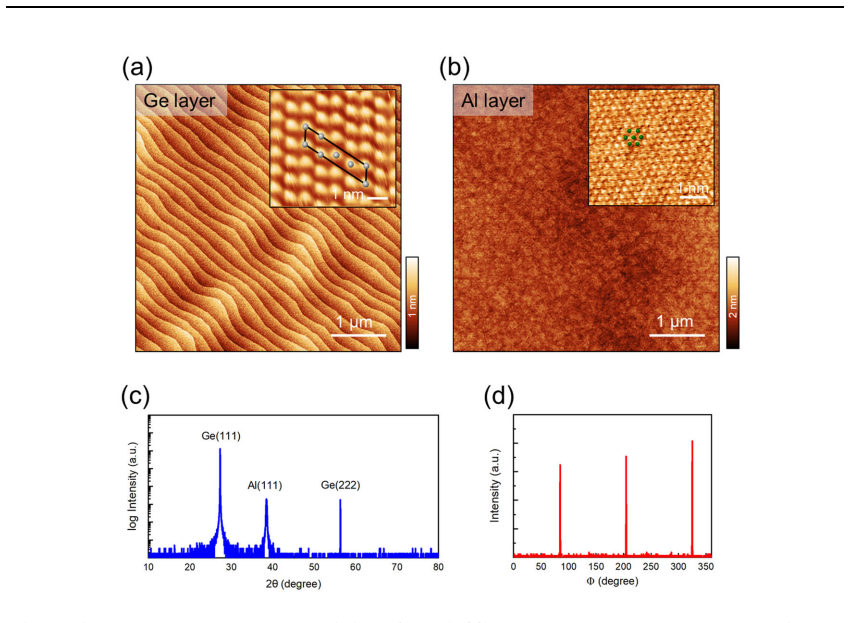
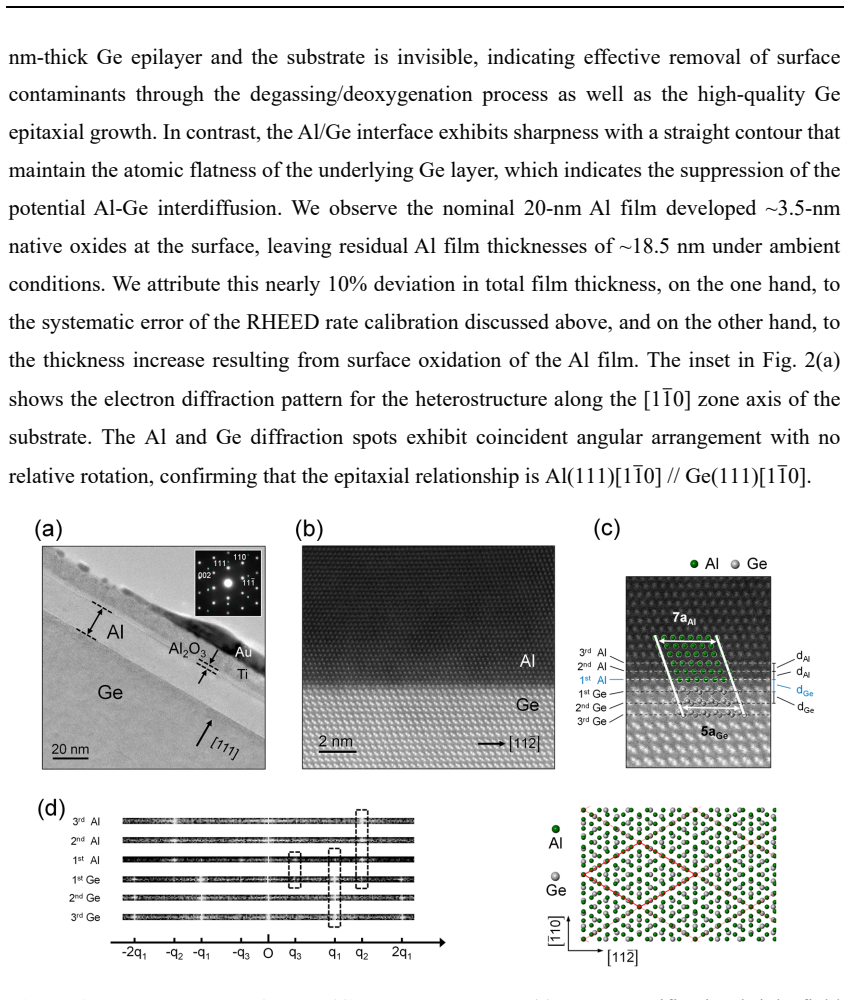
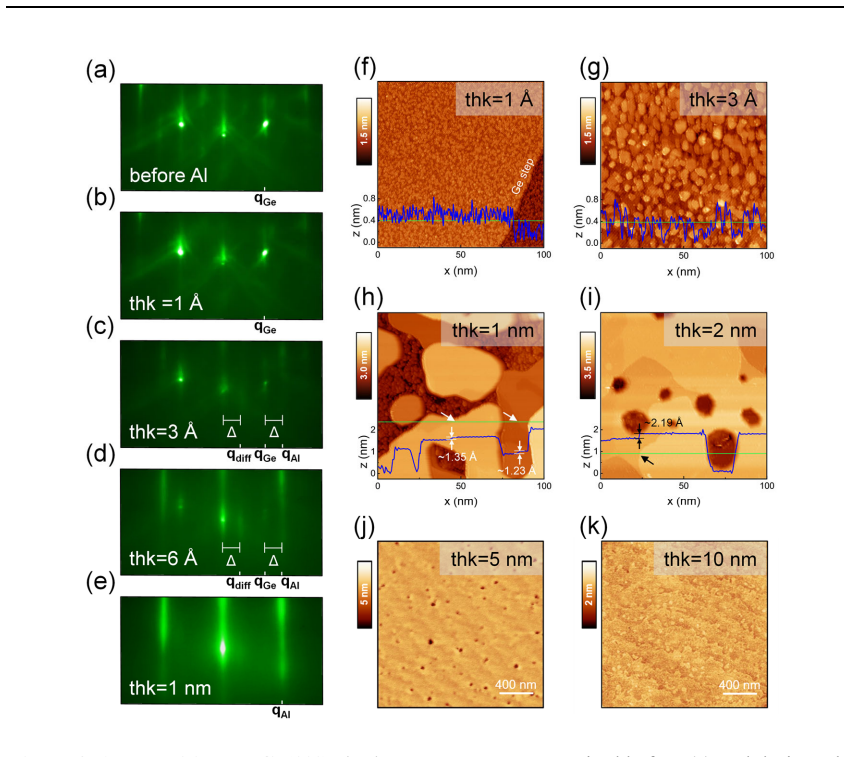
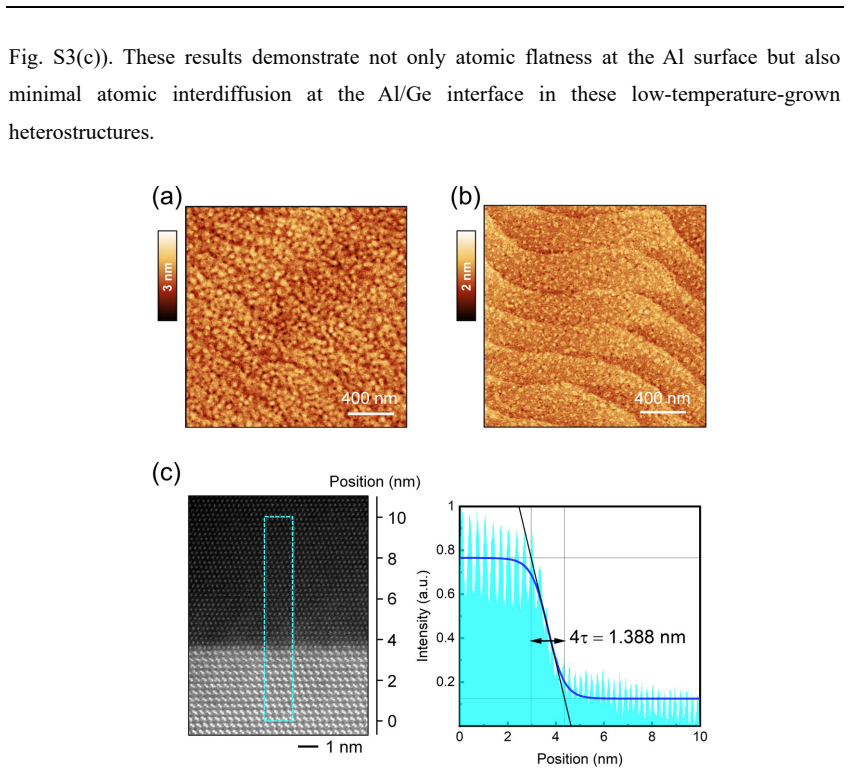
Single-crystalline Al(111) grows epitaxially on Ge(111) by molecular beam epitaxy and forms an atomically flat sharp interface through a commensurate 7-Al-lattice/5-Ge-lattice relationship that reduces the intrinsic mismatch from 28.4% to about 0.1%; the interface appears only above a critical thickness of 0.3 nm after an initial cluster-to-island transition, and the resulting films reach 2 nm thickness with 0.16 nm RMS roughness.
What carries the argument
The 7-Al-lattice/5-Ge-lattice commensurate epitaxial relationship that aligns the two lattices at the interface.
If this is right
- Continuous single-crystalline Al films can reach 2 nm thickness while maintaining 0.16 nm surface roughness.
- Elimination of grain boundaries removes the main pathway for Al-Ge interdiffusion.
- The resulting heterostructures form a platform for experiments on topological quantum states.
Where Pith is reading between the lines
- The same 7/5-style commensuration approach could be tested on other metal-semiconductor pairs that have large intrinsic mismatches.
- The thickness-dependent transition from clusters to islands suggests a general route to flat interfaces that might be modeled for predictive growth of similar systems.
- Reduced defect density at the interface would be expected to improve coherence times or yield in quantum devices built from these layers.
Load-bearing premise
The observed 7/5 relationship and absence of interdiffusion persist under the chosen growth conditions without undetected defects or grain boundaries.
What would settle it
High-resolution imaging that shows either a residual mismatch near 28.4% or measurable Al-Ge interdiffusion across the interface would disprove the atomically sharp commensurate claim.
Figures
read the original abstract
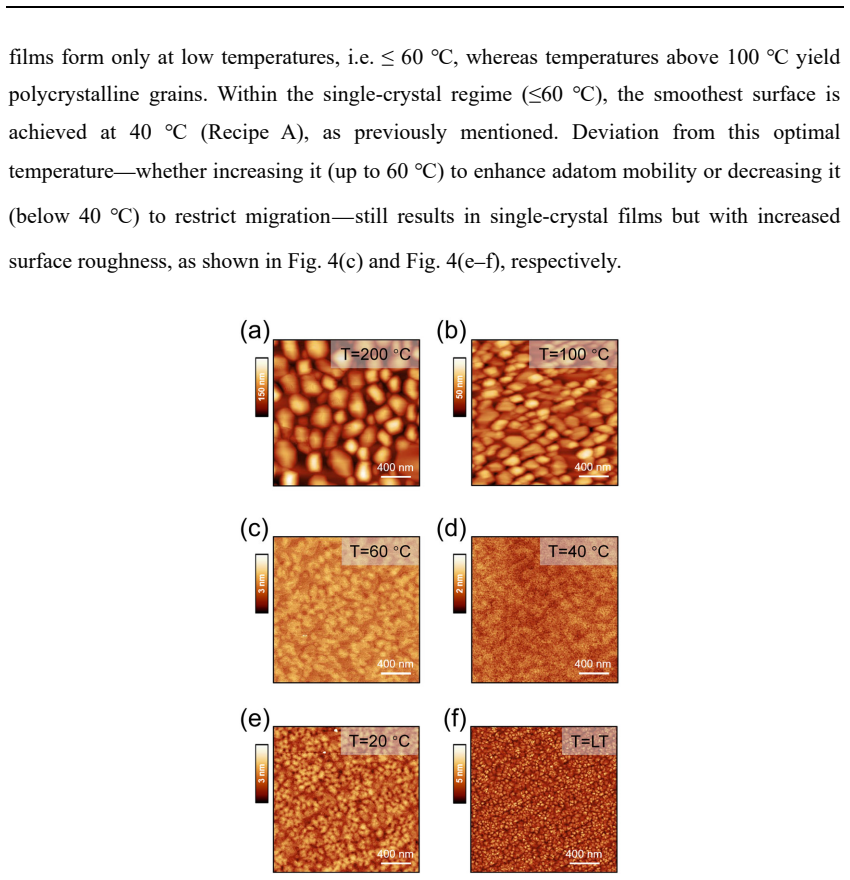
A key challenge in developing Al/Ge heterostructures for quantum applications is Al-Ge interdiffusion. This process is facilitated by grain boundaries in polycrystalline films, which degrades interface quality and impairs device performance and reliability. Here, we present epitaxial growth of single-crystalline Al(111) on Ge(111) by molecular beam epitaxy, achieving an atomically flat and sharp interface. At the interface, a commensurate 7-Al-lattice/5-Ge-lattice epitaxial relationship is observed, which dramatically reduces the intrinsic lattice mismatch from 28.4% to about 0.1%. Interestingly, this well-ordered interface does not form below a critical thickness of 0.3 nm. Instead, Al initially nucleates as random clusters, which then transform into two-dimensional (2D) islands and, as Al deposition further increases, eventually develop into a continuous film. By optimizing the growth parameters, we have achieved an ultra-flat Al film with a surface root-mean-square roughness of about 0.16 nm and an ultra-thin continuous film with thickness of only 2 nm. These epitaxially grown Al-Ge heterostructures, with their atomically flat surfaces and sharp interfaces, provide a promising platform for studying topological quantum states.
Editorial analysis
A structured set of objections, weighed in public.
Referee Report
Summary. The manuscript reports molecular beam epitaxy growth of single-crystalline Al(111) on Ge(111), achieving a commensurate 7-Al-lattice/5-Ge-lattice epitaxial relationship at the interface that reduces the 28.4% lattice mismatch to ~0.1%. It describes a nucleation sequence in which Al initially forms random clusters that transform into 2D islands above a critical thickness of 0.3 nm and eventually yield continuous ultra-thin films (2 nm) with 0.16 nm RMS roughness and an atomically flat, sharp interface, motivated by the need to suppress grain-boundary-mediated Al-Ge interdiffusion for quantum applications.
Significance. If the structural registry and morphological quality are accompanied by chemical abruptness, the result would supply a low-defect platform for studying topological states in Al/Ge heterostructures; the 7/5 commensurability and sub-3 nm continuous films represent a concrete advance over polycrystalline approaches.
major comments (2)
- [Abstract] Abstract and results sections: the central claim of an 'atomically sharp' interface without interdiffusion is supported only by morphological (AFM) and structural (RHEED/XRD/HRTEM) data showing the 7/5 registry; no EDX, EELS, or other composition-sensitive line profiles are presented to quantify possible Al-Ge intermixing, which directly bears on the paper's stated motivation to eliminate interdiffusion.
- [Results (nucleation sequence)] Growth and nucleation description: the statement that the well-ordered 7/5 interface 'does not form below a critical thickness of 0.3 nm' and that optimized parameters yield defect-free continuous films rests on the assumption that the observed cluster-to-island transition introduces neither undetected defects nor interdiffusion, yet the growth parameters themselves remain unspecified and no supporting quantitative metrics (e.g., defect density from TEM) are cited.
minor comments (1)
- The abstract refers to 'optimizing the growth parameters' without listing substrate temperature, flux ratios, or annealing steps, which would improve reproducibility even if the central structural result holds.
Simulated Author's Rebuttal
We thank the referee for the constructive comments and the opportunity to clarify our manuscript. We address the major points below.
read point-by-point responses
-
Referee: [Abstract] Abstract and results sections: the central claim of an 'atomically sharp' interface without interdiffusion is supported only by morphological (AFM) and structural (RHEED/XRD/HRTEM) data showing the 7/5 registry; no EDX, EELS, or other composition-sensitive line profiles are presented to quantify possible Al-Ge intermixing, which directly bears on the paper's stated motivation to eliminate interdiffusion.
Authors: We agree that the evidence for chemical abruptness is indirect and rests on the HRTEM observation of an atomically resolved 7/5 commensurate interface with no visible intermixing. The manuscript's motivation highlights the elimination of grain-boundary-mediated diffusion, but we do not claim to have ruled out all possible atomic-scale interdiffusion. In revision we will modify the abstract and discussion to state that the interface is structurally sharp and commensurate based on the presented diffraction and imaging data, while explicitly noting the absence of direct compositional profiling. revision: yes
-
Referee: [Results (nucleation sequence)] Growth and nucleation description: the statement that the well-ordered 7/5 interface 'does not form below a critical thickness of 0.3 nm' and that optimized parameters yield defect-free continuous films rests on the assumption that the observed cluster-to-island transition introduces neither undetected defects nor interdiffusion, yet the growth parameters themselves remain unspecified and no supporting quantitative metrics (e.g., defect density from TEM) are cited.
Authors: We will add the specific MBE growth parameters (substrate temperature, Al flux, and shutter sequences) to the Methods section in the revised manuscript. The 0.3 nm critical thickness is identified from the evolution of RHEED patterns from diffuse scattering (clusters) to sharp 7/5 spots (ordered islands). While the continuous 2 nm films exhibit 0.16 nm RMS roughness by AFM and ordered interfaces by HRTEM, we acknowledge that quantitative defect densities are not reported; we will insert a brief statement noting that defects below the resolution of the employed techniques cannot be excluded. revision: yes
- Direct chemical composition profiles (EDX or EELS) to quantify possible Al-Ge intermixing are not available in the present study.
Circularity Check
No circularity: purely experimental report
full rationale
The manuscript is an experimental materials science report on MBE growth of Al(111) on Ge(111). Central claims rest on direct morphological (AFM) and structural (RHEED/XRD/HRTEM) observations of nucleation sequence, 7/5 registry, film thickness, and roughness. No equations, fitted parameters, theoretical derivations, predictions, or ansatzes appear. No self-citation chains or uniqueness theorems are invoked to support the results. The work is self-contained against external benchmarks (standard epitaxial characterization techniques) with no reduction of outputs to inputs by construction.
Axiom & Free-Parameter Ledger
Reference graph
Works this paper leans on
-
[1]
DOI: 10.1002/adfm.201807613. (2) Myronov, M.; Kycia, J.; Waldron, P.; Jiang, W.; Barrios, P.; Bogan, A.; Coleridge, P.; Studenikin, S. Holes Outperform Electrons in Group IV Semiconductor Materials. Small Sci. 2023, 3 (4), 2200094. DOI: 10.1002/smsc.202200094. (3) Costa, D.; Stehouwer, L. E. A.; Huang, Y .; Martí-Sánchez, S.; Degli Esposti, D.; Arbiol, J....
-
[2]
(6) Gao, F.; Wang, J.-H.; Watzinger, H.; Hu, H.; Ranc ˇic´, M
DOI: 10.1021/acs.nanolett.8b01799. (6) Gao, F.; Wang, J.-H.; Watzinger, H.; Hu, H.; Ranc ˇic´, M. J.; Zhang, J.-Y .; Wang, T.; Yao, Y .; Wang, G.-L.; Kukucˇka, J.; et al. Site-Controlled Uniform Ge/Si Hut Wires with Electrically Tunable Spin–Orbit Coupling. Adv. Mater. 2020, 32 (16), 1906523. DOI: 10.1002/adma.201906523. (7) Fischer, J.; Coish, W.; Bulaev...
discussion (0)
Sign in with ORCID, Apple, or X to comment. Anyone can read and Pith papers without signing in.