Every Step of the Way: Video-based Parkinsonian Turning Step Counting
Pith reviewed 2026-06-29 04:08 UTC · model grok-4.3
The pith
A passive video framework counts turning steps in Parkinson's disease more accurately than existing wearable methods.
A machine-rendered reading of the paper's core claim, the machinery that carries it, and where it could break.
Core claim
The authors present a coarse-to-fine video-based framework that first derives foot movement signals from 3D human mesh recovery for an initial step count estimate, then employs a motion encoder with cross attention to integrate fine-grained gait dynamics from mesh and optical flow representations, and uses multiple instance learning on partitioned video clips to predict step count residuals, achieving superior performance on real-world Parkinson's disease turning datasets.
What carries the argument
The coarse-to-fine pipeline that queries pixel-level motion cues from optical flow and mesh via cross attention using coarse foot movement signals from 3D mesh recovery, combined with multiple instance learning for residual prediction.
If this is right
- The framework provides a convenient alternative to wearable devices for continuous daily monitoring.
- Cross attention captures subtle parkinsonian gait dynamics that standard methods miss.
- Multiple instance learning handles videos of arbitrary lengths by aggregating clip-wise embeddings.
- Outperformance on real PD turning datasets indicates robustness to variable turning movements.
Where Pith is reading between the lines
- The system could be deployed on home cameras or smartphones for remote symptom tracking.
- The same motion representations might extend to quantifying other gait features such as stride length.
- Performance on more severe shuffling cases would test the limits of the mesh recovery stage.
- Integration with turning angle and duration measurements could yield a complete turning impairment score.
Load-bearing premise
The 3D human mesh recovery produces reliable foot movement signals even when patients exhibit atypical shuffling gait patterns.
What would settle it
A test video sequence of a Parkinson's patient turning where the method's step count deviates significantly from manual ground truth annotation while wearable sensors match the annotation.
Figures



read the original abstract
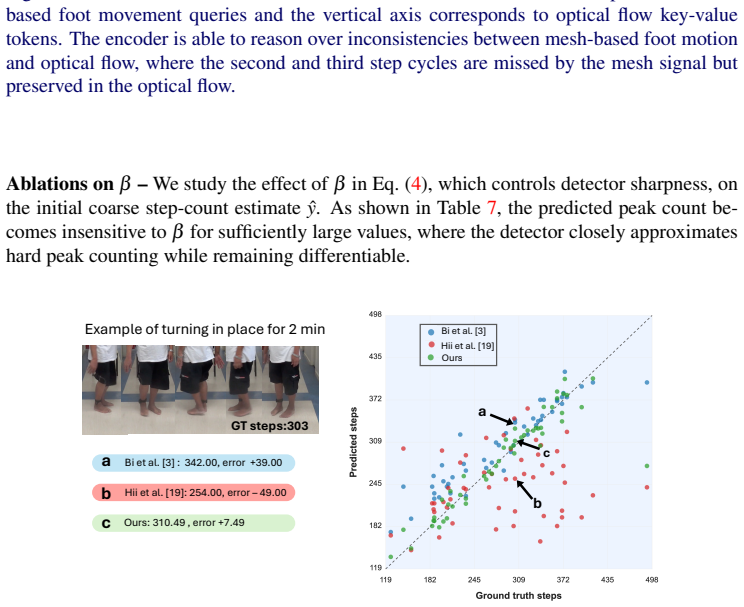
As a prominent symptom of Parkinson's disease (PD), turning impairment is evaluated through parameters such as turning angle, duration, and particularly, the number of steps required to complete a turn, which directly reflects motor dysfunction. Accurate step counting is challenging due to variability in real-world turning movements and atypical shuffling patterns in parkinsonian gait. Existing methods are predominantly wearable-based, requiring users to wear and manage dedicated devices, which can be inconvenient for continuous daily use. To address this, we propose a passive, video-based framework that estimates step count in a coarse-to-fine manner using diverse motion representations. Specifically, an initial step count is estimated from foot movement signals derived from 3D human mesh recovery, providing high-level motion structures. To incorporate fine-grained motion details, a motion encoder learns complementary gait dynamics from mesh and optical flow to refine the initial estimate. In this process, coarse foot movement signals query the pixel-level motion cues via cross attention to capture subtle parkinsonian gait dynamics. To handle varying video lengths, we partition each video into clips and integrate clip-wise motion embeddings via multiple instance learning (MIL) for step count residual prediction. Extensive experiments show our method consistently outperforms existing step counting methods on real-world PD turning datasets.
Editorial analysis
A structured set of objections, weighed in public.
Referee Report
Summary. The manuscript proposes a passive video-based method for counting steps during turning in Parkinson's disease (PD) patients. It employs a coarse-to-fine pipeline: an initial step count is derived from foot movement signals obtained via 3D human mesh recovery, which is then refined using a motion encoder that integrates mesh and optical flow features through cross-attention. Variable-length videos are handled by partitioning into clips and using multiple instance learning (MIL) to predict the step count residual. The paper claims that extensive experiments demonstrate consistent outperformance over existing step counting methods on real-world PD turning datasets.
Significance. Should the empirical claims hold after addressing validation gaps, the work could provide a practical non-contact alternative to wearables for assessing turning impairment, a clinically relevant PD motor symptom. The structured use of 3D mesh for coarse structure, cross-attention for fine gait dynamics, and MIL for variable lengths is a coherent technical response to the problem of atypical shuffling gait.
major comments (2)
- [Abstract / coarse-to-fine pipeline description] The central claim of consistent outperformance rests on the coarse stage producing usable initial step counts from 3D human mesh recovery even for parkinsonian shuffling (minimal lift, atypical posture). The abstract and method description supply no quantitative mesh accuracy metrics on PD data, no PD-specific fine-tuning, and no ablation isolating the coarse signal's contribution versus the cross-attention refinement. If the initial signals are noisy or biased, the MIL residual prediction cannot guarantee the headline performance.
- [Abstract] The abstract asserts 'extensive experiments' and 'consistent outperformance' yet supplies no dataset sizes, baseline details, metrics, error bars, or exclusion criteria. Without these the central empirical claim cannot be evaluated from the provided text.
Simulated Author's Rebuttal
We thank the referee for the constructive comments, which highlight important aspects of validation and clarity. We address each major comment below and will revise the manuscript to strengthen the presentation of our results.
read point-by-point responses
-
Referee: [Abstract / coarse-to-fine pipeline description] The central claim of consistent outperformance rests on the coarse stage producing usable initial step counts from 3D human mesh recovery even for parkinsonian shuffling (minimal lift, atypical posture). The abstract and method description supply no quantitative mesh accuracy metrics on PD data, no PD-specific fine-tuning, and no ablation isolating the coarse signal's contribution versus the cross-attention refinement. If the initial signals are noisy or biased, the MIL residual prediction cannot guarantee the headline performance.
Authors: We agree that explicit validation of the coarse stage is valuable for readers. The full manuscript demonstrates the end-to-end superiority on real-world PD turning videos, but does not report per-frame mesh accuracy numbers on the PD cohort or an ablation that isolates the coarse foot-signal contribution. We will add both: (i) quantitative mesh reconstruction metrics computed on our PD dataset and (ii) an ablation that removes the coarse stage (or replaces it with a constant) while keeping the cross-attention and MIL components fixed. The off-the-shelf mesh model is retained without PD-specific fine-tuning because it already supplies usable high-level foot trajectories for the subsequent refinement; the performance gap versus purely image-based or wearable baselines supports this design choice. revision: yes
-
Referee: [Abstract] The abstract asserts 'extensive experiments' and 'consistent outperformance' yet supplies no dataset sizes, baseline details, metrics, error bars, or exclusion criteria. Without these the central empirical claim cannot be evaluated from the provided text.
Authors: The current abstract is intentionally concise. We will expand it in the revision to report the number of videos and subjects, the main competing methods, the primary metrics (with standard deviations), and a brief statement on exclusion criteria, thereby allowing readers to assess the empirical claims directly from the abstract. revision: yes
Circularity Check
No circularity: standard supervised pipeline with empirical validation
full rationale
The paper describes a coarse-to-fine video pipeline that extracts initial step counts via external 3D mesh recovery, refines via cross-attention motion encoding, and predicts residuals with MIL. No equations, self-definitions, or fitted parameters are shown to reduce the reported outperformance metrics to quantities defined by the method's own inputs. Claims rest on experiments against external PD turning datasets rather than any derivation that collapses by construction. This is a conventional supervised learning setup with no load-bearing self-citation chains or ansatz smuggling.
Axiom & Free-Parameter Ledger
free parameters (2)
- clip partitioning strategy
- cross-attention hyperparameters
axioms (2)
- domain assumption 3D human mesh recovery produces usable foot trajectories on parkinsonian shuffling gait
- domain assumption Optical flow supplies complementary fine-grained cues not captured by mesh alone
Reference graph
Works this paper leans on
-
[1]
A systematic review of wearable patient monitoring systems–current challenges and opportunities for clinical adoption.Journal of medical systems, 41(7): 115, 2017
Mirza Mansoor Baig, Hamid GholamHosseini, Aasia A Moqeem, Farhaan Mirza, and Maria Lindén. A systematic review of wearable patient monitoring systems–current challenges and opportunities for clinical adoption.Journal of medical systems, 41(7): 115, 2017
2017
-
[2]
Step counting: a review of measurement considerations and health-related applications
David R Bassett Jr, Lindsay P Toth, Samuel R LaMunion, and Scott E Crouter. Step counting: a review of measurement considerations and health-related applications. Sports Medicine, 47(7):1303–1315, 2017
2017
-
[3]
Precise step counting algorithm for pedestrians us- ing ultra-low-cost foot-mounted accelerometer.Engineering Applications of Artificial Intelligence, 150:110619, 2025
Jingxue Bi, Jianhui Wang, Baoguo Yu, Guobiao Yao, Yunjia Wang, Hongji Cao, Lu Huang, and Huaqiao Xing. Precise step counting algorithm for pedestrians us- ing ultra-low-cost foot-mounted accelerometer.Engineering Applications of Artificial Intelligence, 150:110619, 2025
2025
-
[4]
Prospective assessment of falls in parkinson’s disease.Journal of neurology, 248(11):950–958, 2001
Bastiaan R Bloem, Yvette AM Grimbergen, Monique Cramer, Mirjam Willemsen, and Aeilko H Zwinderman. Prospective assessment of falls in parkinson’s disease.Journal of neurology, 248(11):950–958, 2001
2001
-
[5]
Parkinson’s disease.The Lancet, 397(10291):2284–2303, 2021
Bastiaan R Bloem, Michael S Okun, and Christine Klein. Parkinson’s disease.The Lancet, 397(10291):2284–2303, 2021
2021
-
[6]
Carlotta Caramia, Diego Torricelli, Maurizio Schmid, Adriana Muñoz-Gonzalez, Jose Gonzalez-Vargas, Francisco Grandas, and Jose L Pons. Imu-based classification of parkinson’s disease from gait: A sensitivity analysis on sensor location and feature selection.IEEE journal of biomedical and health informatics, 22(6):1765–1774, 2018
2018
-
[7]
Your turn: At home turning angle estimation for parkin- son’s disease severity assessment.Artificial Intelligence in Medicine, 167:103194, 2025
Qiushuo Cheng, Catherine Morgan, Arindam Sikdar, Alessandro Masullo, Alan Whone, and Majid Mirmehdi. Your turn: At home turning angle estimation for parkin- son’s disease severity assessment.Artificial Intelligence in Medicine, 167:103194, 2025
2025
-
[8]
Re- liability and validity of current computer vision based motion capture systems in gait analysis: A systematic review.Gait & Posture, 120:150–160, 2025
Xingye Cheng, Yiran Jiao, Rebecca M Meiring, Bo Sheng, and Yanxin Zhang. Re- liability and validity of current computer vision based motion capture systems in gait analysis: A systematic review.Gait & Posture, 120:150–160, 2025. 14CHENG ET AL: VIDEO-BASED PARKINSONIAN TURNING STEP COUNTING
2025
-
[9]
Pose-based gait analysis for diagnosis of parkinson’s disease.Algorithms, 15(12):474, 2022
Tee Connie, Timilehin B Aderinola, Thian Song Ong, Michael Kah Ong Goh, Bayu Erfianto, and Bedy Purnama. Pose-based gait analysis for diagnosis of parkinson’s disease.Algorithms, 15(12):474, 2022
2022
-
[10]
Falls, 1994
Steven R Cummings and Michael C Nevitt. Falls, 1994
1994
-
[11]
Daily steps and health outcomes in adults: a systematic review and dose-response meta-analysis.The Lancet Public Health, 10(8):e668–e681, 2025
Ding Ding, Binh Nguyen, Tracy Nau, Mengyun Luo, Borja del Pozo Cruz, Paddy C Dempsey, Zachary Munn, Barbara J Jefferis, Cathie Sherrington, Elizabeth A Calleja, et al. Daily steps and health outcomes in adults: a systematic review and dose-response meta-analysis.The Lancet Public Health, 10(8):e668–e681, 2025
2025
-
[12]
Counting out time: Class agnostic video repetition counting in the wild
Debidatta Dwibedi, Yusuf Aytar, Jonathan Tompson, Pierre Sermanet, and Andrew Zisserman. Counting out time: Class agnostic video repetition counting in the wild. In Proceedings of the IEEE/CVF conference on computer vision and pattern recognition, pages 10387–10396, 2020
2020
-
[13]
Continuous monitoring of turning in patients with movement disability.Sensors, 14(1):356–369, 2013
Mahmoud El-Gohary, Sean Pearson, James McNames, Martina Mancini, Fay Horak, Sabato Mellone, and Lorenzo Chiari. Continuous monitoring of turning in patients with movement disability.Sensors, 14(1):356–369, 2013
2013
-
[14]
“on” state freezing of gait in parkinson disease: a paradoxical levodopa-induced complica- tion.Neurology, 78(7):454–457, 2012
AJ Espay, A Fasano, BFL Van Nuenen, MM Payne, AH Snijders, and BR Bloem. “on” state freezing of gait in parkinson disease: a paradoxical levodopa-induced complica- tion.Neurology, 78(7):454–457, 2012
2012
-
[15]
Deep neural networks for human activity recognition with wearable sensors: Leave-one-subject-out cross-validation for model selection.Ieee Access, 8:133982–133994, 2020
Davoud Gholamiangonabadi, Nikita Kiselov, and Katarina Grolinger. Deep neural networks for human activity recognition with wearable sensors: Leave-one-subject-out cross-validation for model selection.Ieee Access, 8:133982–133994, 2020
2020
-
[16]
Christopher G Goetz, Barbara C Tilley, Stephanie R Shaftman, Glenn T Stebbins, Stan- ley Fahn, Pablo Martinez-Martin, Werner Poewe, Cristina Sampaio, Matthew B Stern, Richard Dodel, et al. Movement disorder society-sponsored revision of the unified parkinson’s disease rating scale (mds-updrs): scale presentation and clinimetric testing results.Movement di...
2008
-
[17]
Momentum con- trast for unsupervised visual representation learning
Kaiming He, Haoqi Fan, Yuxin Wu, Saining Xie, and Ross Girshick. Momentum con- trast for unsupervised visual representation learning. InProceedings of the IEEE/CVF conference on computer vision and pattern recognition, pages 9729–9738, 2020
2020
-
[18]
Gait and balance in parkinson’s disease subtypes: objective measures and classification con- siderations.Journal of neurology, 261(12):2401–2410, 2014
Talia Herman, Aner Weiss, Marina Brozgol, Nir Giladi, and Jeffrey M Hausdorff. Gait and balance in parkinson’s disease subtypes: objective measures and classification con- siderations.Journal of neurology, 261(12):2401–2410, 2014
2014
-
[19]
Automated gait analysis based on a marker-free pose estimation model.Sensors, 23(14):6489, 2023
Chang Soon Tony Hii, Kok Beng Gan, Nasharuddin Zainal, Norlinah Mo- hamed Ibrahim, Shahrul Azmin, Siti Hajar Mat Desa, Bart van de Warrenburg, and Huay Woon You. Automated gait analysis based on a marker-free pose estimation model.Sensors, 23(14):6489, 2023
2023
-
[20]
Parkinsonism: onset, progression, and mortal- ity.Neurology, 17(5):427–427, 1967
Margaret M Hoehn and Melvin D Yahr. Parkinsonism: onset, progression, and mortal- ity.Neurology, 17(5):427–427, 1967. CHENG ET AL: VIDEO-BASED PARKINSONIAN TURNING STEP COUNTING15
1967
-
[21]
Pedestrian dead reckoning with wearable sensors: A systematic review.IEEE Sensors Journal, 21(1):143–152, 2020
Xinyu Hou and Jeroen Bergmann. Pedestrian dead reckoning with wearable sensors: A systematic review.IEEE Sensors Journal, 21(1):143–152, 2020
2020
-
[22]
A narrative review of turning deficits in people with parkinson’s disease.Disability and rehabilitation, 37 (15):1382–1389, 2015
Sophia Hulbert, Ann Ashburn, Lisa Robert, and Geert Verheyden. A narrative review of turning deficits in people with parkinson’s disease.Disability and rehabilitation, 37 (15):1382–1389, 2015
2015
-
[23]
Attention-based deep multiple instance learning
Maximilian Ilse, Jakub Tomczak, and Max Welling. Attention-based deep multiple instance learning. InInternational conference on machine learning, pages 2127–2136. PMLR, 2018
2018
-
[24]
Tsm: Temporal shift module for efficient video understanding
Ji Lin, Chuang Gan, and Song Han. Tsm: Temporal shift module for efficient video understanding. InProceedings of the IEEE/CVF international conference on computer vision, pages 7083–7093, 2019
2019
-
[25]
A novel robust step detection algorithm for foot-mounted imu.IEEE Sensors Journal, 21(4):5331–5339, 2020
Xin Liu, Ning Li, Geng Xu, and Yonggang Zhang. A novel robust step detection algorithm for foot-mounted imu.IEEE Sensors Journal, 21(4):5331–5339, 2020
2020
-
[26]
Smpl: A skinned multi-person linear model
Matthew Loper, Naureen Mahmood, Javier Romero, Gerard Pons-Moll, and Michael J Black. Smpl: A skinned multi-person linear model. InSeminal Graphics Papers: Pushing the Boundaries, Volume 2, pages 851–866. 2023
2023
-
[27]
Multi-activity step counting al- gorithm using deep learning foot flat detection with an imu inside the sole of a shoe
Quentin Lucot, Erwan Beurienne, and Michel Behr. Multi-activity step counting al- gorithm using deep learning foot flat detection with an imu inside the sole of a shoe. Sensors, 24(21):6927, 2024
2024
-
[28]
On-shoe wearable sensors for gait and turning assessment of patients with parkinson’s disease.IEEE transactions on biomedical engineering, 60(1):155–158, 2012
Benoit Mariani, Mayté Castro Jiménez, François JG Vingerhoets, and Kamiar Aminian. On-shoe wearable sensors for gait and turning assessment of patients with parkinson’s disease.IEEE transactions on biomedical engineering, 60(1):155–158, 2012
2012
-
[29]
A framework for multiple-instance learning
Oded Maron and Tomás Lozano-Pérez. A framework for multiple-instance learning. Advances in neural information processing systems, 10, 1997
1997
-
[30]
Validation of an algorithm for detecting turning in people with cognitive impairment, considering dementia disease subtype.Gait & posture, 118:141–147, 2025
Ríona Mc Ardle, Leigh J Ryan, Rana Zia Ur Rehman, Emily Dignan, Abbie Thomp- son, Silvia Del Din, Brook Galna, Alan J Thomas, Lynn Rochester, and Lisa Alcock. Validation of an algorithm for detecting turning in people with cognitive impairment, considering dementia disease subtype.Gait & posture, 118:141–147, 2025
2025
-
[31]
Gait impairments in parkinson’s disease.The Lancet Neurology, 18(7):697–708, 2019
Anat Mirelman, Paolo Bonato, Richard Camicioli, Terry D Ellis, Nir Giladi, Jamie L Hamilton, Chris J Hass, Jeffrey M Hausdorff, Elisa Pelosin, and Quincy J Almeida. Gait impairments in parkinson’s disease.The Lancet Neurology, 18(7):697–708, 2019
2019
-
[32]
Mobile device accuracy for step counting across age groups.JMIR mHealth and uHealth, 5(6):e7870, 2017
François Modave, Yi Guo, Jiang Bian, Matthew J Gurka, Alice Parish, Megan D Smith, Alexandra M Lee, and Thomas W Buford. Mobile device accuracy for step counting across age groups.JMIR mHealth and uHealth, 5(6):e7870, 2017
2017
-
[33]
Understanding how people with parkinson’s disease turn in gait from a real-world in-home dataset.Parkinsonism & related disorders, 105: 114–122, 2022
Catherine Morgan, Jack Jameson, Ian Craddock, Emma L Tonkin, George Oikonomou, Hanna Kristiina Isotalus, Farnoosh Heidarivincheh, Ryan McConville, Gregory JL Tourte, Kirsi M Kinnunen, et al. Understanding how people with parkinson’s disease turn in gait from a real-world in-home dataset.Parkinsonism & related disorders, 105: 114–122, 2022. 16CHENG ET AL: ...
2022
-
[34]
A multimodal dataset of real world mobility activities in parkinson’s disease.Scientific data, 10(1):918, 2023
Catherine Morgan, Emma L Tonkin, Alessandro Masullo, Ferdian Jovan, Arindam Sik- dar, Pushpajit Khaire, Majid Mirmehdi, Ryan McConville, Gregory JL Tourte, Alan Whone, et al. A multimodal dataset of real world mobility activities in parkinson’s disease.Scientific data, 10(1):918, 2023
2023
-
[35]
Step-count outcomes of 13 different activity trackers: results from labora- tory and free-living experiments.Gait & Posture, 98:24–33, 2022
Takashi Nakagata, Haruka Murakami, Ryoko Kawakami, Julien Tripette, Satoshi Nakae, Yosuke Yamada, Kazuko Ishikawa-Takata, Shigeho Tanaka, and Motohiko Miyachi. Step-count outcomes of 13 different activity trackers: results from labora- tory and free-living experiments.Gait & Posture, 98:24–33, 2022
2022
-
[36]
Multi-domain cop feature analysis of func- tional mobility for parkinson’s disease detection using wearable pressure insoles.Sen- sors, 25(18):5859, 2025
Thathsara Nanayakkara, HMKKMB Herath, Hadi Sedigh Malekroodi, Nuwan Madu- sanka, Myunggi Yi, and Byeong-il Lee. Multi-domain cop feature analysis of func- tional mobility for parkinson’s disease detection using wearable pressure insoles.Sen- sors, 25(18):5859, 2025
2025
-
[37]
Validity of instrumented insoles for step counting, posture and activity recognition: a systematic review.Sen- sors, 19(11):2438, 2019
Armelle M Ngueleu, Andréanne K Blanchette, Désirée Maltais, Hélène Moffet, Brad- ford J McFadyen, Laurent Bouyer, and Charles S Batcho. Validity of instrumented insoles for step counting, posture and activity recognition: a systematic review.Sen- sors, 19(11):2438, 2019
2019
-
[38]
Minh H Pham, Morad Elshehabi, Linda Haertner, Silvia Del Din, Karin Srulijes, Tanja Heger, Matthis Synofzik, Markus A Hobert, Gert S Faber, Clint Hansen, et al. Valida- tion of a step detection algorithm during straight walking and turning in patients with parkinson’s disease and older adults using an inertial measurement unit at the lower back.Frontiers ...
2017
-
[39]
Minh H Pham, Morad Elshehabi, Linda Haertner, Tanja Heger, Markus A Hobert, Gert S Faber, Dina Salkovic, Joaquim J Ferreira, Daniela Berg, Álvaro Sanchez-Ferro, et al. Algorithm for turning detection and analysis validated under home-like condi- tions in patients with parkinson’s disease and older adults using a 6 degree-of-freedom inertial measurement un...
2017
-
[40]
The timed “up & go”: a test of basic func- tional mobility for frail elderly persons.Journal of the American geriatrics Society, 39 (2):142–148, 1991
Diane Podsiadlo and Sandra Richardson. The timed “up & go”: a test of basic func- tional mobility for frail elderly persons.Journal of the American geriatrics Society, 39 (2):142–148, 1991
1991
-
[41]
Flowseek: optical flow made easier with depth founda- tion models and motion bases
Matteo Poggi and Fabio Tosi. Flowseek: optical flow made easier with depth founda- tion models and motion bases. InProceedings of the IEEE/CVF International Confer- ence on Computer Vision, pages 5667–5679, 2025
2025
-
[42]
Rana Zia Ur Rehman, Philipp Klocke, Sofia Hryniv, Brook Galna, Lynn Rochester, Sil- via Del Din, and Lisa Alcock. Turning detection during gait: algorithm validation and influence of sensor location and turning characteristics in the classification of parkin- son’s disease.Sensors, 20(18):5377, 2020
2020
-
[43]
Humor: 3d human motion model for robust pose estimation
Davis Rempe, Tolga Birdal, Aaron Hertzmann, Jimei Yang, Srinath Sridhar, and Leonidas J Guibas. Humor: 3d human motion model for robust pose estimation. InProceedings of the IEEE/CVF international conference on computer vision, pages 11488–11499, 2021. CHENG ET AL: VIDEO-BASED PARKINSONIAN TURNING STEP COUNTING17
2021
-
[44]
Caroline Ribeiro De Souza, Runfeng Miao, Júlia Ávila De Oliveira, Andrea Cristina De Lima-Pardini, Débora Fragoso De Campos, Carla Silva-Batista, Luis Teixeira, So- laiman Shokur, Bouri Mohamed, and Daniel Boari Coelho. A public data set of videos, inertial measurement unit, and clinical scales of freezing of gait in individuals with parkinson’s disease d...
2022
-
[45]
Textured foot orthotics on dynamic stability and turning performance in parkinson’s disease.Journal of Motor Behavior, 52(4):396– 403, 2020
Kelly A Robb and Stephen D Perry. Textured foot orthotics on dynamic stability and turning performance in parkinson’s disease.Journal of Motor Behavior, 52(4):396– 403, 2020
2020
-
[46]
Automation of the timed-up-and-go test using a conventional video camera.IEEE journal of biomed- ical and health informatics, 24(4):1196–1205, 2019
Patrick Savoie, James AD Cameron, Mary E Kaye, and Erik J Scheme. Automation of the timed-up-and-go test using a conventional video camera.IEEE journal of biomed- ical and health informatics, 24(4):1196–1205, 2019
2019
-
[47]
A comprehensive survey on gait analysis: History, parameters, approaches, pose estimation, and future work.Artificial Intelligence in Medicine, 129:102314, 2022
Dimple Sethi, Sourabh Bharti, and Chandra Prakash. A comprehensive survey on gait analysis: History, parameters, approaches, pose estimation, and future work.Artificial Intelligence in Medicine, 129:102314, 2022
2022
-
[48]
World-grounded human motion recovery via gravity- view coordinates
Zehong Shen, Huaijin Pi, Yan Xia, Zhi Cen, Sida Peng, Zechen Hu, Hujun Bao, Ruizhen Hu, and Xiaowei Zhou. World-grounded human motion recovery via gravity- view coordinates. InSIGGRAPH Asia 2024 Conference Papers, pages 1–11, 2024
2024
-
[50]
Quantitative gait analysis us- ing a pose-estimation algorithm with a single 2d-video of parkinson’s disease patients
Jung Hwan Shin, Ri Yu, Jed Noel Ong, Chan Young Lee, Seung Ho Jeon, Hwanpil Park, Han-Joon Kim, Jehee Lee, and Beomseok Jeon. Quantitative gait analysis us- ing a pose-estimation algorithm with a single 2d-video of parkinson’s disease patients. Journal of Parkinson’s Disease, 11(3):1271–1283, 2021
2021
-
[51]
Every shot counts: Using exemplars for repetition counting in videos
Saptarshi Sinha, Alexandros Stergiou, and Dima Damen. Every shot counts: Using exemplars for repetition counting in videos. InProceedings of the Asian Conference on Computer Vision, pages 3056–3073, 2024
2024
-
[52]
Head-pelvis cou- pling is increased during turning in patients with p arkinson’s disease and freezing of gait.Movement Disorders, 28(5):619–625, 2013
Joke Spildooren, Sarah Vercruysse, Elke Heremans, Brook Galna, Jochen Vandenboss- che, Kaat Desloovere, Wim Vandenberghe, and Alice Nieuwboer. Head-pelvis cou- pling is increased during turning in patients with p arkinson’s disease and freezing of gait.Movement Disorders, 28(5):619–625, 2013
2013
-
[53]
Two-dimensional video-based analysis of human gait using pose estimation.PLoS computational biology, 17(4): e1008935, 2021
Jan Stenum, Cristina Rossi, and Ryan T Roemmich. Two-dimensional video-based analysis of human gait using pose estimation.PLoS computational biology, 17(4): e1008935, 2021
2021
-
[54]
Clinical gait analysis using video-based pose estimation: Multiple perspectives, clinical popu- lations, and measuring change.PLOS Digital Health, 3(3):e0000467, 2024
Jan Stenum, Melody M Hsu, Alexander Y Pantelyat, and Ryan T Roemmich. Clinical gait analysis using video-based pose estimation: Multiple perspectives, clinical popu- lations, and measuring change.PLOS Digital Health, 3(3):e0000467, 2024. 18CHENG ET AL: VIDEO-BASED PARKINSONIAN TURNING STEP COUNTING
2024
-
[55]
Periodic motion detection and estimation via space-time sampling
Ashwin Thangali and Stan Sclaroff. Periodic motion detection and estimation via space-time sampling. In2005 Seventh IEEE Workshops on Applications of Computer Vision (WACV/MOTION’05)-Volume 1, volume 2, pages 176–182. IEEE, 2005
2005
-
[56]
Validity of different activity monitors to count steps in an inpa- tient rehabilitation setting.Physical therapy, 97(5):581–588, 2017
Daniel Treacy, Leanne Hassett, Karl Schurr, Sakina Chagpar, Serene S Paul, and Catherine Sherrington. Validity of different activity monitors to count steps in an inpa- tient rehabilitation setting.Physical therapy, 97(5):581–588, 2017
2017
-
[57]
Vision-based motion capture for the gait analysis of neurodegenerative diseases: A review.Gait & posture, 112:95–107, 2024
David Sing Yee Vun, Robert Bowers, and Anthony McGarry. Vision-based motion capture for the gait analysis of neurodegenerative diseases: A review.Gait & posture, 112:95–107, 2024
2024
-
[58]
Prompthmr: Promptable human mesh recovery
Yufu Wang, Yu Sun, Priyanka Patel, Kostas Daniilidis, Michael J Black, and Muhammed Kocabas. Prompthmr: Promptable human mesh recovery. InProceedings of the computer vision and pattern recognition conference, pages 1148–1159, 2025
2025
-
[59]
Ziyu Yao, Xuxin Cheng, and Yuexian Zou. Poserac: Pose saliency transformer for repetitive action counting.arXiv preprint arXiv:2303.08450, 2023
-
[60]
Cris Zampieri, Arash Salarian, Patricia Carlson-Kuhta, Kamiar Aminian, John G Nutt, and Fay B Horak. The instrumented timed up and go test: potential outcome measure for disease modifying therapies in parkinson’s disease.Journal of Neurology, Neuro- surgery & Psychiatry, 81(2):171–176, 2010
2010
-
[61]
Cola: Weakly- supervised temporal action localization with snippet contrastive learning
Can Zhang, Meng Cao, Dongming Yang, Jie Chen, and Yuexian Zou. Cola: Weakly- supervised temporal action localization with snippet contrastive learning. InProceed- ings of the IEEE/CVF conference on computer vision and pattern recognition, pages 16010–16019, 2021
2021
-
[62]
Reducing footskate in human motion reconstruction with ground contact constraints
Yuliang Zou, Jimei Yang, Duygu Ceylan, Jianming Zhang, Federico Perazzi, and Jia- Bin Huang. Reducing footskate in human motion reconstruction with ground contact constraints. InProceedings of the IEEE/CVF Winter Conference on Applications of Computer Vision, pages 459–468, 2020
2020
discussion (0)
Sign in with ORCID, Apple, or X to comment. Anyone can read and Pith papers without signing in.