REVIEW 2 major objections 4 minor 1 cited by
Rotation plus a magnetic field can quench superradiance and create horizon-decaying scalar clouds that isolated Kerr black holes cannot support.
Reviewed by Pith at T0; open to challenge. T0 means a machine referee read the full paper against a public rubric. the ladder, T0–T4 →
T0 review · grok-4.5
2026-07-12 11:34 UTC pith:KGX6PF2O
load-bearing objection Clean weak-field calculation of a magnetic horizon gap that produces Type-II evanescent scalar clouds with Im(ω)=0, but the advertised Kerr-BR geometry is reduced to Kerr plus test field throughout. the 2 major comments →
Horizon-Evanescent Scalar Clouds from Coupled Rotation and Magnetic Fields around Black Holes
The pith
A machine-rendered reading of the paper's core claim, the machinery that carries it, and where it could break.
Core claim
Magnetic coupling in the Kerr-Bertotti-Robinson geometry produces a strictly positive horizon gap, so that inside a finite frequency band below the usual kinematic threshold the horizon wavenumber is purely imaginary; the physical boundary condition becomes a regular exponentially decaying state, the superradiant flux is quenched, and a new class of horizon-decaying (Type-II) scalar clouds exists, distinct from classical synchronized Type-I clouds.
What carries the argument
The positive horizon gap (ω_c^{2} − D = a^{2} B^{2} q^{2} r₊^{2} / 16 M^{2} > 0), which forces the near-horizon wavenumber to become imaginary inside a finite band and thereby converts the horizon boundary condition from a propagating wave into an exponentially decaying state.
Load-bearing premise
The whole construction is done under a weak-magnetic-field approximation that neglects the back-reaction of the magnetic field on the spacetime curvature.
What would settle it
A numerical or analytic calculation of the same charged massive scalar in a magnetized Kerr geometry that retains O(B^{2}) curvature terms, checking whether the positive horizon gap and the zero-flux Type-II clouds survive when B is no longer small.
Editorial analysis
A structured set of objections, weighed in public.
Referee Report
Summary. The paper studies a charged massive scalar field on the Kerr–Bertotti–Robinson (Kerr-BR) geometry and claims that black-hole rotation together with an external magnetic field produces a positive near-horizon gap. After mapping the radial Klein–Gordon equation to a Schrödinger-like form, the authors show that the horizon wavenumber becomes purely imaginary inside a finite frequency band below the usual kinematic threshold ω_c. In that band the physical horizon boundary condition is a regular exponentially decaying state rather than a propagating ingoing wave, the superradiant flux is quenched (Im(ω)=0), and a new class of horizon-decaying (Type-II) scalar clouds appears alongside the classical synchronized (Type-I) clouds. The argument is developed analytically via matched asymptotic expansions (Appendix C) that exhibit an exact imaginary-phase cancellation, and is illustrated by numerical shooting solutions for both branches (Sec. V, Appendix D). All concrete calculations are performed under the weak-field truncation B≪1.
Significance. If the positive-gap mechanism and the resulting Type-II clouds survive under a consistent treatment of the background, the work identifies a qualitatively new stationary bosonic configuration that is absent in isolated Kerr systems and that is realized by the joint action of rotation and magnetic coupling. The algebraic reduction of the discriminant ω_c²−D to the perfect square a²B²q²r₊²/(16M²)>0 (Eqs. 7–8) and the subsequent phase-cancellation proof that forces Im(δω)=0 (Appendix C) are clean and parameter-free within the adopted approximation. The numerical profiles of both Type-I and Type-II clouds, including overtones, supply concrete spatial structure. These results would enlarge the known taxonomy of scalar clouds and motivate further study of magnetized astrophysical environments.
major comments (2)
- The abstract and introduction present the Kerr-BR geometry as the laboratory, yet every concrete result (tortoise coordinate, V_eff, α², discriminant, matched asymptotics, shooting) is obtained after the explicit weak-B truncation that replaces the full Kerr-BR metric functions by their Kerr limits and retains only a test magnetic potential (Sec. II, paragraph preceding App. A; App. A). Because the gap itself is an O(B²) effect, it is not guaranteed a priori that the same algebraic simplification survives once the retained O(B²) curvature corrections of the exact Type-D Kerr-BR metric are restored. The authors themselves flag the ultra-strong regime as open (Sec. VI); the same consistency issue already applies inside the weak-B window used for all reported results. A short calculation that restores the leading O(B²) metric corrections to the near-horizon expansion of V_eff (or an explici
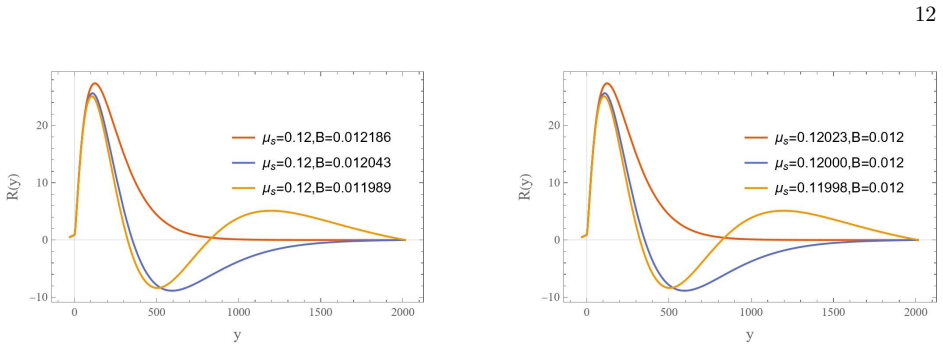
- The numerical Type-II clouds (Figs. 5–7) are shown only at the single frequency ω=ω_c. The analytic quenching band is the finite interval ω₁≤ω≤min{ω₂,ω_f}. At least one representative solution strictly inside the open interval (or a short scan of Im(ω) across the band) should be supplied so that the existence of a continuum of horizon-decaying stationary states, rather than only the mid-band point, is demonstrated.
minor comments (4)
- Notation for the horizon function switches between Δ and Δ₀ without a clear statement of when the B-dependent terms are dropped; a single consistent definition would help.
- In several figure captions the phrase “gradual linear growth” for the near-horizon Type-II profiles is potentially confusing; a brief remark that this is the visual appearance of a very small κ_h would clarify the plots.
- The bound-state constraints of Appendix B are exhaustive but dense; a short summary sentence in the main text pointing to the most relevant (m>0, Bq>0) case would improve readability.
- A few typographical inconsistencies appear (e.g., “Schr¨ odinger”, missing spaces around some equation numbers); a light copy-edit pass would remove them.
Circularity Check
No circularity: the positive horizon gap, Im(ω)=0 quenching, and Type-II existence follow from direct algebraic evaluation of the near-horizon dispersion plus matched asymptotics/shooting on the KG equation; nothing is fitted or self-defined into existence.
full rationale
The load-bearing chain is: (i) weak-B reduction of Kerr-BR + charged massive KG (Sec. II, App. A) yields an effective potential whose near-horizon limit is −k_h^{2} = −[(ω−ω_c)^{2}−(ω_c^{2}−D)]; (ii) explicit substitution produces the algebraic identity ω_c^{2}−D = a^{2}B^{2}q^{2} r_{+}^{2}/(16M^{2}) > 0 (Eqs. 7–8), opening a real band [ω_{1},ω_{2}]; (iii) inside that band α^{2} < 0 so α becomes pure imaginary, the factor α·[k]^{2l+1} cancels the imaginary phase of the far-region wavenumber, forcing δω real (App. C, Eqs. C12–C13); (iv) numerical shooting simply solves the same radial ODE subject to the resulting decaying horizon BC and finds discrete (µ_s,B) pairs that also decay at infinity (App. D). No parameter is fitted to data and then re-used as a prediction; the resonance condition is the standard Detweiler matching, not a self-citation; the sole self-citation ([46]) concerns thermodynamics of the background and is never invoked for the gap or the clouds. The weak-B approximation is an explicit modeling choice whose domain of validity the authors themselves flag (Sec. VI); that is a correctness caveat, not a circular reduction of the claimed derivation to its inputs. Hence score 0.
Axiom & Free-Parameter Ledger
free parameters (2)
- illustrative spin a/M = 0.5
- illustrative charge q = 0.1–0.3
axioms (4)
- domain assumption Kerr-Bertotti-Robinson metric is an exact Type-D Einstein-Maxwell solution that reduces to Kerr when B → 0
- ad hoc to paper Weak-magnetic-field approximation B ≪ 1 permits truncation of O(B²) curvature back-reaction and reduction of the angular equation to a perturbed spheroidal equation
- domain assumption Physical horizon boundary condition is the one that is ingoing in the locally non-rotating frame (Bardeen-Press-Teukolsky)
- standard math Matched asymptotic expansion of Detweiler / Furuhashi-Nambu type yields the leading imaginary frequency shift
invented entities (2)
-
Type-II (horizon-decaying / horizon-evanescent) scalar clouds
no independent evidence
-
Positive horizon gap criterion
no independent evidence
read the original abstract
We show that black-hole rotation and an external magnetic field can jointly generate a qualitatively new class of scalar cloud. Using the Kerr-Bertotti-Robinson geometry as a separable laboratory for magnetized rotating black holes, we study a charged massive scalar field and map the radial Klein-Gordon equation into a one-dimensional Schr\"{o}dinger-like form. The magnetic coupling shifts the near-horizon dispersion relation and realizes a positive horizon gap: a sufficient near-horizon criterion under which the horizon wavenumber becomes purely imaginary in a finite frequency band below the usual kinematic synchronization frequency. In this band the physical horizon boundary condition is no longer a propagating ingoing wave, but a regular exponentially decaying state. This rotation--magnetic-field mechanism quenches the superradiant flux and supports horizon-decaying scalar clouds (Type-II), distinct from the usual synchronized propagating clouds (Type-I). Matched asymptotic expansions and numerical shooting solutions are used to exhibit both branches and their spatial profiles. Thus the Kerr-Bertotti-Robinson solution is not an isolated curiosity, but an explicit realization of a broader positive-gap criterion for stationary bosonic configurations absent in isolated Kerr systems.
Figures




Forward citations
Cited by 1 Pith paper
-
Massless scalar scattering by Kerr-Bertotti-Robinson black holes:transparent-end channels and superradiance
In the transparent-end model, scalar superradiance on Kerr–BR black holes operates only when both the horizon frequency gate and the outer propagation gate are open, and the propagation gate closes the window at BM≈0....
Reference graph
Works this paper leans on
-
[1]
Gravitational collapse: The role of general relativity,
R. Penrose, “Gravitational collapse: The role of general relativity,”Riv. Nuovo Cim.1(1969) 252–276. 23
1969
-
[2]
Reversible and irreversible transformations in black-hole physics,
D. Christodoulou, “Reversible and irreversible transformations in black-hole physics,”Physical Review Letters25no. 25, (1970) 1596
1970
-
[3]
Introducing the black hole,
R. Ruffini and J. A. Wheeler, “Introducing the black hole,”Physics Today24no. 1, (1971) 30–41
1971
-
[4]
Generation of Waves by a Rotating Body,
Y. B. Zeldovich, “Generation of Waves by a Rotating Body,”Soviet Journal of Experimental and Theoretical Physics Letters14(1971) 180
1971
-
[5]
Amplification of Cylindrical Electromagnetic Waves Reflected from a Rotating Body,
Y. B. Zeldovich, “Amplification of Cylindrical Electromagnetic Waves Reflected from a Rotating Body,”Soviet Journal of Experimental and Theoretical Physics35(1972) 1085
1972
-
[6]
Interpretation of gravitational-wave observations,
C. W. Misner, “Interpretation of gravitational-wave observations,”Physical Review Letters28no. 15, (1972) 994
1972
-
[7]
Amplification of waves during reflection from a rotating
A. A. Starobinskii, “Amplification of waves during reflection from a rotating ”black hole”,”Sov. Phys. JETP37no. 1, (1973) 28–32
1973
-
[8]
Extraction of energy and charge from a black hole,
J. D. Bekenstein, “Extraction of energy and charge from a black hole,”Physical Review D7no. 4, (1973) 949
1973
-
[9]
Perturbations of a rotating black hole. i. fundamental equations for gravitational, electromagnetic, and neutrino-field perturbations,
S. A. Teukolsky, “Perturbations of a rotating black hole. i. fundamental equations for gravitational, electromagnetic, and neutrino-field perturbations,”The Astrophysical Journal185(1973) 635–648
1973
-
[10]
Floating orbits, superradiant scattering and the black-hole bomb,
W. H. Press and S. A. Teukolsky, “Floating orbits, superradiant scattering and the black-hole bomb,” Nature238no. 5361, (1972) 211–212
1972
-
[11]
On quantum resonances in stationary geometries,
T. Damour, N. Deruelle, and R. Ruffini, “On quantum resonances in stationary geometries,”Lett. Nuovo Cim.15no. 8, (1976) 257–262
1976
-
[12]
Instabilities of massive scalar perturbations of a rotating black hole,
T. J. M. Zouros and D. M. Eardley, “Instabilities of massive scalar perturbations of a rotating black hole,”Annals of Physics118no. 1, (1979) 139–155
1979
-
[13]
Klein-gordon equation and rotating black holes,
S. Detweiler, “Klein-gordon equation and rotating black holes,”Physical Review D22no. 10, (1980) 2323
1980
-
[14]
Instability of massive scalar fields in kerr-newman spacetime,
H. Furuhashi and Y. Nambu, “Instability of massive scalar fields in kerr-newman spacetime,”Progress of Theoretical Physics112no. 6, (2004) 983–995
2004
-
[15]
Black-hole bomb and superradiant instabilities,
V. Cardoso, O. J. C. Dias, J. P. S. Lemos, and S. Yoshida, “Black-hole bomb and superradiant instabilities,”Physical Review D70no. 4, (2004) 044039
2004
-
[16]
Instability of the massive klein-gordon field on the kerr spacetime,
S. R. Dolan, “Instability of the massive klein-gordon field on the kerr spacetime,”Physical Review D 76no. 8, (2007) 084001
2007
-
[17]
Superradiant instabilities of rotating black holes in the time domain,
S. R. Dolan, “Superradiant instabilities of rotating black holes in the time domain,”Physical Review D87no. 12, (2013) 124026
2013
-
[18]
Superradiant instabilities in astrophysical systems,
H. Witek, V. Cardoso, A. Ishibashi, and U. Sperhake, “Superradiant instabilities in astrophysical systems,”Physical Review D87no. 4, (2013) 043513
2013
-
[19]
Stationary scalar clouds around rotating black holes,
S. Hod, “Stationary scalar clouds around rotating black holes,”Physical Review D86no. 10, (2012) 104026
2012
-
[20]
Kerr-newman black holes with stationary charged scalar clouds,
S. Hod, “Kerr-newman black holes with stationary charged scalar clouds,”Physical Review D90 no. 2, (2014) 024051. 24
2014
-
[21]
Kerr black holes with scalar hair,
C. A. R. Herdeiro and E. Radu, “Kerr black holes with scalar hair,”Physical Review Letters112 no. 22, (2014) 221101
2014
-
[22]
Construction and physical properties of kerr black holes with scalar hair,
C. A. R. Herdeiro and E. Radu, “Construction and physical properties of kerr black holes with scalar hair,”Classical and Quantum Gravity32no. 14, (2015) 144001
2015
-
[23]
Kerr-newman scalar clouds,
C. L. Benone, L. C. B. Crispino, C. A. R. Herdeiro, and E. Radu, “Kerr-newman scalar clouds,” Physical Review D90no. 10, (2014) 104024
2014
-
[24]
Scalar clouds around Kerr–Sen black holes,
Y. Huang, D.-J. Liu, X.-H. Zhai, and X.-Z. Li, “Scalar clouds around Kerr–Sen black holes,”Class. Quant. Grav.34no. 15, (2017) 155002,arXiv:1706.04441 [gr-qc]
Pith/arXiv arXiv 2017
-
[25]
Black-hole bomb and photon-mass bounds,
P. Pani, V. Cardoso, L. Gualtieri, E. Berti, and A. Ishibashi, “Black-hole bomb and photon-mass bounds,”Physical Review Letters109no. 13, (2012) 131102
2012
-
[26]
Superradiant instability and backreaction of massive vector fields around kerr black holes,
W. E. East and F. Pretorius, “Superradiant instability and backreaction of massive vector fields around kerr black holes,”Phys. Rev. Lett.119(Jul, 2017) 041101. https://link.aps.org/doi/10.1103/PhysRevLett.119.041101
-
[27]
Kerr black holes with proca hair,
C. Herdeiro, E. Radu, and H. R´ unarsson, “Kerr black holes with proca hair,”Classical and Quantum Gravity33no. 15, (2016) 154001
2016
-
[28]
Stationary scalar clouds supported by rapidly-rotating acoustic black holes in a photon-fluid model,
S. Hod, “Stationary scalar clouds supported by rapidly-rotating acoustic black holes in a photon-fluid model,”Physical Review D103no. 8, (2021) 084003
2021
-
[29]
Acoustic black-hole bombs and scalar clouds in a photon-fluid model,
M. Ciszak and F. Marino, “Acoustic black-hole bombs and scalar clouds in a photon-fluid model,” Physical Review D103no. 4, (2021) 045004
2021
-
[30]
Superradiance: New Frontiers in Black Hole Physics,
R. Brito, V. Cardoso, and P. Pani, “Superradiance: New Frontiers in Black Hole Physics,”Lect. Notes Phys.906(2015) pp.1–237,arXiv:1501.06570 [gr-qc]
Pith/arXiv arXiv 2015
-
[31]
Electromagnetic extraction of energy from kerr black holes,
R. D. Blandford and R. L. Znajek, “Electromagnetic extraction of energy from kerr black holes,” Monthly Notices of the Royal Astronomical Society179no. 3, (1977) 433–456
1977
-
[32]
Black hole in a uniform magnetic field,
R. M. Wald, “Black hole in a uniform magnetic field,”Physical Review D10no. 6, (1974) 1680
1974
-
[33]
Kerr black holes in a magnetic universe,
F. J. Ernst, “Kerr black holes in a magnetic universe,”Journal of Mathematical Physics17no. 1, (1976) 54–56
1976
-
[34]
Pure magnetic and magic electric geons,
M. A. Melvin, “Pure magnetic and magic electric geons,”Physics Letters8no. 1, (1964) 65–68
1964
-
[35]
Ergoregions in magnetised black hole spacetimes,
G. W. Gibbons, A. H. Mujtaba, and C. N. Pope, “Ergoregions in magnetised black hole spacetimes,” Classical and Quantum Gravity30no. 12, (2013) 125008
2013
-
[36]
Thermodynamics of Regular Accelerating Black Holes,
M. Astorino, “Thermodynamics of Regular Accelerating Black Holes,”Phys. Rev. D95no. 6, (2017) 064007,arXiv:1612.04387 [gr-qc]
Pith/arXiv arXiv 2017
-
[37]
Insights from melvin–kerr–newman spacetimes,
I. Booth, M. Hunt, A. Palomo-Lozano, and H. K. Kunduri, “Insights from melvin–kerr–newman spacetimes,”Classical and Quantum Gravity32no. 23, (2015) 235025
2015
-
[38]
Revival of penrose process for astrophysical applications,
S. M. Wagh, S. V. Dhurandhar, and N. Dadhich, “Revival of penrose process for astrophysical applications,”Atrophys. J.301(1986) 1018
1986
-
[39]
The energetics of black holes in electromagnetic fields by the penrose process,
S. M. Wagh and N. Dadhich, “The energetics of black holes in electromagnetic fields by the penrose process,”Phys. Rept.183no. 4, (1989) 137–192. 25
1989
-
[40]
Magnetized black hole as a gravitational lens,
R. A. Konoplya, “Magnetized black hole as a gravitational lens,”Phys. Lett. B644(2007) 219–223, arXiv:gr-qc/0608066
Pith/arXiv arXiv 2007
-
[41]
Magnetic field creates strong superradiant instability,
R. A. Konoplya, “Magnetic field creates strong superradiant instability,”Phys. Lett. B666(2008) 283–287,arXiv:0801.0846 [hep-th]
Pith/arXiv arXiv 2008
-
[42]
Superradiant instability of black holes immersed in a magnetic field,
R. Brito, V. Cardoso, and P. Pani, “Superradiant instability of black holes immersed in a magnetic field,”Physical Review D89no. 10, (2014) 104045
2014
-
[43]
Black holes, stationary clouds and magnetic fields,
N. M. Santos and C. A. R. Herdeiro, “Black holes, stationary clouds and magnetic fields,”Physics Letters B815(2021) 136142
2021
-
[44]
Kerr black hole in a uniform Bertotti-Robinson magnetic field: An exact solution,
J. Podolsk´ y and H. Ovcharenko, “Kerr black hole in a uniform Bertotti-Robinson magnetic field: An exact solution,”arXiv preprint arXiv:2507.05199(2025)
arXiv 2025
-
[45]
Uniform electromagnetic field in the theory of general relativity,
B. Bertotti, “Uniform electromagnetic field in the theory of general relativity,”Phys. Rev.116(Dec,
-
[46]
1331–1333.https://link.aps.org/doi/10.1103/PhysRev.116.1331
-
[47]
Thermodynamics of Kerr-Bertotti-Robinson black hole,
L. Hu, R.-G. Cai, and S.-J. Wang, “Thermodynamics of Kerr-Bertotti-Robinson black hole,” arXiv:2603.18821 [gr-qc]
-
[48]
Abramowitz and I
M. Abramowitz and I. A. Stegun,Handbook of mathematical functions with formulas, graphs, and mathematical tables, vol. 55. US Government printing office, 1964
1964
-
[49]
C. M. Bender and S. A. Orszag,Advanced mathematical methods for scientists and engineers I: Asymptotic methods and perturbation theory. Springer Science & Business Media, 1999
1999
-
[50]
W. H. Press, S. A. Teukolsky, W. T. Vetterling, and B. P. Flannery,Numerical recipes 3rd edition: The art of scientific computing. Cambridge university press, 2007
2007
-
[51]
Black Hole in an External Magnetic Field,
D. V. Galtsov and V. I. Petukhov, “Black Hole in an External Magnetic Field,”Zh. Eksp. Teor. Fiz. 74(1978) 801–818
1978
-
[52]
Energy extraction via magnetic reconnection in magnetized black holes,
S.-J. Zhang, “Energy extraction via magnetic reconnection in magnetized black holes,”arXiv preprint arXiv:2405.16941(2024)
Pith/arXiv arXiv 2024
-
[53]
Physics in ultra-strong magnetic fields,
R. C. Duncan, “Physics in ultra-strong magnetic fields,”AIP Conf. Proc.526no. 1, (2000) 830, arXiv:astro-ph/0002442
Pith/arXiv arXiv 2000
-
[54]
Rotating black holes: locally nonrotating frames, energy extraction, and scalar synchrotron radiation,
J. M. Bardeen, W. H. Press, and S. A. Teukolsky, “Rotating black holes: locally nonrotating frames, energy extraction, and scalar synchrotron radiation,”The Astrophysical Journal178(1972) 347–370
1972
discussion (0)
Sign in with ORCID, Apple, or X to comment. Anyone can read and Pith papers without signing in.