Quantum Multi-Party Threshold Private Set Intersection with Explicit Cardinality Testing
Pith reviewed 2026-06-29 04:19 UTC · model grok-4.3
The pith
A rotation-based quantum protocol allows multiple parties to test if their private set intersection meets a threshold without revealing its details.
A machine-rendered reading of the paper's core claim, the machinery that carries it, and where it could break.
Core claim
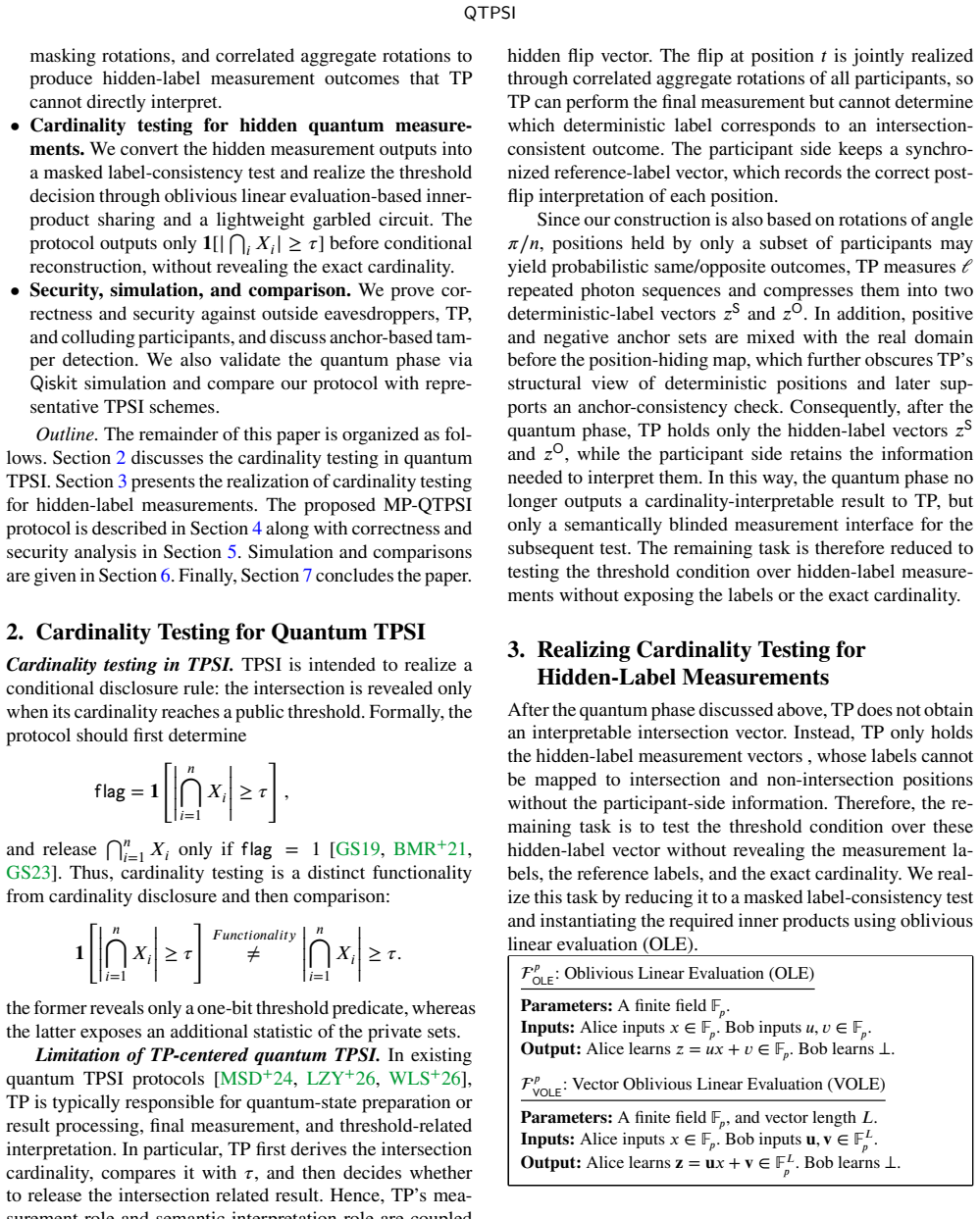
The protocol develops a rotation-based quantum construction in which single-photon sequences are sequentially processed through participant-side data rotations, TP--participant masking rotations, and correlated aggregate rotations. This design produces hidden-label measurement vectors: TP can complete the final measurement, but cannot interpret the semantic meaning of the outcomes. Based on these hidden measurements, we further realize the threshold decision through an oblivious linear evaluation (OLE)-based inner product procedure and a lightweight garbled circuit, revealing only 1[|∩_i X_i| ≥ τ] before conditional intersection reconstruction. We prove the correctness and security of the pr
What carries the argument
Rotation-based quantum construction producing hidden-label measurement vectors via sequential participant data rotations, TP masking rotations, and aggregate rotations.
If this is right
- The protocol outputs only the boolean 1[|intersection| >= τ].
- The third party performs final measurements without semantic interpretation capability.
- Conditional reconstruction of the intersection follows only if the threshold is met.
- Correctness and security are proven, with feasibility shown in Qiskit simulations.
Where Pith is reading between the lines
- The hidden measurement approach could extend to other quantum multiparty protocols requiring controlled revelation.
- Practical testing on physical quantum hardware beyond simulators would validate real-world applicability.
- This method of decoupling measurement from interpretation may apply to broader quantum privacy-preserving computations.
Load-bearing premise
The third party honestly applies the masking rotations without colluding or deriving semantic meaning from the hidden-label vectors, and the OLE and garbled circuit components are secure.
What would settle it
Observing that the third party recovers semantic information about the sets or their intersection from the measurement vectors despite following the protocol would falsify the claim.
Figures


read the original abstract
Threshold private set intersection (TPSI) allows parties to reveal their intersection only when its cardinality reaches a prescribed threshold. Existing quantum TPSI protocols typically rely on a third party (TP) to interpret the final results, which deviates from the cardinality-testing paradigm of TPSI. In this paper, we propose a quantum multiparty TPSI protocol with explicit cardinality testing. Our protocol develops a rotation-based quantum construction in which single-photon sequences are sequentially processed through participant-side data rotations, TP--participant masking rotations, and correlated aggregate rotations. This design produces hidden-label measurement vectors: TP can complete the final measurement, but cannot interpret the semantic meaning of the outcomes. Based on these hidden measurements, we further realize the threshold decision through an oblivious linear evaluation (OLE)-based inner product procedure and a lightweight garbled circuit, revealing only \(\mathbf 1[|\bigcap_i X_i|\ge \tau]\) before conditional intersection reconstruction. We prove the correctness and security of the proposed protocol, and further validate its feasibility through quantum-circuit simulations implemented on the IBM \textsf{Qiskit} platform.
Editorial analysis
A structured set of objections, weighed in public.
Referee Report
Summary. The paper proposes a quantum multi-party threshold private set intersection (TPSI) protocol. It uses a rotation-based construction on single-photon sequences involving participant data rotations, TP-participant masking rotations, and correlated aggregate rotations to generate hidden-label measurement vectors. A third party (TP) performs the final measurement but cannot interpret semantic meaning. Threshold decision is then handled via an OLE-based inner product and lightweight garbled circuit, revealing only the indicator 1[|∩_i X_i| ≥ τ] before conditional reconstruction. The authors claim proofs of correctness and security, plus feasibility validation via Qiskit simulations.
Significance. If the security reduction holds, the work would advance quantum secure multiparty computation by enabling explicit cardinality testing in TPSI without excess leakage to the TP, addressing a limitation in prior quantum protocols. The quantum hiding mechanism combined with classical primitives (OLE, garbled circuits) offers a hybrid approach that could support privacy applications where only threshold information is needed.
major comments (1)
- [Security analysis section] Security analysis (the section containing the proof of security against TP): the central claim that TP cannot interpret semantic meaning from the hidden-label measurement vectors requires an explicit reduction showing that the final density operator (after aggregate rotations) is independent of the intersection labels from TP's perspective. The abstract asserts such a proof exists, but without the concrete calculation demonstrating that the masking angles fully randomize the basis relative to TP's knowledge, the subsequent OLE inner-product and garbled-circuit steps cannot be guaranteed to enforce the claimed leakage bound.
Simulated Author's Rebuttal
We thank the referee for the constructive comment on the security analysis. We address the point below and will revise the manuscript accordingly.
read point-by-point responses
-
Referee: [Security analysis section] Security analysis (the section containing the proof of security against TP): the central claim that TP cannot interpret semantic meaning from the hidden-label measurement vectors requires an explicit reduction showing that the final density operator (after aggregate rotations) is independent of the intersection labels from TP's perspective. The abstract asserts such a proof exists, but without the concrete calculation demonstrating that the masking angles fully randomize the basis relative to TP's knowledge, the subsequent OLE inner-product and garbled-circuit steps cannot be guaranteed to enforce the claimed leakage bound.
Authors: We agree that the security analysis would benefit from an explicit reduction. The current proof sketch in the security analysis section establishes that the aggregate rotations produce a maximally mixed state from the TP's viewpoint by averaging over the random masking angles chosen by the participants, but we acknowledge that a fully expanded calculation tracing out the dependence on the intersection labels is not written out in sufficient detail. In the revised version we will add this concrete calculation, showing that the final density operator ho_TP is independent of the labels (i.e., ho_TP = (1/2)^n I for n photons) and therefore that the subsequent OLE inner-product and garbled-circuit steps inherit the claimed leakage bound. revision: yes
Circularity Check
No circularity; protocol construction and security claims are independent of self-referential definitions or fitted inputs
full rationale
The abstract and description present a rotation-based quantum protocol producing hidden-label vectors, followed by OLE inner-product and garbled-circuit steps for the threshold indicator. No equations, self-citations, or parameter-fitting steps are exhibited that would reduce the claimed correctness, security, or hidden-label property to a tautology or to the paper's own inputs by construction. The security assumptions (TP honesty, OLE/garbled-circuit security) are stated as external and load-bearing but are not derived from the protocol equations themselves. This is the normal case of a self-contained construction claim without detectable circular reduction.
Axiom & Free-Parameter Ledger
axioms (1)
- domain assumption Standard assumptions of quantum mechanics for single-photon rotations and measurements, plus security of OLE and garbled circuit primitives.
Reference graph
Works this paper leans on
-
[1]
31st STOC , year =
Naor, Moni and Pinkas, Benny , title =. 31st STOC , year =
-
[2]
ACM CCS , year =
Boyle, Elette and Couteau, Geoffroy and Gilboa, Niv and Ishai, Yuval , title =. ACM CCS , year =
-
[3]
IEEE S&P , pages =
Weng, Chenkai and Yang, Kang and Katz, Jonathan and Wang, Xiao , title =. IEEE S&P , pages =. 2021 , doi =
2021
-
[4]
Advances in Cryptology -- EUROCRYPT 2021 , pages =
Rindal, Peter and Schoppmann, Phillipp , title =. Advances in Cryptology -- EUROCRYPT 2021 , pages =. 2021 , doi =
2021
-
[5]
Efficient Protocols for Oblivious Linear Function Evaluation from Ring-
Baum, Carsten and Escudero, Daniel and Pedrouzo-Ulloa, Alberto and Scholl, Peter and Troncoso-Pastoriza, Juan Ram\'. Efficient Protocols for Oblivious Linear Function Evaluation from Ring-. J. Comput. Secur. , volume =. 2022 , doi =
2022
-
[6]
and Brassard, Gilles , title =
Bennett, Charles H. and Brassard, Gilles , title =. Theor. Comput. Sci. , volume =. 2014 , doi =
2014
-
[7]
Science Advances , volume =
Proietti, Massimiliano and Ho, Joseph and Grasselli, Federico and Barrow, Peter and Malik, Mehul and Fedrizzi, Alessandro , title =. Science Advances , volume =. 2021 , doi =
2021
-
[8]
Fu, Yao and Yin, Hua-Lei and Chen, Teng-Yun and Chen, Zeng-Bing , title =. Phys. Rev. Lett. , volume =. 2015 , doi =
2015
-
[9]
Optimum Unambiguous Discrimination of Two Mixed Quantum States , journal =
Herzog, Ulrike and Bergou, J. Optimum Unambiguous Discrimination of Two Mixed Quantum States , journal =. 2005 , doi =
2005
-
[10]
Public-Key Cryptography --
Badrinarayanan, Saikrishna and Miao, Peihan and Raghuraman, Srinivasan and Rindal, Peter , title =. Public-Key Cryptography --. 2021 , doi =
2021
-
[11]
IEEE Access , volume =
Zhang, En and Chang, Jian and Li, Yu , title =. IEEE Access , volume =. 2021 , doi =
2021
-
[12]
Hu, Jingwei and Zhao, Yongjun and Tan, Benjamin Hong Meng and Aung, Khin Mi Mi and Wang, Huaxiong , title =. Trans. Info. For. Sec. , volume =. 2024 , doi =
2024
-
[13]
IEEE Internet of Things Journal , volume =
Mohanty, Tapaswini and Srivastava, Vikas and Debnath, Sumit Kumar and Das, Ashok Kumar and Sikdar, Biplab , title =. IEEE Internet of Things Journal , volume =. 2024 , doi =
2024
-
[14]
Chinese Journal of Physics , volume =
Li, Xiang-Rui and Zhou, Yi-Hua and Yang, Yu-Guang and Shi, Wei-Min , title =. Chinese Journal of Physics , volume =. 2026 , doi =
2026
-
[15]
IEEE Internet of Things Journal , volume =
Wang, Tianyin and Li, Shuang and Song, Shuaijia and Du, Jiao and Wei, Chunyan and Cai, Xiaoqiu , title =. IEEE Internet of Things Journal , volume =. 2026 , doi =
2026
-
[16]
IEEE S&P , year=
A More Efficient Cryptographic Matchmaking Protocol for Use in the Absence of a Continuously Available Third Party , author=. IEEE S&P , year=
-
[17]
and Nissim, Kobbi and Pinkas, Benny
Freedman, Michael J. and Nissim, Kobbi and Pinkas, Benny. Efficient Private Matching and Set Intersection. Advances in Cryptology -- EUROCRYPT 2004. 2004
2004
-
[18]
N. Angelou and A. Benaissa and B. Cebere and W. Clark and A. J. Hall and M. A. Hoeh and D. Liu and P. Papadopoulos and R. Roehm and R. Sandmann and P. Schoppmann and T. Titcombe. Asymmetric Private Set Intersection with Applications to Contact Tracing and Private Vertical Federated Machine Learning. NeurIPS 2020 Workshop on Privacy Preserving Machine Lear...
-
[19]
Efficient and Private Set Intersection of Human Genomes , year=
Shen, Liyan and Chen, Xiaojun and Wang, Dakui and Fang, Binxing and Dong, Ye , booktitle=. Efficient and Private Set Intersection of Human Genomes , year=
-
[20]
Cryptology
Ion, Mihaela and Kreuter, Ben and Nergiz, Erhan and Patel, Sarvar and Saxena, Shobhit and Seth, Karn and Shanahan, David and Yung, Moti , title =. Cryptology. 2017 , doi =
2017
-
[21]
Information Security --
Debnath, Sumit Kumar and Dutta, Ratna , title =. Information Security --. 2015 , doi =
2015
-
[22]
NDSS , year=
Private Set Intersection: Are Garbled Circuits Better than Custom Protocols? , author=. NDSS , year=
-
[23]
and Kolesnikov, Vladimir and Boldyreva, Alexandra and Lee, Wenke , title =
Uzun, Erkam and Chung, Simon P. and Kolesnikov, Vladimir and Boldyreva, Alexandra and Lee, Wenke , title =. USENIX Security , pages =. 2021 , url =
2021
-
[24]
2017 , doi =
Hallgren, Per and Orlandi, Claudio and Sabelfeld, Andrei , title =. 2017 , doi =
2017
-
[25]
Zhao, Yongjun and Chow, Sherman S. M. , title =. Proceedings of the 2018 Workshop on Privacy in the Electronic Society , pages =. 2018 , doi =
2018
-
[26]
, title =
Shor, Peter W. , title =. SIAM Journal on Computing , volume =. 1997 , doi =
1997
-
[27]
Quantum Information Processing , volume =
Shi, Runhua and Mu, Yi and Zhong, Hong and Cui, Jie and Zhang, Shun , title =. Quantum Information Processing , volume =. 2016 , doi =
2016
-
[28]
Scientific Reports , volume =
Zhang, Cai and Long, Yinxiang and Sun, Zhiwei and Li, Qin and Huang, Qiong , title =. Scientific Reports , volume =. 2020 , doi =
2020
-
[29]
Journal of Information Security and Applications , volume =
Mohanty, Tapaswini and Debnath, Sumit Kumar , title =. Journal of Information Security and Applications , volume =. 2023 , doi =
2023
-
[30]
Quantum multi-party private set intersection using single photons , journal =. 2024 , issn =. doi:https://doi.org/10.1016/j.physa.2024.129974 , author =
-
[31]
Advances in Cryptology --
Ghosh, Satrajit and Simkin, Mark , title =. Advances in Cryptology --. 2019 , doi =
2019
-
[32]
FOCS'86 , pages =
Yao, Andrew Chi-Chih , title =. FOCS'86 , pages =. 1986 , doi =
1986
-
[33]
, title =
Chefles, Anthony and Barnett, Stephen M. , title =. Journal of Physics A: Mathematical and General , volume =. 1998 , doi =
1998
-
[34]
ArXiv , year=
Over-Threshold Multiparty Private Set Intersection for Collaborative Network Intrusion Detection , author=. ArXiv , year=
-
[35]
Public-Key Cryptography --
Ghosh, Satrajit and Simkin, Mark , title =. Public-Key Cryptography --. 2023 , doi =
2023
discussion (0)
Sign in with ORCID, Apple, or X to comment. Anyone can read and Pith papers without signing in.