Single Electrons in a Dual-Plane Printed-Circuit-Board Penning Trap
Pith reviewed 2026-06-29 04:01 UTC · model grok-4.3
The pith
A dual-plane printed-circuit-board Penning trap traps and detects single electrons at low magnetic fields.
A machine-rendered reading of the paper's core claim, the machinery that carries it, and where it could break.
Core claim
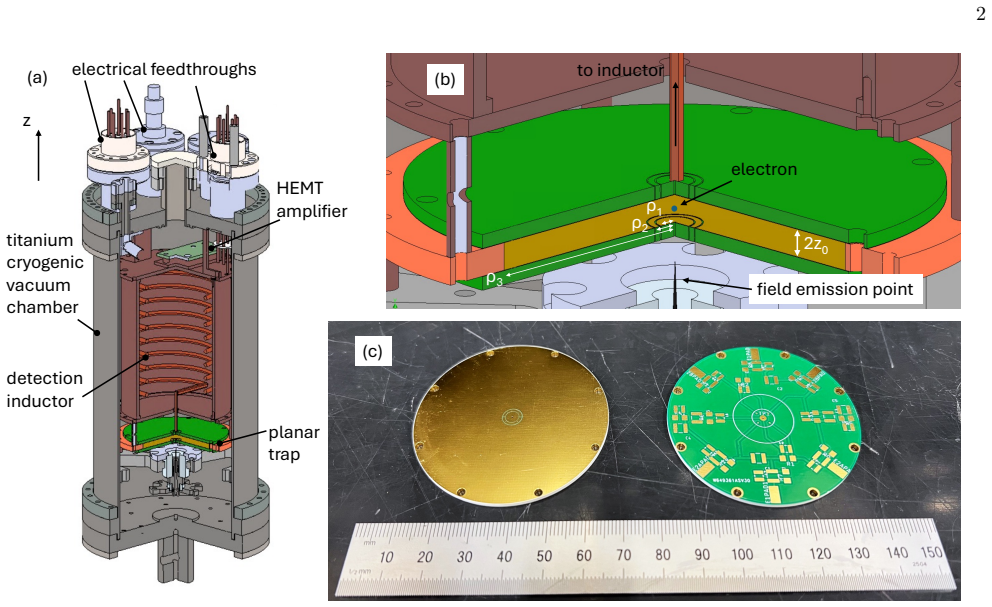
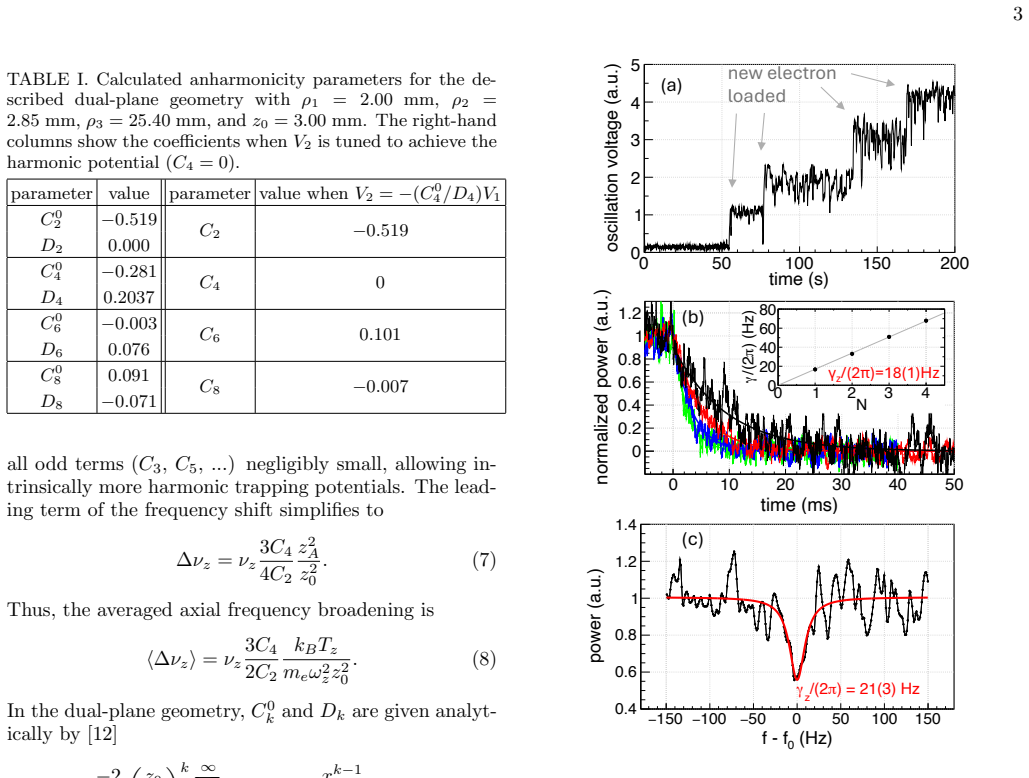
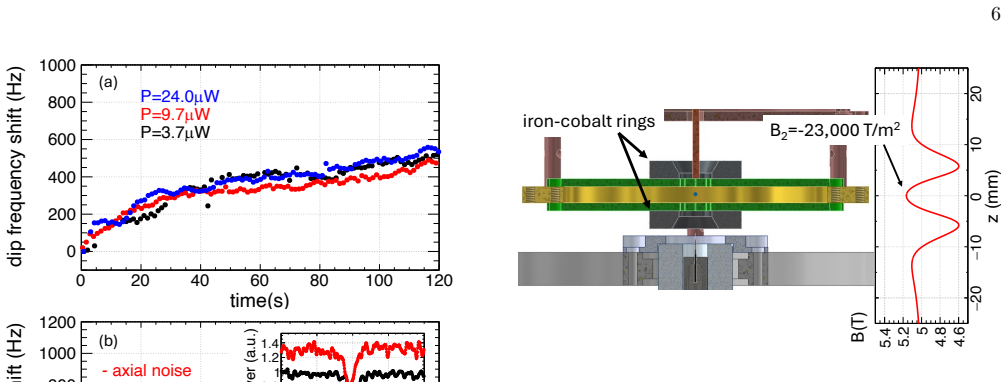
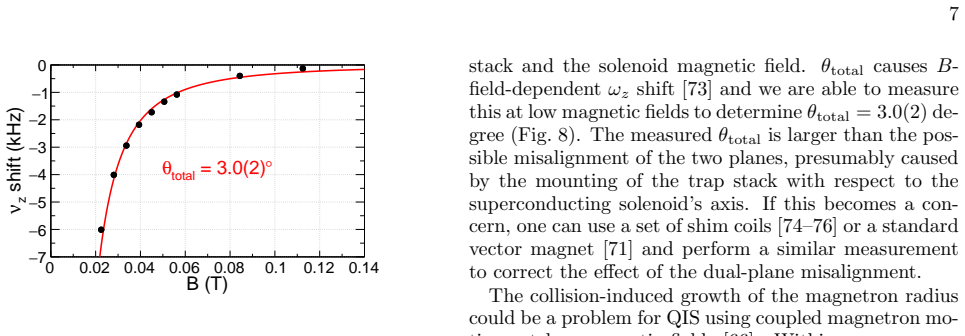
We demonstrate single-electron trapping and detection in a two-dimensionally scalable dual-plane printed-circuit-board Penning trap. We characterize deterministic electron loading, axial damping, axial temperature, and collision-induced magnetron-radius growth at low magnetic fields.
What carries the argument
The dual-plane printed-circuit-board Penning trap, whose electrode layout on two parallel boards generates the electric and magnetic fields needed to confine individual electrons.
If this is right
- Deterministic loading allows controlled introduction of one electron at a time into the trap.
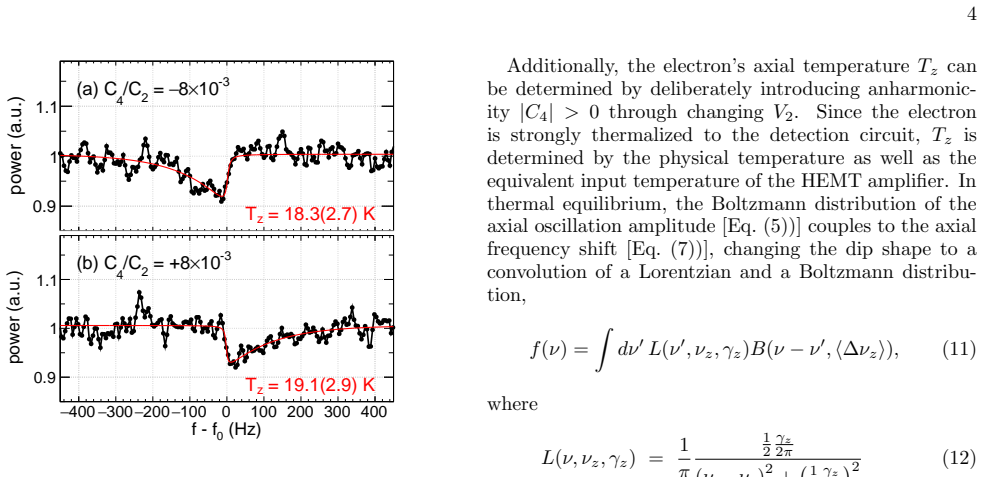
- Axial damping and temperature measurements quantify the cooling and thermal environment experienced by the trapped electron.
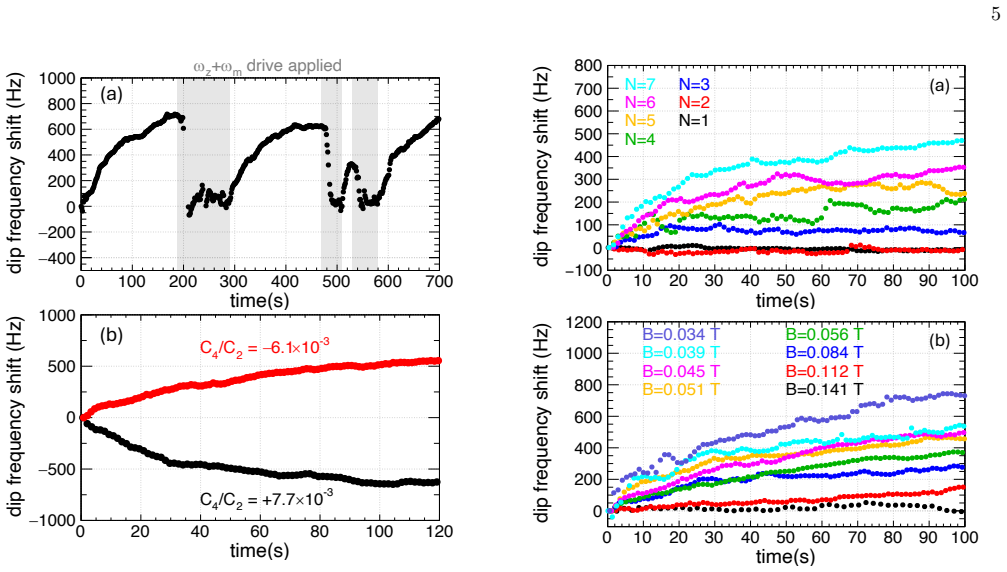
- Collision-induced magnetron growth provides a diagnostic of background gas interactions at low fields.
- The printed-circuit-board construction permits two-dimensional scaling of trap arrays by standard fabrication techniques.
- The platform supplies a concrete next step toward quantum-information applications that require many individually addressable electrons.
Where Pith is reading between the lines
- Integration with on-board microwave lines or optical access could become straightforward because the electrodes are already on circuit boards.
- The same electrode pattern might support simultaneous trapping of multiple species or charged particles of different masses if the magnetic field and voltages are adjusted accordingly.
- Low-field operation reduces the need for large superconducting magnets, potentially allowing compact table-top experiments.
Load-bearing premise
The recorded signals and dynamics arise from single electrons rather than from groups of electrons or from measurement artifacts, and the printed-circuit-board electrode pattern creates stable trapping wells at the low magnetic fields employed.
What would settle it
Observation of signals whose amplitude or frequency statistics match an ensemble of many electrons, or loss of trapping when the magnetic field is lowered to the reported values, would show that individual-electron confinement has not been achieved.
Figures

read the original abstract
We demonstrate single-electron trapping and detection in a two-dimensionally scalable dual-plane printed-circuit-board Penning trap. We characterize deterministic electron loading, axial damping, axial temperature, and collision-induced magnetron-radius growth at low magnetic fields. These results establish a practical platform for planar Penning traps and identify key next steps toward applications in quantum information science.
Editorial analysis
A structured set of objections, weighed in public.
Referee Report
Summary. The manuscript demonstrates single-electron trapping and detection in a two-dimensionally scalable dual-plane printed-circuit-board Penning trap. It characterizes deterministic electron loading, axial damping, axial temperature, and collision-induced magnetron-radius growth at low magnetic fields, positioning the dual-plane PCB geometry as a practical platform for planar Penning traps toward quantum information science applications.
Significance. If the central experimental claims hold, the work establishes a scalable, PCB-based approach to Penning traps that operates at low magnetic fields. This could lower barriers to integration with other quantum technologies and enable two-dimensional trap arrays, providing a concrete experimental foundation rather than a purely theoretical proposal.
major comments (1)
- [Results section (characterization of loading and signals)] The evidence presented for single-electron (as opposed to ensemble) occupancy relies on observed axial damping, temperature, and magnetron growth, but the manuscript does not provide quantitative thresholds, statistical tests, or direct comparisons to multi-electron signals that would rule out alternative interpretations. This distinction is load-bearing for the title and abstract claim.
minor comments (2)
- [Abstract] The abstract states 'low magnetic fields' without numerical values; include the specific B-field range (e.g., in the first paragraph of the results) for immediate context.
- [Figure captions] Figure captions should explicitly note the number of experimental runs or averaging used for each trace to allow assessment of reproducibility.
Simulated Author's Rebuttal
We thank the referee for the constructive report and positive assessment of the work's significance. We address the single major comment below and have revised the manuscript to strengthen the presentation of evidence for single-electron occupancy.
read point-by-point responses
-
Referee: [Results section (characterization of loading and signals)] The evidence presented for single-electron (as opposed to ensemble) occupancy relies on observed axial damping, temperature, and magnetron growth, but the manuscript does not provide quantitative thresholds, statistical tests, or direct comparisons to multi-electron signals that would rule out alternative interpretations. This distinction is load-bearing for the title and abstract claim.
Authors: We thank the referee for identifying this point. The original manuscript infers single-electron occupancy from the deterministic loading statistics, axial damping rates matching single-particle predictions, temperature values extracted from thermal noise, and magnetron growth consistent with single-particle theory at low B. These signatures are theoretically distinct from ensemble behavior. Nevertheless, we agree that explicit quantitative support improves clarity. The revised manuscript adds: calibrated amplitude thresholds distinguishing one versus multiple electrons, Poisson statistics from repeated loading trials, and direct side-by-side comparisons with multi-electron signals obtained in the same apparatus. These additions appear in a new subsection of Results with accompanying text and figures; the core claims and interpretation remain unchanged. revision: yes
Circularity Check
No significant circularity; experimental demonstration only
full rationale
The paper is an experimental report of single-electron trapping and detection in a dual-plane PCB Penning trap. It characterizes observed behaviors (axial damping, temperature, magnetron growth) at low B fields but contains no derivation chain, fitted parameters renamed as predictions, or self-citation load-bearing steps. The central claim rests on direct observation rather than any equation that reduces to its own inputs by construction. This matches the default expectation of no circularity for experimental work without theoretical predictions.
Axiom & Free-Parameter Ledger
Reference graph
Works this paper leans on
-
[1]
New high-precision comparison of electron and positrongfactors,
Robert S. Van Dyck, Paul B. Schwinberg, and Hans G. Dehmelt, “New high-precision comparison of electron and positrongfactors,” Phys. Rev. Lett.59, 26–29 (1987)
1987
-
[2]
Geonium theory: Physics of a single electron or ion in a Penning trap,
Lowell S. Brown and Gerald Gabrielse, “Geonium theory: Physics of a single electron or ion in a Penning trap,” Rev. 8 Mod. Phys.58, 233–311 (1986)
1986
-
[3]
Measurement of the electron magnetic moment,
X. Fan, T. G. Myers, B. A. D. Sukra, and G. Gabrielse, “Measurement of the electron magnetic moment,” Phys. Rev. Lett.130, 071801 (2023)
2023
-
[4]
New measurement of the electron magnetic moment us- ing a one-electron quantum cyclotron,
B. Odom, D. Hanneke, B. D’Urso, and G. Gabrielse, “New measurement of the electron magnetic moment us- ing a one-electron quantum cyclotron,” Phys. Rev. Lett. 97, 030801 (2006)
2006
-
[5]
New mea- surement of the electron magnetic moment and the fine structure constant,
D. Hanneke, S. Fogwell, and G. Gabrielse, “New mea- surement of the electron magnetic moment and the fine structure constant,” Phys. Rev. Lett.100, 120801 (2008)
2008
-
[6]
Quantum-logic spectroscopy of an electron or positron for precise tests of the Standard Model,
Xing Fan, Atsushi Noguchi, and Kento Taniguchi, “Quantum-logic spectroscopy of an electron or positron for precise tests of the Standard Model,” Phys. Rev. A 111, 042806 (2025)
2025
-
[7]
Towards an improved test of the Standard Model’s most precise prediction,
G. Gabrielse, S. E. Fayer, T. G. Myers, and X. Fan, “Towards an improved test of the Standard Model’s most precise prediction,” Atoms7, 45 (2019)
2019
-
[8]
One-electron quantum cyclotron as a milli-eV dark- photon detector,
Xing Fan, Gerald Gabrielse, Peter W. Graham, Roni Harnik, Thomas G. Myers, Harikrishnan Ramani, Bene- dict A. D. Sukra, Samuel S. Y. Wong, and Yawen Xiao, “One-electron quantum cyclotron as a milli-eV dark- photon detector,” Phys. Rev. Lett.129, 261801 (2022)
2022
-
[9]
Highly excited electron cyclotron for QCD axion and dark-photon detection,
Xing Fan, Gerald Gabrielse, Peter W. Graham, Harikr- ishnan Ramani, Samuel S. Y. Wong, and Yawen Xiao, “Highly excited electron cyclotron for QCD axion and dark-photon detection,” Phys. Rev. D111, 075022 (2025)
2025
-
[10]
A Penning trap single-photon counter for axion detection,
Jack A. Devlin, Marko L. Wojtkowiak, Shreyak R. Ban- hatti, He Zhang, Jiacheng Shi, Toren S. Dofher, Jonathan M. H. Gosling, Michael R. Tarbutt, and Richard C. Thompson, “A Penning trap single-photon counter for axion detection,” (2026), arXiv:2601.05472 [hep-ph]
arXiv 2026
-
[11]
Feasibility study of quantum comput- ing using trapped electrons,
Qian Yu, Alberto M. Alonso, Jackie Caminiti, Kristin M. Beck, R. Tyler Sutherland, Dietrich Leibfried, Kayla J. Rodriguez, Madhav Dhital, Boerge Hemmerling, and Hartmut H¨ affner, “Feasibility study of quantum comput- ing using trapped electrons,” Phys. Rev. A105, 022420 (2022)
2022
-
[12]
Optimized planar pen- ning traps for quantum-information studies,
J. Goldman and G. Gabrielse, “Optimized planar pen- ning traps for quantum-information studies,” Phys. Rev. A81, 052335 (2010)
2010
-
[13]
Optimized planar pen- ning traps for quantum information studies,
J. Goldman and G. Gabrielse, “Optimized planar pen- ning traps for quantum information studies,” Hyperfine Interactions199, 279–289 (2011)
2011
-
[14]
Trapping electrons in a room-temperature microwave paul trap,
Clemens Matthiesen, Qian Yu, Jinen Guo, Alberto M. Alonso, and Hartmut H¨ affner, “Trapping electrons in a room-temperature microwave paul trap,” Phys. Rev. X 11, 011019 (2021)
2021
-
[15]
Capacitive coupling of atomic systems to mesoscopic conductors,
Anders S Sørensen, Caspar H van der Wal, Lilian I Chil- dress, and Mikhail D Lukin, “Capacitive coupling of atomic systems to mesoscopic conductors,” Physical re- view letters92, 063601 (2004)
2004
-
[16]
Quantum-limited cooling and detection of radio-frequency oscillations by laser-cooled ions,
D. J. Heinzen and D. J. Wineland, “Quantum-limited cooling and detection of radio-frequency oscillations by laser-cooled ions,” Phys. Rev. A42, 2977–2994 (1990)
1990
-
[17]
Wiring up single electron traps to perform quantum gates,
Jorge R Zurita-S´ anchez and Carsten Henkel, “Wiring up single electron traps to perform quantum gates,” New Journal of Physics10, 083021 (2008)
2008
-
[18]
Feasibility study on ground-state cool- ing and single-phonon readout of trapped electrons using hybrid quantum systems,
Alto Osada, Kento Taniguchi, Masato Shigefuji, and At- sushi Noguchi, “Feasibility study on ground-state cool- ing and single-phonon readout of trapped electrons using hybrid quantum systems,” Physical Review Research4, 033245 (2022)
2022
-
[19]
Quantum logic with a single trapped electron,
Stefano Mancini, Ana M. Martins, and Paolo Tombesi, “Quantum logic with a single trapped electron,” Phys. Rev. A61, 012303 (1999)
1999
-
[20]
Realization of a quantum algorithm using a trapped electron,
G. Ciaramicoli, I. Marzoli, and P. Tombesi, “Realization of a quantum algorithm using a trapped electron,” Phys. Rev. A63, 052307 (2001)
2001
-
[21]
Three-qubit network with a single trapped electron,
G. Ciaramicoli, I. Marzoli, and P. Tombesi, “Three-qubit network with a single trapped electron,” Journal of Mod- ern Optics49, 1307–1323 (2002)
2002
-
[22]
Scalable quantum processor with trapped electrons,
G. Ciaramicoli, I. Marzoli, and P. Tombesi, “Scalable quantum processor with trapped electrons,” Phys. Rev. Lett.91, 017901 (2003)
2003
-
[23]
Trapped electrons in vacuum for a scalable quantum processor,
G. Ciaramicoli, I. Marzoli, and P. Tombesi, “Trapped electrons in vacuum for a scalable quantum processor,” Phys. Rev. A70, 032301 (2004)
2004
-
[24]
Array of planar penning traps as a nuclear magnetic res- onance molecule for quantum computation,
G. Ciaramicoli, F. Galve, I. Marzoli, and P. Tombesi, “Array of planar penning traps as a nuclear magnetic res- onance molecule for quantum computation,” Phys. Rev. A72, 042323 (2005)
2005
-
[25]
A pla- nar penning trap,
S. Stahl, F. Galve, J. Alonso, S. Djekic, W. Quint, T. Valenzuela, J. Verd´ u, M. Vogel, and G. Werth, “A pla- nar penning trap,” Eur. Phys. J. D32, 139–146 (2005)
2005
-
[26]
Operation of a planar penning trap,
F. Galve, P. Fern´ andez, and G. Werth, “Operation of a planar penning trap,” Eur. Phys. J. D40, 201–204 (2006)
2006
-
[27]
Elec- trons in a cryogenic planar penning trap and experimen- tal challenges for quantum processing,
P. Bushev, S. Stahl, R. Natali, G. Marx, E. Stachowska, G. Werth, M. Hellwig, and F. Schmidt-Kaler, “Elec- trons in a cryogenic planar penning trap and experimen- tal challenges for quantum processing,” Eur. Phys. J. D 50, 97–102 (2008)
2008
-
[29]
Ion- trap measurements of electric-field noise near surfaces,
M. Brownnutt, M. Kumph, P. Rabl, and R. Blatt, “Ion- trap measurements of electric-field noise near surfaces,” Rev. Mod. Phys.87, 1419–1482 (2015)
2015
-
[30]
Measurement of ultralow heat- ing rates of a single antiproton in a cryogenic Penning trap,
M. J. Borchert, P. E. Blessing, J. A. Devlin, J. A. Har- rington, T. Higuchi, J. Morgner, C. Smorra, E. Wursten, M. Bohman, M. Wiesinger, A. Mooser, K. Blaum, Y. Matsuda, C. Ospelkaus, W. Quint, J. Walz, Y. Ya- mazaki, and S. Ulmer, “Measurement of ultralow heat- ing rates of a single antiproton in a cryogenic Penning trap,” Phys. Rev. Lett.122, 043201 (2019)
2019
-
[31]
Resolved- sideband cooling of a single 9Be+ ion in a cryogenic multi- Penning-trap for discrete symmetry tests with (anti- )protons,
Juan M. Cornejo, Johannes Brombacher, Julia A. Coen- ders, Moritz von Boehn, Teresa Meiners, Malte Niemann, Stefan Ulmer, and Christian Ospelkaus, “Resolved- sideband cooling of a single 9Be+ ion in a cryogenic multi- Penning-trap for discrete symmetry tests with (anti- )protons,” Phys. Rev. Res.6, 033233 (2024)
2024
-
[32]
Penning micro-trap for quantum computing,
Shreyans Jain, Tobias S¨ agesser, Pavel Hrmo, Celeste Torkzaban, Martin Stadler, Robin Oswald, Chris Axline, Amado Bautista-Salvador, Christian Ospelkaus, Daniel Kienzler, and Jonathan Home, “Penning micro-trap for quantum computing,” Nature627, 510–514 (2024)
2024
-
[33]
A 3- dimensional scanning trapped-ion probe,
Tobias S¨ agesser, Shreyans Jain, Pavel Hrmo, Alexan- der Ferk, Matteo Simoni, Yingying Cui, Carmelo Mor- dini, Daniel Kienzler, and Jonathan Home, “A 3- dimensional scanning trapped-ion probe,” arXiv preprint arXiv:2412.17528 (2024)
arXiv 2024
-
[34]
One electron in an or- thogonalized cylindrical Penning trap,
Joseph Tan and Gerald Gabrielse, “One electron in an or- thogonalized cylindrical Penning trap,” Applied Physics Letters55, 2144–2146 (1989)
1989
-
[35]
The ALPHATRAP experiment,
Sven Sturm, Ioanna Arapoglou, Alexander Egl, Martin H¨ ocker, Sandro Kraemer, Tim Sailer, Bingsheng Tu, An- 9 dreas Weigel, Robert Wolf, Jos´ eCrespo L´ opez-Urrutia, and Klaus Blaum, “The ALPHATRAP experiment,” The European Physical Journal Special Topics227, 1425– 1491 (2019)
2019
-
[36]
BASE – the baryon antibaryon symmetry experiment,
C. Smorra, K. Blaum, L. Bojtar, M. Borchert, K. A. Franke, T. Higuchi, N. Leefer, H. Nagahama, Y. Mat- suda, A. Mooser, M. Niemann, C. Ospelkaus, W. Quint, G. Schneider, S. Sellner, T. Tanaka, S. Van Gorp, J. Walz, Y. Yamazaki, and S. Ulmer, “BASE – the baryon antibaryon symmetry experiment,” The Euro- pean Physical Journal Special Topics224, 3055–3108 (2...
arXiv 2015
-
[37]
BASE—high-precision comparisons of the funda- mental properties of protons and antiprotons,
B. M. Latacz, B. P. Arndt, B. B. Bauer, J. A. Devlin, S. R. Erlewein, M. Fleck, J. I. J¨ ager, M. Schiffelholz, G. Umbrazunas, E. J. Wursten, F. Abbass, P. Micke, D. Popper, M. Wiesinger, C. Will, H. Yildiz, K. Blaum, Y. Matsuda, A. Mooser, C. Ospelkaus, W. Quint, A. Soter, J. Walz, Y. Yamazaki, C. Smorra, and S. Ul- mer, “BASE—high-precision comparisons ...
2023
-
[38]
Mass-difference measurements on heavy nuclides with an eV/c 2 accuracy in the PENTATRAP spectrometer,
A. Rischka, H. Cakir, M. Door, P. Filianin, Z. Har- man, W. J. Huang, P. Indelicato, C. H. Keitel, C. M. K¨ onig, K. Kromer, M. M¨ uller, Y. N. Novikov, R. X. Sch¨ ussler, Ch. Schweiger, S. Eliseev, and K. Blaum, “Mass-difference measurements on heavy nuclides with an eV/c 2 accuracy in the PENTATRAP spectrometer,” Phys. Rev. Lett.124, 113001 (2020)
2020
-
[39]
thesis, Harvard University (2022)
Xing Fan,An improved measurement of the electron mag- netic moment, Ph.D. thesis, Harvard University (2022)
2022
-
[40]
Sixfold improved single particle measurement of the magnetic moment of the antiproton,
H. Nagahama, C. Smorra, S. Sellner, A. Mooser, G. Schneider, M. Bohman, M. J. Borchert, J. A. Har- rington, T. Higuchi, T. Tanaka, K. Blaum, Y. Matsuda, C. Ospelkaus, W. Quint, J. Walz, Y. Yamazaki, and S. Ulmer, “Sixfold improved single particle measurement of the magnetic moment of the antiproton,” Nature Com- munications8, 14084 (2017)
2017
-
[41]
Observation of individual spin quantum tran- sitions of a single antiproton,
C. Smorra, A. Mooser, M. Besirli, M. Bohman, M. J. Borchert, J. Harrington, T. Higuchi, H. Nagahama, G. L. Schneider, S. Sellner, T. Tanaka, K. Blaum, Y. Matsuda, C. Ospelkaus, W. Quint, J. Walz, Y. Yamazaki, and S. Ulmer, “Observation of individual spin quantum tran- sitions of a single antiproton,” Physics Letters B769, 1–6 (2017), arXiv:1703.07096 [phy...
Pith/arXiv arXiv 2017
-
[42]
A parts-per-billion measurement of the antiproton mag- netic moment,
C. Smorra, S. Sellner, M. J. Borchert, J. A. Harring- ton, T. Higuchi, H. Nagahama, T. Tanaka, A. Mooser, G. Schneider, M. Bohman, K. Blaum, Y. Matsuda, C. Os- pelkaus, W. Quint, J. Walz, Y. Yamazaki, and S. Ulmer, “A parts-per-billion measurement of the antiproton mag- netic moment,” Nature550, 371–374 (2017)
2017
-
[43]
A 16-parts-per-trillion measurement of the antiproton- to-proton charge–mass ratio,
M. J. Borchert, J. A. Devlin, S. R. Erlewein, M. Fleck, J. A. Harrington, T. Higuchi, B. M. Latacz, F. Voelk- sen, E. J. Wursten, M. Bohman, A. Mooser, A. Popper, C. Smorra, M. Wiesinger, K. Blaum, Y. Matsuda, C. Os- pelkaus, W. Quint, J. Walz, Y. Yamazaki, and S. Ulmer, “A 16-parts-per-trillion measurement of the antiproton- to-proton charge–mass ratio,”...
2022
-
[44]
Proton transport from the antimatter factory of CERN,
M. Leonhardt, D. Schweitzer, F. Abbass,et al., “Proton transport from the antimatter factory of CERN,” Nature 641, 871–875 (2025)
2025
-
[45]
Coherent spectroscopy with a single antiproton spin,
B. M. Latacz, S. R. Erlewein, M. Fleck,et al., “Coherent spectroscopy with a single antiproton spin,” Nature644, 64–68 (2025)
2025
-
[46]
Trapped electrons and ions as particle detectors,
Daniel Carney, Hartmut H¨ affner, David C. Moore, and Jacob M. Taylor, “Trapped electrons and ions as particle detectors,” Phys. Rev. Lett.127, 061804 (2021)
2021
-
[47]
Strong co- herent ion-electron coupling using a wire data bus,
Baiyi Yu, Ralf Betzholz, and Jianming Cai, “Strong co- herent ion-electron coupling using a wire data bus,” Phys. Rev. Appl.22, 024032 (2024)
2024
-
[48]
Quantum information processing with trapped electrons and superconducting electronics,
Nikos Daniilidis, Dylan J. Gorman, Lin Tian, and Hartmut H¨ affner, “Quantum information processing with trapped electrons and superconducting electronics,” New Journal of Physics15, 073017 (2013), arXiv:1304.4710 [quant-ph]
Pith/arXiv arXiv 2013
-
[49]
Demonstration of a spher- ical penning trap for single electrons,
Zirui Fang and Xing Fan, “Demonstration of a spher- ical penning trap for single electrons,” arXiv preprint arXiv:2606.03639 (2026)
Pith/arXiv arXiv 2026
-
[50]
Cylindrical Penning traps with orthogonalized anharmonicity com- pensation,
Gerald Gabrielse and F.Colin Mackintosh, “Cylindrical Penning traps with orthogonalized anharmonicity com- pensation,” International Journal of Mass Spectrometry and Ion Processes57, 1–17 (1984)
1984
-
[51]
Geonium lineshape,
Lowell S Brown, “Geonium lineshape,” Annals of Physics 159, 62–98 (1985)
1985
-
[52]
Cavity control of a single-electron quantum cyclotron: Measuring the electron magnetic moment,
D. Hanneke, S. Fogwell Hoogerheide, and G. Gabrielse, “Cavity control of a single-electron quantum cyclotron: Measuring the electron magnetic moment,” Phys. Rev. A83, 052122 (2011)
2011
-
[53]
Wiring up trapped ions to study aspects of quantum information,
N Daniilidis, T Lee, R Clark, S Narayanan, and H H¨ affner, “Wiring up trapped ions to study aspects of quantum information,” Journal of Physics B: Atomic, Molecular and Optical Physics42, 154012 (2009)
2009
-
[54]
thesis, Harvard Univer- sity, Cambridge, MA (2003)
Brian Richard D’Urso,Cooling and Self-Excitation of a One-Electron Oscillator, Ph.D. thesis, Harvard Univer- sity, Cambridge, MA (2003)
2003
-
[55]
Relaxation calculation of the electro- static properties of compensated Penning traps with hy- perbolic electrodes,
Gerald Gabrielse, “Relaxation calculation of the electro- static properties of compensated Penning traps with hy- perbolic electrodes,” Phys. Rev. A27, 2277–2290 (1983)
1983
-
[56]
thesis, Harvard University, Cambridge, MA (2011)
Joshua David Goldman,Planar Penning Traps with An- harmonicity Compensation for Single-Electron Qubits, Ph.D. thesis, Harvard University, Cambridge, MA (2011)
2011
-
[57]
the- sis, Harvard University, Cambridge, MA (2019)
Melissa Ann Wessels,Progress Toward a Single-Electron Qubit in an Optimized Planar Penning Trap, Ph.D. the- sis, Harvard University, Cambridge, MA (2019)
2019
-
[58]
Cyclotron motion in a microwave cav- ity: Lifetime and frequency shifts,
Lowell S. Brown, Gerald Gabrielse, Kristian Helmerson, and Joseph Tan, “Cyclotron motion in a microwave cav- ity: Lifetime and frequency shifts,” Phys. Rev. A32, 3204–3218 (1985)
1985
-
[59]
Cyclotron motion in a microwave cav- ity: Possible shifts of the measured electrongfactor,
Lowell S. Brown, Gerald Gabrielse, Kristian Helmerson, and Joseph Tan, “Cyclotron motion in a microwave cav- ity: Possible shifts of the measured electrongfactor,” Phys. Rev. Lett.55, 44–47 (1985)
1985
-
[60]
Observation of in- hibited spontaneous emission,
Gerald Gabrielse and Hans Dehmelt, “Observation of in- hibited spontaneous emission,” Phys. Rev. Lett.55, 67– 70 (1985)
1985
-
[61]
Cyclotron motion in a spherical microwave cavity,
Lowell S. Brown, Kristian Helmerson, and Joseph Tan, “Cyclotron motion in a spherical microwave cavity,” Phys. Rev. A34, 2638–2645 (1986)
1986
-
[62]
Microwave-cavity modes directly observed in a Penning trap,
R. S. Van Dyck, F. L. Moore, D. L. Farnham, P. B. Schwinberg, and H. G. Dehmelt, “Microwave-cavity modes directly observed in a Penning trap,” Phys. Rev. A36, 3455–3456 (1987)
1987
-
[63]
Principles of the stored ion calorimeter,
D. J. Wineland and H. G. Dehmelt, “Principles of the stored ion calorimeter,” Journal of Applied Physics46, 919–930 (1975)
1975
-
[64]
thesis, Harvard Uni- 10 versity, Cambridge, MA (2004)
Brian Carl Odom,Fully Quantum Measurement of the Electron Magnetic Moment, Ph.D. thesis, Harvard Uni- 10 versity, Cambridge, MA (2004)
2004
-
[65]
Scalable arrays of micro-penning traps for quantum computing and simulation,
S. Jain, J. Alonso, M. Grau, and J. P. Home, “Scalable arrays of micro-penning traps for quantum computing and simulation,” Phys. Rev. X10, 031027 (2020)
2020
-
[66]
Towards electron-electron entanglement in penning traps,
L. Lamata, D. Porras, J. I. Cirac, J. Goldman, and G. Gabrielse, “Towards electron-electron entanglement in penning traps,” Phys. Rev. A81, 022301 (2010)
2010
-
[67]
thesis, Harvard University, Cambridge, MA (2007)
David Andrew Hanneke,Cavity Control in a Single- Electron Quantum Cyclotron: An Improved Measurement of the Electron Magnetic Moment, Ph.D. thesis, Harvard University, Cambridge, MA (2007)
2007
-
[68]
Axial, magnetron, cyclotron and spin-cyclotron-beat frequen- cies measured on single electron almost at rest in free space (geonium),
R. van Dyck, P. Ekstrom, and H. Dehmelt, “Axial, magnetron, cyclotron and spin-cyclotron-beat frequen- cies measured on single electron almost at rest in free space (geonium),” Nature (London)262, 776–777 (1976)
1976
-
[69]
Observing the quantum limit of an electron cyclotron: QND measurements of quantum jumps between Fock states,
S. Peil and G. Gabrielse, “Observing the quantum limit of an electron cyclotron: QND measurements of quantum jumps between Fock states,” Phys. Rev. Lett.83, 1287– 1290 (1999)
1999
-
[70]
thesis, Heidelberg University, Heidelberg, Ger- many (2011)
Stefan Ulmer,First Observation of Spin Flips with a Single Proton Stored in a Cryogenic Penning Trap, Ph.D. thesis, Heidelberg University, Heidelberg, Ger- many (2011)
2011
-
[71]
Vector Magnets,
Bluefors, “Vector Magnets,”https://bluefors.com/ products/magnets/vector-magnets/, accessed: 2026- 06-14
2026
-
[72]
Step-by-step design guide of a cryogenic three-axis vector magnet,
Gaia Da Prato, Yong Yu, Ronald Bode, and Simon Gr¨ oblacher, “Step-by-step design guide of a cryogenic three-axis vector magnet,” Review of Scientific Instru- ments96, 065208 (2025)
2025
-
[73]
Precision spec- troscopy of a charged particle in an imperfect penning trap,
Lowell S. Brown and Gerald Gabrielse, “Precision spec- troscopy of a charged particle in an imperfect penning trap,” Physical Review A25, 2423–2425 (1982)
1982
-
[74]
Magnet field profiling: Anal- ysis and correcting coil design,
F. Rom´ eo and D. I. Hoult, “Magnet field profiling: Anal- ysis and correcting coil design,” Magnetic Resonance in Medicine1, 44–65 (1984)
1984
-
[75]
Gaseous 3He nuclear magnetic resonance probe for cryogenic envi- ronments,
X. Fan, S. E. Fayer, and G. Gabrielse, “Gaseous 3He nuclear magnetic resonance probe for cryogenic envi- ronments,” Review of Scientific Instruments90, 083107 (2019)
2019
-
[76]
Ultrastable superconducting magnet system for a Penning trap mass spectrometer,
Jr. Van Dyck, R. S., D. L. Farnham, S. L. Zafonte, and P. B. Schwinberg, “Ultrastable superconducting magnet system for a Penning trap mass spectrometer,” Review of Scientific Instruments70, 1665–1671 (1999)
1999
discussion (0)
Sign in with ORCID, Apple, or X to comment. Anyone can read and Pith papers without signing in.