Imaging geometry- and phase-controlled spectra in a surface-state Andreev cavity
Pith reviewed 2026-06-29 02:04 UTC · model grok-4.3
The pith
Geometry of Andreev trajectories controls the magnetic-field scale and zero-field energies of low-energy spectra in surface-state superconducting cavities.
A machine-rendered reading of the paper's core claim, the machinery that carries it, and where it could break.
Core claim
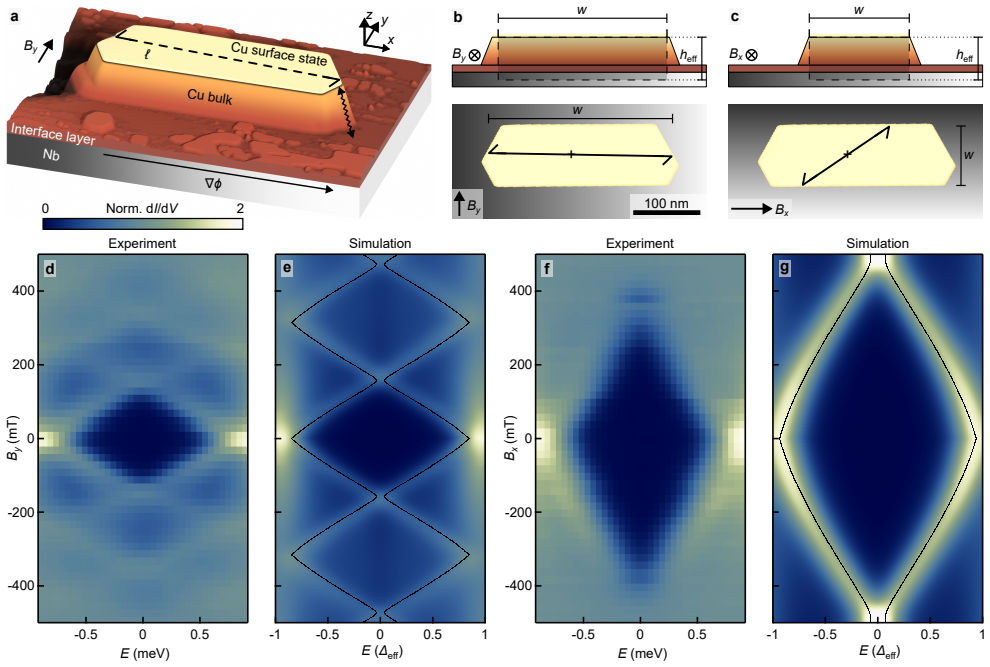
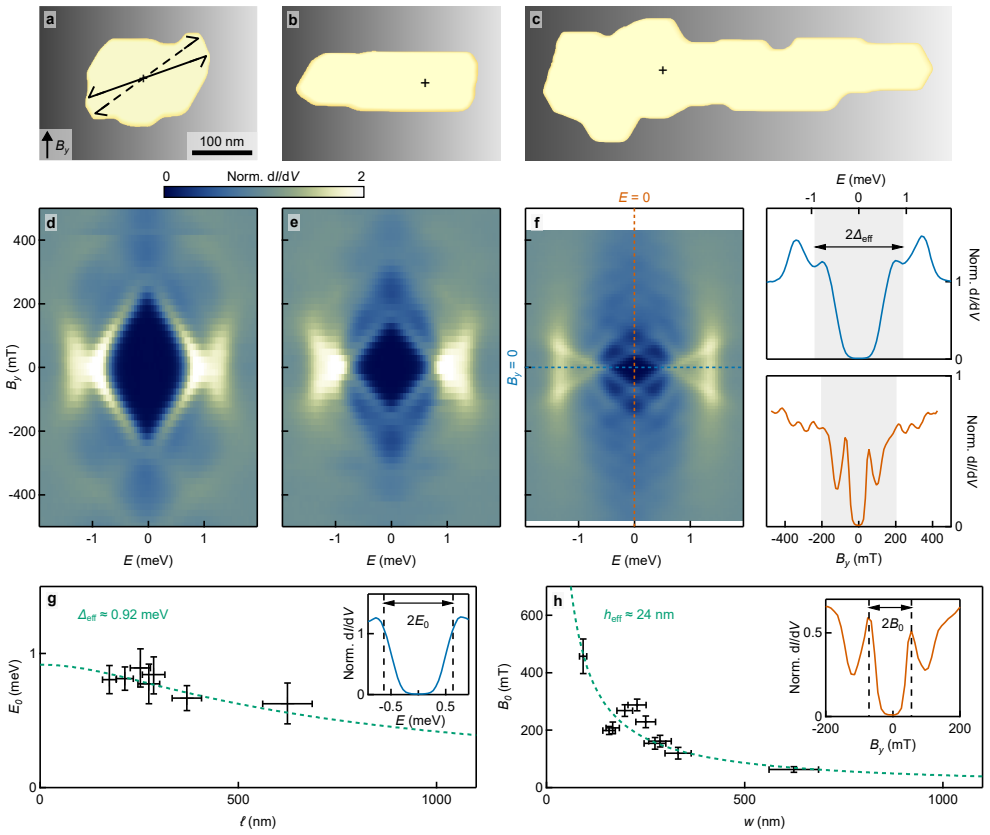
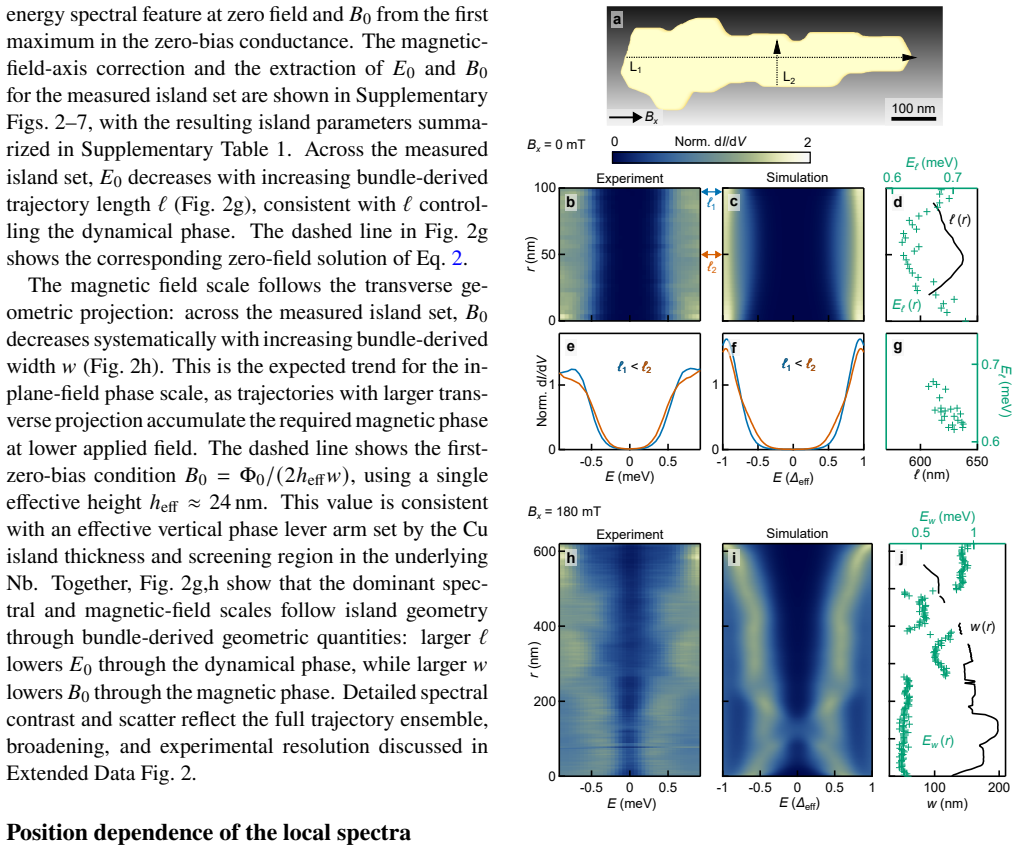
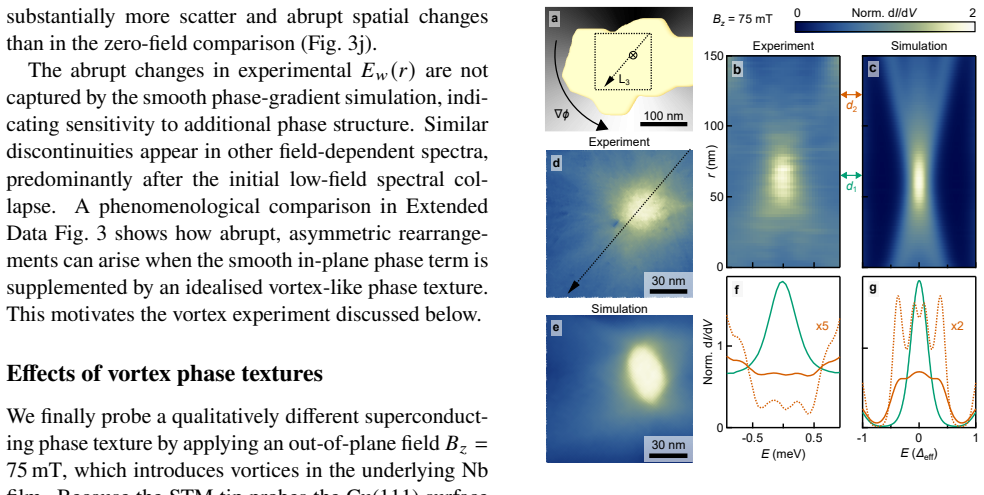
In these Andreev cavities the in-plane magnetic-field scale for the collapse of the resolved low-energy spectrum is set by the transverse extent available to Andreev trajectories, while the zero-field excitation energy evolves with the characteristic trajectory length; both trends, together with intra-island spatial variations and the response to vortex phase textures, are reproduced by a minimal semiclassical phase-accumulation picture.
What carries the argument
Minimal semiclassical phase-accumulation picture along geometry-defined Andreev trajectories
Load-bearing premise
The measured spectra are produced mainly by phase-coherent electron-hole motion along trajectories whose lengths and widths are fixed by the island shape, with little contribution from disorder or full quantum interference.
What would settle it
Finding that the collapse field or zero-field energy shows no systematic dependence on measured island dimensions, or deviates strongly from the semiclassical phase-accumulation prediction across multiple islands.
Figures
read the original abstract
Andreev cavities provide a setting in which superconducting proximity spectra are shaped by phase-coherent electron-hole motion along extended trajectories. While such Andreev physics is well established in transport, local spectra in two-dimensional cavities remain largely unexplored in real space. Here we use scanning tunnelling spectroscopy to study confined Cu(111) surface states coupled to superconducting Nb(110). The in-plane magnetic-field scale for the collapse of the resolved low-energy spectrum is controlled by the transverse extent available to Andreev trajectories, while the zero-field excitation energy evolves with the characteristic trajectory length. These trends, together with spatial variations within individual islands and the response to vortex phase textures, are captured by a minimal semiclassical phase-accumulation picture. Our results identify geometry-defined Andreev trajectories as a design principle for phase-coherent superconducting cavities accessible by local spectroscopy.
Editorial analysis
A structured set of objections, weighed in public.
Referee Report
Summary. The manuscript presents scanning tunneling spectroscopy (STS) measurements on Cu(111) surface states proximitized by Nb(110) islands, forming Andreev cavities. It claims that the in-plane magnetic-field scale for collapse of the resolved low-energy spectrum is set by the transverse extent of Andreev trajectories, while the zero-field excitation energy scales with characteristic trajectory length. Spatial variations within islands and responses to vortex phase textures are also reported to follow these trends. All observations are stated to be captured by a minimal semiclassical phase-accumulation model, establishing geometry-defined Andreev trajectories as a design principle for phase-coherent superconducting cavities accessible via local spectroscopy.
Significance. If the central claim holds, the work demonstrates real-space control of proximity-induced spectra through island geometry in a 2D surface-state system, with direct imaging of trajectory-dependent features. The experimental use of STS to resolve both field scales and spatial variations, combined with a parameter-free semiclassical interpretation, provides a concrete route to designing Andreev cavities without relying on transport averaging. This could impact efforts to engineer phase-coherent superconducting nanostructures.
major comments (1)
- [Abstract and semiclassical model section] Abstract and semiclassical model section: the load-bearing claim is that observed scalings (B-field collapse set by transverse extent; zero-field energy set by trajectory length) arise predominantly from geometry-defined phase-coherent Andreev trajectories under the minimal semiclassical picture, with negligible contributions from disorder, interface scattering, or full BdG quantum interference. The manuscript must provide a concrete argument or quantitative test showing that alternative mechanisms cannot reproduce the same geometry-dependent trends; without this, the interpretation that geometry is the dominant design principle remains under-constrained.
Simulated Author's Rebuttal
We thank the referee for the careful reading and the constructive major comment. We respond point-by-point below.
read point-by-point responses
-
Referee: [Abstract and semiclassical model section] Abstract and semiclassical model section: the load-bearing claim is that observed scalings (B-field collapse set by transverse extent; zero-field energy set by trajectory length) arise predominantly from geometry-defined phase-coherent Andreev trajectories under the minimal semiclassical picture, with negligible contributions from disorder, interface scattering, or full BdG quantum interference. The manuscript must provide a concrete argument or quantitative test showing that alternative mechanisms cannot reproduce the same geometry-dependent trends; without this, the interpretation that geometry is the dominant design principle remains under-constrained.
Authors: We agree that the manuscript would be strengthened by an explicit discussion of why alternative mechanisms are unlikely to reproduce the observed geometry-dependent scalings. The Cu(111) surface states are known from prior STM work to be exceptionally clean, with mean free paths exceeding several hundred nanometers; the islands studied here are smaller than this length scale, and the spectra remain sharp and spatially uniform within each island, inconsistent with strong disorder broadening. Interface scattering at the Nb/Cu boundary would be expected to produce additional subgap states or broadening that varies with island perimeter rather than the specific trajectory length and transverse extent reported. Full BdG quantum interference is approximated by the semiclassical phase accumulation when the Fermi wavelength is much shorter than the trajectory length, which holds for the micron-scale cavities. In the revised manuscript we will add a dedicated paragraph in the semiclassical model section that makes these arguments and cites the relevant surface-state literature. A direct numerical comparison to full BdG simulations for the experimental island sizes remains computationally prohibitive at present. revision: partial
- A quantitative test against full numerical BdG calculations for the specific experimental island geometries and sizes cannot be performed with currently available computational resources.
Circularity Check
No circularity: semiclassical interpretation applied to data without self-referential reduction
full rationale
The provided abstract and context describe experimental STM spectra interpreted via a minimal semiclassical phase-accumulation picture that qualitatively captures geometry-dependent trends in B-field collapse and zero-field energies. No equations, parameter fits to the target data, or self-citations are shown that would make any claimed prediction equivalent to its inputs by construction. The model is presented as an interpretive framework rather than a closed derivation chain, satisfying the default expectation of no significant circularity.
Axiom & Free-Parameter Ledger
axioms (1)
- domain assumption Semiclassical phase accumulation along Andreev trajectories accurately reproduces the observed spectral features in the 2D cavities.
Reference graph
Works this paper leans on
-
[1]
Baumgartner, C.et al.Supercurrent rectification andmagnetochiraleffectsinsymmetricJosephson junctions.Nat. Nanotechnol.17, 39–44 (2022). doi: 10.1038/s41565-021-01009-9
-
[2]
doi: 10.1038/s41586-019-1148-9
Ren, H.et al.Topological superconductivity in a phase-controlled Josephson junction.Nature569, 93–98 (2019). doi: 10.1038/s41586-019-1148-9
-
[3]
Pankratova, N.et al.Multiterminal Josephson effect.Phys. Rev. X10, 031051 (2020). doi: 10.1103/PhysRevX.10.031051
-
[4]
Riwar, R.-P. & Catelani, G. Efficient quasiparti- cle traps with low dissipation through gap engi- neering.Phys. Rev. B100, 144514 (2019). doi: 10.1103/PhysRevB.100.144514
-
[5]
de Gennes, P. G. & Saint-James, D. Elemen- tary excitations in the vicinity of a normal metal- superconductingmetalcontact.Phys. Lett.4,151– 152(1963). doi: 10.1016/0031-9163(63)90148-3
-
[6]
Andreev, A. F. Electron spectrum of the interme- diate state of superconductors.Sov. Phys. JETP 22, 455–458 (1966)
1966
-
[7]
McMillan,W.L.Tunnelingmodelofthesupercon- ductingproximityeffect.Phys. Rev.175,537–542 (1968). doi: 10.1103/PhysRev.175.537
-
[8]
Kulik, I. O. Macroscopic quantization and the proximity effect in S-N-S junctions.Sov. Phys. JETP30, 944–950 (1970)
1970
-
[9]
Stone,M. Spectralflow,Magnusforce,andmutual friction via the geometric optics limit of Andreev reflection.Phys. Rev. B54, 13222–13229 (1996). doi: 10.1103/PhysRevB.54.13222
-
[10]
Beenakker, C. W. J. Random-matrix theory of quantum transport.Rev. Mod. Phys.69, 731–808 (1997). doi: 10.1103/RevModPhys.69.731
-
[11]
Mandal, P.et al.Interfering trajectories in a bal- listic Andreev cavity.Phys. Rev. B113, 104517 (2026). doi: 10.1103/hls3-jqzj
-
[13]
Roditchev, D.et al.Direct observation of Joseph- son vortex cores.Nat. Phys.11, 332–337 (2015). doi: 10.1038/NPHYS3240
-
[15]
Ortuzar, J., Pascual, J. I., Bergeret, F. S. & Cazalilla, M. A. Theory of a single magnetic impurity on a thin metal film in proximity to a superconductor.Phys. Rev. B108,024511(2023). doi: 10.1103/PhysRevB.108.024511
-
[16]
doi: 10.1038/s41586-023-06312-0
Schneider,L.et al.Proximitysuperconductivityin atom-by-atom crafted quantum dots.Nature621, 60–65(2023). doi: 10.1038/s41586-023-06312-0
-
[18]
Crommie, M. F., Lutz, C. P. & Eigler, D. M. Confinement of electrons to quantum corrals on a metal surface.Science262, 218–220 (1993). doi: 10.1126/science.262.5131.218
-
[19]
Reinthaler, R. W., Tkachov, G. & Hankiewicz, E. M. Superconducting quantum spin Hall sys- tems with giant orbital𝑔factors.Phys. Rev. B92, 161303 (2015). doi: 10.1103/Phys- RevB.92.161303
-
[20]
CreatingMajoranamodesfrom segmented Fermi surface.Nat
Papaj,M.&Fu,L. CreatingMajoranamodesfrom segmented Fermi surface.Nat. Commun.12, 577 (2021). doi: 10.1038/s41467-020-20690-3
-
[21]
Belzig, W., Wilhelm, F. K., Bruder, C., Schön, G. & Zaikin, A. D. Quasiclassical Green’s function approachtomesoscopicsuperconductivity.Super- lattices Microstruct.25, 1251–1288 (1999). doi: 10.1006/spmi.1999.0710
-
[22]
Nikodem,E.et al.Tunablesuperconductingdiode effect in a topological nano-SQUID.Sci. Adv.11, eadw4898 (2025). doi: 10.1126/sciadv.adw4898
-
[23]
Altland, A. & Zirnbauer, M. R. Random ma- trix theory of a chaotic Andreev quantum dot. Phys. Rev. Lett.76, 3420–3423 (1996). doi: 10.1103/PhysRevLett.76.3420
-
[24]
Piquero-Zulaica, I.et al.Engineering quantum states and electronic landscapes through surface molecular nanoarchitectures.Rev. Mod. Phys. 94, 045008 (2022). doi: 10.1103/RevMod- Phys.94.045008
-
[25]
Razinkin, A. S. & Kuznetsov, M. V. Scanning tunneling microscopy (STM) of low-dimensional NbO structures on the Nb(110) surface.Phys. Met. Metallogr.110, 531–541 (2010). doi: 10.1134/S0031918X10120033
-
[26]
Schmucker, S. W.et al.Field-directed sput- ter sharpening for tailored probe materials and atomic-scale lithography.Nat. Commun.3, 935 (2012). doi: 10.1038/ncomms1907
-
[27]
Imaging geometry- and phase-controlled spectra in a surface-state Andreev cavity
Kohsaka, Y. SIDAM: Analysis tools for spectroscopic imaging scanning tunneling mi- croscopy/spectroscopy.https://github.com /yuksk/SIDAM(2025). GitHub repository, ver- sion v9.8.8; accessed 2026-04-28. 10 + -20 0Δz (nm) a b 30 20 10 0 P (%) 250200150100500 ℓ n (nm) ℓ ≈ 274 nm 100 nm + e f Trajectory ensembleE 0-defining ℓ bundle d Bx + B0,x-defining w bun...
2025
discussion (0)
Sign in with ORCID, Apple, or X to comment. Anyone can read and Pith papers without signing in.