Estimation--Prediction Tradeoff in Causal Probabilistic Temporal Graphs
Pith reviewed 2026-06-29 04:17 UTC · model grok-4.3
The pith
In binary logistic models for causal temporal graphs, parameter regimes that maximize Fisher information also maximize entropy, making predictions harder despite perfect recovery.
A machine-rendered reading of the paper's core claim, the machinery that carries it, and where it could break.
Core claim
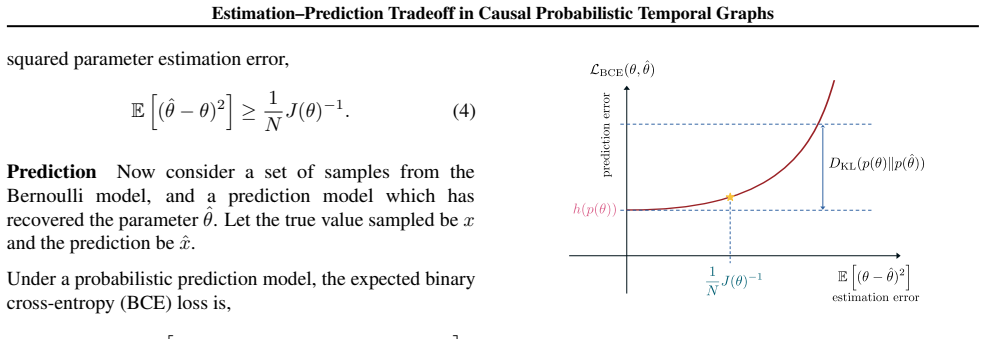
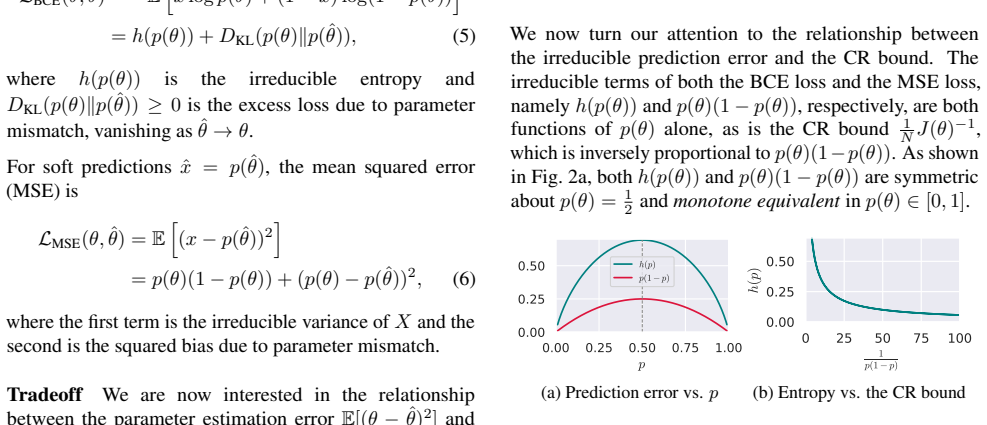
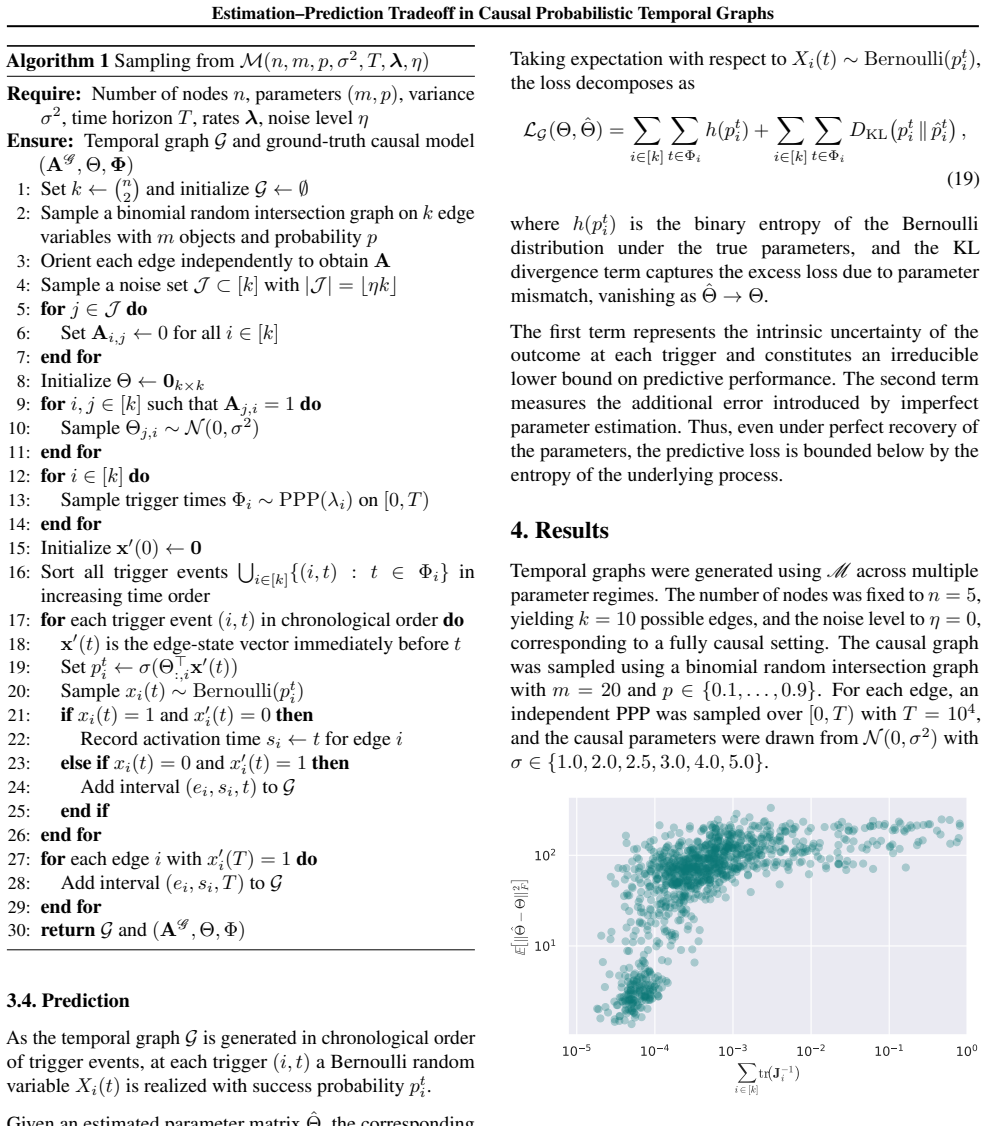
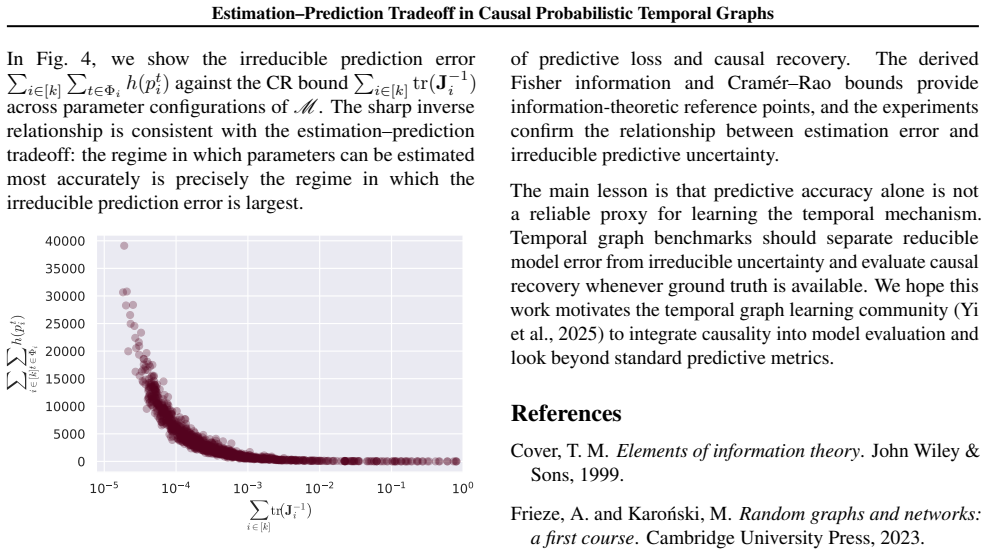
The central discovery is an estimation-prediction tradeoff in binary logistic models of causal probabilistic temporal graphs: the parameter values that maximize Fisher information (improving recoverability) are those with highest entropy, increasing irreducible predictive loss even under perfect parameter recovery. This is validated by deriving the Cramér-Rao bound and testing in a framework that generates temporal graphs with known causal structure.
What carries the argument
The binary logistic parametrisation of the probability of transient edges in the causal temporal graph, which enables direct comparison of the Cramér-Rao bound on parameter error to the irreducible predictive loss via entropy.
Load-bearing premise
The binary logistic parametrisation faithfully represents the causal mechanism generating the transient edges.
What would settle it
A simulation or real dataset where increasing Fisher information decreases or does not increase the entropy of edge predictions, violating the derived tradeoff.
Figures
read the original abstract
Temporal link prediction is usually evaluated by predictive performance on unseen edges, but in probabilistic temporal graphs this criterion can conflate model error with irreducible uncertainty. We study this issue by characterising an inherent estimation--prediction tradeoff in binary logistic models where regimes that maximise Fisher information and improve parameter recoverability are also those with the highest entropy, making individual predictions intrinsically harder even under perfect parameter recovery. We propose a probabilistic causal framework for generating temporal graphs with transient edges and known ground-truth causal structure, allowing temporal link prediction to be evaluated jointly with causal parameter recovery. For the proposed binary logistic parametrisation, we derive the Cram\'{e}r--Rao bound and validate the tradeoff between parameter estimation error and irreducible predictive loss. Our results show that predictive accuracy alone may not reflect whether a model has learned the underlying causal mechanism, motivating benchmarks that distinguish reducible model error from intrinsic process uncertainty.
Editorial analysis
A structured set of objections, weighed in public.
Referee Report
Summary. The paper claims that binary logistic models for probabilistic temporal graphs exhibit an inherent estimation-prediction tradeoff: regimes maximizing Fisher information (and thus parameter recoverability) coincide with maximum Bernoulli entropy, rendering individual predictions intrinsically uncertain even with perfect parameter recovery. The authors introduce a causal generative framework for temporal graphs with transient edges and known ground-truth structure, derive the Cramér-Rao bound under their binary logistic parametrization, and validate the tradeoff on synthetic data.
Significance. If the derivation holds, the work demonstrates that predictive accuracy metrics alone cannot distinguish successful causal mechanism recovery from intrinsic process uncertainty, motivating evaluation protocols that jointly assess parameter estimation and predictive loss. Strengths include the closed-form derivation from standard Fisher information properties, the use of synthetic data with explicit ground truth, and the explicit construction of the model class rather than a universality claim.
minor comments (1)
- The abstract and introduction would benefit from a brief explicit statement that the tradeoff follows directly from the identity I(p) ∝ p(1-p) for the logistic success probability, to make the 'by construction' nature of the result immediately clear to readers.
Simulated Author's Rebuttal
We thank the referee for their positive evaluation of the manuscript and for recommending acceptance. The referee's summary correctly identifies the core contribution: the characterization of an estimation-prediction tradeoff in binary logistic models for causal probabilistic temporal graphs, together with the proposed generative framework and Cramér-Rao analysis.
Circularity Check
No significant circularity; derivation is self-contained
full rationale
The paper's central result is the explicit mathematical identity that, in a binary logistic model, Fisher information for the success probability is maximized precisely where Bernoulli entropy is maximized. This follows directly from the standard formula I(p) = p(1-p) (scaled by design) and the entropy expression -p log p - (1-p) log(1-p); the paper defines its generative causal model using exactly this parametrization, derives the Cramér-Rao bound under it, and evaluates on synthetic data with known ground truth. No step reduces a prediction to a fitted quantity by construction, no uniqueness theorem is imported via self-citation, and the model class is presented as an author-defined framework rather than a universal claim. The derivation is therefore internally closed against external benchmarks.
Axiom & Free-Parameter Ledger
axioms (1)
- domain assumption Binary logistic parametrisation is a valid model for the causal mechanism generating transient edges
Reference graph
Works this paper leans on
-
[1]
Bozorgi, Zahra Dasht and Teinemaa, Irene and Dumas, Marlon and La Rosa, Marcello and Polyvyanyy, Artem , year =. Process. 2020 2nd. doi:10.1109/ICPM49681.2020.00028 , urldate =
-
[2]
Journal of Complex Networks , volume=
An information theory approach to network evolution models , author=. Journal of Complex Networks , volume=. 2022 , publisher=
2022
-
[3]
Learning in graphical models , pages=
A tutorial on learning with Bayesian networks , author=. Learning in graphical models , pages=. 1998 , publisher=
1998
-
[4]
The Twelfth International Conference on Learning Representations , year=
CausalTime: Realistically Generated Time-series for Benchmarking of Causal Discovery , author=. The Twelfth International Conference on Learning Representations , year=
-
[5]
2023 , url=
Yuxiao Cheng and Runzhao Yang and Tingxiong Xiao and Zongren Li and Jinli Suo and Kunlun He and Qionghai Dai , booktitle=. 2023 , url=
2023
-
[6]
Active Causal Structure Learning in Continuous Time , author =. 2023 , month = feb, journal =. doi:10.1016/j.cogpsych.2022.101542 , urldate =
-
[7]
Proceedings of the 39th
Lippe, Phillip and Magliacane, Sara and L. Proceedings of the 39th. 2022 , month = jun, pages =
2022
-
[8]
Annual Review of Organizational Psychology and Organizational Behavior , volume=
Structural equation modeling in organizational research: The state of our science and some proposals for its future , author=. Annual Review of Organizational Psychology and Organizational Behavior , volume=. 2023 , publisher=
2023
-
[9]
Ecosystems , volume=
Spatio-temporal structural equation modeling in a hierarchical bayesian framework: what controls wet heathland vegetation? , author=. Ecosystems , volume=. 2019 , publisher=
2019
-
[10]
2006 , publisher=
Elements of information theory , author=. 2006 , publisher=
2006
-
[11]
2012 , publisher=
Stochastic geometry for wireless networks , author=. 2012 , publisher=
2012
-
[12]
Brazilian symposium on artificial intelligence , pages=
Random generation of Bayesian networks , author=. Brazilian symposium on artificial intelligence , pages=. 2002 , organization=
2002
-
[13]
Physical Review E—Statistical, Nonlinear, and Soft Matter Physics , volume=
Random graph models for directed acyclic networks , author=. Physical Review E—Statistical, Nonlinear, and Soft Matter Physics , volume=. 2009 , publisher=
2009
-
[14]
2021 , url =
Oleksandr Shchur and Ali Caner Turkmen and Tim Januschowski and Stephan Günnemann , title =. 2021 , url =
2021
-
[15]
PLoS computational biology , volume=
A Granger causality measure for point process models of ensemble neural spiking activity , author=. PLoS computational biology , volume=. 2011 , publisher=
2011
-
[16]
2009 , publisher=
Causality , author=. 2009 , publisher=
2009
-
[17]
Detecting and Quantifying Causal Associations in Large Nonlinear Time Series Datasets , author =. 2019 , month = nov, journal =. doi:10.1126/sciadv.aau4996 , urldate =
-
[18]
Sch. Towards. 2021 , month = feb, number =. arXiv , langid =:2102.11107 , primaryclass =
arXiv 2021
-
[19]
Proceedings of the 37th
Zhang, Wei and Panum, Thomas and Jha, Somesh and Chalasani, Prasad and Page, David , year =. Proceedings of the 37th
-
[20]
Zhao, Liang , year =. Event. ACM Computing Surveys , volume =. doi:10.1145/3450287 , urldate =
-
[21]
Artificial intelligence and statistics , pages=
Learning social infectivity in sparse low-rank networks using multi-dimensional hawkes processes , author=. Artificial intelligence and statistics , pages=. 2013 , organization=
2013
-
[22]
2009 , publisher=
Probabilistic graphical models: principles and techniques , author=. 2009 , publisher=
2009
-
[23]
2013 IEEE Global Conference on Signal and Information Processing , pages=
ALARM: A logistic auto-regressive model for binary processes on networks , author=. 2013 IEEE Global Conference on Signal and Information Processing , pages=. 2013 , organization=
2013
-
[24]
Proceedings of the National Academy of Sciences , volume=
Extracting neuronal functional network dynamics via adaptive Granger causality analysis , author=. Proceedings of the National Academy of Sciences , volume=. 2018 , publisher=
2018
-
[25]
Computational and structural biotechnology journal , volume=
Inferring neural information flow from spiking data , author=. Computational and structural biotechnology journal , volume=. 2020 , publisher=
2020
-
[26]
http://archive
UCI machine learning repository , author=. http://archive. ics. uci. edu/ml , year=
-
[27]
2014 , publisher=
Causal modeling and prediction over event streams , author=. 2014 , publisher=
2014
-
[28]
Journal of Applied Econometrics , volume=
Estimating global bank network connectedness , author=. Journal of Applied Econometrics , volume=. 2018 , publisher=
2018
-
[29]
Sensors , volume=
Activity recognition using hybrid generative/discriminative models on home environments using binary sensors , author=. Sensors , volume=. 2013 , publisher=
2013
-
[30]
Advances in Neural Information Processing Systems , volume=
Counterfactual temporal point processes , author=. Advances in Neural Information Processing Systems , volume=
-
[31]
The Thirty-eighth Annual Conference on Neural Information Processing Systems , year=
Causal Discovery from Event Sequences by Local Cause-Effect Attribution , author=. The Thirty-eighth Annual Conference on Neural Information Processing Systems , year=
-
[32]
Network Science , volume=
Network science book , author=. Network Science , volume=
-
[33]
Journal of Machine Learning Research , volume=
Community detection and stochastic block models: recent developments , author=. Journal of Machine Learning Research , volume=
-
[34]
Biometrika , volume=
Spectra of some self-exciting and mutually exciting point processes , author=. Biometrika , volume=. 1971 , publisher=
1971
-
[35]
Proceedings of the AAAI Conference on Artificial Intelligence , volume=
Causal discovery in Hawkes processes by minimum description length , author=. Proceedings of the AAAI Conference on Artificial Intelligence , volume=
-
[36]
ACM Computing Surveys (CSUR) , volume=
Event prediction in the big data era: A systematic survey , author=. ACM Computing Surveys (CSUR) , volume=. 2021 , publisher=
2021
-
[37]
Sociological methods & research , volume=
Sequence similarity: a nonaligning technique , author=. Sociological methods & research , volume=. 2003 , publisher=
2003
-
[38]
Sociological methods & research , volume=
Measuring the agreement between sequences , author=. Sociological methods & research , volume=. 1995 , publisher=
1995
-
[39]
Bulletin of the Institute of International Statistics , volume=
On the evolution of random graphs , author=. Bulletin of the Institute of International Statistics , volume=
-
[40]
Journal of the Royal Statistical Society Series A: Statistics in Society , volume=
What matters in differences between life trajectories: A comparative review of sequence dissimilarity measures , author=. Journal of the Royal Statistical Society Series A: Statistics in Society , volume=. 2016 , publisher=
2016
-
[41]
Gao, Tian and Subramanian, Dharmashankar and Bhattacharjya, Debarun and Shou, Xiao and Mattei, Nicholas and Bennett, Kristin P , year =. Causal. Advances in
-
[42]
IEEE Transactions on Neural Networks and Learning Systems , author =. 2024 , note =. doi:10.1109/TNNLS.2022.3175622 , abstract =
-
[43]
Proceedings of the 25th ACM SIGKDD international conference on knowledge discovery & data mining , pages=
Predicting dynamic embedding trajectory in temporal interaction networks , author=. Proceedings of the 25th ACM SIGKDD international conference on knowledge discovery & data mining , pages=
-
[44]
International conference on learning representations , year=
Dyrep: Learning representations over dynamic graphs , author=. International conference on learning representations , year=
-
[45]
Cong, Weilin and Zhang, Si and Kang, Jian and Yuan, Baichuan and Wu, Hao and Zhou, Xin and Tong, Hanghang and Mahdavi, Mehrdad , year =. Do. The
-
[46]
Kumar, Srijan and Zhang, Xikun and Leskovec, Jure , year =. Predicting. Proceedings of the 25th. doi:10.1145/3292500.3330895 , urldate =
-
[47]
Neighborhood-Aware
Luo, Yuhong and Li, Pan , abstract =. Neighborhood-Aware
-
[48]
Advances in Neural Information Processing Systems , volume=
Towards better evaluation for dynamic link prediction , author=. Advances in Neural Information Processing Systems , volume=
-
[49]
arXiv preprint arXiv:2506.12588 , year=
Are We Really Measuring Progress? Transferring Insights from Evaluating Recommender Systems to Temporal Link Prediction , author=. arXiv preprint arXiv:2506.12588 , year=
-
[50]
Symposium on Probabilistic Machine Learning , year=
Causal Temporal Graphs for Counterfactual Validation of Temporal Link Prediction , author=. Symposium on Probabilistic Machine Learning , year=
-
[51]
The Thirteenth International Conference on Learning Representations , year=
TGB-Seq Benchmark: Challenging Temporal GNNs with Complex Sequential Dynamics , author=. The Thirteenth International Conference on Learning Representations , year=
-
[52]
Poursafaei, Farimah and Rabbany, Reihaneh , year =. Exhaustive. 2023. doi:10.1109/ICDMW60847.2023.00147 , urldate =
- [53]
-
[54]
International
Trivedi, Rakshit and Farajtabar, Mehrdad and Biswal, Prasenjeet and Zha, Hongyuan , year =. International
-
[55]
Transactions on Machine Learning Research , year=
Node feature forecasting in temporal graphs: An interpretable online algorithm , author=. Transactions on Machine Learning Research , year=
-
[56]
ACM Computing Surveys , volume=
A Primer on Temporal Graph Learning , author=. ACM Computing Surveys , volume=. 2025 , publisher=
2025
-
[57]
arXiv preprint arXiv:2507.07354 , year=
Learning from positive and unlabeled examples-Finite size sample bounds , author=. arXiv preprint arXiv:2507.07354 , year=
-
[58]
International Conference on Learning Representations , year=
Inductive Representation Learning in Temporal Networks via Causal Anonymous Walks , author=. International Conference on Learning Representations , year=
-
[59]
International Conference on Learning Representations , year=
Inductive representation learning on temporal graphs , author=. International Conference on Learning Representations , year=
-
[60]
Advances in Neural Information Processing Systems , volume=
Towards better dynamic graph learning: New architecture and unified library , author=. Advances in Neural Information Processing Systems , volume=
-
[61]
Rendiconti del Circolo Matematico di Palermo , author =
Some properties of line digraphs , volume =. Rendiconti del Circolo Matematico di Palermo , author =. 1960 , pages =. doi:10.1007/BF02854581 , language =
-
[62]
and Stoffer, David S
Shumway, Robert H. and Stoffer, David S. , year =. Time
-
[63]
, month = jan, year =
Rahman, Aniq Ur and Coon, Justin P. , month = jan, year =. A
-
[64]
Welch, Greg , year =. An
-
[65]
Peng, Zhen and Huang, Wenbing and Luo, Minnan and Zheng, Qinghua and Rong, Yu and Xu, Tingyang and Huang, Junzhou , month = apr, year =. Graph. Proceedings of. doi:10.1145/3366423.3380112 , language =
-
[66]
Spatial Statistics , month = oct, year =
Spatio-temporal. Spatial Statistics , month = oct, year =. doi:10.1016/j.spasta.2023.100773 , abstract =
-
[67]
Chen, Samantha and Lim, Sunhyuk and Mémoli, Facundo and Wan, Zhengchao and Wang, Yusu , month = sep, year =. The
-
[68]
Bayesian
Barber, David , month = feb, year =. Bayesian
-
[69]
IEEE Transactions on Pattern Analysis and Machine Intelligence , author =
Differentially. IEEE Transactions on Pattern Analysis and Machine Intelligence , author =. 2023 , pages =. doi:10.1109/TPAMI.2022.3228315 , abstract =
-
[70]
Tutorial on
Doersch, Carl , month = jan, year =. Tutorial on
-
[71]
Generative
Song, Yang and Ermon, Stefano , year =. Generative. Advances in
-
[72]
Permutation
Niu, Chenhao and Song, Yang and Song, Jiaming and Zhao, Shengjia and Grover, Aditya and Ermon, Stefano , month = jun, year =. Permutation. Proceedings of the
-
[73]
Bresson, Xavier and Laurent, Thomas , month = jun, year =. A
-
[74]
2013 , publisher=
The nature of statistical learning theory , author=. 2013 , publisher=
2013
-
[75]
, year =
Bishop, Christopher M. , year =. Pattern recognition and machine learning , isbn =
-
[76]
Bayesian
Särkkä, Simo and Svensson, Lennart , year =. Bayesian
-
[77]
Veličković, Petar and Cucurull, Guillem and Casanova, Arantxa and Romero, Adriana and Liò, Pietro and Bengio, Yoshua , month = feb, year =. Graph
-
[78]
Xu, Keyulu and Hu, Weihua and Leskovec, Jure and Jegelka, Stefanie , month = feb, year =. How. doi:10.48550/arXiv.1810.00826 , abstract =
work page internal anchor Pith review Pith/arXiv arXiv doi:10.48550/arxiv.1810.00826
-
[79]
Diffusion
Li, Yaguang and Yu, Rose and Shahabi, Cyrus and Liu, Yan , month = feb, year =. Diffusion
-
[80]
Diffusion-
Atwood, James and Towsley, Don , year =. Diffusion-. Advances in
discussion (0)
Sign in with ORCID, Apple, or X to comment. Anyone can read and Pith papers without signing in.