Efficient targeting of arbitrary excited states with quantum inverse power iteration through filtering polynomials
Pith reviewed 2026-06-29 03:12 UTC · model grok-4.3
The pith
Eigenstate filtering polynomials make quantum inverse power iteration robust for arbitrary excited states
A machine-rendered reading of the paper's core claim, the machinery that carries it, and where it could break.
Core claim
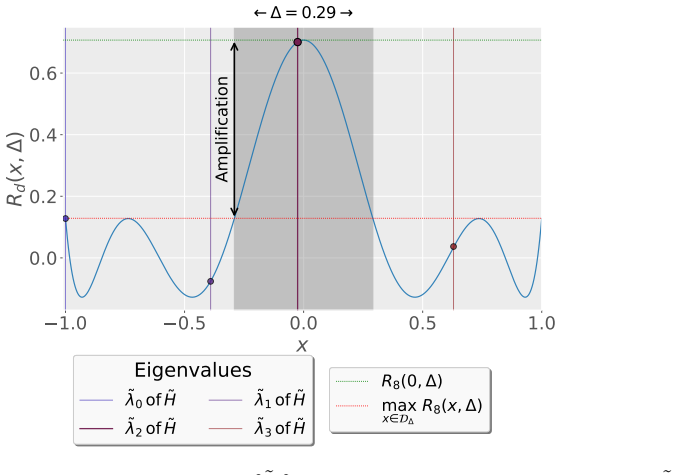
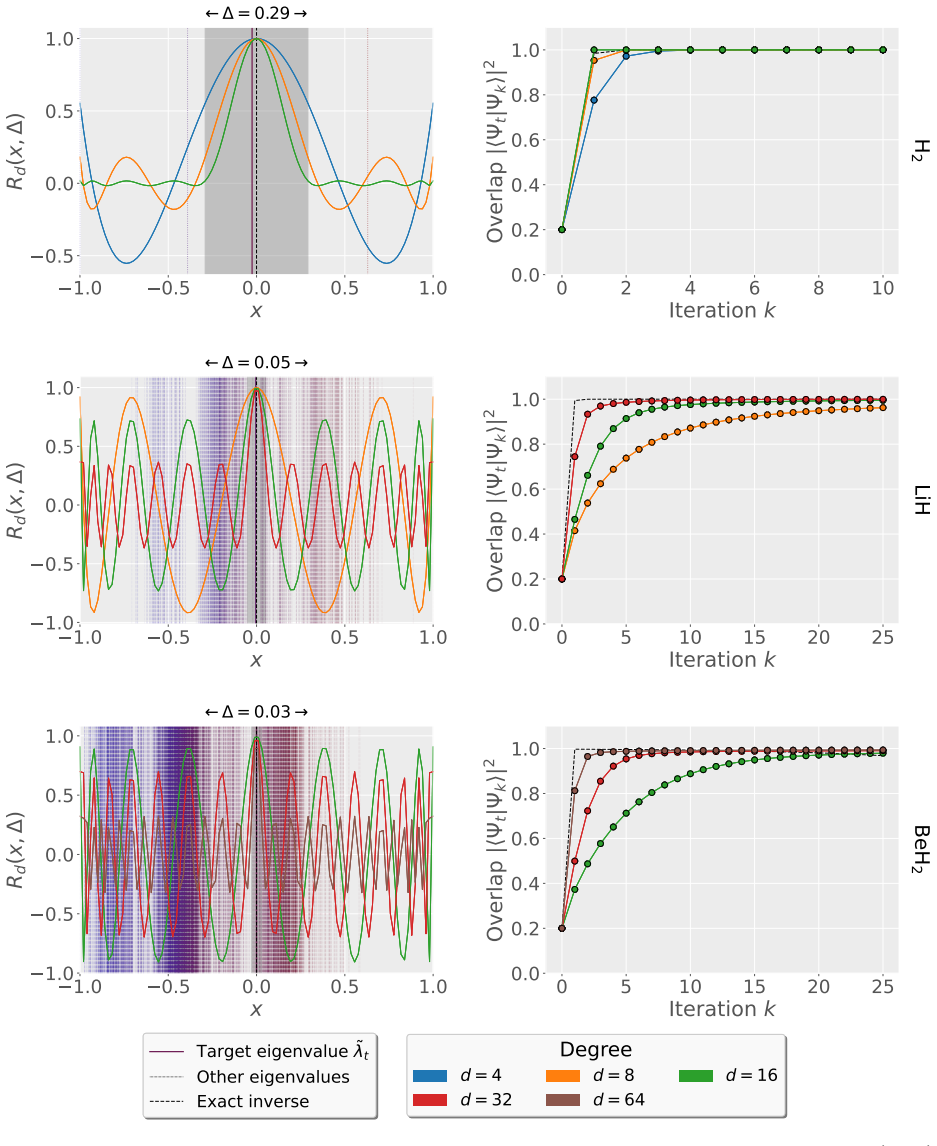
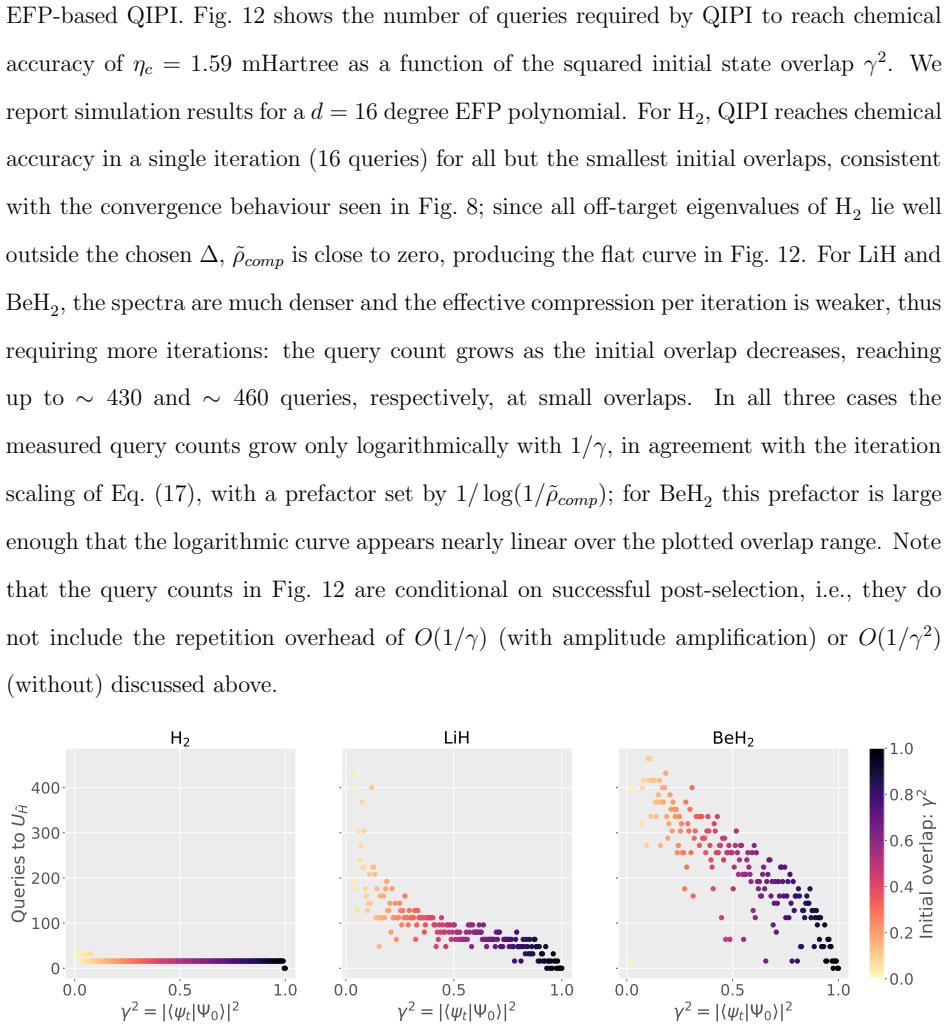
EF-based QIPI is substantially more robust than Cheb-inv and other decomposition-based approaches due to the symmetry of the applied filtering polynomial, avoiding divergence with respect to the choice of ω and efficiently suppressing off-target eigenstates even in closely spaced spectra.
What carries the argument
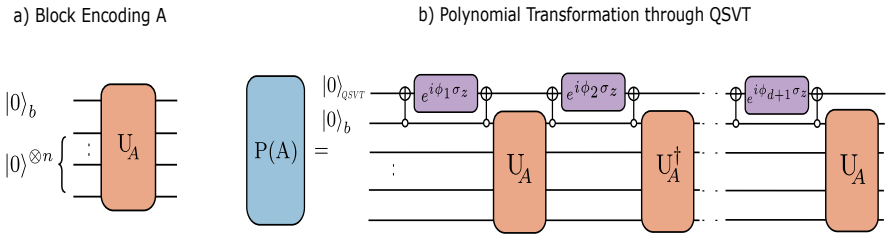
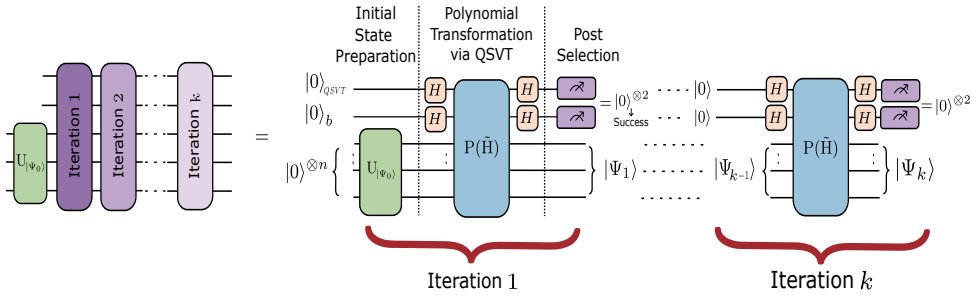
The eigenstate filtering polynomial, applied iteratively via QSVT to approximate the action of the shifted inverse (H - ωI)^{-1} on a trial state.
If this is right
- Improved convergence and access to higher excited states on the molecular Hamiltonians of H2, LiH and BeH2.
- High target-state amplification achieved with modest polynomial degrees.
- Logical T-gate counts remain practical for fault-tolerant implementations under standard oracle access.
- Promising route to scalable excited-state preparation in fault-tolerant quantum chemistry.
Where Pith is reading between the lines
- The same symmetry may reduce hyperparameter sensitivity across a wider range of quantum simulation tasks that currently rely on inverse or power methods.
- If the polynomial degree stays modest on larger molecules, the approach could be paired with existing ground-state routines without large increases in circuit depth.
- A direct comparison of wall-clock resources against variational excited-state methods on the same Hamiltonians would clarify practical trade-offs.
- The method's reliance on an energy shift ω suggests it could be combined with classical diagonalization guesses to further accelerate targeting.
Load-bearing premise
The symmetry property of the eigenstate filtering polynomial will continue to suppress off-target states efficiently when spectra become denser or when the Hamiltonian oracle is implemented on actual hardware.
What would settle it
A simulation or hardware run on a molecular Hamiltonian with several closely spaced excited states that shows either divergence with respect to ω or failure to amplify the target state above a chosen threshold using the EF polynomial.
Figures
read the original abstract
In this work, we introduce a quantum inverse power iteration (QIPI) algorithm based on the quantum singular value transformation (QSVT) to target arbitrary excited states. Given an energy shift $\omega$, QIPI prepares the target excited state by iteratively applying an approximation of the shifted inverse Hamiltonian $(H-\omega I)^{-1}$ to a trial state. Prior quantum inverse power approaches typically relied on Fourier decompositions of the inverse Hamiltonian, with numerical quadrature used to reconstruct the transformation, but such methods are highly sensitive to hyperparameter choices and have been observed to be numerically unstable, effectively restricting their use to ground-state preparation. To enable robust excited-state targeting, we investigate two alternative transformation techniques: a Chebyshev decomposition of the inverse (Cheb-inv) and an eigenstate filtering (EF) approach based on QSVT. We find that EF-based QIPI is substantially more robust than Cheb-inv and other decomposition-based approaches due to the symmetry of the applied filtering polynomial, avoiding divergence with respect to the choice of $\omega$ and efficiently suppressing off-target eigenstates even in closely spaced spectra. Numerical simulations for molecular Hamiltonians of H$_2$, LiH, and BeH$_2$ show improved convergence and enhanced access to higher excited states relative to other quantum power methods. Assuming standard oracle access to the Hamiltonian, we further provide logical resource estimates in fault-tolerant settings in terms of T gate counts, and conclude that QIPI can achieve high target state amplification with modest polynomial degrees, thereby making it a promising candidate for scalable excited-state preparation in fault-tolerant quantum chemistry applications.
Editorial analysis
A structured set of objections, weighed in public.
Referee Report
Summary. The manuscript introduces a QIPI algorithm based on QSVT that uses an eigenstate-filtering polynomial to target arbitrary excited states given an energy shift ω. It contrasts this EF approach with Chebyshev inversion (Cheb-inv) and other decompositions, attributing superior robustness—no divergence w.r.t. ω and efficient off-target suppression even for close eigenvalues—to the symmetry of the EF polynomial. Numerical demonstrations on the H2, LiH, and BeH2 Hamiltonians are reported to show improved convergence to higher excited states, and logical T-gate resource estimates under standard oracle access are supplied.
Significance. If the claimed robustness generalizes, the method would offer a structurally motivated route to excited-state preparation that avoids the hyperparameter sensitivity of quadrature-based inverses. The explicit T-gate counts constitute a concrete strength, enabling direct resource comparisons with other fault-tolerant quantum chemistry algorithms. The symmetry argument supplies a clear mechanistic explanation for the observed stability on the tested instances.
major comments (1)
- [Numerical simulations] Numerical simulations section: the central claim that EF-based QIPI is substantially more robust due to polynomial symmetry and efficiently suppresses off-target states even in closely spaced spectra is supported only by results on H2, LiH, and BeH2. These Hamiltonians possess relatively sparse spectra; no explicit scaling test or counter-example is provided for regimes in which eigenvalue gaps fall below the effective resolution set by the chosen polynomial degree, leaving the extrapolation to denser spectra as an unverified step for the robustness assertion.
Simulated Author's Rebuttal
We thank the referee for the constructive feedback on our manuscript. We address the single major comment below.
read point-by-point responses
-
Referee: Numerical simulations section: the central claim that EF-based QIPI is substantially more robust due to polynomial symmetry and efficiently suppresses off-target states even in closely spaced spectra is supported only by results on H2, LiH, and BeH2. These Hamiltonians possess relatively sparse spectra; no explicit scaling test or counter-example is provided for regimes in which eigenvalue gaps fall below the effective resolution set by the chosen polynomial degree, leaving the extrapolation to denser spectra as an unverified step for the robustness assertion.
Authors: We agree that the numerical demonstrations use H₂, LiH, and BeH₂, whose spectra are relatively sparse compared with larger systems. The manuscript does not contain explicit scaling tests or counter-examples on denser spectra where gaps fall below the polynomial resolution. The robustness claim is grounded in the symmetry of the EF polynomial, which is an odd function around the shift ω; this structural property prevents divergence and ensures consistent off-target suppression for any spectrum provided the degree suffices to resolve the target gap. This argument is independent of the specific eigenvalue density. Nevertheless, we acknowledge that direct numerical verification on denser spectra would strengthen the extrapolation. In the revised manuscript we will add a short paragraph in the numerical simulations section discussing this limitation and the expected scaling of required degree with minimum gap size. revision: partial
Circularity Check
No circularity: robustness attributed to structural polynomial symmetry, supported by explicit simulations
full rationale
The manuscript constructs QIPI via QSVT with an eigenstate-filtering polynomial and attributes robustness (no ω-divergence, off-target suppression) to the polynomial's symmetry as a stated structural property. This is then validated by direct numerical runs on H2, LiH, and BeH2 Hamiltonians. No equation reduces a claimed prediction to a fitted input by construction, no load-bearing self-citation chain appears, and the symmetry is not imported via an ansatz from prior author work. The derivation chain remains self-contained against the reported benchmarks.
Axiom & Free-Parameter Ledger
free parameters (2)
- polynomial degree
- energy shift ω
axioms (2)
- domain assumption Standard oracle access to the Hamiltonian is available and implementable via QSVT block encodings.
- domain assumption The filtering polynomial can be constructed to have the required symmetry properties for any chosen ω.
Reference graph
Works this paper leans on
-
[1]
npj Quantum Inf
Quantum inverse iteration algorithm for programmable quantum simulators , author=. npj Quantum Inf. , volume=. 2020 , publisher=
2020
-
[2]
Preparing Ground States of Quantum Many-Body Systems on a Quantum Computer , author =. Phys. Rev. Lett. , volume =. 2009 , month =. doi:10.1103/PhysRevLett.102.130503 , url =
-
[3]
and Kothari, Robin and Somma, Rolando D
Childs, Andrew M. and Kothari, Robin and Somma, Rolando D. , year=. Quantum Algorithm for Systems of Linear Equations with Exponentially Improved Dependence on Precision , volume=. SIAM J. Comput. , publisher=. doi:10.1137/16m1087072 , number=
work page internal anchor Pith review doi:10.1137/16m1087072
-
[4]
Lin, Lin and Tong, Yu , year=. Optimal polynomial based quantum eigenstate filtering with application to solving quantum linear systems , volume=. doi:10.22331/q-2020-11-11-361 , journal=
-
[5]
Quantum , volume=
Variational quantum computation of excited states , author=. Quantum , volume=. 2019 , publisher=
2019
-
[6]
and Mitarai, Kosuke and Fujii, Keisuke , year=
Nakanishi, Ken M. and Mitarai, Kosuke and Fujii, Keisuke , year=. Subspace-search variational quantum eigensolver for excited states , volume=. Phys. Rev. Res. , publisher=. doi:10.1103/physrevresearch.1.033062 , number=
-
[7]
Simulating chemistry using quantum computers , author=. Annu. Rev. Phys. Chem. , volume=. 2011 , publisher=
2011
-
[8]
Simulating quantum systems on a quantum computer , author=. Proc. R. Soc. A , volume=. 1998 , publisher=
1998
-
[9]
Quantum chemistry in the age of quantum computing , author=. Chem. Rev. , volume=. 2019 , publisher=
2019
-
[10]
1995 , eprint=
Quantum measurements and the Abelian Stabilizer Problem , author=. 1995 , eprint=
1995
-
[11]
Peruzzo, Alberto and McClean, Jarrod and Shadbolt, Peter and Yung, Man-Hong and Zhou, Xiao-Qi and Love, Peter J. and Aspuru-Guzik, Alán and O’Brien, Jeremy L. , year=. A variational eigenvalue solver on a photonic quantum processor , volume=. Nat. Commun. , publisher=. doi:10.1038/ncomms5213 , number=
-
[12]
Cadi Tazi, Lila and Thom, Alex J. W. , title =. J. Chem. Theory Comput. , volume =. 2024 , doi =
2024
-
[13]
Yoshikura, Takahiro and Ten-no, Seiichiro L. and Tsuchimochi, Takashi. Quantum Inverse Algorithm via Adaptive Variational Quantum Linear Solver: Applications to General Eigenstates. J. Phys. Chem. A. 2023. doi:10.1021/acs.jpca.3c02800
-
[14]
Cainelli, Mauro and Baba, Reo and Kurashige, Yuki , title =. J. Chem. Theory Comput. , volume =. 2024 , doi =
2024
-
[15]
Quantum Krylov subspace algorithms for ground- and excited-state energy estimation , author =. Phys. Rev. A , volume =. 2022 , month =. doi:10.1103/PhysRevA.105.022417 , url =
-
[16]
and Childs, Andrew M
Berry, Dominic W. and Childs, Andrew M. and Kothari, Robin , booktitle=. Hamiltonian Simulation with Nearly Optimal Dependence on all Parameters , year=
-
[17]
PRX Quantum , volume=
Even shorter quantum circuit for phase estimation on early fault-tolerant quantum computers with applications to ground-state energy estimation , author=. PRX Quantum , volume=. 2023 , publisher=
2023
-
[18]
PRX Quantum , volume=
Heisenberg-limited ground-state energy estimation for early fault-tolerant quantum computers , author=. PRX Quantum , volume=. 2022 , publisher=
2022
-
[19]
npj Quantum Inf
Quantum chemistry as a benchmark for near-term quantum computers , author=. npj Quantum Inf. , volume=. 2019 , publisher=
2019
-
[20]
Yordanov, Yordan S. and Armaos, V. and Barnes, Crispin H. W. and Arvidsson-Shukur, David R. M. , year=. Qubit-excitation-based adaptive variational quantum eigensolver , volume=. Commun. Phys. , publisher=. doi:10.1038/s42005-021-00730-0 , number=
-
[21]
A Multireference Quantum Krylov Algorithm for Strongly Correlated Electrons , author=. J. Chem. Theory Comput. , volume=. 2020 , doi=
2020
-
[22]
Quantum error correction below the surface code threshold , volume=. Nature , publisher=. 2024 , month=dec, pages=. doi:10.1038/s41586-024-08449-y , number=
-
[23]
Quantum chemistry of the excited state: 2005 overview , journal =
Luis Serrano-Andrés and Manuela Merchán , keywords =. Quantum chemistry of the excited state: 2005 overview , journal =. 2005 , note =. doi:10.1016/j.theochem.2005.03.020 , url =
-
[24]
2020 , publisher=
Quantum chemistry and dynamics of excited states: methods and applications , author=. 2020 , publisher=
2020
-
[25]
Charge and Energy Transfer Dynamics in Molecular Systems
Chergui, Majed , year =. Charge and Energy Transfer Dynamics in Molecular Systems. 2nd, Revised and Enlarged Edition. By Volkhard May and Oliver Kühn , volume =. ChemPhysChem , doi =
-
[26]
* excited states in molecular photochemistry , author=. Phys. Chem. Chem. Phys. , volume=. 2010 , publisher=
2010
-
[27]
Multireference Approaches for Excited States of Molecules , journal =
Lischka, Hans and Nachtigallová, Dana and Aquino, Ad. Multireference Approaches for Excited States of Molecules , journal =. 2018 , doi =
2018
-
[28]
Coupled-cluster theory in quantum chemistry , author =. Rev. Mod. Phys. , volume =. 2007 , month =. doi:10.1103/RevModPhys.79.291 , url =
-
[29]
2011 , publisher=
Numerical methods for large eigenvalue problems: revised edition , author=. 2011 , publisher=
2011
-
[30]
Sun, Qiming and Zhang, Xing, Banerjee et al , title =. J. Chem. Phys. , volume =. 2020 , month =. doi:10.1063/5.0006074 , url =
-
[31]
Ge, Yimin and Tura, Jordi and Cirac, J. Ignacio , title =. J. Math. Phys. , volume =. 2019 , month =. doi:10.1063/1.5027484 , url =
- [32]
-
[33]
, author=
Equation-of-motion coupled-cluster methods for open-shell and electronically excited species: the Hitchhiker's guide to Fock space. , author=. Annu. Rev. Phys. Chem. , year=
-
[34]
, title =
Ullrich, Carsten A. , title =. 2011 , doi =
2011
-
[35]
, title =
Werner, Hans‐Joachim and Knowles, Peter J. , title =. J. Chem. Phys. , volume =. 1985 , doi =
1985
-
[36]
Otis, Leon and Neuscamman, Eric , title =. WIREs Comput. Mol. Sci. , volume =. doi:10.1002/wcms.1659 , year =
-
[37]
Simulating physics with computers , volume =. Int. J. Theor. Phys. , author =. 1982 , pages =. doi:10.1007/BF02650179 , number =
-
[38]
and Tennyson, Jonathan , month = nov, year =
Tilly, Jules and Chen, Hongxiang and Cao, Shuxiang and Picozzi, Dario and Setia, Kanav and Li, Ying and Grant, Edward and Wossnig, Leonard and Rungger, Ivan and Booth, George H. and Tennyson, Jonathan , month = nov, year =. The. doi:10.1016/j.physrep.2022.08.003 , journal =
-
[39]
Self-Consistent Molecular-Orbital Methods. I. Use of Gaussian Expansions of Slater-Type Atomic Orbitals. J. Chem. Phys. , year = 1969, month = sep, volume =
1969
-
[40]
Gilyén, András and Su, Yuan and Low, Guang Hao and Wiebe, Nathan , year=. Quantum singular value transformation and beyond: exponential improvements for quantum matrix arithmetics , url=. doi:10.1145/3313276.3316366 , booktitle=
-
[41]
Quantum Inf
Optimal ancilla-free Clifford+T approximation of z-rotations , author=. Quantum Inf. Comput. , volume=. 2016 , doi=
2016
-
[42]
2025 , eprint=
Generalized Quantum Signal Processing and Non-Linear Fourier Transform are equivalent , author=. 2025 , eprint=
2025
-
[43]
PRX Quantum , volume=
Grand unification of quantum algorithms , author=. PRX Quantum , volume=. 2021 , publisher=
2021
-
[44]
Quantum block. Phys. Rev. A , author =. 2025 , pages =. doi:10.1103/p8wj-gplb , number =
-
[45]
The Bravyi-Kitaev transformation for quantum computation of electronic structure , author=. J. Chem. Phys. , volume=. 2012 , publisher=
2012
-
[46]
Universal quantum computation with ideal Clifford gates and noisy ancillas , author =. Phys. Rev. A , volume =. 2005 , month =. doi:10.1103/PhysRevA.71.022316 , url =
-
[47]
Quantum , volume=
A game of surface codes: Large-scale quantum computing with lattice surgery , author=. Quantum , volume=. 2019 , publisher=
2019
-
[48]
2025 , eprint=
Transversal Surface-Code Game Powered by Neutral Atoms , author=. 2025 , eprint=
2025
-
[49]
2024 , eprint=
Magic state cultivation: growing T states as cheap as CNOT gates , author=. 2024 , eprint=
2024
-
[50]
Magic State Distillation: Not as Costly as You Think , volume=
Litinski, Daniel , year=. Magic State Distillation: Not as Costly as You Think , volume=. doi:10.22331/q-2019-12-02-205 , journal=
-
[51]
and Chuang, Isaac L
Nielsen, Michael A. and Chuang, Isaac L. , biburl =
-
[52]
Surface codes: Towards practical large-scale quantum computation , author =. Phys. Rev. A , volume =. 2012 , doi =
2012
-
[53]
Diagonal gates in the Clifford hierarchy , author =. Phys. Rev. A , volume =. 2017 , publisher =
2017
-
[54]
Quantum , volume =
Qubitization of arbitrary basis quantum chemistry leveraging sparsity and low rank factorization , author =. Quantum , volume =. 2019 , doi =
2019
-
[55]
Quantum Information and Computation , volume =
Hamiltonian simulation using linear combinations of unitary operations , author =. Quantum Information and Computation , volume =
-
[56]
QREChem: quantum resource estimation software for chemistry applications , author =. Front. Quantum Sci. Technol. , volume =. 2023 , doi =
2023
-
[57]
Fixed-point quantum search with an optimal number of queries , author =. Phys. Rev. Lett. , volume =. 2014 , doi =
2014
-
[58]
arXiv preprint arXiv:2507.11142 , year=
Quantum Power Iteration Unified Using Generalized Quantum Signal Processing , author=. arXiv preprint arXiv:2507.11142 , year=. 2507.11142 , archivePrefix=
-
[59]
Imaginary Time Spectral Transforms for Excited State Preparation , author =. Phys. Rev. Research , volume =. 2026 , doi =
2026
-
[60]
arXiv preprint arXiv:2302.06638 , year =
Scalable Quantum Computation of Highly Excited Eigenstates with Spectral Transforms , author =. arXiv preprint arXiv:2302.06638 , year =. 2302.06638 , archivePrefix=
-
[61]
Filter-enhanced adiabatic quantum computing on a digital quantum processor , author =. Phys. Rev. Research , volume =. 2025 , doi =
2025
-
[62]
PRX Quantum , volume =
Ground-State Preparation and Energy Estimation on Early Fault-Tolerant Quantum Computers via Quantum Eigenvalue Transformation of Unitary Matrices , author =. PRX Quantum , volume =. 2022 , publisher =
2022
-
[63]
PRX Quantum , volume =
Initial State Preparation for Quantum Chemistry on Quantum Computers , author =. PRX Quantum , volume =. 2024 , doi =
2024
-
[64]
Improved quantum power method and numerical integration using a quantum singular-value transformation , author =. Phys. Rev. A , volume =. 2025 , month =. doi:10.1103/PhysRevA.111.012434 , url =
-
[65]
2025 , url =
Lorenzo Laneve and Christoph Sünderhauf , title =. 2025 , url =
2025
discussion (0)
Sign in with ORCID, Apple, or X to comment. Anyone can read and Pith papers without signing in.