Diameter truncated operator evolution
Pith reviewed 2026-06-29 02:59 UTC · model grok-4.3
The pith
Truncating quantum operators by the spatial diameter of their support, rather than by Pauli weight, yields accurate local correlation functions and transport coefficients in spin-chain models.
A machine-rendered reading of the paper's core claim, the machinery that carries it, and where it could break.
Core claim
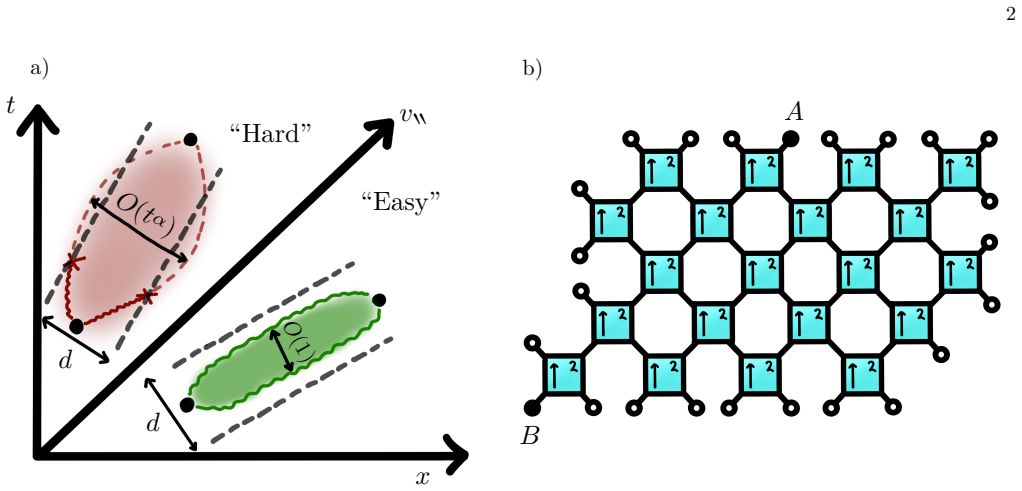
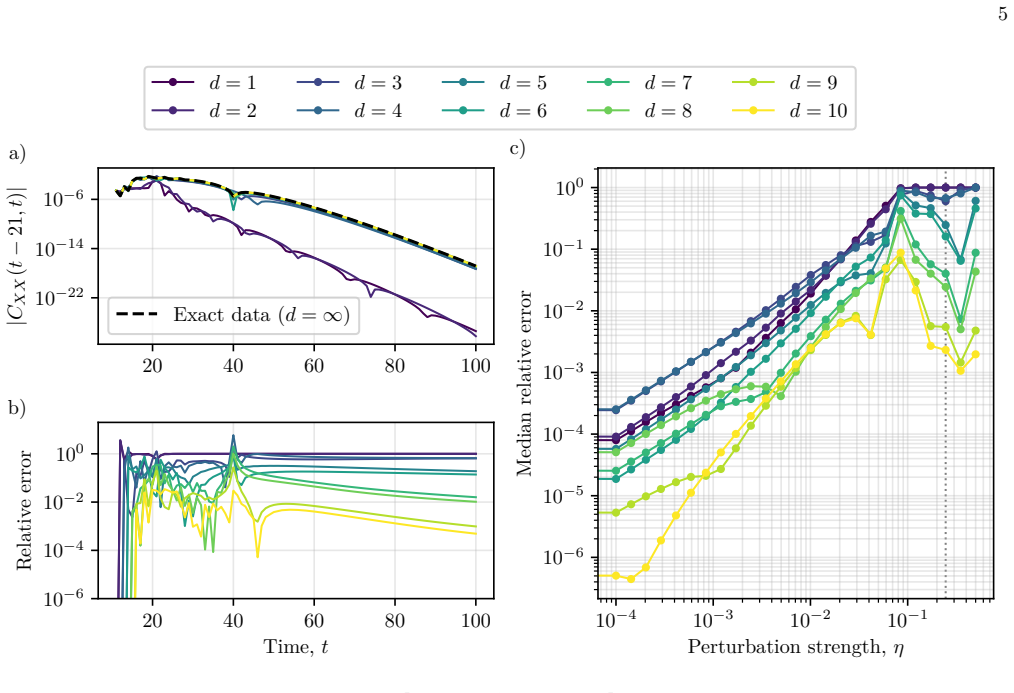
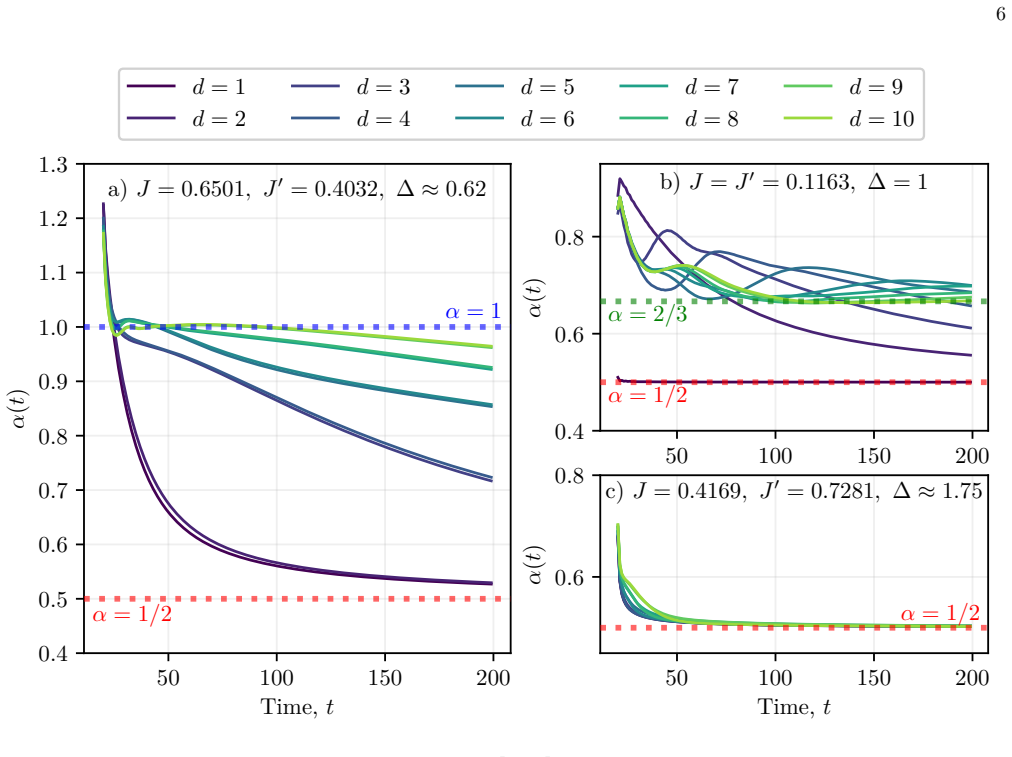
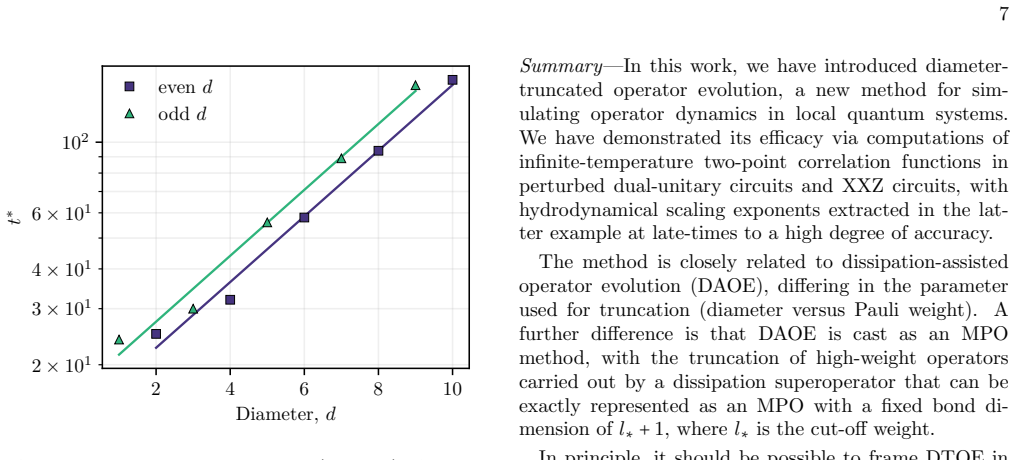
The authors argue that diameter truncation is physically well-motivated and demonstrate through extensive numerics that it efficiently and accurately extracts local correlation functions and transport properties in the kicked Ising and XXZ models.
What carries the argument
Diameter truncation protocol, which discards operators whose non-trivial support spans more than a chosen contiguous lattice segment.
If this is right
- Local two-point correlation functions at infinite temperature can be obtained with reduced computational effort.
- Transport coefficients such as diffusion constants become accessible in the same truncated evolution.
- The method applies equally to the kicked Ising chain and to the XXZ Heisenberg chain.
- Because the cutoff respects the lattice geometry, it automatically respects the causal light-cone structure of local Hamiltonians.
Where Pith is reading between the lines
- The same diameter cutoff could be tested on higher-dimensional lattices where weight-based truncation becomes even more costly.
- It may be possible to combine diameter and weight cutoffs in a hybrid scheme that further reduces memory.
- The approach suggests that any observable whose dominant support remains spatially compact will be well captured by this truncation.
Load-bearing premise
That cutting operators by the size of the spatial region they occupy remains a good approximation for the dynamical quantities of interest.
What would settle it
A direct comparison in which the diameter-truncated correlator deviates by more than a few percent from the exact or weight-truncated result at a time when the operator support is still inside the diameter cutoff.
Figures
read the original abstract
We present a method for simulating operator dynamics in out-of-equilibrium quantum systems. Due to the rapid growth of complexity in these systems, this is typically speaking an intractable task. However, exceptional progress has been made in recent years to sidestep this barrier, with the introduction of a number of methods that make use of a truncation of the simulation to low-weight (the number of non-trivial terms in a Pauli string basis expansion) observables, which turns out to be a good approximation for many dynamical quantities of interest, e.g., two-point infinite-temperature correlation functions between local operators. In this work, we extend this idea to a leaner truncation protocol, truncating operators based on their diameter - that is, the size of the region on the lattice on which they are non-trivially supported. Using existing analysis for generic circuits we argue that this kind of truncation protocol is physically well-motivated, and show via extensive numerical simulations for a number of systems of interest (here, the kicked Ising model and the Heisenberg XXZ model) that it is effective, and allows us to efficiently and accurately extract local correlation functions and transport properties.
Editorial analysis
A structured set of objections, weighed in public.
Referee Report
Summary. The paper introduces a diameter-based truncation protocol for simulating operator dynamics in out-of-equilibrium quantum systems, extending prior low-weight truncation methods. It argues that truncating by the spatial diameter of operator support (rather than Pauli weight) is physically well-motivated by existing analysis of generic circuits, and demonstrates via numerical simulations on the kicked Ising and Heisenberg XXZ models that the approach efficiently and accurately extracts local correlation functions and transport properties.
Significance. If the central claims hold, the method offers a potentially leaner truncation scheme than weight-based approaches, which could improve computational efficiency for studying dynamical quantities in many-body systems. The numerical demonstrations on two concrete models constitute a concrete strength; however, the physical motivation is not fully self-contained within the manuscript.
major comments (2)
- [Abstract/Introduction] Abstract and opening paragraphs: the physical motivation for diameter truncation is asserted via appeal to 'existing analysis for generic circuits' without naming the specific references or showing how their locality/light-cone bounds extend from operator weight to spatial diameter. If those analyses bound only the number of non-identity Paulis, the claimed justification does not transfer to the diameter protocol.
- [Numerical Simulations] Numerical results section: the abstract states that extensive simulations demonstrate effectiveness and accuracy, yet no error bars, data exclusion criteria, or quantitative comparison metrics (e.g., relative errors, R² values, or convergence tests against exact results) are described, leaving the strength of the 'accurate extraction' claim difficult to assess.
minor comments (2)
- [Methods] Define the precise mathematical definition of operator diameter (e.g., via an equation) at the first use rather than assuming it is standard.
- [Results] Add a brief comparison table or plot quantifying the computational cost or accuracy gain of diameter truncation versus weight truncation on the same models.
Simulated Author's Rebuttal
We thank the referee for their careful reading and constructive comments on our manuscript. We address each major comment below and have revised the manuscript accordingly to improve clarity and rigor.
read point-by-point responses
-
Referee: [Abstract/Introduction] Abstract and opening paragraphs: the physical motivation for diameter truncation is asserted via appeal to 'existing analysis for generic circuits' without naming the specific references or showing how their locality/light-cone bounds extend from operator weight to spatial diameter. If those analyses bound only the number of non-identity Paulis, the claimed justification does not transfer to the diameter protocol.
Authors: We agree that the motivation requires more explicit support. In the revised manuscript we will cite the specific references establishing light-cone bounds for generic circuits and add a concise paragraph in the introduction explaining the extension: these bounds imply that operators supported outside the causal light-cone remain close to the identity, so truncating by the spatial diameter of the support directly respects the same locality structure that weight-based truncations exploit. This argument holds even when the original bounds are phrased in terms of Pauli weight, because diameter truncation enforces the identical causal cutoff. revision: yes
-
Referee: [Numerical Simulations] Numerical results section: the abstract states that extensive simulations demonstrate effectiveness and accuracy, yet no error bars, data exclusion criteria, or quantitative comparison metrics (e.g., relative errors, R² values, or convergence tests against exact results) are described, leaving the strength of the 'accurate extraction' claim difficult to assess.
Authors: We accept this criticism. The revised manuscript will add error bars to all numerical plots, describe the convergence criteria and any data-exclusion rules in a dedicated methods subsection, and report quantitative metrics (relative L2 errors and convergence tests against exact results or larger truncations) for the kicked Ising and XXZ simulations. These additions will appear in the numerical results section and will be referenced from the abstract to substantiate the accuracy claims. revision: yes
Circularity Check
Motivation from external analysis; no self-referential derivations or fitted predictions
full rationale
The paper motivates the diameter truncation protocol by appealing to 'existing analysis for generic circuits' and validates effectiveness via numerical simulations on the kicked Ising and XXZ models for local correlation functions and transport. No equations, derivations, or self-citations are exhibited that reduce the truncation accuracy or physical motivation to fitted parameters, self-definitions, or author-overlapping uniqueness theorems by construction. The derivation chain remains independent of the target results and rests on external benchmarks plus direct tests, consistent with a minor (non-load-bearing) self-citation allowance at most.
Axiom & Free-Parameter Ledger
axioms (1)
- domain assumption Truncation to low-diameter operators is a good approximation for local dynamical quantities such as two-point infinite-temperature correlation functions.
Reference graph
Works this paper leans on
-
[1]
do so by truncating out high-weightoperator content: that is, components of the time-evolving operator, when expanded in an operator (Pauli) string basis, that have a high number of non-trivial (non-identity) terms. While such an approximation necessarily chops out a lot of op- erator weight, it keeps the important, low-complexity content that contributes...
Pith/arXiv arXiv 2026
-
[2]
J. M. Deutsch, Quantum statistical mechanics in a closed system, Phys. Rev. A43, 2046 (1991)
2046
-
[3]
Srednicki, Chaos and quantum thermalization, Phys
M. Srednicki, Chaos and quantum thermalization, Phys. Rev. E50, 888 (1994)
1994
-
[4]
Rigol, V
M. Rigol, V. Dunjko, and M. Olshanii, Thermalization and its mechanism for generic isolated quantum systems, Nature452, 854 (2008)
2008
-
[5]
Gogolin and J
C. Gogolin and J. Eisert, Equilibration, thermalisation, and the emergence of statistical mechanics in closed 8 quantum systems, Reports on Progress in Physics79, 056001 (2016)
2016
-
[6]
Popescu, A
S. Popescu, A. J. Short, and A. Winter, Entanglement and the foundations of statistical mechanics, Nature Physics2, 754 (2006)
2006
-
[7]
Goldstein, J
S. Goldstein, J. L. Lebowitz, R. Tumulka, and N. Zangh` ı, Canonical typicality, Phys. Rev. Lett.96, 050403 (2006)
2006
-
[8]
Rigol, V
M. Rigol, V. Dunjko, V. Yurovsky, and M. Olshanii, Re- laxation in a completely integrable many-body quantum system: An ab initio study of the dynamics of the highly excited states of 1d lattice hard-core bosons, Phys. Rev. Lett.98, 050405 (2007)
2007
-
[9]
L. P. Kadanoff and P. C. Martin, Hydrodynamic equa- tions and correlation functions, Annals of Physics24, 419 (1963)
1963
-
[10]
Doyon, Lecture notes on Generalised Hydrodynamics, SciPost Phys
B. Doyon, Lecture notes on Generalised Hydrodynamics, SciPost Phys. Lect. Notes , 18 (2020)
2020
-
[11]
J. Lux, J. M¨ uller, A. Mitra, and A. Rosch, Hydrodynamic long-time tails after a quantum quench, Phys. Rev. A89, 053608 (2014)
2014
-
[12]
Bertini, F
B. Bertini, F. Heidrich-Meisner, C. Karrasch, T. Prosen, R. Steinigeweg, and M. ˇZnidariˇ c, Finite-temperature transport in one-dimensional quantum lattice models, Rev. Mod. Phys.93, 025003 (2021)
2021
-
[13]
Gromov, A
A. Gromov, A. Lucas, and R. M. Nandkishore, Fracton hydrodynamics, Phys. Rev. Res.2, 033124 (2020)
2020
-
[14]
Gopalakrishnan and R
S. Gopalakrishnan and R. Vasseur, Kinetic theory of spin diffusion and superdiffusion inxxzspin chains, Phys. Rev. Lett.122, 127202 (2019)
2019
-
[15]
Calabrese and J
P. Calabrese and J. Cardy, Evolution of entanglement entropy in one-dimensional systems, Journal of Statisti- cal Mechanics: Theory and Experiment2005, P04010 (2005)
2005
-
[16]
Kim and D
H. Kim and D. A. Huse, Ballistic spreading of entan- glement in a diffusive nonintegrable system, Phys. Rev. Lett.111, 127205 (2013)
2013
-
[17]
Turkeshi, E
X. Turkeshi, E. Tirrito, and P. Sierant, Magic spread- ing in random quantum circuits, Nature Communications 16, 2575 (2025)
2025
-
[18]
Zhang and Y
Y. Zhang and Y. Gu, Quantum magic dynamics in ran- dom circuits, npj Quantum Information12, 87 (2026)
2026
-
[19]
Tirrito, X
E. Tirrito, X. Turkeshi, and P. Sierant, Anticoncentration and nonstabilizerness spreading under ergodic quantum dynamics, Phys. Rev. Lett.135, 220401 (2025)
2025
- [20]
-
[21]
J. A. Monta˜ n` a L´ opez and P. Kos, Exact solution of long- range stabilizer r´ enyi entropy in the dual-unitary xxz model*, Journal of Physics A: Mathematical and The- oretical57, 475301 (2024)
2024
-
[22]
Nahum, S
A. Nahum, S. Vijay, and J. Haah, Operator spreading in random unitary circuits, Phys. Rev. X8, 021014 (2018)
2018
-
[23]
C. W. von Keyserlingk, T. Rakovszky, F. Pollmann, and S. L. Sondhi, Operator hydrodynamics, OTOCs, and en- tanglement growth in systems without conservation laws, Phys. Rev. X8, 021013 (2018)
2018
-
[24]
T. c. v. Prosen and M. ˇZnidariˇ c, Is the efficiency of classi- cal simulations of quantum dynamics related to integra- bility?, Phys. Rev. E75, 015202(R) (2007)
2007
-
[25]
Schuch, M
N. Schuch, M. M. Wolf, K. G. H. Vollbrecht, and J. I. Cirac, On entropy growth and the hardness of simulat- ing time evolution, New Journal of Physics10, 033032 (2008)
2008
-
[26]
Dowling, P
N. Dowling, P. Kos, and X. Turkeshi, Magic resources of the heisenberg picture, Phys. Rev. Lett.135, 050401 (2025)
2025
-
[27]
N. Dowling, Classical simulability from operator entan- glement scaling (2026), arXiv:2603.05656 [quant-ph]
Pith/arXiv arXiv 2026
-
[28]
von Keyserlingk, F
C. von Keyserlingk, F. Pollmann, and T. Rakovszky, Op- erator backflow and the classical simulation of quantum transport, Phys. Rev. B105, 245101 (2022)
2022
-
[29]
Rakovszky, C
T. Rakovszky, C. W. von Keyserlingk, and F. Poll- mann, Dissipation-assisted operator evolution method for capturing hydrodynamic transport, Phys. Rev. B105, 075131 (2022)
2022
-
[30]
Nahum, S
A. Nahum, S. Roy, S. Vijay, and T. Zhou, Real-time cor- relators in chaotic quantum many-body systems, Phys. Rev. B106, 224310 (2022)
2022
-
[31]
P. Kos, B. Bertini, and T. Prosen, Correlations in per- turbed dual-unitary circuits: Efficient path-integral for- mula, Phys. Rev. X11, 011022 (2021)
2021
-
[32]
M. S. Rudolph, T. Jones, Y. Teng, A. Angrisani, and Z. Holmes, Pauli propagation: A computational framework for simulating quantum systems (2026), arXiv:2505.21606 [quant-ph]
Pith/arXiv arXiv 2026
-
[33]
Bertini, P
B. Bertini, P. Kos, and T. Prosen, Operator entanglement in local quantum circuits I: Chaotic dual-unitary circuits, SciPost Phys.8, 067 (2020)
2020
-
[34]
Rakovszky, F
T. Rakovszky, F. Pollmann, and C. W. von Keyserlingk, Diffusive hydrodynamics of out-of-time-ordered correla- tors with charge conservation, Phys. Rev. X8, 031058 (2018)
2018
-
[35]
Khemani, A
V. Khemani, A. Vishwanath, and D. A. Huse, Operator spreading and the emergence of dissipative hydrodynam- ics under unitary evolution with conservation laws, Phys. Rev. X8, 031057 (2018)
2018
-
[36]
Bertini, P
B. Bertini, P. Kos, and T. Prosen, Exact correlation func- tions for dual-unitary lattice models in 1+1 dimensions, Phys. Rev. Lett.123, 210601 (2019)
2019
-
[37]
Gopalakrishnan and A
S. Gopalakrishnan and A. Lamacraft, Unitary circuits of finite depth and infinite width from quantum channels, Phys. Rev. B100, 064309 (2019)
2019
-
[38]
Bertini, P
B. Bertini, P. W. Claeys, and T. c. v. Prosen, Exactly solvable quantum many-body dynamics from space-time duality, Rev. Mod. Phys.98, 025001 (2026)
2026
-
[39]
Bertini, P
B. Bertini, P. Kos, and T. Prosen, Exact spectral form factor in a minimal model of many-body quantum chaos, Phys. Rev. Lett.121, 264101 (2018)
2018
-
[40]
Bertini, P
B. Bertini, P. Kos, and T. Prosen, Random matrix spec- tral form factor of dual-unitary quantum circuits, Com- munications in Mathematical Physics387, 597 (2021)
2021
-
[41]
P. W. Claeys and A. Lamacraft, Maximum velocity quan- tum circuits, Phys. Rev. Research2, 033032 (2020)
2020
-
[42]
E. Rosenberg, T. I. Andersen, R. Samajdar, A. Petukhov, J. C. Hoke, D. Abanin, A. Bengtsson, I. K. Drozdov, C. Erickson, P. V. Klimov, X. Mi, A. Morvan, M. Nee- ley, C. Neill, R. Acharya, R. Allen, K. Anderson, M. Ansmann, F. Arute, K. Arya, A. Asfaw, J. Atalaya, J. C. Bardin, A. Bilmes, G. Bortoli, A. Bourassa, J. Bovaird, L. Brill, M. Broughton, B. B. B...
-
[43]
L. E. Fischer, M. Leahy, A. Eddins, N. Keenan, D. Fer- racin, M. A. C. Rossi, Y. Kim, A. He, F. Pietracap- rina, B. Sokolov, S. Dooley, Z. Zimbor´ as, F. Tacchino, S. Maniscalco, J. Goold, G. Garc´ ıa-P´ erez, I. Tavernelli, A. Kandala, and S. N. Filippov, Dynamical simulations of many-body quantum chaos on a quantum computer, Nature Physics22, 302 (2026)
2026
-
[44]
Ljubotina, L
M. Ljubotina, L. Zadnik, and T. c. v. Prosen, Ballistic spin transport in a periodically driven integrable quan- tum system, Phys. Rev. Lett.122, 150605 (2019)
2019
-
[45]
overflow
G. Vidal, Efficient classical simulation of slightly entan- gled quantum computations, Phys. Rev. Lett.91, 147902 (2003). Appendix A: Construction of the DTOE dissipator As alluded to in the main-body of the text, DTOE is similar in spirit to the method of dissipation-assisted operator evolution, or DAOE [33]. DAOE has been im- plemented as a method in wh...
2003
discussion (0)
Sign in with ORCID, Apple, or X to comment. Anyone can read and Pith papers without signing in.