The Crowded Embedding Space: A Mean-Field Mechanism for Emergent Marginalization in Retrieval-Augmented Agents
Pith reviewed 2026-06-30 11:32 UTC · model grok-4.3
The pith
Retrieval objectives in shared embedding spaces drive agents to exclusively serve majority interests.
A machine-rendered reading of the paper's core claim, the machinery that carries it, and where it could break.
Core claim
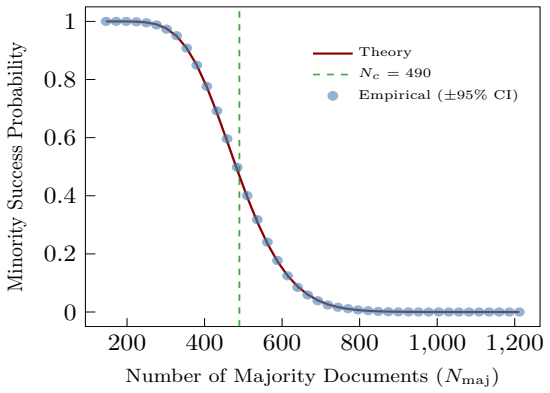
For a fixed embedding space, increasing majority goal density triggers a phase transition that causes catastrophic collapse in minority retrieval performance. In the dynamic setting, local relevance maximization evolves the embeddings according to a non-linear Fokker-Planck equation that drives the system to self-organize into a state serving only majority interests.
What carries the argument
The non-linear Fokker-Planck equation obtained from the mean-field approximation of embedding interactions under local relevance maximization, which produces the emergent marginalization.
If this is right
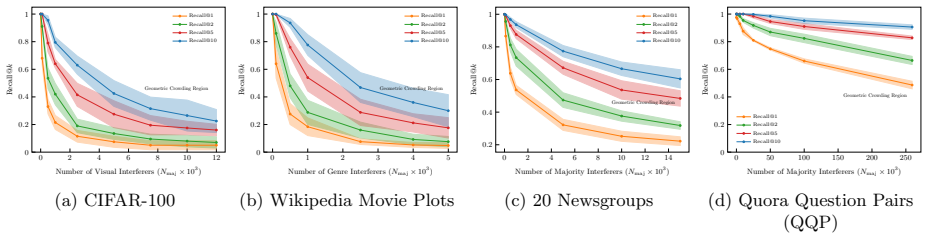
- Minority performance collapses once majority density crosses a critical threshold in a fixed embedding space.
- Dynamic updates amplify crowding until minority content is fully excluded from top-k retrieval.
- Goal collisions impose inherent limits on retrieval accuracy and produce emergent fairness problems.
- Standard local objectives are sufficient to produce a stable majority-only equilibrium.
Where Pith is reading between the lines
- The same crowding dynamic may appear in other systems that optimize embeddings for dense retrieval, such as recommender systems.
- Explicit diversity terms added to the objective could prevent the phase transition to majority-only states.
- Numerical simulations of the Fokker-Planck equation in real embedding geometries would test whether the mean-field prediction holds at practical scales.
Load-bearing premise
Embedding-space interactions can be accurately captured by a mean-field approximation whose evolution is governed by the derived non-linear Fokker-Planck equation under local relevance maximization.
What would settle it
Iteratively update embeddings under local relevance maximization while increasing majority density and measure whether minority retrieval accuracy collapses to near zero.
Figures
read the original abstract
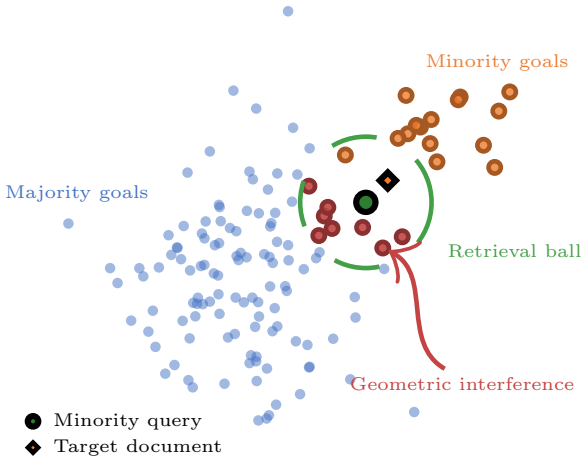
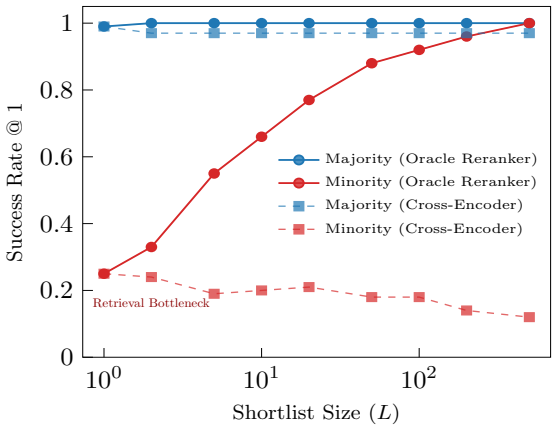
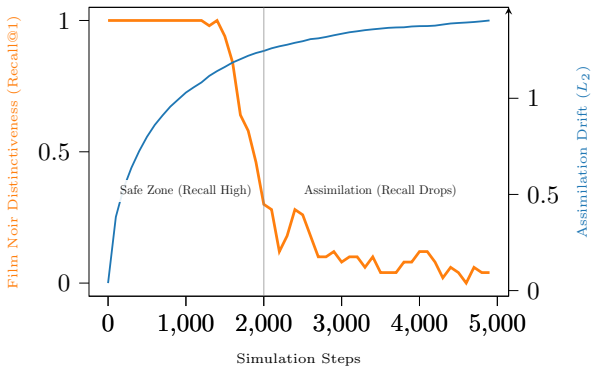
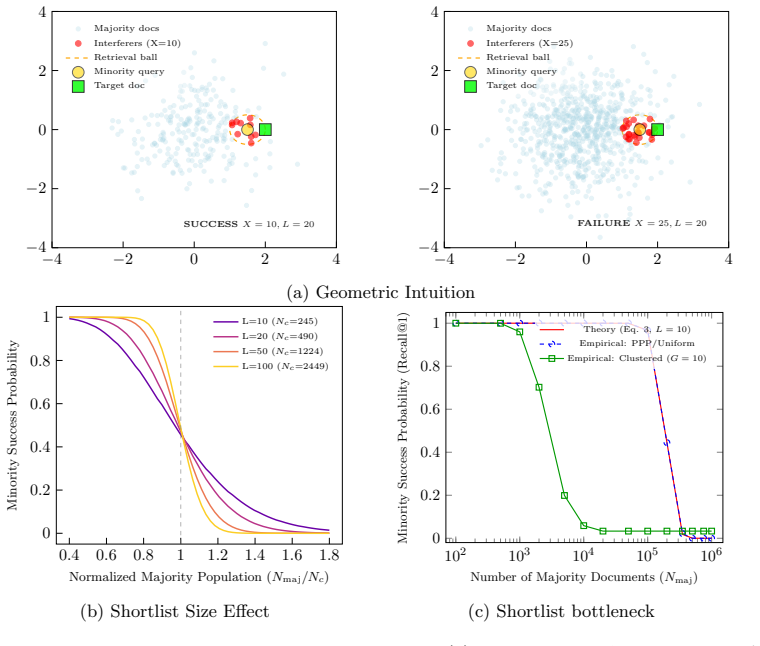
Retrieval-augmented generative agents rely on retrieval for grounding, yet are typically evaluated on a query-by-query basis. This isolates interactions that are geometrically coupled in a shared embedding space. For example, we show that the high document density required to serve majority interests (e.g., generic "Crime" movies) can geometrically overcrowd the retrieval neighborhood of a semantically similar minority (e.g., "Film Noir"), effectively expelling minority content from top-$k$ results. We introduce a formal framework to analyze how such goal collisions in dense retrieval induce fundamental performance limits and emergent fairness issues inherent to spatial crowding. In our static analysis, we demonstrate that for a fixed embedding space, a phase transition occurs where minority user goals suffer a catastrophic collapse in performance as the density of majority goals increases. We then extend this to a dynamic model and derive a non-linear Fokker-Planck equation that governs the evolution of document embeddings as the agent updates them to maximize retrieval accuracy. Our analysis reveals that this local relevance objective triggers an emergent global mechanism that systematically marginalizes minority interests. We prove that such objectives drive the system to self-organize into a state that exclusively serves majority interests. These results provide a theoretical foundation for understanding a critical grounding failure mode in retrieval-augmented agents.
Editorial analysis
A structured set of objections, weighed in public.
Referee Report
Summary. The paper claims that retrieval-augmented agents suffer emergent marginalization of minority interests because majority document density in a shared embedding space geometrically crowds out semantically similar minority content from top-k results. Static analysis identifies a phase transition in minority retrieval performance as majority density increases; a dynamic model then derives a non-linear Fokker-Planck PDE whose drift and diffusion arise from mean-field closure of embedding interactions under local relevance maximization, with the proof that this objective drives the system to an exclusive-majority fixed point.
Significance. If the mean-field derivation and closure are valid, the work supplies a formal mechanism linking local retrieval objectives to global fairness failures in RAG systems, which would be of clear interest to the IR and AI alignment communities. The combination of a static phase-transition result with an explicit dynamical PDE is a constructive step beyond purely empirical observations of retrieval bias.
major comments (2)
- [dynamic model / Fokker-Planck derivation] The central claim that local relevance maximization produces an exclusive-majority fixed point rests on the non-linear Fokker-Planck equation obtained via mean-field closure. The skeptic correctly notes that this closure assumes local density equals the global density field and therefore omits both finite-N fluctuations and the hard top-k cutoff; in the high-density regime where the reported phase transition occurs, those fluctuations are largest precisely where minority expulsion is claimed. Without either a rigorous error bound on the closure or direct comparison of the PDE trajectory against the underlying stochastic top-k process, the deterministic PDE result does not automatically transfer to the discrete retrieval setting.
- [static analysis and dynamic model] The static phase-transition result is presented as independent evidence, yet the manuscript does not state whether the same embedding geometry and top-k rule are used in both the static and dynamic analyses, nor whether the critical density identified in the static case coincides with the fixed-point density of the PDE. If the two analyses employ different approximations, the claimed consistency between them requires explicit verification.
minor comments (1)
- [abstract] The abstract states that the system 'self-organizes into a state that exclusively serves majority interests' without qualifying that this is a mean-field prediction; a brief parenthetical noting the modeling assumptions would improve precision.
Simulated Author's Rebuttal
We thank the referee for the constructive comments on the mean-field closure and the relationship between our static and dynamic results. We respond to each major comment below.
read point-by-point responses
-
Referee: [dynamic model / Fokker-Planck derivation] The central claim that local relevance maximization produces an exclusive-majority fixed point rests on the non-linear Fokker-Planck equation obtained via mean-field closure. The skeptic correctly notes that this closure assumes local density equals the global density field and therefore omits both finite-N fluctuations and the hard top-k cutoff; in the high-density regime where the reported phase transition occurs, those fluctuations are largest precisely where minority expulsion is claimed. Without either a rigorous error bound on the closure or direct comparison of the PDE trajectory against the underlying stochastic top-k process, the deterministic PDE result does not automatically transfer to the discrete retrieval setting.
Authors: We agree that the mean-field closure is an approximation that equates local and global densities and therefore neglects finite-N fluctuations as well as the discrete top-k cutoff. The derivation is performed in the thermodynamic limit where such fluctuations are expected to vanish. The static phase-transition analysis supplies independent evidence that does not rely on the PDE. In revision we will expand the discussion of the approximation's regime of validity and explicitly note the lack of a rigorous error bound. A direct numerical comparison between the PDE trajectories and the underlying stochastic process lies outside the present manuscript. revision: partial
-
Referee: [static analysis and dynamic model] The static phase-transition result is presented as independent evidence, yet the manuscript does not state whether the same embedding geometry and top-k rule are used in both the static and dynamic analyses, nor whether the critical density identified in the static case coincides with the fixed-point density of the PDE. If the two analyses employ different approximations, the claimed consistency between them requires explicit verification.
Authors: The static and dynamic analyses employ identical embedding geometry and the same top-k retrieval rule. The critical density at which minority retrieval collapses in the static analysis is the same density at which the PDE's majority-only fixed point becomes globally attractive. We will add an explicit verification paragraph in the revised manuscript that states this correspondence and confirms that both analyses rest on the same geometric and retrieval assumptions. revision: yes
- Rigorous error bound on the mean-field closure or direct comparison of the PDE trajectory against the underlying stochastic top-k process
Circularity Check
No circularity: derivation chain is self-contained
full rationale
The abstract and description outline a static phase-transition analysis followed by derivation of a non-linear Fokker-Planck equation from an explicit local-relevance update rule, then analysis of that PDE's fixed points. No quoted equations or self-citations are supplied that would reduce the claimed marginalization result to a tautological renaming or re-derivation of the input objective itself. The mean-field closure is presented as an approximation step whose validity is external to the derivation; the marginalization outcome is therefore an independent consequence of solving the resulting PDE rather than a definitional identity. This is the normal, non-circular case for a first-principles dynamical model.
Axiom & Free-Parameter Ledger
axioms (2)
- domain assumption Embedding-space interactions admit a mean-field description
- domain assumption Document positions evolve to maximize local retrieval accuracy
Reference graph
Works this paper leans on
-
[1]
M., Gebru, T., McMillan-Major, A., and Shmitchell, S
Bender, E. M., Gebru, T., McMillan-Major, A., and Shmitchell, S. On the dangers of stochastic parrots: Can language models be too big? InProceedings of the 2021 ACM conference on fairness, accountability, and transparency, pp. 610–623,
2021
-
[2]
Ranking with Fairness Constraints
14 Celis, L. E., Straszak, D., and Vishnoi, N. K. Ranking with fairness constraints.arXiv preprint arXiv:1704.06840,
work page internal anchor Pith review Pith/arXiv arXiv
-
[3]
A tale of tails: Model collapse as a change of scaling laws.arXiv preprint arXiv:2402.07043,
Dohmatob, E., Feng, Y., Yang, P., Charton, F., and Kempe, J. A tale of tails: Model collapse as a change of scaling laws.arXiv preprint arXiv:2402.07043,
-
[4]
Ethayarajh, K. How contextual are contextualized word representations? comparing the geometry of bert, elmo, and gpt-2 embeddings.arXiv preprint arXiv:1909.00512,
-
[5]
Hu, M., Wu, H., Guan, Z., Zhu, R., Guo, D., Qi, D., and Li, S. No free lunch: Retrieval-augmented generation undermines fairness in llms, even for vigilant users.arXiv preprint arXiv:2410.07589,
-
[6]
Unsupervised Dense Information Retrieval with Contrastive Learning
Izacard, G., Caron, M., Hosseini, L., Riedel, S., Bojanowski, P., Joulin, A., and Grave, E. Unsu- pervised dense information retrieval with contrastive learning.arXiv preprint arXiv:2112.09118,
work page internal anchor Pith review Pith/arXiv arXiv
-
[7]
Kim, T. E. and Diaz, F. Towards fair rag: On the impact of fair ranking in retrieval-augmented generation. InProceedings of the 2025 International ACM SIGIR Conference on Innovative Concepts and Theories in Information Retrieval (ICTIR), pp. 33–43,
2025
-
[8]
Newsweeder: Learning to filter netnews
Lang, K. Newsweeder: Learning to filter netnews. InMachine learning proceedings 1995, pp. 331–339. Elsevier,
1995
-
[9]
Holistic Evaluation of Language Models
Liang, P., Bommasani, R., Lee, T., Tsipras, D., Soylu, D., Yasunaga, M., Zhang, Y., Narayanan, D., Wu, Y., Kumar, A., et al. Holistic evaluation of language models.arXiv preprint arXiv:2211.09110,
work page internal anchor Pith review Pith/arXiv arXiv
-
[10]
H., Constant, N., Ma, J., Hall, K., Cer, D., and Yang, Y
16 Ni, J., Abrego, G. H., Constant, N., Ma, J., Hall, K., Cer, D., and Yang, Y. Sentence-t5: Scalable sentence encoders from pre-trained text-to-text models. InFindings of the association for computational linguistics: ACL 2022, pp. 1864–1874,
2022
- [11]
-
[12]
Nogueira, R. and Cho, K. Passage re-ranking with bert.arXiv preprint arXiv:1901.04085,
work page internal anchor Pith review Pith/arXiv arXiv 1901
-
[13]
M., Robinson, K., and Prabhakaran, V
Qadri, R., Davani, A. M., Robinson, K., and Prabhakaran, V. Risks of cultural erasure in large language models.arXiv preprint arXiv:2501.01056,
-
[14]
The Curse of Recursion: Training on Generated Data Makes Models Forget
Shumailov, I., Shumaylov, Z., Zhao, Y., Gal, Y., Papernot, N., and Anderson, R. The curse of recursion: Training on generated data makes models forget.arXiv preprint arXiv:2305.17493,
work page internal anchor Pith review Pith/arXiv arXiv
-
[15]
Freshllms: Refreshing large language models with search engine augmentation
17 Vu, T., Iyyer, M., Wang, X., Constant, N., Wei, J., Wei, J., Tar, C., Sung, Y.-H., Zhou, D., Le, Q., et al. Freshllms: Refreshing large language models with search engine augmentation. InFindings of the Association for Computational Linguistics: ACL 2024, pp. 13697–13720,
2024
-
[16]
On the theoretical limita- tions of embedding-based retrieval,
Weller, O., Boratko, M., Naim, I., and Lee, J. On the theoretical limitations of embedding-based retrieval.arXiv preprint arXiv:2508.21038,
-
[17]
Fairness feedback loops: training on synthetic data amplifies bias
Wyllie, S., Shumailov, I., and Papernot, N. Fairness feedback loops: training on synthetic data amplifies bias. InProceedings of the 2024 ACM Conference on Fairness, Accountability, and Transparency, pp. 2113–2147,
2024
-
[18]
These results quantify the phase transition, providing explicit formulae that allow for the direct calculation of critical collapse thresholds
B Analytical Results for Gaussian Mixtures We now derive exact, closed-form solutions for the minority success probability by instantiating the general framework of Theorem 2.2 with a Gaussian Mixture Model. These results quantify the phase transition, providing explicit formulae that allow for the direct calculation of critical collapse thresholds. Propo...
2019
-
[19]
The PPP baseline models a homogeneous point process with constant interference probability of 5 × 10⁻⁵ per document
and shortlist size ( L = 10). The PPP baseline models a homogeneous point process with constant interference probability of 5 × 10⁻⁵ per document. For the clustered model, each cluster is designated as near with probability 0 .3 (interference probability 0 .012) or far with probability 0 .7 (interference probability 10 −7), reflecting heterogeneous spatia...
2013
discussion (0)
Sign in with ORCID, Apple, or X to comment. Anyone can read and Pith papers without signing in.