Revealing the substellar population of IC 1396: A spectroscopic survey of brown dwarfs in the region
Pith reviewed 2026-06-30 00:52 UTC · model grok-4.3
The pith
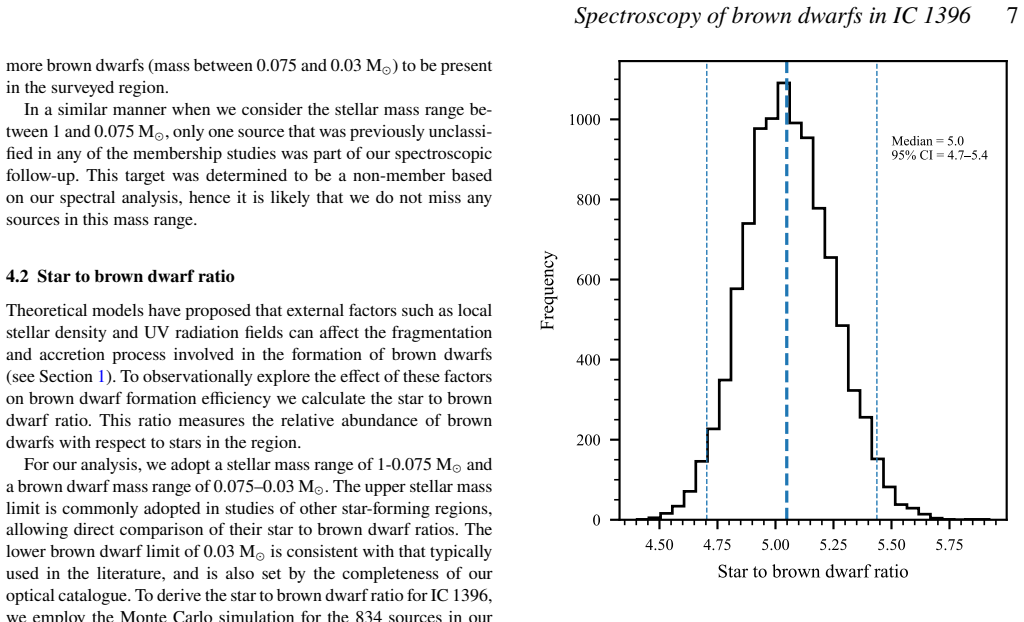
The star to brown dwarf ratio in IC 1396 is 5.0 ± 0.4 across 1 to 0.03 solar masses and matches other young clusters.
A machine-rendered reading of the paper's core claim, the machinery that carries it, and where it could break.
Core claim
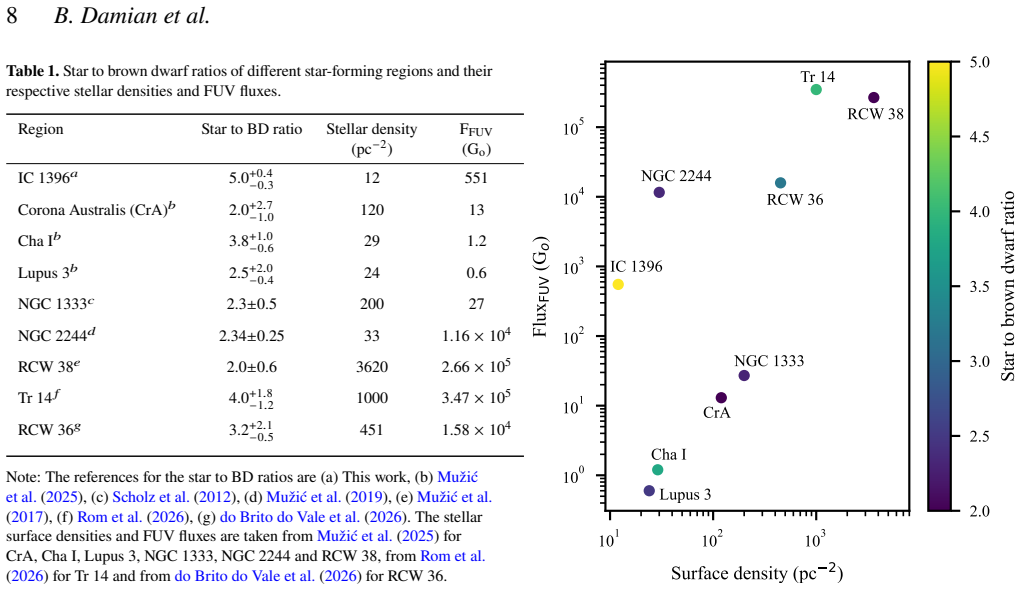
We estimate the star to brown dwarf ratio for IC 1396 to be 5.0±0.4, for a mass range between 1-0.03 M⊙. This ratio is largely consistent with measurements in other young clusters spanning a range of UV radiation fields and stellar densities, supporting formation scenarios in which the relative abundance of brown dwarfs is not strongly influenced by the local environmental conditions.
What carries the argument
The full census of spectroscopically confirmed members combined with BT-Settl model fits to derive effective temperatures and masses for the 0.03-1 solar-mass range.
If this is right
- Brown-dwarf formation channels produce a fixed fraction of objects relative to stars across regions with different radiation environments.
- Stellar density does not measurably change the low-mass end of the initial mass function in young clusters.
- The same relative abundance should appear in regions with still higher or lower ultraviolet exposure once comparable surveys are completed.
Where Pith is reading between the lines
- If the ratio is universal at these masses, then the initial mass function below 0.1 solar masses can be treated as approximately constant when modelling galactic stellar populations.
- Future wide-field surveys that reach similar completeness in more distant or older regions can test whether the ratio remains fixed after dynamical evolution.
Load-bearing premise
The combination of photometric selection, low-resolution spectra, and model grids correctly identifies true cluster members and assigns masses without large contamination or incompleteness in the brown-dwarf regime.
What would settle it
A new spectroscopic survey of another cluster that yields a star-to-brown-dwarf ratio differing by more than the quoted uncertainty, or radial-velocity or proper-motion data showing that a substantial fraction of the IC 1396 candidates are non-members.
Figures
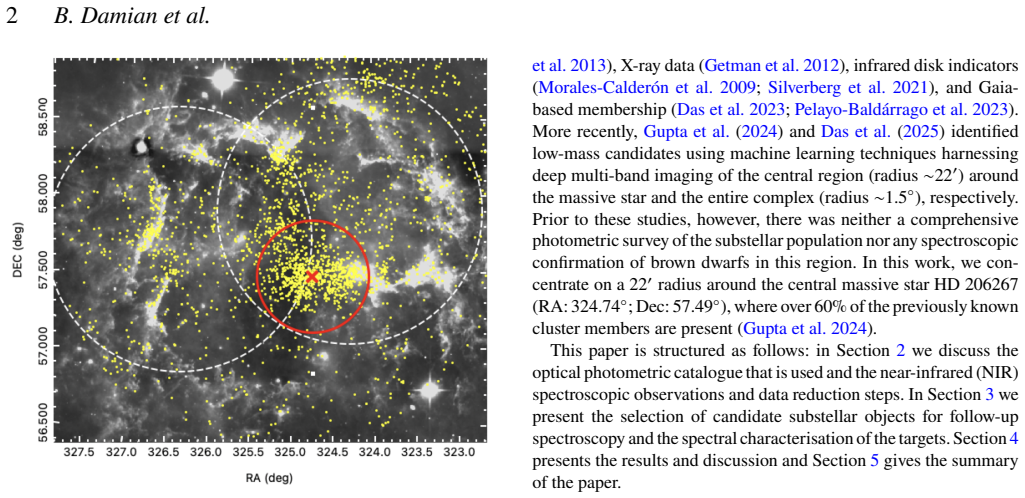
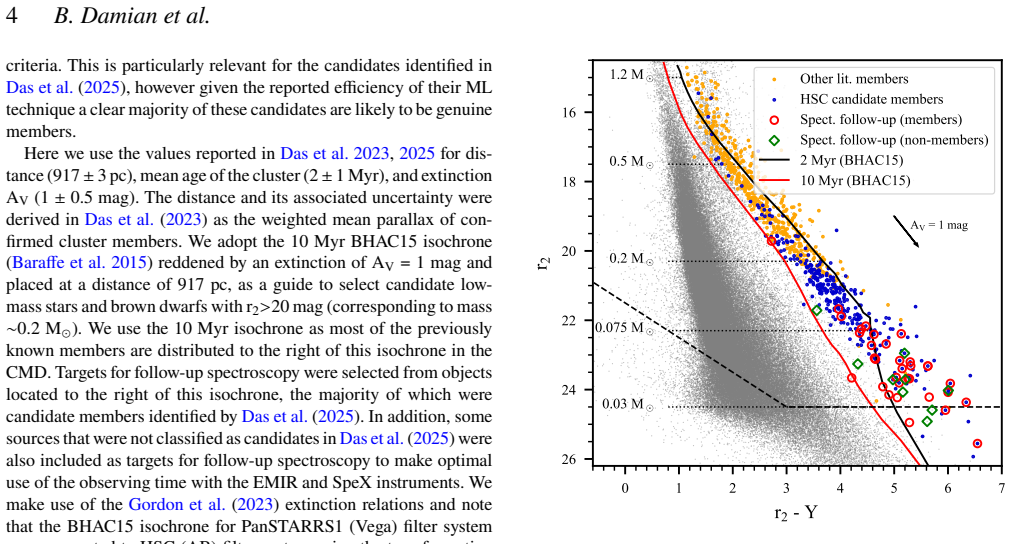
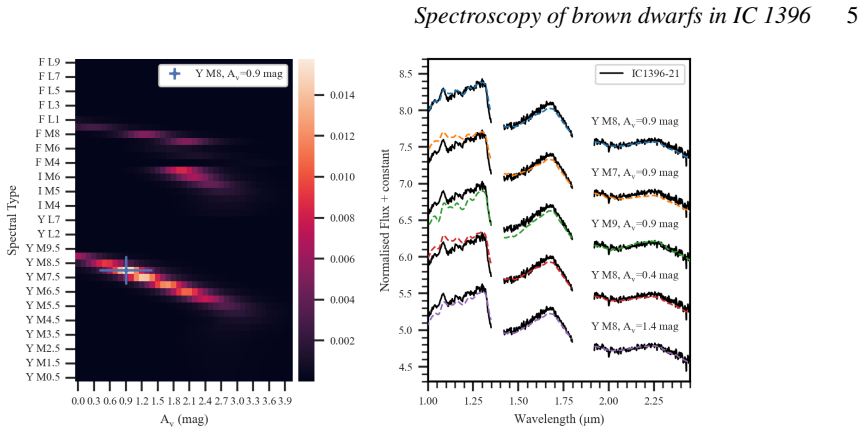
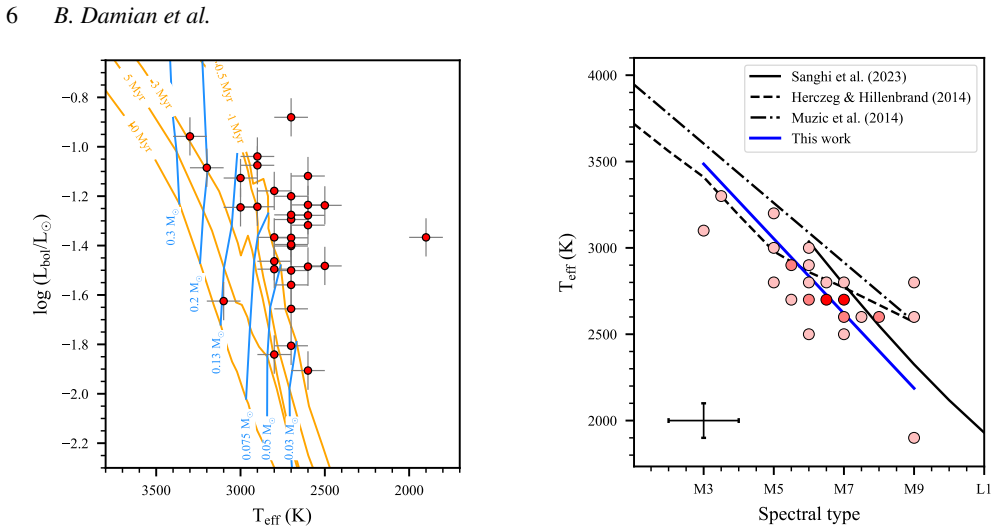
read the original abstract
We present a new spectroscopic view of the brown dwarf population in the young star-forming region IC 1396 and investigate the impact of environment on low-mass star formation. We use deep optical photometry from Subaru-HSC to identify the candidate low-mass stars and brown dwarfs in the region. Our follow-up low-resolution spectroscopic survey with GTC-EMIR and IRTF-SpeX has identified 32 new members in the region with spectral types between M3 and M9, among which 25 are brown dwarfs with spectral types M6 or later. We use the BT-Settl atmospheric models to derive the effective temperatures of the members. Using a comprehensive catalogue of known members and candidates, we estimate the star to brown dwarf ratio for IC 1396 to be 5.0$\pm$0.4, for a mass range between 1-0.03 M$_\odot$. This ratio is largely consistent with measurements in other young clusters spanning a range of UV radiation fields and stellar densities, supporting formation scenarios in which the relative abundance of brown dwarfs is not strongly influenced by the local environmental conditions.
Editorial analysis
A structured set of objections, weighed in public.
Referee Report
Summary. The manuscript reports results from a spectroscopic survey of the substellar population in the young star-forming region IC 1396. Deep Subaru-HSC photometry is used to select low-mass star and brown dwarf candidates, followed by low-resolution spectroscopy with GTC-EMIR and IRTF-SpeX that confirms 32 new members (25 with spectral types M6 or later, classified as brown dwarfs). BT-Settl atmospheric models are applied to derive effective temperatures. Combining these with a catalogue of known members, the star-to-brown-dwarf ratio is computed as 5.0 ± 0.4 over the mass range 1–0.03 M⊙. This value is reported as consistent with measurements in other young clusters spanning varied UV radiation fields and densities, supporting formation scenarios in which brown dwarf abundance is largely independent of local environmental conditions.
Significance. If the membership assignments and mass estimates hold, the work augments the observational sample of brown dwarf populations in young clusters and provides additional empirical support for the environmental independence of the star-to-brown-dwarf ratio. This strengthens the case for formation pathways in which the relative production of brown dwarfs is set by internal processes rather than external factors such as radiation or density, contributing to ongoing debates in low-mass star formation.
major comments (2)
- [Ratio estimation and catalogue construction] The central ratio of 5.0 ± 0.4 (abstract and ratio section) is derived from a 'comprehensive catalogue of known members and candidates'; however, the text does not specify the exact membership criteria, completeness corrections, or contamination estimates applied in the 0.03–1 M⊙ range. Without these, it is not possible to assess whether the quoted uncertainty fully captures systematic effects from photometric selection or model fitting.
- [Discussion of environmental dependence] The conclusion that the ratio is 'largely consistent' with other clusters (abstract and discussion) is load-bearing for the environmental-independence claim, yet no table or quantitative comparison (e.g., listed literature ratios with uncertainties and a statistical measure of agreement) is provided. This weakens the ability to evaluate the degree of consistency.
minor comments (2)
- [Abstract and results] The abstract states that 25 of the 32 new members are brown dwarfs (M6 or later), but the full text should explicitly state the total number of previously known members used in the ratio calculation for transparency.
- [Spectroscopic observations] Clarify the wavelength coverage and resolving power of the GTC-EMIR and IRTF-SpeX observations, as these directly affect the reliability of spectral type assignments between M3 and M9.
Simulated Author's Rebuttal
We thank the referee for their constructive comments on our manuscript. We address each major comment below and have revised the manuscript accordingly to improve clarity and strengthen the presentation of our results.
read point-by-point responses
-
Referee: [Ratio estimation and catalogue construction] The central ratio of 5.0 ± 0.4 (abstract and ratio section) is derived from a 'comprehensive catalogue of known members and candidates'; however, the text does not specify the exact membership criteria, completeness corrections, or contamination estimates applied in the 0.03–1 M⊙ range. Without these, it is not possible to assess whether the quoted uncertainty fully captures systematic effects from photometric selection or model fitting.
Authors: We agree that additional details on the catalogue construction are necessary for a full assessment of the ratio. In the revised manuscript, we have expanded the 'Ratio estimation' section to include a new subsection explicitly describing the membership criteria (photometric selection from Subaru-HSC combined with spectroscopic confirmation and cross-matching with prior catalogues), the adopted completeness corrections derived from artificial star tests, and contamination estimates based on field star simulations and spectroscopic follow-up success rates. We have also clarified that the reported uncertainty of ±0.4 incorporates both Poisson statistics and these systematic contributions. revision: yes
-
Referee: [Discussion of environmental dependence] The conclusion that the ratio is 'largely consistent' with other clusters (abstract and discussion) is load-bearing for the environmental-independence claim, yet no table or quantitative comparison (e.g., listed literature ratios with uncertainties and a statistical measure of agreement) is provided. This weakens the ability to evaluate the degree of consistency.
Authors: We acknowledge that a quantitative comparison would better support the claim. We have added a new table (Table 4) compiling star-to-brown-dwarf ratios from the literature for other young clusters (e.g., Taurus, Orion, Chamaeleon), including reported values with uncertainties and the corresponding mass ranges. We have also included a short paragraph with a statistical assessment (overlap of 1σ uncertainties and a simple reduced-chi-squared metric) demonstrating consistency within the quoted errors. This revision directly addresses the concern while preserving the original interpretation. revision: yes
Circularity Check
No significant circularity in observational derivation
full rationale
The paper's central result is an empirical star-to-brown-dwarf ratio derived from a new photometric candidate selection, spectroscopic confirmation of 32 members (25 BDs), and mass assignment via BT-Settl models on a compiled catalog. This is a direct count within the stated 1-0.03 M⊙ range, then compared to external literature values from other clusters. No equation or step reduces by construction to a fitted parameter, self-citation chain, or ansatz smuggled from prior work by the same authors. The methods are conventional and the claim follows from the membership list without internal redefinition or renaming of known results. This is the most common honest finding for a straightforward observational survey paper.
Axiom & Free-Parameter Ledger
axioms (1)
- domain assumption BT-Settl atmospheric models accurately predict effective temperatures for M3-M9 objects
Reference graph
Works this paper leans on
-
[1]
New Low-Mass Stars and Brown Dwarfs with Disks in the Chamaeleon I Star-Forming Region
New Low-Mass Stars and Brown Dwarfs with Disks in the Chamaeleon I Star-Forming Region. , keywords =. doi:10.1086/590364 , archivePrefix =. 0805.3722 , primaryClass =
work page internal anchor Pith review Pith/arXiv arXiv doi:10.1086/590364
-
[2]
The Disk Population of the Chamaeleon I Star-Forming Region
The Disk Population of the Chamaeleon I Star-forming Region. , keywords =. doi:10.1086/527347 , archivePrefix =. 0803.1019 , primaryClass =
work page internal anchor Pith review Pith/arXiv arXiv doi:10.1086/527347
-
[3]
The Stellar Population of the Chamaeleon I Star-Forming Region
The Stellar Population of the Chamaeleon I Star-forming Region. , keywords =. doi:10.1086/520114 , archivePrefix =. 0710.3037 , primaryClass =
work page internal anchor Pith review Pith/arXiv arXiv doi:10.1086/520114
-
[4]
A Census of Young Stars and Brown Dwarfs in IC 348 and NGC 1333
A Census of Young Stars and Brown Dwarfs in IC 348 and NGC 1333. , keywords =. doi:10.3847/0004-637X/827/1/52 , archivePrefix =. 1605.08907 , primaryClass =
work page internal anchor Pith review Pith/arXiv arXiv doi:10.3847/0004-637x/827/1/52
-
[5]
Substellar Objects in Nearby Young Clusters (SONYC): The Bottom of the Initial Mass Function in NGC 1333. , keywords =. doi:10.1088/0004-637X/702/1/805 , archivePrefix =. 0907.2243 , primaryClass =
work page internal anchor Pith review Pith/arXiv arXiv doi:10.1088/0004-637x/702/1/805
-
[6]
A Census of Stars and Disks in Corona Australis. , keywords =. doi:10.3847/1538-3881/ac3e64 , archivePrefix =. 2111.14903 , primaryClass =
-
[7]
The lower limits of disc fragmentation and the prospects for observing fragmenting discs. , keywords =. doi:10.1111/j.1365-2966.2011.18254.x , archivePrefix =. 1012.3455 , primaryClass =
-
[8]
The formation of free-floating brown dwarves and planetary-mass objects by photo-erosion of prestellar cores. , keywords =. doi:10.1051/0004-6361:20041131 , archivePrefix =. astro-ph/0408522 , primaryClass =
work page internal anchor Pith review Pith/arXiv arXiv doi:10.1051/0004-6361:20041131
-
[9]
Gravitational fragmentation and the formation of brown dwarfs in stellar clusters. , keywords =. doi:10.1111/j.1365-2966.2008.13679.x , archivePrefix =. 0807.0460 , primaryClass =
-
[10]
Looking Deep into the Rosette Nebula s Heart: The (Sub)stellar Content of the Massive Young Cluster NGC 2244. , keywords =. doi:10.3847/1538-4357/ab2da4 , archivePrefix =. 1907.00617 , primaryClass =
-
[11]
Substellar Objects in Nearby Young Clusters (SONYC) IX: The Planetary-Mass Domain of Chamaeleon-I and Updated Mass Function in Lupus-3. , keywords =. doi:10.1088/0004-637X/810/2/159 , archivePrefix =. 1507.07780 , primaryClass =
work page internal anchor Pith review Pith/arXiv arXiv doi:10.1088/0004-637x/810/2/159
-
[12]
A JWST Survey for Planetary Mass Brown Dwarfs in IC 348. , keywords =. doi:10.3847/1538-3881/ad00b7 , adsurl =
-
[13]
Substellar initial mass function of Trumpler 14. , keywords =. doi:10.1051/0004-6361/202556578 , archivePrefix =. 2512.01606 , primaryClass =
-
[14]
Substellar population of the young massive cluster RCW 36 in Vela. , keywords =. doi:10.1051/0004-6361/202557493 , archivePrefix =. 2601.08555 , primaryClass =
-
[15]
An Optical Spectroscopic Study of T Tauri Stars. I. Photospheric Properties. , keywords =. doi:10.1088/0004-637X/786/2/97 , archivePrefix =. 1403.1675 , primaryClass =
work page internal anchor Pith review Pith/arXiv arXiv doi:10.1088/0004-637x/786/2/97
-
[16]
The Hawaii Infrared Parallax Program. VI. The Fundamental Properties of 1000+ Ultracool Dwarfs and Planetary-mass Objects Using Optical to Mid-infrared Spectral Energy Distributions and Comparison to BT-Settl and ATMO 2020 Model Atmospheres. , keywords =. doi:10.3847/1538-4357/acff66 , archivePrefix =. 2309.03082 , primaryClass =
-
[17]
Journal of Astrophysics and Astronomy , keywords =
Protoplanetary disks around young stellar and substellar objects in the Orionis cluster. Journal of Astrophysics and Astronomy , keywords =. doi:10.1007/s12036-023-09968-2 , archivePrefix =. 2305.18147 , primaryClass =
-
[18]
Identification of a Turnover in the Initial Mass Function of a Young Stellar Cluster Down to 0.5 M _ J. , keywords =. doi:10.3847/2041-8213/adb96a , archivePrefix =. 2409.04624 , primaryClass =
-
[19]
Spectroscopic substellar initial mass function of NGC 2244. , keywords =. doi:10.1051/0004-6361/202346237 , archivePrefix =. 2305.07158 , primaryClass =
-
[20]
Some Aspects of Measurement Error in Linear Regression of Astronomical Data
Some Aspects of Measurement Error in Linear Regression of Astronomical Data. , keywords =. doi:10.1086/519947 , archivePrefix =. 0705.2774 , primaryClass =
work page internal anchor Pith review Pith/arXiv arXiv doi:10.1086/519947
-
[21]
Substellar Objects in Nearby Young Clusters (SONYC). VIII. Substellar Population in Lupus 3. , keywords =. doi:10.1088/0004-637X/785/2/159 , archivePrefix =. 1403.0813 , primaryClass =
work page internal anchor Pith review Pith/arXiv arXiv doi:10.1088/0004-637x/785/2/159
-
[22]
The low-mass content of the massive young star cluster RCW 38
The low-mass content of the massive young star cluster RCW 38. , keywords =. doi:10.1093/mnras/stx1906 , archivePrefix =. 1707.00277 , primaryClass =
work page internal anchor Pith review Pith/arXiv arXiv doi:10.1093/mnras/stx1906
-
[23]
Stellar, brown dwarf and multiple star properties from a radiation hydrodynamical simulation of star cluster formation. , keywords =. doi:10.1111/j.1365-2966.2011.19955.x , archivePrefix =. 1110.1092 , primaryClass =
-
[24]
The Origin and Universality of the Stellar Initial Mass Function
The Origin and Universality of the Stellar Initial Mass Function. Protostars and Planets VI , year = 2014, editor =. doi:10.2458/azu_uapress_9780816531240-ch003 , archivePrefix =. 1312.5326 , primaryClass =
work page internal anchor Pith review Pith/arXiv arXiv doi:10.2458/azu_uapress_9780816531240-ch003 2014
-
[25]
Substellar Objects in Nearby Young Clusters (SONYC). VI. The Planetary-mass Domain of NGC 1333. , keywords =. doi:10.1088/0004-637X/756/1/24 , archivePrefix =. 1207.1449 , primaryClass =
work page internal anchor Pith review Pith/arXiv arXiv doi:10.1088/0004-637x/756/1/24
-
[26]
Photoevaporative Dispersal of Protoplanetary Disks around Evolving Intermediate-mass Stars. , keywords =. doi:10.3847/1538-4357/abdb2a , archivePrefix =. 2103.07673 , primaryClass =
-
[27]
Intrinsic Colors, Temperatures, and Bolometric Corrections of Pre-Main Sequence Stars
Intrinsic Colors, Temperatures, and Bolometric Corrections of Pre-main-sequence Stars. , keywords =. doi:10.1088/0067-0049/208/1/9 , archivePrefix =. 1307.2657 , primaryClass =
work page internal anchor Pith review Pith/arXiv arXiv doi:10.1088/0067-0049/208/1/9
-
[28]
The substellar population in Corona Australis. , keywords =. doi:10.1051/0004-6361/202555903 , archivePrefix =. 2508.00612 , primaryClass =
-
[29]
The Formation and Early Evolution of Low-mass Stars and Brown Dwarfs
The Formation and Early Evolution of Low-Mass Stars and Brown Dwarfs. , keywords =. doi:10.1146/annurev-astro-081811-125528 , archivePrefix =. 1208.5800 , primaryClass =
work page internal anchor Pith review Pith/arXiv arXiv doi:10.1146/annurev-astro-081811-125528
-
[30]
Philosophical Transactions of the Royal Society of London Series A , keywords =
Models of very-low-mass stars, brown dwarfs and exoplanets. Philosophical Transactions of the Royal Society of London Series A , keywords =. doi:10.1098/rsta.2011.0269 , archivePrefix =. 1112.3591 , primaryClass =
-
[31]
The Infrared Telescope Facility (IRTF) Spectral Library: Cool Stars
The Infrared Telescope Facility (IRTF) Spectral Library: Cool Stars. , keywords =. doi:10.1088/0067-0049/185/2/289 , archivePrefix =. 0909.0818 , primaryClass =
work page internal anchor Pith review Pith/arXiv arXiv doi:10.1088/0067-0049/185/2/289
-
[32]
The JWST/NIRISS Deep Spectroscopic Survey for Young Brown Dwarfs and Free-floating Planets. , keywords =. doi:10.3847/1538-3881/ad6f0c , archivePrefix =. 2408.12639 , primaryClass =
-
[33]
Spectroscopy of Free-floating Planetary-mass Objects and Their Disks with JWST. , keywords =. doi:10.3847/1538-3881/adea50 , archivePrefix =. 2507.05155 , primaryClass =
-
[34]
One Relation for All Wavelengths: The Far-ultraviolet to Mid-infrared Milky Way Spectroscopic R(V)-dependent Dust Extinction Relationship. , keywords =. doi:10.3847/1538-4357/accb59 , archivePrefix =. 2304.01991 , primaryClass =
-
[35]
The Two Micron All Sky Survey (2MASS). , keywords =. doi:10.1086/498708 , adsurl =
-
[36]
The UKIRT Infrared Deep Sky Survey (UKIDSS). , keywords =. doi:10.1111/j.1365-2966.2007.12040.x , archivePrefix =. astro-ph/0604426 , primaryClass =
-
[37]
Color Transformations for the 2MASS Second Incremental Data Release
Color Transformations for the 2MASS Second Incremental Data Release. , keywords =. doi:10.1086/320383 , archivePrefix =. astro-ph/0101463 , primaryClass =
work page internal anchor Pith review Pith/arXiv arXiv doi:10.1086/320383
-
[38]
The UKIDSS Galactic Plane Survey. , keywords =. doi:10.1111/j.1365-2966.2008.13924.x , archivePrefix =. 0712.0100 , primaryClass =
-
[39]
The Pan-STARRS1 Photometric System
The Pan-STARRS1 Photometric System. , keywords =. doi:10.1088/0004-637X/750/2/99 , archivePrefix =. 1203.0297 , primaryClass =
work page internal anchor Pith review Pith/arXiv arXiv doi:10.1088/0004-637x/750/2/99
-
[40]
Correcting for the Effects of Interstellar Extinction
Correcting for the Effects of Interstellar Extinction. , keywords =. doi:10.1086/316293 , archivePrefix =. astro-ph/9809387 , primaryClass =
work page internal anchor Pith review Pith/arXiv arXiv doi:10.1086/316293
-
[41]
Astronomical Society of India Conference Series , year = 2014, series =
The SpeX Prism Library: 1000+ low-resolution, near-infrared spectra of ultracool M, L, T and Y dwarfs. Astronomical Society of India Conference Series , year = 2014, series =
2014
-
[42]
A Survey for New Members of the Taurus Star-Forming Region with the Sloan Digital Sky Survey
A Survey for New Members of the Taurus Star-forming Region with the Sloan Digital Sky Survey. , keywords =. doi:10.3847/1538-3881/153/1/46 , archivePrefix =. 1610.09412 , primaryClass =
work page internal anchor Pith review Pith/arXiv arXiv doi:10.3847/1538-3881/153/1/46
-
[43]
A Novel Survey for Young Substellar Objects with the W-band Filter. VI. Spectroscopic Census of Substellar Members and the IMF of the Orionis Cluster. , keywords =. doi:10.3847/1538-4357/acd115 , archivePrefix =. 2303.17424 , primaryClass =
-
[44]
, volume = 892, number = 2, pages = 122, doi =
-
[45]
, volume = 772, number = 2, pages = 79, doi =
-
[46]
doi:10.1086/367745 , keywords =
, volume = 115, number = 805, pages =. doi:10.1086/367745 , keywords =
-
[47]
doi:10.1086/382907 , keywords =
, volume = 116, number = 818, pages =. doi:10.1086/382907 , keywords =
-
[48]
doi:10.1086/346193 , keywords =
, volume = 115, number = 805, pages =. doi:10.1086/346193 , keywords =
-
[49]
New Grids of ATLAS9 Model Atmospheres
New Grids of ATLAS9 Model Atmospheres. Modelling of Stellar Atmospheres , year = 2003, editor =. doi:10.48550/arXiv.astro-ph/0405087 , archivePrefix =. astro-ph/0405087 , primaryClass =
work page internal anchor Pith review Pith/arXiv arXiv doi:10.48550/arxiv.astro-ph/0405087 2003
-
[50]
Astronomical Data Analysis Software and Systems XIX , series =
-
[51]
doi:10.1117/12.2232885 , editor =
Ground-based and Airborne Instrumentation for Astronomy VI , series =. doi:10.1117/12.2232885 , editor =
-
[52]
arXiv e-prints , pages =
-
[53]
Twins in diversity: understanding circumstellar disc evolution in the twin clusters of W5 complex. , keywords =. doi:10.1093/mnras/stae2452 , archivePrefix =. 2410.18920 , primaryClass =
-
[54]
doi:10.1093/mnras/stab194 , keywords =
, volume = 504, number = 2, pages =. doi:10.1093/mnras/stab194 , keywords =
-
[55]
doi:10.1051/0004-6361/201425481 , keywords =
, volume = 577, pages =. doi:10.1051/0004-6361/201425481 , keywords =
work page internal anchor Pith review doi:10.1051/0004-6361/201425481
-
[56]
doi:10.1093/mnras/stab2751 , keywords =
, volume = 508, number = 3, pages =. doi:10.1093/mnras/stab2751 , keywords =
-
[57]
Hyper Suprime-Cam: Filters. , keywords =. doi:10.1093/pasj/psy056 , adsurl =
-
[58]
, volume = 162, number = 6, pages = 279, doi =
-
[59]
doi:10.1088/0004-637X/702/2/1507 , keywords =
, volume = 702, number = 2, pages =. doi:10.1088/0004-637X/702/2/1507 , keywords =
-
[60]
doi:10.1111/j.1365-2966.2012.21124.x , adsurl=
, volume = 426, number = 4, pages =. doi:10.1111/j.1365-2966.2012.21879.x , keywords =
-
[61]
doi:10.1086/341825 , keywords =
, volume = 124, number = 3, pages =. doi:10.1086/341825 , keywords =
-
[62]
, volume = 415, number = 1, pages =. doi:10.1111/j.1365-2966.2011.18674.x , keywords =
-
[63]
Subaru Hyper-Supreme Cam observations of IC 1396: Source catalogue, member population, and sub-clusters of the complex. , keywords =. doi:10.1051/0004-6361/202450428 , archivePrefix =. 2503.16205 , primaryClass =
-
[64]
IRAM and Gaia views of multi-episodic star formation in IC 1396A. The origin and dynamics of the Class 0 protostar at the edge of an HII region. , keywords =. doi:10.1051/0004-6361/201833207 , archivePrefix =. 1812.07282 , primaryClass =
work page internal anchor Pith review Pith/arXiv arXiv doi:10.1051/0004-6361/201833207
-
[65]
Membership Analysis and 3D Kinematics of the Star-forming Complex around Trumpler 37 Using Gaia-DR3. , keywords =. doi:10.3847/1538-4357/acbf54 , archivePrefix =. 2302.14347 , primaryClass =
-
[66]
Cepheus OB2: Disk Evolution and Accretion at 3-10 Myr. , keywords =. doi:10.1086/430748 , adsurl =
-
[67]
Star formation in IC1396: Kinematics and subcluster structure revealed by Gaia. , keywords =. doi:10.1051/0004-6361/202244265 , archivePrefix =. 2210.11930 , primaryClass =
-
[68]
doi:10.1111/j.1365-2966.2012.21124.x , adsurl=
The embedded cluster or association Trumpler 37 in IC 1396: a search for evolutionary constraints. , keywords =. doi:10.1111/j.1365-2966.2012.20541.x , archivePrefix =. 1201.2704 , primaryClass =
-
[69]
Star formation in globules in IC1396
Star formation in globules in IC 1396. , keywords =. doi:10.1051/0004-6361:20041791 , archivePrefix =. astro-ph/0411706 , primaryClass =
work page internal anchor Pith review Pith/arXiv arXiv doi:10.1051/0004-6361:20041791
-
[70]
Wide-Field Survey of Emission-line Stars in IC 1396
Wide-field Survey of Emission-line Stars in IC 1396. , keywords =. doi:10.1088/0004-6256/143/3/61 , archivePrefix =. 1201.2761 , primaryClass =
work page internal anchor Pith review Pith/arXiv arXiv doi:10.1088/0004-6256/143/3/61
-
[71]
The low-mass stellar population in the young cluster Tr 37. Disk evolution, accretion, and environment. , keywords =. doi:10.1051/0004-6361/201321867 , archivePrefix =. 1308.0114 , primaryClass =
work page internal anchor Pith review Pith/arXiv arXiv doi:10.1051/0004-6361/201321867
-
[72]
Search for brown dwarfs in IC 1396 with Subaru HSC: interpreting the impact of environmental factors on substellar population. , keywords =. doi:10.1093/mnras/stae369 , archivePrefix =. 2402.05207 , primaryClass =
discussion (0)
Sign in with ORCID, Apple, or X to comment. Anyone can read and Pith papers without signing in.