REVIEW 5 major objections 5 minor 50 references
By anchoring deformable Gaussian splatting to multi-view-consistent depth from a pretrained 3D transformer, Ground4D reconstructs dynamic 4D scenes from a single monocular video with the best reported geometry and rendering accuracy on the
Reviewed by Pith at T0; open to challenge. T0 means a machine referee read the full paper against a public rubric. the ladder, T0–T4 →
T0 review · deepseek-v4-flash
2026-08-02 09:44 UTC pith:442WMJB2
load-bearing objection A solid incremental pipeline for combining VGGT initialization with dynamic Gaussian refinement; the geometry claim is plausible but needs dynamic-region metrics to rule out self-anchoring. the 5 major comments →
Ground4D: Consistency-Aware 4D Reconstruction from Monocular Video
The pith
A machine-rendered reading of the paper's core claim, the machinery that carries it, and where it could break.
Core claim
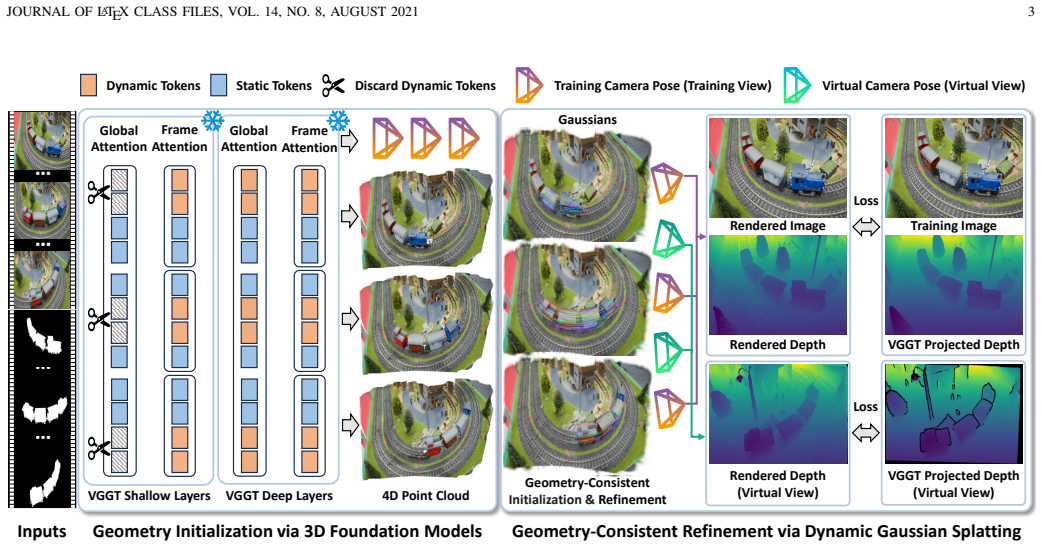
A monocular dynamic scene can be reconstructed in 4D by combining VGGT's multi-view-consistent point maps, produced training-free with dynamic tokens suppressed in shallow global attention, with a deformable Gaussian Splatting model refined under a geometry-consistency loss. Because VGGT predicts all point maps in one shared world frame, projecting the static plus per-frame dynamic points into any camera—including perturbed virtual cameras—yields depth targets that are consistent across viewpoints; aligning rendered depth to these targets anchors the Gaussians and preserves structure in regions not constrained by the image reconstruction loss. Continuous B-spline interpolation of the deforma
What carries the argument
The load-bearing object is VGGT's shared-world-frame point map: static points aggregated across frames plus per-frame dynamic points, projected to produce multi-view-consistent depth. The geometry-consistency loss compares rendered depth with this projected depth at both training views and perturbed virtual cameras, so all depth supervision derives from a single 3D structure. A training-free masking of dynamic tokens in the first five global attention layers keeps that structure clean, and B-spline node trajectories lift the discrete deformation field to continuous time.
Load-bearing premise
The per-frame dynamic point clouds predicted by VGGT—a static-scene model—are accurate enough to serve as geometric anchors; if they are wrong for moving objects, the geometry-consistency loss pulls the Gaussians toward incorrect structure.
What would settle it
Measure geometry error only inside dynamic regions, using ground-truth masks and a depth or multi-view ground truth, and compare Ground4D against a photometric-only dynamic Gaussian baseline. If dynamic-region Chamfer distance or accuracy does not improve—or worsens—the claimed geometry grounding is not actually helping where it matters.
If this is right
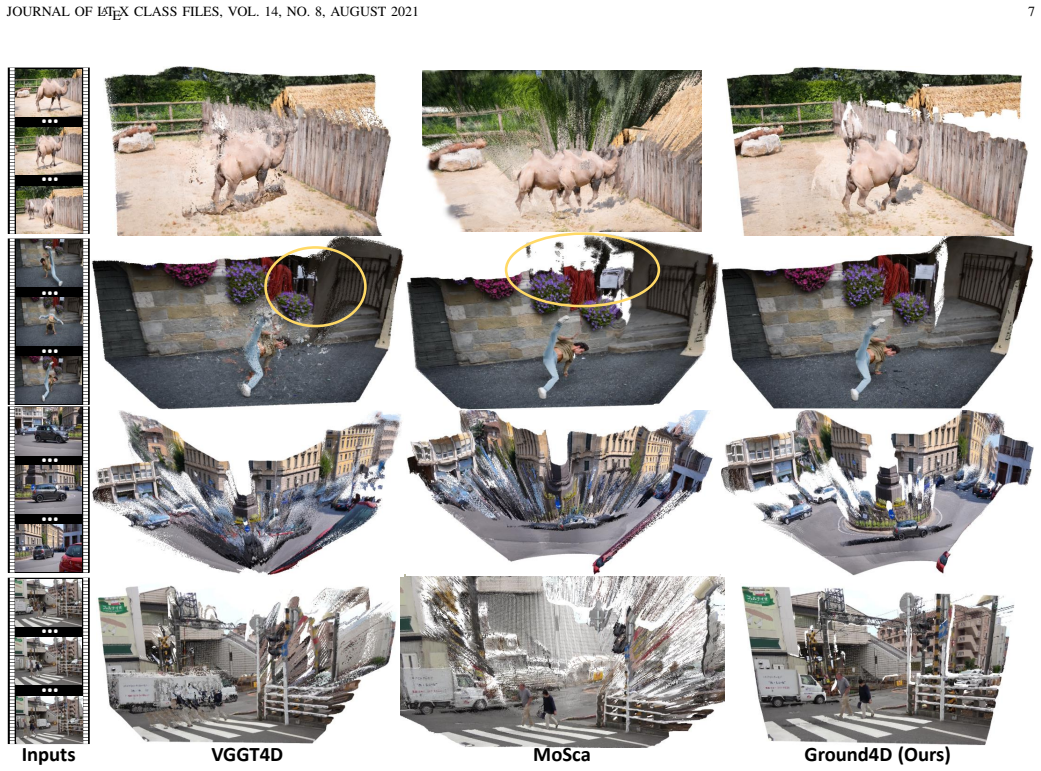
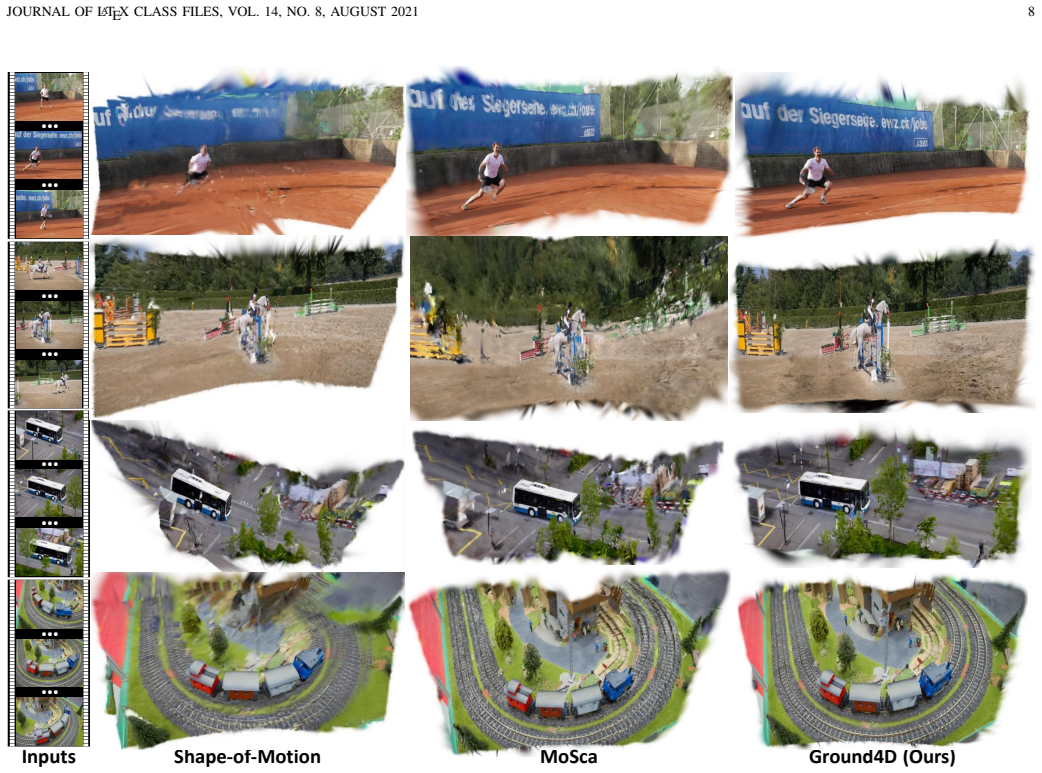
- A single monocular video becomes enough to produce both accurate 4D geometry (mean Chamfer 0.226) and photorealistic novel views (mPSNR 19.43 dB with poses, 19.07 dB without) on DyCheck.
- Because the depth anchors are projected from one shared 3D structure, the same geometry-consistency loss can be added to other dynamic Gaussian backbones; the ablation shows most of the gain comes from this loss, not from initialization alone.
- Virtual-view supervision is cheap: even one perturbed camera per training view improves both rendering and geometry, and the result is insensitive to perturbation size, suggesting easy transfer to other settings.
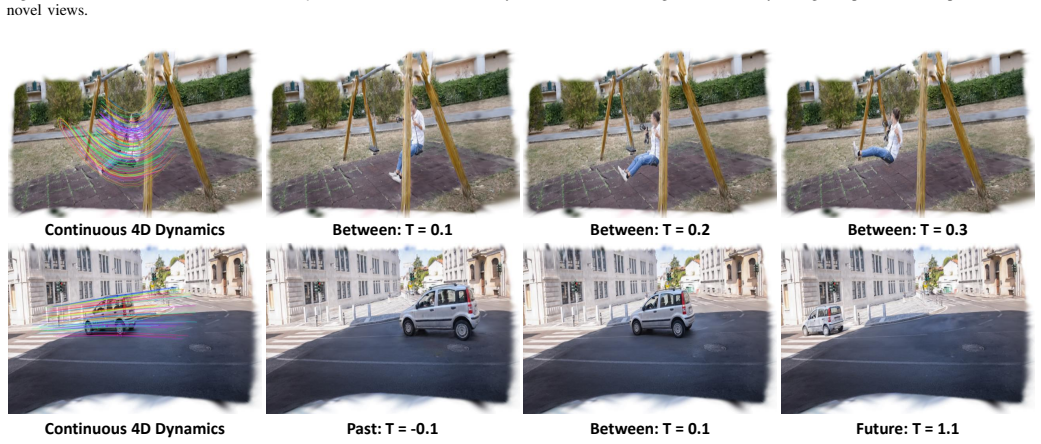
- Continuous B-spline node trajectories let the model render and reconstruct at arbitrary timestamps, including extrapolated past and future times, which discrete-frame methods cannot do.
- Estimated camera trajectories also improve (ATE 0.010 on DyCheck), so the pipeline can operate without ground-truth poses, which matters for real-world deployment.
Where Pith is reading between the lines
- The paper's final paragraph acknowledges computational cost for long sequences and dependence on SAM masks; it does not acknowledge a deeper risk—VGGT is a static-scene model, and its per-frame dynamic points are not temporally consistent—and the ablations do not report geometry accuracy restricted to dynamic regions. The dynamic-part geometry claim is therefore untested.
- If the VGGT-derived geometry is systematically biased, the method inherits that bias; a stress test on sequences with fast motion, occlusions, or reflective surfaces would reveal where photometric-only optimization might actually be safer.
- A natural extension is to replace external masks with motion cues already inside the transformer, which the authors list as future work; since their mask-source ablation shows little sensitivity, such intrinsic masks could remove the SAM dependency without hurting accuracy.
- The consistent-depth-supervision recipe transfers beyond this paper: any module that outputs a shared-world-frame point cloud could initialize and anchor a Gaussian or radiance field, potentially making this a general pattern for dynamic reconstruction.
Editorial analysis
A structured set of objections, weighed in public.
Referee Report
Summary. The paper proposes Ground4D, a two-stage method for dynamic 4D reconstruction from monocular video. The first stage uses VGGT, a pretrained 3D foundation model, in a training-free manner: dynamic tokens are masked in early global attention layers to obtain camera poses, a global static point cloud, and per-frame dynamic point clouds. The second stage initializes a deformable 3D Gaussian Splatting model from these point clouds and optimizes it with a photometric loss, a geometry-consistency loss that aligns rendered depth with VGGT-projected depth at both training and synthetic virtual viewpoints, and motion regularization losses. Experiments on DyCheck report state-of-the-art geometry (Chamfer distance 0.226) and novel-view synthesis (mPSNR 19.43 with GT poses, 19.07 without GT poses), with ablations on masking layers, refinement, mask source, and virtual-view sampling. The paper also claims continuous 4D dynamics via B-spline interpolation of deformation nodes, shown qualitatively on DAVIS.
Significance. If the results hold, Ground4D is a useful integration of geometry priors from a foundation model into dynamic Gaussian optimization. The paper is clearly written and the component-wise ablations, especially the training-free dynamic token masking and the virtual-view geometry-consistency loss, are well designed and support the individual claims. The experiments are internally consistent and the external ground-truth benchmark mitigates the most extreme form of circularity. However, the geometric supervision is derived from the same VGGT model used for initialization, and the paper does not evaluate dynamic-region geometry separately, which is the key weakness. The continuous-time rendering claim is also only qualitative. These issues need to be addressed before the central claims can be fully accepted.
major comments (5)
- [§III-C, Eq. (2)] Equation (2) defines the geometry-consistency loss as a per-pixel L1 distance, but the text states that the depth supervision is applied in a 'scale-invariant manner.' The exact normalization/alignment is never specified. Since rendered depth and VGGT-projected depth generally live in different units, the actual loss is ambiguous and not reproducible. Please provide the precise formulation, including how the scale is estimated (per-frame median? similarity transform?) and how pixels with missing projected depth are masked.
- [§III-B/III-C, Tables I and VI] The load-bearing risk is that the per-frame dynamic point clouds P_dyn_t are obtained from a static-scene model (VGGT) by masking dynamic tokens, and these same points are used both to initialize dynamic Gaussians and to supervise the geometry-consistency loss. If P_dyn_t is biased — e.g., wrong depth or fragmented dynamic regions — the refinement anchors Gaussians to that bias. The current experiments do not measure dynamic-region geometry: Table VI only reports aggregate mean Accuracy/Completeness, and Table I reports aggregate Chamfer distances, both dominated by static background. The manuscript's own limitation statement (§V) acknowledges reliance on the foundation model, but this is not tested. Please report dynamic-only Accuracy/Completeness/Chamfer (e.g., using DyCheck ground-truth dynamic masks/trajectories) and, if feasible, independently evaluate VGGT's dynamic point clouds ag
- [§III-C and Fig. 5] The abstract and Section III claim that Ground4D 'inherently models continuous 4D dynamics' and supports rendering at arbitrary timestamps. However, the only evidence is qualitative visualization in Fig. 5. No quantitative metrics are reported for interpolated or extrapolated timestamps, no comparison is made to other continuous-time baselines, and temporal smoothness is not measured. Since this is stated as a capability of the method, please add a quantitative experiment on DyCheck (e.g., held-out timestamp interpolation with mPSNR/mSSIM and Chamfer) or explicitly soften the claim to a qualitative demonstration.
- [§IV-B, Table II] Table II mixes comparison protocols. The caption states that Shape-of-Motion uses a 5-scene subset at 1x resolution, while all other methods are evaluated on 7 scenes at 2x resolution. This makes the reported SOTA comparisons (e.g., 19.43 mPSNR vs 17.32 for Shape-of-Motion) not directly interpretable. Please either report all methods on the same scenes and resolution or separate the three protocols into distinct tables with clear labeling.
- [§IV-A/IV-C, Table VII] Hyperparameters (L_s, lambda_s, lambda_gc, lambda_r, K, perturbation range) are selected on the DyCheck benchmark itself, and no repeated-seed statistics are provided. Given that Table VII shows only small differences across virtual-view configurations, the claims would be materially strengthened by reporting mean±std over several optimization seeds and by stating how hyperparameters were chosen (e.g., a separate validation split). This is a standard reproducibility requirement for optimization-based scene reconstruction.
minor comments (5)
- [§III-B, Eq. (1)] The notation 't^{(l)}_t(k)' is confusing: the subscript t is reused for both the token index and the frame index. Please use distinct symbols for tokens and frames.
- [§III-A] The paper states that per-frame dynamic masks can be obtained via SAM but does not specify how SAM is applied to video (prompting strategy, instance tracking, or per-frame segmentation). Please provide details.
- [§IV-A] The geometry evaluation protocol is described only as following prior work [9]. Please specify how ground-truth point clouds are sampled, whether a similarity transform is used to align predictions, and how median/mean metrics are computed.
- [§V] The 'Potential limitations' paragraph acknowledges computational cost and reliance on SAM, but no quantitative analysis of runtime or failure cases is given. Including such analysis would improve the paper.
- [General] No code or model release is mentioned. For reproducibility of an optimization-based method with many hyperparameters, code release is strongly recommended.
Circularity Check
No significant circularity: reported results are evaluated against external DyCheck ground truth, and the VGGT-derived depth supervision is a regularizer rather than the evaluation target.
full rationale
Ground4D's derivation chain is not circular. Stage 1 (Sec. III-B) obtains VGGT point clouds and camera poses; Stage 2 (Sec. III-C) initializes Gaussians from those points and adds L_gc (Eq. 2), which aligns rendered depth to depth projected from the same VGGT structure. This shared source is a robustness limitation: if VGGT's per-frame dynamic point clouds are biased, L_gc can anchor Gaussians to that bias, and the paper does not report per-region dynamic geometry accuracy. But this is a correctness/evidence gap, not a circularity. The headline geometry metrics are Accuracy/Completeness/Chamfer against external DyCheck ground truth, not against VGGT depth, and the photometric loss L_rgb plus ARAP/velocity/acceleration regularizers can move Gaussians away from the initialization. The paper does not define its output as the VGGT input; it uses VGGT as a prior and evaluates against independent ground truth. No self-citation is load-bearing: VGGT [10], SAM [40], and DyCheck [45] are external works, and the paper's ablations (Tables IV–VII) test the added components empirically. The skeptical concern about unmeasured dynamic-region accuracy should be recorded as a validation limitation, not as circular reasoning.
Axiom & Free-Parameter Ledger
free parameters (6)
- lambda_s =
0.5
- lambda_gc =
0.1
- lambda_r =
0.01
- L_s =
5
- K =
1
- perturbation_range =
rot 5 deg, trans 0.1
axioms (5)
- domain assumption VGGT predicts point maps for all frames in a shared world coordinate system (first camera frame), so projecting any camera viewpoint yields multi-view-consistent depth.
- domain assumption SAM-provided dynamic masks correctly identify all moving regions; missed dynamic pixels are treated as static and corrupt geometry.
- ad hoc to paper Masking dynamic tokens' key/value in the first L_s=5 global attention layers suppresses motion interference without a harmful distribution shift.
- domain assumption VGGT-estimated camera poses are accurate enough that projecting points into virtual cameras gives valid geometric supervision.
- domain assumption MoSca's deformation-graph representation with SE(3) node trajectories can express the scene motion, including the ARAP/velocity/acceleration priors.
read the original abstract
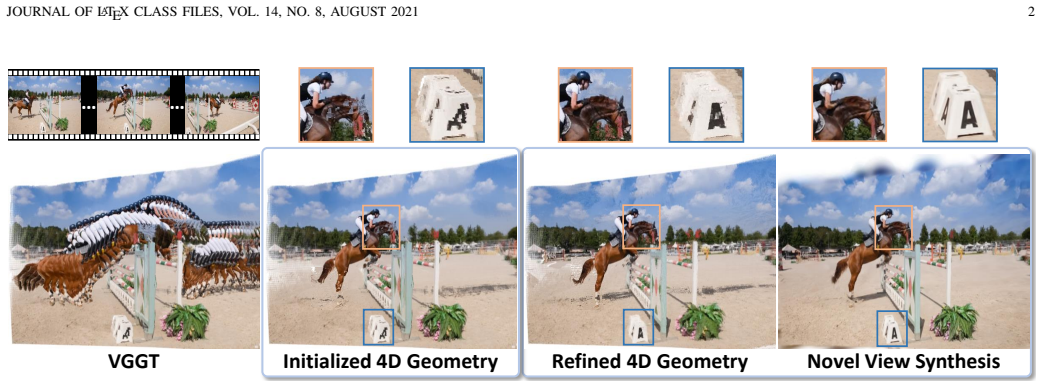
Learning a 4D scene representation from a single monocular video that supports dynamic novel-view synthesis while maintaining faithful geometry over time remains challenging. Dynamic Gaussian Splatting achieves strong rendering performance through photometric optimization, yet does not explicitly enforce multi-view geometric consistency. In contrast, 3D foundation models recover coherent scene geometry and camera motion, but their point-based outputs are not designed for photorealistic rendering. We propose Ground4D, a geometry-grounded framework built on two stages. First, we perform geometry initialization via 3D foundation models, leveraging VGGT in a training-free manner to reconstruct multi-view-consistent 3D geometry and camera poses from monocular video. The recovered geometry provides a structured and reliable initialization for dynamic Gaussian representations. Second, we conduct geometry-consistency-aware refinement via dynamic Gaussian Splatting, optimizing the representation through differentiable rendering while maintaining multi-view geometric consistency across both observed and synthesized viewpoints. Furthermore, Ground4D inherently models the continuous 4D dynamics of the scene, naturally supporting rendering at arbitrary timestamps. By integrating foundation-level geometric priors into dynamic Gaussian optimization, Ground4D achieves stronger reconstruction fidelity and rendering performance, underscoring the role of geometry-grounded constraints in robust 4D scene modeling.
Figures
Reference graph
Works this paper leans on
-
[1]
4d gaussian splatting for real-time dynamic scene rendering,
G. Wu, T. Yi, J. Fang, L. Xie, X. Zhang, W. Wei, W. Liu, Q. Tian, and X. Wang, “4d gaussian splatting for real-time dynamic scene rendering,” inProceedings of the IEEE/CVF conference on computer vision and pattern recognition, 2024, pp. 20 310–20 320
2024
-
[2]
Deformable 3d gaussians for high-fidelity monocular dynamic scene reconstruction,
Z. Yang, X. Gao, W. Zhou, S. Jiao, Y . Zhang, and X. Jin, “Deformable 3d gaussians for high-fidelity monocular dynamic scene reconstruction,” inProceedings of the IEEE/CVF conference on computer vision and pattern recognition, 2024, pp. 20 331–20 341
2024
-
[3]
Dynamic 3d gaussians: Tracking by persistent dynamic view synthesis,
J. Luiten, G. Kopanas, B. Leibe, and D. Ramanan, “Dynamic 3d gaussians: Tracking by persistent dynamic view synthesis,” in2024 International Conference on 3D Vision (3DV). IEEE, 2024, pp. 800– 809
2024
-
[4]
Dynamic gaussian marbles for novel view synthesis of casual monocular videos,
C. Stearns, A. Harley, M. Uy, F. Dubost, F. Tombari, G. Wetzstein, and L. Guibas, “Dynamic gaussian marbles for novel view synthesis of casual monocular videos,” inSIGGRAPH Asia 2024 Conference Papers, 2024, pp. 1–11
2024
-
[5]
Mosca: Dynamic gaussian fusion from casual videos via 4d motion scaffolds,
J. Lei, Y . Weng, A. W. Harley, L. Guibas, and K. Daniilidis, “Mosca: Dynamic gaussian fusion from casual videos via 4d motion scaffolds,” inProceedings of the Computer Vision and Pattern Recognition Confer- ence, 2025, pp. 6165–6177
2025
-
[6]
Shape of motion: 4d reconstruction from a single video,
Q. Wang, V . Ye, H. Gao, W. Zeng, J. Austin, Z. Li, and A. Kanazawa, “Shape of motion: 4d reconstruction from a single video,” inProceedings of the IEEE/CVF International Conference on Computer Vision, 2025, pp. 9660–9672. JOURNAL OF LATEX CLASS FILES, VOL. 14, NO. 8, AUGUST 2021 10
2025
-
[7]
Dust3r: Geometric 3d vision made easy,
S. Wang, V . Leroy, Y . Cabon, B. Chidlovskii, and J. Revaud, “Dust3r: Geometric 3d vision made easy,” inProceedings of the IEEE/CVF conference on computer vision and pattern recognition, 2024, pp. 20 697–20 709
2024
-
[8]
Monst3r: A simple approach for estimating geometry in the presence of motion,
J. Zhang, C. Herrmann, J. Hur, V . Jampani, T. Darrell, F. Cole, D. Sun, and M.-H. Yang, “Monst3r: A simple approach for estimating geometry in the presence of motion,”International Conference on Learning Representations, 2025
2025
-
[9]
Easi3r: Estimating disentangled motion from dust3r without training,
X. Chen, Y . Chen, Y . Xiu, A. Geiger, and A. Chen, “Easi3r: Estimating disentangled motion from dust3r without training,” inProceedings of the IEEE/CVF International Conference on Computer Vision, 2025, pp. 9158–9168
2025
-
[10]
Vggt: Visual geometry grounded transformer,
J. Wang, M. Chen, N. Karaev, A. Vedaldi, C. Rupprecht, and D. Novotny, “Vggt: Visual geometry grounded transformer,” inProceedings of the Computer Vision and Pattern Recognition Conference, 2025, pp. 5294– 5306
2025
-
[11]
Page-4d: Disentangled pose and geometry estimation for 4d perception,
K. Zhou, Y . Wang, G. Chen, G. Beaudouin, F. Zhan, P. P. Liang, and M. Wang, “Page-4d: Disentangled pose and geometry estimation for 4d perception,” inInternational Conference on Learning Representations, 2026
2026
-
[12]
Vggt4d: Mining motion cues in visual geometry transformers for 4d scene reconstruction,
Y . Hu, C. Cheng, S. Yu, X. Guo, and H. Wang, “Vggt4d: Mining motion cues in visual geometry transformers for 4d scene reconstruction,” in Proceedings of the IEEE/CVF Conference on Computer Vision and Pattern Recognition, 2026, pp. 414–424
2026
-
[13]
Building rome in a day,
S. Agarwal, Y . Furukawa, N. Snavely, I. Simon, B. Curless, S. M. Seitz, and R. Szeliski, “Building rome in a day,”Communications of the ACM, vol. 54, no. 10, pp. 105–112, 2011
2011
-
[14]
Self-calibration and metric reconstruction inspite of varying and unknown intrinsic camera parame- ters,
M. Pollefeys, R. Koch, and L. V . Gool, “Self-calibration and metric reconstruction inspite of varying and unknown intrinsic camera parame- ters,”International journal of computer vision, vol. 32, no. 1, pp. 7–25, 1999
1999
-
[15]
Visual modeling with a hand-held camera,
M. Pollefeys, L. Van Gool, M. Vergauwen, F. Verbiest, K. Cornelis, J. Tops, and R. Koch, “Visual modeling with a hand-held camera,” International Journal of Computer Vision, vol. 59, no. 3, pp. 207–232, 2004
2004
-
[16]
Structure-from-motion revisited,
J. L. Schonberger and J.-M. Frahm, “Structure-from-motion revisited,” inProceedings of the IEEE conference on computer vision and pattern recognition, 2016, pp. 4104–4113
2016
-
[17]
Photo tourism: exploring photo collections in 3d,
N. Snavely, S. M. Seitz, and R. Szeliski, “Photo tourism: exploring photo collections in 3d,” inACM siggraph, 2006, pp. 835–846
2006
-
[18]
Modeling the world from internet photo collections,
——, “Modeling the world from internet photo collections,”Interna- tional journal of computer vision, vol. 80, no. 2, pp. 189–210, 2008
2008
-
[19]
Bundle adjustment in the large,
S. Agarwal, N. Snavely, S. M. Seitz, and R. Szeliski, “Bundle adjustment in the large,” inEuropean conference on computer vision. Springer, 2010, pp. 29–42
2010
-
[20]
Scene coordinate reconstruction: Posing of image collections via incremental learning of a relocalizer,
E. Brachmann, J. Wynn, S. Chen, T. Cavallari, A. Monszpart, D. Tur- mukhambetov, and V . A. Prisacariu, “Scene coordinate reconstruction: Posing of image collections via incremental learning of a relocalizer,” inEuropean Conference on Computer Vision. Springer, 2024, pp. 421– 440
2024
-
[21]
Ba-net: Dense bundle adjustment network,
C. Tang and P. Tan, “Ba-net: Dense bundle adjustment network,” International Conference on Learning Representations, 2019
2019
-
[22]
Droid-slam: Deep visual slam for monocular, stereo, and rgb-d cameras,
Z. Teed and J. Deng, “Droid-slam: Deep visual slam for monocular, stereo, and rgb-d cameras,”Advances in neural information processing systems, vol. 34, pp. 16 558–16 569, 2021
2021
-
[23]
Vggsfm: Visual geometry grounded deep structure from motion,
J. Wang, N. Karaev, C. Rupprecht, and D. Novotny, “Vggsfm: Visual geometry grounded deep structure from motion,” inProceedings of the IEEE/CVF conference on computer vision and pattern recognition, 2024, pp. 21 686–21 697
2024
-
[24]
Grounding image matching in 3d with mast3r,
V . Leroy, Y . Cabon, and J. Revaud, “Grounding image matching in 3d with mast3r,” inEuropean conference on computer vision. Springer, 2024, pp. 71–91
2024
-
[25]
Fast3r: Towards 3d reconstruction of 1000+ images in one forward pass,
J. Yang, A. Sax, K. J. Liang, M. Henaff, H. Tang, A. Cao, J. Chai, F. Meier, and M. Feiszli, “Fast3r: Towards 3d reconstruction of 1000+ images in one forward pass,” inProceedings of the Computer Vision and Pattern Recognition Conference, 2025, pp. 21 924–21 935
2025
-
[26]
Streaming 4d visual geometry transformer,
D. Zhuo, W. Zheng, J. Guo, Y . Wu, J. Zhou, and J. Lu, “Streaming 4d visual geometry transformer,”International Conference on Learning Representations, 2026
2026
-
[27]
Infinitevggt: Visual geometry grounded transformer for endless streams,
S. Yuan, Y . Yang, X. Yang, X. Zhang, Z. Zhao, L. Zhang, and Z. Zhang, “Infinitevggt: Visual geometry grounded transformer for endless streams,”arXiv preprint arXiv:2601.02281, 2026
arXiv 2026
-
[28]
π 3: Permutation-equivariant visual geometry learning,
Y . Wang, J. Zhou, H. Zhu, W. Chang, Y . Zhou, Z. Li, J. Chen, J. Pang, C. Shen, and T. He, “π 3: Permutation-equivariant visual geometry learning,”International Conference on Learning Representations, 2026
2026
-
[29]
Fastvggt: Training-free acceleration of visual geometry transformer,
Y . Shen, Z. Zhang, Y . Qu, X. Zheng, J. Ji, S. Zhang, and L. Cao, “Fastvggt: Training-free acceleration of visual geometry transformer,” International Conference on Learning Representations, 2026
2026
-
[30]
Continuous 3d perception model with persistent state,
Q. Wang, Y . Zhang, A. Holynski, A. A. Efros, and A. Kanazawa, “Continuous 3d perception model with persistent state,” inProceedings of the Computer Vision and Pattern Recognition Conference, 2025, pp. 10 510–10 522
2025
-
[31]
Das3r: Dynamics- aware gaussian splatting for static scene reconstruction,
K. Xu, T. H. E. Tse, J. Peng, and A. Yao, “Das3r: Dynamics- aware gaussian splatting for static scene reconstruction,”arXiv preprint arXiv:2412.19584, 2024
Pith/arXiv arXiv 2024
-
[32]
Vision transformers for dense prediction,
R. Ranftl, A. Bochkovskiy, and V . Koltun, “Vision transformers for dense prediction,” inProceedings of the IEEE/CVF international conference on computer vision, 2021, pp. 12 179–12 188
2021
-
[33]
Nerf: Representing scenes as neural radiance fields for view synthesis,
B. Mildenhall, P. P. Srinivasan, M. Tancik, J. T. Barron, R. Ramamoorthi, and R. Ng, “Nerf: Representing scenes as neural radiance fields for view synthesis,”Communications of the ACM, vol. 65, no. 1, pp. 99–106, 2021
2021
-
[34]
Mip-nerf: A multiscale representation for anti- aliasing neural radiance fields,
J. T. Barron, B. Mildenhall, M. Tancik, P. Hedman, R. Martin-Brualla, and P. P. Srinivasan, “Mip-nerf: A multiscale representation for anti- aliasing neural radiance fields,” inProceedings of the IEEE/CVF inter- national conference on computer vision, 2021, pp. 5855–5864
2021
-
[35]
Robust dynamic radiance fields,
Y .-L. Liu, C. Gao, A. Meuleman, H.-Y . Tseng, A. Saraf, C. Kim, Y .-Y . Chuang, J. Kopf, and J.-B. Huang, “Robust dynamic radiance fields,” inProceedings of the IEEE/CVF Conference on Computer Vision and Pattern Recognition, 2023, pp. 13–23
2023
-
[36]
Cbarf: cascaded bundle-adjusting neural radiance fields from imperfect camera poses,
H. Fu, X. Yu, L. Li, and L. Zhang, “Cbarf: cascaded bundle-adjusting neural radiance fields from imperfect camera poses,”IEEE Transactions on Multimedia, vol. 26, pp. 9304–9315, 2024
2024
-
[37]
4dgstream: Variable bitrate dynamic gaussian splatting streaming,
Z. Liang, D. Zhang, L. Shen, M. Zhang, J. Zhang, B. Ju, M. Dasari, F. Wang, and J. Liu, “4dgstream: Variable bitrate dynamic gaussian splatting streaming,”IEEE Transactions on Multimedia, 2026
2026
-
[38]
3d gaussian splatting for real-time radiance field rendering
B. Kerbl, G. Kopanas, T. Leimk ¨uhler, G. Drettakiset al., “3d gaussian splatting for real-time radiance field rendering.”ACM Trans. Graph., vol. 42, no. 4, pp. 139–1, 2023
2023
-
[39]
Mip-splatting: Alias-free 3d gaussian splatting,
Z. Yu, A. Chen, B. Huang, T. Sattler, and A. Geiger, “Mip-splatting: Alias-free 3d gaussian splatting,” inProceedings of the IEEE/CVF conference on computer vision and pattern recognition, 2024, pp. 19 447–19 456
2024
-
[40]
Segment anything,
A. Kirillov, E. Mintun, N. Ravi, H. Mao, C. Rolland, L. Gustafson, T. Xiao, S. Whitehead, A. C. Berg, W.-Y . Loet al., “Segment anything,” inProceedings of the IEEE/CVF international conference on computer vision, 2023, pp. 4015–4026
2023
-
[41]
Dinov2: Learning robust visual features without supervision,
M. Oquab, T. Darcet, T. Moutakanni, H. V o, M. Szafraniec, V . Khalidov, P. Fernandez, D. Haziza, F. Massa, A. El-Noubyet al., “Dinov2: Learning robust visual features without supervision,”Transactions on Machine Learning Research, 2024
2024
-
[42]
Skinning with dual quaternions,
L. Kavan, S. Collins, J. ˇZ´ara, and C. O’Sullivan, “Skinning with dual quaternions,” inProceedings of the 2007 symposium on Interactive 3D graphics and games, 2007, pp. 39–46
2007
-
[43]
As-rigid-as-possible surface modeling,
O. Sorkine, M. Alexaet al., “As-rigid-as-possible surface modeling,” in Symposium on Geometry processing, vol. 4, 2007, pp. 109–116
2007
-
[44]
Dynamicfusion: Recon- struction and tracking of non-rigid scenes in real-time,
R. A. Newcombe, D. Fox, and S. M. Seitz, “Dynamicfusion: Recon- struction and tracking of non-rigid scenes in real-time,” inProceedings of the IEEE conference on computer vision and pattern recognition, 2015, pp. 343–352
2015
-
[45]
Monocular dynamic view synthesis: A reality check,
H. Gao, R. Li, S. Tulsiani, B. Russell, and A. Kanazawa, “Monocular dynamic view synthesis: A reality check,”Advances in Neural Informa- tion Processing Systems, vol. 35, pp. 33 768–33 780, 2022
2022
-
[46]
A benchmark dataset and evaluation methodology for video object segmentation,
F. Perazzi, J. Pont-Tuset, B. McWilliams, L. Van Gool, M. Gross, and A. Sorkine-Hornung, “A benchmark dataset and evaluation methodology for video object segmentation,” inProceedings of the IEEE conference on computer vision and pattern recognition, 2016, pp. 724–732
2016
-
[47]
The 2017 davis challenge on video object segmen- tation,
J. Pont-Tuset, F. Perazzi, S. Caelles, P. Arbel ´aez, A. Sorkine-Hornung, and L. Van Gool, “The 2017 davis challenge on video object segmen- tation,”arXiv preprint arXiv:1704.00675, 2017
Pith/arXiv arXiv 2017
-
[48]
A benchmark for the evaluation of rgb-d slam systems,
J. Sturm, N. Engelhard, F. Endres, W. Burgard, and D. Cremers, “A benchmark for the evaluation of rgb-d slam systems,” in2012 IEEE/RSJ international conference on intelligent robots and systems. IEEE, 2012, pp. 573–580
2012
-
[49]
Unsupervised collaborative learning of keyframe detection and visual odometry towards monocular deep slam,
L. Sheng, D. Xu, W. Ouyang, and X. Wang, “Unsupervised collaborative learning of keyframe detection and visual odometry towards monocular deep slam,” inProceedings of the IEEE/CVF International Conference on Computer Vision, 2019, pp. 4302–4311
2019
-
[50]
Ttt3r: 3d recon- struction as test-time training,
X. Chen, Y . Chen, Y . Xiu, A. Geiger, and A. Chen, “Ttt3r: 3d recon- struction as test-time training,”International Conference on Learning Representations, 2026
2026
discussion (0)
Sign in with ORCID, Apple, or X to comment. Anyone can read and Pith papers without signing in.