Dineutron clusters
Pith reviewed 2026-06-30 08:26 UTC · model grok-4.3
The pith
Compact dineutron clusters form in the low-density outer regions of neutron-rich nuclei such as 11Li.
A machine-rendered reading of the paper's core claim, the machinery that carries it, and where it could break.
Core claim
The dineutron is a spatially compact two-neutron cluster expected to appear in the low-density part of nuclei. Evidence for this structure has been obtained in two-neutron halo nuclei such as 11Li through Coulomb breakup, charge radii, and quasi-free proton scattering. Specific unbound nuclei just beyond the neutron drip line, including 16Be, are under study for the same correlation. Theoretically the dineutron arises in part from admixture of different-parity configurations of the valence neutrons, and few-body models that include decay dynamics are required to interpret the observed three-body decays. The discussion extends to four-neutron clusters, recent tetraneutron experiments, and the
What carries the argument
The dineutron correlation, a compact two-neutron spatial cluster that forms in low-density nuclear regions and is diagnosed through breakup, radius, and scattering data together with parity-mixing calculations.
If this is right
- Dineutron structure should appear in additional unbound nuclei beyond the neutron drip line and can be tested with decay spectroscopy.
- Four-neutron clusters observed in 28O and tetraneutron experiments may share the same correlation mechanism.
- Few-body theories that incorporate decay dynamics become essential for extracting cluster properties from three-body final states.
- Universal few-body features may link these nuclear clusters to analogous systems studied in other fields of physics.
Where Pith is reading between the lines
- Confirmation in heavier candidates would tighten constraints on how pairing evolves at very low densities.
- The same experimental signatures could be searched for in other drip-line nuclei using existing or planned facilities.
- If the parity-mixing picture holds, it supplies a simple mechanism that could be tested in lighter three-body systems.
Load-bearing premise
The signals seen in Coulomb breakup, radius measurements, and scattering can be attributed specifically to a compact dineutron pair rather than to other many-body effects or reaction mechanisms.
What would settle it
A measurement or calculation on 11Li that reproduces the same breakup and radius data without any compact two-neutron correlation once all alternative reaction and many-body contributions are included.
Figures
read the original abstract
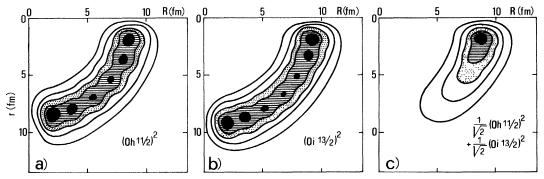
The dineutron is a spatially compact two-neutron cluster, which is expected to appear in a low-density part of nuclei. In recent years, there has been rapid progress in experimental and theoretical research on dineutron clusters, particularly on neutron-rich rare isotopes. Experimentally, evidence for dineutron in two-neutron halo nuclei, such as $^{11}$Li, has been obtained using Coulomb breakup, measurements of charge radii, and quasi-free proton scattering. Specific unbound nuclei just beyond the neutron drip line, which decay by emitting two neutrons, are also candidates for having a dineutron correlation. For instance, the dineutron structure has recently been investigated for $^{16}$Be, focusing on its decay into the core and the two neutrons. Theoretically, it is shown that the dineutron is partially due to the admixture of different-parity configurations for the two valence neutrons. Few-body theories, including dynamical effects of the decay process, play important roles in interpreting three-body decays. We also discuss the four-neutron clusters, showing the experimental results of recent tetraneutron experiments and observation of $^{28}$O. Possible relevance of these states to dineutron correlation is discussed. Finally, we discuss future perspectives on dineutron clusters in neutron-rich nuclei and their relation to the universal features in few-body physics.
Editorial analysis
A structured set of objections, weighed in public.
Referee Report
Summary. The manuscript reviews the concept and evidence for spatially compact dineutron clusters in the low-density surface of neutron-rich nuclei. It summarizes experimental results from Coulomb breakup, charge-radius measurements, and quasi-free scattering in 11Li, discusses candidates such as 16Be, outlines theoretical interpretations involving parity admixture and few-body dynamics for three-body decays, covers tetraneutron states including recent experiments on 28O, and concludes with future perspectives linking to universal few-body physics.
Significance. If the interpretive attribution of existing data to a distinct dineutron degree of freedom holds, the review would usefully synthesize recent experimental and theoretical progress on neutron correlations near the drip line. The manuscript does not introduce new data, derivations, or quantitative model comparisons, so its significance rests on the clarity of the literature summary rather than on novel falsifiable claims.
major comments (2)
- [Abstract and experimental-evidence paragraphs] The central interpretive step—that Coulomb breakup, charge-radius, and quasi-free scattering data in 11Li constitute specific evidence for a compact dineutron cluster rather than generic pairing, continuum three-body dynamics, or reaction-mechanism effects—is presented as established without any model-comparison table, Bayesian evidence ratio, or quantitative discrimination against the listed alternatives.
- [16Be discussion] The statement that the dineutron structure in 16Be has been investigated via its two-neutron decay is given without reference to any new analysis or explicit comparison to non-clustered decay mechanisms within the manuscript itself.
minor comments (2)
- Notation for nuclei (e.g., 11Li vs. ^{11}Li) is inconsistent between the abstract and later text; standardize to a single convention.
- The manuscript would benefit from an explicit statement of the review's scope and selection criteria for the cited experiments.
Simulated Author's Rebuttal
We thank the referee for the constructive comments on our review manuscript. We address each major comment below and indicate the revisions we will make to improve clarity on the interpretive aspects of the summarized literature.
read point-by-point responses
-
Referee: [Abstract and experimental-evidence paragraphs] The central interpretive step—that Coulomb breakup, charge-radius, and quasi-free scattering data in 11Li constitute specific evidence for a compact dineutron cluster rather than generic pairing, continuum three-body dynamics, or reaction-mechanism effects—is presented as established without any model-comparison table, Bayesian evidence ratio, or quantitative discrimination against the listed alternatives.
Authors: As a review, the manuscript summarizes interpretations advanced in the cited experimental and theoretical literature rather than performing new quantitative analyses. We will revise the abstract and experimental-evidence sections to employ more cautious phrasing (e.g., “have been interpreted as evidence for…”), explicitly note the model dependence, and add a concise paragraph discussing the listed alternatives with appropriate references to works addressing generic pairing and three-body continuum effects. A new model-comparison table or Bayesian evidence ratios cannot be generated within the scope of this review. revision: partial
-
Referee: [16Be discussion] The statement that the dineutron structure in 16Be has been investigated via its two-neutron decay is given without reference to any new analysis or explicit comparison to non-clustered decay mechanisms within the manuscript itself.
Authors: The statement summarizes results from recently published studies on 16Be that are already cited. We will expand the relevant paragraph to include additional detail on the decay analyses reported in those works and note any comparisons to non-clustered mechanisms that appear in the cited literature. revision: yes
- Provision of new quantitative model comparisons, tables, or Bayesian evidence ratios, which would require original research beyond the scope of a literature review.
Circularity Check
Review paper summarizing literature; no derivation chain or equations present
full rationale
The manuscript is a literature review on dineutron clusters, citing experimental results from Coulomb breakup, charge radii, and quasi-free scattering in nuclei such as 11Li and 16Be, along with theoretical discussions of parity admixture and few-body dynamics. No original equations, derivations, fitted parameters, or load-bearing self-citations appear in the provided text. The central statements attribute existing data interpretations to dineutron correlations but do not reduce any claim to a self-referential fit or definition by construction. This is a standard non-circular summary of external results.
Axiom & Free-Parameter Ledger
Reference graph
Works this paper leans on
-
[1]
Cambridge Monographs on Particle Physics, Nuclear Physics and Cosmology
Brink, D.M., Broglia, R.A.: Nuclear Superfluidity :Pairing in Finite Systems. Cambridge Monographs on Particle Physics, Nuclear Physics and Cosmology. Cambridge University Press, Cambridge (2005)
2005
-
[2]
Springer, New York (1980)
Ring, P., Schuck, P.: The Nuclear Many-Body Problem. Springer, New York (1980)
1980
-
[3]
Soviet Journal of Nuclear Physics16, 238 (1973)
Migdal, A.B.: Two interacting particles in a potential well. Soviet Journal of Nuclear Physics16, 238 (1973)
1973
-
[4]
Nakamura, T., Vinodkumar, A.M., Sugimoto, T., Aoi, N., Baba, H., Bazin, D., Fukuda, N., Gomi, T., Hasegawa, H., Imai, N., Ishihara, M., Kobayashi, T., Kondo, Y., Kubo, T., Miura, M., Motobayashi, T., Otsu, H., Saito, A., Sakurai, H., Shimoura, S., Watanabe, K., Watanabe, Y.X., Yakushiji, T., Yanagisawa, 37 Y., Yoneda, K.: Observation of strong low-lyingE1...
2006
-
[5]
Kubota, Y., Corsi, A., Authelet, G., Baba, H., Caesar, C., Calvet, D., Delbart, A., Dozono, M., Feng, J., Flavigny, F., Gheller, J.-M., Gibelin, J., Giganon, A., Gillibert, A., Hasegawa, K., Isobe, T., Kanaya, Y., Kawakami, S., Kim, D., Kikuchi, Y., Kiyokawa, Y., Kobayashi, M., Kobayashi, N., Kobayashi, T., Kondo, Y., Korkulu, Z., Koyama, S., Lapoux, V., ...
-
[6]
Monteagudo, B., Marqu´ es, F.M., Gibelin, J., Orr, N.A., Corsi, A., Kubota, Y., Casal, J., G´ omez-Camacho, J., Authelet, G., Baba, H., Caesar, C., Calvet, D., Delbart, A., Dozono, M., Feng, J., Flavigny, F., Gheller, J.-M., Giganon, A., Gillibert, A., Hasegawa, K., Isobe, T., Kanaya, Y., Kawakami, S., Kim, D., Kiyokawa, Y., Kobayashi, M., Kobayashi, N., ...
-
[7]
The European Physical Journal A61(12), 273 (2025) https: //doi.org/10.1140/epja/s10050-025-01736-w
Nakamura, T., Shigaki, K., Ohnishi, H., Tamura, H., Takahashi, Y., Horikoshi, M., Hiyama, E., Hosaka, A.: Clustering as a window on the hierarchical structure of quantum systems. The European Physical Journal A61(12), 273 (2025) https: //doi.org/10.1140/epja/s10050-025-01736-w
-
[8]
The European Physical Journal A61(6), 141 (2025) https://doi.org/10
Horikoshi, M., Ohashi, Y., Kagamihara, D.: Equation of state of quantum cluster matter. The European Physical Journal A61(6), 141 (2025) https://doi.org/10. 1140/epja/s10050-025-01606-5
2025
-
[9]
Matsuo, M.: Spatial structure of neutron cooper pair in low density uniform matter. Phys. Rev. C73, 044309 (2006) https://doi.org/10.1103/PhysRevC.73. 044309
-
[10]
Journal of Physics 38 G: Nuclear and Particle Physics27(5), 69 (2001) https://doi.org/10.1088/ 0954-3899/27/5/201
Machleidt, R., Slaus, I.: The nucleon-nucleon interaction. Journal of Physics 38 G: Nuclear and Particle Physics27(5), 69 (2001) https://doi.org/10.1088/ 0954-3899/27/5/201
2001
-
[11]
G˚ ardestig, A.: Extracting the neutron–neutron scattering length—recent devel- opments. Journal of Physics G: Nuclear and Particle Physics36(5), 053001 (2009) https://doi.org/10.1088/0954-3899/36/5/053001
-
[12]
Physics Letters B814, 136072 (2021) https://doi.org/10.1016/j.physletb.2021.136072
Sun, Y.L., Nakamura, T., Kondo, Y., Satou, Y., Lee, J., Matsumoto, T., Ogata, K., Kikuchi, Y., Aoi, N., Ichikawa, Y., Ieki, K., Ishihara, M., Kobayshi, T., Motobayashi, T., Otsu, H., Sakurai, H., Shimamura, T., Shimoura, S., Shi- nohara, T., Sugimoto, T., Takeuchi, S., Togano, Y., Yoneda, K.: Three-body breakup of 6He and its halo structure. Physics Lette...
-
[13]
Mueller, P., Sulai, I.A., Villari, A.C.C., Alc´ antara-N´ u˜ nez, J.A., Alves-Cond´ e, R., Bailey, K., Drake, G.W.F., Dubois, M., El´ eon, C., Gaubert, G., Holt, R.J., Janssens, R.V.F., Lecesne, N., Lu, Z.-T., O’Connor, T.P., Saint-Laurent, M.-G., Thomas, J.-C., Wang, L.-B.: Nuclear charge radius of 8He. Phys. Rev. Lett.99, 252501 (2007) https://doi.org/1...
-
[14]
Physics Letters B840, 137875 (2023) https://doi.org/10.1016/j.physletb.2023.137875
Corsi, A., Kubota, Y., Casal, J., G´ omez-Ramos, M., Moro, A.M., Authelet, G., Baba, H., Caesar, C., Calvet, D., Delbart, A., Dozono, M., Feng, J., Flav- igny, F., Gheller, J.-M., Gibelin, J., Giganon, A., Gillibert, A., Hasegawa, K., Isobe, T., Kanaya, Y., Kawakami, S., Kim, D., Kiyokawa, Y., Kobayashi, M., Kobayashi, N., Kobayashi, T., Kondo, Y., Korkul...
-
[15]
Cook, K.J., Nakamura, T., Kondo, Y., Hagino, K., Ogata, K., Saito, A.T., Achouri, N.L., Aumann, T., Baba, H., Delaunay, F., Deshayes, Q., Doornenbal, P., Fukuda, N., Gibelin, J., Hwang, J.W., Inabe, N., Isobe, T., Kameda, D., Kanno, D., Kim, S., Kobayashi, N., Kobayashi, T., Kubo, T., Leblond, S., Lee, J., Marqu´ es, F.M., Minakata, R., Motobayashi, T., M...
-
[16]
Spyrou, A., Kohley, Z., Baumann, T., Bazin, D., Brown, B.A., Christian, G., DeYoung, P.A., Finck, J.E., Frank, N., Lunderberg, E., Mosby, S., Peters, W.A., Schiller, A., Smith, J.K., Snyder, J., Strongman, M.J., Thoennessen, M., Volya, A.: First observation of ground state dineutron decay: 16Be. Phys. Rev. Lett. 108, 102501 (2012) https://doi.org/10.1103/...
-
[17]
Hagino, K., Sagawa, H.: Correlated two-neutron emission in the decay of the unbound nucleus 26O. Phys. Rev. C89, 014331 (2014) https://doi.org/10.1103/ PhysRevC.89.014331
2014
-
[18]
Hagino, K., Sagawa, H.: Decay dynamics of the unbound 25O and 26O nuclei. Phys. Rev. C93, 034330 (2016) https://doi.org/10.1103/PhysRevC.93.034330
-
[19]
Kikuchi, Y., Matsumoto, T., Minomo, K., Ogata, K.: Two neutron decay from the 2 + 1 state of 6He. Phys. Rev. C88, 021602 (2013) https://doi.org/10.1103/ PhysRevC.88.021602
2013
-
[20]
Kisamori, K., Shimoura, S., Miya, H., Michimasa, S., Ota, S., Assie, M., Baba, H., Baba, T., Beaumel, D., Dozono, M., Fujii, T., Fukuda, N., Go, S., Hammache, F., Ideguchi, E., Inabe, N., Itoh, M., Kameda, D., Kawase, S., Kawabata, T., Kobayashi, M., Kondo, Y., Kubo, T., Kubota, Y., Kurata-Nishimura, M., Lee, C.S., Maeda, Y., Matsubara, H., Miki, K., Nish...
-
[21]
Nature606, 678–682 (2022) https://doi.org/10.1038/s41586-022-04827-6 40
Duer, M., Aumann, T., Gernh¨ auser, R., Panin, V., Paschalis, S., Rossi, D.M., Achouri, N.L., Ahn, D., Baba, H., Bertulani, C.A., B¨ ohmer, M., Boretzky, K., Caesar, C., Chiga, N., Corsi, A., Cortina-Gil, D., Douma, C.A., Dufter, F., Elekes, Z., Feng, J., Fern¨ andez-Dom´ ınguez, B., Forsberg, U., Fukuda, N., Gas- paric, I., Ge, Z., Gheller, J.M., Gibelin...
-
[22]
Kondo, Y., Achouri, N.L., Falou, H.A., Atar, L., Aumann, T., Baba, H., Boret- zky, K., Caesar, C., Calvet, D., Chae, H., Chiga, N., Corsi, A., Delaunay, F., Delbart, A., Deshayes, Q., Dombr´ adi, Z., Douma, C.A., Ekstr¨ om, A., Elekes, Z., Forss´ en, C., Gaˇ spariˇ c, I., Gheller, J.-M., Gibelin, J., Gillibert, A., Hagen, G., Harakeh, M.N., Hirayama, A., ...
-
[23]
Tanihata, I., Hamagaki, H., Hashimoto, O., Shida, Y., Yoshikawa, N., Sugimoto, K., Yamakawa, O., Kobayashi, T., Takahashi, N.: Measurements of interaction cross sections and nuclear radii in the lightp-shell region. Phys. Rev. Lett.55, 2676–2679 (1985) https://doi.org/10.1103/PhysRevLett.55.2676
-
[24]
Tanihata, I., Savajols, H., Kanungo, R.: Recent experimental progress in nuclear halo structure studies. Progress in Particle and Nuclear Physics68, 215–313 (2013) https://doi.org/10.1016/j.ppnp.2012.07.001
-
[26]
(eds.) Coulomb Breakup and Soft E1 Excitation of Neutron Halo Nuclei, pp
Nakamura, T.: In: Tanihata, I., Toki, H., Kajino, T. (eds.) Coulomb Breakup and Soft E1 Excitation of Neutron Halo Nuclei, pp. 1–37. Springer, Singa- pore (2020). https://doi.org/10.1007/978-981-15-8818-1 68-1 . https://doi.org/ 10.1007/978-981-15-8818-1 68-1
-
[27]
Reports on Progress in Physics 80(5), 056001 (2017) https://doi.org/10.1088/1361-6633/aa50e8
Naidon, P., Endo, S.: Efimov physics: a review. Reports on Progress in Physics 80(5), 056001 (2017) https://doi.org/10.1088/1361-6633/aa50e8
-
[28]
SciPost Phys.15, 123 (2023) https://doi.org/10
Naidon, P.: Universal geometry of two-neutron halos and Borromean Efimov states close to dissociation. SciPost Phys.15, 123 (2023) https://doi.org/10. 21468/SciPostPhys.15.3.123
2023
-
[29]
Zhukov, M.V., Danilin, B.V., Fedorov, D.V., Bang, J.M., Thompson, I.J., Vaa- gen, J.S.: Bound state properties of borromean halo nuclei: 6He and 11Li. Phys. Rep.231(4), 151–199 (1993) https://doi.org/10.1016/0370-1573(93)90141-Y 41
-
[30]
Hagino, K., Sagawa, H., Carbonell, J., Schuck, P.: Coexistence of BCS- and BEC-Like Pair Structures in Halo Nuclei. Phys. Rev. Lett.99, 022506 (2007) https://doi.org/10.1103/PhysRevLett.99.022506
-
[31]
Physics Reports163(5), 299–408 (1988) https://doi.org/10.1016/ 0370-1573(88)90142-1
Bertulani, C.A., Baur, G.: Electromagnetic processes in relativistic heavy ion collisions. Physics Reports163(5), 299–408 (1988) https://doi.org/10.1016/ 0370-1573(88)90142-1
1988
-
[32]
Physica Scripta2013(T152), 014012 (2013) https://doi.org/10.1088/0031-8949/2013/ T152/014012
Aumann, T., Nakamura, T.: The electric dipole response of exotic nuclei. Physica Scripta2013(T152), 014012 (2013) https://doi.org/10.1088/0031-8949/2013/ T152/014012
-
[33]
Physics Letters B331(3), 296–301 (1994) https://doi.org/10.1016/0370-2693(94)91055-3
Nakamura, T., Shimoura, S., Kobayashi, T., Teranishi, T., Abe, K., Aoi, N., Doki, Y., Fujimaki, M., Inabe, N., Iwasa, N., Katori, K., Kubo, T., Okuno, H., Suzuki, T., Tanihata, I., Watanabe, Y., Yoshida, A., Ishihara, M.: Coulomb dissociation of a halo nucleus 11Be at 72AMeV. Physics Letters B331(3), 296–301 (1994) https://doi.org/10.1016/0370-2693(94)91055-3
-
[34]
Fukuda, N., Nakamura, T., Aoi, N., Imai, N., Ishihara, M., Kobayashi, T., Iwasaki, H., Kubo, T., Mengoni, A., Notani, M., Otsu, H., Sakurai, H., Shi- moura, S., Teranishi, T., Watanabe, Y.X., Yoneda, K.: Coulomb and nuclear breakup of a halo nucleus 11Be. Phys. Rev. C70, 054606 (2004) https://doi. org/10.1103/PhysRevC.70.054606
-
[35]
Palit, R., Adrich, P., Aumann, T., Boretzky, K., Carlson, B.V., Cortina, D., Datta Pramanik, U., Elze, T.W., Emling, H., Geissel, H., Hellstr¨ om, M., Jones, K.L., Kratz, J.V., Kulessa, R., Leifels, Y., Leistenschneider, A., M¨ unzenberg, G., Nociforo, C., Reiter, P., Simon, H., S¨ ummerer, K., Walus, W.: Exclusive measurement of breakup reactions with th...
-
[36]
Otsuka, T., Ishihara, M., Fukunishi, N., Nakamura, T., Yokoyama, M.: Neutron halo effect on direct neutron capture and photodisintegration. Phys. Rev. C49, 2289–2292 (1994) https://doi.org/10.1103/PhysRevC.49.R2289
-
[37]
Nagarajan, M.A., Lenzi, S.M., Vitturi, A.: Low-lying dipole strength for weakly bound systems: A simple analytic estimate. The European Physical Journal A - Hadrons and Nuclei24(1), 63–67 (2005) https://doi.org/10.1140/epja/ i2004-10129-2
-
[38]
Smith, M., Brodeur, M., Brunner, T., Ettenauer, S., Lapierre, A., Ringle, R., Ryjkov, V.L., Ames, F., Bricault, P., Drake, G.W.F., Delheij, P., Lunney, D., Sarazin, F., Dilling, J.: First penning-trap mass measurement of the exotic halo nucleus 11Li. Phys. Rev. Lett.101, 202501 (2008) https://doi.org/10.1103/ PhysRevLett.101.202501
2008
-
[39]
Wang, M., Huang, W.J., F.G., K., G., A., Naimi, S.: The ame 2020 atomic mass 42 evaluation (ii). tables, graphs and references. Chinese Physics C45(3), 030003 (2021) https://doi.org/10.1088/1674-1137/abddaf
-
[40]
Esbensen, H., Bertsch, G.F.: Soft dipole excitations in 11Li. Nucl. Phys. A 542(2), 310–340 (1992) https://doi.org/10.1016/0375-9474(92)90219-A
-
[41]
Hagino, K., Sagawa, H.: Dipole excitation and geometry of borromean nuclei. Phys. Rev. C76, 047302 (2007) https://doi.org/10.1103/PhysRevC.76.047302
-
[42]
Hussein, M.: Geometry of borromean halo nuclei
Bertulani, C.A., S. Hussein, M.: Geometry of borromean halo nuclei. Phys. Rev. C76, 051602 (2007) https://doi.org/10.1103/PhysRevC.76.051602
-
[43]
Esbensen, H., Hagino, K., Mueller, P., Sagawa, H.: Charge radius and dipole response of 11Li. Phys. Rev. C76, 024302 (2007) https://doi.org/10.1103/ PhysRevC.76.024302
2007
-
[44]
Physics Letters B476(3), 219–225 (2000) https://doi.org/10.1016/S0370-2693(00)00141-6
Marqu´ es, F.M., Labiche, M., Orr, N.A., Ang´ elique, J.C., Axelsson, L., Benoit, B., Bergmann, U.C., Borge, M.J.G., Catford, W.N., Chappell, S.P.G., Clarke, N.M., Costa, G., Curtis, N., D’Arrigo, A., de Oliveira Santos, F., de G´ oes Bren- nand, E., Dorvaux, O., Freer, M., Fulton, B.R., Giardina, G., Gregori, C., Gr´ evy, S., Guillemaud-Mueller, D., Hana...
-
[45]
Nuclear Physics A658(4), 313–326 (1999) https://doi.org/10.1016/ S0375-9474(99)00376-0
Suzuki, T., Kanungo, R., Bochkarev, O., Chulkov, L., Cortina, D., Fukuda, M., Geissel, H., Hellstr¨ om, M., Ivanov, M., Janik, R., Kimura, K., Kobayashi, T., Korsheninnikov, A.A., M¨ unzenberg, G., Nickel, F., Ogloblin, A.A., Ozawa, A., Pf¨ utzner, M., Pribora, V., Simon, H., Sit´ ar, B., Strmeˇ n, P., Sumiyoshi, K., S¨ ummerer, K., Tanihata, I., Winkler,...
1999
-
[46]
Friar, J.L., Martorell, J., Sprung, D.W.L.: Nuclear sizes and the isotope shift. Phys. Rev. A56, 4579–4586 (1997) https://doi.org/10.1103/PhysRevA.56.4579
-
[47]
Navas, S.,et al.: Review of particle physics. Phys. Rev. D110, 030001 (2024) https://doi.org/10.1103/PhysRevD.110.030001
-
[48]
Tsukada, K., Enokizono, A., Ohnishi, T., Adachi, K., Fujita, T., Hara, M., Hori, M., Hori, T., Ichikawa, S., Kurita, K., Matsuda, K., Suda, T., Tamae, T., Togasaki, M., Wakasugi, M., Watanabe, M., Yamada, K.: First elastic electron scattering from 132Xe at the scrit facility. Phys. Rev. Lett.118, 262501 (2017) https://doi.org/10.1103/PhysRevLett.118.262501 43
-
[49]
Tsukada, K., Abe, Y., Enokizono, A., Goke, T., Hara, M., Honda, Y., Hori, T., Ichikawa, S., Ito, Y., Kurita, K., Legris, C., Maehara, Y., Ohnishi, T., Ogawara, R., Suda, T., Tamae, T., Wakasugi, M., Watanabe, M., Wauke, H.: First obser- vation of electron scattering from online-produced radioactive target. Phys. Rev. Lett.131, 092502 (2023) https://doi.or...
-
[50]
S´ anchez, R., N¨ ortersh¨ auser, W., Ewald, G., Albers, D., Behr, J., Bricault, P., Bushaw, B.A., Dax, A., Dilling, J., Dombsky, M., Drake, G.W.F., G¨ otte, S., Kirchner, R., Kluge, H.-J., K¨ uhl, T., Lassen, J., Levy, C.D.P., Pearson, M.R., Prime, E.J., Ryjkov, V., Wojtaszek, A., Yan, Z.-C., Zimmermann, C.: Nuclear charge radii of 9,11Li: The influence ...
-
[51]
N¨ ortersh¨ auser, W., S´ anchez, R., Ewald, G., Dax, A., Behr, J., Bricault, P., Bushaw, B.A., Dilling, J., Dombsky, M., Drake, G.W.F., G¨ otte, S., Kluge, H.- J., K¨ uhl, T., Lassen, J., Levy, C.D.P., Pachucki, K., Pearson, M., Puchalski, M., Wojtaszek, A., Yan, Z.-C., Zimmermann, C.: Isotope-shift measurements of stable and short-lived lithium isotopes...
-
[52]
Wang, L.-B., Mueller, P., Bailey, K., Drake, G.W.F., Greene, J.P., Henderson, D., Holt, R.J., Janssens, R.V.F., Jiang, C.L., Lu, Z.-T., O’Connor, T.P., Pardo, R.C., Rehm, K.E., Schiffer, J.P., Tang, X.D.: Laser spectroscopic determination of the 6He nuclear charge radius. Phys. Rev. Lett.93, 142501 (2004) https: //doi.org/10.1103/PhysRevLett.93.142501
-
[53]
Physics Letters B116(4), 212–214 (1982) https://doi.org/10.1016/0370-2693(82)90327-6
Sick, I.: Precise nuclear radii from electron scattering. Physics Letters B116(4), 212–214 (1982) https://doi.org/10.1016/0370-2693(82)90327-6
-
[54]
Kanada-En’yo, Y.: Dineutron structure in 8He. Phys. Rev. C76, 044323 (2007) https://doi.org/10.1103/PhysRevC.76.044323
-
[56]
Itagaki, N., Ito, M., Arai, K., Aoyama, S., Kokalova, T.: Mixing of di-neutron components in 8He. Phys. Rev. C78, 017306 (2008) https://doi.org/10.1103/ PhysRevC.78.017306
2008
-
[57]
Kobayashi, F., Kanada-En’yo, Y.: Dineutron formation and breaking in 8He. Phys. Rev. C88, 034321 (2013) https://doi.org/10.1103/PhysRevC.88.034321
-
[58]
Yamaguchi, Y., Horiuchi, W., Ichikawa, T., Itagaki, N.: Dineutron-dineutron correlation in 8He. Phys. Rev. C108, 011304 (2023) https://doi.org/10.1103/ PhysRevC.108.L011304 44
2023
-
[59]
Nakagawa, K., Kanada-En’yo, Y.:α+ 2 n+ 2 n3-body cluster structures and dineutron breaking in 8He. Phys. Rev. C112, 034309 (2025) https://doi.org/ 10.1103/tjnl-jnxp
-
[60]
Simon, H., Aleksandrov, D., Aumann, T., Axelsson, L., Baumann, T., Borge, M.J.G., Chulkov, L.V., Collatz, R., Cub, J., Dostal, W., Eberlein, B., Elze, T.W., Emling, H., Geissel, H., Gr¨ unschloss, A., Hellstr¨ om, M., Holeczek, J., Holzmann, R., Jonson, B., Kratz, J.V., Kraus, G., Kulessa, R., Leifels, Y., Leis- tenschneider, A., Leth, T., Mukha, I., M¨ u...
-
[61]
Kobayashi, T., Chiga, N., Isobe, T., Kondo, Y., Kubo, T., Kusaka, K., Moto- bayashi, T., Nakamura, T., Ohnishi, J., Okuno, H., Otsu, H., Sako, T., Sato, H., Shimizu, Y., Sekiguchi, K., Takahashi, K., Tanaka, R., Yoneda, K.: SAMU- RAI spectrometer for RI beam experiments. Nuclear Instruments and Methods in Physics Research Section B: Beam Interactions with...
-
[62]
Santamaria, C., Obertelli, A., Ota, S., Sasano, M., Takada, E., Audirac, L., Baba, H., Calvet, D., Chˆ ateau, F., Corsi, A., Delbart, A., Doornenbal, P., Giganon, A., Gillibert, A., Kondo, Y., Kubota, Y., Lahonde-Hamdoun, C., Lapoux, V., Leboeuf, D., Lee, C.S., Liu, H.N., Matsushita, M., Motobayashi, T., Niikura, M., Kurata-Nishimura, M., Otsu, H., Peyaud...
-
[63]
The European Physical Journal A47(9), 105 (2011) https://doi.org/10.1140/epja/i2011-11105-5
Obertelli, A., Uesaka, T.: Hydrogen targets for exotic-nuclei studies developed over the past 10 years. The European Physical Journal A47(9), 105 (2011) https://doi.org/10.1140/epja/i2011-11105-5
-
[64]
Kikuchi, Y., Ogata, K., Kubota, Y., Sasano, M., Uesaka, T.: Determination of a dineutron correlation in borromean nuclei via a quasi-free knockout (p,pn) reac- tion. Progress of Theoretical and Experimental Physics2016(10), 103–03 (2016) https://doi.org/10.1093/ptep/ptw148 https://academic.oup.com/ptep/article- pdf/2016/10/103D03/9621191/ptw148.pdf
-
[65]
The European Physical Journal A57(3), 88 (2021) https: 45 //doi.org/10.1140/epja/s10050-021-00384-0
Corsi, A., Monteagudo, B., Marqu´ es, F.M.: The neutron dripline atZ= 4: the case of 13,15Be. The European Physical Journal A57(3), 88 (2021) https: 45 //doi.org/10.1140/epja/s10050-021-00384-0
-
[66]
Yang, Z.H., Kubota, Y., Corsi, A., Yoshida, K., Sun, X.-X., Li, J.G., Kimura, M., Michel, N., Ogata, K., Yuan, C.X., Yuan, Q., Authelet, G., Baba, H., Caesar, C., Calvet, D., Delbart, A., Dozono, M., Feng, J., Flavigny, F., Gheller, J.-M., Gibelin, J., Giganon, A., Gillibert, A., Hasegawa, K., Isobe, T., Kanaya, Y., Kawakami, S., Kim, D., Kiyokawa, Y., Ko...
-
[67]
Hagino, K., Sagawa, H.: Pairing correlations in nuclei on the neutron-drip line. Phys. Rev. C72, 044321 (2005) https://doi.org/10.1103/PhysRevC.72.044321
-
[68]
Bertsch, G.F., Esbensen, H.: Pair correlations near the neutron drip line. Ann. of Phys.209(2), 327–363 (1991) https://doi.org/10.1016/0003-4916(91)90033-5
-
[69]
Di-neutron
Oganessian, Y.T., Zagrebaev, V.I., Vaagen, J.S.: “Di-neutron” configura- tion of 6He. Phys. Rev. Lett.82, 4996–4999 (1999) https://doi.org/10.1103/ PhysRevLett.82.4996
1999
-
[70]
Matsuo, M., Mizuyama, K., Serizawa, Y.: Di-neutron correlation and soft dipole excitation in medium mass neutron-rich nuclei near drip line. Phys. Rev. C71, 064326 (2005) https://doi.org/10.1103/PhysRevC.71.064326
-
[71]
Pillet, N., Sandulescu, N., Schuck, P.: Generic strong coupling behavior of Cooper pairs on the surface of superfluid nuclei. Phys. Rev. C76, 024310 (2007) https://doi.org/10.1103/PhysRevC.76.024310
-
[72]
Kobayashi, F., Kanada-En’yo, Y.: A new approach to investigate dineu- tron correlation and its application to 10Be. Progress of Theoreti- cal Physics126(3), 457–482 (2011) https://doi.org/10.1143/PTP.126.457 https://academic.oup.com/ptp/article-pdf/126/3/457/6866257/126-3-457.pdf
-
[73]
Catara, F., Insolia, A., Maglione, E., Vitturi, A.: Relation between pairing cor- relations and two-particle space correlations. Phys. Rev. C29, 1091–1094 (1984) https://doi.org/10.1103/PhysRevC.29.1091
-
[74]
Hagino, K., Sagawa, H., Nakamura, T., Shimoura, S.: Two-particle correlations in continuum dipole transitions in borromean nuclei. Phys. Rev. C80, 031301 46 (2009) https://doi.org/10.1103/PhysRevC.80.031301
-
[75]
Dobaczewski, J., Michel, N., Nazarewicz, W., P loszajczak, M., Rotureau, J.: Shell structure of exotic nuclei. Progress in Particle and Nuclear Physics 59(1), 432–445 (2007) https://doi.org/10.1016/j.ppnp.2007.01.022 . Interna- tional Workshop on Nuclear Physics 28th Course
-
[77]
Kuchera, A.N., Shahid, R., Zhao, J., Edmondson, A., DeYoung, P.A., Frank, N., McDonaugh, J., Peterson-Veatch, O., Rogers, W.F., Redpath, T., Thoennessen, M.: Evidence for the 15Be ground state from 12Be + 3nevents. Phys. Rev. C 110, 064302 (2024) https://doi.org/10.1103/PhysRevC.110.064302
-
[78]
Snyder, J., Baumann, T., Christian, G., Haring-Kaye, R.A., DeYoung, P.A., Kohley, Z., Luther, B., Mosby, M., Mosby, S., Simon, A., Smith, J.K., Spyrou, A., Stephenson, S., Thoennessen, M.: First observation of 15Be. Phys. Rev. C 88, 031303 (2013) https://doi.org/10.1103/PhysRevC.88.031303
-
[79]
Kohley, Z., Baumann, T., Christian, G., DeYoung, P.A., Finck, J.E., Frank, N., Luther, B., Lunderberg, E., Jones, M., Mosby, S., Smith, J.K., Spyrou, A., Thoennessen, M.: Three-body correlations in the ground-state decay of 26O. Phys. Rev. C91, 034323 (2015) https://doi.org/10.1103/PhysRevC.91.034323
-
[80]
Physics Letters B654(5), 160–164 (2007) https://doi.org/10.1016/j.physletb.2007.08.052
Sugimoto, T., Nakamura, T., Kondo, Y., Aoi, N., Baba, H., Bazin, D., Fukuda, N., Gomi, T., Hasegawa, H., Imai, N., Ishihara, M., Kobayashi, T., Kubo, T., Miura, M., Motobayashi, T., Otsu, H., Saito, A., Sakurai, H., Shimoura, S., Vinodkumar, A.M., Watanabe, K., Watanabe, Y.X., Yakushiji, T., Yanagisawa, Y., Yoneda, K.: The first 2 + state of 14Be. Physics...
-
[81]
Volya, A., Zelevinsky, V.: Continuum shell model. Phys. Rev. C74, 064314 (2006) https://doi.org/10.1103/PhysRevC.74.064314
-
[82]
EPJ Web of Conferences38, 03003 (2012) https://doi.org/10.1051/epjconf/ 20123803003 47
Volya, Alexander: Physics of unstable nuclei: from structure to sequential decays. EPJ Web of Conferences38, 03003 (2012) https://doi.org/10.1051/epjconf/ 20123803003 47
-
[83]
first observation of ground state dineutron decay: 16Be
Marqu´ es, F.M., Orr, N.A., Achouri, N.L., Delaunay, F., Gibelin, J.: Comment on “first observation of ground state dineutron decay: 16Be”. Phys. Rev. Lett. 109, 239201 (2012) https://doi.org/10.1103/PhysRevLett.109.239201
discussion (0)
Sign in with ORCID, Apple, or X to comment. Anyone can read and Pith papers without signing in.