On Surrogate Modeling of Static Response of AM Short-Fiber Thermoplastics Using Graph Neural Networks
Pith reviewed 2026-06-30 09:28 UTC · model grok-4.3
The pith
A GNN-LSTM surrogate predicts stiffness and nonlinear stress-strain response of unseen short-fiber thermoplastic microstructures at over 100 times lower cost than finite element simulation.
A machine-rendered reading of the paper's core claim, the machinery that carries it, and where it could break.
Core claim
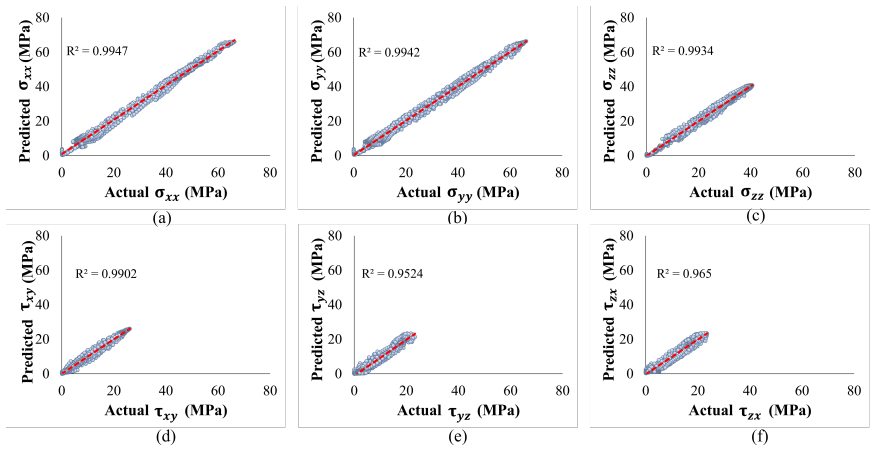
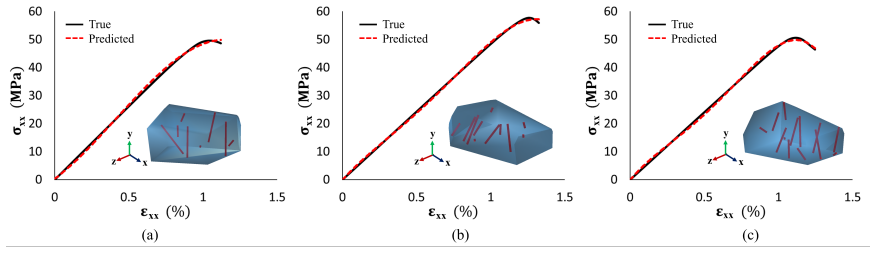
The hybrid GNN-LSTM architecture, trained on homogenized nonlinear responses from Voronoi-partitioned cells that incorporate matrix damage, predicts the stiffness and history-dependent stress-strain behavior of unseen microstructures with R² approximately 0.98 relative to high-fidelity finite element simulations while delivering more than two orders of magnitude reduction in computational cost.
What carries the argument
The hybrid Graph Neural Network-Long Short-Term Memory architecture that encodes the graph topology of Voronoi cells and the time-dependent evolution of damage and deformation.
If this is right
- Fiber orientation, clustering, and porosity can be ranked by their contribution to local effective stiffness.
- Mechanically weak cells within a component can be identified rapidly for design iteration.
- The surrogate can be coupled to experimentally calibrated damage laws to extend predictions beyond elastic response.
- Digital-twin development for SFT components becomes feasible at engineering time scales.
Where Pith is reading between the lines
- The same cell-partitioning strategy might transfer to other heterogeneous materials if damage mechanisms remain localized.
- Embedding the surrogate inside topology optimization loops could accelerate discovery of manufacturing-tolerant microstructures.
- Real-time feedback during additive manufacturing might become possible if the model runs on embedded hardware.
Load-bearing premise
Responses computed on isolated Voronoi cells supply enough information for the model to generalize to assembled microstructures without additional inter-cell physics constraints.
What would settle it
A new microstructure assembled from the same cell library where the surrogate's predicted global stress-strain curve deviates by more than 10 percent from a full-component finite element simulation that includes all cell interactions.
Figures
read the original abstract
Short-fiber thermoplastic (SFT) composites are increasingly employed in lightweight aerospace and automotive structures owing to their favorable strength-to-weight ratio, high production rates, and recyclability. Unlike continuous-fiber systems, the mechanical response of SFTs is governed by mesoscale interactions among fiber orientation, spatial clustering, and manufacturing-induced porosity. These features exhibit significant spatial variability in manufactured components and influence stiffness, damage initiation, and nonlinear deformation. Although mesoscale finite element (FE) models can resolve such heterogeneity, their application to realistic three-dimensional microstructures remains computationally intractable. A data-driven surrogate framework is proposed to predict the mechanical behavior of additively manufactured, compression-molded (AM-CM) SFTs. Microstructures reconstructed from micro-computed tomography data were discretized into Voronoi-based cells representing distinct fiber-interaction neighborhoods. Each cell was homogenized via nonlinear FE simulations incorporating matrix damage, and the resulting stress-strain responses trained a hybrid Graph Neural Network-Long Short-Term Memory (GNN-LSTM) architecture encoding microstructural topology and history-dependent mechanical evolution. The surrogate accurately predicts stiffness and stress-strain behavior of unseen microstructures, achieving $R^2\approx 0.98$ relative to high-fidelity FE simulations with over two orders-of-magnitude reduction in computational cost. Coupling the framework with experimentally calibrated damage laws demonstrates that fiber orientation, clustering, and porosity collectively govern local effective stiffness. The approach provides a physics-informed, data-efficient pathway to identify mechanically weak microstructural cells and accelerate digital-twin development for SFT components.
Editorial analysis
A structured set of objections, weighed in public.
Referee Report
Summary. The manuscript proposes a hybrid GNN-LSTM surrogate to predict stiffness and nonlinear stress-strain response of AM short-fiber thermoplastics. Micro-CT microstructures are partitioned into Voronoi cells; each cell is homogenized with nonlinear FE including matrix damage to generate training data. The surrogate encodes topology and history dependence, claiming R²≈0.98 on unseen microstructures versus high-fidelity FE with >100× speedup. It further shows that fiber orientation, clustering, and porosity govern local effective stiffness when coupled with calibrated damage laws.
Significance. If the reported generalization holds, the framework could substantially accelerate mesoscale analysis of heterogeneous SFT components for digital-twin applications in aerospace and automotive structures. The graph-based encoding of Voronoi topology combined with LSTM for path-dependent damage is a coherent technical choice that directly addresses the intractability of full 3-D FE on realistic microstructures. Credit is due for the end-to-end pipeline from micro-CT reconstruction through cell-level homogenization to component-scale surrogate evaluation.
major comments (2)
- [Abstract] Abstract: the central claim that the surrogate 'accurately predicts stiffness and stress-strain behavior of unseen microstructures' (R²≈0.98) is predicated on generalization from isolated-cell training data to assembled microstructures. The abstract supplies no evidence that test cases include inter-cell mechanical coupling, global equilibrium, or damage propagation across cell boundaries; without such validation the reported accuracy and speedup cannot be taken as support for full-component prediction.
- [Methods] Methods (data generation and model training): training data consist exclusively of independent nonlinear FE simulations of isolated Voronoi cells under (presumably) simplified boundary conditions. No additional physics constraints (global equilibrium enforcement, inter-cell traction continuity, or consistent damage evolution across cell interfaces) are described. This omission directly bears on whether the GNN-LSTM can recover the coupled fields required for the claimed R² on realistic microstructures.
minor comments (2)
- [Abstract] Abstract: no information is given on train/test split ratios, cross-validation strategy, error bars on the R² metric, or whether the quoted accuracy reflects post-hoc selection among multiple architectures.
- [Abstract] Abstract: the phrase 'physics-informed' is used, yet the framework description indicates purely data-driven training on FE outputs; clarify whether any physics-based regularization or constraint is imposed beyond the training data itself.
Simulated Author's Rebuttal
We thank the referee for the constructive review and for recognizing the potential of the proposed framework. We address the major comments point-by-point below. We agree that the manuscript requires revisions to clarify the scope of the validation and the data generation process.
read point-by-point responses
-
Referee: [Abstract] Abstract: the central claim that the surrogate 'accurately predicts stiffness and stress-strain behavior of unseen microstructures' (R²≈0.98) is predicated on generalization from isolated-cell training data to assembled microstructures. The abstract supplies no evidence that test cases include inter-cell mechanical coupling, global equilibrium, or damage propagation across cell boundaries; without such validation the reported accuracy and speedup cannot be taken as support for full-component prediction.
Authors: We acknowledge the validity of this observation. The training data are indeed from isolated Voronoi cells, and the reported R² values are for predictions on unseen isolated cells. The GNN is applied to the topology of full microstructures, but without explicit validation on coupled assembled systems in the current results. We will revise the abstract to specify 'unseen Voronoi cells within microstructures' and add a paragraph in the discussion section addressing the assumptions and limitations regarding inter-cell interactions and damage propagation. revision: yes
-
Referee: [Methods] Methods (data generation and model training): training data consist exclusively of independent nonlinear FE simulations of isolated Voronoi cells under (presumably) simplified boundary conditions. No additional physics constraints (global equilibrium enforcement, inter-cell traction continuity, or consistent damage evolution across cell interfaces) are described. This omission directly bears on whether the GNN-LSTM can recover the coupled fields required for the claimed R² on realistic microstructures.
Authors: The referee is correct; the methods section describes only independent simulations of isolated cells with simplified boundary conditions and does not include or enforce additional physics constraints for coupling. The hybrid GNN-LSTM learns from the provided data and the graph topology but does not explicitly model or constrain inter-cell mechanics. We will revise the methods to detail the exact boundary conditions employed and include a new subsection on model assumptions and limitations, explaining that the current approach approximates local responses and that full coupled validation is planned for future work. revision: yes
Circularity Check
No circularity: standard data-driven surrogate trained on external FE data
full rationale
The paper describes a GNN-LSTM surrogate trained on stress-strain curves from independent nonlinear FE simulations of isolated Voronoi cells, then evaluated on unseen microstructures with reported R²≈0.98. No equations, fitted parameters, or self-citations are shown that reduce the reported performance metric or central claim to an input by construction. The derivation chain relies on external high-fidelity simulations as training data and standard ML generalization testing, making the result self-contained against external benchmarks.
Axiom & Free-Parameter Ledger
Reference graph
Works this paper leans on
-
[1]
K. M. M. Billah, V . Kumar, N. Rathod, A. Phadatare, D. Nuttall, T. Smith, U. Vaidya, S. Kim, V . Kunc, A. A. Hassen, Experimental investigation of short fiber reinforced thermoplastic composite joining in an integrated additive manufacturing and compression molding system, Additive Manufacturing; Ad- vanced Materials Manufacturing; Biomanufacturing; Life...
-
[2]
J. H. S. Almeida, A. Miettinen, F. Léonard, B. G. Falzon, P. J. Withers, Microstructure and damage evolution in short carbon fibre 3d-printed composites during tensile straining, Composites Part B: En- gineering 292 (2025) 112073.doi:10.1016/j.compositesb.2024.112073
-
[3]
P. Pathak, S. Gururaja, Porosity evolution in additively manufactured compression molded short fiber thermoplastics under cyclic loading: Insights from micro-computed tomography and infrared ther- mography, Composites Part A: Applied Science and Manufacturing 194 (2025) 108881.doi: 10.1016/j.compositesa.2025.108881
-
[4]
V . Kumar, S. P. Alwekar, V . Kunc, E. Cakmak, V . Kishore, T. Smith, J. Lindahl, U. Vaidya, C. Blue, M. Theodore, S. Kim, A. A. Hassen, High-performance molded composites using additively manufac- tured preforms with controlled fiber and pore morphology, Additive Manufacturing 37 (2021) 101733. doi:10.1016/j.addma.2020.101733
-
[5]
F. Rezaei, R. Yunus, N. A. Ibrahim, E. S. Mahdi, Development of Short-Carbon-Fiber-Reinforced Polypropylene Composite for Car Bonnet, Polymer-Plastics Technology and Engineering 47 (2008) 351–357.doi:10.1080/03602550801897323
-
[6]
M. Donal, Short fiber orientation and its effects on the properties of thermoplastic compos- ite materials., Polymer-Plastics Technology and Engineering 8 (1997) 101–54.doi:10.1080/ 03602557708545033
1997
-
[7]
U. Gandhi, D. B. Sebastian, V . Kunc, Y . Song, Method to measure orientation of discontinuous fiber embedded in the polymer matrix from computerized tomography scan data, Journal of Thermoplastic Composite Materials 29 (2016) 1696–1709.doi:10.1177/0892705715584411
-
[8]
H. L. Tekinalp, V . Kunc, G. M. Velez-Garcia, C. E. Duty, L. J. Love, A. K. Naskar, C. A. Blue, S. Ozcan, Highly oriented carbon fiber–polymer composites via additive manufacturing, Composites Science and Technology 105 (2014) 144–150.doi:10.1016/j.compscitech.2014.10.009
-
[9]
P. Parandoush, D. Lin, A review on additive manufacturing of polymer-fiber composites, Composite Structures 182 (2017) 36–53.doi:10.1016/j.compstruct.2017.08.088
-
[10]
C. Park, W. Lee, 3 - compression molding in polymer matrix composites, in: Manufacturing Techniques for Polymer Matrix Composites (PMCs), Woodhead Publishing Series in Composites Science and En- gineering, Woodhead Publishing, 2012, pp. 47–94.doi:10.1533/9780857096258.1.47
-
[11]
M. Arif, N. Saintier, F. Meraghni, J. Fitoussi, Y . Chemisky, G. Robert, Multiscale fatigue damage characterization in short glass fiber reinforced polyamide-66, Composites Part B: Engineering 61 (2014) 55–65.doi:10.1016/j.compositesb.2014.01.019
-
[12]
S. F. Almeida, Z. S. Neto, Effect of void content on the strength of composite laminates, Composite Structures 28 (1994) 139–148.doi:10.1016/0263-8223(94)90044-2
-
[13]
Stamopoulos, K
A. Stamopoulos, K. Tserpes, P. Prucha, D. Vavrik, Evaluation of porosity effects on the mechani- cal properties of carbon fiber-reinforced plastic unidirectional laminates by x-ray computed tomog- raphy and mechanical testing, Journal of Composite Materials 50 (2016) 2087–98.doi:10.1177/ 0021998315602049. 37
2016
-
[14]
S. Yu, J. Y . Hwang, S. H. Hong, 3D microstructural characterization and mechanical properties determi- nation of short basalt fiber-reinforced polyamide 6,6 composites, Composites Part B: Engineering 187 (2020) 107839.doi:10.1016/j.compositesb.2020.107839
-
[15]
J. Horst, J. Spoormaker, Fatigue fracture mechanism and fractography of short-glassfibre- reinforced polyamide 6, Journal of Materials Science 32 (1997) 3641–3651.doi:10.1023/A: 1018634530869
work page doi:10.1023/a: 1997
-
[16]
S. Y . Fu, B. Lauke, Y . H. Zhang, Y .-W. Mai, On the post-mortem fracture surface morphology of short fiber reinforced thermoplastics, Composites Part A: Applied Science and Manufacturing 36 (2005) 987– 994.doi:10.1016/j.compositesa.2004.11.005
-
[17]
S. Tamboura, M. Laribi, J. Fitoussi, M. Shirinbayan, R. T. Bi, A. Tcharkhtchi, H. B. Dali, Damage and fatigue life prediction of short fiber reinforced composites submitted to variable temperature load- ing: Application to sheet molding compound composites, International Journal of Fatigue 138 (2020) 105676.doi:10.1016/j.ijfatigue.2020.105676
-
[19]
A. Nagaraja, A. BR, C. Ramesh, D. Ghosh, S. Gururaja, Multiscale modeling for mechanical property estimation of polymer matrix composites with nano- and micro-scale reinforcements, Journal of Rein- forced Plastics and Composites 45 (2024) 1001–1021.doi:10.1177/07316844241291718
-
[20]
J. Pothnis, S. Gururaja, D. Kalyanasundaram, Development and characterization of electric field di- rected preferentially aligned cnt nanocomposites, Mechanics of Advanced Materials and Structures 26 (2019) 35–41.doi:10.1080/15376494.2018.1534165
-
[21]
S. Kammoun, I. Doghri, L. Brassart, L. Delannay, Micromechanical modeling of the progressive failure in short glass–fiber reinforced thermoplastics – first pseudo-grain damage model, Composites Part A: Applied Science and Manufacturing 73 (2015) 166–175.doi:10.1016/j.compositesa.2015. 02.017
-
[22]
K. Breuer, M. Stommel, Prediction of short fiber composite properties by an artificial neural network trained on an rve database, Fibers 9 (2021) 8.doi:10.3390/fib9020008
-
[23]
H. Xu, M. Kuczynska, N. Schafet, F. Welschinger, J. Hohe, Fe-based damage modeling approach for short fiber reinforced thermoplastics under quasi-static load coupling anisotropic viscoplasticity and matrix degradation, Journal of Composite Materials 56 (2022) 3113–3125.doi:10.1177/ 00219983221109327
2022
-
[24]
V . Müller, M. Kabel, H. Andrä, T. Böhlke, Homogenization of linear elastic properties of short-fiber reinforced composites – A comparison of mean field and voxel-based methods, International Journal of Solids and Structures 67-68 (2015) 56–70.doi:10.1016/j.ijsolstr.2015.02.030
-
[25]
J. M. Kaiser, M. Stommel, An extended mean-field homogenization model to predict the strength of short-fibre polymer composites, Accessed: Dec. 29, 2025. [Online]. Available:https:// journals.ub.ovgu.de/index.php/techmech/article/view/725, (2012)
2025
-
[26]
L. Anqi, J. Remmers, A. V . Dommelen, J. Massart, G. Geers, A mean-field homogenization model for fiber reinforced composite materials in large deformation with plasticity, International Journal of Solids and Structures 310 (2025) 113200.doi:10.1016/j.ijsolstr.2024.113200. 38
-
[27]
K. Uhlig, M. Tosch, L. Bittrich, A. Leipprand, S. Dey, A. Spickenheuer, G. Heinrich, Meso-scaled finite element analysis of fiber reinforced plastics made by Tailored Fiber Placement, Composite Structures 143 (2016) 53–62.doi:10.1016/j.compstruct.2016.01.049
-
[28]
A. Estefani, L. Távara, Numerical multiscale analysis of 3D printed short fiber composites parts: Fila- ment anisotropy and toolpath effects, Engineering Reports 6 (2024) 12799.doi:10.1002/eng2. 12799
-
[30]
L. Schraa, C. Rodricks, G. Kalinka, K. Roetsch, C. Scheffler, A. Sambale, K. Uhlig, M. Stom- mel, V . Trappe, Characterisation and modelling of the fibre-matrix interface of short fibre reinforced thermoplastics using the push-out technique, Composites Part B: Engineering 297 (2025) 112317. doi:10.1016/j.compositesb.2025.112317
-
[31]
N. Mentges, H. Çelik, C. Hopmann, M. Fagerström, S. M. Mirkhalaf, Micromechanical modelling of short fibre composites considering fibre length distributions, Composites Part B: Engineering 264 (2023) 110868.doi:10.1016/j.compositesb.2023.110868
-
[32]
M. H. Hamza, L. Borkowski, A. Chattopadhyay, Physics-constrained machine learning surrogate model for time-dependent behavior of ceramic matrix composites, Composites Part B: Engineering 307 (2025) 112825.doi:10.1016/j.compositesb.2025.112825
-
[33]
J. Köbler, M. Schneider, F. Ospald, H. Andrä, R. Müller, Fiber orientation interpolation for the multi- scale analysis of short fiber reinforced composite parts, Computational Mechanics 61 (2018) 729–750. doi:10.1007/s00466-017-1478-0
-
[34]
B. Eyri, O. Gul, N. G. Karsli, T. Yilmaz, Modeling short fiber reinforced polymer matrix composite materials using material designer, Polymer Composites 46 (2025) 10350–10360.doi:10.1002/ pc.29625
2025
-
[35]
A. Senthilnathan, V . Saseendran, P. Acar, N. Yamamoto, V . Sundararaghavan, Comparison and val- idation of stochastic microstructure characterization and reconstruction: Machine learning vs. deep learning methodologies, Acta Materialia 278 (2024) 120220.doi:10.1016/j.actamat.2024. 120220
-
[36]
F. Chinesta, P. Ladeveze, E. Cueto, A Short Review on Model Order Reduction Based on Proper Generalized Decomposition, Archives of Computational Methods in Engineering 18 (2011) 395–404. doi:10.1007/s11831-011-9064-7
-
[37]
M. Dai, M. F. Demirel, Y . Liang, J.-M. Hu, Graph neural networks for an accurate and interpretable prediction of the properties of polycrystalline materials, Computational Materials 7 (2021) 103.doi: 10.1038/s41524-021-00574-w
-
[38]
J. Summerscales, F. J. Guild, N. R. L. Pearce, P. M. Russell, V oronoi cells, fractal dimensions and fibre composites, Journal of Microscopy 201 (2001) 153–162.doi:10.1046/j.1365-2818.2001. 00841.x
-
[39]
D. E. Gulmez, J. Maldonado, K. Masania, J. Sinke, C. Dransfeld, Quantification of structural response and edge orientation of Chopped Tape Thermoplastic Composites in net-shaped specimens, Composite Structures 321 (2023) 117302.doi:10.1016/j.compstruct.2023.117302. 39
-
[40]
Satellite maneuver detection and estimation with radar survey observations,
S. Cassola, M. Duhovic, T. Schmidt, D. May, Machine learning for polymer composites process simulation – a review, Composites Part B: Engineering 246 (2022) 110208.doi:10.1016/j. compositesb.2022.110208
work page doi:10.1016/j 2022
-
[41]
H. Sharma, G. Arora, M. K. Singh, V . Ayyappan, P. Bhowmik, S. M. Rangappa, S. Siengchin, Review of machine learning approaches for predicting mechanical behavior of composite materials, Discover Applied Sciences 7 (2025) 1238.doi:10.1007/s42452-025-07616-8
-
[42]
S. Ferdousi, Z. Demchuk, W. Choi, R. C. Advincula, Y . Jiang, A deep learning and finite element approach for exploration of inverse structure–property designs of lightweight hybrid composites, Com- posite Structures 365 (2025) 119179.doi:10.1016/j.compstruct.2025.119179
-
[43]
F. Kibrete, T. Trzepieci ´nski, H. S. Gebremedhen, D. E. Woldemichael, Artificial intelligence in pre- dicting mechanical properties of composite materials, Journal of Composites Science 7 (2023) 364. doi:10.3390/jcs7090364
-
[44]
C.-T. Chen, G. X. Gu, Machine learning for composite materials, MRS Communications 9 (2019) 556– 566.doi:10.1557/mrc.2019.32
-
[45]
J. Ge, X. Chao, H. Hu, W. Tian, W. Li, L. Qi, Numerical Assessment of Effective Elastic Properties of Needled Carbon/Carbon Composites Based on a Multiscale Method, Journal of Carbon Research 10 (2024) 85.doi:10.3390/c10030085
-
[46]
M. Yacouti, M. Shakiba, Integrated convolutional and graph neural networks for predicting mechanical fields in composite microstructures, Composites Part A: Applied Science and Manufacturing 190 (2025) 108618.doi:10.1016/j.compositesa.2024.108618
-
[47]
Vitulyova, T
Y . Vitulyova, T. Babenko, K. Kolesnikova, N. Kiktev, O. Abramkina, A Hybrid Approach Using Graph Neural Networks and LSTM for Attack Vector Reconstruction, Computers 14 (2025) 301.doi:10. 3390/computers14080301
2025
-
[48]
Y . Zhao, Z. Chen, X. Jian, A high-generalizability machine learning framework for analyzing the homogenized properties of short fiber-reinforced polymer composites, Polymers 15 (2023) 3962. doi:10.3390/polym15193962
-
[49]
J. Gunst, E. Vaghefi, E. Mirkoohi, G. Deshpande, B. Prorok, S. Gururaja, Leveraging machine learning to quantify the effect of porosity on mode i delamination in ceramic matrix composites, Composite Structures 372 (2025) 119542.doi:10.1016/j.compstruct.2025.119542
-
[50]
Q. Chen, R. Jia, S. Pang, Deep long short-term memory neural network for accelerated elastoplastic analysis of heterogeneous materials: An integrated data-driven surrogate approach, Composite Struc- tures 264 (2021) 113688.doi:10.1016/j.compstruct.2021.113688
-
[51]
L. Jiang, Y . Zhou, F. Jin, Design of short fiber-reinforced thermoplastic composites: A review, Polymer Composites 43 (2022) 4835–4847.doi:10.1002/pc.26817
-
[52]
M. Mozaffar, R. Bostanabad, W. Chen, K. Ehmann, J. Cao, M. A. Bessa, Deep learning predicts path- dependent plasticity, Proceedings of the National Academy of Sciences 116 (2019) 26414–26420.doi: 10.1073/pnas.1911815116
-
[53]
J. Ghaboussi, J. H. Garrett, X. Wu, Knowledge-based modeling of material behavior with neu- ral networks, Journal of Engineering Mechanics 117 (1991) 132–153.doi:10.1061/(ASCE) 0733-9399(1991)117:1(132)
-
[54]
B. Liu, E. Ocegueda, M. Trautner, A. M. Stuart, K. Bhattacharya, Learning macroscopic internal vari- ables and history dependence from microscopic models, Journal of the Mechanics and Physics of Solids 178 (2023) 105329.doi:10.1016/j.jmps.2023.105329. 40
-
[55]
P. Pathak, S. Gururaja, V . Kumar, D. Nuttall, A. Mahmoudi, M. Khonsari, U. Vaidya, Examining infrared thermography based approaches to rapid fatigue characterization of additively manufactured compression molded short fiber thermoplastic composites, Composites Structure 351 (2025) 118610. doi:10.1016/j.compstruct.2024.118610
-
[56]
P. Pathak, K. F. Bristy, V . Kumar, K. M. M., S. Gururaja, On the influence of cyclic loading frequency on fatigue limit of short-fiber thermoplastics, Fatigue and Fracture of Engineering Materials and Structures 45 (2026) 1001–1021.doi:10.1111/ffe.70241
-
[57]
V . Kumar, A. A. Hassen, V . Kunc, D. Nuttall, A. Kircaliali, S. I. Talabi, J. Reynolds, J. Vaughan, P. Mhatre, T. Smith, B. Šeta, J. Spangenberg, C. Blue, Genesis of a novel high-rate composite man- ufacturing process using large-scale additive manufacturing – compression molding (am-cm) sys- tem: Possibilities and limitations∗, Composites Part B: Engine...
-
[58]
Arabatti, N
T. Arabatti, N. K. Parambil, S. Gururaja, Micromechanical modeling of damage development in poly- mer composites, Advanced Composites Letters 25 (2016) 096369351602500301.doi:10.1177/ 096369351602500301
2016
-
[59]
L. Shuguang, W. Anchana, Unit cells for micromechanical analyses of particle-reinforced composites, Mechanics of Materials 36 (2004) 543–572.doi:10.1016/S0167-6636(03)00062-0
-
[60]
L. Wang, Z. Wang, S. Dong, W. Zhang, Y . Wang, Finite element simulation of stress distribution and development of cf/sic ceramic–matrix composite coated with single layer sic coating during thermal shock, Composites Part B: Engineering 51 (2013) 204–214.doi:10.1016/j.compositesb. 2013.03.028
-
[61]
F. Bandinelli, L. Peroni, A. Morena, Elasto-plastic mechanical modeling of fused deposition 3d printing materials, Polymers 15 (2023) 234.doi:10.3390/polym15010234
-
[62]
E., The relationship between stress and strain for homogeneous deformation, Journal of the Institute of Metals 74 (1948) 537–562
V . E., The relationship between stress and strain for homogeneous deformation, Journal of the Institute of Metals 74 (1948) 537–562
1948
-
[63]
A. Krairi, I. Doghri, A thermodynamically-based constitutive model for thermoplastic polymers cou- pling viscoelasticity, viscoplasticity and ductile damage, International Journal of Plasticity 60 (2014) 163–181.doi:10.1016/j.ijplas.2014.04.010
-
[64]
N. Abhilash, G. Suhasini, Effect of chemical vapor infiltration induced matrix porosity on the mechan- ical behavior of ceramic matrix minicomposites, ASCE-ASME J Risk and Uncert in Engrg Sys Part B Mech Engrg 6 (2020) 041005.doi:10.1115/1.4047465
-
[65]
J. A. Nairn, On the use of shear-lag methods for analysis of stress transfer in unidirectional composites, Mechanics of Materials 26 (1997) 63–80.doi:10.1016/S0167-6636(97)00023-9
-
[66]
C. M. Landis, M. A. McGlockton, R. M. McMeeking, An improved shear lag model for broken fibers in composite materials, Journal of Composite Materials 33 (1999) 667–680.doi:10.1177/ 002199839903300704
1999
-
[67]
H. L. Cox, The elasticity and strength of paper and other fibrous materials, British Journal of Applied Physics 3 (1952) 72.doi:10.1088/0508-3443/3/3/302
-
[68]
D. Marshall, B. Cox, A. Evans, The mechanics of matrix cracking in brittle-matrix fiber composites., Acta Metallurgica 33 (1985) 2013–2021.doi:10.1016/0001-6160(85)90124-5
-
[69]
D. Marshall, B. Cox, Tensile fracture of brittle matrix composites: Influence of fiber strength, Acta Metallurgica 35 (1987) 2607–2619.doi:10.1016/0001-6160(87)90260-4. 41
-
[70]
L. Mishnaevsky, P. Brøndsted, Micromechanical modeling of damage and fracture of unidirectional fiber reinforced composites: A review, Computational Materials Science 44 (2009) 1351–1359.doi: 10.1016/j.commatsci.2008.09.004
-
[71]
Decoupled Weight Decay Regularization
I. Loshchilov, F. Hutter, Decoupled weight decay regularization (2019).arXiv:1711.05101
work page internal anchor Pith review Pith/arXiv arXiv 2019
-
[72]
Bengio, Practical Recommendations for Gradient-Based Training of Deep Architectures, V ol
Y . Bengio, Practical Recommendations for Gradient-Based Training of Deep Architectures, V ol. 7700, Springer Berlin Heidelberg, 2012.doi:10.1007/978-3-642-35289-8_26
-
[73]
D. K. Pokkalla, V . Kumar, E. Jo, A. A. Hassen, E. Cakmak, S. Alwekar, V . Kunc, U. Vaidya, H. Baid, S. Kim, Anisotropic mechanical properties of polymer composites from a hybrid additive manufacturing-compression molding process using x-ray computer tomography, in: Nondestructive Characterization and Monitoring of Advanced Materials, Aerospace, Civil Inf...
-
[74]
Z. Liu, Y . Lei, X. Zhang, Z. Kang, J. Zhang, Effect mechanism and simulation of voids on hygrothermal performances of composites, Polymers 14 (2022).doi:10.3390/polym14050901
-
[75]
D. A. Head, A. J. Levine, F. C. MacKintosh, Deformation of cross-linked semiflexible polymer net- works, Phys. Rev. Lett. 91 (2003) 108102.doi:10.1103/PhysRevLett.91.108102
-
[76]
Torquato, Random Heterogeneous Materials: Microstructure and Macroscopic Properties, V ol
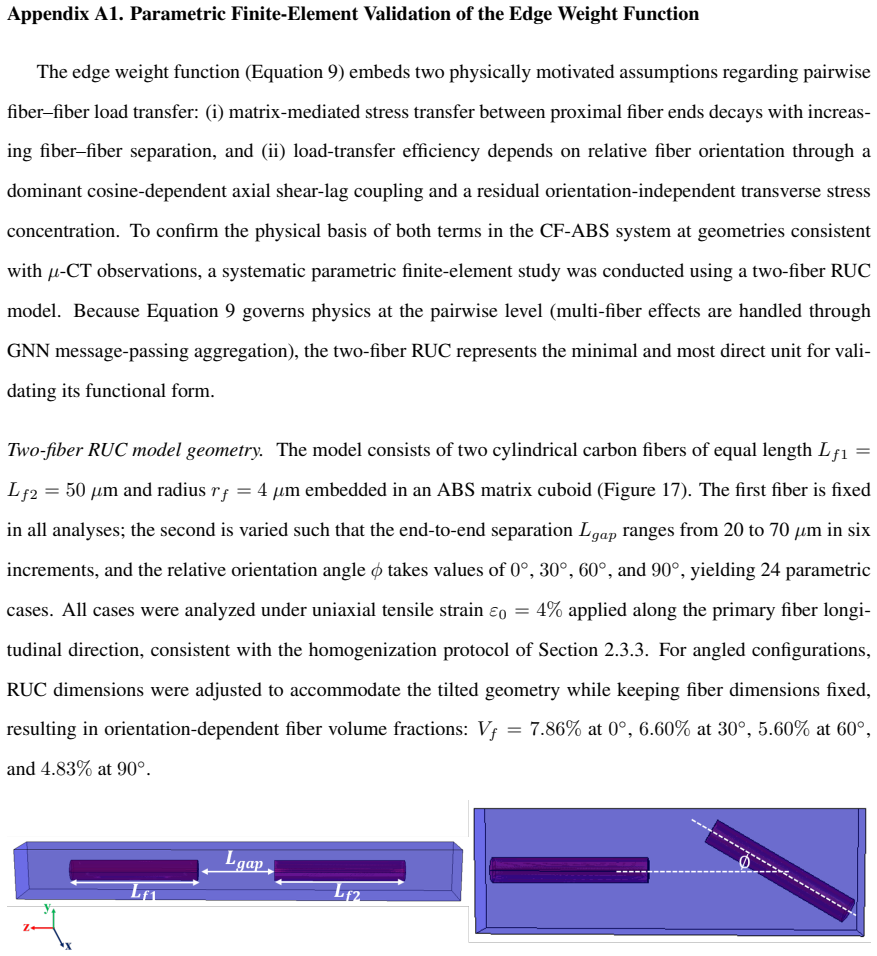
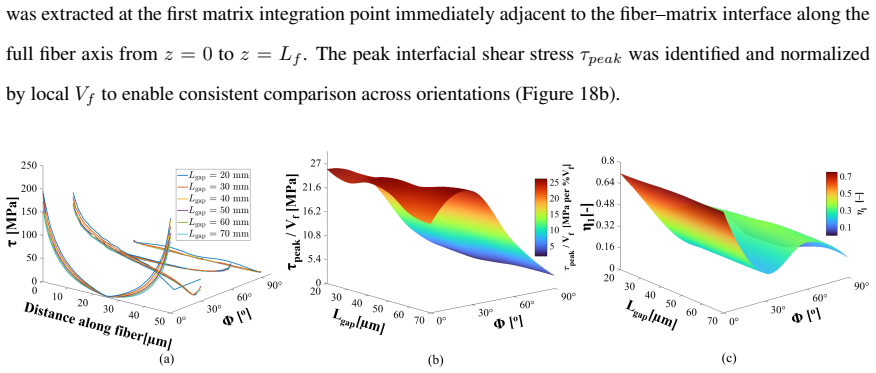
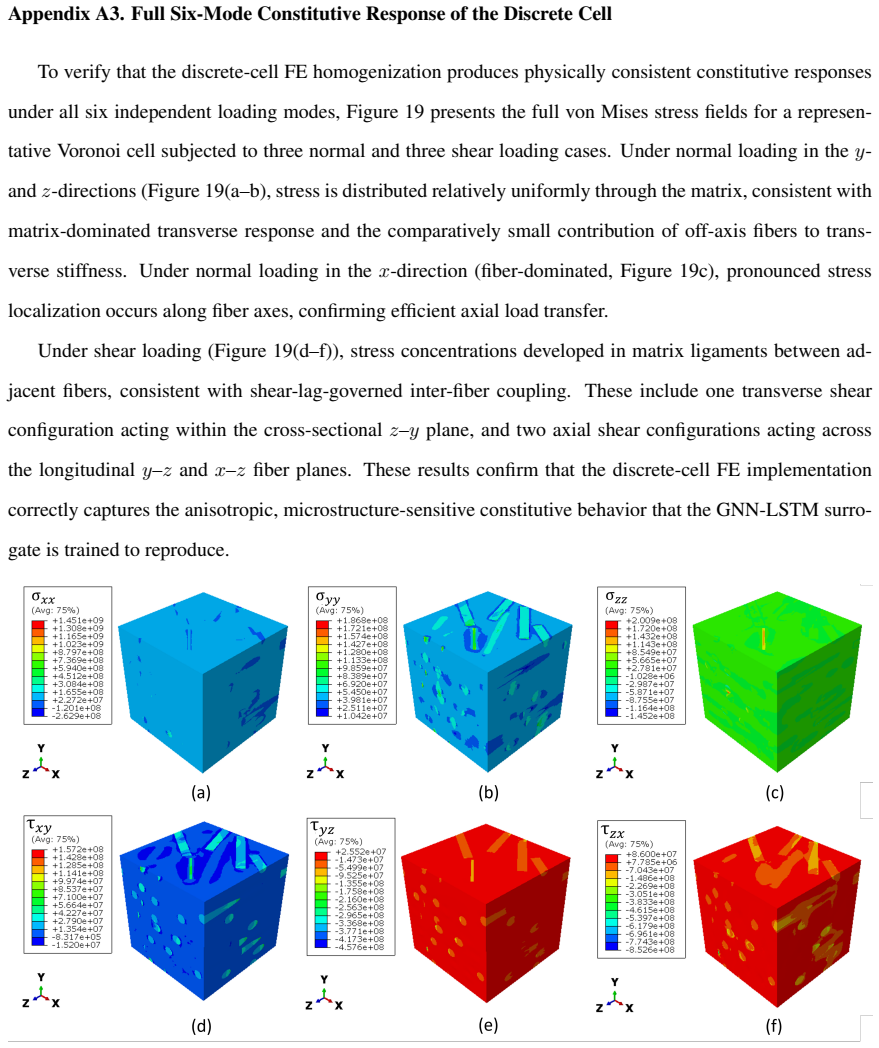
S. Torquato, Random Heterogeneous Materials: Microstructure and Macroscopic Properties, V ol. 55, Springer Nature, 2002, publication Title: Applied Mechanics Reviews - APPL MECH REV .doi: 10.1115/1.1483342. 42 Appendix A1. Parametric Finite-Element Validation of the Edge Weight Function The edge weight function (Equation 9) embeds two physically motivated...
discussion (0)
Sign in with ORCID, Apple, or X to comment. Anyone can read and Pith papers without signing in.